

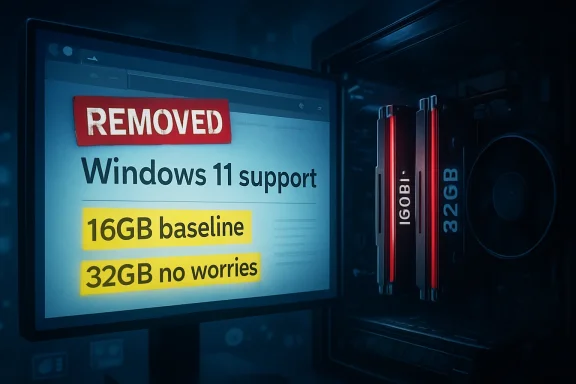
Microsoft removed a Windows 11 gaming guidance page in early May 2026 after readers and hardware sites objected to its claim that 16GB of RAM was merely a practical baseline and 32GB was the “no worries” choice for modern PC gaming. The sentence was not technically outrageous; many enthusiast gaming PCs already ship that way. The problem was that Microsoft said it during a memory-price shock that has made every extra gigabyte feel like a tax. In doing so, Redmond turned a routine buying guide into a referendum on Windows bloat, AI infrastructure, and whether the PC industry still understands its own customers.
There is a version of this story in which Microsoft is mostly right. A serious gaming PC in 2026 is better off with 32GB of RAM than 16GB, especially if the user keeps Discord, a browser, capture software, launchers, overlays, RGB utilities, and a half-dozen update agents running alongside a modern game. The old idea that 32GB is extravagant has been fading for years.
But that is not the version of the story Microsoft published into. The company did not merely say “more memory gives you more headroom.” It reportedly framed 16GB as the baseline and 32GB as the relaxed, future-proof choice — the “no worries” tier. That phrase did the damage, because for many PC buyers right now, memory is exactly the worry.
The backlash was predictable because the audience was not arguing from a spec sheet. It was arguing from checkout carts, upgrade budgets, and the creeping sense that the PC is being made more expensive by forces ordinary users did not ask for. When RAM prices are rising and AI data centers are absorbing supply, “just buy more” lands less like advice and more like institutional amnesia.
Microsoft then compounded the issue by pulling the page, which gave the story a second life. A quiet deletion rarely reads as accountability on the modern web. It reads as confirmation that the company knew the message was bad and hoped the archive would forget.
That gap between official minimums and lived requirements is where Microsoft keeps getting into trouble. On paper, Windows is inclusive enough to run on budget machines. In practice, the experience increasingly nudges users toward hardware that looks more premium than mainstream. The 32GB guidance made that contradiction visible.
There is nothing inherently scandalous about different recommendations for different workloads. Gaming is not email, and a modded open-world title is not Notepad. But Microsoft has spent years presenting Windows 11 as the default operating system for the broad PC market while also layering in more background services, cloud hooks, AI features, security virtualization, widgets, indexing, telemetry, and app integration.
That creates a credibility problem. When the same company that keeps adding system-level features tells users that more memory is the comfortable answer, many hear an evasion. They do not hear “games are bigger now.” They hear “Windows wants more room for itself.”
Some of that reaction is unfair, because modern games really do consume more memory. Textures are larger, worlds are denser, engines stream more assets, and players often multitask more heavily than they did a decade ago. But public trust is not allocated according to technical nuance. Microsoft has trained users to expect that each new Windows generation will ask for more while explaining less.
That means the old enthusiast rhythm — wait for a sale, double your memory, move on — no longer feels dependable. For years, 32GB was the easy recommendation for builders who wanted to stop thinking about RAM. It was not free, but it was often cheap enough to be a rounding error next to the GPU. In 2026, that calculation has changed.
This is why the TechPowerUp comment thread reads less like a debate over one Microsoft page and more like a pressure valve opening. Users mocked the company for deleting the post, accused Windows of taking too much memory, and tied the shortage to the same AI boom Microsoft is enthusiastically promoting. The jokes were crude, but the grievance was coherent.
Microsoft is not solely responsible for DRAM pricing. The memory market is cyclical, capital-intensive, and driven by global demand far beyond Windows. Still, the optics are brutal: a company spending heavily on AI infrastructure is also telling PC gamers that a more expensive RAM configuration is the “no worries” choice.
That is the kind of message that makes users connect dots, even when some of those dots are indirect. Windows has Copilot branding everywhere. Microsoft wants AI PCs to be the next upgrade cycle. Memory is expensive partly because AI infrastructure is hungry. Then Microsoft says 32GB is the comfortable Windows gaming tier. The audience does not need a supply-chain white paper to understand the emotional throughline.
That assumption is what made the recommendation feel tone-deaf. A 32GB kit is a sensible purchase for many new gaming builds, but it is not a casual upgrade for everyone. Budget builders often make trade-offs among CPU, GPU, storage, display, power supply, and memory. If RAM prices are high, every recommendation has an opportunity cost.
For a mainstream gamer, the difference between 16GB and 32GB may be the difference between a better GPU tier and a worse one, a larger SSD and a smaller one, or building now versus waiting months. Microsoft’s guidance treated memory as a comfort upgrade. The market has turned it into a strategic decision.
There is also a geographic and economic dimension that large platform companies often flatten. A spec that seems reasonable in a U.S. enthusiast context may be punishing in markets where components are imported, wages are lower, taxes are higher, and used hardware is a bigger part of the ecosystem. Windows is global. Its recommendations travel farther than Microsoft’s assumed buyer persona.
The company could have written the same technical advice in a way that respected this reality. It could have said 16GB remains workable for many games, 32GB is advisable for demanding titles and heavy multitasking, and users should prioritize GPU, SSD, and memory according to the games they actually play. Instead, the now-pulled language reportedly made the higher number sound like peace of mind itself.
Peace of mind is expensive. That was the backlash in one sentence.
The problem is that Windows is the landlord of this crowded apartment. It sets the defaults, blesses the ecosystem, and increasingly participates in the background noise. Users may not know which process is responsible for which gigabyte, but they know the machine feels busier than it used to.
That perception matters because Windows 11 already has a reputation problem among enthusiasts. The complaints are familiar: too many prompts, too much Microsoft account pressure, too many web-backed surfaces, too many preinstalled apps, too many settings that move or reset, too much Copilot adjacency. Even users who like the operating system often feel they are negotiating with it.
So when Microsoft makes a memory recommendation, it is not speaking as a neutral hardware adviser. It is speaking as the vendor of the platform that many users suspect is part of the resource problem. The advice is filtered through years of irritation.
This is where the backlash becomes more than a meme. Microsoft wants Windows to be the best place to play games, create, work, and run AI-assisted workflows. But the more Windows tries to be the connective tissue for everything, the more users want proof that the OS itself is disciplined. A platform that asks for headroom must show restraint.
But AI has changed the politics of hardware advice. A few years ago, telling users to buy more RAM would have sounded like routine future-proofing. In 2026, it sounds entangled with the same industry trend that is distorting component availability. The AI boom is not an abstract innovation story to PC builders; it is showing up in memory prices, GPU availability, data-center power demand, and a general sense that consumer hardware is no longer first in line.
Microsoft is especially exposed because it sits on both sides of the divide. It sells the consumer operating system, courts gamers, runs Azure, invests in AI at enormous scale, and pushes AI features into Windows. When the company gives hardware guidance, users hear it from the whole Microsoft, not just a Windows Learning Center editor.
That does not mean Microsoft should avoid discussing realistic hardware needs. Silence is not a strategy either. But the company needs a different communications model for the AI era, one that acknowledges trade-offs instead of smoothing them over with lifestyle phrasing.
A better Microsoft would say: memory demand is rising, prices are painful, and Windows should be more efficient. It would explain which workloads benefit from 32GB and which do not. It would stop pretending that every recommendation can be wrapped in cheerful procurement language.
It did not, because Microsoft’s trust margin with enthusiasts is thin. Windows 11 arrived with stricter hardware requirements than Windows 10, including TPM and CPU-generation boundaries that left many otherwise capable PCs outside the official upgrade path. The company then spent years pushing users toward Microsoft accounts, Edge, OneDrive, Bing, widgets, Copilot, and cloud-connected defaults.
Each individual decision can be defended. Security matters. Cloud sync is useful. AI features may become genuinely helpful. But together they create the impression of an operating system whose first loyalty is increasingly to Microsoft’s services strategy rather than the user’s machine.
That is why a small phrase on a support page can explode. It is not just about RAM. It is about who gets to decide what a “normal” PC is, and whether that definition is being set by users’ needs or by the platform owner’s ambitions.
The deletion also reinforced a familiar complaint: Microsoft is often better at retreating from bad messaging than at explaining itself. Pulling the page may have been the right short-term move, but it left a vacuum. Into that vacuum poured every existing frustration about Windows bloat, AI, cost of living, and corporate tone-deafness.
Sixteen gigabytes, however, is not suddenly e-waste. For many games and many users, it remains viable, especially with a clean software environment and realistic expectations. The distinction matters because not every recommendation should be converted into a moral panic or a purchase mandate.
Microsoft’s communication failure was the collapse of nuance. A good hardware guide would separate minimum, mainstream, comfortable, and enthusiast tiers. It would also distinguish between gaming alone, gaming plus streaming, heavily modded games, creator workloads, and AI-assisted local tasks. Those are different users.
The company should also avoid treating future-proofing as a universal virtue. Future-proofing is attractive when prices are stable and upgrade paths are predictable. During a shortage, overbuying can be irrational. A user who buys 16GB now and upgrades later may be making the smarter financial decision if prices normalize, even if the machine is less comfortable today.
The Windows ecosystem needs advice that respects budgets as much as benchmarks. Enthusiasts can smell condescension. They know when a recommendation is technically true but economically insulated.
OEMs also dislike support problems. A machine with more RAM generates fewer complaints when users keep dozens of browser tabs open, run overlays, and install half the peripheral software industry. Extra memory is a buffer against messy real-world behavior.
But if memory prices stay elevated, PC makers will face ugly choices. They can raise prices, reduce margins, ship fewer 32GB configurations, solder smaller amounts of RAM into laptops, or make upgrades more expensive after purchase. None of those outcomes helps users.
This is where Microsoft’s messaging matters beyond one page. Windows guidance influences OEM positioning, retail copy, and user expectations. If Microsoft casually blesses 32GB as the worry-free tier, it helps normalize a more expensive baseline at the exact moment the industry is struggling to keep PCs affordable.
For IT departments, the same dynamic plays out at scale. A few extra dollars per device becomes real money across a fleet. If 16GB is still workable for office productivity but 32GB becomes the recommended comfort tier for AI-era Windows, refresh budgets will feel it. Hardware guidance is not just a gamer debate; it is procurement policy by another name.
That is not nostalgia. It is a practical demand. If Windows is going to host AI features, virtualization-based security, advanced gaming APIs, cloud sync, search indexing, accessibility services, and a modern app platform, then Microsoft has to prove that the foundation is efficient. Otherwise every new feature becomes suspect.
Microsoft has recently talked more about performance, reliability, and responsiveness in Windows 11, and that is the right direction. But the company needs to turn performance into a visible product value, not a blog-cycle promise. Users should be able to see lower idle memory use, fewer intrusive background tasks, faster File Explorer behavior, cleaner startup defaults, and clearer controls over optional services.
There is a trust dividend in restraint. If Microsoft can show that Windows is giving memory back, then its future hardware recommendations will be heard differently. If it cannot, every spec bump will be interpreted as proof that the OS is eating the PC from the inside.
The AI PC era makes this more urgent, not less. Local models, recall systems, semantic search, and assistant features will all need resources. Microsoft cannot ask users to accept that future unless it first convinces them the present is under control.
Source: TechPowerUp Microsoft Pulls Windows 11 "No Worries" 32 GB RAM Recommendation After Backlash
 Microsoft’s Mistake Was Not the Number, It Was the Vibe
There is a version of this story in which Microsoft is mostly right. A serious gaming PC in 2026 is better off with 32GB of RAM than 16GB, especially if the user keeps Discord, a browser, capture software, launchers, overlays, RGB utilities, and a half-dozen update agents running alongside a modern game. The old idea that 32GB is extravagant has been fading for years.But that is not the version of the story Microsoft published into. The company did not merely say “more memory gives you more headroom.” It reportedly framed 16GB as the baseline and 32GB as the relaxed, future-proof choice — the “no worries” tier. That phrase did the damage, because for many PC buyers right now, memory is exactly the worry.
The backlash was predictable because the audience was not arguing from a spec sheet. It was arguing from checkout carts, upgrade budgets, and the creeping sense that the PC is being made more expensive by forces ordinary users did not ask for. When RAM prices are rising and AI data centers are absorbing supply, “just buy more” lands less like advice and more like institutional amnesia.
Microsoft then compounded the issue by pulling the page, which gave the story a second life. A quiet deletion rarely reads as accountability on the modern web. It reads as confirmation that the company knew the message was bad and hoped the archive would forget.
The 32GB Line Exposed a Split Personality in Windows
Windows 11’s official minimum requirement remains 4GB of RAM, a figure that exists mostly as a compatibility floor rather than a satisfying real-world recommendation. Nobody who has used a low-end 4GB Windows 11 machine in anger would confuse it with a good experience. Even 8GB can feel cramped once the user’s normal software stack arrives.That gap between official minimums and lived requirements is where Microsoft keeps getting into trouble. On paper, Windows is inclusive enough to run on budget machines. In practice, the experience increasingly nudges users toward hardware that looks more premium than mainstream. The 32GB guidance made that contradiction visible.
There is nothing inherently scandalous about different recommendations for different workloads. Gaming is not email, and a modded open-world title is not Notepad. But Microsoft has spent years presenting Windows 11 as the default operating system for the broad PC market while also layering in more background services, cloud hooks, AI features, security virtualization, widgets, indexing, telemetry, and app integration.
That creates a credibility problem. When the same company that keeps adding system-level features tells users that more memory is the comfortable answer, many hear an evasion. They do not hear “games are bigger now.” They hear “Windows wants more room for itself.”
Some of that reaction is unfair, because modern games really do consume more memory. Textures are larger, worlds are denser, engines stream more assets, and players often multitask more heavily than they did a decade ago. But public trust is not allocated according to technical nuance. Microsoft has trained users to expect that each new Windows generation will ask for more while explaining less.
The RAM Crisis Turned a Buying Guide Into a Class Marker
The anger around the deleted page cannot be separated from the memory market. DRAM and NAND pricing have been under pressure as AI infrastructure spending pulls capacity toward high-margin server products, especially high-bandwidth memory. Consumer desktop RAM is not the center of the universe for Samsung, SK hynix, or Micron when hyperscalers are fighting for accelerator supply.That means the old enthusiast rhythm — wait for a sale, double your memory, move on — no longer feels dependable. For years, 32GB was the easy recommendation for builders who wanted to stop thinking about RAM. It was not free, but it was often cheap enough to be a rounding error next to the GPU. In 2026, that calculation has changed.
This is why the TechPowerUp comment thread reads less like a debate over one Microsoft page and more like a pressure valve opening. Users mocked the company for deleting the post, accused Windows of taking too much memory, and tied the shortage to the same AI boom Microsoft is enthusiastically promoting. The jokes were crude, but the grievance was coherent.
Microsoft is not solely responsible for DRAM pricing. The memory market is cyclical, capital-intensive, and driven by global demand far beyond Windows. Still, the optics are brutal: a company spending heavily on AI infrastructure is also telling PC gamers that a more expensive RAM configuration is the “no worries” choice.
That is the kind of message that makes users connect dots, even when some of those dots are indirect. Windows has Copilot branding everywhere. Microsoft wants AI PCs to be the next upgrade cycle. Memory is expensive partly because AI infrastructure is hungry. Then Microsoft says 32GB is the comfortable Windows gaming tier. The audience does not need a supply-chain white paper to understand the emotional throughline.
“No Worries” Is a Dangerous Phrase During an Upgrade Squeeze
The phrase “no worries” sounds harmless in a marketing deck. It suggests confidence, simplicity, and headroom. But it also assumes the buyer has enough money to make the worry disappear.That assumption is what made the recommendation feel tone-deaf. A 32GB kit is a sensible purchase for many new gaming builds, but it is not a casual upgrade for everyone. Budget builders often make trade-offs among CPU, GPU, storage, display, power supply, and memory. If RAM prices are high, every recommendation has an opportunity cost.
For a mainstream gamer, the difference between 16GB and 32GB may be the difference between a better GPU tier and a worse one, a larger SSD and a smaller one, or building now versus waiting months. Microsoft’s guidance treated memory as a comfort upgrade. The market has turned it into a strategic decision.
There is also a geographic and economic dimension that large platform companies often flatten. A spec that seems reasonable in a U.S. enthusiast context may be punishing in markets where components are imported, wages are lower, taxes are higher, and used hardware is a bigger part of the ecosystem. Windows is global. Its recommendations travel farther than Microsoft’s assumed buyer persona.
The company could have written the same technical advice in a way that respected this reality. It could have said 16GB remains workable for many games, 32GB is advisable for demanding titles and heavy multitasking, and users should prioritize GPU, SSD, and memory according to the games they actually play. Instead, the now-pulled language reportedly made the higher number sound like peace of mind itself.
Peace of mind is expensive. That was the backlash in one sentence.
Gamers Heard “Windows Bloat” Even When Microsoft Meant “Game Headroom”
Microsoft’s defenders have a point when they say gamers sometimes blame Windows for memory that applications, launchers, overlays, and games themselves consume. A clean Windows install is not the only resident in RAM. A modern gaming session often includes Steam, Epic, Battle.net, Discord, a Chromium browser, GPU control panels, anti-cheat services, capture tools, peripheral software, and cloud sync clients.The problem is that Windows is the landlord of this crowded apartment. It sets the defaults, blesses the ecosystem, and increasingly participates in the background noise. Users may not know which process is responsible for which gigabyte, but they know the machine feels busier than it used to.
That perception matters because Windows 11 already has a reputation problem among enthusiasts. The complaints are familiar: too many prompts, too much Microsoft account pressure, too many web-backed surfaces, too many preinstalled apps, too many settings that move or reset, too much Copilot adjacency. Even users who like the operating system often feel they are negotiating with it.
So when Microsoft makes a memory recommendation, it is not speaking as a neutral hardware adviser. It is speaking as the vendor of the platform that many users suspect is part of the resource problem. The advice is filtered through years of irritation.
This is where the backlash becomes more than a meme. Microsoft wants Windows to be the best place to play games, create, work, and run AI-assisted workflows. But the more Windows tries to be the connective tissue for everything, the more users want proof that the OS itself is disciplined. A platform that asks for headroom must show restraint.
The AI PC Push Makes Every Hardware Recommendation Political
The timing is awkward because Microsoft is trying to make the AI PC feel inevitable. Copilot+ PCs, local inference, NPUs, Recall-like features, on-device models, and cloud-assisted productivity all form part of the company’s attempt to define the next Windows era. Hardware requirements are central to that pitch.But AI has changed the politics of hardware advice. A few years ago, telling users to buy more RAM would have sounded like routine future-proofing. In 2026, it sounds entangled with the same industry trend that is distorting component availability. The AI boom is not an abstract innovation story to PC builders; it is showing up in memory prices, GPU availability, data-center power demand, and a general sense that consumer hardware is no longer first in line.
Microsoft is especially exposed because it sits on both sides of the divide. It sells the consumer operating system, courts gamers, runs Azure, invests in AI at enormous scale, and pushes AI features into Windows. When the company gives hardware guidance, users hear it from the whole Microsoft, not just a Windows Learning Center editor.
That does not mean Microsoft should avoid discussing realistic hardware needs. Silence is not a strategy either. But the company needs a different communications model for the AI era, one that acknowledges trade-offs instead of smoothing them over with lifestyle phrasing.
A better Microsoft would say: memory demand is rising, prices are painful, and Windows should be more efficient. It would explain which workloads benefit from 32GB and which do not. It would stop pretending that every recommendation can be wrapped in cheerful procurement language.
The Deleted Page Shows How Thin Microsoft’s Trust Margin Has Become
Large companies delete or revise pages all the time. Sometimes guidance is premature. Sometimes wording is sloppy. Sometimes a page goes live before the right stakeholders review it. In a calmer environment, this story would have lasted an afternoon.It did not, because Microsoft’s trust margin with enthusiasts is thin. Windows 11 arrived with stricter hardware requirements than Windows 10, including TPM and CPU-generation boundaries that left many otherwise capable PCs outside the official upgrade path. The company then spent years pushing users toward Microsoft accounts, Edge, OneDrive, Bing, widgets, Copilot, and cloud-connected defaults.
Each individual decision can be defended. Security matters. Cloud sync is useful. AI features may become genuinely helpful. But together they create the impression of an operating system whose first loyalty is increasingly to Microsoft’s services strategy rather than the user’s machine.
That is why a small phrase on a support page can explode. It is not just about RAM. It is about who gets to decide what a “normal” PC is, and whether that definition is being set by users’ needs or by the platform owner’s ambitions.
The deletion also reinforced a familiar complaint: Microsoft is often better at retreating from bad messaging than at explaining itself. Pulling the page may have been the right short-term move, but it left a vacuum. Into that vacuum poured every existing frustration about Windows bloat, AI, cost of living, and corporate tone-deafness.
The Sensible Advice Was Hiding Inside the Bad Message
The irony is that the underlying recommendation is not absurd. If someone is building a gaming PC from scratch in 2026 and can afford 32GB without sacrificing the GPU or SSD, 32GB is the more comfortable choice. It gives newer games room to breathe, makes multitasking less brittle, and can extend the useful life of the system.Sixteen gigabytes, however, is not suddenly e-waste. For many games and many users, it remains viable, especially with a clean software environment and realistic expectations. The distinction matters because not every recommendation should be converted into a moral panic or a purchase mandate.
Microsoft’s communication failure was the collapse of nuance. A good hardware guide would separate minimum, mainstream, comfortable, and enthusiast tiers. It would also distinguish between gaming alone, gaming plus streaming, heavily modded games, creator workloads, and AI-assisted local tasks. Those are different users.
The company should also avoid treating future-proofing as a universal virtue. Future-proofing is attractive when prices are stable and upgrade paths are predictable. During a shortage, overbuying can be irrational. A user who buys 16GB now and upgrades later may be making the smarter financial decision if prices normalize, even if the machine is less comfortable today.
The Windows ecosystem needs advice that respects budgets as much as benchmarks. Enthusiasts can smell condescension. They know when a recommendation is technically true but economically insulated.
OEMs Will Quietly Make the Same Decision for Buyers
The uncomfortable truth is that Microsoft may have retreated from the phrase, but the market is moving in the same direction. Gaming laptops and desktops with 32GB of RAM will become more common at the mid-to-high end, not because every game strictly requires it, but because system builders need simple tiers. “16GB base, 32GB preferred” is easy to sell.OEMs also dislike support problems. A machine with more RAM generates fewer complaints when users keep dozens of browser tabs open, run overlays, and install half the peripheral software industry. Extra memory is a buffer against messy real-world behavior.
But if memory prices stay elevated, PC makers will face ugly choices. They can raise prices, reduce margins, ship fewer 32GB configurations, solder smaller amounts of RAM into laptops, or make upgrades more expensive after purchase. None of those outcomes helps users.
This is where Microsoft’s messaging matters beyond one page. Windows guidance influences OEM positioning, retail copy, and user expectations. If Microsoft casually blesses 32GB as the worry-free tier, it helps normalize a more expensive baseline at the exact moment the industry is struggling to keep PCs affordable.
For IT departments, the same dynamic plays out at scale. A few extra dollars per device becomes real money across a fleet. If 16GB is still workable for office productivity but 32GB becomes the recommended comfort tier for AI-era Windows, refresh budgets will feel it. Hardware guidance is not just a gamer debate; it is procurement policy by another name.
Windows Needs a Lean Story Before It Gets an AI Story
The most damaging part of the backlash is that it collided with Microsoft’s broader narrative. The company wants users to believe Windows is entering a smarter, more capable era. But many users are still asking for a leaner one.That is not nostalgia. It is a practical demand. If Windows is going to host AI features, virtualization-based security, advanced gaming APIs, cloud sync, search indexing, accessibility services, and a modern app platform, then Microsoft has to prove that the foundation is efficient. Otherwise every new feature becomes suspect.
Microsoft has recently talked more about performance, reliability, and responsiveness in Windows 11, and that is the right direction. But the company needs to turn performance into a visible product value, not a blog-cycle promise. Users should be able to see lower idle memory use, fewer intrusive background tasks, faster File Explorer behavior, cleaner startup defaults, and clearer controls over optional services.
There is a trust dividend in restraint. If Microsoft can show that Windows is giving memory back, then its future hardware recommendations will be heard differently. If it cannot, every spec bump will be interpreted as proof that the OS is eating the PC from the inside.
The AI PC era makes this more urgent, not less. Local models, recall systems, semantic search, and assistant features will all need resources. Microsoft cannot ask users to accept that future unless it first convinces them the present is under control.
Redmond’s “No Worries” Moment Leaves a Short Checklist
The deleted RAM guidance will not change the direction of PC hardware, but it should change how Microsoft talks about it. The episode was small, fast, and embarrassing precisely because it condensed several larger anxieties into one phrase.- Microsoft should treat 32GB of RAM as a workload-specific comfort recommendation, not as a casual new normal for every Windows gaming PC.
- Sixteen gigabytes remains a realistic floor for many gamers, but it is increasingly tight for demanding titles, heavy multitasking, streaming, and modded play.
- The current memory-price spike makes tone as important as technical accuracy, because users are making real trade-offs with limited budgets.
- Windows’ own reputation for background complexity weakens Microsoft’s credibility when it tells users to buy more hardware.
- The AI boom has made component guidance politically sensitive, especially for a company that is both promoting AI PCs and consuming data-center memory at scale.
- Microsoft’s best answer is not to delete awkward pages, but to publish clearer guidance and make Windows visibly leaner.
Source: TechPowerUp Microsoft Pulls Windows 11 "No Worries" 32 GB RAM Recommendation After Backlash
