

Microsoft and SAP are accelerating enterprise post-quantum cryptography plans, with Microsoft moving its Quantum Safe Program toward a 2029 transition for its services and products while SAP adds hybrid post-quantum key exchange to TLS connections in SAP HANA cloud systems now.
The news, reported by SDxCentral, is not that a quantum computer has suddenly broken the internet. It is that two of the enterprise stack’s most consequential vendors are treating the migration window as operationally short, politically useful, and technically unforgiving. The practical message for Windows shops, Azure customers, SAP estates, and security teams is blunt: post-quantum cryptography has moved from research-track concern to infrastructure planning problem.
Microsoft’s move matters because it gives the enterprise market a date that is close enough to affect budgets, architecture reviews, vendor roadmaps, and compliance conversations. According to SDxCentral, Microsoft is accelerating the Microsoft Quantum Safe Program timeline so that Microsoft’s services and products move to a post-quantum cryptography footing by 2029. That does not mean Microsoft is saying a cryptographically relevant quantum computer will definitely arrive in 2029; it means Microsoft is no longer comfortable treating the migration as a vague, late-decade exercise.
Azure CTO Mark Russinovich put the pressure in unusually direct terms. Cryptographically relevant quantum computers could arrive “sooner than previously expected and the work required to prepare is significant so organizations need to start now.” That sentence is doing two things at once: warning that the technical trigger could arrive earlier than planning models assumed, and reminding customers that crypto migrations are slow even when everyone agrees they are necessary.
For Microsoft, the 2029 date is less a single engineering milestone than a forcing function across a sprawling estate. SDxCentral reports that Microsoft plans to step up the modernization of network cryptography, protect stored data through crypto-agility, and modernize cryptographic trust chains. Each of those phrases hides years of unglamorous work: finding cryptography embedded inside protocols, certificates, hardware dependencies, identity systems, update pipelines, backup archives, and application frameworks that may have been designed long before “post-quantum” became an enterprise requirement.
That is why this announcement should not be read like a typical cloud roadmap update. Microsoft is signaling that the problem is not solved by swapping one algorithm for another at the edge of a service. The harder job is making Microsoft’s own systems—and, by implication, its customers’ systems—capable of changing cryptography without redesigning entire platforms when the next risk model arrives.
That choice matters because SAP HANA sits close to the crown jewels. It is not a peripheral application where experimental security can be treated as a pilot. SAP HANA cloud systems support enterprise data workloads, and SDxCentral notes that outside SAP, the database system can also be found as infrastructure-as-a-service from the three main hyperscalers. When SAP changes how network sessions are negotiated for that environment, it is making a statement about the shelf life of enterprise data.
The mechanism is the TLS handshake, where TLS 1.3 encrypts internet traffic and supports certificate-based authentication between clients and servers. SAP is not throwing away classical cryptography in one dramatic cutover. It is using a hybrid key exchange, which is the most pragmatic posture available to large vendors: keep compatibility and today’s security assumptions intact while adding quantum-resistant protection against tomorrow’s decryption risk.
SAP’s stated reason, per SDxCentral, is to blunt harvest-now, decrypt-later attacks. That phrase has become the bridge between quantum security theory and board-level risk. An attacker does not need a quantum computer today to create a quantum-era breach; they need patience, access to encrypted traffic or stored encrypted material, and confidence that the protected data will still matter when stronger decryption becomes available.
That is the real reason 2029 is an aggressive but not extravagant planning horizon. The risk clock does not start on “Q-day,” the industry shorthand for the point when quantum decryption becomes practically relevant. It starts when an adversary can collect useful encrypted material and expect that the data’s value will outlast the cryptography protecting it.
Microsoft and SAP are therefore responding to a time asymmetry that conventional patch management is poorly equipped to handle. A vulnerable endpoint can be patched after a bug is found; a captured archive of encrypted traffic cannot be un-captured. If the data remains sensitive for five, ten, or twenty years, then waiting for definitive proof of a cryptographically relevant quantum computer is not caution. It is a bet that the adversary did not already save the ciphertext.
This is where the story widens beyond quantum computing. SDxCentral notes that Microsoft also sees broader cybersecurity hygiene as a driver of the 2029 deadline. A serious post-quantum inventory forces companies to find where cryptography exists across legacy infrastructure, and that discovery process can expose weaknesses that have nothing to do with quantum attacks. In practice, quantum readiness becomes a lever for cleaning up decades of certificate sprawl, undocumented protocol dependencies, brittle key-management assumptions, and legacy systems that nobody wants to touch until a deadline makes them unavoidable.
Crypto-agility means applications and platforms are not hard-wired to one algorithm, one certificate profile, one key length, one hardware security module behavior, or one TLS configuration that nobody has revisited in years. It means cryptographic choices can be changed through configuration, policy, libraries, negotiated protocol support, and lifecycle management rather than emergency rewrites. It also means organizations can test hybrid modes, phase out older primitives, and recover from algorithmic surprises without treating every migration like a once-in-a-generation infrastructure shock.
That is particularly relevant for Windows and Azure environments because cryptography is not a single layer. It is present in identity, device authentication, update signing, remote access, VPNs, browser traffic, application APIs, database connections, certificate authorities, secrets management, code signing, storage encryption, email, endpoint management, and backup systems. Some of those dependencies are visible to administrators. Many are buried in vendor products, integration middleware, scripts, appliances, and decade-old business applications that still perform essential work.
Microsoft’s mention of modernizing cryptographic trust chains points to the same complexity. Trust chains are not only about encrypted pipes; they are about what a system accepts as authentic. In a Microsoft estate, that can touch everything from certificates and signing infrastructure to service authentication and software distribution. A post-quantum transition that strengthens data-in-transit encryption but leaves authentication and trust validation stranded in older assumptions would be incomplete.
SAP’s hybrid TLS move is a concrete example of crypto-agility in action. It does not ask customers to pretend classical cryptography has already failed. Instead, it combines classical and quantum-resistant approaches during key exchange. The enterprise benefit is incremental deployment with layered assurance: current systems continue to interoperate, while the session negotiation begins to account for attacks that may become practical later.
The nuance matters because the 2029 date was easy to misunderstand. Some observers reportedly interpreted Google’s timeline as a prediction that the first relevant quantum computer would arrive in that year. Mark Pecen, chair of ETSI’s Technical Committee on Quantum Technology, rejected that framing. “Google framed 2029 as a PQC migration timeline, intended to create ‘clarity and urgency’ across industry, not as a certain date for a cryptographically relevant quantum computer,” he told SDxCentral.
That distinction should be preserved because it is the difference between risk management and prophecy. A migration deadline is something enterprises can act on. A prediction about the exact arrival of a cryptographically relevant quantum computer is far less useful, and almost certainly less defensible.
The industry is converging on 2029 because large cryptographic migrations take years, not because every serious actor believes the same machine will appear on the same calendar date. Vendors need time to implement, test, deploy, and support new cryptographic modes. Customers need time to inventory dependencies, validate application compatibility, coordinate with auditors, update policies, and replace systems that cannot be made ready.
That is why the Google-Microsoft parallel matters. Once two hyperscale vendors treat 2029 as the working target, suppliers and customers downstream lose the luxury of indefinite ambiguity. A cloud vendor’s internal crypto roadmap becomes an external planning constraint for software vendors, managed service providers, enterprise architects, and regulators.
That does not mean every encrypted file or session protected with these systems is instantly exposed today. It means the trust assumptions behind widely deployed public-key cryptography are now being revised under a credible future threat model. The challenge is less dramatic than a sudden universal collapse, but more operationally painful: enterprises must move while the old systems still work, before there is a clean external signal that waiting has become untenable.
Pecen’s warning, as relayed by SDxCentral, also complicates the story by noting that classical computers already pose a major threat to enterprises. That is an important corrective. Post-quantum work should not become a fashionable distraction from ransomware, credential theft, misconfigured cloud storage, expired certificates, weak key management, and ordinary software vulnerabilities. If anything, the post-quantum transition exposes how much of enterprise cryptography has been treated as plumbing rather than actively governed infrastructure.
The uncomfortable truth is that many organizations do not know where RSA and ECC are used across their environments. They know the obvious places: public websites, VPNs, certificate authorities, identity systems, and major cloud services. They often do not know the hidden places: embedded devices, legacy Java applications, internal APIs, old middleware, partner connections, file-transfer tools, backup products, industrial systems, and custom software whose original authors have long since left.
That is why Microsoft’s emphasis on visibility is so important. You cannot migrate cryptography you cannot find. For many organizations, the first year of post-quantum readiness will look less like algorithm deployment and more like archaeology.
A typical Windows-heavy organization may depend on Microsoft 365, Azure, Active Directory or Microsoft Entra integrations, Windows endpoints, line-of-business apps, SAP systems, third-party VPNs, security appliances, managed file-transfer platforms, endpoint agents, browser-based apps, storage systems, and an ecosystem of suppliers. Each one may use cryptography differently. Each one may expose different configuration controls. Each one may have a different post-quantum roadmap, or none at all.
This creates a two-speed market. The biggest platform vendors will publish migration milestones and gradually expose PQC-capable services. Customers will then discover that their own readiness depends on the slowest vendor in the chain. A cloud service may support stronger key exchange, but an old client library may not. A database platform may add hybrid TLS, but a monitoring appliance may fail negotiation. A certificate authority may support new profiles in time, but an application may reject them because it was coded against older assumptions.
That is why hybrid approaches are likely to dominate the first phase. They give vendors a path to improve resilience without forcing every customer to make a synchronized leap. They also give administrators a testing window: observe handshake behavior, validate performance, examine compatibility, and decide where fallback behavior is acceptable and where it creates a false sense of safety.
The risk is that hybrid support becomes a checkbox rather than a transition plan. If an organization enables a hybrid mode but does not know where it is active, what clients are using it, where fallback occurs, and what data remains protected only by older assumptions, then the migration becomes cosmetic. Post-quantum readiness must be measurable, not merely enabled.
Start with the systems that move or protect long-lived data. SAP HANA cloud connections are the obvious example from SDxCentral’s reporting, but the principle extends to identity platforms, privileged access systems, backups, archival storage, legal records, regulated datasets, confidential engineering material, and sensitive partner integrations. If captured data would still matter after 2029, it belongs in the first wave of review.
Next, separate cryptography you control from cryptography you consume. An enterprise can often configure TLS settings, certificate lifetimes, key sizes, and accepted cipher suites for systems it owns. It may have less direct control over SaaS platforms, managed services, embedded products, and vendor-hosted applications. Those dependencies should be tracked with vendor roadmap questions now, not after auditors or executives start asking whether the organization is “quantum safe.”
The language of procurement will also need to change. Asking whether a vendor “uses encryption” is already too vague; in a post-quantum migration cycle, it is almost meaningless. Buyers will need to ask whether products support crypto-agility, whether post-quantum or hybrid key exchange is on the roadmap, whether TLS 1.3 is supported where relevant, how certificates and trust chains are managed, how algorithm changes are delivered, and how fallback or compatibility modes are logged.
This is not only a security-team concern. Application owners, infrastructure teams, identity administrators, compliance officers, legal departments, and procurement teams all own pieces of the migration. If they do not coordinate, the organization will get a fragmented picture: a secure cloud roadmap here, a stranded legacy application there, and no coherent way to prove what has actually changed.
That does not mean regulators will all converge instantly, or that every standard will mature on the same schedule. It does mean enterprises should expect questions to become more specific. Where is cryptography used? Which systems protect long-lived sensitive data? Which vendors have PQC roadmaps? Which systems support crypto-agility? Which trust chains depend on RSA or ECC? Which services can be migrated without breaking compatibility?
The awkward phase will come when platform providers are ready before customers are. Microsoft may modernize parts of its estate, SAP may add hybrid key exchange, and Google may push its own migration forward, while individual enterprises discover that internal systems, third-party products, or old clients cannot keep pace. In that world, “we use a quantum-ready cloud provider” will not be enough. The weakest links will remain wherever old assumptions persist.
The other awkward phase will come when customers are ready before vendors are. Large enterprises with sensitive data may want contractual commitments, testing environments, or technical details that suppliers are not yet prepared to provide. Smaller vendors may treat post-quantum support as a future feature rather than an architectural requirement. That gap will create pressure in renewals, security questionnaires, and regulated industries.
This is why Microsoft’s crypto-agility emphasis may end up being more influential than the 2029 date itself. A vendor that cannot change cryptography without redesigning its product is not merely behind on PQC; it is structurally fragile. Customers should learn to distinguish between vendors that are implementing specific algorithms and vendors that have built systems capable of surviving cryptographic change.
Some services will hide the transition from users almost entirely. Cloud providers can update managed endpoints, negotiate stronger sessions, and rotate infrastructure beneath the customer-visible surface. Other systems will require explicit customer action, especially where certificates, client compatibility, network inspection, appliances, or application dependencies are involved. Still others may be impossible to migrate without replacement.
Enterprises should also be careful about the word “quantum-proof.” It is rhetorically powerful but operationally dangerous. The safer framing is post-quantum readiness or quantum-resistant transition. Security is not a final state, and cryptography is not immune to future cryptanalysis, implementation flaws, side-channel problems, misconfiguration, or protocol mistakes. The value of crypto-agility is precisely that it assumes today’s answer may not be tomorrow’s last answer.
SAP’s hybrid approach reflects that humility. It does not ask customers to abandon all classical assumptions overnight, and it does not pretend that a single switch solves the entire quantum problem. It begins with the handshake, where sensitive session material is negotiated, and adds quantum-resistant protection alongside existing methods. That is how serious infrastructure transitions usually start: in compatibility-preserving layers, with the hardest edge cases discovered later.
Microsoft’s broader program faces the bigger version of the same problem. Services and products are not a single environment. They include consumer-facing systems, enterprise services, developer platforms, identity infrastructure, management tooling, storage, networking, and dependencies that reach deep into customer environments. The 2029 date gives the effort shape, but it does not make the migration simple.
The second sign will be test coverage. Hybrid key exchange and post-quantum support need to be validated against real clients, proxies, inspection tools, load balancers, logging systems, certificate infrastructure, and application behavior. Enterprises that discover compatibility problems in a lab will treat 2029 as a manageable program. Enterprises that discover them during a forced rollout will treat it as another security fire drill.
The third sign will be governance. Cryptography has historically been scattered across teams: network engineers own TLS settings, identity teams own certificates, developers choose libraries, cloud teams configure managed services, security teams write policies, and procurement teams accept vendor claims. Post-quantum migration requires a common owner or at least a common operating model. Without that, every team will optimize its own corner and no one will know whether the organization is actually safer.
The fourth sign will be vendor pressure. Microsoft, SAP, and Google can move the center of gravity, but enterprises still need answers from the rest of their supply chains. That includes security tools, observability platforms, backup products, database drivers, API gateways, file-transfer systems, endpoint agents, and niche line-of-business software. The uncomfortable but useful question is simple: if a supplier cannot explain how it will handle cryptographic change, why should customers assume it will handle the post-quantum transition well?
The fifth sign will be discipline around long-lived data. Not every system deserves the same urgency. A low-sensitivity internal service with short-lived data is not the same as a legal archive, identity database, payment system, healthcare record store, or product-design repository. The organizations that succeed will prioritize by data value and confidentiality lifetime rather than chasing a generic “quantum safe” label across the entire estate at once.
The concrete lessons are already visible:
That is why the Microsoft and SAP moves are useful even before every technical detail is visible. Microsoft’s 2029 target gives customers a planning horizon. SAP’s HANA cloud update gives administrators a concrete example of hybrid post-quantum protection entering a mainstream enterprise system. Google’s earlier 2029 framing adds competitive pressure and prevents the industry from pretending that the migration can wait for perfect certainty.
The danger is that enterprises mistake vendor progress for customer readiness. A Microsoft cloud service moving toward PQC does not automatically fix a brittle internal application. SAP supporting hybrid TLS for HANA cloud connections does not inventory every dependent client or partner integration. Google creating clarity and urgency does not eliminate the need for each organization to decide which data must remain confidential beyond the decade.
The next phase will reward organizations that treat cryptography as managed infrastructure rather than invisible plumbing. That means knowing where it is, who owns it, how it changes, how failure is detected, and how vendors will support the transition. The post-quantum era may arrive gradually, then suddenly; the enterprises that fare best will be the ones that used the gradual part to do the work everyone else postponed.
The news, reported by SDxCentral, is not that a quantum computer has suddenly broken the internet. It is that two of the enterprise stack’s most consequential vendors are treating the migration window as operationally short, politically useful, and technically unforgiving. The practical message for Windows shops, Azure customers, SAP estates, and security teams is blunt: post-quantum cryptography has moved from research-track concern to infrastructure planning problem.
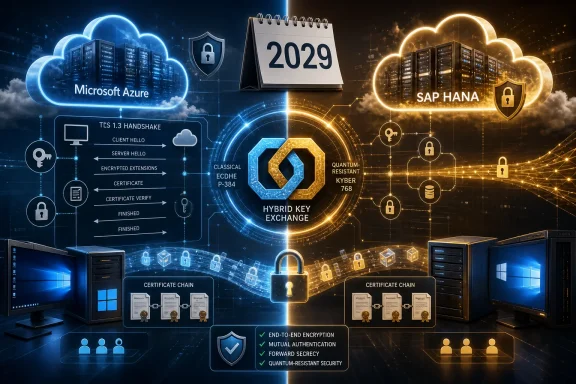 Microsoft Turns 2029 Into a Deadline, Not a Prediction
Microsoft’s move matters because it gives the enterprise market a date that is close enough to affect budgets, architecture reviews, vendor roadmaps, and compliance conversations. According to SDxCentral, Microsoft is accelerating the Microsoft Quantum Safe Program timeline so that Microsoft’s services and products move to a post-quantum cryptography footing by 2029. That does not mean Microsoft is saying a cryptographically relevant quantum computer will definitely arrive in 2029; it means Microsoft is no longer comfortable treating the migration as a vague, late-decade exercise.Azure CTO Mark Russinovich put the pressure in unusually direct terms. Cryptographically relevant quantum computers could arrive “sooner than previously expected and the work required to prepare is significant so organizations need to start now.” That sentence is doing two things at once: warning that the technical trigger could arrive earlier than planning models assumed, and reminding customers that crypto migrations are slow even when everyone agrees they are necessary.
For Microsoft, the 2029 date is less a single engineering milestone than a forcing function across a sprawling estate. SDxCentral reports that Microsoft plans to step up the modernization of network cryptography, protect stored data through crypto-agility, and modernize cryptographic trust chains. Each of those phrases hides years of unglamorous work: finding cryptography embedded inside protocols, certificates, hardware dependencies, identity systems, update pipelines, backup archives, and application frameworks that may have been designed long before “post-quantum” became an enterprise requirement.
That is why this announcement should not be read like a typical cloud roadmap update. Microsoft is signaling that the problem is not solved by swapping one algorithm for another at the edge of a service. The harder job is making Microsoft’s own systems—and, by implication, its customers’ systems—capable of changing cryptography without redesigning entire platforms when the next risk model arrives.
SAP Moves First Where the Data Is Most Worth Stealing
SAP’s part of the story is more targeted but no less important. According to SDxCentral, SAP updated its SAP HANA cloud system with post-quantum cryptography for transport layer security connections. The system will now handle network connections using a hybrid key exchange that combines classical and quantum-resistant algorithms.That choice matters because SAP HANA sits close to the crown jewels. It is not a peripheral application where experimental security can be treated as a pilot. SAP HANA cloud systems support enterprise data workloads, and SDxCentral notes that outside SAP, the database system can also be found as infrastructure-as-a-service from the three main hyperscalers. When SAP changes how network sessions are negotiated for that environment, it is making a statement about the shelf life of enterprise data.
The mechanism is the TLS handshake, where TLS 1.3 encrypts internet traffic and supports certificate-based authentication between clients and servers. SAP is not throwing away classical cryptography in one dramatic cutover. It is using a hybrid key exchange, which is the most pragmatic posture available to large vendors: keep compatibility and today’s security assumptions intact while adding quantum-resistant protection against tomorrow’s decryption risk.
SAP’s stated reason, per SDxCentral, is to blunt harvest-now, decrypt-later attacks. That phrase has become the bridge between quantum security theory and board-level risk. An attacker does not need a quantum computer today to create a quantum-era breach; they need patience, access to encrypted traffic or stored encrypted material, and confidence that the protected data will still matter when stronger decryption becomes available.
Harvest-Now, Decrypt-Later Makes the Future a Current Breach Window
The phrase “harvest-now, decrypt-later” can sound speculative until it is applied to the categories of data enterprises actually keep. Identity records, regulated personal data, trade secrets, contract histories, financial models, medical records, source code, authentication artifacts, and long-term government or industrial secrets may retain value for years. If encrypted material can be captured now and decrypted later, then the loss event happens before the cryptographic break is publicly visible.That is the real reason 2029 is an aggressive but not extravagant planning horizon. The risk clock does not start on “Q-day,” the industry shorthand for the point when quantum decryption becomes practically relevant. It starts when an adversary can collect useful encrypted material and expect that the data’s value will outlast the cryptography protecting it.
Microsoft and SAP are therefore responding to a time asymmetry that conventional patch management is poorly equipped to handle. A vulnerable endpoint can be patched after a bug is found; a captured archive of encrypted traffic cannot be un-captured. If the data remains sensitive for five, ten, or twenty years, then waiting for definitive proof of a cryptographically relevant quantum computer is not caution. It is a bet that the adversary did not already save the ciphertext.
This is where the story widens beyond quantum computing. SDxCentral notes that Microsoft also sees broader cybersecurity hygiene as a driver of the 2029 deadline. A serious post-quantum inventory forces companies to find where cryptography exists across legacy infrastructure, and that discovery process can expose weaknesses that have nothing to do with quantum attacks. In practice, quantum readiness becomes a lever for cleaning up decades of certificate sprawl, undocumented protocol dependencies, brittle key-management assumptions, and legacy systems that nobody wants to touch until a deadline makes them unavoidable.
The Migration Is Really About Crypto-Agility
The most important phrase in Microsoft’s plan may be “crypto-agility.” SDxCentral describes it as the ability to change cryptography without redesigning systems from scratch. That sounds dry, but it is the difference between an enterprise that can absorb the post-quantum transition and one that has to rediscover its own architecture under pressure.Crypto-agility means applications and platforms are not hard-wired to one algorithm, one certificate profile, one key length, one hardware security module behavior, or one TLS configuration that nobody has revisited in years. It means cryptographic choices can be changed through configuration, policy, libraries, negotiated protocol support, and lifecycle management rather than emergency rewrites. It also means organizations can test hybrid modes, phase out older primitives, and recover from algorithmic surprises without treating every migration like a once-in-a-generation infrastructure shock.
That is particularly relevant for Windows and Azure environments because cryptography is not a single layer. It is present in identity, device authentication, update signing, remote access, VPNs, browser traffic, application APIs, database connections, certificate authorities, secrets management, code signing, storage encryption, email, endpoint management, and backup systems. Some of those dependencies are visible to administrators. Many are buried in vendor products, integration middleware, scripts, appliances, and decade-old business applications that still perform essential work.
Microsoft’s mention of modernizing cryptographic trust chains points to the same complexity. Trust chains are not only about encrypted pipes; they are about what a system accepts as authentic. In a Microsoft estate, that can touch everything from certificates and signing infrastructure to service authentication and software distribution. A post-quantum transition that strengthens data-in-transit encryption but leaves authentication and trust validation stranded in older assumptions would be incomplete.
SAP’s hybrid TLS move is a concrete example of crypto-agility in action. It does not ask customers to pretend classical cryptography has already failed. Instead, it combines classical and quantum-resistant approaches during key exchange. The enterprise benefit is incremental deployment with layered assurance: current systems continue to interoperate, while the session negotiation begins to account for attacks that may become practical later.
Google’s 2029 Move Became the Industry’s Starter Pistol
Microsoft is not moving in isolation. SDxCentral notes that Google had already declared it would accelerate its post-quantum cryptography transition to 2029. That earlier move appears to have helped set the competitive and psychological frame for the rest of the industry.The nuance matters because the 2029 date was easy to misunderstand. Some observers reportedly interpreted Google’s timeline as a prediction that the first relevant quantum computer would arrive in that year. Mark Pecen, chair of ETSI’s Technical Committee on Quantum Technology, rejected that framing. “Google framed 2029 as a PQC migration timeline, intended to create ‘clarity and urgency’ across industry, not as a certain date for a cryptographically relevant quantum computer,” he told SDxCentral.
That distinction should be preserved because it is the difference between risk management and prophecy. A migration deadline is something enterprises can act on. A prediction about the exact arrival of a cryptographically relevant quantum computer is far less useful, and almost certainly less defensible.
The industry is converging on 2029 because large cryptographic migrations take years, not because every serious actor believes the same machine will appear on the same calendar date. Vendors need time to implement, test, deploy, and support new cryptographic modes. Customers need time to inventory dependencies, validate application compatibility, coordinate with auditors, update policies, and replace systems that cannot be made ready.
That is why the Google-Microsoft parallel matters. Once two hyperscale vendors treat 2029 as the working target, suppliers and customers downstream lose the luxury of indefinite ambiguity. A cloud vendor’s internal crypto roadmap becomes an external planning constraint for software vendors, managed service providers, enterprise architects, and regulators.
| Organization | Reported move | Timeline or status | Technical focus | Stated or implied motive |
|---|---|---|---|---|
| Microsoft | Accelerating the Microsoft Quantum Safe Program | 2029 | Microsoft services and products on a PQC footing; network cryptography, stored data, crypto-agility, trust chains | Prepare for cryptographically relevant quantum computers that could arrive sooner than previously expected |
| SAP | Updated SAP HANA cloud system with PQC for TLS connections | Now reported by SDxCentral | Hybrid key exchange combining classical and quantum-resistant algorithms in TLS connections | Thwart harvest-now, decrypt-later attacks |
| Accelerating its PQC transition | 2029 | Post-quantum cryptography migration across its own environment | Create clarity and urgency across industry, not predict a certain quantum-computer arrival date |
RSA and ECC Are the Aging Foundation Everyone Built On
The reason this migration is so disruptive is that modern enterprise security relies heavily on public-key systems that were never designed to survive a mature quantum adversary. SDxCentral’s reporting names Rivest-Shamir-Adleman, better known as RSA, and elliptic curve cryptography, or ECC, as aging standard public-key systems vulnerable in this context. These systems are not obscure academic artifacts; they are foundational to how authentication, key exchange, and digital trust have worked across the internet and enterprise software.That does not mean every encrypted file or session protected with these systems is instantly exposed today. It means the trust assumptions behind widely deployed public-key cryptography are now being revised under a credible future threat model. The challenge is less dramatic than a sudden universal collapse, but more operationally painful: enterprises must move while the old systems still work, before there is a clean external signal that waiting has become untenable.
Pecen’s warning, as relayed by SDxCentral, also complicates the story by noting that classical computers already pose a major threat to enterprises. That is an important corrective. Post-quantum work should not become a fashionable distraction from ransomware, credential theft, misconfigured cloud storage, expired certificates, weak key management, and ordinary software vulnerabilities. If anything, the post-quantum transition exposes how much of enterprise cryptography has been treated as plumbing rather than actively governed infrastructure.
The uncomfortable truth is that many organizations do not know where RSA and ECC are used across their environments. They know the obvious places: public websites, VPNs, certificate authorities, identity systems, and major cloud services. They often do not know the hidden places: embedded devices, legacy Java applications, internal APIs, old middleware, partner connections, file-transfer tools, backup products, industrial systems, and custom software whose original authors have long since left.
That is why Microsoft’s emphasis on visibility is so important. You cannot migrate cryptography you cannot find. For many organizations, the first year of post-quantum readiness will look less like algorithm deployment and more like archaeology.
The Enterprise Stack Is Splitting Between Platform Leaders and Everyone Else
Microsoft, SAP, and Google can set post-quantum timelines because they control large parts of their own stacks. They have cryptography teams, protocol engineers, product owners, cloud control planes, and enough market leverage to make partners pay attention. Most enterprises do not have that luxury.A typical Windows-heavy organization may depend on Microsoft 365, Azure, Active Directory or Microsoft Entra integrations, Windows endpoints, line-of-business apps, SAP systems, third-party VPNs, security appliances, managed file-transfer platforms, endpoint agents, browser-based apps, storage systems, and an ecosystem of suppliers. Each one may use cryptography differently. Each one may expose different configuration controls. Each one may have a different post-quantum roadmap, or none at all.
This creates a two-speed market. The biggest platform vendors will publish migration milestones and gradually expose PQC-capable services. Customers will then discover that their own readiness depends on the slowest vendor in the chain. A cloud service may support stronger key exchange, but an old client library may not. A database platform may add hybrid TLS, but a monitoring appliance may fail negotiation. A certificate authority may support new profiles in time, but an application may reject them because it was coded against older assumptions.
That is why hybrid approaches are likely to dominate the first phase. They give vendors a path to improve resilience without forcing every customer to make a synchronized leap. They also give administrators a testing window: observe handshake behavior, validate performance, examine compatibility, and decide where fallback behavior is acceptable and where it creates a false sense of safety.
The risk is that hybrid support becomes a checkbox rather than a transition plan. If an organization enables a hybrid mode but does not know where it is active, what clients are using it, where fallback occurs, and what data remains protected only by older assumptions, then the migration becomes cosmetic. Post-quantum readiness must be measurable, not merely enabled.
Windows Shops Should Treat This as an Inventory Problem First
For WindowsForum.com readers, the immediate consequence is not that every desktop must be reconfigured tomorrow. It is that Windows-centered IT estates need to start mapping cryptographic dependencies with the same seriousness they apply to endpoint inventory and vulnerability management. The 2029 vendor timelines are close enough that waiting for final vendor defaults will compress testing into the same window as procurement, compliance, and application remediation.Start with the systems that move or protect long-lived data. SAP HANA cloud connections are the obvious example from SDxCentral’s reporting, but the principle extends to identity platforms, privileged access systems, backups, archival storage, legal records, regulated datasets, confidential engineering material, and sensitive partner integrations. If captured data would still matter after 2029, it belongs in the first wave of review.
Next, separate cryptography you control from cryptography you consume. An enterprise can often configure TLS settings, certificate lifetimes, key sizes, and accepted cipher suites for systems it owns. It may have less direct control over SaaS platforms, managed services, embedded products, and vendor-hosted applications. Those dependencies should be tracked with vendor roadmap questions now, not after auditors or executives start asking whether the organization is “quantum safe.”
The language of procurement will also need to change. Asking whether a vendor “uses encryption” is already too vague; in a post-quantum migration cycle, it is almost meaningless. Buyers will need to ask whether products support crypto-agility, whether post-quantum or hybrid key exchange is on the roadmap, whether TLS 1.3 is supported where relevant, how certificates and trust chains are managed, how algorithm changes are delivered, and how fallback or compatibility modes are logged.
This is not only a security-team concern. Application owners, infrastructure teams, identity administrators, compliance officers, legal departments, and procurement teams all own pieces of the migration. If they do not coordinate, the organization will get a fragmented picture: a secure cloud roadmap here, a stranded legacy application there, and no coherent way to prove what has actually changed.
Action checklist for admins
- Build an inventory of systems that use public-key cryptography, starting with TLS endpoints, identity services, VPNs, certificate authorities, databases, backup systems, and high-value application integrations.
- Identify data with a long confidentiality shelf life and prioritize systems that transmit or store it, especially where harvest-now, decrypt-later exposure would matter.
- Ask Microsoft, SAP, cloud providers, security vendors, and critical software suppliers for their post-quantum cryptography and crypto-agility roadmaps.
- Test TLS 1.3 behavior and certificate dependencies in lab environments before enabling new hybrid or post-quantum modes in production.
- Track where RSA and ECC remain embedded in legacy systems, custom applications, appliances, and partner connections.
- Update procurement and architecture review templates so “encryption supported” is replaced with specific questions about crypto-agility, trust chains, algorithm migration, and logging.
The Compliance Conversation Will Arrive Before the Quantum Computer
The enterprise market often moves fastest when security risk becomes procurement language, audit language, or insurance language. Microsoft and Google putting 2029 on their post-quantum transition timelines will help turn an abstract risk into a question auditors can ask and boards can understand. SAP adding hybrid PQC to TLS connections in SAP HANA cloud systems gives the same conversation a concrete example inside a mission-critical business platform.That does not mean regulators will all converge instantly, or that every standard will mature on the same schedule. It does mean enterprises should expect questions to become more specific. Where is cryptography used? Which systems protect long-lived sensitive data? Which vendors have PQC roadmaps? Which systems support crypto-agility? Which trust chains depend on RSA or ECC? Which services can be migrated without breaking compatibility?
The awkward phase will come when platform providers are ready before customers are. Microsoft may modernize parts of its estate, SAP may add hybrid key exchange, and Google may push its own migration forward, while individual enterprises discover that internal systems, third-party products, or old clients cannot keep pace. In that world, “we use a quantum-ready cloud provider” will not be enough. The weakest links will remain wherever old assumptions persist.
The other awkward phase will come when customers are ready before vendors are. Large enterprises with sensitive data may want contractual commitments, testing environments, or technical details that suppliers are not yet prepared to provide. Smaller vendors may treat post-quantum support as a future feature rather than an architectural requirement. That gap will create pressure in renewals, security questionnaires, and regulated industries.
This is why Microsoft’s crypto-agility emphasis may end up being more influential than the 2029 date itself. A vendor that cannot change cryptography without redesigning its product is not merely behind on PQC; it is structurally fragile. Customers should learn to distinguish between vendors that are implementing specific algorithms and vendors that have built systems capable of surviving cryptographic change.
The Real Risk Is a False Sense of Synchronization
A shared year can create a misleading sense of order. Microsoft’s 2029 target, Google’s 2029 target, and SAP’s current HANA cloud update all point in the same direction, but they do not mean the ecosystem will move together cleanly. Post-quantum migration will be uneven by product, geography, industry, protocol, and customer maturity.Some services will hide the transition from users almost entirely. Cloud providers can update managed endpoints, negotiate stronger sessions, and rotate infrastructure beneath the customer-visible surface. Other systems will require explicit customer action, especially where certificates, client compatibility, network inspection, appliances, or application dependencies are involved. Still others may be impossible to migrate without replacement.
Enterprises should also be careful about the word “quantum-proof.” It is rhetorically powerful but operationally dangerous. The safer framing is post-quantum readiness or quantum-resistant transition. Security is not a final state, and cryptography is not immune to future cryptanalysis, implementation flaws, side-channel problems, misconfiguration, or protocol mistakes. The value of crypto-agility is precisely that it assumes today’s answer may not be tomorrow’s last answer.
SAP’s hybrid approach reflects that humility. It does not ask customers to abandon all classical assumptions overnight, and it does not pretend that a single switch solves the entire quantum problem. It begins with the handshake, where sensitive session material is negotiated, and adds quantum-resistant protection alongside existing methods. That is how serious infrastructure transitions usually start: in compatibility-preserving layers, with the hardest edge cases discovered later.
Microsoft’s broader program faces the bigger version of the same problem. Services and products are not a single environment. They include consumer-facing systems, enterprise services, developer platforms, identity infrastructure, management tooling, storage, networking, and dependencies that reach deep into customer environments. The 2029 date gives the effort shape, but it does not make the migration simple.
What the First Wave of Readiness Will Look Like
The first credible sign of readiness will not be a press release using the phrase “quantum safe.” It will be inventory quality. Organizations that can name their cryptographic dependencies, identify high-value long-lived data flows, and map vendor roadmaps will be far ahead of organizations that wait for a final product toggle.The second sign will be test coverage. Hybrid key exchange and post-quantum support need to be validated against real clients, proxies, inspection tools, load balancers, logging systems, certificate infrastructure, and application behavior. Enterprises that discover compatibility problems in a lab will treat 2029 as a manageable program. Enterprises that discover them during a forced rollout will treat it as another security fire drill.
The third sign will be governance. Cryptography has historically been scattered across teams: network engineers own TLS settings, identity teams own certificates, developers choose libraries, cloud teams configure managed services, security teams write policies, and procurement teams accept vendor claims. Post-quantum migration requires a common owner or at least a common operating model. Without that, every team will optimize its own corner and no one will know whether the organization is actually safer.
The fourth sign will be vendor pressure. Microsoft, SAP, and Google can move the center of gravity, but enterprises still need answers from the rest of their supply chains. That includes security tools, observability platforms, backup products, database drivers, API gateways, file-transfer systems, endpoint agents, and niche line-of-business software. The uncomfortable but useful question is simple: if a supplier cannot explain how it will handle cryptographic change, why should customers assume it will handle the post-quantum transition well?
The fifth sign will be discipline around long-lived data. Not every system deserves the same urgency. A low-sensitivity internal service with short-lived data is not the same as a legal archive, identity database, payment system, healthcare record store, or product-design repository. The organizations that succeed will prioritize by data value and confidentiality lifetime rather than chasing a generic “quantum safe” label across the entire estate at once.
The Near-Term Signal Hidden in the 2029 Noise
The most useful way to read the Microsoft, SAP, and Google moves is not as a countdown to a single quantum event, but as a market signal about how much work remains. If vendors with deep cryptographic expertise and massive engineering resources are treating 2029 as urgent, customers should not imagine that their own migration can begin in 2028. The calendar is not the only constraint; discovery, compatibility, governance, and vendor readiness may take longer than algorithm deployment.The concrete lessons are already visible:
- Microsoft is accelerating its Quantum Safe Program so its services and products move to a post-quantum cryptography footing by 2029.
- SAP has updated its SAP HANA cloud system so TLS connections use a hybrid key exchange combining classical and quantum-resistant algorithms.
- Google’s 2029 timeline should be read as an industry migration target, not as a prediction that a cryptographically relevant quantum computer arrives that year.
- Harvest-now, decrypt-later risk makes long-lived sensitive data a current security problem, not a future theoretical one.
- RSA and ECC exposure should be inventoried across visible and hidden systems before migration pressure peaks.
- Crypto-agility is the strategic goal because this will not be the last cryptographic transition enterprises face.
The Winners Will Be the Boring Organizations That Start Early
There is a temptation to make quantum security sound cinematic: a breakthrough machine, a shattered encryption scheme, a new era arriving all at once. The enterprise reality will be more bureaucratic and more consequential. Spreadsheets of cryptographic assets, vendor questionnaires, lab tests, certificate reviews, protocol negotiations, budget cycles, and uncomfortable meetings about unsupported legacy systems will decide whether organizations are ready.That is why the Microsoft and SAP moves are useful even before every technical detail is visible. Microsoft’s 2029 target gives customers a planning horizon. SAP’s HANA cloud update gives administrators a concrete example of hybrid post-quantum protection entering a mainstream enterprise system. Google’s earlier 2029 framing adds competitive pressure and prevents the industry from pretending that the migration can wait for perfect certainty.
The danger is that enterprises mistake vendor progress for customer readiness. A Microsoft cloud service moving toward PQC does not automatically fix a brittle internal application. SAP supporting hybrid TLS for HANA cloud connections does not inventory every dependent client or partner integration. Google creating clarity and urgency does not eliminate the need for each organization to decide which data must remain confidential beyond the decade.
The next phase will reward organizations that treat cryptography as managed infrastructure rather than invisible plumbing. That means knowing where it is, who owns it, how it changes, how failure is detected, and how vendors will support the transition. The post-quantum era may arrive gradually, then suddenly; the enterprises that fare best will be the ones that used the gradual part to do the work everyone else postponed.
References
- Primary source: SDxCentral
Published: Mon, 06 Jul 2026 17:13:06 GMT
Loading…
www.sdxcentral.com
