

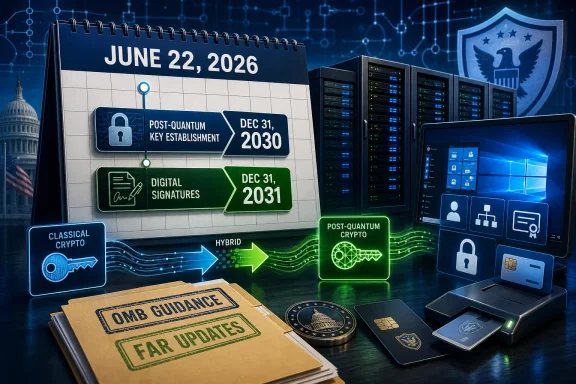
President Donald Trump signed a June 22, 2026 executive order requiring federal agencies to name post-quantum cryptography transition leads within 30 days and move high-value assets and high-impact systems to quantum-resistant keys by December 31, 2030, with digital signatures due one year later. The order does not invent the federal PQC transition, but it changes the tempo from “prepare” to “execute.” For agencies, contractors, cloud providers, and software vendors, the message is blunt: the cryptographic plumbing of government now has a deadline.
Post-quantum cryptography has spent years in the awkward space between science-fiction urgency and enterprise backlog. Everyone in security has been told that a sufficiently capable quantum computer could one day break widely used public-key cryptography. Far fewer organizations have treated that as a line item in next year’s budget.
The White House order tries to end that ambiguity. It puts agency CIOs, CISOs, and procurement officials on a clock, and it does so using the language federal IT understands best: designated officials, OMB guidance, NIST pilots, Federal Acquisition Regulation changes, and compliance dates.
That matters because cryptography is not a normal software upgrade. Replacing a browser, patching a VPN, or retiring a server is visible work. Cryptography is often invisible until it fails. It sits inside identity systems, TLS endpoints, smart cards, code-signing chains, firmware update mechanisms, cloud APIs, databases, backup archives, message queues, and long-forgotten appliances sitting in well-lit racks nobody wants to touch.
The executive order’s real impact is therefore not that it says quantum risk exists. NIST, CISA, NSA, OMB, and the private sector have been saying that for years. Its impact is that it makes quantum risk operational: someone must be accountable, someone must inventory the exposure, and someone must explain why a high-value system is not ready by the end of 2030.
That is why the 30-day requirement to name agency transition leads is more than bureaucratic ceremony. Without an owner, PQC becomes the kind of horizontal security problem that everybody endorses and nobody funds. It touches security architecture, application development, procurement, cloud engineering, identity management, records retention, endpoint management, and vendor risk.
The most difficult part is discovery. Agencies need a cryptographic inventory detailed enough to distinguish between systems that can be migrated through ordinary software updates and systems that will require redesign, replacement, or vendor intervention. Many organizations still struggle to maintain accurate software bills of materials; cryptographic bills of materials are even less mature.
The deadlines also separate two categories that are often blurred in casual PQC discussions. Key establishment — the process by which systems agree on shared secrets — gets the 2030 deadline for high-value and high-impact systems. Digital signatures, which underpin authentication, integrity, and non-repudiation, get until the end of 2031. That sequencing reflects reality: signatures are embedded in longer-lived trust chains, code-signing ecosystems, documents, devices, and certificates that may be harder to unwind cleanly.
The uncomfortable truth is that agencies do not have four and a half years to start. They have four and a half years to finish the first critical slice.
Those standards answered a long-running question: which algorithms should organizations begin preparing to deploy? They did not answer the messier questions: which systems first, which vendors are ready, which protocols need updates, which certificates must change, and how much performance overhead agencies can tolerate.
The executive order is best understood as the bridge between NIST’s standards work and actual federal operations. It gives OMB 90 days to issue new guidance, directs NIST to begin a migration pilot within 180 days, and requires that pilot to be completed by the end of 2027. That sequencing suggests the administration knows the order alone is insufficient. Agencies need playbooks, tested migration patterns, and procurement language that will survive contact with real systems.
The NIST pilot could be one of the most consequential pieces of the order if it produces practical implementation evidence rather than another strategic framework. Federal agencies need to know where hybrid deployments make sense, how to validate vendor claims, how to handle certificate lifecycles, and how to test interoperability across systems that may adopt PQC at different speeds.
The pilot also gives vendors a forcing function. A supplier that can say it supports PQC in a slide deck is not the same as a supplier that can demonstrate it inside a federal architecture, under federal requirements, with logging, auditability, rollback planning, and lifecycle management.
That threat model, often described as “harvest now, decrypt later,” is why long-lived federal data sits at the center of the debate. Tax records, census data, intelligence holdings, personnel files, health information, legal records, and sensitive research can remain valuable for decades. If an adversary captures encrypted traffic or archives now, the damage may arrive long after the breach report is closed.
This creates a mismatch between ordinary cyber risk management and quantum-era risk. Traditional remediation often focuses on stopping current exploitation, rotating credentials, and restoring normal operations. PQC planning must also ask how long protected information must remain confidential. A system storing data with a three-year sensitivity window presents a different risk profile than one storing information that must remain confidential for 30 years.
That is why the order’s focus on high-value assets and high-impact systems is necessary but incomplete. The most important systems are the obvious starting point, but the most quantum-exposed data is not always sitting in the system with the most prominent label. It may be replicated into analytics platforms, exported into archives, copied into development environments, or transmitted through integration points that were never classified as crown jewels.
This is where Windows-heavy enterprise environments should pay attention. The problem is not limited to federal mainframes or classified networks. It reaches Active Directory Certificate Services, VPN concentrators, TLS inspection boxes, endpoint management platforms, document-signing workflows, smart card infrastructure, code-signing pipelines, SQL Server connections, backup systems, and cloud identity integrations. If it uses public-key cryptography to establish trust, it belongs in the inventory.
By directing OMB, NASA, and the General Services Administration to identify cost-saving opportunities — including shared procurement of PQC tools, joint training, cloud migration opportunities, and centralized support — the order acknowledges a basic reality: most agencies cannot each invent their own PQC transition from scratch. A fragmented approach would waste money, dilute expertise, and create inconsistent security outcomes.
The planned Federal Acquisition Regulation changes are the sharper instrument. Once contractors are required to comply with PQC requirements by December 31, 2030, quantum readiness becomes a market access issue. Vendors that sell into the federal government will have to show not only that their products can support NIST-approved algorithms, but that they can do so within the government’s migration schedule.
That will ripple beyond Washington. Federal requirements have a long history of shaping commercial security baselines, especially when large vendors prefer one product roadmap over two. If Microsoft, Amazon, Google, Cisco, Palo Alto Networks, VMware, Oracle, ServiceNow, and the rest of the enterprise stack must satisfy federal PQC expectations, private-sector customers will inherit some of the benefits.
But procurement can also produce theater. Agencies may be tempted to demand “PQC compliant” products before the ecosystem has agreed on meaningful evidence of compliance. Vendors may respond with marketing language that outruns their engineering. The next phase will require testable requirements, not slogans.
For administrators, the practical question will be simple: can this product tell me which algorithms it uses, where it uses them, whether they are configurable, and how it will support NIST-approved post-quantum options without breaking my environment?
PQC migration competes with every other unfunded or underfunded federal cyber mandate. Agencies are already dealing with zero-trust implementation, endpoint modernization, cloud migration, identity hardening, logging requirements, vulnerability management, software supply-chain controls, and the ordinary churn of unsupported systems. Adding a cryptographic migration of this scale without dedicated funding risks creating compliance paperwork rather than real risk reduction.
The financial burden is also uneven. A cloud-forward agency with modern managed identity, current application stacks, and strong asset visibility has a different starting point from an agency running decades-old mission systems and bespoke integrations. The order’s governmentwide deadlines may be uniform, but the implementation terrain is not.
That creates a familiar federal IT danger: agencies with the most technical debt may have the hardest time complying, even though they may also carry some of the most sensitive data. A deadline can concentrate attention, but it cannot compress procurement cycles, vendor roadmaps, testing windows, and modernization work indefinitely.
The best version of this transition uses PQC as leverage to clean up cryptographic sprawl. The worst version bolts new algorithms onto brittle systems without understanding where trust actually begins and ends.
That is the lesson agencies should take from the quantum threat even before a cryptographically relevant quantum computer exists. The danger is not only that today’s algorithms may become vulnerable. It is that organizations have built systems in which changing cryptography is slow, opaque, and risky.
PQC standards themselves may evolve. Additional algorithms may be standardized. Implementation guidance may shift as performance data, side-channel research, and interoperability testing mature. Agencies that treat the 2030 and 2031 deadlines as a one-time destination may find themselves repeating the same painful migration later.
This is especially important for Windows ecosystems, where trust chains are deeply embedded. Certificate templates, domain controllers, enterprise CAs, smart cards, Intune policies, VPN profiles, Wi-Fi authentication, S/MIME, PowerShell signing, driver signing, and internal PKI dependencies all create operational gravity. Changing the cryptographic layer can touch user authentication, device enrollment, application deployment, and update trust.
The immediate task is migration. The strategic task is making the next migration less traumatic.
The most visible pressure points will likely appear in identity and certificate infrastructure. Active Directory Certificate Services remains deeply entrenched in government and enterprise networks, often in configurations that have accumulated over years. Internal PKI supports smart card logon, device certificates, Wi-Fi authentication, VPN access, application authentication, document signing, and internal TLS.
Cloud identity adds another layer. Entra ID, federation services, conditional access integrations, and SaaS applications depend on token signing, certificate validation, TLS, and API trust. Some of these layers will be abstracted away by Microsoft and other cloud providers. Others will remain the customer’s responsibility, especially in hybrid environments.
This division of responsibility will matter. Cloud providers can upgrade parts of the stack centrally, which is one reason the order explicitly points to cloud-based technologies as a possible cost-saving path. But customers still need to know where they terminate TLS, where they manage certificates, where they operate private keys, and where legacy applications pin algorithms or certificates in ways that complicate migration.
For federal contractors, the downstream effect could be even more immediate. If procurement rules require PQC compliance by the end of 2030, vendors and integrators will need evidence. That means documentation, configuration controls, attestations, test results, and support commitments — not merely a roadmap slide promising quantum readiness.
That does not mean every company should blindly copy the federal timeline. Risk depends on data sensitivity, retention periods, industry regulation, exposure, and threat model. A hospital, bank, defense supplier, software vendor, and local retailer do not face identical PQC urgency.
But the order changes the burden of proof. Before, an enterprise could plausibly say PQC was too early to prioritize beyond monitoring standards development. After NIST’s 2024 standards and the 2026 executive order, that argument is weaker. The standards exist, the federal migration clock is running, and sophisticated adversaries have a rational incentive to collect long-lived encrypted data now.
The most sensible private-sector response is not panic purchasing. It is disciplined discovery. Organizations need to know where public-key cryptography is used, which data has long-term confidentiality needs, which vendors control critical trust points, and which systems cannot be easily upgraded.
That work is not glamorous. It is asset management, architecture review, vendor management, and risk classification. It is also the work that determines whether PQC migration becomes a planned modernization effort or a future emergency.
There is also a standards maturity challenge. NIST’s first PQC standards are ready for use, but production migration across the federal government requires supporting protocol updates, validated implementations, hardware and software support, operational guidance, and security testing. Agencies cannot simply paste algorithm names into acquisition documents and declare victory.
Interoperability will be a recurring pain point. During the transition, systems will need to communicate across mixed environments where some endpoints support PQC, some rely on hybrid modes, and others remain stuck with classical algorithms. Backward compatibility, downgrade resistance, logging, and policy enforcement will all matter.
Performance will matter, too. Post-quantum algorithms can have different key sizes, signature sizes, and computational characteristics from the algorithms they replace. For modern servers this may be manageable; for constrained devices, high-volume services, or latency-sensitive systems, it may require careful engineering.
The federal government’s migration will therefore be less like flipping a national switch and more like rewiring a city while the power stays on.
Those systems often sit near mission-critical workflows. They may use old TLS stacks, hard-coded libraries, unsupported appliances, proprietary middleware, embedded certificates, or vendor-controlled update mechanisms. They may be documented poorly, owned ambiguously, and connected to newer systems through layers of compensating controls.
PQC migration will expose those weak points. An agency can only migrate a system if it understands the system’s dependencies. It can only replace cryptography if the relevant software and hardware can support replacement. It can only demand vendor compliance if the contract gives it leverage or the market offers alternatives.
This is where the 2030 deadline may become a modernization accelerant. Agencies that have postponed replacing brittle systems may now have a security-driven reason to act. But that also means PQC costs should not be understood narrowly as the cost of new cryptographic libraries. The real cost may include application modernization, hardware refreshes, contract changes, staff training, testing environments, and downtime planning.
There is a useful discipline in that. Quantum risk forces agencies to ask which systems are truly worth preserving. If a high-impact system cannot be made crypto-agile by 2030, perhaps the problem is not the deadline. Perhaps the problem is that the system has been allowed to remain strategically important while becoming operationally immovable.
The order’s contractor deadline recognizes that reality. A federal agency can harden its own systems and still expose sensitive data through vendor integrations, managed services, or supply-chain dependencies. Cryptographic risk follows the data and the trust relationship, not the org chart.
This will be a major shift for vendor risk management. Agencies will need to ask contractors where public-key cryptography is used in their services, how customer data is protected in transit and at rest, whether long-lived sensitive data is exposed to harvest-now risk, and how the contractor plans to support NIST-approved algorithms. Those questions will need to appear in solicitations, renewals, security assessments, and continuous monitoring.
Contractors, meanwhile, will face a familiar compliance squeeze. They will be expected to prove readiness before every upstream dependency is fully mature. Smaller vendors may struggle to hire cryptographic expertise or absorb implementation costs. Larger vendors may support PQC in flagship products while leaving older offerings on slower timelines.
The federal market can drive security improvements, but it can also create uneven compliance rituals. The difference will depend on whether procurement officials demand meaningful evidence and whether agencies coordinate requirements instead of creating a patchwork of slightly different PQC questionnaires.
There is also an epistemic challenge: the exact arrival date of a cryptographically relevant quantum computer remains uncertain. That uncertainty can be abused in both directions. Skeptics can use it to justify delay; vendors can use it to sell fear. Good policy has to steer between those errors.
The rational position is not that quantum code-breaking is imminent in a cinematic sense. It is that some data has a long enough shelf life, and some adversaries have enough patience, that waiting for a public quantum breakthrough would be irresponsible. By the time the threat is undeniable, it may be too late for data already stolen.
That is why the order’s deadlines are both aggressive and defensible. They compress a transition that was already coming. They also force the government to confront whether its cryptographic foundations are visible, governable, and replaceable.
 Washington Turns a Future Threat Into This Decade’s Procurement Problem
Post-quantum cryptography has spent years in the awkward space between science-fiction urgency and enterprise backlog. Everyone in security has been told that a sufficiently capable quantum computer could one day break widely used public-key cryptography. Far fewer organizations have treated that as a line item in next year’s budget.The White House order tries to end that ambiguity. It puts agency CIOs, CISOs, and procurement officials on a clock, and it does so using the language federal IT understands best: designated officials, OMB guidance, NIST pilots, Federal Acquisition Regulation changes, and compliance dates.
That matters because cryptography is not a normal software upgrade. Replacing a browser, patching a VPN, or retiring a server is visible work. Cryptography is often invisible until it fails. It sits inside identity systems, TLS endpoints, smart cards, code-signing chains, firmware update mechanisms, cloud APIs, databases, backup archives, message queues, and long-forgotten appliances sitting in well-lit racks nobody wants to touch.
The executive order’s real impact is therefore not that it says quantum risk exists. NIST, CISA, NSA, OMB, and the private sector have been saying that for years. Its impact is that it makes quantum risk operational: someone must be accountable, someone must inventory the exposure, and someone must explain why a high-value system is not ready by the end of 2030.
The Deadline Is Aggressive Because the Inventory Is the Hard Part
The technical phrase post-quantum cryptography can make the transition sound like an algorithm swap. It is not. The federal government is not merely replacing one cipher with another; it is trying to find every place public-key cryptography is used, decide whether the data protected there will still matter years from now, and coordinate changes across systems that were never designed to move in lockstep.That is why the 30-day requirement to name agency transition leads is more than bureaucratic ceremony. Without an owner, PQC becomes the kind of horizontal security problem that everybody endorses and nobody funds. It touches security architecture, application development, procurement, cloud engineering, identity management, records retention, endpoint management, and vendor risk.
The most difficult part is discovery. Agencies need a cryptographic inventory detailed enough to distinguish between systems that can be migrated through ordinary software updates and systems that will require redesign, replacement, or vendor intervention. Many organizations still struggle to maintain accurate software bills of materials; cryptographic bills of materials are even less mature.
The deadlines also separate two categories that are often blurred in casual PQC discussions. Key establishment — the process by which systems agree on shared secrets — gets the 2030 deadline for high-value and high-impact systems. Digital signatures, which underpin authentication, integrity, and non-repudiation, get until the end of 2031. That sequencing reflects reality: signatures are embedded in longer-lived trust chains, code-signing ecosystems, documents, devices, and certificates that may be harder to unwind cleanly.
The uncomfortable truth is that agencies do not have four and a half years to start. They have four and a half years to finish the first critical slice.
NIST Gave Everyone the Algorithms; the Order Demands the Migration
NIST’s August 2024 finalization of the first three post-quantum cryptography standards was the moment the federal transition stopped being theoretical. FIPS 203, based on ML-KEM, provides the primary standard for quantum-resistant key establishment. FIPS 204, based on ML-DSA, and FIPS 205, based on SLH-DSA, cover digital signatures.Those standards answered a long-running question: which algorithms should organizations begin preparing to deploy? They did not answer the messier questions: which systems first, which vendors are ready, which protocols need updates, which certificates must change, and how much performance overhead agencies can tolerate.
The executive order is best understood as the bridge between NIST’s standards work and actual federal operations. It gives OMB 90 days to issue new guidance, directs NIST to begin a migration pilot within 180 days, and requires that pilot to be completed by the end of 2027. That sequencing suggests the administration knows the order alone is insufficient. Agencies need playbooks, tested migration patterns, and procurement language that will survive contact with real systems.
The NIST pilot could be one of the most consequential pieces of the order if it produces practical implementation evidence rather than another strategic framework. Federal agencies need to know where hybrid deployments make sense, how to validate vendor claims, how to handle certificate lifecycles, and how to test interoperability across systems that may adopt PQC at different speeds.
The pilot also gives vendors a forcing function. A supplier that can say it supports PQC in a slide deck is not the same as a supplier that can demonstrate it inside a federal architecture, under federal requirements, with logging, auditability, rollback planning, and lifecycle management.
“Harvest Now, Decrypt Later” Is the Argument That Makes Waiting Dangerous
The most persuasive case for moving before quantum computers are known to be cryptographically relevant is not that tomorrow’s login session will suddenly be broken. It is that sensitive data stolen today may retain value long enough to be decrypted later.That threat model, often described as “harvest now, decrypt later,” is why long-lived federal data sits at the center of the debate. Tax records, census data, intelligence holdings, personnel files, health information, legal records, and sensitive research can remain valuable for decades. If an adversary captures encrypted traffic or archives now, the damage may arrive long after the breach report is closed.
This creates a mismatch between ordinary cyber risk management and quantum-era risk. Traditional remediation often focuses on stopping current exploitation, rotating credentials, and restoring normal operations. PQC planning must also ask how long protected information must remain confidential. A system storing data with a three-year sensitivity window presents a different risk profile than one storing information that must remain confidential for 30 years.
That is why the order’s focus on high-value assets and high-impact systems is necessary but incomplete. The most important systems are the obvious starting point, but the most quantum-exposed data is not always sitting in the system with the most prominent label. It may be replicated into analytics platforms, exported into archives, copied into development environments, or transmitted through integration points that were never classified as crown jewels.
This is where Windows-heavy enterprise environments should pay attention. The problem is not limited to federal mainframes or classified networks. It reaches Active Directory Certificate Services, VPN concentrators, TLS inspection boxes, endpoint management platforms, document-signing workflows, smart card infrastructure, code-signing pipelines, SQL Server connections, backup systems, and cloud identity integrations. If it uses public-key cryptography to establish trust, it belongs in the inventory.
Procurement Is Where the Order Gets Teeth
The executive order’s procurement language may prove more important than its technical language. Federal agencies rarely modernize alone; they buy platforms, managed services, cloud infrastructure, endpoint tools, identity systems, consulting support, and software from a sprawling contractor ecosystem. If that ecosystem does not move, agency timelines become aspirational.By directing OMB, NASA, and the General Services Administration to identify cost-saving opportunities — including shared procurement of PQC tools, joint training, cloud migration opportunities, and centralized support — the order acknowledges a basic reality: most agencies cannot each invent their own PQC transition from scratch. A fragmented approach would waste money, dilute expertise, and create inconsistent security outcomes.
The planned Federal Acquisition Regulation changes are the sharper instrument. Once contractors are required to comply with PQC requirements by December 31, 2030, quantum readiness becomes a market access issue. Vendors that sell into the federal government will have to show not only that their products can support NIST-approved algorithms, but that they can do so within the government’s migration schedule.
That will ripple beyond Washington. Federal requirements have a long history of shaping commercial security baselines, especially when large vendors prefer one product roadmap over two. If Microsoft, Amazon, Google, Cisco, Palo Alto Networks, VMware, Oracle, ServiceNow, and the rest of the enterprise stack must satisfy federal PQC expectations, private-sector customers will inherit some of the benefits.
But procurement can also produce theater. Agencies may be tempted to demand “PQC compliant” products before the ecosystem has agreed on meaningful evidence of compliance. Vendors may respond with marketing language that outruns their engineering. The next phase will require testable requirements, not slogans.
For administrators, the practical question will be simple: can this product tell me which algorithms it uses, where it uses them, whether they are configurable, and how it will support NIST-approved post-quantum options without breaking my environment?
The Funding Gap Is the Part No Deadline Can Wish Away
The order sets dates, but it does not magically create agency budgets. During the previous administration, OMB estimated the federal PQC transition could cost roughly $7.1 billion over 10 years. That figure may prove conservative once agencies begin mapping legacy systems, contractor dependencies, certificate infrastructures, and embedded devices.PQC migration competes with every other unfunded or underfunded federal cyber mandate. Agencies are already dealing with zero-trust implementation, endpoint modernization, cloud migration, identity hardening, logging requirements, vulnerability management, software supply-chain controls, and the ordinary churn of unsupported systems. Adding a cryptographic migration of this scale without dedicated funding risks creating compliance paperwork rather than real risk reduction.
The financial burden is also uneven. A cloud-forward agency with modern managed identity, current application stacks, and strong asset visibility has a different starting point from an agency running decades-old mission systems and bespoke integrations. The order’s governmentwide deadlines may be uniform, but the implementation terrain is not.
That creates a familiar federal IT danger: agencies with the most technical debt may have the hardest time complying, even though they may also carry some of the most sensitive data. A deadline can concentrate attention, but it cannot compress procurement cycles, vendor roadmaps, testing windows, and modernization work indefinitely.
The best version of this transition uses PQC as leverage to clean up cryptographic sprawl. The worst version bolts new algorithms onto brittle systems without understanding where trust actually begins and ends.
Crypto-Agility Moves From Buzzword to Survival Requirement
The phrase crypto-agility has been used so often in vendor decks that it can sound empty. The PQC deadline gives it substance. A crypto-agile system can change algorithms, key sizes, libraries, certificates, and policies without requiring a full architectural rewrite or a multi-year emergency project.That is the lesson agencies should take from the quantum threat even before a cryptographically relevant quantum computer exists. The danger is not only that today’s algorithms may become vulnerable. It is that organizations have built systems in which changing cryptography is slow, opaque, and risky.
PQC standards themselves may evolve. Additional algorithms may be standardized. Implementation guidance may shift as performance data, side-channel research, and interoperability testing mature. Agencies that treat the 2030 and 2031 deadlines as a one-time destination may find themselves repeating the same painful migration later.
This is especially important for Windows ecosystems, where trust chains are deeply embedded. Certificate templates, domain controllers, enterprise CAs, smart cards, Intune policies, VPN profiles, Wi-Fi authentication, S/MIME, PowerShell signing, driver signing, and internal PKI dependencies all create operational gravity. Changing the cryptographic layer can touch user authentication, device enrollment, application deployment, and update trust.
The immediate task is migration. The strategic task is making the next migration less traumatic.
Microsoft’s Customers Will Feel This Through Identity, Certificates, and Cloud
Although the executive order is aimed at federal agencies, Windows administrators should not treat it as distant Washington machinery. Microsoft-based environments are full of cryptographic dependencies, and many federal agencies and contractors run heavily on Windows, Microsoft 365, Azure, Entra ID, Active Directory, and related management tooling.The most visible pressure points will likely appear in identity and certificate infrastructure. Active Directory Certificate Services remains deeply entrenched in government and enterprise networks, often in configurations that have accumulated over years. Internal PKI supports smart card logon, device certificates, Wi-Fi authentication, VPN access, application authentication, document signing, and internal TLS.
Cloud identity adds another layer. Entra ID, federation services, conditional access integrations, and SaaS applications depend on token signing, certificate validation, TLS, and API trust. Some of these layers will be abstracted away by Microsoft and other cloud providers. Others will remain the customer’s responsibility, especially in hybrid environments.
This division of responsibility will matter. Cloud providers can upgrade parts of the stack centrally, which is one reason the order explicitly points to cloud-based technologies as a possible cost-saving path. But customers still need to know where they terminate TLS, where they manage certificates, where they operate private keys, and where legacy applications pin algorithms or certificates in ways that complicate migration.
For federal contractors, the downstream effect could be even more immediate. If procurement rules require PQC compliance by the end of 2030, vendors and integrators will need evidence. That means documentation, configuration controls, attestations, test results, and support commitments — not merely a roadmap slide promising quantum readiness.
The Private Sector Just Got Its Roadmap, Whether It Asked for One or Not
Federal cyber mandates often become de facto enterprise standards because the government is too large a customer to ignore. PQC is likely to follow that pattern. The executive order gives vendors a deadline they can build against and gives private customers a benchmark for asking uncomfortable questions.That does not mean every company should blindly copy the federal timeline. Risk depends on data sensitivity, retention periods, industry regulation, exposure, and threat model. A hospital, bank, defense supplier, software vendor, and local retailer do not face identical PQC urgency.
But the order changes the burden of proof. Before, an enterprise could plausibly say PQC was too early to prioritize beyond monitoring standards development. After NIST’s 2024 standards and the 2026 executive order, that argument is weaker. The standards exist, the federal migration clock is running, and sophisticated adversaries have a rational incentive to collect long-lived encrypted data now.
The most sensible private-sector response is not panic purchasing. It is disciplined discovery. Organizations need to know where public-key cryptography is used, which data has long-term confidentiality needs, which vendors control critical trust points, and which systems cannot be easily upgraded.
That work is not glamorous. It is asset management, architecture review, vendor management, and risk classification. It is also the work that determines whether PQC migration becomes a planned modernization effort or a future emergency.
The Order Solves the Calendar Problem, Not the Engineering Problem
The White House has done something important by making the transition unavoidable. It has not made the transition simple. The government still needs OMB guidance that is specific enough to drive action, NIST pilots that produce reusable patterns, procurement rules that distinguish real readiness from marketing, and funding that matches the scope of the work.There is also a standards maturity challenge. NIST’s first PQC standards are ready for use, but production migration across the federal government requires supporting protocol updates, validated implementations, hardware and software support, operational guidance, and security testing. Agencies cannot simply paste algorithm names into acquisition documents and declare victory.
Interoperability will be a recurring pain point. During the transition, systems will need to communicate across mixed environments where some endpoints support PQC, some rely on hybrid modes, and others remain stuck with classical algorithms. Backward compatibility, downgrade resistance, logging, and policy enforcement will all matter.
Performance will matter, too. Post-quantum algorithms can have different key sizes, signature sizes, and computational characteristics from the algorithms they replace. For modern servers this may be manageable; for constrained devices, high-volume services, or latency-sensitive systems, it may require careful engineering.
The federal government’s migration will therefore be less like flipping a national switch and more like rewiring a city while the power stays on.
The 2030 Clock Starts With the Systems Nobody Wants to Admit They Still Run
The hardest part of the order is not the deadline that appears in the headline. It is the implied confrontation with legacy infrastructure. Every large organization has systems that remain operational because replacing them is expensive, risky, politically difficult, or all three.Those systems often sit near mission-critical workflows. They may use old TLS stacks, hard-coded libraries, unsupported appliances, proprietary middleware, embedded certificates, or vendor-controlled update mechanisms. They may be documented poorly, owned ambiguously, and connected to newer systems through layers of compensating controls.
PQC migration will expose those weak points. An agency can only migrate a system if it understands the system’s dependencies. It can only replace cryptography if the relevant software and hardware can support replacement. It can only demand vendor compliance if the contract gives it leverage or the market offers alternatives.
This is where the 2030 deadline may become a modernization accelerant. Agencies that have postponed replacing brittle systems may now have a security-driven reason to act. But that also means PQC costs should not be understood narrowly as the cost of new cryptographic libraries. The real cost may include application modernization, hardware refreshes, contract changes, staff training, testing environments, and downtime planning.
There is a useful discipline in that. Quantum risk forces agencies to ask which systems are truly worth preserving. If a high-impact system cannot be made crypto-agile by 2030, perhaps the problem is not the deadline. Perhaps the problem is that the system has been allowed to remain strategically important while becoming operationally immovable.
Contractors Are Now Part of the Cryptographic Boundary
Federal systems do not end at the agency firewall. Contractors host data, operate platforms, maintain applications, process records, provide analytics, and connect through privileged channels. If those contractors lag on PQC, the government’s migration remains porous.The order’s contractor deadline recognizes that reality. A federal agency can harden its own systems and still expose sensitive data through vendor integrations, managed services, or supply-chain dependencies. Cryptographic risk follows the data and the trust relationship, not the org chart.
This will be a major shift for vendor risk management. Agencies will need to ask contractors where public-key cryptography is used in their services, how customer data is protected in transit and at rest, whether long-lived sensitive data is exposed to harvest-now risk, and how the contractor plans to support NIST-approved algorithms. Those questions will need to appear in solicitations, renewals, security assessments, and continuous monitoring.
Contractors, meanwhile, will face a familiar compliance squeeze. They will be expected to prove readiness before every upstream dependency is fully mature. Smaller vendors may struggle to hire cryptographic expertise or absorb implementation costs. Larger vendors may support PQC in flagship products while leaving older offerings on slower timelines.
The federal market can drive security improvements, but it can also create uneven compliance rituals. The difference will depend on whether procurement officials demand meaningful evidence and whether agencies coordinate requirements instead of creating a patchwork of slightly different PQC questionnaires.
The Fire Is Real, but So Is the Fog
The Federal News Network framing that the order “lights a fire” is right, but fire alone is not a plan. The order accelerates accountability, but the hardest decisions are still ahead. Agencies must decide what to migrate first, how to classify data by future sensitivity, which vendors to trust, and how to fund work that may not produce visible user-facing improvements.There is also an epistemic challenge: the exact arrival date of a cryptographically relevant quantum computer remains uncertain. That uncertainty can be abused in both directions. Skeptics can use it to justify delay; vendors can use it to sell fear. Good policy has to steer between those errors.
The rational position is not that quantum code-breaking is imminent in a cinematic sense. It is that some data has a long enough shelf life, and some adversaries have enough patience, that waiting for a public quantum breakthrough would be irresponsible. By the time the threat is undeniable, it may be too late for data already stolen.
That is why the order’s deadlines are both aggressive and defensible. They compress a transition that was already coming. They also force the government to confront whether its cryptographic foundations are visible, governable, and replaceable.
The New Federal Crypto Race Has a Few Non-Negotiables
The practical meaning of the order is narrower than the hype and broader than the paperwork. Agencies do not need a quantum panic. They need a credible migration program that begins with discovery and ends with systems that can change cryptography again when the next standard, threat, or failure arrives.- Agencies must name accountable PQC transition leaders within 30 days of the June 22, 2026 order, which turns a long-range security issue into an executive responsibility.
- High-value assets and high-impact systems must move to post-quantum key establishment by December 31, 2030, with post-quantum digital signatures due by December 31, 2031.
- NIST’s 2024 standards give agencies a technical foundation, but OMB guidance, pilots, procurement rules, and vendor implementation will determine whether migration works in practice.
- The most urgent risk is long-lived sensitive data that can be stolen now and decrypted later, not merely future network sessions after quantum computers mature.
- Federal contractors should expect PQC readiness to become a procurement requirement, and private-sector enterprises should treat the federal timeline as an early warning rather than a distant government-only mandate.
- Crypto-agility is now the strategic goal, because the next cryptographic migration should not require another national scramble.
References
- Primary source: Federal News Network
Published: Tue, 23 Jun 2026 21:41:14 GMT
White House PQC order ‘lights a fire’ under post-quantum transition | Federal News Network
Trump’s new post-quantum cryptography executive order sets hard deadlines for agencies, but key questions remain about funding and implementation.federalnewsnetwork.com - Related coverage: whitehouse.gov
Ushering in the Next Frontier of Quantum Innovation
By the authority vested in me as President by the Constitution and the laws of the United States of America, it is hereby ordered: Section 1. Purpose.www.whitehouse.gov - Official source: pages.nist.gov
- Official source: csrc.nist.gov
Post-Quantum Cryptography | CSRC
Short URL:  https://www.nist.gov/pqcrypto For a plain-language introduction to post-quantum cryptography, see What Is Post-Quantum Cryptography?   PQC Standards  |  Migration to PQC  |  Ongoing PQC Standardization Process NIST’s Post-Quantum...csrc.nist.gov - Official source: nist.gov
