

Rocky’s Quiet Release Carries a Loud Enterprise Signal
Rocky Linux exists because a large slice of the Linux world wanted the old CentOS bargain back: a free, community-governed operating system that behaved like RHEL closely enough for serious production use. That bargain has become harder to explain and harder to execute since Red Hat changed the availability of RHEL source code, but Rocky has kept its public argument simple. It wants to be boring in the best enterprise sense.
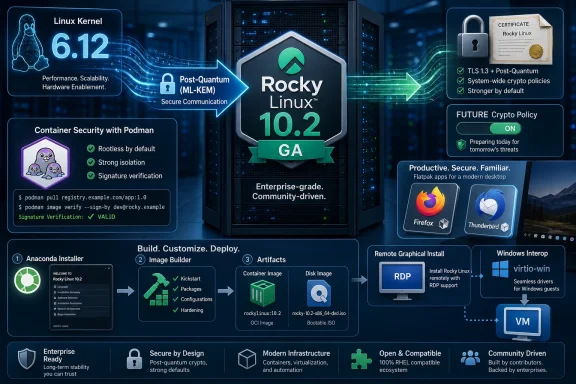
Rocky Linux 10.2 is therefore interesting precisely because it is not trying to be flashy. The big ticket items are inherited from the Enterprise Linux stack: kernel 6.12, updated compilers and language runtimes, wider post-quantum cryptography support, newer infrastructure services, and changes in the installer and image pipeline. The Rocky project’s job is to deliver those changes with as little drama as possible.
But “little drama” is not the same as “little consequence.” A minor point release that changes how desktop applications are installed, how cryptographic policy behaves, how images are produced, and how administrators handle package streams can still alter the operational texture of a fleet. The headline is Rocky 10.2’s availability; the story is the steady expansion of what an Enterprise Linux rebuild now has to absorb.
For WindowsForum readers who live mostly in Microsoft territory, this matters because Enterprise Linux rarely exists in isolation anymore. It is the substrate under identity bridges, container hosts, CI runners, Kubernetes nodes, storage appliances, build systems, and line-of-business services that Windows administrators increasingly inherit whether they asked for them or not.
Kernel 6.12 Makes This a Modern Enterprise Baseline, Not a Legacy Rebuild
The most visible platform marker in Rocky Linux 10.2 is Linux kernel 6.12. In Enterprise Linux terms, that number does not mean Rocky is chasing the rolling-release world. It means the EL10 generation has a modern long-lived kernel baseline with enough contemporary hardware and subsystem support to keep the platform relevant through the next wave of server, edge, and workstation deployments.
That distinction matters. Enterprise distributions do not sell novelty; they sell a controlled version of modernity. Rocky 10.2’s kernel is not there so administrators can brag about being current. It is there because newer CPUs, newer accelerators, updated storage paths, industrial networking, virtualization features, and security primitives need a kernel foundation that is not trapped in the previous hardware era.
For organizations that standardize on RHEL-compatible systems, Rocky 10.2 therefore becomes a practical inflection point. Rocky 9 remains the more conservative choice for estates that value long-settled behavior over newer defaults. Rocky 10.2 is for shops that want the newer EL10 base but have been waiting for the first post-launch updates to shake out early friction.
There is always a psychological threshold with a new enterprise major version. Version 10.0 is where adventurous teams test. Version 10.1 is where platform teams begin documenting. Version 10.2 is where more cautious organizations start asking whether the new generation is ready for real workloads. Rocky’s release arrives directly in that window.
Post-Quantum Cryptography Moves From Slideware to Policy Risk
The most consequential theme in Rocky Linux 10.2 is not a compiler version or a desktop packaging choice. It is the expansion of post-quantum cryptography support across pieces of the system administrators actually use: OpenSSH, libssh, Directory Server, p11-kit, and container tooling. That turns post-quantum readiness from a conference-track abstraction into something that can affect connection behavior.
OpenSSH support for ML-KEM hybrid key exchange in FIPS mode is a particularly important marker. Hybrid post-quantum key exchange does not ask administrators to abandon traditional cryptography overnight. Instead, it combines quantum-resistant mechanisms with established algorithms, creating a transition path that tries to avoid betting the farm on either yesterday’s assumptions or tomorrow’s still-maturing standards.
Rocky 10.2 also inherits a sharper edge in the FUTURE system-wide cryptographic policy. That policy now permits only hybrid ML-KEM key exchange algorithms and removes traditional non-post-quantum methods in that mode. The default policy remains unchanged, which is the right call, because turning this on globally can break connections to endpoints that do not support post-quantum cryptography.
That warning is not academic. Most public internet services and a large amount of enterprise infrastructure are not ready for post-quantum-only policy decisions, even in hybrid form. The point of Rocky 10.2 is not that administrators should flip the FUTURE switch everywhere. The point is that they can now test the future in a system-wide way, and testing will expose just how uneven the transition is going to be.
This is where the enterprise Linux model earns its keep. Cryptographic transitions fail when they are treated as a one-time upgrade. They succeed when platform teams can stage policy changes, identify incompatible endpoints, document exceptions, and move gradually. Rocky 10.2 gives community users and cost-sensitive organizations a realistic proving ground for that work.
The Desktop Shift to Flatpak Is a Small Change With a Long Tail
Rocky Linux has never been primarily a desktop distribution, but its desktop choices still matter. In Rocky Linux 10.2, graphical installations now receive Firefox and Thunderbird as Flatpaks by default when a graphical environment is selected. RPM versions remain available in AppStream for the life of Rocky Linux 10, and administrators can override the installer behavior with Kickstart.
That is a practical compromise, and also a signal. Browsers and mail clients move faster than the rest of an enterprise operating system. Shipping them as Flatpaks gives the distribution more flexibility around application delivery without turning the base OS into a moving target. For users, it may simply mean the expected apps appear and update through a different plumbing layer.
For administrators, though, application packaging is never merely cosmetic. Flatpak changes how applications are sandboxed, updated, mirrored, audited, and managed. It affects image composition, offline environments, compliance documentation, and user support scripts that assume RPM ownership of the application stack.
The key is that Rocky has not removed the RPM escape hatch. That matters in tightly managed environments where AppStream packages, internal repositories, and traditional package inventory remain the governance model. The Flatpak default is a nudge toward the broader Linux desktop trend, not a hard break with enterprise packaging discipline.
Windows administrators may recognize the shape of the problem. Microsoft has spent years juggling Win32, MSIX, Store delivery, winget, and enterprise deployment tooling. Linux is not immune from the same split between stable operating system foundations and fast-moving user applications. Rocky 10.2 simply makes that split more visible.
Anaconda and Image Builder Admit the Server Is Often Never Touched
The installer and image creation updates in Rocky Linux 10.2 speak to a reality that old-school server operating systems sometimes hid: many systems are not installed by a human sitting at a console. The default /boot partition size is now 2 GiB, a mundane-sounding change that reflects the growing footprint of initramfs images, firmware interactions, and modern boot layouts.
The new rdp Kickstart command is more revealing. It enables headless graphical installations over Remote Desktop Protocol, which is an unexpectedly Windows-shaped feature in a Linux installer story. For administrators used to RDP as the lingua franca of remote Windows management, the idea of using it for a graphical Linux install is not exotic. It is almost overdue.
This does not replace automated Kickstart deployments, PXE workflows, cloud-init, or image-first provisioning. But it does widen the practical middle ground between “fully automated” and “someone found a crash cart.” Remote graphical installation is useful in labs, edge deployments, datacenters with awkward console access, and mixed teams where not every operator is comfortable living in text-mode installers.
Image Builder’s new ability to create bootable container and disk images points in the same direction. Enterprise Linux is increasingly consumed as an artifact, not installed as an event. Administrators want reproducible images for clouds, hypervisors, bare metal, and specialized environments. The stateless PXE image support through pxe-tar-xz is especially relevant for HPC and diskless systems where nodes are cattle in the purest sense.
The result is a release that treats installation as a pipeline problem. That is healthy. The more Linux competes as an infrastructure substrate across hybrid environments, the less acceptable it is for installation to remain a bespoke ritual. Rocky 10.2 moves more of that work into repeatable workflows.
Developers Get a New Stack, but Stability Still Sets the Terms
Rocky Linux 10.2 refreshes a large part of the developer and service stack: Node.js 24, PHP 8.4, Ruby 4.0, Python 3.14, OpenJDK 25, Apache HTTP Server 2.4.63, MariaDB 11.8, and PostgreSQL 18. The toolchain moves as well, with GCC 14.3, glibc 2.39, Binutils 2.41, and additional toolsets for GCC 15, LLVM 21, Rust 1.92, and Go 1.26.
Those version numbers are easy to skim past, but they define what kinds of applications can treat Rocky 10 as a first-class deployment target. A conservative enterprise OS that lacks modern language support becomes a place where applications go to be backported into exhaustion. A conservative OS with current-enough toolsets can remain boring underneath while letting developers build with contemporary assumptions.
This is the delicate balance Enterprise Linux always tries to strike. The base system is not supposed to churn. The application stack cannot be allowed to fossilize. AppStreams, modular packaging, and toolsets are all mechanisms for managing that contradiction without giving up the core promise of a stable platform.
The PHP situation is a reminder that choice has operational cost. Rocky’s notes warn that both PHP 8.4 and PHP 8.3 are now available, meaning dependency resolution may select different streams depending on what is already installed. That is the kind of detail that ruins an otherwise clean maintenance window if no one tests it beforehand.
For developers, the release is good news. For administrators, it is a prompt to review dependency locks, build pipelines, CI images, and application documentation. The newer stack is only an upgrade if the organization controls how it lands.
Security Enhancements Show How Trust Is Becoming Distributed
Rocky Linux 10.2’s security updates extend beyond post-quantum cryptography. Keylime Agent 0.2.9 brings an agent-driven push attestation model, and the new clevis-pin-trustee package supports automated LUKS volume decryption through remote attestation. The security story is no longer limited to packages being patched; it is increasingly about machines proving what they are before secrets are released.
That shift is particularly important in edge, cloud, and hybrid deployments. A server in a locked corporate datacenter is one trust model. A node in a remote facility, a cloud instance assembled from templates, or a container host participating in a larger platform is another. Remote attestation tries to make trust measurable rather than assumed.
Fapolicyd 1.4.3 adds rule filtering, while SELinux confinement for the redfish-finder service tightens one more corner of the management stack. The new libreswan-minimal subpackage is aimed at smaller container images, which is a reminder that security work now has to fit into constrained and composable environments.
None of these individual changes will make Rocky 10.2 a security silver bullet. That is not how enterprise security works. But together they show a platform adapting to a world where identity, attestation, encryption, policy enforcement, and image minimization have to work across bare metal, VMs, containers, and management controllers.
The practical lesson for administrators is straightforward: security features increasingly arrive as plumbing, not products. They are useful only if platform teams understand where to integrate them. Rocky 10.2 widens the available toolbox, but it does not design the architecture for you.
Containers and Virtual Machines Are Now First-Class Operating System Concerns
Rocky Linux 10.2 gives Podman a meaningful refresh. Podman now uses Sequoia-PGP for OpenPGP image signature verification, including support for post-quantum algorithms. Podman 5.8.2 also brings automatic BoltDB-to-SQLite migration on reboot, a new podman quadlet install command, quadlet REST APIs, and an unless-stopped restart policy that persists across reboots.
That last point may sound minor, but persistent restart behavior is the kind of operational polish that matters when containers are used as system services rather than developer toys. Quadlet has become one of the more interesting pieces of the Podman ecosystem because it lets administrators express container workloads through systemd-native patterns. Rocky 10.2 strengthens that bridge.
The OpenPGP verification change also fits the broader release theme. Supply-chain trust is not a separate category anymore. It touches container registries, image signatures, cryptographic libraries, and policy engines. If post-quantum readiness is going to matter, container signature verification cannot be left out of the story.
Virtualization receives similarly practical updates. Native Forced Unit Access I/O support in QEMU, new virtio-win components for host-to-Windows-VM socket communication, encrypted libvirt secrets through virt-secrets-init-encryption, improved handling of backup jobs when a guest shuts down, and local PCCS attestation for Intel TDX in air-gapped environments all point toward mixed, security-conscious virtualization estates.
The Windows angle is worth underlining. Virtio-win improvements matter because many Linux virtualization hosts run Windows guests, and many Windows-centric organizations run Linux hypervisors or appliances without thinking of themselves as Linux shops. Better host-to-Windows-VM communication is not a niche concern; it is part of the messy middle where real infrastructure lives.
Rocky’s value here is not that it invents these capabilities. It packages them into an Enterprise Linux-compatible base that organizations can standardize on without buying into a fast-moving distribution model. That is exactly the role a RHEL-compatible community distribution is supposed to play.
Networking Updates Target Factories, Firewalls, and the Edge
Networking in Rocky Linux 10.2 is another area where the release looks more industrial than glamorous. Full support for PRP and HSR redundancy protocols, including VLAN segmentation on HSR and PRP interfaces, is not a feature most laptop users will notice. It matters in industrial and high-availability environments where network interruption is not merely inconvenient.
The inclusion of Wi-Fi 7 hardware support broadens the hardware story, while nftables 1.1.5 promises reduced memory usage for sets and maps. Firewalld gains new policy sets, and TCP retransmission timeout behavior becomes more configurable. These are not marketing-friendly features, but they are the kinds of changes that let Linux fit into more demanding network roles.
Enterprise Linux has always straddled two worlds. One is the general-purpose server OS that hosts databases, web servers, and business applications. The other is the specialized substrate inside appliances, telecom systems, industrial nodes, lab equipment, and managed edge devices. Rocky 10.2’s networking updates are aimed heavily at the second world.
That is one reason community rebuilds matter beyond cost savings. When an enterprise-compatible distribution is available without subscription gates, it becomes easier for labs, universities, small manufacturers, open infrastructure projects, and regional providers to build on the same technical base as larger enterprises. The software stack becomes a common language.
The risk is that these environments are also slow to upgrade. Industrial and edge systems are often deployed for long periods with limited maintenance windows. Rocky 10.2 gives them newer primitives, but the adoption curve will depend less on release notes than on vendor validation and field testing.
Cockpit Keeps Turning Linux Administration Into a Browser Workflow
Cockpit 356 arrives in Rocky Linux 10.2 with changes that continue the gradual normalization of browser-based Linux administration. A health dashboard can warn about unclean shutdowns, custom branding can be handled through /etc/cockpit/branding.css, VNC console windows can be detached, cockpit-podman gains quadlet lifecycle management, and the file manager can create empty files.
Cockpit is sometimes underestimated because it does not feel revolutionary. It is not trying to replace configuration management, observability platforms, or terminal expertise. It is making common administrative tasks visible and approachable without pretending the command line no longer exists.
That is valuable in mixed teams. Windows administrators are accustomed to graphical management surfaces, even when PowerShell is the real automation engine underneath. Linux teams often prefer the shell, but that preference can become a bottleneck when responsibility for Linux systems spreads across broader IT operations.
The quadlet lifecycle work in cockpit-podman is especially aligned with Rocky 10.2’s container story. If containers are going to behave like system services, administrators need ways to see, start, stop, and reason about them in that context. A browser interface does not eliminate the need for systemd knowledge, but it lowers the barrier to safe day-two operations.
Custom branding may seem superficial, but in enterprise environments it can matter. Internal platforms, managed appliances, and delegated administration portals benefit when users can clearly identify the system they are touching. Small details reduce mistakes, and mistakes are what operational tooling exists to prevent.
The Compatibility Promise Now Includes Telling Admins What Will Break
Rocky Linux 10.2’s workflow warnings are some of the most useful parts of the release. The project calls out PHP stream behavior, the changed vi command behavior, the end of support for Windows Server 2012 R2 Active Directory trust configuration, and the deprecation of SCTP transport for knet in Corosync. These are the details that separate a successful upgrade from an afternoon of avoidable troubleshooting.
The vi change is almost comically small until it hits muscle memory. When both vim-minimal and vim-enhanced are present, vi no longer launches full Vim; users must run vim explicitly for the full editor. That will not change anyone’s architecture, but it will annoy enough administrators to be worth documenting.
The Active Directory trust change is more significant for mixed Windows and Linux environments. Windows Server 2012 R2 is already well past its mainstream moment, but legacy domain controllers and trust relationships have a way of lingering in enterprises long after planning documents say they should be gone. Rocky 10.2 is another nudge that old identity infrastructure is becoming harder to carry forward.
Corosync’s SCTP deprecation for knet is a more specialized concern, but clustering teams should treat it as an early warning. Deprecations are the enterprise software equivalent of weather alerts. They are not always urgent today, but ignoring them is how future migrations become emergency projects.
The larger point is that compatibility is no longer just a binary claim about matching RHEL behavior. It is also an editorial obligation to tell users where matching upstream behavior will surprise them. Rocky’s release notes serve that function, and administrators should read them as operational intelligence rather than marketing collateral.
Rocky’s Upgrade Path Remains Conservative by Design
Existing Rocky Linux 10 users can move to 10.2 with the familiar dnf upgrade path, while desktop users can use GNOME Software or KDE Discover. That is the comfortable part of the story. Minor-version upgrades are supposed to be routine, provided organizations test their workloads and understand package stream implications.
Major-version upgrades are different. Rocky Linux still does not support in-place upgrades between major versions, so moving from Rocky 9 to Rocky 10 requires a fresh installation. In an era when some distributions and vendors spend heavily on in-place upgrade tooling, that may feel old-fashioned. It is also defensible.
Enterprise Linux major upgrades are not just package transactions. They change compilers, libraries, kernels, crypto defaults, system behavior, supported hardware assumptions, and sometimes the shape of administrative workflows. A clean install forces organizations to treat that move as a platform migration rather than a casual patch.
That does not make the work easier. It means Rocky is being honest about the work. For many environments, the right migration pattern will be new images, new hosts, workload redeployment, and controlled cutover. That model aligns with modern infrastructure practices better than trying to drag a long-lived pet server across a major-version boundary.
For users of other Enterprise Linux 10-compatible distributions, the migrate2rocky utilities remain the conversion path. That matters in a landscape where AlmaLinux, Oracle Linux, CentOS Stream, RHEL, and Rocky each represent different trade-offs around governance, support, compatibility, and release philosophy. Migration tools keep the market fluid.
The RHEL-Compatible World Is Less Uniform Than It Looks
Rocky Linux 10.2 lands in a RHEL-compatible ecosystem that is both more important and more politically complicated than it was a few years ago. Rocky’s public identity remains rooted in bug-for-bug compatibility with RHEL. AlmaLinux has been more willing to define compatibility at the application binary interface level rather than as a strict rebuild philosophy. Oracle Linux adds its own kernel options and commercial posture.
For administrators, the practical question is not which project has the purest slogan. It is which compatibility model best fits the workload, support expectations, compliance requirements, and risk tolerance of the organization. Rocky’s answer is still the most CentOS-like answer: stay close to upstream Enterprise Linux and minimize surprises.
Rocky 10.2 benefits from that clarity. Its new features are not presented as Rocky-specific innovation layered on top of RHEL. They are the community availability of the EL10.2 stack, rebuilt and distributed for users who want that base without a Red Hat subscription relationship. The value proposition is continuity.
But the ecosystem’s fragmentation should not be ignored. Enterprises that standardize on RHEL-compatible distributions need to track subtle differences in repositories, kernel builds, security errata timing, image availability, support channels, and project governance. Compatibility reduces friction; it does not eliminate due diligence.
That is especially true for Windows-heavy organizations adopting Linux for infrastructure roles. The temptation is to treat “RHEL-compatible” as a single checkbox. Rocky 10.2 is a reminder that the checkbox hides a lot: cryptographic policy choices, AD trust behavior, package stream resolution, image-building workflows, and container trust decisions.
The 10.2 Upgrade Is Really a Readiness Test
Rocky Linux 10.2 is a release administrators can install today, but the smarter move is to treat it as a readiness test for the next several years of enterprise Linux operations. The concrete changes point toward a platform that is more cryptographically ambitious, more image-driven, more container-aware, and more honest about hybrid Windows-Linux estates.
- Rocky Linux 10.2 brings the Enterprise Linux 10 stack forward with kernel 6.12, refreshed developer runtimes, updated toolchains, and newer infrastructure services.
- The expanded post-quantum cryptography support is useful for testing and planning, but the stricter FUTURE crypto policy can break connections to systems that do not yet support hybrid ML-KEM key exchange.
- Firefox and Thunderbird now arrive as Flatpaks by default in graphical installs, while RPM packages remain available for administrators who need traditional package governance.
- Installer and Image Builder changes make Rocky 10.2 better suited to headless, image-based, HPC, and diskless deployment workflows.
- Container, virtualization, and Cockpit updates show Rocky adapting to day-two operations where Podman, Windows guests, remote consoles, and browser-based management all coexist.
- Administrators should review PHP stream behavior, the
vicommand change, Windows Server 2012 R2 Active Directory trust removal, and Corosync SCTP deprecation before treating the upgrade as routine.
Rocky Linux 10.2 is not the kind of release that asks for applause. It asks for lab time. The organizations that benefit most will be the ones that test the post-quantum settings before mandating them, validate Flatpak behavior before imaging desktops, rehearse image-based deployment before refreshing fleets, and treat minor-version release notes as a map of future operational debt. That is the real enterprise story here: Rocky is still trying to be the calm rebuild in the room, but the room itself is getting more complex.
References
- Rocky Linux 10.2 Released with Updated Enterprise Linux Stack Linuxiac · 2026-05-29T17:40:13.525324