

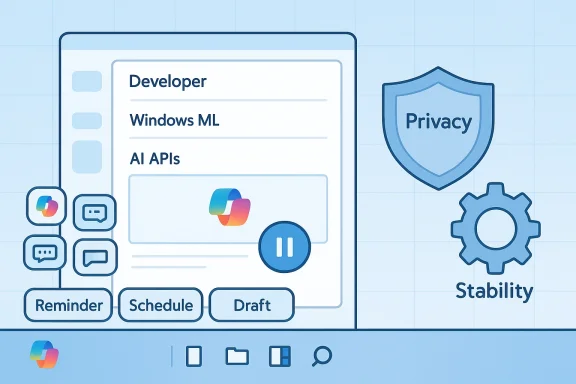
Microsoft’s much‑advertised “AI‑first” push for Windows 11 appears to be losing momentum after a loud wave of user and admin pushback, with reports that Microsoft is pausing or reworking visible Copilot integrations and shifting engineering focus back toward stability and core OS health.
Microsoft spent the last two years positioning Copilot as the connective tissue for a new, AI‑driven Windows: conversational helpers in the taskbar, inline “Ask Copilot” affordances in lightweight apps, vision and voice features, and an ambitious timeline index feature called Windows Recall. The company’s public messaging — including a high‑profile post by Windowsuri describing Windows as “evolving into an agentic OS” — crystallized the strategy and, unintentionally, the backlash.
That backlash was not limited to social noise. Security researchers, enterprise IT teams, and power users flagged several concrete problems: intrusive UI clutter from Copilot buttons in essential utilities, unexpected or unreliable behaviour in recent updaivacy concerns about Recall’s design to index local screen content. Those issues combined to produce negative coverage and community action, including tools and scripts aimed at removing or hiding on‑device AI surfaces.
That tactical pivot makes sense technically and politically, but it will not automatically fix the trust deficit. Microsoft must now deliver measurable improvements — fewer regressions, clearer governance, and transparent opt‑ins — before claims about an “agentic OS” regain broad legitimacy. For Windows users, administrators, and OEM partners, the practical course is to remain engaged: test updates, insist on clear policy controls, and hold product teams to concrete milestones rather than slogans.
If Microsoft executes this recalibration well, Windows 11 can still become a platform where selective, well‑governed AI features add real productivity without eroding control. If it doesn’t, the episode will stand as a cautionary example of how platform ambition must be matched by stewardship, transparency, and an obsessive focus on the basics.
Source: XDA Microsoft is reportedly backing down on its AI-first plan after people made their voices heard
 Background
Microsoft spent the last two years positioning Copilot as the connective tissue for a new, AI‑driven Windows: conversational helpers in the taskbar, inline “Ask Copilot” affordances in lightweight apps, vision and voice features, and an ambitious timeline index feature called Windows Recall. The company’s public messaging — including a high‑profile post by Windowsuri describing Windows as “evolving into an agentic OS” — crystallized the strategy and, unintentionally, the backlash. That backlash was not limited to social noise. Security researchers, enterprise IT teams, and power users flagged several concrete problems: intrusive UI clutter from Copilot buttons in essential utilities, unexpected or unreliable behaviour in recent updaivacy concerns about Recall’s design to index local screen content. Those issues combined to produce negative coverage and community action, including tools and scripts aimed at removing or hiding on‑device AI surfaces.
What Microsoft is reportedly rethinking
Insider reporting from multiple outlets indicates Microsoft is taking a more measuriate changes under review include:- Reviewing and potentially removing or rebranding Copilot buttons and micro‑affordances in lightweight, built‑in apps such as Notepad and Paint.
- Pausing further rollouts of additional Copilot UI elements (the so‑called “Copilot everywhere” experiment) while product teams triage which placements actually deliver value.
- Reassessing Windows Recall — internal language reportedly characterizes the feature “in its current form” as failed, prompting a redesign, narrower scope, or even a potential renaming.
Why the pushback matters: UX, privacy, and cism is concentrated in three overlapping buckets.
1) UX clutter and perceived upsell
Small Copilot icons, inline prompts, and taskbar nudges multiplied across shells and apps. For many users, these felt like advertising more than assistance — a visibility‑first approach that created UI noise without consistent productivity payoffs. When a helper surfaces in places like Notepad or Paint where users expect minimal, predictable behavior, even marginal value becomes magnifieindowscen2) Privacy and security concerns (Recall as the focal point)
Windows Recall’s architecture — periodic local snapshots and searchable timelines of on‑screen content — prompted immediate scrutiny. Researchers demonstrated plausible attack scenarios where an inadequately protected index could leak sensitive screenshots or parsed text. Even with Microsoft’s subsequent design changes (opt‑in defaults, Windows Hello gating), the specter of a poorly securedreated regulatory and enterprise unease.3) Reliability and update regressions
Several high‑impact updatase regressions eroded confidence. Reports of Copilot being unintentionally uninstalled by updates, or Copilot auto‑launching in preview builds, fed a narrative that Microsoft prioritized feature spectacle over shipping dependable, well‑tested code. That perception matters enormously for an OS that must serve billions of devices and countless enterprise environments.Technical verification: what we can confirm — and what remains unverution is needed: many of the most sensitive claims about internal deliberations are sourced to “people familiar with Microsoft’s plans.” Where possible, I verified concrete technical claims against publicly available build notes, blog posts, and reputable reporting.
- Microsoft has publicly acknowledged it’s rebalancing priorities and has signaled a renewed focus on reliability and core experience fixi’s November post generated criticism. This admission is documented in multiple follow‑ups and executive comments.
- Insider notes and reporting corroborate a pause on certain Copilot UI experiments and a more conservative rollout strategy for visible integrations. Windows Central’s reporting and other outlets independently describe exactly this pause, which Microsoft’s Insider release notes also reflect.
- A Group Policy allowing admins to remove the Copilot app has appeared in Insider build notes and has been covered by trade press; however, the policy has restrictive conditions and is not a blanket removal mechanism for all managed environments. The precise build number a been reported in community and tech sites; I could confirm coverage of the Group Policy across independent outlets, but enterprise admins should test these options in their environment before relying on them as a universal solution.
- No public Microsoft statement lists an exact inventory of Copilot UI elements that will be removed (if any), nor are there firm timelines published for which apps will be changed or when. These are likely to remain internal until Microsoft makes formal product announcements. Treat such granular claims as reported but not confirmed.
- The future of Windows Recall — whether it will be renamed, scaled back, or replaced by a narrower design — is described in reporting as under active reconsideration; we lack a definitive product road‑map from Microsoft to verify the final outcome. Proceed with caution when treating specifics as fact.
Strategic analysis — strengths, risks, and the stewardship challenge
Microsoft’s AI chops and platform reach make the strategy technically sensible: local model acceleration (Copilot+ NPUs), robust developer tooling (Windows ML and AI APIs), and cloud integration can deliver meaningful experiences. But the execution and governance determine whether those investments are a boon or a liability.Strengths that remain
- On‑device inference and hardware acceleration reduce latency and can, when designed correctly, limit how much user data needs to be sent to the cloud. This preserves a privacy advantage over cloud‑only approaches when architectures are responsibly implemented.
- Developer tooling and APIs give third‑party apps a path to integrate local or hybrid AI capabilities without forcing the Copilot brand into every UI surface. This is a scalable approach that preserves innovation while reducing OS‑level surface area for faux helpers.
- **Adminisoup Policy, MDM settings) are gradually improving, offering enterprises mechanisms to govern Copilot features. Those controls are important for adoption in regulated and high‑security environments.
Key risks and downsides
- Trust erosion is the biggest near‑term threat. Once a platform appear, visibility, or feature spectacle over predictability and privacy, restoring faith is slow and expensive. Pausing UI experiments is necessary, but not sufficient; users will demand demonstrable improvements in reliability and governance.
- Fragmentation risk emerges if Microsoft narrows visible AI features for mainstream Windows but continues divergent Copilot+ or enterprise pathways. Customers and OEMs need clear compatibility, policy, and servicing guidance to avoid fractured experiences across devices.
- Regulatory and security exposure: features that archive or index local activity can trigger compliance headaches across jurisdictions. Even features labeled “local‑first” require airtight implementation, clear auditability, and simple user controls to pass regulatory tical implications for users, admins, and OEMs
- For everyday users: Expect fewer intrusive Copilot m in lightweight apps. If you’ve found Copilot annoying, watch for cleaner defaults and a slower rollout cadence. Still, don’t assume all AI elements will disappear — some useful Copilot features will remain for those who enable them.
- For power users and enthusiasts: Community tools and forks will continue to exist for those who want an AI‑free baselines can carry servicing and support risks; the safer route is to use official settings and group policies where available, and to keep full backups before running heavy‑handed uninstall scripts.
- For enterprise admins and IT: Audit and pilot Copilot and Recall features in controlled groups. Use Group Policy and MDM settings to create a predictable baseline. If images or provisioning processes are used, bake policy and updates into your standard images and test rollback scenarios thoroughly.
- For OEMs and partners: Cexperiences are supported on device SKUs and ensure OEM drivers, firmware, and update channels can deliver consistent experiences across the installed base. OEMs should press for clear Microsoft guidance on what constitutes Copilot+ hardware requirements and certification.
Recommended checklist: how Microsoft can fix this — and how users can respond
- Microsoft should prioritize a short, verifiable list of fixes: concrete reliability milestones, reproducible update remediation steps, and clear privacy governance for Recall‑like features. Deliverables must be measurable and auditable.
- Move visible AI experiments behind conservative opt‑in defaults and expand the role of Insiders and enterprise pilots as gatekeepers for broader rollouts.
- Publish explicit admin and OEM guidance for Copilot+ hardware, Group Policy behavior, and servicing interactions to minimize fragmentation risk.
- For users: prefer official toggles and documented opt‑outs over community servicing hacks; if you choose third‑party removal tools, test them in a VM or on a disposable device first.
Final assessment
This is not a binary story of abandonment versus triumph. What’s playing out is a classic product‑management correction: Microsoft invested heavily in an ambitious vision that outpaced the trust and stability fundamentals users demand. The company now appears to be pruning visible AI surfaces, reassessing the hardest privacy questions (Recall), and refocusing engineering cycles on reliability and user experience — while continuing to invest in the platform primitives that will enable AI for third‑party apps.That tactical pivot makes sense technically and politically, but it will not automatically fix the trust deficit. Microsoft must now deliver measurable improvements — fewer regressions, clearer governance, and transparent opt‑ins — before claims about an “agentic OS” regain broad legitimacy. For Windows users, administrators, and OEM partners, the practical course is to remain engaged: test updates, insist on clear policy controls, and hold product teams to concrete milestones rather than slogans.
If Microsoft executes this recalibration well, Windows 11 can still become a platform where selective, well‑governed AI features add real productivity without eroding control. If it doesn’t, the episode will stand as a cautionary example of how platform ambition must be matched by stewardship, transparency, and an obsessive focus on the basics.
Source: XDA Microsoft is reportedly backing down on its AI-first plan after people made their voices heard
