

On June 4, 2026, Windows Central reported that Microsoft had repaired and returned Rhener Furtado’s rare 50th Anniversary Surface Laptop after the limited-edition PC was mistakenly replaced with a standard Surface Laptop 7 during a support process. The happy ending matters, but not because a collector got his prize back. It matters because the episode exposed the awkward seam between Microsoft’s premium hardware storytelling and the industrial machinery that services that hardware after the sale. Surface has long been sold as the most Microsoft expression of Windows; this time, the repair pipeline treated one of Microsoft’s most symbolic PCs as just another SKU.
The device at the center of the story was never an ordinary Surface Laptop 7. Microsoft produced roughly 50 special 50th Anniversary Surface Laptops as part of its anniversary celebration, giving them out through a U.S. sweepstakes rather than selling them as normal retail machines. Furtado’s unit carried the kind of commemorative details that turn commodity hardware into an artifact: special branding, anniversary touches, and the status that comes from knowing there are only dozens like it.
That scarcity was not incidental. Microsoft’s 50th birthday was a corporate memory exercise, a way to connect today’s AI-and-cloud giant to the scrappy company founded in 1975. A commemorative Surface was meant to embody that story in hardware, which is precisely why swapping it for a standard machine was not a normal warranty inconvenience.
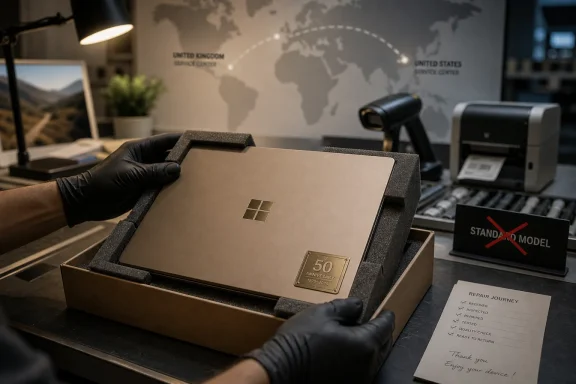
Furtado reportedly made the uniqueness of the device clear before sending it in for service. According to Windows Central’s account, he was assured that the repair would be a “same unit repair,” meaning the expectation was that the original machine would be fixed and returned rather than exchanged. He even placed a note with the device asking the repair team not to replace it with a standard model without contacting him first.
The result was the opposite. Microsoft’s service process classified the laptop as non-repairable and sent back a regular Surface Laptop 7 with comparable core specifications. On paper, that might satisfy a narrow interpretation of replacement value. In reality, it erased the only thing that made this particular machine irreplaceable.
A limited-edition commemorative laptop is not fungible. Its processor, RAM, storage, and screen can be matched by another unit, but its meaning cannot. The mistake in Furtado’s case was not merely that Microsoft returned the wrong laptop; it was that Microsoft’s process appeared unable to distinguish between equivalent specifications and equivalent value.
That distinction is especially important for Surface. Microsoft is not just another Windows OEM shipping beige-box logic in nicer aluminum. Surface has always been positioned as a reference point for the Windows ecosystem, a line of devices meant to show what Microsoft thinks a PC should be. When the company creates a rare anniversary edition, it is explicitly asking users to care about the object, not just the spec sheet.
The support operation then has to honor that promise. If the marketing team says a device is a collectible and the repair system says it is interchangeable inventory, the repair system wins in the moment — and the brand loses afterward.
That cross-border detail appears to have mattered. According to the report, the special units were not flagged correctly in Microsoft’s service workflow outside the United States. In other words, the system that handled Furtado’s repair did not reliably know that it was dealing with one of 50 commemorative machines.
This is the kind of failure that rarely looks dramatic from inside a company. A service center sees a laptop, reads a status, follows a workflow, and issues a replacement when repair is not the expected path. Every step may look reasonable in isolation. The failure is that no step carried the one fact the customer had been trying to preserve from the beginning: this was not a normal Surface Laptop.
The lesson for Microsoft is unflattering but useful. Premium hardware cannot depend on individual employees noticing exceptions after a story becomes public. If a device is rare enough to be used in corporate celebration, it is rare enough to be hard-coded into the support system.
Furtado credited the community, media coverage, and Microsoft employees who reached out privately rather than the formal ticket process. That is both heartening and damning. It is heartening because people inside Microsoft evidently cared enough to push the issue. It is damning because the support machinery did not surface the case with the urgency and nuance it deserved.
This is a familiar dynamic in consumer technology. A company’s public-facing support system is designed for scale, but its reputation is often saved by informal escalation: a viral Reddit post, a journalist’s inbox, an employee who recognizes the optics, a product leader who can cut across departments. The outcome may be good, but the path is brittle.
For ordinary users, that brittleness is the uncomfortable part. Most people do not own one-of-50 collector laptops, and most repair disputes will not become minor social media events. If public attention is what turns a dead-end support case into a solved one, then the process still has a fairness problem even when the headline ends well.
That intention has to extend beyond launch day. A premium device is not just a premium device when it is unboxed, photographed, reviewed, or displayed at an event. It is still a premium device when its owner contacts support, ships it to a depot, and waits for the company to make good on the warranty.
This matters because repair has become part of the buying decision. Users increasingly care about parts availability, serviceability, device longevity, and whether a company can support expensive hardware over years rather than months. Microsoft has improved its repair posture over time, including more public self-repair information and a broader conversation around replaceable components. But service culture is not just about parts; it is about whether the company’s systems understand the products they are servicing.
The Furtado case shows how easy it is for the human story of a device to vanish inside a logistics process. Microsoft did eventually recover, repair, and return the original laptop. But the fact that it took community pressure and internal intervention suggests the first-line process was not designed for edge cases that Microsoft itself created.
That is the right kind of repair. Public apologies are cheap. Exceptional one-off remedies are necessary but limited. Updating the workflow so the same mistake is less likely to happen again is what turns a public embarrassment into institutional learning.
There is still a broader question Microsoft should be asking itself. If 50 anniversary laptops can fall through the cracks, what other special-case devices, regional variants, prototypes, business configurations, accessibility-modified machines, or customer-critical systems are vulnerable to the same flattening logic? Not every device has collector value, but many devices have context that matters.
Enterprise IT understands this instinctively. A laptop is not only a laptop when it is enrolled in management, assigned to an executive, configured for a regulated workflow, or tied to a deployment chain. Support processes that treat hardware as interchangeable can collide with the operational reality of the people who depend on it.
That does not make the device less interesting. If anything, Furtado’s laptop is now one of the more storied units in the batch. It was won, cherished, lost inside a process, replaced incorrectly, amplified by the community, recovered by Microsoft, and returned repaired. For a collector, that is not just provenance; it is a narrative.
But Microsoft should resist the temptation to see the ending as vindication. The company did the right thing eventually, and individuals inside the Surface organization appear to have treated the matter with sincerity. Still, the repair process failed at the exact moment it needed to be careful.
The best version of Surface is meticulous. The worst version is a beautiful machine processed by a system that cannot see beauty. This episode contained both.
 A Collector’s Laptop Became a Systems Test Microsoft Failed
The device at the center of the story was never an ordinary Surface Laptop 7. Microsoft produced roughly 50 special 50th Anniversary Surface Laptops as part of its anniversary celebration, giving them out through a U.S. sweepstakes rather than selling them as normal retail machines. Furtado’s unit carried the kind of commemorative details that turn commodity hardware into an artifact: special branding, anniversary touches, and the status that comes from knowing there are only dozens like it.That scarcity was not incidental. Microsoft’s 50th birthday was a corporate memory exercise, a way to connect today’s AI-and-cloud giant to the scrappy company founded in 1975. A commemorative Surface was meant to embody that story in hardware, which is precisely why swapping it for a standard machine was not a normal warranty inconvenience.
Furtado reportedly made the uniqueness of the device clear before sending it in for service. According to Windows Central’s account, he was assured that the repair would be a “same unit repair,” meaning the expectation was that the original machine would be fixed and returned rather than exchanged. He even placed a note with the device asking the repair team not to replace it with a standard model without contacting him first.
The result was the opposite. Microsoft’s service process classified the laptop as non-repairable and sent back a regular Surface Laptop 7 with comparable core specifications. On paper, that might satisfy a narrow interpretation of replacement value. In reality, it erased the only thing that made this particular machine irreplaceable.
The Spreadsheet View of Hardware Misses the Thing People Actually Bought
Modern device service is built around efficiency, not sentiment. Serial numbers, parts availability, regional depots, warranty entitlements, and refurbished replacement pools all exist to move millions of devices through support systems without turning every case into a bespoke negotiation. That model works tolerably well when the product is fungible.A limited-edition commemorative laptop is not fungible. Its processor, RAM, storage, and screen can be matched by another unit, but its meaning cannot. The mistake in Furtado’s case was not merely that Microsoft returned the wrong laptop; it was that Microsoft’s process appeared unable to distinguish between equivalent specifications and equivalent value.
That distinction is especially important for Surface. Microsoft is not just another Windows OEM shipping beige-box logic in nicer aluminum. Surface has always been positioned as a reference point for the Windows ecosystem, a line of devices meant to show what Microsoft thinks a PC should be. When the company creates a rare anniversary edition, it is explicitly asking users to care about the object, not just the spec sheet.
The support operation then has to honor that promise. If the marketing team says a device is a collectible and the repair system says it is interchangeable inventory, the repair system wins in the moment — and the brand loses afterward.
The Real Bug Was in the Workflow, Not the Motherboard
Windows Central’s follow-up points to a process gap rather than a mystery disappearance. The anniversary laptops were created for the U.S. market because that is where the sweepstakes took place. Furtado, who is based in the United Kingdom, reportedly traveled to the U.S. to pick up the device, adding personal weight to a machine that was already rare.That cross-border detail appears to have mattered. According to the report, the special units were not flagged correctly in Microsoft’s service workflow outside the United States. In other words, the system that handled Furtado’s repair did not reliably know that it was dealing with one of 50 commemorative machines.
This is the kind of failure that rarely looks dramatic from inside a company. A service center sees a laptop, reads a status, follows a workflow, and issues a replacement when repair is not the expected path. Every step may look reasonable in isolation. The failure is that no step carried the one fact the customer had been trying to preserve from the beginning: this was not a normal Surface Laptop.
The lesson for Microsoft is unflattering but useful. Premium hardware cannot depend on individual employees noticing exceptions after a story becomes public. If a device is rare enough to be used in corporate celebration, it is rare enough to be hard-coded into the support system.
Reddit Did What the Escalation Path Could Not
The most revealing part of the saga is not that Microsoft eventually fixed it. Large companies often correct highly visible mistakes once the right people see them. The revealing part is that the ordinary support channel was apparently not enough.Furtado credited the community, media coverage, and Microsoft employees who reached out privately rather than the formal ticket process. That is both heartening and damning. It is heartening because people inside Microsoft evidently cared enough to push the issue. It is damning because the support machinery did not surface the case with the urgency and nuance it deserved.
This is a familiar dynamic in consumer technology. A company’s public-facing support system is designed for scale, but its reputation is often saved by informal escalation: a viral Reddit post, a journalist’s inbox, an employee who recognizes the optics, a product leader who can cut across departments. The outcome may be good, but the path is brittle.
For ordinary users, that brittleness is the uncomfortable part. Most people do not own one-of-50 collector laptops, and most repair disputes will not become minor social media events. If public attention is what turns a dead-end support case into a solved one, then the process still has a fairness problem even when the headline ends well.
Surface’s Premium Identity Depends on Boring Operational Competence
Surface has survived multiple eras of Microsoft strategy. It began as a bold, sometimes awkward attempt to redefine Windows hardware, became a benchmark for 2-in-1 PCs, and now sits inside a market being reshaped by Copilot+ PCs, Arm processors, and AI branding. Through all of that, Microsoft has tried to make Surface feel more intentional than the average laptop.That intention has to extend beyond launch day. A premium device is not just a premium device when it is unboxed, photographed, reviewed, or displayed at an event. It is still a premium device when its owner contacts support, ships it to a depot, and waits for the company to make good on the warranty.
This matters because repair has become part of the buying decision. Users increasingly care about parts availability, serviceability, device longevity, and whether a company can support expensive hardware over years rather than months. Microsoft has improved its repair posture over time, including more public self-repair information and a broader conversation around replaceable components. But service culture is not just about parts; it is about whether the company’s systems understand the products they are servicing.
The Furtado case shows how easy it is for the human story of a device to vanish inside a logistics process. Microsoft did eventually recover, repair, and return the original laptop. But the fact that it took community pressure and internal intervention suggests the first-line process was not designed for edge cases that Microsoft itself created.
Microsoft’s Best Response Was Quietly Practical
The most important corrective action was not the store credit, though Microsoft reportedly gave Furtado £150 toward a daily PC. Nor was it the call with Sandra Andrews, Microsoft’s Chief Marketing and Operations leader for Surface, though that call appears to have mattered personally. The important fix was operational: Microsoft reportedly flagged the anniversary units internally so support centers around the world would recognize them.That is the right kind of repair. Public apologies are cheap. Exceptional one-off remedies are necessary but limited. Updating the workflow so the same mistake is less likely to happen again is what turns a public embarrassment into institutional learning.
There is still a broader question Microsoft should be asking itself. If 50 anniversary laptops can fall through the cracks, what other special-case devices, regional variants, prototypes, business configurations, accessibility-modified machines, or customer-critical systems are vulnerable to the same flattening logic? Not every device has collector value, but many devices have context that matters.
Enterprise IT understands this instinctively. A laptop is not only a laptop when it is enrolled in management, assigned to an executive, configured for a regulated workflow, or tied to a deployment chain. Support processes that treat hardware as interchangeable can collide with the operational reality of the people who depend on it.
The Anniversary Laptop Now Carries a Different Story
Before this saga, the 50th Anniversary Surface Laptop was a celebration object. It represented Microsoft looking backward at its own history and forward at the modern Windows PC. After the repair incident, it also represents something more complicated: the gap between brand mythology and service reality.That does not make the device less interesting. If anything, Furtado’s laptop is now one of the more storied units in the batch. It was won, cherished, lost inside a process, replaced incorrectly, amplified by the community, recovered by Microsoft, and returned repaired. For a collector, that is not just provenance; it is a narrative.
But Microsoft should resist the temptation to see the ending as vindication. The company did the right thing eventually, and individuals inside the Surface organization appear to have treated the matter with sincerity. Still, the repair process failed at the exact moment it needed to be careful.
The best version of Surface is meticulous. The worst version is a beautiful machine processed by a system that cannot see beauty. This episode contained both.
The Small Rare PC Has a Big Ordinary Lesson
The practical lesson is not that every Surface owner should panic before sending a device for repair. It is that customers with unusual hardware need written clarity, and companies that create unusual hardware need systems that can honor it. Microsoft’s fix appears to have addressed the immediate gap for these anniversary units, but the case is a reminder that support workflows are part of the product.- Furtado’s 50th Anniversary Surface Laptop was reportedly repaired and returned after Microsoft initially sent him a standard Surface Laptop 7 as a replacement.
- The original failure appears to have involved a service workflow that did not properly flag the rare anniversary units outside the United States.
- Microsoft reportedly updated its internal handling so support centers globally can identify the limited-edition devices.
- The case shows why “same specs” is not the same as “same value” when a device is rare, customized, or personally significant.
- The ordinary support path did not appear to solve the problem until community attention, press coverage, and Microsoft employees pushed it higher.
References
- Primary source: Windows Central
Published: Thu, 04 Jun 2026 15:34:27 GMT
Lost 50th Anniversary Surface repaired and returned to owner — what went wrong and how Microsoft fixed it | Windows Central
Microsoft returned a rare 50th Anniversary Surface Laptop after a repair mix‑up exposed a workflow flaw.www.windowscentral.com - Official source: support.microsoft.com
How to get service or repair for Surface | Microsoft Support
Learn how the service process for Microsoft Surface works and how to request service online if your Surface needs repair.support.microsoft.com - Official source: news.microsoft.com
Microsoft celebrates 50 years
Celebrate Microsoft's 50th anniversary with a timeline of milestones, retro photos, exclusive leader insights, partner quotes and key resources showcasing five decades of innovation and impact.news.microsoft.com - Official source: learn.microsoft.com
Microsoft has not returned my laptop after repair and refuses to respond - what do I do? - Microsoft Q&A
I sent my Microsoft Surface laptop (under warranty) to be repaired by Microsoft on December 20th. Microsoft shipped the laptop back on Dec 27th, and on January 2nd it was marked as delivered by UPS. However, the laptop had not in fact been delivered, and…learn.microsoft.com - Related coverage: qoo10.co.id
Microsoft Replaces A Lost 50th Anniversary Surface Laptop With A Standard Surface Laptop 7
A rare Surface Laptop 7 50th Anniversary edition has become the center of an unusual service dispute after its owner said Microsoft returned a standard replacem…www.qoo10.co.id - Related coverage: macworld.com
Microsoft made me want a Fiftieth Anniversary MacBook more than ever | Macworld
The Microsoft Surface Laptop, 50th Anniversary Edition is exactly the kind of celebration we want to see from Apple in 2026.www.macworld.com
- Official source: microsoft.com
ECOPROFILE Surface Laptop 13.8 and 15 inch 7th Edition for Business (Intel)
PDF documentwww.microsoft.com
- Related coverage: download.intel.com
Microsoft Announces New Surface Laptop – Powered by 7th Gen Intel Core | Intel Newsroom
PDF documentdownload.intel.com
- Official source: blogs.windows.com
- Official source: download.microsoft.com
MSFT Canada INS EN Consumer Complete TermsandConditions V3
Minimal refresh of Assure T&Cs and add XBoxdownload.microsoft.com
