

Microsoft’s 2026 Surface lineup has become unusually hard to decode because the company is selling similarly named Surface Pro and Surface Laptop models across consumer and business channels, with screen sizes, edition numbers, chip platforms, and generations all competing to describe different machines. That is not just a branding nuisance. It is a purchase-risk problem for ordinary buyers and an inventory-risk problem for IT departments. Surface was supposed to be Microsoft’s cleanest expression of Windows hardware; right now, its names read like a spreadsheet that escaped into retail.
The immediate complaint is easy to understand: Microsoft has made “Surface Laptop” and “Surface Pro” do too much work. A buyer looking for a new Surface Laptop can encounter a 13-inch model, a 13.8-inch model, older 7th Edition stock, newer 8th Edition hardware, consumer configurations, business configurations, Intel models, Snapdragon models, and retailer listings that do not always surface the distinction cleanly.
That might be tolerable for a workstation vendor selling to procurement specialists. It is much harder to defend for a premium consumer PC brand whose sales pitch has long rested on simplicity, polish, and direct comparison with Apple’s MacBook and iPad lines. A MacBook Air is not immune to configuration confusion, but Apple usually keeps the consumer-facing product identity legible. Surface now asks shoppers to know whether a number is a generation, a screen size, a business designation, or a casual shorthand invented by reviewers.
The Surface Pro side is worse because the line has history. Earlier Surface Pro devices used plain numbers, then Microsoft moved toward edition-style naming, then screen-size-first naming, and now the 12-inch and 13-inch models create a collision between what people naturally call a product and what Microsoft officially means. “Surface Pro 12” sounds like the successor to Surface Pro 11. “Surface Pro, 12-inch” sounds like a smaller branch. Those are not the same idea, but the language almost guarantees that many buyers will collapse them into one.
The result is a brand taxonomy that may make sense inside Microsoft’s product-planning decks but does not survive contact with search boxes. And in modern retail, the search box is the shelf.
The trouble is that Microsoft is using too many overlapping naming signals at once. Screen size, edition number, market segment, processor family, and release wave are all being asked to identify the machine. In isolation, each of those signals is useful. Together, they blur.
Take the laptop family. “Surface Laptop, 13-inch” and “Surface Laptop, 13.8-inch” are technically different names, but they are also close enough that a normal person can reasonably assume they are variants of the same device. Many manufacturers round display sizes in marketing. A shopper who sees 13 and 13.8 inches may think they are looking at two listings for one class of product, not a smaller entry model and a larger mainstream design with different internal assumptions.
The Surface Pro family creates the more comic example. A 12-inch Surface Pro can exist alongside a 13-inch Surface Pro whose edition number is 12th Edition. In everyday speech, the first invites the phrase “Surface Pro 12-inch,” while the second invites “Surface Pro 12.” One hyphenated measurement and one generation shorthand are suddenly separated by a cliff.
That is how enthusiast brands lose the casual buyer. The fan can parse it. The reviewer can make a chart. The IT admin can build a comparison table. The person trying to buy a good Windows laptop before a flight should not have to.
Then came the edition language. In a vacuum, “11th Edition” or “12th Edition” is defensible. It gives Microsoft a way to preserve the Surface Pro name while indicating lineage. It also works better when the hardware family contains multiple sizes. But it becomes awkward when consumers, retailers, and publications continue to shorten those names into the simpler “Surface Pro 11” and “Surface Pro 12.”
Microsoft cannot pretend those casual names do not exist. They are how people talk. They are how headlines fit. They are how search works. If the official name depends on everyone resisting the obvious shorthand, the official name is not doing its job.
The company has made a similar mistake before with Xbox. Xbox One sounded like a first-generation product even though it was the third major Xbox console family. Xbox Series X and Series S then arrived with names that were technically precise but retail-hostile, especially when placed next to Xbox One X and Xbox One S. Microsoft is very good at platform strategy and very bad at remembering that ordinary customers use names as navigation tools.
Surface now has the same disease. The name describes the architecture of the portfolio, not the path through it.
Third-party retailers often compress product names to fit cards, filters, and promotional layouts. They may omit “edition” language, bury processor details, or show a screen size without making clear whether the listing belongs to an older generation or a newer one. The shopper sees a Surface Laptop with a familiar chassis, a similar display size, and a sale price. The difference between a 7th Edition and an 8th Edition can become a footnote.
For enthusiasts, that is a solvable puzzle. For a parent buying a graduation laptop, a small business owner replacing two PCs, or a student trying to qualify for a Copilot+ PC feature set, it is a trap. Microsoft has spent the last two years telling users that AI-era Windows hardware requires new silicon and new capabilities. If the brand name does not clearly distinguish which Surface does what, Microsoft is undermining its own upgrade story.
The problem is amplified by the coexistence of Intel and Arm models. Snapdragon-based Surface devices and Intel-based Surface devices can have different performance profiles, compatibility considerations, battery-life expectations, management implications, and price points. A naming system that treats processor platform as just another configuration detail may be elegant on a spec sheet, but it is dangerous in a market where “Windows on Arm” still carries practical consequences for some users.
This does not mean Microsoft needs to plaster “Intel” and “Snapdragon” across every product name. It does mean the primary product identity has to leave fewer opportunities for accidental substitution. If two machines have meaningfully different audiences, they should not look like near-duplicates in the first three words of a retail listing.
But staggered announcements make the public-facing story harder to follow. If business versions arrive first, then consumer versions follow later, the market gets two waves of similar headlines using similar shorthand. A person who saw “Surface Laptop 8” in a business context may later encounter a consumer Surface Laptop with nearly the same broad identity and assume continuity where Microsoft intended segmentation.
Enterprise buyers can handle segmentation when it maps cleanly to procurement categories. “For Business” is a useful tag. It signals support posture, management readiness, and fleet-oriented configuration. The confusion begins when the business designation coexists with edition numbers that consumers and journalists also use casually.
There is also a subtle prestige problem. Surface began as Microsoft’s flagship hardware statement: this is what Windows can be when the software company controls the device. If the flagship requires a decoder ring, the halo dims. A premium brand cannot rely on enthusiasts to explain it forever.
For IT departments, the stakes are not merely aesthetic. Naming confusion can create support ambiguity, accessory mismatches, image-management mistakes, and procurement friction. If the help desk ticket says “Surface Pro 12,” does that mean the 12-inch model or the 13-inch 12th Edition model? In a large organization, that kind of ambiguity becomes a tax.
Consumers are trained to treat display sizes as approximate. Laptop makers round up, round down, and simplify all the time. A 13.3-inch, 13.4-inch, 13.5-inch, and 13.8-inch notebook may all be mentally filed as “a 13-inch laptop.” Microsoft can insist that 13 and 13.8 are separate identities, but that is asking buyers to think like a product manager.
Screen size also fails because it does not describe hierarchy. Is the 12-inch Surface Pro newer, cheaper, smaller, less powerful, or simply different? The name does not say. Is the 13-inch Surface Laptop the latest mainstream machine or a more affordable branch under the 13.8-inch version? Again, the name does not say enough.
Apple has sometimes used screen size as a differentiator, but it usually pairs it with a stable family identity: MacBook Air, MacBook Pro, iPad Air, iPad Pro. The modifier tells you the class. The size tells you the variant. Surface currently lets size, edition, and class fight for dominance.
That fight is unwinnable in search results. “Surface Laptop 13” is not a crisp product name when “Surface Laptop 13.8” also exists and older Surface Laptops remain in channel. It is an invitation to compare the wrong things.
That would at least tell buyers which era of hardware they are considering. It would align with how car model years work, how iPhone generations work, and how many PC buyers already think about product refreshes. It would also reduce the awkward collision where “12” can mean either inches or generation.
Alternatively, Microsoft could split the family names more aggressively. A smaller, lower-cost Surface Pro could become Surface Pro Go, Surface Pro Air, or another durable sub-brand. The larger flagship could remain Surface Pro. That would create its own marketing challenge, but it would make the hierarchy visible.
What Microsoft should not do is continue to use official names that the public immediately rewrites into ambiguous shorthand. If the market calls the 13-inch 12th Edition “Surface Pro 12,” then launching a “Surface Pro, 12-inch” nearby is asking for confusion. The distinction may be typographically clear; it is not conversationally clear.
Branding succeeds when the correct phrase is also the easy phrase. Surface increasingly requires the correct phrase to be the unnatural one.
A confusing Surface lineup makes the message harder. Surface is supposed to be the reference implementation for modern Windows. If Microsoft cannot clearly explain which Surface is which, why should buyers trust the broader Copilot+ PC ecosystem to be easier?
The company also faces an unusual platform split. Snapdragon X devices have given Windows on Arm a more credible foundation, while Intel remains essential for many business customers and compatibility-sensitive workflows. That is a real strategic advantage if handled well: Microsoft can offer Arm battery life and Intel familiarity under one premium hardware umbrella. But it becomes a liability if buyers cannot tell what they are buying without studying the processor field.
This is not just about nerds wanting tidy labels. Names shape expectations. A customer who buys what they believe is the newest Surface Pro may be disappointed if they discover they chose the smaller branch instead of the flagship generation. Another customer may avoid a good device because the naming makes it seem like a downgrade or an old model. Confusion suppresses confidence.
The AI PC market already asks consumers to absorb a new vocabulary: TOPS, NPUs, Copilot+ eligibility, local models, Recall, on-device processing. Surface should reduce that cognitive load, not add to it.
Microsoft can either design for that reality or keep fighting it. Fighting it means publishing official names that are technically consistent but socially brittle. Designing for it means choosing names that survive headlines, search bars, store shelves, and support chats.
This is where Windows Central’s frustration resonates. The article is not merely complaining that a chart was necessary. It is pointing to a failure of user empathy. If a person who follows Surface closely has to stop and map the lineup, the average buyer has little chance.
There is a temptation to dismiss this as inside baseball. But inside baseball is precisely where premium hardware brands either build trust or lose it. People who buy expensive devices want to feel that they understand the tradeoffs. If the naming itself becomes a source of suspicion, every spec choice looks more opaque than it is.
The irony is that Microsoft’s hardware teams often make thoughtful devices. Surface design has produced excellent keyboards, distinctive aspect ratios, strong build quality, repairability improvements, and some of the best Windows tablets available. The naming makes the hardware look less coherent than it may actually be.
Surface now has too many names that are precise only after explanation. “Surface Pro, 12-inch” may be accurate. “Surface Pro 13-inch, 12th Edition” may be accurate. “Surface Laptop, 13-inch” and “Surface Laptop, 13.8-inch” may be accurate. Accuracy is not enough if the names collide in ordinary speech.
The cleanest fix would be to build the lineup around stable tiers. Microsoft could reserve plain “Surface Pro” for the flagship detachable, create a clearly named smaller Pro-adjacent model, and make business models extensions of those identities rather than parallel mysteries. For laptops, it could decide whether 13-inch and 13.8-inch devices are truly the same family or different tiers. If they are different tiers, they need different names.
The company should also coordinate announcements so business and consumer versions do not look like disconnected fragments of the same launch. Staggering may be operationally convenient, but it fragments the story. Surface needs a public roadmap that shoppers can hold in their heads.
Above all, Microsoft should stop assuming that official product pages are the center of the buying journey. They are not. Search engines, retailer filters, YouTube reviews, Reddit threads, school purchasing portals, and IT asset systems all mediate the brand. A name that works only on Microsoft.com does not work.
Here is the practical read on the mess:
Surface still matters because it remains Microsoft’s most visible argument for what a Windows PC can be. But if the company wants Surface to carry Windows into the AI PC era, it needs to make the lineup legible again: fewer overlapping numbers, clearer tiers, and names that sound like products rather than catalog entries. The next Surface refresh should not need a chart to explain what launched; it should make the chart obsolete.
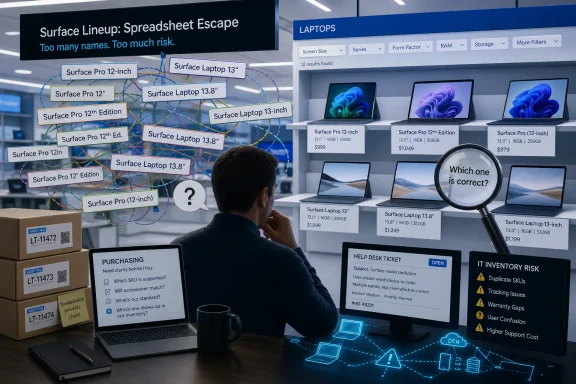 Surface Has Become a Product Line You Need to Study Before You Shop
The immediate complaint is easy to understand: Microsoft has made “Surface Laptop” and “Surface Pro” do too much work. A buyer looking for a new Surface Laptop can encounter a 13-inch model, a 13.8-inch model, older 7th Edition stock, newer 8th Edition hardware, consumer configurations, business configurations, Intel models, Snapdragon models, and retailer listings that do not always surface the distinction cleanly.That might be tolerable for a workstation vendor selling to procurement specialists. It is much harder to defend for a premium consumer PC brand whose sales pitch has long rested on simplicity, polish, and direct comparison with Apple’s MacBook and iPad lines. A MacBook Air is not immune to configuration confusion, but Apple usually keeps the consumer-facing product identity legible. Surface now asks shoppers to know whether a number is a generation, a screen size, a business designation, or a casual shorthand invented by reviewers.
The Surface Pro side is worse because the line has history. Earlier Surface Pro devices used plain numbers, then Microsoft moved toward edition-style naming, then screen-size-first naming, and now the 12-inch and 13-inch models create a collision between what people naturally call a product and what Microsoft officially means. “Surface Pro 12” sounds like the successor to Surface Pro 11. “Surface Pro, 12-inch” sounds like a smaller branch. Those are not the same idea, but the language almost guarantees that many buyers will collapse them into one.
The result is a brand taxonomy that may make sense inside Microsoft’s product-planning decks but does not survive contact with search boxes. And in modern retail, the search box is the shelf.
The Problem Is Not That Surface Has Too Many Models
A broad lineup is not automatically a bad lineup. Microsoft sells to students, developers, traveling executives, classroom fleets, creative professionals, frontline workers, and IT-managed businesses. Those customers do not all need the same device, and Surface has always straddled consumer aspiration and enterprise practicality.The trouble is that Microsoft is using too many overlapping naming signals at once. Screen size, edition number, market segment, processor family, and release wave are all being asked to identify the machine. In isolation, each of those signals is useful. Together, they blur.
Take the laptop family. “Surface Laptop, 13-inch” and “Surface Laptop, 13.8-inch” are technically different names, but they are also close enough that a normal person can reasonably assume they are variants of the same device. Many manufacturers round display sizes in marketing. A shopper who sees 13 and 13.8 inches may think they are looking at two listings for one class of product, not a smaller entry model and a larger mainstream design with different internal assumptions.
The Surface Pro family creates the more comic example. A 12-inch Surface Pro can exist alongside a 13-inch Surface Pro whose edition number is 12th Edition. In everyday speech, the first invites the phrase “Surface Pro 12-inch,” while the second invites “Surface Pro 12.” One hyphenated measurement and one generation shorthand are suddenly separated by a cliff.
That is how enthusiast brands lose the casual buyer. The fan can parse it. The reviewer can make a chart. The IT admin can build a comparison table. The person trying to buy a good Windows laptop before a flight should not have to.
Microsoft Keeps Renaming the Map While Users Are Walking It
Surface naming has never been perfectly consistent, but the current mess is sharper because Microsoft changed conventions after users had already learned the old one. The first Surface Pro generations taught people to expect sequential numbering. Surface Pro 3 followed Surface Pro 2. Surface Pro 4 followed Surface Pro 3. The pattern was obvious enough that even when Microsoft temporarily softened it, the market kept using the numbers anyway.Then came the edition language. In a vacuum, “11th Edition” or “12th Edition” is defensible. It gives Microsoft a way to preserve the Surface Pro name while indicating lineage. It also works better when the hardware family contains multiple sizes. But it becomes awkward when consumers, retailers, and publications continue to shorten those names into the simpler “Surface Pro 11” and “Surface Pro 12.”
Microsoft cannot pretend those casual names do not exist. They are how people talk. They are how headlines fit. They are how search works. If the official name depends on everyone resisting the obvious shorthand, the official name is not doing its job.
The company has made a similar mistake before with Xbox. Xbox One sounded like a first-generation product even though it was the third major Xbox console family. Xbox Series X and Series S then arrived with names that were technically precise but retail-hostile, especially when placed next to Xbox One X and Xbox One S. Microsoft is very good at platform strategy and very bad at remembering that ordinary customers use names as navigation tools.
Surface now has the same disease. The name describes the architecture of the portfolio, not the path through it.
Retail Search Turns Small Naming Choices Into Big Purchase Mistakes
This is where the issue stops being funny. A confusing name in a press release is annoying. A confusing name in a retailer’s search results can cost someone money.Third-party retailers often compress product names to fit cards, filters, and promotional layouts. They may omit “edition” language, bury processor details, or show a screen size without making clear whether the listing belongs to an older generation or a newer one. The shopper sees a Surface Laptop with a familiar chassis, a similar display size, and a sale price. The difference between a 7th Edition and an 8th Edition can become a footnote.
For enthusiasts, that is a solvable puzzle. For a parent buying a graduation laptop, a small business owner replacing two PCs, or a student trying to qualify for a Copilot+ PC feature set, it is a trap. Microsoft has spent the last two years telling users that AI-era Windows hardware requires new silicon and new capabilities. If the brand name does not clearly distinguish which Surface does what, Microsoft is undermining its own upgrade story.
The problem is amplified by the coexistence of Intel and Arm models. Snapdragon-based Surface devices and Intel-based Surface devices can have different performance profiles, compatibility considerations, battery-life expectations, management implications, and price points. A naming system that treats processor platform as just another configuration detail may be elegant on a spec sheet, but it is dangerous in a market where “Windows on Arm” still carries practical consequences for some users.
This does not mean Microsoft needs to plaster “Intel” and “Snapdragon” across every product name. It does mean the primary product identity has to leave fewer opportunities for accidental substitution. If two machines have meaningfully different audiences, they should not look like near-duplicates in the first three words of a retail listing.
The Business Line Makes Sense to Microsoft and Noise to Everyone Else
The enterprise side of Surface explains part of the naming sprawl. Business devices often ship on different schedules, offer different manageability options, include different security expectations, and sometimes use different processors than consumer models. Microsoft is not wrong to distinguish Surface for Business from consumer Surface.But staggered announcements make the public-facing story harder to follow. If business versions arrive first, then consumer versions follow later, the market gets two waves of similar headlines using similar shorthand. A person who saw “Surface Laptop 8” in a business context may later encounter a consumer Surface Laptop with nearly the same broad identity and assume continuity where Microsoft intended segmentation.
Enterprise buyers can handle segmentation when it maps cleanly to procurement categories. “For Business” is a useful tag. It signals support posture, management readiness, and fleet-oriented configuration. The confusion begins when the business designation coexists with edition numbers that consumers and journalists also use casually.
There is also a subtle prestige problem. Surface began as Microsoft’s flagship hardware statement: this is what Windows can be when the software company controls the device. If the flagship requires a decoder ring, the halo dims. A premium brand cannot rely on enthusiasts to explain it forever.
For IT departments, the stakes are not merely aesthetic. Naming confusion can create support ambiguity, accessory mismatches, image-management mistakes, and procurement friction. If the help desk ticket says “Surface Pro 12,” does that mean the 12-inch model or the 13-inch 12th Edition model? In a large organization, that kind of ambiguity becomes a tax.
Screen Size Is a Bad Substitute for Product Identity
Microsoft appears to be leaning on screen size as a clarifying device. The logic is understandable. A Surface Pro, 12-inch and a Surface Pro, 13-inch are physically distinct. A Surface Laptop, 13-inch and a Surface Laptop, 13.8-inch are technically distinguishable. The problem is that screen size is not a stable enough brand anchor.Consumers are trained to treat display sizes as approximate. Laptop makers round up, round down, and simplify all the time. A 13.3-inch, 13.4-inch, 13.5-inch, and 13.8-inch notebook may all be mentally filed as “a 13-inch laptop.” Microsoft can insist that 13 and 13.8 are separate identities, but that is asking buyers to think like a product manager.
Screen size also fails because it does not describe hierarchy. Is the 12-inch Surface Pro newer, cheaper, smaller, less powerful, or simply different? The name does not say. Is the 13-inch Surface Laptop the latest mainstream machine or a more affordable branch under the 13.8-inch version? Again, the name does not say enough.
Apple has sometimes used screen size as a differentiator, but it usually pairs it with a stable family identity: MacBook Air, MacBook Pro, iPad Air, iPad Pro. The modifier tells you the class. The size tells you the variant. Surface currently lets size, edition, and class fight for dominance.
That fight is unwinnable in search results. “Surface Laptop 13” is not a crisp product name when “Surface Laptop 13.8” also exists and older Surface Laptops remain in channel. It is an invitation to compare the wrong things.
Edition Numbers Work Only If Microsoft Commits to Them
There is a path out of this, and it is not complicated. Microsoft could make edition numbers the backbone of the lineup and treat screen size as a secondary attribute. The Surface Pro 12th Edition could come in 12-inch and 13-inch variants if Microsoft wants size diversity. The Surface Laptop 8th Edition could come in 13-inch, 13.8-inch, and 15-inch variants if the company believes all belong to the same generation.That would at least tell buyers which era of hardware they are considering. It would align with how car model years work, how iPhone generations work, and how many PC buyers already think about product refreshes. It would also reduce the awkward collision where “12” can mean either inches or generation.
Alternatively, Microsoft could split the family names more aggressively. A smaller, lower-cost Surface Pro could become Surface Pro Go, Surface Pro Air, or another durable sub-brand. The larger flagship could remain Surface Pro. That would create its own marketing challenge, but it would make the hierarchy visible.
What Microsoft should not do is continue to use official names that the public immediately rewrites into ambiguous shorthand. If the market calls the 13-inch 12th Edition “Surface Pro 12,” then launching a “Surface Pro, 12-inch” nearby is asking for confusion. The distinction may be typographically clear; it is not conversationally clear.
Branding succeeds when the correct phrase is also the easy phrase. Surface increasingly requires the correct phrase to be the unnatural one.
The Copilot+ Era Raises the Cost of Confusion
This naming problem lands at a particularly bad moment because Microsoft is trying to make Copilot+ PCs matter. The company wants users to understand that new Windows experiences depend on specific hardware capabilities, especially neural processing units and modern system-on-chip designs. That message is already difficult because some AI features have rolled out slowly, changed names, or arrived with caveats.A confusing Surface lineup makes the message harder. Surface is supposed to be the reference implementation for modern Windows. If Microsoft cannot clearly explain which Surface is which, why should buyers trust the broader Copilot+ PC ecosystem to be easier?
The company also faces an unusual platform split. Snapdragon X devices have given Windows on Arm a more credible foundation, while Intel remains essential for many business customers and compatibility-sensitive workflows. That is a real strategic advantage if handled well: Microsoft can offer Arm battery life and Intel familiarity under one premium hardware umbrella. But it becomes a liability if buyers cannot tell what they are buying without studying the processor field.
This is not just about nerds wanting tidy labels. Names shape expectations. A customer who buys what they believe is the newest Surface Pro may be disappointed if they discover they chose the smaller branch instead of the flagship generation. Another customer may avoid a good device because the naming makes it seem like a downgrade or an old model. Confusion suppresses confidence.
The AI PC market already asks consumers to absorb a new vocabulary: TOPS, NPUs, Copilot+ eligibility, local models, Recall, on-device processing. Surface should reduce that cognitive load, not add to it.
Enthusiast Shorthand Has Become the Real Naming System
One reason this debate feels circular is that Microsoft’s official names and the public’s practical names have diverged. Reviewers say Surface Pro 11 because it is shorter than Surface Pro, 13-inch, 11th Edition. Retailers compress names because product cards are small. Users search for what they remember from headlines. Over time, the shorthand becomes the real naming system.Microsoft can either design for that reality or keep fighting it. Fighting it means publishing official names that are technically consistent but socially brittle. Designing for it means choosing names that survive headlines, search bars, store shelves, and support chats.
This is where Windows Central’s frustration resonates. The article is not merely complaining that a chart was necessary. It is pointing to a failure of user empathy. If a person who follows Surface closely has to stop and map the lineup, the average buyer has little chance.
There is a temptation to dismiss this as inside baseball. But inside baseball is precisely where premium hardware brands either build trust or lose it. People who buy expensive devices want to feel that they understand the tradeoffs. If the naming itself becomes a source of suspicion, every spec choice looks more opaque than it is.
The irony is that Microsoft’s hardware teams often make thoughtful devices. Surface design has produced excellent keyboards, distinctive aspect ratios, strong build quality, repairability improvements, and some of the best Windows tablets available. The naming makes the hardware look less coherent than it may actually be.
The Surface Brand Needs Fewer Clever Distinctions and More Plain English
Microsoft does not need to copy Apple, but it should learn the simplest lesson Apple keeps teaching: product names are interfaces. They are the first UI. A good name tells the buyer where they are before the spec sheet tells them what they can configure.Surface now has too many names that are precise only after explanation. “Surface Pro, 12-inch” may be accurate. “Surface Pro 13-inch, 12th Edition” may be accurate. “Surface Laptop, 13-inch” and “Surface Laptop, 13.8-inch” may be accurate. Accuracy is not enough if the names collide in ordinary speech.
The cleanest fix would be to build the lineup around stable tiers. Microsoft could reserve plain “Surface Pro” for the flagship detachable, create a clearly named smaller Pro-adjacent model, and make business models extensions of those identities rather than parallel mysteries. For laptops, it could decide whether 13-inch and 13.8-inch devices are truly the same family or different tiers. If they are different tiers, they need different names.
The company should also coordinate announcements so business and consumer versions do not look like disconnected fragments of the same launch. Staggering may be operationally convenient, but it fragments the story. Surface needs a public roadmap that shoppers can hold in their heads.
Above all, Microsoft should stop assuming that official product pages are the center of the buying journey. They are not. Search engines, retailer filters, YouTube reviews, Reddit threads, school purchasing portals, and IT asset systems all mediate the brand. A name that works only on Microsoft.com does not work.
The Chart Should Embarrass Redmond More Than the Names Themselves
The most damaging part of the current Surface situation is not any single awkward label. It is that the awkward labels accumulate into proof that Microsoft is not treating naming as part of the product experience. When a publication has to make a chart just to keep the last few devices straight, the chart becomes the story.Here is the practical read on the mess:
- Microsoft is selling Surface devices whose official names depend heavily on screen size and edition number, but those signals are easy to confuse in everyday shopping.
- The 12-inch Surface Pro and the 13-inch Surface Pro 12th Edition create a particularly bad collision between size-based naming and generation-based shorthand.
- Retailers can make the confusion worse by shortening names, mixing generations, and omitting details that Microsoft may consider essential.
- Business and consumer Surface launches now arrive in staggered waves, which makes similar hardware sound like separate product families or makes separate product families sound identical.
- The Copilot+ PC push raises the stakes because buyers need to understand hardware generation, processor platform, and feature eligibility before spending premium money.
- Microsoft can fix the problem only by choosing a naming structure that survives search, shorthand, and support conversations, not merely one that looks orderly in official documentation.
Surface still matters because it remains Microsoft’s most visible argument for what a Windows PC can be. But if the company wants Surface to carry Windows into the AI PC era, it needs to make the lineup legible again: fewer overlapping numbers, clearer tiers, and names that sound like products rather than catalog entries. The next Surface refresh should not need a chart to explain what launched; it should make the chart obsolete.
References
- Primary source: Windows Central
Published: Wed, 17 Jun 2026 18:04:16 GMT
The Surface Pro 12 isn't the Surface Pro 12-inch: Microsoft's naming scheme has reached peak chaos | Windows Central
With the arrival of the second Surface Pro 12 in two months, it's time to take a closer look at Microsoft's horrible naming scheme for flagship PCs.www.windowscentral.com - Related coverage: tomshardware.com
Microsoft debuts Surface Pro and Surface Laptop with new jade green color and Qualcomm Snapdragon X2 chips — refreshed devices start at $1,499 with 16GB of RAM | Tom's Hardware
The Laptop features Microsoft's new haptic touchpad.www.tomshardware.com - Related coverage: techradar.com
Microsoft reveals new Surface Pro and Surface Laptop with big graphics upgrades from Snapdragon X2 CPUs — but they're seriously pricey | TechRadar
Around an up to 50% boost in graphics performancewww.techradar.com - Official source: learn.microsoft.com
Surface Pro for Business 12th Edition – Intel and Snapdragon Laptop Tablet | Microsoft Surface
Discover Surface Pro for Business 12th Edition. These AI 2-in-1 laptop tablets are available with Intel® or Snapdragon® processors in 12-inch or 13-inch, with optional 5G. Built for teams that work anywhere.learn.microsoft.com
- Official source: blogs.windows.com
Introducing all-new Surface Copilot+ PCs: The Surface Pro, 12-inch and Surface Laptop, 13-inch
Copilot+ PCs continue to define the next wave of personal computing — fast, long lasting, secure PCs that are purpose-built to unlock AI experiences that empower us to get more done. Today, Microsoft and Surface expand the Copilot+ PC family with tblogs.windows.com - Official source: microsoft.com
- Related coverage: bhphotovideo.com
Microsoft 13.8" Surface Laptop For Business Copilot+ PC
Buy Microsoft 13.8" Surface Laptop For Business Copilot+ PC (8th Edition, Platinum) featuring Intel Core Ultra 5 (Series 3) 8-Core, 16GB RAM | 512GB SSD, 13.8" 2304 x 1536 PixelSense Touchscreen, Intel Graphics | Built-In NPU (47 TOPS), Wi-Fi 7 (802.11be) | Bluetooth 5.4, USB-C |...www.bhphotovideo.com - Related coverage: phonearena.com
Microsoft is expanding the Surface Pro family with a smaller, lighter, and cheaper iPad Pro rival - PhoneArena
Microsoft's latest Surface Pro model is smaller, considerably lighter, thinner, and cheaper than the 13-inch variant released last year, starting at a relatively affordable $799.99 price.www.phonearena.com - Related coverage: techrepublic.com
New Microsoft Surface Pro & Laptop Get Major AI Boost — Starting at $799 - TechRepublic
Microsoft unveils the all-new 12" Surface Pro and 13" Surface Laptop — AI-powered, ultra-light Copilot+ PCs with long battery life, starting at $799.www.techrepublic.com
- Related coverage: tomsguide.com
Microsoft quietly hiked prices on all its Surface laptops — it's now cheaper to buy a MacBook Air | Tom's Guide
Microsoft has quietly hiked the prices of almost all of its Snapdragon-powered Surface devices as the RAM crisis continues to make tech even more expensive.www.tomsguide.com
