

Microsoft Research’s 2026 study of imitation-learning agents playing streamed video games reports that training on pixelation, blur, scrubs, and ghosting can sharply improve robustness, raising Game 1 Task 2 performance from 54.9% to 96% under synthetic artifacts and from 44.5% to 90% under real streaming noise. The accompanying paper, “Augmentations for Robust and Efficient Imitation Learning in Streamed Video Games,” is listed for the Conference on Games 2026. Its central argument is deceptively simple: an agent expected to play through a video stream should learn from the failures of video streams, not merely from pristine gameplay frames. The larger implication is that network damage can be treated as a training distribution rather than an unavoidable source of deployment failure.
Imitation learning usually begins with demonstrations: examples of a person or another capable agent performing the task that the model is expected to reproduce. In a video game, those demonstrations can pair visual observations with actions, allowing an agent to learn behavior without requiring a bespoke interface exposing the game’s internal state.
That vision-only approach is attractive because it reduces dependence on game-specific integrations, but it also creates a brittle point of failure. If the agent learns that a particular arrangement of sharp pixels means “jump now,” its policy may stop making sense when compression turns those pixels into blocks, a delayed frame persists on screen, or movement is smeared across several observations.
A locally running game can already produce visual variation through effects, motion, camera changes, and interface overlays. Streaming adds a separate class of corruption generated between the game and the agent: frames can lose detail, blend with their predecessors, arrive with discontinuities, or carry the visible consequences of lag.
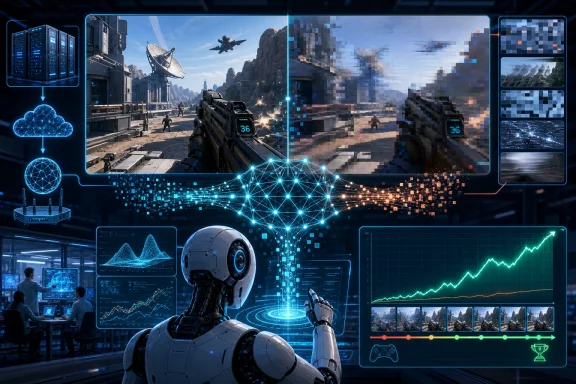
Microsoft Research’s supplementary material turns those failures into a training regimen. The work models pixelation, blur-like fuzziness, short scrub-like disruptions, and ghosting, then evaluates agents in clean streams, synthetically degraded streams, and streams carrying induced lag and real streaming artifacts.
That separation matters. The research is not merely asking whether more image augmentation makes a model generally stronger; it is asking whether approximating the faults of the eventual delivery system produces an agent better adapted to that system.
Those techniques can discourage a model from memorizing exact colors or coordinates. They are useful when an object appears under different lighting, at a slightly different scale, or in another part of the frame, but they do not necessarily reproduce what happens when a video stream fails across time.
The streaming augmentations target that missing dimension. Fuzziness softens details over time, pixelation reduces local fidelity through block-like artifacts, and ghosting leaves persistence trails that combine information from nearby frames. Scrubs interfere with continuity itself, simulating brief playback disturbances rather than merely changing the appearance of one isolated image.
This is the methodological heart of the project. A streaming fault does not always replace correct information with random noise; it can leave the agent observing plausible but temporally incorrect information. A ghosted frame, for example, may contain both where an object is and where it recently was, while a scrub can interfere with the perceived order or continuity of events.
For a sequential decision-maker, that is more dangerous than a cosmetic color shift. The agent must infer not only what is visible but what has just happened, what is moving, and when its next action should occur.
Microsoft also shows an “all streaming augmentations” pipeline that combines the streaming-specific family on the same source clip. Its broader “all augmentations” pipeline first applies the standard stack and then the streaming stack, exposing the model to both conventional spatial variation and delivery-specific temporal corruption.
The distinction between those pipelines becomes important in the results. Generic augmentation sometimes provides only a small improvement and, in one reported case, performs slightly worse than no augmentation. The streaming-specific stack is where the decisive gains appear.
The following table highlights representative results rather than reproducing every rollout listed in Microsoft’s supplementary material.
On synthetic Game 1 Task 1, no augmentation averages 72.3%, or 8.68 of 12 milestones. Standard augmentation lifts that to 76.5%, but streaming augmentation reaches 87%, or 10.44 milestones.
Using all augmentations produces 86.7%, fractionally below streaming augmentation alone. That difference is small, but it is analytically useful: more transformations do not automatically produce the best policy. Training succeeds when the added variation resembles the deployment problem, not simply when the pipeline becomes more complicated.
Game 1 Task 2 makes that argument more forcefully. No augmentation averages 54.9%, while standard augmentation falls slightly to 53.5%. Streaming augmentation reaches 96%, and all augmentation edges it at 96.2%.
The gap between generic and streaming-specific augmentation is therefore more than 42 percentage points in that task. Standard color and spatial changes do not prepare the agent for the temporal and compression-like faults that dominate the synthetic evaluation.
The medians tell the same story. On synthetic Game 1 Task 2, the no-augmentation median is 72.7%, while standard augmentation drops to 45.5%. Both streaming augmentation and all augmentation achieve median episodes of 100%.
That is strong evidence for the paper’s particular augmentation design, not a blanket endorsement of data augmentation. The result is about matching training corruption to deployment corruption.
With 30 demonstrations on clean Game 1 Task 1, no augmentation averages 76.7%, or 9.20 of 12 milestones. All augmentation reaches 85.8%, or 10.30 milestones, and raises the median episode from 66.7% to 100%.
On Game 1 Task 2, where the baseline is already strong, the gain is smaller. No augmentation averages 94.4%, while all augmentation reaches 97.5%; both have 100% median and best episodes.
Game 2 Task 3 remains more difficult. No augmentation averages 55.2%, or 8.28 of 15 milestones, while all augmentation raises that to 65.1%, or 9.76 milestones. The median improves from 60% to 66.7%, although both methods can produce a 100% best episode.
These clean-condition gains suggest that the transformations may be doing more than teaching recovery from visible corruption. They may also be discouraging the policy from relying on fragile details that happen to correlate with actions in a limited demonstration set.
That interpretation remains an inference rather than a mechanism proven by the supplementary page. Even so, it fits the pattern: a model forced to act when low-level details are unreliable must learn representations built around more stable cues.
In practical terms, an agent trained for bad streams may become less dependent on pixel-perfect conditions even when the stream is good. This resembles a familiar systems principle: designing for expected failure can improve normal operation because it exposes assumptions that otherwise remain hidden.
On Game 1 Task 1 with 15 demonstrations, no augmentation averages only 43.3%, or 5.20 of 12 milestones. All augmentation reaches 84.7%, or 10.16 milestones—a gain of 41.4 percentage points.
The augmented agent trained with 15 demonstrations therefore exceeds the 76.7% average of the unaugmented agent trained with 30. It also records a 91.7% median and a 100% best episode, compared with 50% for both the median and best episode of the 15-demonstration baseline.
The same pattern remains at 10 demonstrations. No augmentation averages 44%, while all augmentation reaches 79.2%. The unaugmented median is 41.7%, versus 91.7% with augmentation, and the best episode rises from 66.7% to 100%.
Even five demonstrations produce a meaningful difference. Game 1 Task 1 rises from 42.2% without augmentation to 72.2% with all augmentation, while the median jumps from 41.7% to 83.3%.
That five-demonstration augmented result remains below the 30-demonstration augmented average of 85.8%, so the method does not make additional data irrelevant. It does, however, bring the agent within 4.5 percentage points of the 30-demonstration unaugmented baseline.
Game 1 Task 2 shows a different shape. At 15 demonstrations, the baseline is already 88.7%, and augmentation raises it to 98%. At 10 demonstrations, performance increases from 88% to 96.5%.
The collapse arrives at five demonstrations. Without augmentation, the average falls to 36.5%, or 4.02 of 11 milestones; with augmentation, it recovers to 67.5%, or 7.42 milestones. The median more than doubles from 27.3% to 63.6%, and the best episode rises from 81.8% to 100%.
This is why “sample efficiency” is more than an academic label in the paper’s title. If the result generalizes, augmentation can function as a data multiplier, allowing a smaller set of demonstrations to support behavior that would otherwise require substantially more examples.
It is not a literal replacement for demonstrations. Synthetic variation cannot invent missing strategies, unexplored states, or actions never shown by an expert. What it can do is prevent the model from spending precious examples learning that every valid state has only one exact visual presentation.
That could reflect differences in task complexity, demonstration diversity, visual ambiguity, action timing, or the distribution of milestones. The supplementary material does not provide enough detail to isolate the cause.
At five demonstrations, however, Task 2’s no-augmentation performance drops from 88% at 10 demonstrations to 36.5%. That suggests the baseline may have crossed a coverage threshold: the smaller set no longer contains enough variation for stable imitation.
Augmentation softens that collapse but does not eliminate it. The five-demonstration augmented result of 67.5% is much better than the baseline, yet it remains far below the 96.5% achieved by all augmentation with 10 demonstrations.
The practical lesson is that augmentation and data quantity solve overlapping but different problems. Additional demonstrations expand the set of behaviors and situations an agent has actually observed; augmentation expands the visual and temporal forms in which those situations may appear.
Teams evaluating this approach would therefore need learning curves rather than a single favored budget. A strong result at 30 demonstrations cannot reveal where an agent becomes unstable, and a dramatic gain at five demonstrations does not prove that five examples cover all behavior needed in deployment.
Those definitions matter because best episodes reach 100% in a striking number of configurations, including methods whose averages are much lower. On synthetic Game 1 Task 2, for example, no augmentation has a 100% best episode despite averaging only 54.9%. Standard augmentation also reaches a 100% best episode while averaging 53.5% and recording a median of 45.5%.
A perfect best rollout establishes that a method can complete the task under at least one represented run. It does not establish that completion is typical, repeatable, or likely.
The same issue appears in clean Game 2 Task 3. Both methods have 100% best episodes, but no augmentation averages 55.2% and all augmentation averages 65.1%. Judging only from the selected best videos would conceal most of the performance gap.
Median episodes are more informative for understanding representative behavior, but they too should be interpreted alongside averages and seed counts. An average can expose the effect of particularly weak rollouts, while the median indicates whether the center of the distribution has shifted.
On clean Game 1 Task 1 with 30 demonstrations, augmentation raises the average by 9.1 points but moves the median from 66.7% to 100%. That suggests the improvement is not merely one unusually successful run pulling the mean upward; the typical selected performance changes materially.
The presentation of both median and best rollouts is useful because qualitative videos can reveal failure modes that milestone scores miss. But the numerical summaries remain essential. A video of one flawless completion is evidence of capability, not evidence of reliability.
On Game 1 Task 2 with 30 demonstrations, no augmentation averages 44.5%, or 4.90 of 11 milestones. All augmentation reaches 90%, or 9.90 milestones—a gain of 45.5 percentage points.
The median rises from 36.4% to 90.9%, while the best episode improves from 81.8% to 100%. Unlike comparisons in which both approaches can occasionally finish the task, the unaugmented method does not record a perfect best rollout here.
This is the study’s most persuasive practical result. The training intervention is not merely improving performance against the same synthetic transformations used to construct the training pipeline; it reportedly transfers to a stream degraded through induced lag.
But the result comes from one seed, whereas the clean and synthetic results listed on the supplementary page generally use five seeds. A one-seed comparison cannot show how much performance varies across independent training runs or whether the large gap is stable.
The page also contains a documentation inconsistency that should not be ignored. Its heading displays Game 1 Task 2 as having 12 milestones in the real-streaming-noise section, while both reported scores use a denominator of 11, consistent with the clean and synthetic Task 2 results.
The percentages and milestone totals agree with an 11-milestone denominator: 4.90 of 11 corresponds to roughly 44.5%, and 9.90 of 11 corresponds to 90%. The displayed “12 Milestones” label therefore appears inconsistent with the underlying figures, but Microsoft’s material does not explicitly resolve it.
Neither issue erases the observed gap. They do limit the strength of the conclusion that should be drawn from it. The real-noise experiment is compelling evidence that the hypothesis deserves broader testing, not final evidence that the technique will reliably double performance across games, networks, and trained agents.
Instead, they train the policy to make better decisions from impaired observations. The network can remain degraded while the agent becomes less likely to fail because of that degradation.
This distinction is operationally important. A video delivery team tries to prevent or conceal artifacts before they reach a viewer. An agent-robustness team assumes that some artifacts will still arrive and prepares the decision-maker to handle them.
The two approaches are complementary. Better transport and encoding reduce the frequency and severity of damage, while robust training reduces the cost of whatever damage remains.
There is also a limit to what augmentation can accomplish. A model can learn tolerance to partial, blurred, delayed, or blended information, but it cannot reliably recover information that never arrives and has no predictable relationship to surrounding frames.
As latency grows or continuity breaks for longer periods, the problem may shift from visual robustness to uncertainty management. The agent may need temporal memory, confidence estimates, action suppression, or an explicit strategy for waiting rather than acting on stale evidence.
The supplementary material demonstrates that modeled artifacts can help. It does not establish the maximum outage, delay, or degradation under which the trained policy remains safe and useful.
The subjects of the evaluation are imitation-learning agents receiving streamed gameplay observations. The goal is to improve how those agents behave under normal and degraded streaming conditions, not to improve the picture directly for a human player.
For Windows users, the immediate consequence is therefore limited. There is no switch to enable, update to install, or gaming-service problem that the research claims to solve today.
The longer-term relevance lies in the systems that surround games. Vision-based agents can potentially be used for automated testing, demonstration-driven behavior, research experiments, and other workflows where direct access to a game’s internal state is unavailable or undesirable.
Streaming can make those workflows easier to centralize because execution and observation do not need to occur in the same local process. It can also introduce the very distribution shift documented here: a model trained from clean images may encounter a different visual world when placed behind a real video pipeline.
For IT and test-infrastructure teams, the paper’s underlying principle is more important than its specific game scores. If an automated system consumes compressed, delayed, or remotely rendered visuals in production, its validation environment should include failures produced by that delivery path.
A clean local test can confirm that the policy understands the task. It cannot confirm that the deployed system will still understand the task after transport has altered the evidence.
That transparency is especially valuable for temporal augmentation because names such as “ghosting” and “scrubs” can otherwise hide very different implementations. Showing the unmodified reference alongside color jitter, random affine changes, fuzziness, ghosting, pixelation, and scrubs gives readers a practical sense of what information each transformation removes or distorts.
The combined pipeline is also described in its actual order: standard augmentation first, streaming augmentation second. Pipeline order can matter because the second transformation acts on the output of the first, potentially producing a distribution different from either family in isolation.
The rollout categories help prevent another common ambiguity. “Clean” still means evaluation through streaming; it is clean because no lag or visual artifacts are intentionally introduced. Synthetic conditions add modeled artifacts without induced lag, while real streaming noise introduces lag that leads to the artifacts being modeled.
This gives the evaluation a useful progression. Clean tests whether augmentation harms or helps normal behavior, synthetic tests controlled exposure to the targeted corruptions, and real streaming noise tests whether the training transfers to a less artificial failure process.
The structure is good experimental storytelling, even though the public supplementary page cannot replace the full methodological detail needed for reproduction. It lets readers connect the transformations to the rollouts and the rollouts to the aggregate scores.
The real-streaming-noise evidence is narrower still: one task, one demonstration budget, two methods, and one seed. That is enough to produce an important signal but not enough to characterize variation across tasks or training runs.
The supplementary page also does not establish how well the chosen artifact distributions match the full range of real streaming behavior. Pixelation, fuzziness, ghosting, and scrubs are recognizable failure classes, but their duration, intensity, frequency, and interaction can determine whether an augmentation is realistic or merely visually similar.
A policy may also respond differently to network faults depending on the game. A brief discontinuity during slow navigation may be harmless, while the same disruption during a timing-sensitive action can make the current observation unusable.
Milestone completion captures progress, but it does not necessarily capture all undesirable behavior. An agent could reach the same milestone after hesitation, repeated corrections, unsafe actions, or a route that would be unacceptable in an automated test.
Those questions do not undermine the reported findings. They define the work needed before the approach can be treated as a general solution rather than a promising task-specific result.
That means identifying which degradations actually occur, how long they last, whether they correlate with latency spikes, and which parts of the task are most sensitive to them. A realistic augmentation policy should follow those observations rather than assuming every platform fails in the same way.
Training and evaluation corruptions should also remain partly separate. If every test artifact is generated by the same code and parameter ranges used in training, high performance may indicate adaptation to the augmentation implementation rather than robustness to the broader failure class.
Real streaming trials are therefore indispensable. They should cover independent training seeds, multiple network profiles, repeated runs, and tasks with different timing and visual demands.
Teams should preserve clean evaluation as well. A robustness intervention that survives degraded streams but significantly damages normal performance may be a poor production trade, particularly when most sessions operate under good conditions.
Microsoft’s results are encouraging on that point because all augmentation generally improves the displayed clean averages. The evidence nevertheless comes from a limited set of tasks, so clean-regression testing would remain necessary for any separate deployment.
Finally, evaluation should emphasize distributions rather than highlight reels. Median performance, lower-performing runs, failure rates, and variance across seeds will often matter more than whether one best episode can reach 100%.
 Microsoft Trains for the Network, Not Just the Game
Imitation learning usually begins with demonstrations: examples of a person or another capable agent performing the task that the model is expected to reproduce. In a video game, those demonstrations can pair visual observations with actions, allowing an agent to learn behavior without requiring a bespoke interface exposing the game’s internal state.That vision-only approach is attractive because it reduces dependence on game-specific integrations, but it also creates a brittle point of failure. If the agent learns that a particular arrangement of sharp pixels means “jump now,” its policy may stop making sense when compression turns those pixels into blocks, a delayed frame persists on screen, or movement is smeared across several observations.
A locally running game can already produce visual variation through effects, motion, camera changes, and interface overlays. Streaming adds a separate class of corruption generated between the game and the agent: frames can lose detail, blend with their predecessors, arrive with discontinuities, or carry the visible consequences of lag.
Microsoft Research’s supplementary material turns those failures into a training regimen. The work models pixelation, blur-like fuzziness, short scrub-like disruptions, and ghosting, then evaluates agents in clean streams, synthetically degraded streams, and streams carrying induced lag and real streaming artifacts.
That separation matters. The research is not merely asking whether more image augmentation makes a model generally stronger; it is asking whether approximating the faults of the eventual delivery system produces an agent better adapted to that system.
The Crucial Shift Is Temporal, Not Merely Visual
Conventional image augmentation tends to treat each frame as an independent picture. Microsoft’s standard stack includes color jitter, which perturbs colors per frame, and random affine transformations such as translation, scaling, and rotation.Those techniques can discourage a model from memorizing exact colors or coordinates. They are useful when an object appears under different lighting, at a slightly different scale, or in another part of the frame, but they do not necessarily reproduce what happens when a video stream fails across time.
The streaming augmentations target that missing dimension. Fuzziness softens details over time, pixelation reduces local fidelity through block-like artifacts, and ghosting leaves persistence trails that combine information from nearby frames. Scrubs interfere with continuity itself, simulating brief playback disturbances rather than merely changing the appearance of one isolated image.
This is the methodological heart of the project. A streaming fault does not always replace correct information with random noise; it can leave the agent observing plausible but temporally incorrect information. A ghosted frame, for example, may contain both where an object is and where it recently was, while a scrub can interfere with the perceived order or continuity of events.
For a sequential decision-maker, that is more dangerous than a cosmetic color shift. The agent must infer not only what is visible but what has just happened, what is moving, and when its next action should occur.
Microsoft also shows an “all streaming augmentations” pipeline that combines the streaming-specific family on the same source clip. Its broader “all augmentations” pipeline first applies the standard stack and then the streaming stack, exposing the model to both conventional spatial variation and delivery-specific temporal corruption.
The distinction between those pipelines becomes important in the results. Generic augmentation sometimes provides only a small improvement and, in one reported case, performs slightly worse than no augmentation. The streaming-specific stack is where the decisive gains appear.
Specialized Corruption Beats Generic Variety
The clearest comparison comes from the synthetic evaluation using 30 demonstrations. Under these conditions, the stream has no induced lag, but the researchers deliberately introduce visual artifacts using the streaming augmentations.The following table highlights representative results rather than reproducing every rollout listed in Microsoft’s supplementary material.
| Condition | Budget | Task | No augmentation | Strongest reported method | Gain |
|---|---|---|---|---|---|
| Synthetic | 30 demonstrations | Game 1 Task 1 | 72.3% | Streaming: 87% | 14.7 points |
| Synthetic | 30 demonstrations | Game 1 Task 2 | 54.9% | All: 96.2% | 41.3 points |
| Real Streaming Noise | 30 demonstrations | Game 1 Task 2 | 44.5% | All: 90% | 45.5 points |
| Clean | 15 demonstrations | Game 1 Task 1 | 43.3% | All: 84.7% | 41.4 points |
| Clean | 5 demonstrations | Game 1 Task 2 | 36.5% | All: 67.5% | 31 points |
Using all augmentations produces 86.7%, fractionally below streaming augmentation alone. That difference is small, but it is analytically useful: more transformations do not automatically produce the best policy. Training succeeds when the added variation resembles the deployment problem, not simply when the pipeline becomes more complicated.
Game 1 Task 2 makes that argument more forcefully. No augmentation averages 54.9%, while standard augmentation falls slightly to 53.5%. Streaming augmentation reaches 96%, and all augmentation edges it at 96.2%.
The gap between generic and streaming-specific augmentation is therefore more than 42 percentage points in that task. Standard color and spatial changes do not prepare the agent for the temporal and compression-like faults that dominate the synthetic evaluation.
The medians tell the same story. On synthetic Game 1 Task 2, the no-augmentation median is 72.7%, while standard augmentation drops to 45.5%. Both streaming augmentation and all augmentation achieve median episodes of 100%.
That is strong evidence for the paper’s particular augmentation design, not a blanket endorsement of data augmentation. The result is about matching training corruption to deployment corruption.
Clean Performance Reveals a Second Benefit
The obvious purpose of streaming augmentation is to make an agent survive a damaged stream. Less obvious is the supplementary material’s finding that the same training can improve performance even when evaluation occurs through streaming with no induced lag and no introduced visual artifacts.With 30 demonstrations on clean Game 1 Task 1, no augmentation averages 76.7%, or 9.20 of 12 milestones. All augmentation reaches 85.8%, or 10.30 milestones, and raises the median episode from 66.7% to 100%.
On Game 1 Task 2, where the baseline is already strong, the gain is smaller. No augmentation averages 94.4%, while all augmentation reaches 97.5%; both have 100% median and best episodes.
Game 2 Task 3 remains more difficult. No augmentation averages 55.2%, or 8.28 of 15 milestones, while all augmentation raises that to 65.1%, or 9.76 milestones. The median improves from 60% to 66.7%, although both methods can produce a 100% best episode.
These clean-condition gains suggest that the transformations may be doing more than teaching recovery from visible corruption. They may also be discouraging the policy from relying on fragile details that happen to correlate with actions in a limited demonstration set.
That interpretation remains an inference rather than a mechanism proven by the supplementary page. Even so, it fits the pattern: a model forced to act when low-level details are unreliable must learn representations built around more stable cues.
In practical terms, an agent trained for bad streams may become less dependent on pixel-perfect conditions even when the stream is good. This resembles a familiar systems principle: designing for expected failure can improve normal operation because it exposes assumptions that otherwise remain hidden.
Scarce Demonstrations Are Where Augmentation Earns Its Keep
The study’s most consequential clean-condition results appear when the demonstration budget shrinks. Demonstrations are valuable because they require useful gameplay trajectories, and collecting, processing, and validating them can become a bottleneck.On Game 1 Task 1 with 15 demonstrations, no augmentation averages only 43.3%, or 5.20 of 12 milestones. All augmentation reaches 84.7%, or 10.16 milestones—a gain of 41.4 percentage points.
The augmented agent trained with 15 demonstrations therefore exceeds the 76.7% average of the unaugmented agent trained with 30. It also records a 91.7% median and a 100% best episode, compared with 50% for both the median and best episode of the 15-demonstration baseline.
The same pattern remains at 10 demonstrations. No augmentation averages 44%, while all augmentation reaches 79.2%. The unaugmented median is 41.7%, versus 91.7% with augmentation, and the best episode rises from 66.7% to 100%.
Even five demonstrations produce a meaningful difference. Game 1 Task 1 rises from 42.2% without augmentation to 72.2% with all augmentation, while the median jumps from 41.7% to 83.3%.
That five-demonstration augmented result remains below the 30-demonstration augmented average of 85.8%, so the method does not make additional data irrelevant. It does, however, bring the agent within 4.5 percentage points of the 30-demonstration unaugmented baseline.
Game 1 Task 2 shows a different shape. At 15 demonstrations, the baseline is already 88.7%, and augmentation raises it to 98%. At 10 demonstrations, performance increases from 88% to 96.5%.
The collapse arrives at five demonstrations. Without augmentation, the average falls to 36.5%, or 4.02 of 11 milestones; with augmentation, it recovers to 67.5%, or 7.42 milestones. The median more than doubles from 27.3% to 63.6%, and the best episode rises from 81.8% to 100%.
This is why “sample efficiency” is more than an academic label in the paper’s title. If the result generalizes, augmentation can function as a data multiplier, allowing a smaller set of demonstrations to support behavior that would otherwise require substantially more examples.
It is not a literal replacement for demonstrations. Synthetic variation cannot invent missing strategies, unexplored states, or actions never shown by an expert. What it can do is prevent the model from spending precious examples learning that every valid state has only one exact visual presentation.
The Budget Results Expose Task-Specific Thresholds
The numbers also warn against treating demonstration count as a universal measure of difficulty. Game 1 Task 2 remains relatively strong without augmentation at 10 and 15 demonstrations, while Game 1 Task 1 falls into the low-40% range at both budgets.That could reflect differences in task complexity, demonstration diversity, visual ambiguity, action timing, or the distribution of milestones. The supplementary material does not provide enough detail to isolate the cause.
At five demonstrations, however, Task 2’s no-augmentation performance drops from 88% at 10 demonstrations to 36.5%. That suggests the baseline may have crossed a coverage threshold: the smaller set no longer contains enough variation for stable imitation.
Augmentation softens that collapse but does not eliminate it. The five-demonstration augmented result of 67.5% is much better than the baseline, yet it remains far below the 96.5% achieved by all augmentation with 10 demonstrations.
The practical lesson is that augmentation and data quantity solve overlapping but different problems. Additional demonstrations expand the set of behaviors and situations an agent has actually observed; augmentation expands the visual and temporal forms in which those situations may appear.
Teams evaluating this approach would therefore need learning curves rather than a single favored budget. A strong result at 30 demonstrations cannot reveal where an agent becomes unstable, and a dramatic gain at five demonstrations does not prove that five examples cover all behavior needed in deployment.
Perfect Best Episodes Can Hide an Unreliable Agent
Microsoft’s supplementary page defines best episodes as the highest-scoring latest completed rollouts for a setting. Median episodes are taken from the middle of the score distribution.Those definitions matter because best episodes reach 100% in a striking number of configurations, including methods whose averages are much lower. On synthetic Game 1 Task 2, for example, no augmentation has a 100% best episode despite averaging only 54.9%. Standard augmentation also reaches a 100% best episode while averaging 53.5% and recording a median of 45.5%.
A perfect best rollout establishes that a method can complete the task under at least one represented run. It does not establish that completion is typical, repeatable, or likely.
The same issue appears in clean Game 2 Task 3. Both methods have 100% best episodes, but no augmentation averages 55.2% and all augmentation averages 65.1%. Judging only from the selected best videos would conceal most of the performance gap.
Median episodes are more informative for understanding representative behavior, but they too should be interpreted alongside averages and seed counts. An average can expose the effect of particularly weak rollouts, while the median indicates whether the center of the distribution has shifted.
On clean Game 1 Task 1 with 30 demonstrations, augmentation raises the average by 9.1 points but moves the median from 66.7% to 100%. That suggests the improvement is not merely one unusually successful run pulling the mean upward; the typical selected performance changes materially.
The presentation of both median and best rollouts is useful because qualitative videos can reveal failure modes that milestone scores miss. But the numerical summaries remain essential. A video of one flawless completion is evidence of capability, not evidence of reliability.
Real Streaming Noise Produces the Strongest Headline and the Largest Caveat
The real-streaming-noise evaluation is the closest the supplementary material comes to the deployment problem the paper is trying to solve. Microsoft defines this condition as evaluation through streaming with induced lag, producing the kinds of visual artifacts modeled by the augmentations.On Game 1 Task 2 with 30 demonstrations, no augmentation averages 44.5%, or 4.90 of 11 milestones. All augmentation reaches 90%, or 9.90 milestones—a gain of 45.5 percentage points.
The median rises from 36.4% to 90.9%, while the best episode improves from 81.8% to 100%. Unlike comparisons in which both approaches can occasionally finish the task, the unaugmented method does not record a perfect best rollout here.
This is the study’s most persuasive practical result. The training intervention is not merely improving performance against the same synthetic transformations used to construct the training pipeline; it reportedly transfers to a stream degraded through induced lag.
But the result comes from one seed, whereas the clean and synthetic results listed on the supplementary page generally use five seeds. A one-seed comparison cannot show how much performance varies across independent training runs or whether the large gap is stable.
The page also contains a documentation inconsistency that should not be ignored. Its heading displays Game 1 Task 2 as having 12 milestones in the real-streaming-noise section, while both reported scores use a denominator of 11, consistent with the clean and synthetic Task 2 results.
The percentages and milestone totals agree with an 11-milestone denominator: 4.90 of 11 corresponds to roughly 44.5%, and 9.90 of 11 corresponds to 90%. The displayed “12 Milestones” label therefore appears inconsistent with the underlying figures, but Microsoft’s material does not explicitly resolve it.
Neither issue erases the observed gap. They do limit the strength of the conclusion that should be drawn from it. The real-noise experiment is compelling evidence that the hypothesis deserves broader testing, not final evidence that the technique will reliably double performance across games, networks, and trained agents.
The Experiment Separates Robustness From Network Repair
It would be easy to describe this work as an attempt to “fix lag,” but that would be inaccurate. The augmentations do not lower latency, restore missing frames, increase bandwidth, or repair the video stream.Instead, they train the policy to make better decisions from impaired observations. The network can remain degraded while the agent becomes less likely to fail because of that degradation.
This distinction is operationally important. A video delivery team tries to prevent or conceal artifacts before they reach a viewer. An agent-robustness team assumes that some artifacts will still arrive and prepares the decision-maker to handle them.
The two approaches are complementary. Better transport and encoding reduce the frequency and severity of damage, while robust training reduces the cost of whatever damage remains.
There is also a limit to what augmentation can accomplish. A model can learn tolerance to partial, blurred, delayed, or blended information, but it cannot reliably recover information that never arrives and has no predictable relationship to surrounding frames.
As latency grows or continuity breaks for longer periods, the problem may shift from visual robustness to uncertainty management. The agent may need temporal memory, confidence estimates, action suppression, or an explicit strategy for waiting rather than acting on stale evidence.
The supplementary material demonstrates that modeled artifacts can help. It does not establish the maximum outage, delay, or degradation under which the trained policy remains safe and useful.
This Is Not an Xbox Cloud Gaming Feature Announcement
The Microsoft branding and streamed-game setting make the research easy to read as a preview of an imminent consumer feature. The published material does not announce a Windows option, an Xbox Cloud Gaming setting, a new client component, or a production rollout.The subjects of the evaluation are imitation-learning agents receiving streamed gameplay observations. The goal is to improve how those agents behave under normal and degraded streaming conditions, not to improve the picture directly for a human player.
For Windows users, the immediate consequence is therefore limited. There is no switch to enable, update to install, or gaming-service problem that the research claims to solve today.
The longer-term relevance lies in the systems that surround games. Vision-based agents can potentially be used for automated testing, demonstration-driven behavior, research experiments, and other workflows where direct access to a game’s internal state is unavailable or undesirable.
Streaming can make those workflows easier to centralize because execution and observation do not need to occur in the same local process. It can also introduce the very distribution shift documented here: a model trained from clean images may encounter a different visual world when placed behind a real video pipeline.
For IT and test-infrastructure teams, the paper’s underlying principle is more important than its specific game scores. If an automated system consumes compressed, delayed, or remotely rendered visuals in production, its validation environment should include failures produced by that delivery path.
A clean local test can confirm that the policy understands the task. It cannot confirm that the deployed system will still understand the task after transport has altered the evidence.
The Supplementary Material Is Strongest as an Audit Trail
Microsoft’s website does more than publish final averages. It provides definitions for the evaluation conditions, explains how representative episodes are selected, and includes visual examples of each augmentation family.That transparency is especially valuable for temporal augmentation because names such as “ghosting” and “scrubs” can otherwise hide very different implementations. Showing the unmodified reference alongside color jitter, random affine changes, fuzziness, ghosting, pixelation, and scrubs gives readers a practical sense of what information each transformation removes or distorts.
The combined pipeline is also described in its actual order: standard augmentation first, streaming augmentation second. Pipeline order can matter because the second transformation acts on the output of the first, potentially producing a distribution different from either family in isolation.
The rollout categories help prevent another common ambiguity. “Clean” still means evaluation through streaming; it is clean because no lag or visual artifacts are intentionally introduced. Synthetic conditions add modeled artifacts without induced lag, while real streaming noise introduces lag that leads to the artifacts being modeled.
This gives the evaluation a useful progression. Clean tests whether augmentation harms or helps normal behavior, synthetic tests controlled exposure to the targeted corruptions, and real streaming noise tests whether the training transfers to a less artificial failure process.
The structure is good experimental storytelling, even though the public supplementary page cannot replace the full methodological detail needed for reproduction. It lets readers connect the transformations to the rollouts and the rollouts to the aggregate scores.
The Missing Breadth Still Matters
The public results cover Game 1 Task 1, Game 1 Task 2, and Game 2 Task 3, but not every combination appears under every condition and budget. Game 2 Task 3 is shown in the clean 30-demonstration section, for example, but not in the displayed synthetic or real-noise comparisons.The real-streaming-noise evidence is narrower still: one task, one demonstration budget, two methods, and one seed. That is enough to produce an important signal but not enough to characterize variation across tasks or training runs.
The supplementary page also does not establish how well the chosen artifact distributions match the full range of real streaming behavior. Pixelation, fuzziness, ghosting, and scrubs are recognizable failure classes, but their duration, intensity, frequency, and interaction can determine whether an augmentation is realistic or merely visually similar.
A policy may also respond differently to network faults depending on the game. A brief discontinuity during slow navigation may be harmless, while the same disruption during a timing-sensitive action can make the current observation unusable.
Milestone completion captures progress, but it does not necessarily capture all undesirable behavior. An agent could reach the same milestone after hesitation, repeated corrections, unsafe actions, or a route that would be unacceptable in an automated test.
Those questions do not undermine the reported findings. They define the work needed before the approach can be treated as a general solution rather than a promising task-specific result.
Production Evaluation Must Test the Whole Stream
A team adopting this idea should resist copying only the names of Microsoft’s augmentations. The useful process begins by measuring the artifacts in its own streaming environment.That means identifying which degradations actually occur, how long they last, whether they correlate with latency spikes, and which parts of the task are most sensitive to them. A realistic augmentation policy should follow those observations rather than assuming every platform fails in the same way.
Training and evaluation corruptions should also remain partly separate. If every test artifact is generated by the same code and parameter ranges used in training, high performance may indicate adaptation to the augmentation implementation rather than robustness to the broader failure class.
Real streaming trials are therefore indispensable. They should cover independent training seeds, multiple network profiles, repeated runs, and tasks with different timing and visual demands.
Teams should preserve clean evaluation as well. A robustness intervention that survives degraded streams but significantly damages normal performance may be a poor production trade, particularly when most sessions operate under good conditions.
Microsoft’s results are encouraging on that point because all augmentation generally improves the displayed clean averages. The evidence nevertheless comes from a limited set of tasks, so clean-regression testing would remain necessary for any separate deployment.
Finally, evaluation should emphasize distributions rather than highlight reels. Median performance, lower-performing runs, failure rates, and variance across seeds will often matter more than whether one best episode can reach 100%.
What the Milestones Really Establish
The supplementary material supports a stronger conclusion than “augmentation helps,” but a narrower one than “Microsoft has solved AI gameplay over imperfect networks.” Its evidence says that deliberately modeling the delivery channel can improve both robustness and sample efficiency, with the largest reported gains appearing where the baseline lacks data or faces streaming-specific damage.- Streaming augmentation reaches 87% on synthetic Game 1 Task 1, compared with 72.3% without augmentation and 76.5% with standard augmentation.
- On synthetic Game 1 Task 2, all augmentation reaches 96.2%, while no augmentation records 54.9% and standard augmentation 53.5%.
- On clean Game 1 Task 1, 15 augmented demonstrations produce an 84.7% average, exceeding the 76.7% baseline trained with 30 demonstrations.
- With only five demonstrations, augmentation raises clean Game 1 Task 1 from 42.2% to 72.2% and Task 2 from 36.5% to 67.5%.
- Real streaming noise produces the largest reported gain, from 44.5% to 90%, but that evaluation uses only one seed.
- Best episodes frequently reach 100% even for weak averages, making median performance, means, and seed counts essential to interpreting the rollouts.
References
- Primary source: Microsoft
Published: Fri, 10 Jul 2026 15:33:15 GMT
Temporal Augmentations for Streamed Video Games: Supplementary Material - Microsoft Research
This supplementary website accompanies the paper “Augmentations for Robust and Efficient Imitation Learning in Streamed Video Games,” published at the Conference on Games 2026. The paper studies whether spatiotemporal augmentations that mimic common streaming artifacts like pixelation...www.microsoft.com - Related coverage: conf.researchr.org
Enhancing Automated Video Game Regression Testing through Behavior-Driven Development and Imitation Learning (GAS 2026 - 10th International Workshop on Games and Software Engineering) - ICSE 2026
The growing adoption of gameful experiences make their development increasingly complex due to, for example, the number and variety of users, goals, potential mission criticality, and their inherent interdisciplinary nature. This complexity is exasperated by current limitations in theoretical...conf.researchr.org
- Related coverage: imperial.ac.uk
I-X Seminar Series – Decision-Making in Modern Video Games: From Game-Playing Agents to World Models with Lukas Schäfer | Events | Imperial College London
This talk by Lukas Schäfer, Researcher at Microsoft Research (Cambridge), presents recent research on decision-making in modern video games conducted by the People-Centric AI team at Microsoft Research Cambridge.www.imperial.ac.uk - Related coverage: 2026.hci.international

HCI-Games | HCI International 2026
2026.hci.international