

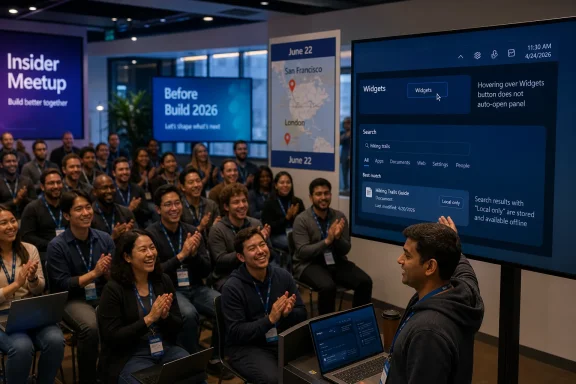
Microsoft has revived in-person Windows Insider meetups in 2026, bringing regular Windows users face to face with product leaders before Microsoft Build in San Francisco and planning more stops, including London on June 22. That sounds small beside the company’s larger Build-stage narrative about Copilot, agents, GitHub, and developer platforms. It is not small. If Microsoft is serious about making Windows feel less like a billboard and more like an operating system again, the room where users applaud a non-annoying Widgets button may matter as much as any keynote demo.
For years, Windows has suffered from a peculiar problem: it is both everywhere and oddly distant from the people who depend on it. A billion-plus users can complain about Start menu ads, account requirements, taskbar regressions, broken search, and Copilot overreach, but the complaint often disappears into telemetry, Feedback Hub votes, Reddit threads, and product-management abstraction. The PCWorld account of Microsoft’s revived Windows Insider meetup is striking because it describes something unfashionably analog: users in a room, reacting in real time, to the people building the thing.
That matters because Windows is not a normal consumer app. It is the ground under other software. It is the thing that appears before the browser, before Steam, before Office, before a VPN client, before a domain join, before the help desk ticket. When Windows gets noisy, it does not merely annoy users; it taxes every workflow built on top of it.
The most revealing detail from the meetup was not a sweeping AI announcement. It was the applause when Tali Roth showed that hovering over the Widgets button would no longer automatically trigger the Widgets panel. The cheer for a less intrusive hover target says more about Windows 11’s reputation than a hundred sentiment dashboards could.
The second cheer, for Windows Search returning only local files when asked to do so, is just as telling. Users are not rejecting ambition. They are rejecting the feeling that the operating system keeps smuggling in somebody else’s priorities.
But the Insider meetup described by PCWorld operated on a different frequency. It was not about whether Windows can host the next generation of agents. It was about whether Windows can stop surprising users with things they did not ask for. That distinction is not a sideshow. It is the prerequisite.
A platform that wants to run semi-autonomous software on a user’s behalf must first earn confidence doing ordinary things predictably. If File Explorer feels sluggish, if Search feels polluted, if Start feels monetized, if notifications feel like nagging, then “agentic Windows” lands less like progress and more like another layer of intrusion. Before Microsoft can ask users to trust Windows with more agency, it has to make Windows feel less presumptuous.
That is why the meetup format fits the moment. A keynote rewards spectacle. A user room punishes evasiveness. In a keynote, “cleaner and quieter” can become a slogan; in a meetup, someone can ask why the Widgets panel ever opened on hover in the first place.
Change itself was not the fatal offense. The deeper problem was the sense that decisions arrived pre-decided. The Windows 11 launch felt less like a conversation than a verdict. The centered Start menu, the simplified taskbar, the removed customization points, the Microsoft account pressure, the subscription nudges, and later the Copilot experiments all contributed to a perception that Windows had become a delivery vehicle for corporate strategy rather than a workbench for users.
That perception is hard to undo because Windows has a long memory. Power users remember when the taskbar could move. Admins remember when local accounts were less adversarial. Gamers remember when the OS felt like the neutral floor beneath their hardware. Small regressions accumulate into folklore, and folklore shapes adoption as much as benchmark charts do.
The revived Insider meetup is meaningful because it implicitly acknowledges that the missing layer was not only code quality. It was consent. Windows 11 did not just need bug fixes; it needed a way for users to believe their objections could change the product.
Modern software companies often mistake engagement for satisfaction. If a panel opens, a feed loads, an account prompt appears, or a notification gets clicked, the system can record activity. But activity is not trust. A startled user can create a metric. So can an irritated one.
Windows has been especially vulnerable to this trap because it sits at the junction of operating system, services business, advertising surface, app platform, and AI strategy. Every team has a reason to surface something. Every surface has a plausible justification. The result, from the user’s chair, is a death by a dozen “helpful” moments.
A cleaner Windows requires more than restraint in one feature team. It requires a hierarchy of values. The operating system must decide, repeatedly, that not interrupting the user is more valuable than promoting a feature, a feed, a subscription, or an assistant. That is an organizational discipline, not a toggle.
The codename itself matters less than the implied admission. Microsoft does not launch a broad quality-and-craft effort because everything is fine. It does so because the product has accumulated enough friction that “more features” no longer answers the complaint.
For IT pros, this is the part to watch. Performance improvements to Start, File Explorer, Search, update reliability, and memory behavior are not cosmetic; they determine how Windows feels across fleets of machines that are not all premium Copilot+ PCs. A faster demo on new silicon is one thing. A less annoying Windows on a four-year-old office laptop is the real test.
The danger is that K2 becomes another umbrella label under which Microsoft ships both repairs and new intrusions. A local AI runtime can be useful. On-device models can be useful. Better APIs for developers can be useful. But if the same release train also brings more prompts, more defaults that favor cloud services, and more “recommendations,” then users will reasonably conclude that the repair campaign was packaging.
But an Insider program can become performative if feedback is collected without power. Users can file reports forever. They can upvote issues, submit logs, complain in forums, and attend sessions. None of that matters if the product organization treats feedback as sentiment rather than input.
The revived meetups therefore face a credibility test. It is not enough for Microsoft staff to listen warmly. The company needs to show visible reversals, not only refinements. When a design choice is disliked, users need to see that the answer can be “we changed course,” not merely “we appreciate the feedback.”
The taskbar is a useful example. Windows 11’s taskbar simplification angered users because it removed established behaviors in the name of a cleaner foundation. Restoring flexibility is not just a feature request; it is a symbolic repair. It says the desktop is still a place users configure, not merely a surface Microsoft curates.
Microsoft’s best communities have usually formed around people, not portals. Developers trusted certain .NET voices because they could explain tradeoffs plainly. PowerShell grew partly because its designers talked like practitioners. Sysinternals became indispensable because it solved real problems and carried the credibility of people who understood Windows at a low level.
Windows needs more of that. Not brand accounts. Not sanitized blog language. Not “we heard your feedback” as a ritual phrase. It needs recognizable humans explaining why a decision was made, why it was wrong, what is hard about changing it, and what will happen next.
That does not mean every user request should win. Some old features are costly. Some preferences conflict. Some enterprise requirements frustrate consumers, and some consumer defaults horrify admins. But honest tradeoff talk is different from silence, and silence is what made many Windows 11 decisions feel arrogant.
Security teams have understood this for years. Alert fatigue is not just a SOC problem; it is a desktop problem. If Windows constantly asks users to consider promotions, recommendations, account nudges, browser defaults, backup reminders, news widgets, AI suggestions, and update prompts, then the system devalues its own interruptions.
A calmer Windows would make meaningful prompts more meaningful. If a security warning appears in an environment where Windows otherwise behaves with restraint, users are more likely to treat it as important. If it appears amid a swarm of engagement bait, it becomes just another obstacle.
This is also where enterprise IT and consumer UX converge. Admins want fewer surprise surfaces because surprise surfaces create tickets, risk, and policy exceptions. Home users want fewer surprise surfaces because they bought a PC to do something else. In both cases, quiet is not emptiness; it is respect.
Microsoft has business incentives to blend local and online results. Bing, Edge, Microsoft 365, Copilot, and cloud content all benefit when Windows becomes a funnel. But Windows Search loses trust when it feels less like an index and more like a sales clerk.
The right answer is not that web search should never exist in Windows. Some users like integrated results. Some enterprise environments benefit from unified search across cloud documents and local files. The answer is that scope must be legible and controllable.
A search box that says, in effect, “I am searching your PC and only your PC,” is a small act of clarity. The applause says users are hungry for clarity. They are tired of interfaces that blur boundaries and then call the blur convenience.
Telemetry can tell Microsoft that a feature is not used. It cannot always tell Microsoft whether users avoided it because they disliked it, misunderstood it, disabled it, feared it, or never found it. Feedback Hub can collect reports. It cannot fully capture the tone of a room when a product manager shows a fix to a long-standing irritation. Social media can amplify anger. It often punishes nuance.
A meetup is imperfect, of course. The attendees are self-selected. They skew enthusiast. They may overrepresent power-user concerns and underrepresent the silent majority that just uses whatever ships. But that is not a flaw so much as a known bias. Enthusiasts are the early-warning system for friction that later becomes mainstream resentment.
Windows has always depended on these people more than Microsoft sometimes admits. They are the family tech support desk, the workplace troubleshooters, the forum answerers, the imaging-script maintainers, the registry archaeologists, the people who know what changed after Patch Tuesday. If they feel ignored, the reputational damage spreads far beyond the room.
The Windows 11 era has made this especially important because Microsoft is changing multiple layers at once. Hardware requirements, security baselines, account flows, cloud identity assumptions, AI integrations, update cadence, Store behavior, and endpoint management expectations are all shifting. Even small UX changes can become expensive at scale.
A moved button can generate tickets. A changed default can break a documented procedure. A new consumer-facing prompt can confuse managed-device users. A feature that seems harmless on a personal laptop can become a compliance problem in a regulated environment.
In-person engagement is not a replacement for formal enterprise channels, preview rings, documentation, or deployment controls. But it can surface the lived reality behind those channels. The admin who says “this will create 5,000 help desk calls” is giving Microsoft a different kind of signal than a telemetry graph.
That ambition is not inherently hostile to users. Local AI could make accessibility better, search smarter, workflows faster, and privacy stronger when computation stays on device. Developers could build genuinely useful tools that understand local context without spraying data everywhere. Windows could become a strong client platform again rather than merely a launcher for web apps.
But the user concern is rational: agency cuts both ways. An agent that helps can also misfire. A system with more context can also expose more. A feature that acts on your behalf can also act beyond your intent. The more powerful Windows becomes, the more important it is that users understand boundaries and controls.
The meetup questions about agents trashing data go straight to the heart of the matter. Microsoft cannot answer those concerns with vibes. It needs permissions models, audit trails, rollback mechanisms, clear defaults, and admin controls that match the seriousness of the claim that software will do more on our behalf.
This is the unglamorous part of “cleaner and quieter.” Someone must have the authority to tell teams no. No, you may not add another prompt. No, you may not hijack this surface. No, you may not treat the Start menu as a conversion funnel. No, you may not make the default more confusing because it helps a quarterly metric.
Without that authority, Windows will drift back toward noise. The gravitational pull is too strong. Microsoft has too many services that want distribution, too many AI features that want attention, too many growth teams that can rationalize one more nudge as helpful.
The hopeful sign is that the current Windows conversation seems to recognize quality as a top-to-bottom concern rather than a polish pass. If Microsoft treats calmness as an architectural goal, not a marketing adjective, the company may have a chance to reset the relationship.
That embarrassment is useful. It keeps abstraction from hardening into arrogance. It reminds product teams that a “minor annoyance” can be a daily irritation for millions. It forces executives to hear not only what users want, but how tired they are of explaining it.
Microsoft should resist the urge to overproduce these meetups. The value is not in turning them into mini keynotes with lanyards and talking points. The value is proximity. Put the people who make decisions in the same room as the people who live with those decisions.
If the company continues the tour through London and other cities, it should bring engineers, designers, program managers, accessibility specialists, security people, and documentation owners. The best answers will not always come from the most senior person in the room. They will come from the person who can say, “I know why that happens, and here is what it would take to fix it.”
The evidence will look mundane. A Start menu that opens quickly. A taskbar that respects preference. A search experience whose scope is obvious. Widgets that wait to be summoned. Updates that complete with fewer surprises. Prompts that appear because they are necessary, not because a service wants attention.
These are not anti-innovation demands. They are the conditions under which innovation becomes welcome. Users are more open to new capabilities when the base system feels trustworthy. They are more willing to experiment when they believe they can undo, disable, or ignore what they do not want.
The worst possible outcome would be for Microsoft to treat the meetup applause as proof that the message is working rather than proof that the product had become too irritating. The cheers were not for branding. They were for relief.
 Microsoft Rediscovers the People Who Actually Use Windows
For years, Windows has suffered from a peculiar problem: it is both everywhere and oddly distant from the people who depend on it. A billion-plus users can complain about Start menu ads, account requirements, taskbar regressions, broken search, and Copilot overreach, but the complaint often disappears into telemetry, Feedback Hub votes, Reddit threads, and product-management abstraction. The PCWorld account of Microsoft’s revived Windows Insider meetup is striking because it describes something unfashionably analog: users in a room, reacting in real time, to the people building the thing.That matters because Windows is not a normal consumer app. It is the ground under other software. It is the thing that appears before the browser, before Steam, before Office, before a VPN client, before a domain join, before the help desk ticket. When Windows gets noisy, it does not merely annoy users; it taxes every workflow built on top of it.
The most revealing detail from the meetup was not a sweeping AI announcement. It was the applause when Tali Roth showed that hovering over the Widgets button would no longer automatically trigger the Widgets panel. The cheer for a less intrusive hover target says more about Windows 11’s reputation than a hundred sentiment dashboards could.
The second cheer, for Windows Search returning only local files when asked to do so, is just as telling. Users are not rejecting ambition. They are rejecting the feeling that the operating system keeps smuggling in somebody else’s priorities.
The Build Keynote Was Selling the Future; the Meetup Was Repairing the Present
Microsoft Build 2026 was, predictably, about developers and AI. The company’s public messaging leaned into agentic apps, local AI experiences, cloud services, GitHub workflows, and Windows as a platform for building. That is the pitch Microsoft wants investors, developers, and enterprise buyers to hear: Windows is not merely surviving the AI transition; it is becoming the local runtime for it.But the Insider meetup described by PCWorld operated on a different frequency. It was not about whether Windows can host the next generation of agents. It was about whether Windows can stop surprising users with things they did not ask for. That distinction is not a sideshow. It is the prerequisite.
A platform that wants to run semi-autonomous software on a user’s behalf must first earn confidence doing ordinary things predictably. If File Explorer feels sluggish, if Search feels polluted, if Start feels monetized, if notifications feel like nagging, then “agentic Windows” lands less like progress and more like another layer of intrusion. Before Microsoft can ask users to trust Windows with more agency, it has to make Windows feel less presumptuous.
That is why the meetup format fits the moment. A keynote rewards spectacle. A user room punishes evasiveness. In a keynote, “cleaner and quieter” can become a slogan; in a meetup, someone can ask why the Widgets panel ever opened on hover in the first place.
Windows 11’s Original Sin Was Not Change, but Silence
Windows users have endured disruptive change before. Windows 8 turned the desktop into a battleground. Windows 10 turned servicing into a permanent condition. Windows 11 moved the Start menu, constrained the taskbar, raised hardware requirements, and polished away options that power users had treated as muscle memory for decades.Change itself was not the fatal offense. The deeper problem was the sense that decisions arrived pre-decided. The Windows 11 launch felt less like a conversation than a verdict. The centered Start menu, the simplified taskbar, the removed customization points, the Microsoft account pressure, the subscription nudges, and later the Copilot experiments all contributed to a perception that Windows had become a delivery vehicle for corporate strategy rather than a workbench for users.
That perception is hard to undo because Windows has a long memory. Power users remember when the taskbar could move. Admins remember when local accounts were less adversarial. Gamers remember when the OS felt like the neutral floor beneath their hardware. Small regressions accumulate into folklore, and folklore shapes adoption as much as benchmark charts do.
The revived Insider meetup is meaningful because it implicitly acknowledges that the missing layer was not only code quality. It was consent. Windows 11 did not just need bug fixes; it needed a way for users to believe their objections could change the product.
The Applause for “Less” Should Terrify Product Managers
The strangest thing about the PCWorld report is how modest the applause lines were. Users cheered when Windows promised not to pop open a panel accidentally. They cheered when Search could behave like search rather than a portal. Those are not moonshots. They are signs that the baseline had drifted.Modern software companies often mistake engagement for satisfaction. If a panel opens, a feed loads, an account prompt appears, or a notification gets clicked, the system can record activity. But activity is not trust. A startled user can create a metric. So can an irritated one.
Windows has been especially vulnerable to this trap because it sits at the junction of operating system, services business, advertising surface, app platform, and AI strategy. Every team has a reason to surface something. Every surface has a plausible justification. The result, from the user’s chair, is a death by a dozen “helpful” moments.
A cleaner Windows requires more than restraint in one feature team. It requires a hierarchy of values. The operating system must decide, repeatedly, that not interrupting the user is more valuable than promoting a feature, a feed, a subscription, or an assistant. That is an organizational discipline, not a toggle.
K2 Sounds Like a Codename for Contrition
Microsoft’s reported Windows K2 effort has been described as a broad push to improve performance, reliability, and the core Windows experience. The details vary depending on the report, but the theme is consistent: make Windows faster, calmer, more reliable, and less stuffed with distractions. That is not glamorous. It is exactly what Windows needs.The codename itself matters less than the implied admission. Microsoft does not launch a broad quality-and-craft effort because everything is fine. It does so because the product has accumulated enough friction that “more features” no longer answers the complaint.
For IT pros, this is the part to watch. Performance improvements to Start, File Explorer, Search, update reliability, and memory behavior are not cosmetic; they determine how Windows feels across fleets of machines that are not all premium Copilot+ PCs. A faster demo on new silicon is one thing. A less annoying Windows on a four-year-old office laptop is the real test.
The danger is that K2 becomes another umbrella label under which Microsoft ships both repairs and new intrusions. A local AI runtime can be useful. On-device models can be useful. Better APIs for developers can be useful. But if the same release train also brings more prompts, more defaults that favor cloud services, and more “recommendations,” then users will reasonably conclude that the repair campaign was packaging.
The Insider Program Is Useful Only If It Can Say No
The Windows Insider Program began as one of Microsoft’s better post-Windows 8 ideas. It gave enthusiasts a way to test builds, offer feedback, and feel like part of the product’s direction. It also gave Microsoft an enormous distributed test surface during the shift to Windows as a continually serviced product.But an Insider program can become performative if feedback is collected without power. Users can file reports forever. They can upvote issues, submit logs, complain in forums, and attend sessions. None of that matters if the product organization treats feedback as sentiment rather than input.
The revived meetups therefore face a credibility test. It is not enough for Microsoft staff to listen warmly. The company needs to show visible reversals, not only refinements. When a design choice is disliked, users need to see that the answer can be “we changed course,” not merely “we appreciate the feedback.”
The taskbar is a useful example. Windows 11’s taskbar simplification angered users because it removed established behaviors in the name of a cleaner foundation. Restoring flexibility is not just a feature request; it is a symbolic repair. It says the desktop is still a place users configure, not merely a surface Microsoft curates.
Scott Hanselman’s Presence Signals a Different Kind of Windows Conversation
The presence of figures like Scott Hanselman and Marcus Ash matters because Windows’ public voice has often been strangely institutional. Hanselman, in particular, brings a long history of developer empathy, blogging culture, podcasting, small tools, and direct public conversation. That does not magically fix Windows, but it changes the texture of engagement.Microsoft’s best communities have usually formed around people, not portals. Developers trusted certain .NET voices because they could explain tradeoffs plainly. PowerShell grew partly because its designers talked like practitioners. Sysinternals became indispensable because it solved real problems and carried the credibility of people who understood Windows at a low level.
Windows needs more of that. Not brand accounts. Not sanitized blog language. Not “we heard your feedback” as a ritual phrase. It needs recognizable humans explaining why a decision was made, why it was wrong, what is hard about changing it, and what will happen next.
That does not mean every user request should win. Some old features are costly. Some preferences conflict. Some enterprise requirements frustrate consumers, and some consumer defaults horrify admins. But honest tradeoff talk is different from silence, and silence is what made many Windows 11 decisions feel arrogant.
A Quieter Windows Is Also a Security Feature
The “cleaner, quieter Windows” phrase sounds like user-experience language, but it has security implications. A noisy operating system trains users to dismiss prompts, ignore banners, and click through interruptions. Every unnecessary notification competes with the rare notification that actually matters.Security teams have understood this for years. Alert fatigue is not just a SOC problem; it is a desktop problem. If Windows constantly asks users to consider promotions, recommendations, account nudges, browser defaults, backup reminders, news widgets, AI suggestions, and update prompts, then the system devalues its own interruptions.
A calmer Windows would make meaningful prompts more meaningful. If a security warning appears in an environment where Windows otherwise behaves with restraint, users are more likely to treat it as important. If it appears amid a swarm of engagement bait, it becomes just another obstacle.
This is also where enterprise IT and consumer UX converge. Admins want fewer surprise surfaces because surprise surfaces create tickets, risk, and policy exceptions. Home users want fewer surprise surfaces because they bought a PC to do something else. In both cases, quiet is not emptiness; it is respect.
The Local Search Cheer Was a Vote Against Cloud Creep
The reaction to local-only Windows Search deserves special attention. Search is one of the most revealing parts of an operating system because it exposes what the vendor thinks the user is trying to do. When a person searches from the Start menu or File Explorer, they may be looking for a document, an app, a setting, a command, or a file they touched yesterday. If the OS responds as if every query is an opportunity to open the web, it breaks the mental model.Microsoft has business incentives to blend local and online results. Bing, Edge, Microsoft 365, Copilot, and cloud content all benefit when Windows becomes a funnel. But Windows Search loses trust when it feels less like an index and more like a sales clerk.
The right answer is not that web search should never exist in Windows. Some users like integrated results. Some enterprise environments benefit from unified search across cloud documents and local files. The answer is that scope must be legible and controllable.
A search box that says, in effect, “I am searching your PC and only your PC,” is a small act of clarity. The applause says users are hungry for clarity. They are tired of interfaces that blur boundaries and then call the blur convenience.
Meetups Are Not Nostalgia; They Are Product Infrastructure
It is tempting to romanticize the old user-group era: the rooms, the stickers, the product managers taking heat, the strange thrill of speaking directly to someone who could change the software. But the point is not nostalgia. The point is that direct feedback is a form of product infrastructure.Telemetry can tell Microsoft that a feature is not used. It cannot always tell Microsoft whether users avoided it because they disliked it, misunderstood it, disabled it, feared it, or never found it. Feedback Hub can collect reports. It cannot fully capture the tone of a room when a product manager shows a fix to a long-standing irritation. Social media can amplify anger. It often punishes nuance.
A meetup is imperfect, of course. The attendees are self-selected. They skew enthusiast. They may overrepresent power-user concerns and underrepresent the silent majority that just uses whatever ships. But that is not a flaw so much as a known bias. Enthusiasts are the early-warning system for friction that later becomes mainstream resentment.
Windows has always depended on these people more than Microsoft sometimes admits. They are the family tech support desk, the workplace troubleshooters, the forum answerers, the imaging-script maintainers, the registry archaeologists, the people who know what changed after Patch Tuesday. If they feel ignored, the reputational damage spreads far beyond the room.
The Enterprise Case for Listening Is Brutally Practical
For enterprise administrators, the revived Insider engagement should not be read as feel-good community outreach. It is potentially a risk-reduction mechanism. When Microsoft hears early and clearly that a change will break workflows, create training burdens, or trigger support spikes, everyone downstream benefits.The Windows 11 era has made this especially important because Microsoft is changing multiple layers at once. Hardware requirements, security baselines, account flows, cloud identity assumptions, AI integrations, update cadence, Store behavior, and endpoint management expectations are all shifting. Even small UX changes can become expensive at scale.
A moved button can generate tickets. A changed default can break a documented procedure. A new consumer-facing prompt can confuse managed-device users. A feature that seems harmless on a personal laptop can become a compliance problem in a regulated environment.
In-person engagement is not a replacement for formal enterprise channels, preview rings, documentation, or deployment controls. But it can surface the lived reality behind those channels. The admin who says “this will create 5,000 help desk calls” is giving Microsoft a different kind of signal than a telemetry graph.
Microsoft’s AI Ambition Still Hangs Over the Room
None of this can be separated from Microsoft’s larger AI strategy. The company wants Windows to matter in an era where computing shifts toward agents, local inference, semantic search, and cloud-connected workflows. It wants developers to build AI experiences that use Windows capabilities. It wants Copilot and related services to feel native rather than bolted on.That ambition is not inherently hostile to users. Local AI could make accessibility better, search smarter, workflows faster, and privacy stronger when computation stays on device. Developers could build genuinely useful tools that understand local context without spraying data everywhere. Windows could become a strong client platform again rather than merely a launcher for web apps.
But the user concern is rational: agency cuts both ways. An agent that helps can also misfire. A system with more context can also expose more. A feature that acts on your behalf can also act beyond your intent. The more powerful Windows becomes, the more important it is that users understand boundaries and controls.
The meetup questions about agents trashing data go straight to the heart of the matter. Microsoft cannot answer those concerns with vibes. It needs permissions models, audit trails, rollback mechanisms, clear defaults, and admin controls that match the seriousness of the claim that software will do more on our behalf.
A Passion Project Still Needs Governance
PCWorld’s framing that Windows now almost feels like a passion project is encouraging, but passion alone is not a product strategy. Windows is too large, too old, too commercially important, and too politically contested inside Microsoft to be saved by enthusiasm alone. The operating system needs governance that protects the user experience from internal land grabs.This is the unglamorous part of “cleaner and quieter.” Someone must have the authority to tell teams no. No, you may not add another prompt. No, you may not hijack this surface. No, you may not treat the Start menu as a conversion funnel. No, you may not make the default more confusing because it helps a quarterly metric.
Without that authority, Windows will drift back toward noise. The gravitational pull is too strong. Microsoft has too many services that want distribution, too many AI features that want attention, too many growth teams that can rationalize one more nudge as helpful.
The hopeful sign is that the current Windows conversation seems to recognize quality as a top-to-bottom concern rather than a polish pass. If Microsoft treats calmness as an architectural goal, not a marketing adjective, the company may have a chance to reset the relationship.
The Real Win Is a Windows Team Willing to Be Embarrassed in Public
There is a reason in-person feedback disappeared from many corners of the tech industry. It is uncomfortable. Users ask blunt questions. They remember old promises. They bring edge cases. They do not always respect the elegance of internal constraints. They applaud when you undo something your team once shipped.That embarrassment is useful. It keeps abstraction from hardening into arrogance. It reminds product teams that a “minor annoyance” can be a daily irritation for millions. It forces executives to hear not only what users want, but how tired they are of explaining it.
Microsoft should resist the urge to overproduce these meetups. The value is not in turning them into mini keynotes with lanyards and talking points. The value is proximity. Put the people who make decisions in the same room as the people who live with those decisions.
If the company continues the tour through London and other cities, it should bring engineers, designers, program managers, accessibility specialists, security people, and documentation owners. The best answers will not always come from the most senior person in the room. They will come from the person who can say, “I know why that happens, and here is what it would take to fix it.”
The Windows Reset Will Be Measured in Defaults, Not Declarations
The revived meetup program gives Microsoft a better way to hear users, but the product will be judged by shipped defaults. Enthusiasts have heard enough pledges. The next phase is evidence.The evidence will look mundane. A Start menu that opens quickly. A taskbar that respects preference. A search experience whose scope is obvious. Widgets that wait to be summoned. Updates that complete with fewer surprises. Prompts that appear because they are necessary, not because a service wants attention.
These are not anti-innovation demands. They are the conditions under which innovation becomes welcome. Users are more open to new capabilities when the base system feels trustworthy. They are more willing to experiment when they believe they can undo, disable, or ignore what they do not want.
The worst possible outcome would be for Microsoft to treat the meetup applause as proof that the message is working rather than proof that the product had become too irritating. The cheers were not for branding. They were for relief.
The Applause in That Room Gives Microsoft Its New Scorecard
The PCWorld report is valuable because it captures a rare Windows moment in which the company’s strategic story and the user’s daily reality briefly met. The lesson is not that every Insider meetup will change the operating system. The lesson is that Microsoft now has a public, human-scale test for whether its Windows reset is real.- Microsoft has restarted in-person Windows Insider meetups in 2026, with San Francisco activity around Build and a London meetup planned for June 22.
- The strongest user reactions described so far were for reduced annoyance: Widgets not opening on hover and Search returning local files without unwanted web clutter.
- The broader Windows K2 push will be judged less by its codename than by concrete improvements to performance, reliability, Search, File Explorer, updates, and default behavior.
- The Insider Program becomes meaningful only if feedback can visibly reverse unpopular decisions, not merely decorate decisions already made.
- Microsoft’s AI plans for Windows need a calmer, more trustworthy operating system underneath them, because agentic features will magnify both usefulness and risk.
- Enterprise IT should watch these meetups as an early signal of whether Microsoft is reducing support friction or simply finding friendlier language for the same old defaults.
References
- Primary source: PCWorld
Published: Thu, 04 Jun 2026 20:04:00 GMT
Windows Insider meetups are back. I went to one and so should you | PCWorld
Microsoft's Windows Insider meetups are back. They're a reminder of what made Windows 10 feel so personal and worth caring about.www.pcworld.com - Related coverage: windowscentral.com
"Listening to how we can keep making it better for you": Windows Insider meetups are coming back after years away, connecting Windows 11 users with Microsoft | Windows Central
Planned Windows Insider meetups include New York, San Francisco, London, and more cities worldwide in 2026.www.windowscentral.com - Related coverage: techspot.com
Microsoft's "Windows K2" plan promises a faster Start menu, instant search, and fewer botched updates | TechSpot
Sources tell Windows Central that recent Windows 11 updates are only a sliver of a much larger internal effort to stabilize the operating system after a string...www.techspot.com - Related coverage: pureinfotech.com
Microsoft's Windows K2 project aims to fix the Windows 11 core problems and rebuild user trust - Pureinfotech
Windows K2 brings faster performance, fewer bugs, and no Start menu ads as Microsoft resets how Windows 11 is built. pureinfotech.com
- Related coverage: techradar.com
Windows 12 at Build 2026: What to expect | TechRadar
What Build 2026 signals about the future of the Windowswww.techradar.com - Related coverage: windowslatest.com
Microsoft says it’s rebuilding Windows 11 around what users actually want: performance, reliability, quality and craft
Microsoft says it has assembled a group of product experts and engineers who are passionate and take pride in building Windows 11. www.windowslatest.com
- Related coverage: winbuzzer.com
Microsoft VP Wants to End Windows 11 Microsoft Account Mandate
Microsoft VP Scott Hanselman has revealed he is working to end Windows 11's mandatory Microsoft account requirement, amid a growing internal campaign.winbuzzer.com - Official source: download.microsoft.com
