

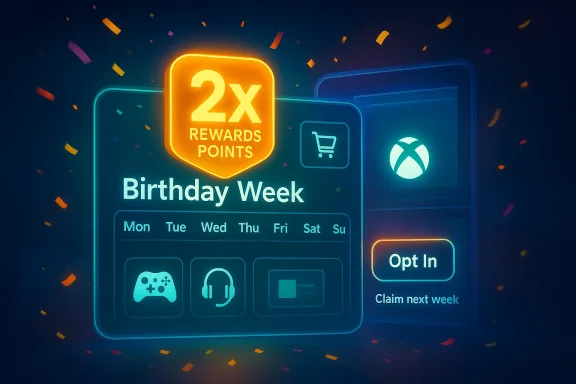
Microsoft Rewards has added a Birthday Gift that looks generous on paper and a little bureaucratic in practice. The new perk offers 2x Rewards points on eligible games and add-ons purchased from the Microsoft Store during your birthday week, but only if you opt in through the Rewards hub and then come back later to claim the bonus. That makes it more of a mini campaign than a simple birthday present, even if the underlying idea is friendly and personal.
What makes the update interesting is not just the extra points, but the timing. Microsoft has been reshaping Rewards for months, trimming some easy earnings while also adding new ways to interact with the ecosystem, including direct point spending on the Xbox dashboard. The birthday feature fits that pattern: it is a goodwill gesture, but also a nudge to keep people active in the store and inside the Rewards loop.
Microsoft Rewards has always sat at the intersection of loyalty program and engagement engine. At its core, the service lets users earn points for search, shopping, and select Xbox-related activity, then redeem those points for gift cards, sweepstakes entries, or charitable donations. Microsoft describes it as a free program tied to a Microsoft account, with point earning limits and marketplace restrictions depending on region, age, and activity type.
The program has changed noticeably over time, and not always in ways that users love. Windows Central itself has documented a wave of modifications, including the discontinuation of the Xbox Rewards app in favor of a simplified hub and other adjustments that made some reward paths less convenient. In that context, a birthday bonus is easy to read as Microsoft trying to soften the edges of a program that has felt more restrictive lately.
That is important because Rewards is not just a promotion; it is a behavioral loop. If users visit daily, they are more likely to search with Bing, check the Xbox dashboard, and buy through Microsoft Store rather than elsewhere. The birthday gift therefore acts as both a token of appreciation and a retention mechanism. That dual purpose is the key to understanding the rollout.
The new perk also lands at a moment when Xbox and Microsoft Store economics matter more than ever. Microsoft has pushed harder toward services, digital content, and platform engagement, while console and PC buyers have become increasingly value-conscious. A birthday multiplier can make a purchase feel more rewarding without cutting sticker prices, which is a classic platform strategy.
In practical terms, the feature is narrow but meaningful. It does not change the whole Rewards structure, and it does not remove the existing monthly earning cap on qualifying Store purchases. Instead, it creates a timed bonus window, which is exactly the sort of mechanic that turns a casual perk into a planned action.
That structure matters more than it first appears. A straight birthday bonus would be passive, but Microsoft chose an opt-in flow with a delayed claim step. The result is a feature that rewards attention and repeated visits, which is exactly what engagement-focused programs are designed to do. It is generous, but it is also designed like a funnel.
The important implication is that this is not free money in the broadest sense. It is a targeted multiplier on specific content types, inside a specific time window, and only for users who engage with the dashboard at the right times. That makes it more like a promotional event than a standing birthday entitlement.
That is a more involved process than most birthday bonuses. Many loyalty schemes simply push a one-time credit to the account, or they apply the perk automatically during a broader birthday month. Microsoft instead makes the user participate, which likely lowers accidental misuse but also reduces spontaneity. Convenience was not the design priority here.
This is where the feature feels less like a gift card equivalent and more like a quest. Microsoft is rewarding the act of remembering, not just the act of celebrating. That may frustrate casual users, but it suits the company’s broader strategy of turning every touchpoint into an active relationship.
A numbered breakdown makes the process clearer:
There is also a retention logic here. A lot of loyalty programs become invisible once the novelty wears off, but Microsoft Rewards depends on regular checking, daily earning, and recurring store activity. A birthday feature creates a predictable annual reason to come back, even for users who have drifted away.
That does not make it cynical by default. Big consumer platforms often use perks to encourage good habits and reward loyalty, and this one does exactly that. But the administrative steps make the intent visible, which is why some users may feel the perk is more transactional than celebratory.
The company likely also benefits from the birthday framing because it makes the program feel more human. Rewards is often criticized as being overly mechanical, especially when point values shift or features get removed. A birthday gift introduces a small emotional beat that can soften those perceptions.
That matters because the Xbox audience is already accustomed to seasonal events, punch cards, and limited-time promotions. A birthday multiplier does not feel alien in that environment; it feels like another event to track. The difference is that this one is tied to the individual rather than the calendar.
That ecosystem strategy is why the offer excludes subscriptions and gift card purchases from standard reward earning. Microsoft wants points to reinforce shopping and engagement behavior, not to create a free cash-equivalent loop. That policy is consistent with the company’s existing Rewards rules and store terms.
There is also a subtle merchandising angle. Birthday-week buyers may be more likely to purchase a bigger game or an extra add-on because the 2x offer makes the spending feel more efficient. If Microsoft can shift just a fraction of those purchases onto its store, the feature pays for itself in retention and revenue.
This is where the user experience can get messy. A promotion advertised as a birthday boost can quickly become an exercise in decoding overlapping rules. That is fine for seasoned Rewards hunters, but it is less friendly for the casual user who just wants a low-friction perk.
It also means that the perk is more strategic than emotional. If you are near the cap, the “gift” may produce far fewer points than the headline suggests. That does not make it worthless, but it does make it conditional in a way that birthday promotions usually are not.
There is another practical wrinkle: point values can vary by currency and Rewards level. Microsoft’s broader Rewards documentation already ties earning rates and redemption value to local market factors, so the birthday bonus is not perfectly uniform across regions. That is standard for a global loyalty program, but it does complicate the user’s mental math.
The Reddit discussion also suggests that the perk may resonate differently depending on how often someone already uses Rewards. Power users tend to treat every promotional tweak as a new optimization puzzle, while more casual users ask why a birthday gift needs a checklist. That gap explains the tone of the conversation better than the feature itself does.
At the same time, the birthday gift has enough charm to stand out. It personalizes a system that often feels abstract, and it gives users a reason to open the Rewards hub outside the usual daily grind. That alone makes it a better community conversation piece than a standard points rate change.
The most telling part of the reaction is that people are not arguing about whether the feature exists. They are arguing about whether it should have been simpler. That is usually a sign that the idea is appealing, but the execution is just bureaucratic enough to irritate people who care about friction.
That means the real question is not whether this specific perk is good. It is whether Microsoft can keep making Rewards feel rewarding while continuing to tighten the mechanics around it. The more the company leans into structured offers, the more important clarity and simplicity will become. A good perk can survive complexity; a confusing one cannot.
In the end, this is a good example of modern Microsoft at its best and most frustrating: thoughtful, platform-aware, and just a little too procedural. The Birthday Gift is genuinely useful for the right user at the right time, but it also reminds everyone that nothing in Rewards is ever entirely free, entirely simple, or entirely accidental.
Source: Windows Central Xbox Rewards new Birthday Gift is great but basically homework
What makes the update interesting is not just the extra points, but the timing. Microsoft has been reshaping Rewards for months, trimming some easy earnings while also adding new ways to interact with the ecosystem, including direct point spending on the Xbox dashboard. The birthday feature fits that pattern: it is a goodwill gesture, but also a nudge to keep people active in the store and inside the Rewards loop.
 Background
Microsoft Rewards has always sat at the intersection of loyalty program and engagement engine. At its core, the service lets users earn points for search, shopping, and select Xbox-related activity, then redeem those points for gift cards, sweepstakes entries, or charitable donations. Microsoft describes it as a free program tied to a Microsoft account, with point earning limits and marketplace restrictions depending on region, age, and activity type.The program has changed noticeably over time, and not always in ways that users love. Windows Central itself has documented a wave of modifications, including the discontinuation of the Xbox Rewards app in favor of a simplified hub and other adjustments that made some reward paths less convenient. In that context, a birthday bonus is easy to read as Microsoft trying to soften the edges of a program that has felt more restrictive lately.
That is important because Rewards is not just a promotion; it is a behavioral loop. If users visit daily, they are more likely to search with Bing, check the Xbox dashboard, and buy through Microsoft Store rather than elsewhere. The birthday gift therefore acts as both a token of appreciation and a retention mechanism. That dual purpose is the key to understanding the rollout.
The new perk also lands at a moment when Xbox and Microsoft Store economics matter more than ever. Microsoft has pushed harder toward services, digital content, and platform engagement, while console and PC buyers have become increasingly value-conscious. A birthday multiplier can make a purchase feel more rewarding without cutting sticker prices, which is a classic platform strategy.
In practical terms, the feature is narrow but meaningful. It does not change the whole Rewards structure, and it does not remove the existing monthly earning cap on qualifying Store purchases. Instead, it creates a timed bonus window, which is exactly the sort of mechanic that turns a casual perk into a planned action.
What Microsoft Actually Changed
The headline idea is simple: eligible Rewards members can earn double points on qualifying Store purchases during their birthday week. According to Microsoft’s FAQ, that week runs from Monday through Sunday, and the bonus points are claimable during the week after the birthday week ends. In other words, the program creates an incentive period and then makes users return later to collect the reward.That structure matters more than it first appears. A straight birthday bonus would be passive, but Microsoft chose an opt-in flow with a delayed claim step. The result is a feature that rewards attention and repeated visits, which is exactly what engagement-focused programs are designed to do. It is generous, but it is also designed like a funnel.
The basic rules
Microsoft’s own wording shows that the offer is not universal, not immediate, and not unlimited. The perk is tied to the Rewards hub, the birthday week, and qualifying Store purchases such as games and add-ons. It is also constrained by the usual monthly limits and by the general Rewards rule that subscriptions and gift card purchases are not eligible for points.The important implication is that this is not free money in the broadest sense. It is a targeted multiplier on specific content types, inside a specific time window, and only for users who engage with the dashboard at the right times. That makes it more like a promotional event than a standing birthday entitlement.
- Birthday week runs Monday to Sunday.
- The birthday gift is opt-in through the Rewards hub.
- Bonus points are claimed later, not instantly.
- Only eligible games and add-ons qualify.
- Monthly earning caps still apply.
How the Birthday Gift Works in Practice
The flow is best understood as a three-step process. First, you need to find the offer in the Rewards hub during your birthday month and opt in. Second, you must buy eligible Store content during the designated Monday-to-Sunday birthday week. Third, you have to revisit the hub the following week to claim the double points.That is a more involved process than most birthday bonuses. Many loyalty schemes simply push a one-time credit to the account, or they apply the perk automatically during a broader birthday month. Microsoft instead makes the user participate, which likely lowers accidental misuse but also reduces spontaneity. Convenience was not the design priority here.
Why the claim flow matters
The delayed claim step is a small detail with big behavioral implications. It forces an extra return visit, and return visits are the currency of modern platform loyalty. Each additional check-in reinforces familiarity with the Rewards hub and increases the odds of future spending or activity.This is where the feature feels less like a gift card equivalent and more like a quest. Microsoft is rewarding the act of remembering, not just the act of celebrating. That may frustrate casual users, but it suits the company’s broader strategy of turning every touchpoint into an active relationship.
A numbered breakdown makes the process clearer:
- Open the Rewards hub during your birthday month and opt in.
- Buy eligible games or add-ons only during the birthday week.
- Return the following week to claim your bonus points.
- The perk is timed rather than automatic.
- The bonus is tracked through the hub.
- Users must claim points separately.
- It favors planned purchases over impulse buys.
- It rewards users who already check Rewards often.
Why Microsoft Chose This Model
Microsoft’s new birthday gift is not happening in isolation. The company has been iterating on Rewards in ways that seem aimed at making the program more integrated with Xbox and the Microsoft Store, while also tightening some of the older easy-win mechanics. A birthday multiplier fits that strategy because it increases perceived value without permanently increasing baseline payout rates.There is also a retention logic here. A lot of loyalty programs become invisible once the novelty wears off, but Microsoft Rewards depends on regular checking, daily earning, and recurring store activity. A birthday feature creates a predictable annual reason to come back, even for users who have drifted away.
Engagement over generosity
This is where the feature starts to look like classic platform design. A truly generous birthday gift would probably be automatic, unconditional, and easy to redeem. Microsoft instead built a participatory gift, which preserves the feel of generosity while serving the company’s engagement goals.That does not make it cynical by default. Big consumer platforms often use perks to encourage good habits and reward loyalty, and this one does exactly that. But the administrative steps make the intent visible, which is why some users may feel the perk is more transactional than celebratory.
The company likely also benefits from the birthday framing because it makes the program feel more human. Rewards is often criticized as being overly mechanical, especially when point values shift or features get removed. A birthday gift introduces a small emotional beat that can soften those perceptions.
- It encourages annual re-engagement.
- It nudges users toward the Microsoft Store.
- It keeps rewards tied to digital content spending.
- It preserves Microsoft’s ability to enforce caps and exclusions.
- It adds a more personalized tone to the program.
The Xbox and Microsoft Store Angle
The birthday gift is particularly relevant to Xbox users because the ecosystem has been leaning harder into dashboard-based spending and reward discovery. Windows Central noted the companion update allowing users to spend points directly on the Xbox dashboard, which means Rewards is becoming more tightly woven into the console experience. The birthday perk extends that logic by making the store itself a place where earned value can be amplified.That matters because the Xbox audience is already accustomed to seasonal events, punch cards, and limited-time promotions. A birthday multiplier does not feel alien in that environment; it feels like another event to track. The difference is that this one is tied to the individual rather than the calendar.
Consumer experience versus ecosystem strategy
From a consumer perspective, the perk is easy to understand: buy the game or add-on you were already considering and get extra points. From Microsoft’s perspective, the transaction is richer than that because it keeps the user inside a broader ecosystem that includes Rewards, the Store, and Xbox identity.That ecosystem strategy is why the offer excludes subscriptions and gift card purchases from standard reward earning. Microsoft wants points to reinforce shopping and engagement behavior, not to create a free cash-equivalent loop. That policy is consistent with the company’s existing Rewards rules and store terms.
There is also a subtle merchandising angle. Birthday-week buyers may be more likely to purchase a bigger game or an extra add-on because the 2x offer makes the spending feel more efficient. If Microsoft can shift just a fraction of those purchases onto its store, the feature pays for itself in retention and revenue.
- The Xbox dashboard is becoming a more important Rewards surface.
- Birthday bonuses encourage store-native purchases.
- Microsoft can steer users toward digital content, not cash-like redemptions.
- The offer reinforces the idea that Xbox is a service ecosystem, not just a console.
- The perk may be most valuable for users already planning a new release purchase.
The Fine Print That Changes the Value
A lot of the real story lives in the exclusions. Microsoft says the birthday gift cannot be combined with other Rewards promotions, and standard monthly earning limits still apply. That means the actual value of the perk depends heavily on what else you have earned that month and whether the purchase overlaps with other offers.This is where the user experience can get messy. A promotion advertised as a birthday boost can quickly become an exercise in decoding overlapping rules. That is fine for seasoned Rewards hunters, but it is less friendly for the casual user who just wants a low-friction perk.
Limits, caps, and overlap rules
The monthly cap is especially important because it prevents the birthday gift from becoming an unlimited multiplier. Microsoft already states that qualifying Store purchases earn points under a monthly ceiling, and promotional offers do not stack in the way some users might hope. In practice, this means the birthday bonus is most useful when you have room left under your cap.It also means that the perk is more strategic than emotional. If you are near the cap, the “gift” may produce far fewer points than the headline suggests. That does not make it worthless, but it does make it conditional in a way that birthday promotions usually are not.
There is another practical wrinkle: point values can vary by currency and Rewards level. Microsoft’s broader Rewards documentation already ties earning rates and redemption value to local market factors, so the birthday bonus is not perfectly uniform across regions. That is standard for a global loyalty program, but it does complicate the user’s mental math.
- The offer does not stack with other Rewards promotions.
- The regular monthly cap still applies.
- Value can change with local currency and Rewards level.
- The perk works best when you have unused purchase capacity.
- The fine print narrows the pool of truly high-value use cases.
Community Reaction and What It Says
The early reaction has been a mix of delight, confusion, and dry humor. Some users see the feature as a nice personal touch, while others immediately noticed how many steps are involved. That split is predictable whenever a platform introduces something that feels rewarding but requires more attention than expected.The Reddit discussion also suggests that the perk may resonate differently depending on how often someone already uses Rewards. Power users tend to treat every promotional tweak as a new optimization puzzle, while more casual users ask why a birthday gift needs a checklist. That gap explains the tone of the conversation better than the feature itself does.
A familiar Microsoft pattern
This launch also feels familiar because Microsoft has made several Rewards changes that encourage active participation rather than passive accumulation. The shift away from simpler routines has trained the community to look at every new perk through a skeptical lens. As a result, even a genuinely positive addition can be received with a shrug and a spreadsheet.At the same time, the birthday gift has enough charm to stand out. It personalizes a system that often feels abstract, and it gives users a reason to open the Rewards hub outside the usual daily grind. That alone makes it a better community conversation piece than a standard points rate change.
The most telling part of the reaction is that people are not arguing about whether the feature exists. They are arguing about whether it should have been simpler. That is usually a sign that the idea is appealing, but the execution is just bureaucratic enough to irritate people who care about friction.
- Enthusiasts like the extra optimization opportunity.
- Casual users dislike the multi-step claim process.
- The feature is seen as goodwill, but not elegant.
- Community sentiment is broadly positive, with reservations.
- The update reinforces the idea that Rewards users must stay alert to rule changes.
Strengths and Opportunities
The best thing about the Birthday Gift is that it gives Microsoft Rewards a warmer, more human edge at a time when the program can feel increasingly mechanical. It also creates a natural annual touchpoint for users who might otherwise ignore the Rewards hub for months. Used well, it can become one of those small perks that quietly improves perception of the entire ecosystem. The opportunity is bigger than the bonus itself.- It adds a personalized reason to visit Rewards.
- It can nudge users toward planned Store purchases.
- It may improve retention by creating an annual habit.
- It strengthens the link between Xbox, Store, and Rewards.
- It offers meaningful value to users who already buy games and add-ons.
- It can soften negative sentiment around recent Rewards shake-ups.
- It gives Microsoft a low-cost way to signal appreciation.
Risks and Concerns
The biggest concern is friction. A birthday gift should feel effortless, but Microsoft’s version asks users to opt in, track a specific week, make eligible purchases, and return later to claim the bonus. That may be acceptable for enthusiasts, but it is exactly the sort of process that makes casual users abandon the feature before it becomes meaningful.- The claim process is more complex than a typical birthday perk.
- The bonus is limited by monthly earning caps.
- It may be confusing when combined with other promotions.
- Its value is uneven across regions and currencies.
- Users could miss the window and lose the benefit entirely.
- It may reinforce the impression that Rewards is becoming more restrictive.
- The feature could feel less like a gift and more like a task.
Looking Ahead
The birthday gift is likely a sign of more tuning rather than a one-off experiment. Microsoft Rewards has been evolving into a more structured ecosystem, and features like this suggest the company wants to preserve the program’s appeal while making it more targeted and controllable. If the rollout goes smoothly, expect Microsoft to keep experimenting with personalized incentives, seasonal boosts, and dashboard-based reward prompts.That means the real question is not whether this specific perk is good. It is whether Microsoft can keep making Rewards feel rewarding while continuing to tighten the mechanics around it. The more the company leans into structured offers, the more important clarity and simplicity will become. A good perk can survive complexity; a confusing one cannot.
- Watch for clearer in-hub messaging about eligibility and claim timing.
- Look for possible expansion or adjustment of birthday-week rules.
- Monitor whether Microsoft adds more personalized Rewards offers.
- Pay attention to how the update affects Xbox Store shopping behavior.
- See whether community feedback pushes Microsoft toward a simpler redemption flow.
In the end, this is a good example of modern Microsoft at its best and most frustrating: thoughtful, platform-aware, and just a little too procedural. The Birthday Gift is genuinely useful for the right user at the right time, but it also reminds everyone that nothing in Rewards is ever entirely free, entirely simple, or entirely accidental.
Source: Windows Central Xbox Rewards new Birthday Gift is great but basically homework
