

Microsoft Rewards is once again in the middle of a quiet but meaningful redesign, and this time the changes look bigger than the usual point-value tweaks. What users are seeing is a more structured tier system, new earning paths, and a shift that could materially affect anyone who treats Rewards like a daily routine rather than an occasional perk. For casual users, the update may look like a cosmetic refresh; for frequent earners and heavy redeemers, it could change the math in ways that are easy to underestimate.
Microsoft Rewards has always been one of those Microsoft programs that looks simple on the surface and grows more complicated the longer you use it. The basic promise has stayed the same for years: search, browse, shop, complete tasks, and turn those activities into points that can be redeemed for gift cards, donations, or other rewards. Microsoft’s current support pages still describe the program in those familiar terms, and they still emphasize that points can be earned through Bing searches, Microsoft Edge activity, Xbox-related actions, and daily dashboard tasks.
But the fine print matters, and it has always mattered. Microsoft’s own support documentation makes clear that earning rates, reward availability, and market-specific features vary by region, and that point limits apply. In other words, Microsoft Rewards is not a fixed-value program in the way a store loyalty card might be; it is a dynamic system that Microsoft can tune at any time. That flexibility has become increasingly visible as users report changes to daily point totals, redemption thresholds, and the way status levels work.
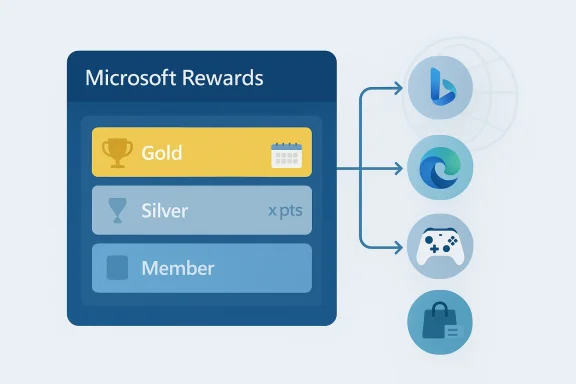
The latest changes are interesting because they appear to be part of a broader global rollout rather than a one-off experiment. Microsoft’s own Rewards pages already show a classic two-level structure in many markets, with Level 1 and Level 2 tied to monthly point accumulation, while some regional experiences have been observed with Member, Silver, and Gold tiers. That contrast is important: it suggests Microsoft is not merely changing a few numbers, but potentially operating multiple versions of the program at once depending on country, account history, and rollout stage.
That kind of split experience is exactly why the current wave of complaints has landed with so much force. Long-time users tend to notice when daily points shrink, when a streak bonus changes, or when a new dashboard introduces another layer of friction. Even if Microsoft frames the update as an improvement, the reality for many users may be less simplicity, more segmentation, and possibly less value unless they actively adapt their habits.
Historically, the program has oscillated between generosity and restraint. Earlier versions were more straightforward, with clear tiering and visible incentives tied to repeat behavior. Microsoft’s current public documentation still reflects that structure in many regions: Level 1 is automatic, Level 2 requires 500 points per month, and Level 2 unlocks higher search caps and additional perks. That framework has been stable enough that many users now treat it as the “normal” version of Microsoft Rewards.
The problem is that loyalty programs rarely stay stable once they become widely used. Microsoft Rewards is now a mature program with millions of participants, and mature loyalty systems often shift from broad acquisition incentives to efficiency-focused designs. In plain English, that means companies frequently start asking how to deliver the same engagement with fewer subsidy-like benefits. The recent reports of point reductions, tier changes, and region-by-region rollouts fit that pattern neatly.
There is also a regional dimension that cannot be ignored. Microsoft’s official pages repeatedly note that offers, features, and earning rules vary by market. That gives the company enormous flexibility, but it also creates a fragmented user experience in which one country may see a new tier system months before another. Users in places such as Mexico, India, Germany, France, Thailand, and the United Kingdom have reported or discussed seeing the newer structure earlier than U.S. users, which supports the idea that Microsoft is testing and expanding in phases.
All of that leads to the central point: this is not just a Rewards redesign. It is a rebalancing of incentive economics, and those kinds of changes tend to have winners and losers. The people who earn casually may barely notice, while the users who extract the most value from daily sets, search routines, and redemption optimization will feel the difference immediately. That is why the reaction has been so mixed, and why some users are already calling the new setup not so good.
Another visible shift is the promise of more ways to earn, including monthly bonuses. That sounds attractive on paper, and in the best-case scenario it could make the program feel more dynamic. But in loyalty program design, “more ways to earn” often comes with a tradeoff: the base earning rate is compressed, and the new bonuses become the carrot that nudges users into higher engagement. That is not necessarily a bad thing, but it does mean the headline improvement may mask a lower default value for many accounts.
That structure also creates a more visible path for nudging users upward. If Gold can indeed deliver “up to 7x more points” in some form, then Microsoft is signaling that participation depth will be increasingly rewarded. The phrase up to is doing a lot of work there, though, because it leaves room for market-specific ceilings, activity-specific multipliers, and promotional quirks that may make the real-world benefit less dramatic than users expect.
That fragmentation can be frustrating, but it also gives Microsoft room to test reactions before standardizing. If a three-tier system produces higher engagement in one market and backlash in another, the company can adjust thresholds, rewards, or messaging before expanding further. In that sense, the rollout is not merely a product update; it is a live experiment in consumer behavior.
That matters because rollout timing shapes perception. A user encountering the system for the first time may view it as a fresh feature set, while a user who has watched point values decline for months will see it as a cut dressed up as a redesign. Context determines reaction, and Microsoft may be underestimating how much goodwill it has already spent.
That distinction is crucial. If Microsoft lowers the effective value of points or makes the route to redeem them longer, it is not technically taking away money from users. It is redesigning the exchange rate inside a closed ecosystem. For frequent redeemers, that can feel like a real loss even if the program terms allow it. Psychologically, that is often the same thing.
That is why reports about daily point reductions can hit so hard. A 5-point daily set instead of 10 points may sound trivial in isolation, but over weeks and months it changes the arithmetic for streak builders. A similar effect happens when monthly bonuses become the dominant source of value, because users who miss a day or two can no longer rely on a steady baseline to keep their totals healthy.
For enterprise observers, Rewards is a reminder of how Microsoft increasingly uses incentives to reinforce product behavior. Bing search, Edge usage, Xbox engagement, and store activity are not isolated experiences; they are part of a broader platform strategy. A more segmented Rewards system may not matter much to corporate IT buyers directly, but it does reveal how Microsoft thinks about engagement, funnel design, and cross-service monetization.
The emotional part matters here too. Rewards programs are built on the idea of earned perks, so any reduction can feel personal. Even if the change is mathematically small, the sense of losing a benefit you had come to count on can be enough to sour the whole experience.
The company also benefits from the fact that Rewards is not a traditional cashback program. It can adjust offers, change redemption catalogs, and shift the point economy without having to publish the kind of transparent financial conversion rules a bank or retailer might need. That flexibility is powerful, but it also means users must accept more ambiguity. Convenience comes with opacity.
That is where the “Gold” concept becomes strategically important. Gold is not just a badge; it is a segmentation tool. It lets Microsoft say that the most active users deserve the best rates while quietly making the average user work a little harder for the same outcome. That may be efficient for Microsoft, but it risks turning a friendly loyalty program into a performance ladder.
The issue is not simply that people dislike change. Users often accept change when it is framed as a genuine upgrade and when the reward is obvious. What tends to trigger backlash is when the new structure looks more complicated while delivering less obvious value. That is a dangerous combination for a program built on habit and goodwill.
That is why the criticism spreading through communities like Reddit is so consequential. Enthusiasts often become the unofficial support layer for a program like this, and when they turn negative, casual users tend to follow their lead. Microsoft can manage complaints, but it cannot easily unsee a reputation problem once it becomes part of the conversation.
Another risk is fragmentation. If the new system behaves differently across countries, support teams will face more confusion and users will struggle to compare notes. That can make the program feel unfair, even when the differences are simply regional policy variations. Confusion is expensive in a loyalty ecosystem.
The most important thing to watch is not the branding, but the behavior. Are users earning more in practice, or merely chasing a more elaborate set of conditions for the same total value? Are redemption options improving, or are they becoming more selective and harder to reach? Those are the questions that will determine whether the new Rewards model feels like progress or simply a reshuffling of the deck.
Source: Windows Central Microsoft confirms major Rewards changes in May that may impact daily point earners and frequent redeemers
 Overview
Microsoft Rewards has always been one of those Microsoft programs that looks simple on the surface and grows more complicated the longer you use it. The basic promise has stayed the same for years: search, browse, shop, complete tasks, and turn those activities into points that can be redeemed for gift cards, donations, or other rewards. Microsoft’s current support pages still describe the program in those familiar terms, and they still emphasize that points can be earned through Bing searches, Microsoft Edge activity, Xbox-related actions, and daily dashboard tasks.But the fine print matters, and it has always mattered. Microsoft’s own support documentation makes clear that earning rates, reward availability, and market-specific features vary by region, and that point limits apply. In other words, Microsoft Rewards is not a fixed-value program in the way a store loyalty card might be; it is a dynamic system that Microsoft can tune at any time. That flexibility has become increasingly visible as users report changes to daily point totals, redemption thresholds, and the way status levels work.
The latest changes are interesting because they appear to be part of a broader global rollout rather than a one-off experiment. Microsoft’s own Rewards pages already show a classic two-level structure in many markets, with Level 1 and Level 2 tied to monthly point accumulation, while some regional experiences have been observed with Member, Silver, and Gold tiers. That contrast is important: it suggests Microsoft is not merely changing a few numbers, but potentially operating multiple versions of the program at once depending on country, account history, and rollout stage.
That kind of split experience is exactly why the current wave of complaints has landed with so much force. Long-time users tend to notice when daily points shrink, when a streak bonus changes, or when a new dashboard introduces another layer of friction. Even if Microsoft frames the update as an improvement, the reality for many users may be less simplicity, more segmentation, and possibly less value unless they actively adapt their habits.
Background
Microsoft Rewards began life as Bing Rewards and later evolved into a broader Microsoft ecosystem loyalty program. Over time, the company folded in search, browsing, shopping, gaming, and promotional activity, turning a simple search incentive into a cross-product engagement engine. The long arc matters because it shows Microsoft’s intent: Rewards is not just about giving away points, but about keeping users in Microsoft’s ecosystem longer and more often.Historically, the program has oscillated between generosity and restraint. Earlier versions were more straightforward, with clear tiering and visible incentives tied to repeat behavior. Microsoft’s current public documentation still reflects that structure in many regions: Level 1 is automatic, Level 2 requires 500 points per month, and Level 2 unlocks higher search caps and additional perks. That framework has been stable enough that many users now treat it as the “normal” version of Microsoft Rewards.
The problem is that loyalty programs rarely stay stable once they become widely used. Microsoft Rewards is now a mature program with millions of participants, and mature loyalty systems often shift from broad acquisition incentives to efficiency-focused designs. In plain English, that means companies frequently start asking how to deliver the same engagement with fewer subsidy-like benefits. The recent reports of point reductions, tier changes, and region-by-region rollouts fit that pattern neatly.
There is also a regional dimension that cannot be ignored. Microsoft’s official pages repeatedly note that offers, features, and earning rules vary by market. That gives the company enormous flexibility, but it also creates a fragmented user experience in which one country may see a new tier system months before another. Users in places such as Mexico, India, Germany, France, Thailand, and the United Kingdom have reported or discussed seeing the newer structure earlier than U.S. users, which supports the idea that Microsoft is testing and expanding in phases.
All of that leads to the central point: this is not just a Rewards redesign. It is a rebalancing of incentive economics, and those kinds of changes tend to have winners and losers. The people who earn casually may barely notice, while the users who extract the most value from daily sets, search routines, and redemption optimization will feel the difference immediately. That is why the reaction has been so mixed, and why some users are already calling the new setup not so good.
What Microsoft appears to be changing
The clearest sign of change is the move to a three-tier structure: Member, Silver, and Gold. That alone is enough to signal a different philosophy. Instead of a simple two-level ladder that rewards monthly consistency, Microsoft appears to be introducing more granular progression, presumably so it can tailor earning rates, bonuses, and redemption perks more precisely.Another visible shift is the promise of more ways to earn, including monthly bonuses. That sounds attractive on paper, and in the best-case scenario it could make the program feel more dynamic. But in loyalty program design, “more ways to earn” often comes with a tradeoff: the base earning rate is compressed, and the new bonuses become the carrot that nudges users into higher engagement. That is not necessarily a bad thing, but it does mean the headline improvement may mask a lower default value for many accounts.
The new tier logic
The naming itself is revealing. Calling the lowest tier Member instead of Bronze is unusual, but it fits Microsoft’s branding style, which tends to prefer clean, corporate language over game-like medal terms. Still, the label matters less than what it implies operationally: a tighter hierarchy in which the company can reserve the best multipliers and perks for the most active users.That structure also creates a more visible path for nudging users upward. If Gold can indeed deliver “up to 7x more points” in some form, then Microsoft is signaling that participation depth will be increasingly rewarded. The phrase up to is doing a lot of work there, though, because it leaves room for market-specific ceilings, activity-specific multipliers, and promotional quirks that may make the real-world benefit less dramatic than users expect.
- Member appears to be the baseline entry tier.
- Silver likely acts as the mid-level engagement tier.
- Gold is the premium participation tier with the strongest bonuses.
- Monthly bonuses may become more central than daily default earnings.
- The new system may encourage habitual engagement rather than occasional participation.
Why the rollout matters more than the headline
The biggest reason this update matters is that it seems to be rolling out unevenly across markets. Microsoft’s official support materials already say that Rewards availability and features vary by country, and that is exactly the kind of language that enables gradual global deployment. For users, that means there may be no single universal Microsoft Rewards experience anymore, only a set of overlapping regional versions.That fragmentation can be frustrating, but it also gives Microsoft room to test reactions before standardizing. If a three-tier system produces higher engagement in one market and backlash in another, the company can adjust thresholds, rewards, or messaging before expanding further. In that sense, the rollout is not merely a product update; it is a live experiment in consumer behavior.
Regional testing as strategy
We have seen this pattern in other Microsoft services before: a feature appears in one geography, gets iterated on, then slowly spreads. The same likely applies here. Users in Mexico have reportedly lived with a version of the tiered Rewards system for some time, while newer reports suggest countries such as Germany, France, Thailand, and the United Kingdom are only now seeing similar changes.That matters because rollout timing shapes perception. A user encountering the system for the first time may view it as a fresh feature set, while a user who has watched point values decline for months will see it as a cut dressed up as a redesign. Context determines reaction, and Microsoft may be underestimating how much goodwill it has already spent.
- Regional rollouts allow Microsoft to test changes quietly.
- Fragmented deployment makes support and comparison harder for users.
- Earlier adopters often become the loudest critics.
- Perception of value is shaped by prior point totals, not just current ones.
- Global expansion can make a small policy change feel much larger.
The economics of points
Microsoft Rewards works because users perceive points as a meaningful substitute for cash-like value. The company’s support pages reinforce that perception by showing redemption thresholds, gift card options, and donation pathways. But those same pages also make clear that points do not have cash value, offers vary by market, and redemptions are subject to limits and eligibility rules.That distinction is crucial. If Microsoft lowers the effective value of points or makes the route to redeem them longer, it is not technically taking away money from users. It is redesigning the exchange rate inside a closed ecosystem. For frequent redeemers, that can feel like a real loss even if the program terms allow it. Psychologically, that is often the same thing.
Why daily earners care most
The most sensitive users are the ones who build a routine around daily searches, daily sets, and bonus tasks. These users are not just accumulating points; they are optimizing a system that rewards consistency and predictability. When Microsoft changes the ceiling or alters the available actions, the entire routine loses value because the time investment no longer maps cleanly to the expected return.That is why reports about daily point reductions can hit so hard. A 5-point daily set instead of 10 points may sound trivial in isolation, but over weeks and months it changes the arithmetic for streak builders. A similar effect happens when monthly bonuses become the dominant source of value, because users who miss a day or two can no longer rely on a steady baseline to keep their totals healthy.
- Daily earners optimize for predictability.
- Small point cuts compound over time.
- Bonus-heavy systems favor consistency over flexibility.
- Lower base rates can make the program feel less fair.
- Frequent redeemers notice value loss sooner than casual users.
Consumer versus enterprise impact
For consumers, the main issue is whether Rewards still feels worth the effort. If the average user can only redeem meaningful items after a longer grind, the program risks becoming a low-grade retention tool rather than a satisfying loyalty benefit. Microsoft can tolerate that to a point, but only if participation stays high enough to keep the ecosystem engaged.For enterprise observers, Rewards is a reminder of how Microsoft increasingly uses incentives to reinforce product behavior. Bing search, Edge usage, Xbox engagement, and store activity are not isolated experiences; they are part of a broader platform strategy. A more segmented Rewards system may not matter much to corporate IT buyers directly, but it does reveal how Microsoft thinks about engagement, funnel design, and cross-service monetization.
Consumer pain points
Consumers tend to react most strongly to anything that affects visible value. When reward thresholds rise or the daily payoff falls, they interpret it as a downgrade regardless of Microsoft’s wording. That response is especially strong among users who redeem for Xbox gift cards, Microsoft Store credits, or other recurring purchases.The emotional part matters here too. Rewards programs are built on the idea of earned perks, so any reduction can feel personal. Even if the change is mathematically small, the sense of losing a benefit you had come to count on can be enough to sour the whole experience.
- Consumers want simplicity and visible value.
- Small cuts can create outsized frustration.
- Redemption habits are built around trust.
- Xbox and gift card users are especially sensitive.
- Perceived fairness can matter more than raw point totals.
Microsoft’s broader loyalty strategy
There is a larger business logic behind all of this. Microsoft has spent years trying to make its consumer ecosystem more interconnected, and Rewards is one of the least expensive ways to do that. By tying points to search, browsing, shopping, and gaming, Microsoft creates a behavioral loop that nudges users back into Microsoft products even when competitors may be more convenient in the short term.The company also benefits from the fact that Rewards is not a traditional cashback program. It can adjust offers, change redemption catalogs, and shift the point economy without having to publish the kind of transparent financial conversion rules a bank or retailer might need. That flexibility is powerful, but it also means users must accept more ambiguity. Convenience comes with opacity.
Ecosystem reinforcement
From Microsoft’s perspective, a more elaborate tier system may help reward the users who are most valuable to the ecosystem. Someone who searches, browses, shops, and plays across Microsoft services is giving the company more data, more engagement signals, and more opportunity for cross-sell. A tiered Rewards system can be used to formalize that relationship.That is where the “Gold” concept becomes strategically important. Gold is not just a badge; it is a segmentation tool. It lets Microsoft say that the most active users deserve the best rates while quietly making the average user work a little harder for the same outcome. That may be efficient for Microsoft, but it risks turning a friendly loyalty program into a performance ladder.
- Rewards reinforces Microsoft product usage.
- Tiers help Microsoft segment valuable users.
- More engagement can mean more ecosystem lock-in.
- Flexibility allows Microsoft to tune costs over time.
- Opacity can undermine trust if changes feel arbitrary.
The backlash problem
The online reaction is the part Microsoft cannot ignore. Even where the new system has been available for some time, users have been blunt in describing it as underwhelming. Complaints about lower daily value, missing progress indicators, and the perceived downgrading of older reward routines suggest that the redesign may be more efficient for Microsoft than it is satisfying for members.The issue is not simply that people dislike change. Users often accept change when it is framed as a genuine upgrade and when the reward is obvious. What tends to trigger backlash is when the new structure looks more complicated while delivering less obvious value. That is a dangerous combination for a program built on habit and goodwill.
Why perception can outrun facts
Microsoft may be able to argue that the new tier structure creates more earning opportunities overall. It may even be true in some markets and for some user profiles. But if users believe the program is less generous than before, the factual defense may not matter much. Loyalty programs live and die on perception, not accounting spreadsheets.That is why the criticism spreading through communities like Reddit is so consequential. Enthusiasts often become the unofficial support layer for a program like this, and when they turn negative, casual users tend to follow their lead. Microsoft can manage complaints, but it cannot easily unsee a reputation problem once it becomes part of the conversation.
- Backlash usually begins with frequent users.
- Complexity without visible value fuels skepticism.
- Perceived generosity matters more than internal logic.
- Community sentiment can shape mainstream adoption.
- A loyalty program depends on trust as much as math.
Strengths and Opportunities
Despite the criticism, there are real opportunities in a tiered Rewards system if Microsoft executes it with enough clarity and consistency. A better-structured program could help Microsoft surface more relevant tasks, reward deeper engagement, and make the ecosystem feel more personalized. The trick is making the value easier to understand than the current rollout appears to be.- Clearer segmentation could allow Microsoft to tailor rewards more effectively.
- Higher engagement may come from more visible progression.
- Monthly bonuses can create stronger habit loops.
- Regional tuning lets Microsoft optimize for different markets.
- More reward paths could improve user retention if the earning math is fair.
- Gold-tier perks may keep power users invested in Microsoft services.
- Cross-product incentives could strengthen Bing, Edge, Xbox, and Store usage.
Risks and Concerns
The most obvious risk is that Microsoft may have overestimated how much users tolerate reduced simplicity in exchange for theoretical upside. If the daily grind gets longer while the visible rewards stay the same or decline, people will stop believing the program is worth their time. Once that trust erodes, even a generous bonus structure can struggle to recover it.Another risk is fragmentation. If the new system behaves differently across countries, support teams will face more confusion and users will struggle to compare notes. That can make the program feel unfair, even when the differences are simply regional policy variations. Confusion is expensive in a loyalty ecosystem.
- Reduced daily value can alienate long-time earners.
- Opaque rollout timing may create mistrust.
- Regional inconsistency can make support harder.
- Complex tier logic may discourage casual participation.
- Overpromised bonuses could lead to disappointment.
- Community backlash may spread faster than Microsoft can clarify.
- Perceived devaluation risks turning rewards into chores.
Looking Ahead
The next few months will tell us whether Microsoft Rewards is being refined or quietly redefined. If the company adds better explanations, clearer dashboards, and transparent tier math, the changes could settle down into something users understand and accept. If instead the rollout remains uneven and the value proposition keeps shifting, Microsoft will likely face a steady drumbeat of dissatisfaction from the very users who keep the program alive.The most important thing to watch is not the branding, but the behavior. Are users earning more in practice, or merely chasing a more elaborate set of conditions for the same total value? Are redemption options improving, or are they becoming more selective and harder to reach? Those are the questions that will determine whether the new Rewards model feels like progress or simply a reshuffling of the deck.
- Whether Microsoft publishes clearer tier rules.
- Whether U.S. users get the same structure as other markets.
- Whether daily point totals continue to decline.
- Whether Gold delivers meaningful, repeatable value.
- Whether support pages are updated to match the new system.
Source: Windows Central Microsoft confirms major Rewards changes in May that may impact daily point earners and frequent redeemers
