

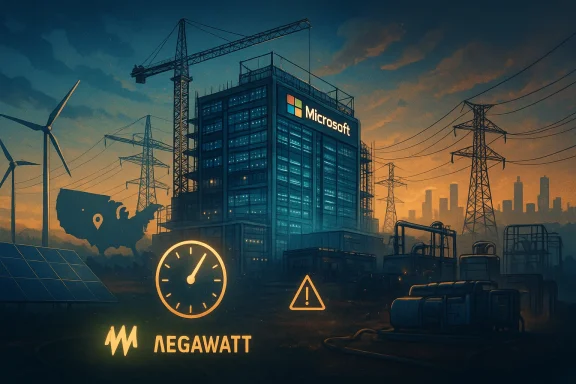
Microsoft’s AI infrastructure strategy is shifting fast from restraint to urgency, and that reversal is now becoming visible in the company’s balance sheet, site selection, and power strategy. After reportedly slowing down data center construction in late 2024 and early 2025, Microsoft now appears to be scrambling to restore lost capacity just as AI demand remains stubbornly strong. The result is a more expensive, more complex, and more politically fraught expansion cycle that could shape Azure’s competitive position for years.
Microsoft’s present scramble did not emerge overnight. It traces back to the collision of two powerful forces: the explosion in demand for AI compute and a finance-driven effort to keep capital spending from outrunning expectations. By the time Microsoft’s leaders realized that AI appetite would remain elevated, the company had already paused or delayed some projects, giving rivals room to move into the grid queue and claim sites that might otherwise have belonged to Azure.
That matters because in today’s AI infrastructure market, grid access is strategy. Data center shells, GPUs, cooling systems, and software orchestration all matter, but power is the bottleneck that can decide who ships capacity first and who waits years for a new campus to go live. Once a large cloud provider loses a favorable position in a utility interconnect queue, regaining it can require not just money but patience, engineering work, permitting, and local political management.
Microsoft’s own earnings commentary made the shortage public. In early 2025, Amy Hood acknowledged that AI capacity constraints would persist even as the company continued bringing new data center supply online. That was not merely a warning to investors; it was an admission that demand was growing faster than Microsoft’s ability to convert capital into usable racks, electrical service, and delivered AI capacity. The company was still spending heavily, but the pipeline was not filling quickly enough.
The second layer of the story is reputational. Microsoft has spent years presenting itself as a leader in clean energy, sustainability, and responsible infrastructure. Its public commitments around renewable energy, carbon-free electricity, and datacenter community benefits make sense in a world where enterprise buyers, regulators, and communities increasingly expect tech giants to prove their social license to operate. Yet the current catch-up phase is pushing Microsoft toward off-grid natural gas generation, a move that is understandable from a capacity standpoint and uncomfortable from a climate standpoint.
This tension is not unique to Microsoft, but it is especially visible because of the scale of the company’s AI ambitions. In other words, the company did not simply overspend or underspend in a normal sense. It moved through a market where compute, power, land, and permitting are all interdependent, and it briefly lost momentum in the one area where momentum is hardest to buy back.
That is what appears to have happened in several regions. Oracle reportedly claimed significant utility capacity in Wisconsin, while Google accelerated campuses in Indiana. These are not abstract market share moves; they are physical moves in a resource-constrained environment. Whoever secures power first often secures the right to build first, train first, and monetize first.
Microsoft’s retreat from some projects therefore mattered beyond the specific campuses involved. It may have altered the pacing of the broader market by allowing competitors to move into position while Azure waited. That kind of delay compounds because the winner of one queue position can become the winner of the next, especially when AI workloads are growing rapidly and every new campus can be pre-sold internally or externally.
The key implications are straightforward:
Microsoft has already had to explain that dynamic to Wall Street. The company’s earnings calls made clear that AI demand was running ahead of available capacity, and that data center and power shortages would not disappear quickly. Once those shortages became public, the market knew Azure’s constraint was not a short-term blip but a structural issue the company would need to solve through capex, partnerships, or both.
There is also a timing cost. The AI hardware cycle moves quickly, but infrastructure cycles do not. A GPU generation can turn over before a data center is fully energized. That means a delayed campus may miss the peak of one chip cycle and have to be adapted for the next, which is a very expensive kind of catch-up.
That creates a classic tension inside large tech companies: financial discipline versus strategic overbuild. Spend too early and too much, and you risk underutilized assets. Spend too late, and you surrender market share, pricing power, and technical leadership. Microsoft’s current moves suggest it now believes the second risk is larger than the first.
Among the practical costs are:
The recent projects in Texas and West Virginia signal a willingness to accept higher complexity in exchange for speed. That includes agreements tied to Crusoe in Texas and preliminary arrangements involving Nscale and Caterpillar turbines in West Virginia. The unifying theme is not ideology. It is velocity.
But self-generation is not free, and it is not simple. It often requires additional backup systems to approximate grid reliability, plus fuel infrastructure, maintenance, and contractual complexity. If final costs rise too high, Microsoft can still walk away, but by then it will have spent time and political capital to get there.
This is where the company’s messaging will matter. If Microsoft frames these projects as transitional capacity while maintaining renewable procurement elsewhere, it can defend the move as pragmatic. If it appears to be quietly swapping a clean-energy narrative for a fossil-fuel workaround, the reputational backlash could be sharper. In the AI race, optics travel almost as fast as megawatts.
The broader lesson is that off-grid gas is a tactical bridge, not a strategic end state. Microsoft may use it to relieve immediate constraints, but it still has to reconcile that choice with its long-term environmental commitments and the cost of operating a more fragmented power portfolio.
In the U.S., local tax policy and public acceptance can become decisive. In Europe, permitting and energy constraints are often paired with stricter sustainability expectations. Microsoft has to satisfy both environments while keeping AI capacity on schedule, which makes every regional choice a tradeoff.
Microsoft’s decision to revisit or revoke some property tax abatements in La Porte suggests the company understands the political optics of growth. It may prefer to be seen as a good neighbor before opposition hardens. But that also shows how quickly the local bargain can change once residents realize a project is bigger than initially expected.
European expansion is often slower, but it can be more durable once established. Microsoft’s push in the U.K. and elsewhere suggests the company wants to avoid over-reliance on a single geography or a single grid. That is sensible, especially in an era when AI workloads can be globally distributed but data sovereignty and energy access remain local.
Key benefits of this diversified approach include:
That means the economics of AI are front-loaded. You spend first, wait for buildout, and hope the demand curve persists long enough to justify the assets. Microsoft’s slowdown suggests management briefly became concerned that it might be building too aggressively relative to its capex plan. Its catch-up suggests the company now believes the market is still expanding faster than its earlier caution allowed.
This is why capacity shortages are more than a technical nuisance. They can reshape customer relationships. A company that cannot offer enough GPU-backed capacity today may lose not only this quarter’s revenue but next year’s platform preference. That makes urgency a commercial necessity, not just an operational one.
This is also why Microsoft’s partnership-heavy approach matters. If the company can shift some delivery risk to developers and operators who specialize in power and campus execution, it may get capacity online faster than if it tried to do everything itself. That said, partnering is only helpful if the partner can actually deliver on time, on budget, and at the required reliability standard.
That matters because infrastructure is not just a financial problem. It is a talent problem. The best teams know how to negotiate with utilities, manage developer relationships, anticipate permitting bottlenecks, and sequence procurement around long-lead items. When those teams are disrupted, the company loses more than a project plan. It loses execution rhythm.
Microsoft’s current surge suggests it needs those competencies more than ever. If the company can rebuild and retain the right team, it may still recover much of the strategic ground it lost. But the talent market for infrastructure specialists is now competitive, and the best people can move to vendors, developers, or rivals with fewer internal constraints.
In practical terms, Microsoft now needs:
The most important thing to watch is whether Microsoft’s new buildout actually translates into usable AI capacity on the timelines the market cares about. Infrastructure announcements are easy; energization is hard. And in the AI era, delivered megawatts matter more than promised megawatts.
Source: Bitget Last year Microsoft slowed down data center construction and now regrets it, so it's beginning to catch up quickly. | Bitget News
 Background
Microsoft’s present scramble did not emerge overnight. It traces back to the collision of two powerful forces: the explosion in demand for AI compute and a finance-driven effort to keep capital spending from outrunning expectations. By the time Microsoft’s leaders realized that AI appetite would remain elevated, the company had already paused or delayed some projects, giving rivals room to move into the grid queue and claim sites that might otherwise have belonged to Azure.That matters because in today’s AI infrastructure market, grid access is strategy. Data center shells, GPUs, cooling systems, and software orchestration all matter, but power is the bottleneck that can decide who ships capacity first and who waits years for a new campus to go live. Once a large cloud provider loses a favorable position in a utility interconnect queue, regaining it can require not just money but patience, engineering work, permitting, and local political management.
Microsoft’s own earnings commentary made the shortage public. In early 2025, Amy Hood acknowledged that AI capacity constraints would persist even as the company continued bringing new data center supply online. That was not merely a warning to investors; it was an admission that demand was growing faster than Microsoft’s ability to convert capital into usable racks, electrical service, and delivered AI capacity. The company was still spending heavily, but the pipeline was not filling quickly enough.
The second layer of the story is reputational. Microsoft has spent years presenting itself as a leader in clean energy, sustainability, and responsible infrastructure. Its public commitments around renewable energy, carbon-free electricity, and datacenter community benefits make sense in a world where enterprise buyers, regulators, and communities increasingly expect tech giants to prove their social license to operate. Yet the current catch-up phase is pushing Microsoft toward off-grid natural gas generation, a move that is understandable from a capacity standpoint and uncomfortable from a climate standpoint.
This tension is not unique to Microsoft, but it is especially visible because of the scale of the company’s AI ambitions. In other words, the company did not simply overspend or underspend in a normal sense. It moved through a market where compute, power, land, and permitting are all interdependent, and it briefly lost momentum in the one area where momentum is hardest to buy back.
How Microsoft’s Pause Became a Competitive Opening
The most important consequence of Microsoft’s slowdown is that it created a vacuum others could fill. Once one hyperscaler steps away from a promising power reservation or site option, the opportunity rarely stays idle for long. Utilities, developers, and local governments have their own timelines, and if Microsoft hesitates, a competitor can often snap up the same scarce infrastructure input.That is what appears to have happened in several regions. Oracle reportedly claimed significant utility capacity in Wisconsin, while Google accelerated campuses in Indiana. These are not abstract market share moves; they are physical moves in a resource-constrained environment. Whoever secures power first often secures the right to build first, train first, and monetize first.
Power queues are the new strategic moat
In the AI era, the biggest moat may no longer be software alone. It is increasingly the combination of land, power, transmission, and time. A data center project that looks modest on a map can have outsized strategic value if it sits behind a favorable utility interconnect or near a site with usable gas, water, fiber, and local political support.Microsoft’s retreat from some projects therefore mattered beyond the specific campuses involved. It may have altered the pacing of the broader market by allowing competitors to move into position while Azure waited. That kind of delay compounds because the winner of one queue position can become the winner of the next, especially when AI workloads are growing rapidly and every new campus can be pre-sold internally or externally.
The key implications are straightforward:
- Delays can be permanent in practice, even if they are temporary on paper.
- Utility capacity is finite, especially in grid-constrained regions.
- Competitors rarely leave capacity unused once it becomes available.
- Infrastructure timing now shapes cloud market share as much as product features do.
- Early hesitation can force later premium pricing for the same asset class.
Why this mattered for Azure
Azure’s growth profile depends on Microsoft’s ability to turn customer demand into delivered capacity. When the company is constrained, it can still post strong demand metrics, but it cannot fully monetize them. That creates a difficult investor narrative: demand looks healthy, yet revenue and service availability can still be limited by a physical bottleneck.Microsoft has already had to explain that dynamic to Wall Street. The company’s earnings calls made clear that AI demand was running ahead of available capacity, and that data center and power shortages would not disappear quickly. Once those shortages became public, the market knew Azure’s constraint was not a short-term blip but a structural issue the company would need to solve through capex, partnerships, or both.
The Cost of Regaining Lost Ground
Microsoft is now trying to catch up, but regaining lost ground is expensive. Once a company gives up an advantageous site or grid position, the next-best option often costs more, takes longer to permit, or requires compromise on design. That is especially true in hot AI regions where every player is trying to acquire the same mix of land, transmission rights, and power equipment.There is also a timing cost. The AI hardware cycle moves quickly, but infrastructure cycles do not. A GPU generation can turn over before a data center is fully energized. That means a delayed campus may miss the peak of one chip cycle and have to be adapted for the next, which is a very expensive kind of catch-up.
CFO discipline versus infrastructure urgency
Amy Hood’s caution was not irrational. A finance chief has to control burn, preserve optionality, and avoid overcommitting to a growth curve that may later normalize. If AI demand had cooled meaningfully, Microsoft would have looked prudent rather than hesitant. But AI demand did not cool enough, and the company appears to have found itself underbuilt for the near-term spike.That creates a classic tension inside large tech companies: financial discipline versus strategic overbuild. Spend too early and too much, and you risk underutilized assets. Spend too late, and you surrender market share, pricing power, and technical leadership. Microsoft’s current moves suggest it now believes the second risk is larger than the first.
The hidden expense of reentry
Reentering a constrained market also means accepting imperfect substitutes. That can include off-grid generation, more expensive backup systems, more complex site engineering, and higher community scrutiny. When a hyperscaler is no longer choosing from the best options but from the remaining viable options, the economics change materially.Among the practical costs are:
- Higher capex per megawatt for bespoke power solutions.
- More expensive backup and redundancy systems to preserve reliability.
- Longer lead times for turbines, transformers, and switchgear.
- Greater exposure to local opposition on taxes, zoning, and environmental impact.
- Potential redesigns if chip generations or cooling requirements change midstream.
- Lower flexibility if future demand proves uneven across regions.
Off-Grid Natural Gas as the Stopgap
Microsoft’s strongest near-term answer appears to be off-grid self-generation, especially natural gas-backed capacity built with third-party developers. That is a striking move for a company that has built much of its brand around sustainability, but it is also a practical response to a constrained grid. If the utility system cannot deliver power fast enough, then the company can either wait or build around it.The recent projects in Texas and West Virginia signal a willingness to accept higher complexity in exchange for speed. That includes agreements tied to Crusoe in Texas and preliminary arrangements involving Nscale and Caterpillar turbines in West Virginia. The unifying theme is not ideology. It is velocity.
Why self-generation is attractive now
Self-generation offers a way to bypass slow grid queues and avoid competing with every other major industrial user for the same transmission buildout. It can also create a cleaner internal schedule, because the developer is effectively packaging power, cooling, and site delivery into a more integrated product. For a hyperscaler under pressure, that packaging has real value.But self-generation is not free, and it is not simple. It often requires additional backup systems to approximate grid reliability, plus fuel infrastructure, maintenance, and contractual complexity. If final costs rise too high, Microsoft can still walk away, but by then it will have spent time and political capital to get there.
The climate contradiction
The biggest tension here is obvious. Microsoft has publicly committed to ambitious sustainability goals, including renewable energy procurement and broader climate targets. Yet the company is now leaning on natural gas in at least some of its fastest-growing AI infrastructure plans. That does not necessarily mean it is abandoning sustainability goals, but it does suggest those goals are being balanced against a more immediate operational imperative.This is where the company’s messaging will matter. If Microsoft frames these projects as transitional capacity while maintaining renewable procurement elsewhere, it can defend the move as pragmatic. If it appears to be quietly swapping a clean-energy narrative for a fossil-fuel workaround, the reputational backlash could be sharper. In the AI race, optics travel almost as fast as megawatts.
What natural gas solves — and what it doesn’t
Natural gas can solve speed, but it does not fully solve policy friction. Communities may still oppose the plants. Regulators may still ask hard questions. Investors who value Microsoft’s sustainability profile may also want a clearer explanation of how these sites fit into the company’s long-term carbon strategy.The broader lesson is that off-grid gas is a tactical bridge, not a strategic end state. Microsoft may use it to relieve immediate constraints, but it still has to reconcile that choice with its long-term environmental commitments and the cost of operating a more fragmented power portfolio.
Europe, the U.S., and the Politics of Buildout
Microsoft’s catch-up phase is not limited to one geography. It spans U.S. expansion in places like Wisconsin and Indiana and renewed investment in Europe, including the U.K., Norway, and Portugal. That geographic spread is important because the company is not just buying capacity; it is also negotiating different political regimes, energy markets, and community expectations.In the U.S., local tax policy and public acceptance can become decisive. In Europe, permitting and energy constraints are often paired with stricter sustainability expectations. Microsoft has to satisfy both environments while keeping AI capacity on schedule, which makes every regional choice a tradeoff.
U.S. communities are no longer passive
Data center politics have become more visible in American towns and counties because the projects are so large and the tax consequences can be so immediate. In places like La Porte, Indiana, local officials are balancing promised investment against the possibility that a single data center campus could materially change a municipal budget or school district. That is the kind of scale that turns an infrastructure project into a civic referendum.Microsoft’s decision to revisit or revoke some property tax abatements in La Porte suggests the company understands the political optics of growth. It may prefer to be seen as a good neighbor before opposition hardens. But that also shows how quickly the local bargain can change once residents realize a project is bigger than initially expected.
Europe demands a different playbook
In Europe, Microsoft is rebuilding capacity while also reinforcing the image of a responsible infrastructure operator. That means more than just placing servers on the continent. It means aligning with regional expectations around energy sourcing, environmental impact, and strategic autonomy.European expansion is often slower, but it can be more durable once established. Microsoft’s push in the U.K. and elsewhere suggests the company wants to avoid over-reliance on a single geography or a single grid. That is sensible, especially in an era when AI workloads can be globally distributed but data sovereignty and energy access remain local.
Regional diversification as a hedge
Microsoft’s renewed buildout seems designed to spread risk rather than eliminate it. A diversified footprint can help the company absorb delays in one region by leaning on another. It can also help with customer sales, because enterprise buyers increasingly want a blend of performance, residency, and compliance options.Key benefits of this diversified approach include:
- Less dependence on one utility market.
- More resilience against local permitting delays.
- Better alignment with data residency needs.
- Improved flexibility for AI and cloud workloads.
- Reduced exposure to a single community’s political backlash.
- A stronger negotiating position with developers and suppliers.
What the Delay Reveals About AI Economics
The Microsoft story is not just about one company’s judgment. It is a signal about how AI economics are changing. In the old cloud era, software demand could be scaled relatively smoothly by adding servers, storage, and networking. In the new AI era, the limiting factor is often physical infrastructure that cannot be conjured quickly, no matter how much demand exists.That means the economics of AI are front-loaded. You spend first, wait for buildout, and hope the demand curve persists long enough to justify the assets. Microsoft’s slowdown suggests management briefly became concerned that it might be building too aggressively relative to its capex plan. Its catch-up suggests the company now believes the market is still expanding faster than its earlier caution allowed.
Compute scarcity changes customer behavior
When a cloud provider cannot deliver enough capacity, customers adapt. They may move workloads to competitors, split demand across multiple clouds, or delay projects. In the AI world, that can be especially damaging because the customer may not come back quickly once alternative tooling, model access, or hosting relationships are in place.This is why capacity shortages are more than a technical nuisance. They can reshape customer relationships. A company that cannot offer enough GPU-backed capacity today may lose not only this quarter’s revenue but next year’s platform preference. That makes urgency a commercial necessity, not just an operational one.
The market is rewarding speed, not just scale
Microsoft remains a giant, but the AI infrastructure race has created new openings for rivals that can move quickly on power and land. Oracle’s ability to seize utility capacity and Google’s willingness to accelerate construction show that scale alone is no longer enough. The winners are the companies that can translate balance-sheet strength into physical progress before competitors do.This is also why Microsoft’s partnership-heavy approach matters. If the company can shift some delivery risk to developers and operators who specialize in power and campus execution, it may get capacity online faster than if it tried to do everything itself. That said, partnering is only helpful if the partner can actually deliver on time, on budget, and at the required reliability standard.
Microsoft’s Internal Infrastructure Reset
One underappreciated consequence of the slowdown was organizational. When a company pauses a strategic buildout in a market where grid access can take years to secure, internal teams do not always wait politely. People leave, priorities shift, and institutional memory erodes. Microsoft’s own energy leadership appears to have been affected, including the departure of Bobby Hollis.That matters because infrastructure is not just a financial problem. It is a talent problem. The best teams know how to negotiate with utilities, manage developer relationships, anticipate permitting bottlenecks, and sequence procurement around long-lead items. When those teams are disrupted, the company loses more than a project plan. It loses execution rhythm.
The role of specialized infrastructure talent
The AI infrastructure stack is now deep enough to require real specialization. Teams need people who understand power markets, cooling systems, civil engineering, interconnection queues, and chip roadmaps. That is a much broader skill set than the average cloud operations function once required.Microsoft’s current surge suggests it needs those competencies more than ever. If the company can rebuild and retain the right team, it may still recover much of the strategic ground it lost. But the talent market for infrastructure specialists is now competitive, and the best people can move to vendors, developers, or rivals with fewer internal constraints.
Why departures matter in capital-intensive markets
A data center strategy can look robust in a presentation deck while becoming brittle in execution. Once the market turns, the difference between a strong and weak infrastructure organization is often the speed with which it can reassemble a pipeline. That is especially true when the underlying assets are highly customized and the power system is regionally constrained.In practical terms, Microsoft now needs:
- Faster decision loops between finance and infrastructure teams.
- More durable relationships with utilities and developers.
- Better scenario planning for chip demand and cooling requirements.
- A stronger internal bridge between sustainability and capacity goals.
- Retention of niche power-market expertise.
- Clearer authority over capital allocation tradeoffs.
Strengths and Opportunities
Microsoft is not merely correcting a mistake; it is also exploiting the fact that it has one of the strongest balance sheets in the industry and a customer base that still wants Azure scale. If the company can convert its renewed urgency into delivered capacity, it may turn an embarrassing pause into a manageable detour. The upside is still real, especially if AI demand remains elevated and enterprise adoption broadens.- Massive financial capacity to fund rapid buildout.
- Strong customer demand for Azure and Microsoft AI services.
- Ability to partner with specialized developers rather than build everything alone.
- Global diversification that reduces dependence on one region.
- Potential to secure better terms if weaker speculators fail.
- Deep enterprise relationships that can keep customers inside the Microsoft ecosystem.
- Room to improve operational discipline after an expensive wake-up call.
Risks and Concerns
The risks are equally substantial, and they extend beyond the immediate capex bill. Microsoft may be forced to pay more for the same capacity, accept more public scrutiny, and navigate a messy contradiction between its climate messaging and its power strategy. If the company mishandles any of those issues, it could lose not just money but trust.- Higher costs from off-grid natural gas projects and bespoke power systems.
- Ongoing capacity shortages that continue to constrain Azure growth.
- Reputational tension with Microsoft’s clean-energy commitments.
- Community resistance to tax incentives, land use, and utility impacts.
- Execution risk from complex, partner-led infrastructure projects.
- Competitive slippage if Google, Oracle, or others keep building faster.
- Workforce instability if infrastructure talent continues to leave.
Looking Ahead
The next phase will reveal whether Microsoft’s reset is a temporary scramble or a more durable strategic correction. If the company can bring enough capacity online by pairing grid-connected sites, off-grid generation, and partner-led campuses, it may still defend its position in the AI cloud market. If not, the company risks spending heavily while remaining a step behind rivals that were quicker to lock up power.The most important thing to watch is whether Microsoft’s new buildout actually translates into usable AI capacity on the timelines the market cares about. Infrastructure announcements are easy; energization is hard. And in the AI era, delivered megawatts matter more than promised megawatts.
- Progress on the Texas and West Virginia projects and whether they stay on schedule.
- Changes in Azure capacity guidance in upcoming earnings calls.
- Further moves in Wisconsin and Indiana as Microsoft reclaims momentum.
- Any clarification on sustainability strategy for gas-backed sites.
- Whether competitors keep winning utility capacity while Microsoft rebuilds.
- Signs that enterprise customers are shifting workloads toward providers with available capacity.
Source: Bitget Last year Microsoft slowed down data center construction and now regrets it, so it's beginning to catch up quickly. | Bitget News
Last edited:
