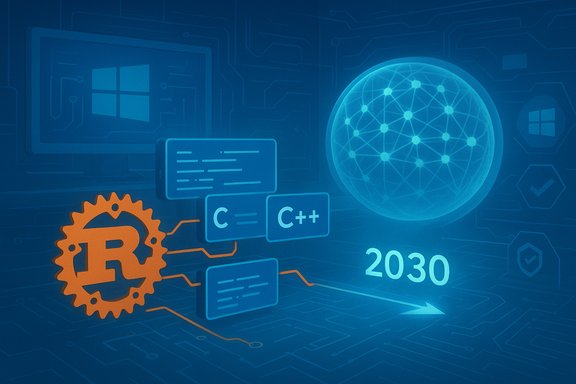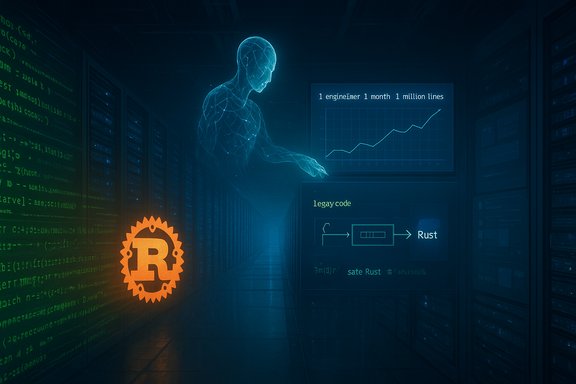
Microsoft’s engineering gamble — to use AI to rewrite millions of lines of legacy C and C++ into Rust by 2030 — landed squarely in the spotlight this winter after a months‑long string of Windows 11 malfunctions and a formal Microsoft support advisory that traced the outages to XAML registration and provisioning timing issues. The announcement, made public in a LinkedIn hiring post by Distinguished Engineer Galen Hunt, sets a blistering productivity target — “1 engineer, 1 month, 1 million lines of code” — and a corporate deadline to eliminate every line of C and C++ from Microsoft products by 2030, even as the company scrambled to patch shell and XAML regressions first disclosed in November 2025.
Background / Overview
Microsoft’s AI‑first narrative has accelerated dramatically across 2024–2025. Public comments from senior executives signalled a rapid shift: CEO Satya Nadella told an AI conference that roughly 20–30% of code in some Microsoft repositories was already being generated or authored with AI assistance, while CTO Kevin Scott has expressed ambition for the vast majority of future code to be AI‑authored by the end of the decade. Those executive remarks are important context for the company’s internal push to automate large‑scale code modernization. At the same time Microsoft committed unprecedented capital to build AI datacenter capacity — public reporting and company statements put the company’s 2025 infrastructure investment plan at approximately $80 billion for datacenter and AI infrastructure expansion, including a flagship Fairwater hyperscale facility in Wisconsin described by Microsoft as a new class of AI training center. The company’s infrastructure scale provides the compute substrate for the kinds of large‑scale code‑processing pipelines Hunt described. This article synthesizes those developments, verifies the technical facts where possible, and offers a critical analysis of strengths, risks, and unanswered questions as Microsoft pursues an AI‑assisted rewrite of core system software.What happened: the Windows 11 regression timeline
- July 2025: Monthly cumulative updates beginning with the July servicing wave were later identified by community trackers as the inflection point for a reproducible class of failures affecting XAML‑backed UI surfaces during provisioning or first‑logon sequences.
- July–October 2025: System administrators, imaging teams, and enterprise help desks reported recurring incidents where freshly provisioned or non‑persistent virtual desktop images exhibited missing or non‑functional Start menus, blank taskbars, Explorer instability, and System Settings failures.
- Late November 2025: Microsoft published a formal support advisory (documented as KB5072911) acknowledging the issue and outlining mitigations and the technical root cause: XAML/AppX dependency packages sometimes failed to register into the interactive user session in time, creating a timing‑dependent activation race that left shell components unable to initialize. Microsoft characterized the problem as primarily affecting specific enterprise and provisioning scenarios and provided manual re‑registration workarounds while engineering worked on a permanent servicing fix.
The technical breakdown: XAML registration and a provisioning race
The Microsoft advisory makes the technical story clear and — importantly — non‑mystical. Windows’ modern user‑visible shell hosts many UI surfaces as updatable AppX/MSIX packages containing XAML components and manifests. Servicing replaces those package files on disk; a separate registration step makes the packages available to the interactive user session. When provisioning or first‑logon sequences proceed quickly after servicing, shell processes (Explorer.exe, StartMenuExperienceHost, ShellHost and similar) may attempt to instantiate XAML views before the OS has completed package registration. The resulting COM/XAML activation calls fail and the UI either crashes or renders blank. Microsoft’s KB documents the affected package families and recommends mitigations appropriate for non‑persistent and enterprise imaging scenarios. Two points are critical here:- This is a timing and lifecycle bug (ordering/race condition), not a straightforward logic bug in an algorithm that LLMs would produce; it arises from the intersection of servicing semantics, image provisioning timing, and shell startup sequence.
- The incident disproportionately affected enterprise provisioning and VDI images where package registration is performed at logon — that explains why many consumer machines were unaffected while IT-managed fleets experienced widespread pain. Independent community reproductions and enterprise telemetry supported Microsoft’s technical explanation, prompting the vendor to publish mitigations and promise a servicing fix.
Hunt’s announcement: the AI + Rust rewrite plan
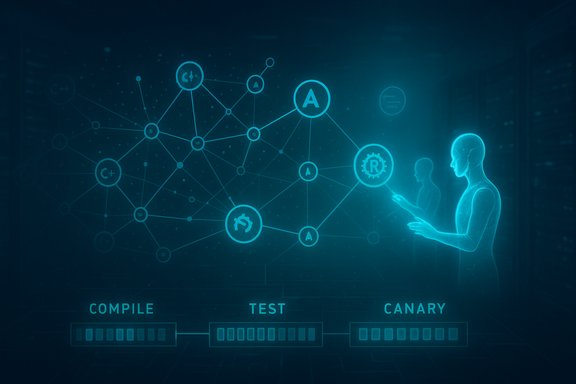
On November 25, 2025, Galen Hunt posted a high‑profile LinkedIn call for a Principal Software Engineer to join a CoreAI team chartered to build “infrastructure for code processing” that pairs algorithmic program analysis with AI agents to rewrite Microsoft’s largest C and C++ systems into Rust. The post articulated an audacious north star: eliminate C and C++ from Microsoft products by 2030 and achieve a productivity scale summarized as “1 engineer, 1 month, 1 million lines of code.” The job posting specifically requested systems‑level Rust experience, indicating that the company intends to anchor translations in a modern, memory‑safe language. Public outlets quickly republished and interpreted the hire‑post, framing it as an organizational endorsement of a company‑wide migration away from legacy languages that historically contributed a large fraction of memory‑safety vulnerabilities. The stated strategy combines two technical axes:- Algorithmic program analysis that represents large codebases as scalable graphs and applies deterministic, compiler‑grade reasoning.
- AI agents that can perform translation, rewriting, and refactoring tasks at scale, guided by the algorithmic layer and by human supervision.
Why Rust — and what it realistically buys Microsoft
Rust’s main appeal for system‑level migration is memory safety by design: the language prevents whole classes of vulnerabilities (use‑after‑free, many buffer‑overrun patterns, and certain concurrency bugs) via ownership and borrow semantics enforced at compile time. For a vendor that still patches many memory‑safety flaws in legacy code, that’s an attractive goal.Rust adoption in systems engineering has been steadily growing — the language is already used in parts of Windows, Azure, and other cloud components — and industry players (including Google and cloud providers) have funded Rust‑ecosystem work to ease interop and migration. Replacing C/C++ components with Rust would, in principle, lower the future vulnerability surface for memory errors and make new code safer by default.
But the practical challenges are non‑trivial:
- Rust’s safety model relies on correct abstractions and careful API design. Translating unsafe C/C++ idioms into idiomatic, safe Rust is more than a line‑for‑line mechanical rewrite — it requires design choices about ownership, lifetime management, and concurrency that affect performance and semantics.
- Large language models (LLMs) and current code generation tools are uneven across languages. Public reporting and developer experience indicate stronger LLM performance for high‑data languages like Python and JavaScript, and comparatively weaker results for Rust due to smaller training corpora and less code availability in the public training set. That raises questions about how much of a rewrite can truly be automated versus how much will require expert human oversight. Several operational commentaries and developer threads expressed skepticism that LLMs are ready to produce production‑grade systems Rust at scale without bespoke model fine‑tuning and strong verification layers.
Verifying the claims: what’s documented, what’s implied, and what’s speculative
- Documented: Microsoft published KB5072911 detailing the XAML/AppX provisioning regession affecting Windows 11 shell components and offered manual mitigations. That bulletin is the authoritative public artifact describing the July–November 2025 timeline and the technical nature of the failure.
- Documented: Galen Hunt’s LinkedIn hiring post and associated job description explicitly describe a goal to translate large C/C++ systems into Rust using combined AI + algorithmic infrastructure; the post and job ad are publicly viewable and have been redistributed by multiple outlets.
- Corroborated: Satya Nadella’s remarks that 20–30% of certain Microsoft codebases were already being written by AI are on the public record from April 2025 and were widely reported by mainstream tech press. CTO Kevin Scott’s forward‑looking comments about AI‑authored code are similarly public. These statements are claims about internal practice and intent; they are corroborated by multiple media reports quoting corporate executives.
- Partially verifiable / context: The linkage between AI‑authored code and the XAML provisioning regressions is not a documented causal relationship in Microsoft’s KB or formal communications. The KB points to a lifecycle and registration timing issue rather than to fundamental logic errors introduced by code generation. Claims that AI‑authored code “broke Windows” are therefore associative and circumstantial: the company’s AI usage figures and the subsequent OS regressions occurred in the same calendar window, but Microsoft’s official technical summary does not attribute the regression to AI tool output. That distinction matters and should be flagged explicitly.
Testing, verification, and the hard problem of scale
A rewrite of millions of lines of systems code creates a combinatorial verification challenge:- Traditional testing (unit, integration, system, fuzzing, property‑based tests) scales poorly when the goal is to rewrite or refactor entire OS subsystems.
- Formal verification or proof‑assisted translation of system semantics is possible for smaller components, but scaling formal methods to the size of Windows — with decades of implicit assumptions, device drivers, and compatibility contracts — is unprecedented in industry.
- LLM‑assisted translation can produce plausible, compiles‑clean code that still violates edge semantics, concurrency contracts, or ABI expectations. Industry examples have shown that AI code generation tools can hallucinate APIs or misuse platform invariants while producing superficially plausible code. Without heavy investment in reproducible test harnesses, differential testing against real workloads, and deterministic verification, automation at this scale is a high‑stakes gamble.
- Build massive differential test suites that exercise legacy behaviors, driver/ABI contracts, and third‑party dependencies.
- Implement staged rollout channels that allow new Rust replacements to be exercised behind feature flags and on subsets of telemetry‑consenting devices.
- Invest in automated, semantics‑aware verification — compiler IR checks, symbolic execution, and model‑based fuzzing — to detect contract violations before shipping.
- Require human‑in‑the‑loop expert review on all safety‑critical translations and maintain a rigorous provenance and audit trail for each automated change.
Workforce and organizational implications
Microsoft’s hiring posture — resuming targeted recruiting and specifying in‑person Redmond roles with deep Rust and systems experience — signals recognition that this strategy requires specialized skills. The company’s leadership frames the transition as a productivity multiplier akin to spreadsheets in the 1980s: tools change what work looks like and how processes are organized. But the redistribution of tasks matters:- Engineers will need to master new workflows that combine program analysis, model oversight, and domain knowledge about kernel semantics, device driver interaction, and system bootstrapping.
- The company’s stated expectation that employees will achieve new workflows within roughly a year is optimistic. Achieving safety and performance parity requires months or years of iterative validation and production telemetry.
- The leverage gains from AI typically accrue disproportionately to organization owners (efficiency, margins) unless matched by retraining, role redefinition, and contractual changes for engineers. That poses labor and policy questions about where productivity gains translate into compensation or product pricing.
Infrastructure, cost, and economic tradeoffs
Microsoft’s $80 billion datacenter commitments and the Fairwater hyperscale facility provide the compute firepower to run the large models and code‑analysis workloads necessary for mass translation tasks. Large investments in GPU‑heavy clusters (GB200/GB300 families) and dedicated national‑scale buildouts create an environment where experimentation at scale is feasible — but they also raise capital efficiency questions:- Massive upfront infrastructure accelerates capability, but it also magnifies the business impact of operational regressions when widely used platform components are involved.
- The economics of migrating code (one‑time rewrite and ongoing maintenance savings) must be balanced against the cost of additional testing, human oversight, and the potential productivity loss when regressions occur in production. Industry commentary has already framed the calculus in blunt terms: incremental cost savings at the micro level can be outweighed by macro productivity losses if stability degrades.
Industry reaction and community skepticism
The announcement and the Windows regressions provoked vigorous discussion across developer communities, security researchers, and enterprise IT forums. Key themes:- Skepticism that LLMs are mature enough to produce large amounts of systems‑level Rust reliably without extensive domain‑specific fine‑tuning and heavyweight verification.
- Concern that the corporate pace of AI feature introductions is outpacing rigorous testing for foundational OS components — an observation underscored by the multi‑month window between the first community reports and the formal Microsoft advisory.
- Debate over whether the migration priority (move to Rust) aligns with the parts of Windows that actually experienced the most breakage; some observers noted that many affected components were modern XAML pieces rather than kernel C/C++ subsystems. That suggests the need to focus governance and testing where changes are most likely to cause customer‑visible regressions.
What to watch next
- Microsoft’s December 2025 servicing update and subsequent servicing rollups will reveal whether the corrective measures addressed the provisioning‑time race comprehensively and whether regressions re‑appear in other update waves. The speed and completeness of the fix are the first practical indicators of the company’s response capability.
- The CoreAI team’s hiring and published research or tool prototypes: look for model fine‑tuning details, test suite descriptions, and evidence of semantics‑preserving translation pipelines (for example, a reproducible demonstrate‑and‑verify workflow).
- Independent audits or academic collaborations that publish results of automated translation efforts; third‑party validation will be essential for enterprise trust. If Microsoft releases whitepapers or reproducible datasets describing verification strategies, that will materially change the technical assessment.
- How Microsoft stages deployments of translated Rust components in shipping Windows builds: feature flags, Canary rings, or opt‑in developer channels will show the company’s commitment to cautious rollout and telemetry‑driven validation.
Conclusion — risk, reward, and the long arc of system modernization
Microsoft’s plan to use AI to eliminate C and C++ across its products by 2030 and translate large legacy systems into Rust is bold and strategically coherent: reduce memory‑safety vulnerabilities, modernize maintainability, and align the OS with a safer systems language. The company has the compute resources and engineering depth to attempt such a transformation. The Fairwater hyperscale facilities and multibillion‑dollar infrastructure commitment make the ambition technically feasible at scale. However, the recent Windows 11 XAML provisioning regressions underscore the practical limits of aggressive automation when the product in question is both massively distributed and mission‑critical. Microsoft’s KB describes a timing‑dependent lifecycle failure that is not demonstrably the direct result of AI‑generated source code, but it does highlight the fragility introduced when deployment, servicing, and testing pipelines are stressed. The real risk is not that AI will spontaneously “write” disastrous code; it is that higher throughput of changes, new toolchains, and immature verification practices can produce systemic regressions with outsized impact. For enterprises and IT professionals, the practical lesson is granular:- Treat any replacement of foundational components as a multi‑year engineering program requiring massive differential testing, staged rollouts, and human oversight.
- Insist on provenance, audit trails, and verification artifacts for automated code transformations that touch kernel or compatibility boundaries.
- Expect a prolonged coexistence of C/C++ and Rust where interop, driver compatibility, and performance tradeoffs are handled conservatively rather than replaced overnight.
Source: PPC Land Microsoft bets on AI to rewrite Windows after code it wrote broke the OS