

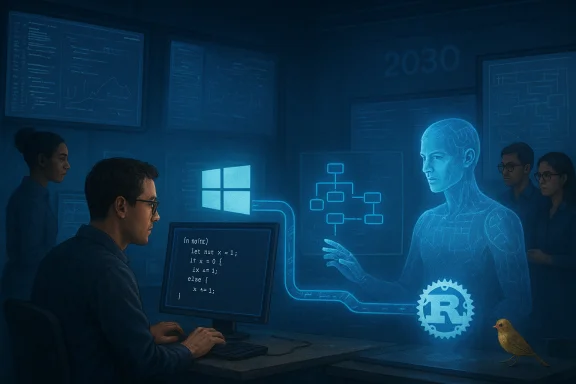
A viral LinkedIn hiring post from a senior Microsoft engineer ignited a week of sensational headlines: did Microsoft plan to use AI to rewrite Windows 11 from C/C++ into Rust by 2030? The short, verified answer from Microsoft and the post’s author is: no — the LinkedIn message described a research and tooling effort, not a shipped product plan to hand the Windows kernel to unsupervised AI. The episode exposed real technical ambitions, legitimate security motivations, and equally real operational risks — and it underlined how a single public personnel post can be misread as corporate strategy.
Microsoft has been experimenting with Rust and memory-safe languages for several years. The company maintains the Rust for Windows project and publishes Rust bindings that let developers call Win32, COM, and modern Windows APIs from Rust, showing an ongoing commitment to making Rust interoperable with the Windows platform. At the same time, Microsoft — like other large vendors — has publicly embraced AI assistance in software engineering. In a widely reported April conversation, CEO Satya Nadella said roughly 20–30% of the code inside some Microsoft repositories is now generated or assisted by AI. That executive-level comment is directional: it signals heavy use of AI in parts of the company’s engineering workflows but is not a granular, audited breakdown of every product. Into that context came a LinkedIn hiring post by Galen Hunt, a Distinguished Engineer at Microsoft, which used provocative phrasing and a striking throughput metric: “My goal is to eliminate every line of C and C++ from Microsoft by 2030” and a north‑star of “1 engineer, 1 month, 1 million lines of code.” The wording was part recruitment, part research charter description — and part aspirational rhetoric intended to attract systems‑level Rust engineers. That original post, however, was widely amplified and sometimes stripped of qualification, producing headlines that Microsoft later stepped in to calm.
Source: Research Snipers Windows 11 recoding with Rust? Microsoft stops wild AI rumors – Research Snipers
 Background / Overview
Microsoft has been experimenting with Rust and memory-safe languages for several years. The company maintains the Rust for Windows project and publishes Rust bindings that let developers call Win32, COM, and modern Windows APIs from Rust, showing an ongoing commitment to making Rust interoperable with the Windows platform. At the same time, Microsoft — like other large vendors — has publicly embraced AI assistance in software engineering. In a widely reported April conversation, CEO Satya Nadella said roughly 20–30% of the code inside some Microsoft repositories is now generated or assisted by AI. That executive-level comment is directional: it signals heavy use of AI in parts of the company’s engineering workflows but is not a granular, audited breakdown of every product. Into that context came a LinkedIn hiring post by Galen Hunt, a Distinguished Engineer at Microsoft, which used provocative phrasing and a striking throughput metric: “My goal is to eliminate every line of C and C++ from Microsoft by 2030” and a north‑star of “1 engineer, 1 month, 1 million lines of code.” The wording was part recruitment, part research charter description — and part aspirational rhetoric intended to attract systems‑level Rust engineers. That original post, however, was widely amplified and sometimes stripped of qualification, producing headlines that Microsoft later stepped in to calm. What happened: the LinkedIn post and the backlash
The post that started the firestorm
- The LinkedIn listing described a Principal Software Engineer role in a CoreAI team and detailed a charter to build a "powerful code processing infrastructure" combining deterministic algorithmic analysis with AI agents to enable large‑scale language migration (C/C++ → Rust). The post explicitly set a 2030 target and the “1 engineer, 1 month, 1 million lines” north‑star as an aspirational throughput goal.
- Social amplification was immediate. Tech blogs, forums, and social feeds distilled the post into the shorthand: “Microsoft will have AI rewrite Windows in Rust,” a reading that understandably alarmed driver vendors, OEMs, enterprise IT, and Windows power users given Windows’ ABI sensitivity and the scale of legacy C/C++ code in the platform.
The clarifications: Hunt and Microsoft push back
- Within days, Galen Hunt edited his LinkedIn post to add an explicit clarification: “Windows is NOT being rewritten in Rust with AI. My team’s project is a research project. We are building tech to make migration from language to language possible.” That edit reframed the announcement as a research‑and‑tooling effort and a hiring signal, not a Windows product strategy.
- Microsoft communications also intervened to make the same distinction: the hiring post described an internal research charter and staffing call, not a shipped plan to rewrite Windows 11 via AI. The company emphasized staged pilots, tooling, and human‑in‑the‑loop controls rather than an unsupervised, wholesale rewrite.
Why the post went viral — and why the reaction was intense
A small list of structural reasons explains the outsized public reaction:- Seniority of the author. A Distinguished Engineer’s public hiring language carries perceived strategic weight and is often read as telegraphing priority.
- Absolute framing. “Eliminate every line of C and C++ by 2030” reads like a company‑wide deadline rather than a research target.
- Provocative metric. “1 engineer, 1 month, 1 million lines” is eye‑catching and invites scrutiny because the productivity numerics appear implausible without automation and massive verification tooling.
- Context of AI anxiety. Executive comments that a sizable share of code is now AI‑generated make the public more sensitive to stories that suggest mission‑critical systems could be handed to models.
Technical reality: what “AI + Algorithms” likely means (and what it does not)
The LinkedIn post and subsequent reporting describe a hybrid approach — not a magic LLM that consumes a kernel binary and emits a drop‑in Rust kernel. Distinguishing the components matters:- Algorithmic program analysis: deterministic tooling to build whole‑program graphs, call graphs, type and ABI metadata, and other compile‑time artifacts that are essential to preserving semantics when changing languages. This reduces the solution space an AI must operate in.
- AI-assisted transformations: LLMs and specialized models that propose syntactic and idiomatic translations, suggest refactorings, and scaffold interop code — but operating under algorithmic constraints. Human reviewers and compile/test/verify loops remain necessary.
- Verification and testing: fuzzing, equivalence testing, differential testing, and staged canaries that aim to detect semantic drift, regressions, and ABI incompatibilities before any translated component reaches broad production rings. This is non‑negotiable for OS subsystems.
- It is not an unsupervised “turn the model loose on the kernel” process. That would be engineering malpractice for ABI‑sensitive system code. The research framing and Microsoft’s clarifications emphasize human oversight and rigorous verification.
Why Microsoft would explore Rust at scale
There are defensible technical and security reasons to pursue memory‑safe languages for systems code:- Memory safety reduces a large class of security vulnerabilities. Historically, buffer overflows, use‑after‑free, and other memory‑safety errors account for a high percentage of critical vulnerabilities in OS and cloud software. Rust’s ownership and borrow checker model eliminates many of these issues at compile time without adding a garbage collector.
- Modern toolchains and ecosystem benefits. Rust brings modern package management, compilation toolchains, and community crates that can improve maintainability for certain subsystems when used judiciously. Microsoft already supports a Rust-for-Windows projection and an official windows crate to ease interop and adoption.
- Scale and economics. Microsoft has unique scale — huge test farms, telemetry, and Azure compute — which makes multi‑year, measurement‑driven migrations more realistic for them than for smaller vendors. But scale is neither a substitute for verification nor a guarantee of safe outcomes.
The hard engineering problems: why a wholesale rewrite is not simple
Translating mature C/C++ systems into idiomatic Rust is not a purely mechanical job. Major technical obstacles include:- Undefined behavior (UB): much real‑world C/C++ depends on implementation‑specific behaviors. Preserving semantics across translation requires whole‑program reasoning or explicit redesign.
- ABI and binary contracts: drivers, firmware, and third‑party components rely on exact calling conventions and memory layouts. Preserving binary compatibility demands shims, wrappers, or gradual migration strategies.
- Concurrency and timing: low‑level lock‑free algorithms and timing‑sensitive code can silently break when memory layout or ordering assumptions change.
- The “unsafe” trap: naive mechanical translations that simply wrap code in Rust’s unsafe blocks yield little net safety benefit. The payoff requires idiomatic Rust that reduces unsafe surface area.
The numbers: a reality check on “1 engineer, 1 month, 1 million lines”
The north‑star productivity metric from the LinkedIn post was deliberately aspirational, but it invites a math check and skepticism:- Translating 1,000,000 lines in a single month implies thousands of lines per hour, per developer, and leaves almost no room for meaningful review, testing, or debugging unless the pipeline includes automated verification artifacts at scale. Independent analysts and engineers have noted that the throughput claim, if taken literally, doesn’t leave time for essential verification work — which is exactly the point many critics raised.
- The appropriate and safer reading is to treat the metric as a tooling throughput target: a measurement of what the pipeline could assist humans to accomplish given extensive automated testing, not a promise that individual engineers will author safe, production‑ready translations unaided. Hunt’s edited post and Microsoft’s follow‑ups support this more conservative interpretation.
Security and operational risk: the tradeoffs
The potential benefits of a successful migration are real: fewer memory‑safety vulnerabilities and better long‑term maintenance for certain subsystems. But the risks are concrete and high for platform vendors:- Compatibility cascades. ABI changes can break third‑party drivers and OEM integrations, producing large‑scale disruptions if not tightly controlled.
- Availability regressions. Shifting failure modes (for example, panics in Rust vs. silent memory corruption in C) can produce different incident profiles that still affect reliability unless mitigated.
- False security assurances. Mechanical translations that leave much code in unsafe blocks or introduce semantic drift could create new vulnerabilities, negating the intended safety gains.
- Ecosystem strain. ISVs, driver authors, and OEM partners will require long lead times, clear certification guidance, and stable interfaces; abrupt changes would increase support and testing burdens.
What Microsoft (and any vendor attempting this) should do next
The research program that Hunt described — if pursued responsibly — should prioritize transparency, reproducibility, and partner coordination. Concrete actions include:- Publish reproducible benchmarks, equivalence test suites, and pilot results so the community can validate safety and correctness claims.
- Keep human‑in‑the‑loop review gates for any translation that touches kernel, driver, or ABI‑sensitive code.
- Use staged ringed rollouts (Insider, Canary) and extensive telemetry to detect regressions early and to give ISVs and OEMs time to respond.
- Provide compatibility shims and clear certification guidance for third‑party driver ecosystems.
- Open or document tooling where feasible: published tools, whitepapers, and open‑source components will build community trust and enable independent validation.
What enterprises, ISVs, and power users should do now
- Treat the public hiring post as an early signal of priority, not an immediate product roadmap. Microsoft has denied a Windows rewrite and framed the work as research. Continue to require compatibility guarantees before adopting new components.
- Maintain robust image and rollback playbooks, test against Insider builds when evaluating potential changes, and demand reproducible equivalence tests from any translated components.
- For driver and hardware vendors: preserve ABI contracts and engage early with Microsoft if pilot programs affect your modules. Regression windows and certification periods will matter more than ever.
- For developers: upskill in Rust and verification tooling (static analyzers, fuzzers, differential test harnesses) to be ready for potential, staged migration programs.
Signals to watch — how to tell real progress from rhetoric
Look for tangible, verifiable artifacts rather than slogans:- Published technical papers or whitepapers describing the algorithmic graph model, equivalence checking methods, and test harnesses.
- Open‑sourced or documented tooling and small, reproducible migration examples that third parties can run and validate.
- Insider/canary pilots that show translated components with telemetry demonstrating fewer vulnerabilities and no increased regressions.
- Independent audits or reproducible benchmarks showing how automated translations compare to human re‑writes on correctness and performance.
Critical reading: strengths and potential weaknesses of Microsoft’s stated approach
Strengths
- Technical rationale is strong. Memory safety is a defensible motivation; Rust’s model addresses tangible, historically costly bug classes.
- Microsoft has scale and tooling resources. Massive test farms and Azure compute make iterative, measurement‑driven pilots feasible in ways smaller vendors cannot easily replicate.
- Hybrid approach reduces risk. Combining deterministic analysis with AI assistance, human review, and staged rollouts is the right high‑level architecture for a safe migration.
Weaknesses and risks
- Throughput claims are unverified and optimistic. The “1 million lines per engineer per month” metric requires rigorous benchmarking and transparency to be credible.
- Measurement vs. semantics. Focusing on lines of code as a throughput metric risks incentivizing surface transformation rather than semantic equivalence and idiomatic safety.
- Ecosystem impact. Without careful coordination, major driver and OEM ecosystems could face certification and compatibility bottlenecks.
Final analysis — measured takeaway
The LinkedIn post performed an information‑theory trick: it compressed a long‑term research ambition, a hiring call, and an aspirational throughput metric into a few lines that the public read as a product‑level strategy. Microsoft and Galen Hunt corrected that reading: the work is a research and tooling program intended to enable large‑scale migrations over time, not an immediate plan to rewrite Windows 11 using AI. The technical rationale for exploring Rust at scale is sound — memory safety matters — and Microsoft already offers official Rust bindings and tooling for Windows. But the operational and verification hurdles are immense. The safest, most credible path forward is incremental: publish tooling and verification artifacts, run constrained pilots, require exhaustive equivalence testing, and keep humans central to the pipeline. If Microsoft (and other large vendors) can tie ambitious automation to strong verification and transparent pilot results, this research push could materially reduce entire classes of vulnerabilities. If they shortcut verification for throughput, the result could be visible regressions and significant reputation cost.Conclusion
What began as a provocative hiring post has turned into a useful public conversation about the future of systems engineering: the merits of Rust, the rising role of AI in code assistance, and the engineering discipline required to modernize decades‑old platforms safely. Microsoft’s public denials were correct in substance: Windows 11 is not being rewritten by AI into Rust today. What remains is a research frontier — promising, high‑risk, and deserving of careful scrutiny. The practical test will be the next public artifacts: papers, open tooling, reproducible benchmarks, and pilot telemetry. Until those appear, treat bold timelines and throughput slogans as signals of ambition, not as deployed strategy.Source: Research Snipers Windows 11 recoding with Rust? Microsoft stops wild AI rumors – Research Snipers
