

At the Build 2026 conference on June 2, 2026, Microsoft introduced Scout, a permanently active Microsoft 365 agent designed to identify, prepare, and carry out tasks in Teams, Outlook, OneDrive, and SharePoint without waiting for every individual user prompt. With this, the company is moving Copilot out of the chat box and toward a form of work automation that treats calendars, files, meetings, and enterprise context as operational resources. The real news, therefore, is not another AI assistant, but Microsoft’s attempt to turn office work itself into a platform for agents. For Windows users, administrators, and investors, Scout is a signal: Microsoft is no longer selling only software with AI, but AI as a new organizational logic.
Copilot has primarily been a response system until now. The user typed a question, selected a spreadsheet, asked for an email summary, or requested a draft. That logic was powerful, but it remained tied to the old idea of computing: the human starts, the machine responds.
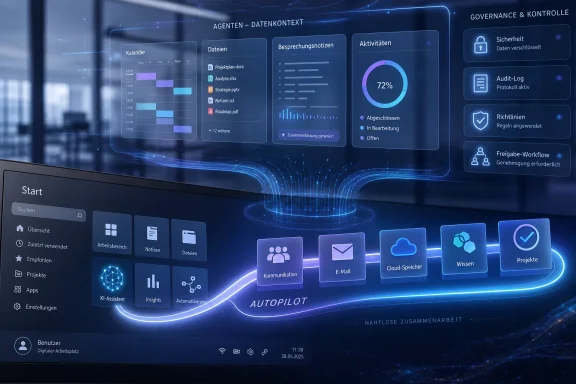
Scout carefully but significantly reverses that relationship. Microsoft describes the agent as the first Autopilot for work, and that word was not chosen by accident. An autopilot does not replace the pilot, but it takes over recurring procedures, keeps the course, reports conflicts, and steps in where the human should not have to keep a hand on the controls every second.
That may sound like productivity romanticism, but the technical and organizational shift is real. An agent that prepares meetings, detects scheduling conflicts, and initiates routine tasks needs more than a language model. It needs access to context, permissions, files, communication histories, company rules, and action interfaces.
That is exactly where Microsoft has the advantage. Few other vendors sit so deeply inside the daily workflows of large organizations. Outlook, Teams, SharePoint, OneDrive, Entra, Purview, Defender, Intune, and Windows together form not just a product family, but a map of work itself.
Scout is therefore less a single feature than a trial balloon for a new work architecture. If Microsoft succeeds with it, the question in many companies will no longer be whether AI is used. It will be which tasks should still have to wait for a human to explicitly start them.
A chatbot without context can write well, but it does not know the difference between an important customer escalation, an internal status meeting, and a polite but irrelevant email. A work agent, by contrast, must understand priorities, relationships, and permissions. It must know which file is the current version, which chat contains the actual decision, and which information a specific user is even allowed to see.
The new Work IQ API is therefore strategically more important than many of the more eye-catching demo moments from the conference. It is intended to let developers build agentic applications that can reason over Microsoft 365 data without breaking existing security and compliance boundaries. That is Microsoft’s pitch to enterprise IT: we give agents more context, but within the governance framework you already manage.
That is both tempting and unsettling. Tempting, because many office processes really do consist of searching, coordinating, following up, and summarizing. Unsettling, because an agent that knows enough to be useful also knows enough to cause damage if permissions, logging, or error tolerances are configured incorrectly.
Microsoft is trying to translate that conflict into platform terms. Agents should not roam freely through the company, but should run in controlled environments, with traceable actions and policies. That is the right direction, but it does not make deployment trivial. The more autonomy Microsoft promises, the more responsibility shifts to the administrators who must limit that autonomy.
In the first Copilot wave, much of the messaging sounded as if users would have to buy new devices with special neural processing units to get the more interesting local AI features. That hardware remains important, especially for efficiency and battery life. But Microsoft’s new direction opens more local AI features to standard CPUs and GPUs, making the installed Windows base less abruptly left behind.
For WindowsForum readers, that is the real practical point. If AI features run properly only on new premium laptops, the topic remains an argument for a hardware refresh. But if Microsoft brings useful models, APIs, and agent sandboxes to a wider range of device classes, Windows itself becomes a development target again.
This also explains why Microsoft emphasized not only end-user features at Build, but developer tools as well. Agents need runtimes, identities, storage, observability, security, and interfaces to both local and cloud-based resources. An operating system that only provides windows and drivers would not be enough.
The company is therefore trying to turn Windows into an agent station. Applications should not merely receive AI buttons, but should host agents or work with them. That is ambitious, but also risky: the more Windows acts in the background, the more important transparency, undo functions, and clear boundaries between assistance and paternalism become.
That is a different kind of ROI. An email summary is nice, but it rarely changes a business process. An agent that gathers the relevant documents before a meeting, identifies open decisions, alerts participants to conflicts, and then initiates follow-ups reaches deeper into the way a team works.
For companies, that is exactly what makes the idea attractive. The biggest friction losses do not always occur when writing a document, but between documents: searching, aligning, reminding, escalating, and tracking. Microsoft’s agent strategy targets these gaps, where work often disappears invisibly.
The problem is that these gaps are politically and organizationally complicated. Who is allowed to decide that a topic is urgent? Which follow-ups are useful, and which are merely automated noise? When does an agent become a relief, and when does it create new work because all of its suggestions have to be reviewed?
Scout will be measured precisely at that boundary. Not by whether it recognizes a scheduling conflict in a demo, but by whether it builds trust in real organizations without producing a flood of notifications, false priorities, and half-baked actions.
This sounds like a classic Microsoft moment. Redmond delivers a powerful platform, wraps it in productivity promises, and leaves enterprise IT to turn it into a manageable system. That was true with Active Directory, SharePoint, Teams, and Azure. Now it is happening with agents.
The decisive questions are less glamorous than the keynote. How are agent actions logged? How can mistakes be rolled back? Which data may an agent combine from different sources? How do you prevent a well-intentioned agent from pulling confidential information into the wrong context?
Microsoft’s answer is governance. Work IQ is supposed to respect existing permissions, and Windows agents are supposed to run in controlled environments. But governance is not a switch. It is a combination of licensing, policies, auditing, training, data hygiene, and a sober assessment of which processes are suitable for agents at all.
The transition from assistance to delegation is especially sensitive. An AI that creates a draft is easy to control. An AI that moves meetings, prepares files, creates tasks, or starts workflows changes real work states. That is useful, but it requires a security model that understands not only data access, but the consequences of actions.
That fits the introduction of new packages such as the Frontier Suite, or Microsoft 365 E7, which integrate E5, Copilot, and Agent 365 into a broader narrative. Microsoft is not merely selling more software, but a trust architecture: identity, security, compliance, productivity, and agents from a single source. For many large customers, that is convenient. For others, it is another level of dependency.
The tightening around E5 as a prerequisite mentioned in the financial article should be read carefully, because Microsoft’s Copilot licensing landscape is notoriously complex and varies by product, region, contract, and channel. But the trend is clear: the most interesting AI features are moving into paid, higher-value packages. The free or low-barrier Copilot experience remains an entry point, but the strategic substance is in the enterprise segment.
That has consequences for small and midsize businesses. Companies that currently work with Business Premium, E3, or mixed licensing environments will have to calculate more carefully. The price of an agent strategy is not just the Copilot surcharge, but often also the path toward stronger identity, compliance, and security functions.
Microsoft can make good arguments for this. If agents really act on enterprise data, strong governance functions are not luxury equipment. But from the customer’s perspective, the question remains whether security necessity and commercial upselling can always be separated cleanly.
Microsoft Discovery is a platform for AI-assisted scientific work. It is intended to help researchers develop hypotheses, orchestrate simulations, and tackle complex materials or chemistry problems more quickly. By making this platform generally available, Microsoft is making clear that agents are not meant to structure only office processes, but research processes as well.
Majorana 2 serves as a symbolic piece of evidence. Microsoft claims significant progress in the reliability of its topological qubit architecture, and the company also presents the chip’s development as a success for agentic research tools. That is not just science marketing, but platform marketing for a future in which AI systems do not merely create text, but plan experiments and simulations.
Quantum announcements should generally be treated with skepticism. The industry runs on roadmaps, breakthrough promises, and very long time horizons. Microsoft’s Majorana approach has been scientifically controversial in the past, and practical, fault-tolerant quantum computers remain a difficult goal.
Even so, the message matters. Microsoft wants to show that agents are not just paper clips with a language model. They are meant to acquire the same platform character in software development, research, security, administration, and knowledge work. Scout is the work-adjacent version of this idea; Discovery is the scientific version.
At the same time, the stock is under pressure, at least measured by the decline from the October high and the weak year-to-date performance in euros described in the financial article. That does not necessarily mean the market does not believe Microsoft’s AI strategy. It may also mean that expectations have become so high that even good numbers are no longer enough.
At Microsoft, the valuation question is closely tied to the capital intensity of the AI wave. Data centers, GPUs, network infrastructure, energy, model training, and cloud capacity consume enormous sums. The market is therefore asking not only whether Microsoft can sell AI. It is asking whether the margins of the AI era can remain as attractive as the margins of the classic software era.
Scout is an important piece of that puzzle. If agents become deeply embedded in Microsoft 365 and customers are willing to buy higher-tier packages, that improves monetization of the AI infrastructure. If agents are instead perceived as nice but unreliable add-ons, the investment story becomes more vulnerable.
The dividend of $0.91 per share seems almost old-fashioned in this debate. It is a reminder that Microsoft is not a pure future promise, but an extremely profitable company with a broad base. Yet the stock is not currently being measured by the dividend. It is being measured by whether Microsoft can turn AI into a new platform return.
Every organization has shadow processes. People know which calendar blocks are serious, which file is outdated despite its name, which manager prefers a short message, and which task sounds urgent but is politically better left alone. An agent can learn such patterns, but it can also misinterpret them grotesquely.
Microsoft’s advantage is that it does not have to guess this reality from the outside. The signals already exist in Microsoft 365. That is powerful, but it also raises expectations. If Scout produces only generic suggestions despite access to calendars, documents, and communication, its usefulness will quickly be questioned.
For administrators, the rollout strategy will be decisive. Scout should not be deployed as a big-bang automation project, but in narrow, measurable scenarios. Meeting preparation, follow-up detection, scheduling alignment, and document compilation are more plausible than open-ended, company-wide freedom of action.
For users, Microsoft also needs a new trust design. An agent must be able to explain why it suggests or does something. It must show which data it used. And at critical points, it should ask for approval rather than create facts in the name of productivity.
That means classic Windows expertise is not disappearing; it is expanding. Anyone who manages devices will also have to understand which local AI components are running. Anyone who manages identities will have to model agent permissions. Anyone responsible for compliance will have to review not only human data access, but machine action.
The good news is that Microsoft is embedding much of this into familiar management models. The bad news is that familiar consoles do not automatically mean simple decisions. Agents increase the number of possible states, and therefore also the number of possible misconfigurations.
For developers, a new layer is opening at the same time. Work IQ, agentic APIs, and Microsoft Foundry give them the ability to build applications that do not merely digitize forms, but orchestrate work steps. That is exciting, but it demands discipline. A bad agent is worse than a bad dashboard because it does not merely inform incorrectly; it can act incorrectly.
That may be the most useful side effect of the entire AI wave. Many companies have accumulated digital work for years without curating it properly. Agents make that disorder expensive because they are built on exactly the signals that, until now, often could be interpreted correctly only by people with local knowledge.
Anyone who wants to seriously test Scout and similar systems should therefore not begin with the question of which spectacular tasks AI can take over. The better question is which processes are well enough understood, permissioned, and documented that an agent may usefully assist in them at all. That is less glamorous than a Build demo, but closer to reality.
For investors, a similar logic applies. Microsoft’s AI story is not only a question of model quality, but of execution across millions of workplaces. If customers are willing to align their processes, licenses, and data structures around agents, a powerful growth path emerges. If not, part of the vision remains stuck in marketing.
 Microsoft Turns Copilot Into a Background Worker
Copilot has primarily been a response system until now. The user typed a question, selected a spreadsheet, asked for an email summary, or requested a draft. That logic was powerful, but it remained tied to the old idea of computing: the human starts, the machine responds.Scout carefully but significantly reverses that relationship. Microsoft describes the agent as the first Autopilot for work, and that word was not chosen by accident. An autopilot does not replace the pilot, but it takes over recurring procedures, keeps the course, reports conflicts, and steps in where the human should not have to keep a hand on the controls every second.
That may sound like productivity romanticism, but the technical and organizational shift is real. An agent that prepares meetings, detects scheduling conflicts, and initiates routine tasks needs more than a language model. It needs access to context, permissions, files, communication histories, company rules, and action interfaces.
That is exactly where Microsoft has the advantage. Few other vendors sit so deeply inside the daily workflows of large organizations. Outlook, Teams, SharePoint, OneDrive, Entra, Purview, Defender, Intune, and Windows together form not just a product family, but a map of work itself.
Scout is therefore less a single feature than a trial balloon for a new work architecture. If Microsoft succeeds with it, the question in many companies will no longer be whether AI is used. It will be which tasks should still have to wait for a human to explicitly start them.
The Agent Needs Context, and Microsoft Has It
The most important building block behind Scout is not the interface, but the context layer. Microsoft calls this approach Microsoft IQ, with Work IQ as the part that makes Microsoft 365 signals usable. Behind it is a simple insight: agents are useful only when they know what they are acting on.A chatbot without context can write well, but it does not know the difference between an important customer escalation, an internal status meeting, and a polite but irrelevant email. A work agent, by contrast, must understand priorities, relationships, and permissions. It must know which file is the current version, which chat contains the actual decision, and which information a specific user is even allowed to see.
The new Work IQ API is therefore strategically more important than many of the more eye-catching demo moments from the conference. It is intended to let developers build agentic applications that can reason over Microsoft 365 data without breaking existing security and compliance boundaries. That is Microsoft’s pitch to enterprise IT: we give agents more context, but within the governance framework you already manage.
That is both tempting and unsettling. Tempting, because many office processes really do consist of searching, coordinating, following up, and summarizing. Unsettling, because an agent that knows enough to be useful also knows enough to cause damage if permissions, logging, or error tolerances are configured incorrectly.
Microsoft is trying to translate that conflict into platform terms. Agents should not roam freely through the company, but should run in controlled environments, with traceable actions and policies. That is the right direction, but it does not make deployment trivial. The more autonomy Microsoft promises, the more responsibility shifts to the administrators who must limit that autonomy.
Windows Is Not Being Replaced; It Is Being Rebuilt
Build 2026 also showed that Microsoft does not want Windows to be a bystander in the AI wave. The company continues to work on turning Windows into an AI-native operating system, where models, agents, and local runtime environments appear not as add-ons, but as part of the platform. That is an important difference.In the first Copilot wave, much of the messaging sounded as if users would have to buy new devices with special neural processing units to get the more interesting local AI features. That hardware remains important, especially for efficiency and battery life. But Microsoft’s new direction opens more local AI features to standard CPUs and GPUs, making the installed Windows base less abruptly left behind.
For WindowsForum readers, that is the real practical point. If AI features run properly only on new premium laptops, the topic remains an argument for a hardware refresh. But if Microsoft brings useful models, APIs, and agent sandboxes to a wider range of device classes, Windows itself becomes a development target again.
This also explains why Microsoft emphasized not only end-user features at Build, but developer tools as well. Agents need runtimes, identities, storage, observability, security, and interfaces to both local and cloud-based resources. An operating system that only provides windows and drivers would not be enough.
The company is therefore trying to turn Windows into an agent station. Applications should not merely receive AI buttons, but should host agents or work with them. That is ambitious, but also risky: the more Windows acts in the background, the more important transparency, undo functions, and clear boundaries between assistance and paternalism become.
The Old Copilot Question Was Too Small
Since the launch of Microsoft 365 Copilot, the debate has often revolved around a narrow calculation: does the AI save enough time to justify the additional cost per user? That question remains valid, but Scout shows that Microsoft is aiming for a larger answer. The company does not merely want to save individual minutes in Word or Excel, but to automate entire chains of coordination.That is a different kind of ROI. An email summary is nice, but it rarely changes a business process. An agent that gathers the relevant documents before a meeting, identifies open decisions, alerts participants to conflicts, and then initiates follow-ups reaches deeper into the way a team works.
For companies, that is exactly what makes the idea attractive. The biggest friction losses do not always occur when writing a document, but between documents: searching, aligning, reminding, escalating, and tracking. Microsoft’s agent strategy targets these gaps, where work often disappears invisibly.
The problem is that these gaps are politically and organizationally complicated. Who is allowed to decide that a topic is urgent? Which follow-ups are useful, and which are merely automated noise? When does an agent become a relief, and when does it create new work because all of its suggestions have to be reviewed?
Scout will be measured precisely at that boundary. Not by whether it recognizes a scheduling conflict in a demo, but by whether it builds trust in real organizations without producing a flood of notifications, false priorities, and half-baked actions.
Administrators Get More Power and More Liability
For IT departments, the agent wave is not just a feature update. It shifts responsibilities. Until now, administrators could define fairly clearly who may access which data and which applications have which permissions. Agents make that matrix more dynamic because they do not only read; they act depending on context.This sounds like a classic Microsoft moment. Redmond delivers a powerful platform, wraps it in productivity promises, and leaves enterprise IT to turn it into a manageable system. That was true with Active Directory, SharePoint, Teams, and Azure. Now it is happening with agents.
The decisive questions are less glamorous than the keynote. How are agent actions logged? How can mistakes be rolled back? Which data may an agent combine from different sources? How do you prevent a well-intentioned agent from pulling confidential information into the wrong context?
Microsoft’s answer is governance. Work IQ is supposed to respect existing permissions, and Windows agents are supposed to run in controlled environments. But governance is not a switch. It is a combination of licensing, policies, auditing, training, data hygiene, and a sober assessment of which processes are suitable for agents at all.
The transition from assistance to delegation is especially sensitive. An AI that creates a draft is easy to control. An AI that moves meetings, prepares files, creates tasks, or starts workflows changes real work states. That is useful, but it requires a security model that understands not only data access, but the consequences of actions.
The Licensing Policy Reveals the Real Target Customer
The commercial side of the announcements is at least as revealing as the technical side. Microsoft has increasingly tied the Copilot and agent world to higher Microsoft 365 SKUs, add-on licenses, and new bundles. Anyone who wants to use the full vision is not merely supposed to buy an AI feature, but to move deeper into Microsoft’s enterprise stack.That fits the introduction of new packages such as the Frontier Suite, or Microsoft 365 E7, which integrate E5, Copilot, and Agent 365 into a broader narrative. Microsoft is not merely selling more software, but a trust architecture: identity, security, compliance, productivity, and agents from a single source. For many large customers, that is convenient. For others, it is another level of dependency.
The tightening around E5 as a prerequisite mentioned in the financial article should be read carefully, because Microsoft’s Copilot licensing landscape is notoriously complex and varies by product, region, contract, and channel. But the trend is clear: the most interesting AI features are moving into paid, higher-value packages. The free or low-barrier Copilot experience remains an entry point, but the strategic substance is in the enterprise segment.
That has consequences for small and midsize businesses. Companies that currently work with Business Premium, E3, or mixed licensing environments will have to calculate more carefully. The price of an agent strategy is not just the Copilot surcharge, but often also the path toward stronger identity, compliance, and security functions.
Microsoft can make good arguments for this. If agents really act on enterprise data, strong governance functions are not luxury equipment. But from the customer’s perspective, the question remains whether security necessity and commercial upselling can always be separated cleanly.
Quantum and Discovery Are Not Sideshows
The Build announcements about Majorana 2 and Microsoft Discovery seemed at first glance like a different story. Quantum chips, materials research, and scientific simulations appear far removed from Scout, Teams, and Outlook. In reality, they belong to the same strategic narrative.Microsoft Discovery is a platform for AI-assisted scientific work. It is intended to help researchers develop hypotheses, orchestrate simulations, and tackle complex materials or chemistry problems more quickly. By making this platform generally available, Microsoft is making clear that agents are not meant to structure only office processes, but research processes as well.
Majorana 2 serves as a symbolic piece of evidence. Microsoft claims significant progress in the reliability of its topological qubit architecture, and the company also presents the chip’s development as a success for agentic research tools. That is not just science marketing, but platform marketing for a future in which AI systems do not merely create text, but plan experiments and simulations.
Quantum announcements should generally be treated with skepticism. The industry runs on roadmaps, breakthrough promises, and very long time horizons. Microsoft’s Majorana approach has been scientifically controversial in the past, and practical, fault-tolerant quantum computers remain a difficult goal.
Even so, the message matters. Microsoft wants to show that agents are not just paper clips with a language model. They are meant to acquire the same platform character in software development, research, security, administration, and knowledge work. Scout is the work-adjacent version of this idea; Discovery is the scientific version.
The Stock Is Trading Not Just on the Numbers, but on the Doubt
The financial side makes the situation paradoxical. Microsoft’s latest quarterly figures were strong: in the third quarter of fiscal year 2026, the company reported about $82.9 billion in revenue and diluted earnings per share of $4.27. That is not the picture of a company running out of growth.At the same time, the stock is under pressure, at least measured by the decline from the October high and the weak year-to-date performance in euros described in the financial article. That does not necessarily mean the market does not believe Microsoft’s AI strategy. It may also mean that expectations have become so high that even good numbers are no longer enough.
At Microsoft, the valuation question is closely tied to the capital intensity of the AI wave. Data centers, GPUs, network infrastructure, energy, model training, and cloud capacity consume enormous sums. The market is therefore asking not only whether Microsoft can sell AI. It is asking whether the margins of the AI era can remain as attractive as the margins of the classic software era.
Scout is an important piece of that puzzle. If agents become deeply embedded in Microsoft 365 and customers are willing to buy higher-tier packages, that improves monetization of the AI infrastructure. If agents are instead perceived as nice but unreliable add-ons, the investment story becomes more vulnerable.
The dividend of $0.91 per share seems almost old-fashioned in this debate. It is a reminder that Microsoft is not a pure future promise, but an extremely profitable company with a broad base. Yet the stock is not currently being measured by the dividend. It is being measured by whether Microsoft can turn AI into a new platform return.
The Market Is Waiting for Proof in Everyday Use
The major danger for Microsoft is not that Scout is technically impossible. The danger is that agents fail in everyday work because of mundane issues: incorrect context, poor data quality, unclear responsibilities, overly cautious admins, distrustful users, and a company culture that demands delegation to software but does not tolerate mistakes.Every organization has shadow processes. People know which calendar blocks are serious, which file is outdated despite its name, which manager prefers a short message, and which task sounds urgent but is politically better left alone. An agent can learn such patterns, but it can also misinterpret them grotesquely.
Microsoft’s advantage is that it does not have to guess this reality from the outside. The signals already exist in Microsoft 365. That is powerful, but it also raises expectations. If Scout produces only generic suggestions despite access to calendars, documents, and communication, its usefulness will quickly be questioned.
For administrators, the rollout strategy will be decisive. Scout should not be deployed as a big-bang automation project, but in narrow, measurable scenarios. Meeting preparation, follow-up detection, scheduling alignment, and document compilation are more plausible than open-ended, company-wide freedom of action.
For users, Microsoft also needs a new trust design. An agent must be able to explain why it suggests or does something. It must show which data it used. And at critical points, it should ask for approval rather than create facts in the name of productivity.
Build’s Message for Windows Pros Is More Practical Than the Hype
For Windows enthusiasts and IT pros, Build 2026 is not a distant developer event. It describes where the client, the tenant, and day-to-day administration are heading. Windows is becoming more of an execution environment for agents, Microsoft 365 a source of context, and Entra, Purview, and Defender the control layer.That means classic Windows expertise is not disappearing; it is expanding. Anyone who manages devices will also have to understand which local AI components are running. Anyone who manages identities will have to model agent permissions. Anyone responsible for compliance will have to review not only human data access, but machine action.
The good news is that Microsoft is embedding much of this into familiar management models. The bad news is that familiar consoles do not automatically mean simple decisions. Agents increase the number of possible states, and therefore also the number of possible misconfigurations.
For developers, a new layer is opening at the same time. Work IQ, agentic APIs, and Microsoft Foundry give them the ability to build applications that do not merely digitize forms, but orchestrate work steps. That is exciting, but it demands discipline. A bad agent is worse than a bad dashboard because it does not merely inform incorrectly; it can act incorrectly.
Scout Forces Microsoft Customers Into an Uncomfortable Inventory
Scout is not a feature that can simply be switched on and booked as a productivity gain. It is a mirror for the state of an organization’s Microsoft 365 environment. Poor permissions, chaotic SharePoint structures, unclear data classification, and overcrowded Teams channels will not magically improve because of agents. They will become more visible.That may be the most useful side effect of the entire AI wave. Many companies have accumulated digital work for years without curating it properly. Agents make that disorder expensive because they are built on exactly the signals that, until now, often could be interpreted correctly only by people with local knowledge.
Anyone who wants to seriously test Scout and similar systems should therefore not begin with the question of which spectacular tasks AI can take over. The better question is which processes are well enough understood, permissioned, and documented that an agent may usefully assist in them at all. That is less glamorous than a Build demo, but closer to reality.
For investors, a similar logic applies. Microsoft’s AI story is not only a question of model quality, but of execution across millions of workplaces. If customers are willing to align their processes, licenses, and data structures around agents, a powerful growth path emerges. If not, part of the vision remains stuck in marketing.
What Remains from Build 2026 in the Admin Inbox
The core of the announcements is more concrete than the buzzwords suggest. Microsoft is building a stack in which agents receive context, act under control, and are executed across Windows and Microsoft 365. This will not reinvent the workplace overnight, but it is already changing planning for IT departments.- Scout is Microsoft’s clearest sign that Copilot is not meant to stop at reactive chat functions.
- Work IQ makes Microsoft 365 context programmable, making it a key component for enterprise agents.
- Windows is becoming more important as a local and hybrid agent platform, not less important.
- The licensing strategy suggests that the most powerful AI features will mainly land in higher-value enterprise packages.
- Administrators must treat agents as acting identities, not harmless assistants.
- The stock will depend less on individual AI demos than on whether Microsoft can turn AI into durable, high-margin platform revenue.
References
- Primary source: Finanztrends
Published: 2026-06-14T11:12:14.823945
Microsoft Aktie: Scout startet als Autopilot-Agent - Finanztrends - Official source: blogs.microsoft.com
Microsoft Build 2026: Be yourself at work - The Official Microsoft Blog - Official source: learn.microsoft.com
Microsoft Work IQ API (preview) | Microsoft Learn - Related coverage: techradar.com
'A new category of agents': Microsoft reveals Scout, its first "Autopilot", which wants to change how you work for good | TechRadar - Official source: microsoft.com
FY26 Q3 - Press Releases - Investor Relations - Microsoft - Official source: news.microsoft.com
Microsoft Build Live
- Official source: devblogs.microsoft.com
Work IQ: Production‑ready intelligence for every agent - Microsoft 365 Developer Blog - Related coverage: digitalapplied.com
Microsoft Scout: The Personal AI Agent Goes Mainstream - Related coverage: axios.com
Microsoft debuts Scout agent, homegrown reasoning model - Related coverage: linkloot.io
Microsoft Build 2026 puts agent context, Scout, and MAI models into one developer stack – Blog | LinkLoot - Related coverage: gate.com
Buy/Sell Bitcoin, Ethereum and 4,700+ Altcoins | Cryptocurrency Exchange | Gate.com - Related coverage: windowscentral.com
"Agents are only as good as the context we give them": Microsoft IQ connects AI agents to your workspace data and the web | Windows Central - Related coverage: tomsguide.com
Biggest Microsoft Build 2026 announcements — agentic AI, RTX Spark Dev Box, GitHub Copilot app, new MAI models, and more | Tom's Guide - Related coverage: zeronoise.ai
pdf - Official source: adoption.microsoft.com
V2 - Related coverage: techxplore.com
https://techxplore.com/news/2026-06-microsoft-unveils-ai-independence-openai.pdf - Official source: download.microsoft.com
Setting up rep pair - Related coverage: tomshardware.com
Microsoft announces Majorana 2 quantum computing chip — claims a practical machine will come in 2029 | Tom's Hardware - Related coverage: ca.investing.com
Microsoft declares quarterly dividend of $0.91 per share By Investing.com - Related coverage: crnasia.com
Microsoft makes its quantum R&D platform commercially available alongside Majorana 2 launch - Official source: quantum.microsoft.com
Microsoft Quantum | Homepage - Related coverage: itpro.com
Microsoft says its Majorana 2 chip was built using AI – and it helped deliver huge performance gains | IT Pro - Related coverage: techriver.com
Microsoft Word - Microsoft O365 November 2025 Updates.docx - Related coverage: apac.crayonchannel.com
Default Section
Last edited:
