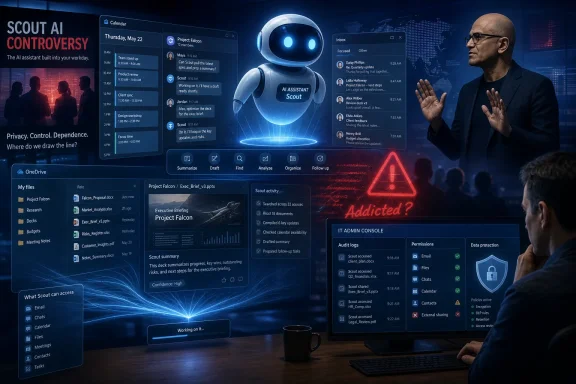
Microsoft announced Scout on June 2, 2026, as an always-on AI agent for Microsoft 365, while a leaked internal planning document reported the same day said the first phase of the project was to “make people addicted.” That collision between product launch and internal language is the story, not because one phrase proves a conspiracy, but because it exposes the tension at the center of enterprise AI. Microsoft wants to sell Scout as time returned to workers; the leaked framing makes it sound like dependency engineered at platform scale. For Windows users and IT departments, the uncomfortable question is not whether Satya Nadella likes the word “addicted,” but whether Microsoft can build a deeply embedded assistant without turning work itself into the engagement funnel.
Scout is not another chatbot box bolted onto the side of Office. Microsoft is positioning it as a persistent personal agent, one that lives across the productivity stack, observes work patterns, and acts on a user’s behalf in places like Outlook, Teams, Word, Edge, calendars, files, and workflows. That makes it more ambitious than the Copilot sidebar many users already learned to ignore.
The sales pitch is familiar: fewer repetitive tasks, less administrative drag, more focus for the work that matters. Microsoft has spent the last several years arguing that AI can make office software feel less like office software, and Scout is the logical extension of that campaign. Instead of asking Copilot for help, the user is supposed to have an agent that already understands the context.
That is also why the leak matters. A document reportedly titled “ClawPilot: Overview and Plan with Project Lobster” described a staged rollout whose first phase was, according to 404 Media’s reporting, “Make people addicted.” Microsoft’s public language says empowerment; the leaked internal language says habit formation, retention, intensity, and dependency. Those are not merely different tones. They are different theories of the user.
The company’s response has only sharpened the contradiction. Nadella reportedly told staff he was “not sure what this document is or who is writing and leaking this nonsense,” while Microsoft spokespeople emphasized that Scout is intended to help people complete tasks more effectively, not increase screen time. But if the document was indeed written or credited by senior people tied to Scout, the denial reads less like clarification and more like a scramble to separate the CEO from the vocabulary of the product team.
There is a charitable reading. Inside a product team, “addicted” may have been used casually to mean “so useful people rely on it every day.” Plenty of teams say they want a tool to become indispensable, and enterprise software lives or dies by whether it becomes part of daily muscle memory. In that interpretation, Microsoft did not mean compulsive psychological dependency; it meant durable utility.
But the charitable reading does not fully rescue the company. The AI industry is already under scrutiny for designing systems that simulate companionship, authority, memory, and personalization. A persistent workplace agent is not a neutral spreadsheet macro. It watches, remembers, suggests, intervenes, and increasingly acts. If the design goal is daily dependence, then the ethical burden rises with the product’s intimacy.
Microsoft also cannot pretend this language arrived from nowhere. “Addiction” may be an embarrassing word, but the underlying metrics are standard operating procedure in modern software. Products are measured by frequency, retention, depth of usage, and expansion. In consumer tech, that logic produced the infinite scroll and the notification economy. In enterprise tech, it produces dashboards that celebrate whether a worker has turned the tool into a reflex.
The danger is that AI collapses the distance between usefulness and capture. A word processor that people use every day is a tool. An agent that reads the inbox, triages messages, writes replies, tracks behavior, and nudges next actions is closer to infrastructure. Once that agent becomes hard to remove from the workday, “addiction” stops sounding like a metaphor and starts sounding like a procurement strategy.
The audience for that message was not only journalists. It was Microsoft’s own workforce, especially employees uneasy about the direction of AI inside the company. 404 Media reported that unnamed Microsoft employees found the language troubling, which is not surprising. Many engineers and product managers are now being asked to build systems that operate closer to users’ private work lives than previous software ever did.
A denial can be true in the narrow sense and still evasive in the broader one. Nadella may sincerely oppose designing products for unhealthy dependence. Microsoft may sincerely believe Scout returns time rather than consumes it. But the leaked document, if accurately described, suggests that at least some internal strategy used the language of compulsion to frame early adoption.
That is the distinction Microsoft needs to confront. The scandal is not that one executive used a dumb phrase in a slide deck. The scandal is that the phrase mapped so neatly onto what everyone already suspects about AI assistants: that the business case depends on making them unavoidable before users, regulators, and IT administrators have fully understood the tradeoffs.
The credibility gap widens because Scout is not a hobby project. Reports and Microsoft’s own launch materials place Omar Shahine, a corporate vice president, at the center of the effort. This is not a rogue intern’s brainstorm scribbled into a meeting note. It appears to be attached to a strategic product Microsoft is now pushing into one of the most valuable software estates in the world.
Microsoft’s advantage is distribution. Windows, Office, Teams, Outlook, Edge, SharePoint, OneDrive, Entra, Intune, Defender, GitHub, and Azure form a mesh of identity, productivity, development, security, and device management. A personal agent inside that mesh is more powerful than a standalone AI app because it can see more context and touch more workflows.
That is also why Scout feels different from earlier Copilot features. Copilot was often an assistant you invoked. Scout is being framed as something closer to a colleague, a background process, or an “autopilot” with its own identity and permissions. The agent is not just summarizing a document; it may eventually monitor tasks, coordinate schedules, prepare materials, and act across applications.
For Microsoft, this is the prize. If Scout becomes the layer through which users experience Microsoft 365, the company gets a new control point over enterprise productivity. The agent becomes the interface, the habit, and eventually the reason to stay inside the Microsoft ecosystem. That is not necessarily sinister. It is platform strategy.
But platform strategy is exactly why administrators should pay attention. When an agent becomes the default path through corporate knowledge, its failure modes become organizational failure modes. A bad summary, an overbroad permission, a misrouted message, or a hallucinated action is not just an AI glitch. It is a workflow incident.
Still, Scout’s power depends on context. The agent becomes useful by understanding email, meetings, documents, chats, calendars, browser activity, tasks, and recurring work patterns. Even if that data remains inside a tenant and is not used for broad model training, the user experience is built on aggregating sensitive signals into a persistent operational profile.
That changes the privacy conversation. Traditional enterprise software stores data. Scout-like agents interpret it. They infer priorities, relationships, urgency, habits, and intent. They may learn which colleague a user responds to quickly, which meetings are ignored, which documents are reused, which customer issues are escalating, and which tasks routinely slip.
For IT pros, the question is not only “Where does the data go?” It is “What new inferences are being produced, who can inspect them, how long do they persist, and what happens when they are wrong?” A compliance team may be comfortable with email retention policies. It may be less comfortable with an AI-generated behavioral map of how employees actually work.
There is also a labor dimension. If Scout can automate or semi-automate the visible surface of work, managers may start to measure work differently. The agent that promises to reduce toil can also become the system that records the absence of toil, the pace of response, and the number of automated workflows a worker is expected to maintain. Time saved has a way of becoming capacity reassigned.
Scout will inherit all of that, then add autonomy. An assistant that only reads is one thing. An assistant that acts is another. The difference between “summarize this thread” and “respond to this customer” is the difference between information retrieval and delegated authority.
That is where Microsoft’s “clear choice and control” language will be tested. In an enterprise, choice is rarely as simple as a toggle. If a company deploys Scout, integrates it into workflows, and normalizes its use among managers and teams, workers may have formal control but little practical ability to opt out. A tool can be optional in the settings menu and mandatory in the culture.
Administrators will need to think like risk managers, not feature enablers. Which actions can Scout take without confirmation? Which systems are off limits? Can the agent access sensitive HR, legal, finance, or customer data? Are outputs logged in ways that support investigation without creating a new surveillance archive? Can a user or administrator reset Scout’s memory without breaking business continuity?
The first wave of Scout adoption will likely happen among enthusiasts and internal champions, the same pattern Microsoft has described in its own experimentation. That is useful for feedback, but it is not the same as enterprise readiness. Early adopters tolerate rough edges because they want the future to arrive. Regulated industries do not have that luxury.
Microsoft’s move is to domesticate that energy. Wrap it in Microsoft 365, give it enterprise identity, bind it to compliance claims, and make it usable by people who do not want to configure an experimental agent framework. That is a smart product move. It is also a classic Microsoft move: take a chaotic developer fascination and turn it into infrastructure.
The risk is that the qualities that make agentic tools compelling are the same qualities that make them hard to govern. Agents are useful because they generalize. They can take messy instructions, navigate applications, and improvise across contexts. But generality is difficult to test exhaustively, especially when the environment is a live workplace full of confidential documents, ambiguous relationships, and changing priorities.
Microsoft will likely argue that Scout is being rolled out carefully, starting with Frontier users and expanding as the technology matures. That is the correct posture. But “careful rollout” does not erase the strategic ambition. The leaked document’s phased approach, if accurate, suggests that early dependency is not a side effect of the launch strategy. It is the launch strategy.
That is what should worry competitors as well as customers. If Microsoft can make Scout the preferred agent inside Microsoft 365, it can shape the market before rivals have a comparable workplace foothold. Google can do the same inside Workspace, and other vendors will fight for narrower lanes. The AI assistant war is becoming a war over who owns the working context.
Scout raises the stakes because it is not simply another icon in the taskbar. If Microsoft succeeds, the assistant becomes a layer that follows users between devices and applications. Windows becomes not just an operating system but the home base for a persistent work agent tied to identity, cloud services, and organizational data.
That could be genuinely useful. A well-designed Scout could reduce context switching, remind users of commitments, prepare meetings from scattered materials, and handle small administrative chores that drain hours from the week. For power users, sysadmins, and developers, a reliable agent could become the automation layer Microsoft has been promising since the early days of scripting, macros, and Power Automate.
But the integration must be earned. Windows users have grown wary of features that arrive as defaults before they arrive as mature products. If Scout appears too aggressively, asks for too much context, or becomes difficult to disable, Microsoft will trigger the same backlash that has followed unwanted Edge prompts, account nudges, advertising surfaces, and telemetry controversies.
The difference is that an AI agent asks for a more intimate kind of trust. Users may tolerate a browser nag. They will be less forgiving of an assistant that misunderstands a private conversation, mishandles a customer issue, or makes a recommendation based on context they did not realize it had consumed.
Enterprise AI has a cleaner path to monetization than consumer chatbots because companies already pay per seat for productivity software. But the price increases and premium SKUs only work if AI becomes something organizations feel they cannot remove. In other words, the product does not need to be addictive in the clinical sense. It needs to become operationally indispensable.
That is the uncomfortable overlap between value and lock-in. If Scout saves a finance team hundreds of hours a month, the team becomes dependent on it in a perfectly rational way. If Scout learns company workflows and automates recurring tasks, switching away becomes costly. If employees build habits around it, the assistant becomes part of institutional memory.
Microsoft has done this before. Excel is not addictive, but entire companies cannot function without it. Active Directory is not exciting, but removing it from a large enterprise can feel like organ surgery. Teams became deeply embedded not because everyone loved it, but because it became the place where work happened.
Scout is a bid to create that level of dependency for AI. The problem is that the word “addicted” makes the strategy sound manipulative rather than infrastructural. Microsoft wants the benefits of indispensability without the optics of compulsion. The leak collapsed that distinction.
The reported employee discomfort is credible because the AI debate inside tech companies is no longer abstract. Workers are being asked to ship systems that raise questions about labor displacement, surveillance, consent, copyright, safety, environmental cost, and psychological dependency. Some believe the risks are manageable. Others see a gold rush moving faster than governance.
Nadella has spent years presenting Microsoft as the responsible adult in the AI room: enterprise-grade, security-conscious, productivity-oriented, and less socially reckless than consumer social platforms. The leaked language undercuts that positioning. It makes Microsoft sound like every other engagement-obsessed tech company, only with deeper access to the office.
That reputational damage matters because Microsoft’s AI brand depends on trust. Companies do not hand over workplace context to a vendor they think is optimizing for compulsion. They do it when they believe the vendor understands governance, restraint, and institutional risk. Scout’s success will depend as much on that belief as on model quality.
Microsoft can recover from a bad phrase. It cannot recover as easily from a pattern that makes the phrase look accurate. The next few months of Scout rollout will therefore be watched not only for features, but for defaults, opt-in design, admin controls, pricing, documentation, audit logs, and how candidly Microsoft discusses limitations.
Regulators may not focus on the leaked phrase itself. They are more likely to ask about competition, data access, consent, market tying, and whether Microsoft uses its existing platform power to preference its own AI assistant. If Scout becomes deeply integrated into Microsoft 365 in ways rivals cannot match, antitrust concerns will follow naturally.
There is also a workplace governance angle. AI agents that process employee communications and behavior may intersect with labor law, privacy law, sector-specific compliance, and emerging AI regulations. Organizations deploying Scout will need to know whether employees have been properly notified, whether sensitive categories of data are excluded, and whether automated actions can be audited and contested.
The user harm will not always look dramatic. It may look like overcollection, quiet normalization, soft coercion, or a gradual shift in expectations. The assistant that once helped draft emails may become the mechanism by which workers are expected to respond faster, prepare better, and let fewer tasks fall through the cracks. Productivity tools often promise liberation and then raise the baseline.
That is not solely Microsoft’s fault. It is the history of workplace technology. But AI agents accelerate the pattern because they blur the line between assistance and management. Once software can observe the work, do parts of the work, and report on the work, it becomes part of the power structure of the office.
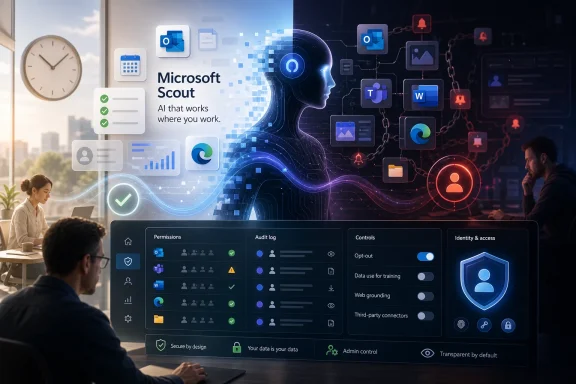 Microsoft’s New Agent Arrived With a Trust Problem Attached
Scout is not another chatbot box bolted onto the side of Office. Microsoft is positioning it as a persistent personal agent, one that lives across the productivity stack, observes work patterns, and acts on a user’s behalf in places like Outlook, Teams, Word, Edge, calendars, files, and workflows. That makes it more ambitious than the Copilot sidebar many users already learned to ignore.The sales pitch is familiar: fewer repetitive tasks, less administrative drag, more focus for the work that matters. Microsoft has spent the last several years arguing that AI can make office software feel less like office software, and Scout is the logical extension of that campaign. Instead of asking Copilot for help, the user is supposed to have an agent that already understands the context.
That is also why the leak matters. A document reportedly titled “ClawPilot: Overview and Plan with Project Lobster” described a staged rollout whose first phase was, according to 404 Media’s reporting, “Make people addicted.” Microsoft’s public language says empowerment; the leaked internal language says habit formation, retention, intensity, and dependency. Those are not merely different tones. They are different theories of the user.
The company’s response has only sharpened the contradiction. Nadella reportedly told staff he was “not sure what this document is or who is writing and leaking this nonsense,” while Microsoft spokespeople emphasized that Scout is intended to help people complete tasks more effectively, not increase screen time. But if the document was indeed written or credited by senior people tied to Scout, the denial reads less like clarification and more like a scramble to separate the CEO from the vocabulary of the product team.
“Addiction” Was the Wrong Word Because It Was Too Honest
The bluntness of “make people addicted” is why the phrase has traveled so far. Corporate strategy documents usually bury this kind of thinking under softer nouns: engagement, retention, stickiness, habit loops, daily active usage, customer success. The leaked phrase appears to say the quiet part with no varnish.There is a charitable reading. Inside a product team, “addicted” may have been used casually to mean “so useful people rely on it every day.” Plenty of teams say they want a tool to become indispensable, and enterprise software lives or dies by whether it becomes part of daily muscle memory. In that interpretation, Microsoft did not mean compulsive psychological dependency; it meant durable utility.
But the charitable reading does not fully rescue the company. The AI industry is already under scrutiny for designing systems that simulate companionship, authority, memory, and personalization. A persistent workplace agent is not a neutral spreadsheet macro. It watches, remembers, suggests, intervenes, and increasingly acts. If the design goal is daily dependence, then the ethical burden rises with the product’s intimacy.
Microsoft also cannot pretend this language arrived from nowhere. “Addiction” may be an embarrassing word, but the underlying metrics are standard operating procedure in modern software. Products are measured by frequency, retention, depth of usage, and expansion. In consumer tech, that logic produced the infinite scroll and the notification economy. In enterprise tech, it produces dashboards that celebrate whether a worker has turned the tool into a reflex.
The danger is that AI collapses the distance between usefulness and capture. A word processor that people use every day is a tool. An agent that reads the inbox, triages messages, writes replies, tracks behavior, and nudges next actions is closer to infrastructure. Once that agent becomes hard to remove from the workday, “addiction” stops sounding like a metaphor and starts sounding like a procurement strategy.
Nadella’s Denial Was Aimed at Employees as Much as the Public
Nadella’s reported internal response matters because it shows Microsoft understood the reputational threat immediately. The CEO did not merely say the wording was unfortunate. He reportedly rejected it as a goal and suggested that whoever wrote or leaked it might not belong at the company. That is a hard pivot from product launch enthusiasm to cultural discipline.The audience for that message was not only journalists. It was Microsoft’s own workforce, especially employees uneasy about the direction of AI inside the company. 404 Media reported that unnamed Microsoft employees found the language troubling, which is not surprising. Many engineers and product managers are now being asked to build systems that operate closer to users’ private work lives than previous software ever did.
A denial can be true in the narrow sense and still evasive in the broader one. Nadella may sincerely oppose designing products for unhealthy dependence. Microsoft may sincerely believe Scout returns time rather than consumes it. But the leaked document, if accurately described, suggests that at least some internal strategy used the language of compulsion to frame early adoption.
That is the distinction Microsoft needs to confront. The scandal is not that one executive used a dumb phrase in a slide deck. The scandal is that the phrase mapped so neatly onto what everyone already suspects about AI assistants: that the business case depends on making them unavoidable before users, regulators, and IT administrators have fully understood the tradeoffs.
The credibility gap widens because Scout is not a hobby project. Reports and Microsoft’s own launch materials place Omar Shahine, a corporate vice president, at the center of the effort. This is not a rogue intern’s brainstorm scribbled into a meeting note. It appears to be attached to a strategic product Microsoft is now pushing into one of the most valuable software estates in the world.
Scout Is Microsoft 365’s Most Aggressive Bet on Ambient Work
The core idea behind Scout is simple: the assistant should not wait for commands. It should know enough about your work to anticipate what needs doing, then execute or suggest actions inside the tools you already use. For anyone drowning in meetings, email, files, and follow-ups, that pitch is seductive.Microsoft’s advantage is distribution. Windows, Office, Teams, Outlook, Edge, SharePoint, OneDrive, Entra, Intune, Defender, GitHub, and Azure form a mesh of identity, productivity, development, security, and device management. A personal agent inside that mesh is more powerful than a standalone AI app because it can see more context and touch more workflows.
That is also why Scout feels different from earlier Copilot features. Copilot was often an assistant you invoked. Scout is being framed as something closer to a colleague, a background process, or an “autopilot” with its own identity and permissions. The agent is not just summarizing a document; it may eventually monitor tasks, coordinate schedules, prepare materials, and act across applications.
For Microsoft, this is the prize. If Scout becomes the layer through which users experience Microsoft 365, the company gets a new control point over enterprise productivity. The agent becomes the interface, the habit, and eventually the reason to stay inside the Microsoft ecosystem. That is not necessarily sinister. It is platform strategy.
But platform strategy is exactly why administrators should pay attention. When an agent becomes the default path through corporate knowledge, its failure modes become organizational failure modes. A bad summary, an overbroad permission, a misrouted message, or a hallucinated action is not just an AI glitch. It is a workflow incident.
The Privacy Problem Is Not Just Data Collection, It Is Context Collection
Microsoft will almost certainly emphasize controls: tenant boundaries, enterprise compliance, permissions, policies, admin configuration, auditability, and user choice. Those assurances matter, and they are not empty. Microsoft has spent decades selling software into regulated and risk-averse environments, and it knows that enterprise buyers will not tolerate a consumer-grade free-for-all inside corporate systems.Still, Scout’s power depends on context. The agent becomes useful by understanding email, meetings, documents, chats, calendars, browser activity, tasks, and recurring work patterns. Even if that data remains inside a tenant and is not used for broad model training, the user experience is built on aggregating sensitive signals into a persistent operational profile.
That changes the privacy conversation. Traditional enterprise software stores data. Scout-like agents interpret it. They infer priorities, relationships, urgency, habits, and intent. They may learn which colleague a user responds to quickly, which meetings are ignored, which documents are reused, which customer issues are escalating, and which tasks routinely slip.
For IT pros, the question is not only “Where does the data go?” It is “What new inferences are being produced, who can inspect them, how long do they persist, and what happens when they are wrong?” A compliance team may be comfortable with email retention policies. It may be less comfortable with an AI-generated behavioral map of how employees actually work.
There is also a labor dimension. If Scout can automate or semi-automate the visible surface of work, managers may start to measure work differently. The agent that promises to reduce toil can also become the system that records the absence of toil, the pace of response, and the number of automated workflows a worker is expected to maintain. Time saved has a way of becoming capacity reassigned.
Enterprise IT Has Seen This Movie, Just Not With a Talking Agent
Every major Microsoft platform shift arrives with a productivity promise and an administrative hangover. Teams was going to simplify collaboration; it also created sprawl, governance headaches, notification fatigue, and eDiscovery complexity. OneDrive and SharePoint modernized file access; they also forced organizations to rethink data loss prevention, sharing policies, and records management. Copilot promised knowledge work acceleration; it exposed how messy permissions and file hygiene had become.Scout will inherit all of that, then add autonomy. An assistant that only reads is one thing. An assistant that acts is another. The difference between “summarize this thread” and “respond to this customer” is the difference between information retrieval and delegated authority.
That is where Microsoft’s “clear choice and control” language will be tested. In an enterprise, choice is rarely as simple as a toggle. If a company deploys Scout, integrates it into workflows, and normalizes its use among managers and teams, workers may have formal control but little practical ability to opt out. A tool can be optional in the settings menu and mandatory in the culture.
Administrators will need to think like risk managers, not feature enablers. Which actions can Scout take without confirmation? Which systems are off limits? Can the agent access sensitive HR, legal, finance, or customer data? Are outputs logged in ways that support investigation without creating a new surveillance archive? Can a user or administrator reset Scout’s memory without breaking business continuity?
The first wave of Scout adoption will likely happen among enthusiasts and internal champions, the same pattern Microsoft has described in its own experimentation. That is useful for feedback, but it is not the same as enterprise readiness. Early adopters tolerate rough edges because they want the future to arrive. Regulated industries do not have that luxury.
The OpenClaw Lineage Makes the Product More Interesting and More Volatile
Scout’s reported roots in OpenClaw help explain both the excitement and the anxiety. OpenClaw became popular because it represented a more agentic style of AI: less chatbot, more operator. Engineers liked the flexibility, the sense that the system could chain tasks together and behave like a programmable assistant rather than a glorified autocomplete box.Microsoft’s move is to domesticate that energy. Wrap it in Microsoft 365, give it enterprise identity, bind it to compliance claims, and make it usable by people who do not want to configure an experimental agent framework. That is a smart product move. It is also a classic Microsoft move: take a chaotic developer fascination and turn it into infrastructure.
The risk is that the qualities that make agentic tools compelling are the same qualities that make them hard to govern. Agents are useful because they generalize. They can take messy instructions, navigate applications, and improvise across contexts. But generality is difficult to test exhaustively, especially when the environment is a live workplace full of confidential documents, ambiguous relationships, and changing priorities.
Microsoft will likely argue that Scout is being rolled out carefully, starting with Frontier users and expanding as the technology matures. That is the correct posture. But “careful rollout” does not erase the strategic ambition. The leaked document’s phased approach, if accurate, suggests that early dependency is not a side effect of the launch strategy. It is the launch strategy.
That is what should worry competitors as well as customers. If Microsoft can make Scout the preferred agent inside Microsoft 365, it can shape the market before rivals have a comparable workplace foothold. Google can do the same inside Workspace, and other vendors will fight for narrower lanes. The AI assistant war is becoming a war over who owns the working context.
The Windows Angle Is Bigger Than Another Copilot Button
Windows users have already lived through Microsoft’s increasingly aggressive AI distribution strategy. Copilot has appeared in Windows, Edge, Microsoft 365, GitHub, and developer tools, sometimes in ways that felt more imposed than invited. The company has learned that technical capability is only one part of adoption; placement, defaults, and repetition matter just as much.Scout raises the stakes because it is not simply another icon in the taskbar. If Microsoft succeeds, the assistant becomes a layer that follows users between devices and applications. Windows becomes not just an operating system but the home base for a persistent work agent tied to identity, cloud services, and organizational data.
That could be genuinely useful. A well-designed Scout could reduce context switching, remind users of commitments, prepare meetings from scattered materials, and handle small administrative chores that drain hours from the week. For power users, sysadmins, and developers, a reliable agent could become the automation layer Microsoft has been promising since the early days of scripting, macros, and Power Automate.
But the integration must be earned. Windows users have grown wary of features that arrive as defaults before they arrive as mature products. If Scout appears too aggressively, asks for too much context, or becomes difficult to disable, Microsoft will trigger the same backlash that has followed unwanted Edge prompts, account nudges, advertising surfaces, and telemetry controversies.
The difference is that an AI agent asks for a more intimate kind of trust. Users may tolerate a browser nag. They will be less forgiving of an assistant that misunderstands a private conversation, mishandles a customer issue, or makes a recommendation based on context they did not realize it had consumed.
The Business Model Wants Dependence Even If the CEO Does Not
Nadella may dislike “addiction” as a stated goal, but Microsoft’s AI economics make dependency hard to avoid. The company and its peers are spending enormous sums on chips, data centers, model development, acquisitions, talent, and cloud capacity. Those investments require durable revenue streams, not occasional curiosity clicks.Enterprise AI has a cleaner path to monetization than consumer chatbots because companies already pay per seat for productivity software. But the price increases and premium SKUs only work if AI becomes something organizations feel they cannot remove. In other words, the product does not need to be addictive in the clinical sense. It needs to become operationally indispensable.
That is the uncomfortable overlap between value and lock-in. If Scout saves a finance team hundreds of hours a month, the team becomes dependent on it in a perfectly rational way. If Scout learns company workflows and automates recurring tasks, switching away becomes costly. If employees build habits around it, the assistant becomes part of institutional memory.
Microsoft has done this before. Excel is not addictive, but entire companies cannot function without it. Active Directory is not exciting, but removing it from a large enterprise can feel like organ surgery. Teams became deeply embedded not because everyone loved it, but because it became the place where work happened.
Scout is a bid to create that level of dependency for AI. The problem is that the word “addicted” makes the strategy sound manipulative rather than infrastructural. Microsoft wants the benefits of indispensability without the optics of compulsion. The leak collapsed that distinction.
The Leak Also Reveals a Cultural Split Inside Microsoft
The most revealing part of the controversy may be that the document leaked at all. Microsoft is a massive company with competing cultures: research idealists, enterprise pragmatists, security veterans, growth teams, cloud strategists, Windows traditionalists, and AI acceleration groups all trying to shape the next platform shift. Leaks often emerge when people inside a company believe normal channels are not enough.The reported employee discomfort is credible because the AI debate inside tech companies is no longer abstract. Workers are being asked to ship systems that raise questions about labor displacement, surveillance, consent, copyright, safety, environmental cost, and psychological dependency. Some believe the risks are manageable. Others see a gold rush moving faster than governance.
Nadella has spent years presenting Microsoft as the responsible adult in the AI room: enterprise-grade, security-conscious, productivity-oriented, and less socially reckless than consumer social platforms. The leaked language undercuts that positioning. It makes Microsoft sound like every other engagement-obsessed tech company, only with deeper access to the office.
That reputational damage matters because Microsoft’s AI brand depends on trust. Companies do not hand over workplace context to a vendor they think is optimizing for compulsion. They do it when they believe the vendor understands governance, restraint, and institutional risk. Scout’s success will depend as much on that belief as on model quality.
Microsoft can recover from a bad phrase. It cannot recover as easily from a pattern that makes the phrase look accurate. The next few months of Scout rollout will therefore be watched not only for features, but for defaults, opt-in design, admin controls, pricing, documentation, audit logs, and how candidly Microsoft discusses limitations.
Regulators Will Not Need the Word “Addiction” to Notice the Pattern
The controversy also lands at a moment when regulators are already scrutinizing large technology platforms, AI concentration, and the power of default ecosystems. Microsoft has avoided some of the consumer-facing heat aimed at Meta, Google, TikTok, and Apple, but its enterprise dominance makes Scout politically interesting. A persistent agent embedded in the world’s most common productivity suite is not a niche feature.Regulators may not focus on the leaked phrase itself. They are more likely to ask about competition, data access, consent, market tying, and whether Microsoft uses its existing platform power to preference its own AI assistant. If Scout becomes deeply integrated into Microsoft 365 in ways rivals cannot match, antitrust concerns will follow naturally.
There is also a workplace governance angle. AI agents that process employee communications and behavior may intersect with labor law, privacy law, sector-specific compliance, and emerging AI regulations. Organizations deploying Scout will need to know whether employees have been properly notified, whether sensitive categories of data are excluded, and whether automated actions can be audited and contested.
The user harm will not always look dramatic. It may look like overcollection, quiet normalization, soft coercion, or a gradual shift in expectations. The assistant that once helped draft emails may become the mechanism by which workers are expected to respond faster, prepare better, and let fewer tasks fall through the cracks. Productivity tools often promise liberation and then raise the baseline.
That is not solely Microsoft’s fault. It is the history of workplace technology. But AI agents accelerate the pattern because they blur the line between assistance and management. Once software can observe the work, do parts of the work, and report on the work, it becomes part of the power structure of the office.
The Scout Fight Leaves Microsoft With a Narrower Path Than Its Launch Suggested
The practical lessons from this episode are sharper than the public-relations noise around it. Microsoft can still make Scout useful, even important, but it has made the trust problem harder by letting internal language outrun public assurances. For WindowsForum readers, the issue is not whether to cheer or jeer AI. It is whether Microsoft’s next productivity layer can be governed before it becomes invisible.- Microsoft announced Scout as an always-on Microsoft 365 agent, not merely a chat interface, which means its permissions and memory deserve the same scrutiny as any major enterprise platform.
- The reported “make people addicted” language is damaging because it aligns with standard engagement metrics that already shape modern software design.
- Nadella’s rejection of the phrase does not resolve the deeper issue of whether Microsoft is optimizing Scout for user agency or platform dependency.
- IT administrators should evaluate Scout first through identity, permissions, auditability, data retention, and opt-out policy rather than productivity demos.
- Microsoft’s strongest argument will be that Scout saves time, but its weakest point will be proving that saved time does not become another form of organizational control.
- The rollout will be defined less by launch-day promises than by defaults, pricing, admin controls, transparency, and how Microsoft responds when the agent makes mistakes.
References
- Primary source: Kotaku
Published: Fri, 05 Jun 2026 13:07:39 GMT
Leak Reveals Microsoft Wants Its AI To Be 'Addictive'
The new 'AI personal assistant' Scout has apparently already hooked its own employees kotaku.com
- Related coverage: axios.com
Microsoft debuts Scout agent, homegrown reasoning model
Microsoft is seeking to show it is a serious player in AI.www.axios.com
- Related coverage: techradar.com
'A new category of agents': Microsoft reveals Scout, its first "Autopilot", which wants to change how you work for good | TechRadar
Say hello to Autopilots from Microsoftwww.techradar.com - Related coverage: techcrunch.com
Microsoft launches Scout, an OpenClaw-inspired personal assistant | TechCrunch
Launched at Build, Microsoft Scout is a new AI assistant meant to bring the power and flexibility of OpenClaw into the Microsoft 365 system.techcrunch.com - Official source: microsoft.com
Introducing Microsoft Scout: Your always-on personal agent | Microsoft 365 Blog
Microsoft introduces a new, always-on personal agent, Microsoft Scout, integrated across the Microsoft 365 apps you use every day.www.microsoft.com - Related coverage: businesschief.com
Microsoft Announces Scout, an Always-On AI Agent for Teams | Business Chief
Microsoft announces Scout, an always-on AI agent for Teams and Microsoft 365 that schedules, drafts and chases work while employees are offline businesschief.com
- Related coverage: techspot.com
Microsoft took OpenClaw, wrapped it in enterprise security, and called it Scout | TechSpot
A few days after Google introduced its OpenClaw-based AI agent with Spark, Microsoft is now doing the same with Scout. The new AI tool is the first...www.techspot.com - Official source: news.microsoft.com
- Related coverage: semafor.com
Microsoft launches AI assistant powered by OpenClaw | Semafor
The tool could give businesses a taste of what agentic AI looks like at scale.www.semafor.com - Related coverage: singtaousa.com
微軟內部文件揭示Scout AI助手策略,首要目標是「讓用戶上癮」
微軟內部文件揭示,其新AI個人助理「Scout」的首要目標是「讓用戶上癮」。該計劃旨在將OpenClaw人工智能工具整合至Microsoft 365產品套件中。 | 星島日報www.singtaousa.com - Official source: learn.microsoft.com
Microsoft Scout (Frontier) overview | Microsoft Learn
Learn about Microsoft Scout, an AI desktop application that takes action across your files, shell, browser, and Microsoft 365.learn.microsoft.com - Related coverage: dev.ua
Microsoft launches Scout, a personal AI agent based on the OpenClaw framework | dev.ua
Microsoft Corporation has introduced Scout, a new always-on, artificial intelligence-based assistant for the Microsoft 365 ecosystem.dev.ua - Related coverage: gigazine.net
MicrosoftがOpenClawベースの常時稼働型AIエージェント「Scout」を発表、ユーザーの代わりに仕事を進める「Autopilot」第1弾 - GIGAZINE
Microsoftが、Microsoft 365向けの常時稼働型AIエージェント「Microsoft Scout」を発表しました。ScoutはAIエージェントフレームワークである「OpenClaw」の技術を基盤としており、ユーザーが毎回指示を出さなくてもバックグラウンドで作業を進める「Autopilot」という新カテゴリの最初のエージェントとして位置付けられています。gigazine.net - Related coverage: techxplore.com
- Related coverage: oversight.house.gov
- Related coverage: media.business-humanrights.org