

Microsoft’s recent selloff is a reminder that even the market’s most admired giants can be punished when expectations outrun execution. The company is still enormously profitable, still central to enterprise software, and still one of the core platforms for the AI buildout. But the stock’s sharp reversal in early 2026 exposed a harder truth: great businesses can become bad trades when investors pay too much for a perfect story.
Microsoft spent much of 2024 and 2025 trading like the safest way to own the artificial intelligence boom. Azure kept growing, Copilot became the poster child for enterprise AI, and Satya Nadella’s message was simple: Microsoft would monetize the next computing era through software, cloud infrastructure, and distribution at scale. That thesis pushed the shares to record highs and made the company look almost immune to the usual volatility that hits big technology names. The market treated Microsoft not just as a leader, but as a kind of benchmark for what “AI done right” was supposed to look like.
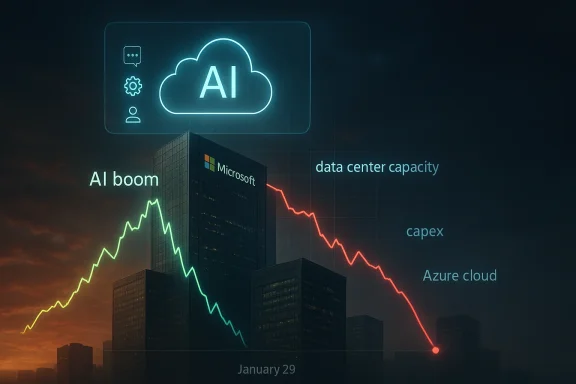
Then the mood changed. By the end of March 2026, Microsoft had suffered its worst six-month stretch since 2009, with the stock down roughly 32% from its October 2025 peak. The first quarter of 2026 was especially brutal, with shares falling about 23%, far worse than the Nasdaq’s roughly 7% decline over the same period. A single session on January 29 erased about $357 billion in market value, a staggering loss that immediately reframed the company’s AI narrative as a test of patience rather than a guaranteed payoff.
That does not mean Microsoft suddenly became a weak business. Far from it. Azure growth remained substantial, Microsoft 365 continued to generate recurring revenue, and the company kept investing aggressively in data centers and AI infrastructure. But public markets rarely price businesses on reality alone. They price them on the relationship between reality and expectation, and in Microsoft’s case that spread had become too wide for comfort.
The deeper issue is that Microsoft’s valuation had absorbed a very optimistic timeline for AI monetization. Investors were not merely paying for current earnings; they were paying for a rapid transition from AI excitement to AI adoption, from demos to durable usage, and from product launches to measurable enterprise habit. When that timeline looked slower than expected, the stock reacted like a premium multiple stock always does: violently.
At the same time, the broader market started to draw sharper distinctions within the AI trade. Companies that sold the picks and shovels of the AI era were often rewarded more than companies trying to monetize the end-user layer. That distinction matters because Microsoft sits awkwardly in the middle. It owns the cloud plumbing, but it also tries to turn AI into a software feature people will pay for every month. That combination is powerful, but it also makes the company more exposed to adoption risk than the market once admitted.
The OpenAI partnership strengthened that position dramatically. Microsoft was not just licensing access to frontier models; it was embedding itself in the AI supply chain at a moment when investors wanted direct exposure to the theme. Copilot became the clearest expression of that strategy. It promised to bring generative AI into the everyday workflows of knowledge workers, which made it more than a chatbot and more than a demo. In theory, it was the bridge between technical progress and enterprise revenue.
Microsoft also benefited from a trust advantage. Investors knew the company was not dependent on consumer virality or one-hit-product dynamics. It had decades of enterprise relationships, deep distribution, and a balance sheet that could support massive capital spending. That made the stock feel safer than many AI peers, even while it traded at a meaningfully elevated valuation. Safety, however, is not the same thing as insulation.
That matters for Copilot. The product may still prove powerful, but the path from launch to broad enterprise standard is longer than many investors priced in. The gap between “available” and “embedded” is often where software narratives go to die. Microsoft knows this as well as anyone, but the market sometimes forgets it when enthusiasm is high.
The answer was not a sudden collapse in the business itself. The earnings report still pointed to a company with strong revenue, healthy cloud demand, and major AI investments. What changed was the interpretation. Investors began to focus on the pace of monetization, the cost of AI infrastructure, and whether the spending curve would outpace the revenue curve for longer than expected. In other words, the market started treating Microsoft’s AI capex as a question, not a triumph.
There is also a reflexive element to these moves. Once a stock becomes a consensus winner, any sign of concern is amplified. Portfolio managers reduce risk, momentum traders exit, and valuation-sensitive investors begin looking elsewhere. The move can then become detached from the underlying business fundamentals, at least temporarily, which is exactly what makes the market so difficult to navigate at scale.
The issue is not whether Copilot is useful. It almost certainly is in the right environment. The issue is whether Microsoft can turn usefulness into adoption fast enough to justify the valuation investors assigned during the peak enthusiasm period. That is a different question, and it is much harder to answer with a keynote, a demo, or a press release.
A second issue is measurement. If a company buys Copilot, how exactly does it quantify the return? Time saved is useful, but it is rarely enough on its own. Productivity gains have to translate into either cost reduction, revenue improvement, or a compelling strategic advantage. Otherwise the software risks becoming another line item that executives admire but do not expand aggressively.
The result is a mismatch between product timing and financial timing. Microsoft can be right about the direction of enterprise AI and still be wrong about the pace at which money follows. That distinction is one of the most important lessons in this entire story.
The real debate is not whether Azure matters. It is whether Azure growth, while strong, can offset the rising cost of AI infrastructure fast enough to satisfy a market that became accustomed to near-perfect margin expansion. AI is expensive. It requires chips, power, networking, cooling, data centers, and long planning cycles. That means revenue growth can coexist with margin pressure for longer than investors may like.
This is where Microsoft’s reputation can become a burden. Because the company has historically delivered clean execution, the market expects clean execution now. But infrastructure rollouts are messy even for the best-run firms. Delays, bottlenecks, and capacity sequencing issues are not necessarily signs of weakness; they are often the unavoidable friction of scale.
One practical way to think about it is this: Azure is not a bad story; it is a story with a higher operating cost than investors wanted to admit. That does not invalidate the business model. It just changes the margin of safety.
That is what happened here. Microsoft’s valuation came down from the roughly 30x forward earnings range that defined its premium era to something much closer to the low 20s. On paper, that makes the stock look cheaper and potentially more attractive to long-term buyers. In practice, it reflects a market asking whether the growth narrative deserves the old premium at all.
That is why analyst target prices matter but do not settle the debate. A range from the mid-$500s to the high-$600s sounds optimistic, but it does not remove uncertainty about timing. A stock can be undervalued in a long-horizon sense and still be volatile for months if investors want proof first.
The contrast matters because it highlights a deeper strategic issue. Microsoft is both infrastructure provider and application-layer seller. That dual identity is powerful, but it also means the company can be judged by two different standards at once. If the software layer grows too slowly, investors question adoption. If infrastructure spending rises too quickly, they question efficiency.
This dynamic can make Microsoft look less like the purest AI play and more like the most complicated one. The market often prefers clarity. Nvidia’s story is easy to tell: more AI, more chips, more revenue. Microsoft’s story is more layered: cloud, productivity, data centers, software distribution, enterprise change management, and AI feature monetization. The breadth is impressive, but it can also muddy the investment narrative.
Still, a rebound driven by one piece of infrastructure news should not be mistaken for a full narrative repair. A data center opening ahead of schedule is positive, but it does not instantly solve the broader questions around demand absorption, capital intensity, and Copilot adoption. It is one piece of the puzzle, not the whole picture.
At the same time, the market needs to know what that capacity will be used for and how quickly it will earn its keep. A vast data center is only as valuable as the demand that fills it. If demand rises, the buildout looks visionary. If demand lags, the buildout can look overcommitted.
This is also a reminder that AI investing has graduated from simple enthusiasm to more demanding scrutiny. The market is no longer satisfied by the existence of AI strategy, AI partnerships, or AI mentions in earnings calls. It wants usage, conversion, margin discipline, and evidence that the spend is generating a return. That is good news for disciplined investors, but it is a harder environment for momentum-driven ones.
It also shows why concentration risk matters. If a portfolio is built around the assumption that a small number of megacap winners will carry the entire AI theme, any disappointment can hit performance hard. Diversification does not eliminate risk, but it can reduce the damage when the market recalibrates its favorite narrative.
That difference explains much of the current tension. Microsoft may be building toward a deeper enterprise AI footprint, but the stock was partly priced for an immediate consumer-like adoption curve. Markets punish that mismatch when it becomes visible.
The company does not need to “win” every AI debate to recover investor confidence. It needs to narrow the gap between expectation and execution. If Microsoft can do that, the selloff may later be remembered not as the beginning of a structural problem, but as the market’s overdue demand for realism.
Source: ABC Money Microsoft's Worst Six-Month Stretch Since 2009 Is a Wake-Up Call for Every Tech Investor
 Overview
Microsoft spent much of 2024 and 2025 trading like the safest way to own the artificial intelligence boom. Azure kept growing, Copilot became the poster child for enterprise AI, and Satya Nadella’s message was simple: Microsoft would monetize the next computing era through software, cloud infrastructure, and distribution at scale. That thesis pushed the shares to record highs and made the company look almost immune to the usual volatility that hits big technology names. The market treated Microsoft not just as a leader, but as a kind of benchmark for what “AI done right” was supposed to look like.Then the mood changed. By the end of March 2026, Microsoft had suffered its worst six-month stretch since 2009, with the stock down roughly 32% from its October 2025 peak. The first quarter of 2026 was especially brutal, with shares falling about 23%, far worse than the Nasdaq’s roughly 7% decline over the same period. A single session on January 29 erased about $357 billion in market value, a staggering loss that immediately reframed the company’s AI narrative as a test of patience rather than a guaranteed payoff.
That does not mean Microsoft suddenly became a weak business. Far from it. Azure growth remained substantial, Microsoft 365 continued to generate recurring revenue, and the company kept investing aggressively in data centers and AI infrastructure. But public markets rarely price businesses on reality alone. They price them on the relationship between reality and expectation, and in Microsoft’s case that spread had become too wide for comfort.
The deeper issue is that Microsoft’s valuation had absorbed a very optimistic timeline for AI monetization. Investors were not merely paying for current earnings; they were paying for a rapid transition from AI excitement to AI adoption, from demos to durable usage, and from product launches to measurable enterprise habit. When that timeline looked slower than expected, the stock reacted like a premium multiple stock always does: violently.
At the same time, the broader market started to draw sharper distinctions within the AI trade. Companies that sold the picks and shovels of the AI era were often rewarded more than companies trying to monetize the end-user layer. That distinction matters because Microsoft sits awkwardly in the middle. It owns the cloud plumbing, but it also tries to turn AI into a software feature people will pay for every month. That combination is powerful, but it also makes the company more exposed to adoption risk than the market once admitted.
Background
Microsoft’s modern investor case was built on three pillars: cloud, productivity software, and platform leverage. Azure transformed the company from a late cloud entrant into one of the market’s dominant hyperscalers. Microsoft 365 turned office software into a subscription machine. And under Satya Nadella, the company learned how to sell enterprise change without looking like it was forcing change on customers. That credibility mattered when generative AI arrived, because Microsoft could present itself as the distributor, integrator, and commercial wrapper for the new wave.The OpenAI partnership strengthened that position dramatically. Microsoft was not just licensing access to frontier models; it was embedding itself in the AI supply chain at a moment when investors wanted direct exposure to the theme. Copilot became the clearest expression of that strategy. It promised to bring generative AI into the everyday workflows of knowledge workers, which made it more than a chatbot and more than a demo. In theory, it was the bridge between technical progress and enterprise revenue.
The AI premium that carried the stock
By late 2024 and into 2025, Microsoft’s shares were being valued as if AI adoption would accelerate quickly and cleanly. That meant the market was assigning a premium multiple not only to current earnings but to future product adoption, Azure demand, and a broad monetization wave that would arrive without much friction. The problem with premium multiples is that they leave very little room for disappointment. If growth is merely good instead of explosive, the stock can still fall hard.Microsoft also benefited from a trust advantage. Investors knew the company was not dependent on consumer virality or one-hit-product dynamics. It had decades of enterprise relationships, deep distribution, and a balance sheet that could support massive capital spending. That made the stock feel safer than many AI peers, even while it traded at a meaningfully elevated valuation. Safety, however, is not the same thing as insulation.
Why enterprise AI is slower than hype
Enterprise software adoption is rarely linear. New products have to be approved, tested, integrated, trained, supported, and justified internally. That is true even when the software is obviously useful. A hospital network, a law firm, or a manufacturing company does not replace core workflows because a keynote looked convincing. It changes because the new workflow survives procurement, security review, and employee resistance.That matters for Copilot. The product may still prove powerful, but the path from launch to broad enterprise standard is longer than many investors priced in. The gap between “available” and “embedded” is often where software narratives go to die. Microsoft knows this as well as anyone, but the market sometimes forgets it when enthusiasm is high.
- Microsoft’s strength came from recurring revenue, not one-time product excitement.
- The OpenAI deal amplified the company’s AI visibility.
- Copilot became the symbolic test of enterprise AI adoption.
- High expectations created a fragile stock narrative.
- Slower rollout does not equal failure, but it can crush sentiment.
- Premium valuations leave little room for delays.
The January 29 Shock
The January 29 collapse became the clearest signal that the market was no longer willing to give Microsoft a free pass. The company’s shares fell sharply after earnings, and the market value loss of roughly $357 billion was widely described as the largest single-day decline in Microsoft’s history. Even for a company that large, that kind of destruction is hard to ignore. It instantly changed the conversation from “how much upside remains?” to “what exactly is the market worried about?”The answer was not a sudden collapse in the business itself. The earnings report still pointed to a company with strong revenue, healthy cloud demand, and major AI investments. What changed was the interpretation. Investors began to focus on the pace of monetization, the cost of AI infrastructure, and whether the spending curve would outpace the revenue curve for longer than expected. In other words, the market started treating Microsoft’s AI capex as a question, not a triumph.
When good numbers are not enough
This is a classic public-market problem. A company can post strong results and still get punished if the results are merely strong rather than strong enough. Microsoft’s case was particularly vulnerable because expectations had become so elevated. The stock had already priced in a long runway of AI-related acceleration, so even a modest hint of slower-than-hoped adoption could trigger a violent repricing.There is also a reflexive element to these moves. Once a stock becomes a consensus winner, any sign of concern is amplified. Portfolio managers reduce risk, momentum traders exit, and valuation-sensitive investors begin looking elsewhere. The move can then become detached from the underlying business fundamentals, at least temporarily, which is exactly what makes the market so difficult to navigate at scale.
What the selloff really said
The selloff did not say Microsoft was broken. It said the market was no longer comfortable paying a perfect multiple for an imperfect rollout. That is a much more subtle and more important point. A great company can still be a poor stock if the entry price assumes flawless execution. The January drop was a reminder that Wall Street often punishes not failure, but disappointment relative to fantasy.- The move reflected valuation anxiety as much as business concern.
- AI infrastructure spending became a focal point.
- Investors wanted faster evidence of monetization.
- Microsoft’s size magnified the market impact.
- The selloff reset expectations for the rest of 2026.
- Strong fundamentals did not prevent a sharp repricing.
Copilot and the Monetization Problem
Copilot is at the heart of Microsoft’s current debate because it sits where product promise meets revenue reality. The pitch is easy to understand: use AI to make knowledge work faster, easier, and more valuable. The harder part is making that pitch stick across millions of seats, thousands of organizations, and a wide range of use cases. Enterprises may love the idea of AI productivity, but budgets, governance, and workflow inertia are very real constraints.The issue is not whether Copilot is useful. It almost certainly is in the right environment. The issue is whether Microsoft can turn usefulness into adoption fast enough to justify the valuation investors assigned during the peak enthusiasm period. That is a different question, and it is much harder to answer with a keynote, a demo, or a press release.
Enterprise adoption is a marathon
Large organizations do not adopt software the way consumers install apps. They roll it out in phases, negotiate licenses, test security controls, and train staff. Often, the main obstacle is not the product itself but the organizational cost of change. That makes Copilot an especially challenging business lever, because its value is tied to behavior, and behavior is slow to shift.A second issue is measurement. If a company buys Copilot, how exactly does it quantify the return? Time saved is useful, but it is rarely enough on its own. Productivity gains have to translate into either cost reduction, revenue improvement, or a compelling strategic advantage. Otherwise the software risks becoming another line item that executives admire but do not expand aggressively.
Why the market got ahead of itself
Microsoft’s AI story was compelling enough to support a premium multiple, but premium multiples require precision. Investors were effectively assuming that Copilot would become a broad default across enterprise workflows in a short window. That may still happen eventually, but the market does not always reward eventual when it has already priced in immediate.The result is a mismatch between product timing and financial timing. Microsoft can be right about the direction of enterprise AI and still be wrong about the pace at which money follows. That distinction is one of the most important lessons in this entire story.
- Copilot’s promise is real, but adoption is uneven.
- Change management is a major enterprise friction point.
- ROI is harder to prove than the demos suggest.
- Investors priced in faster conversion than reality delivered.
- The timing gap between product and monetization matters.
- Software usefulness does not automatically equal stock upside.
Azure Still Matters
It is tempting to reduce Microsoft’s entire situation to Copilot, but that would miss the larger picture. Azure remains one of the company’s most important engines, and its growth has still been robust by any normal standard. Microsoft’s cloud business continues to benefit from enterprise migration, hybrid infrastructure demand, and AI-related workloads that need large-scale compute. That is not the profile of a company in operational distress.The real debate is not whether Azure matters. It is whether Azure growth, while strong, can offset the rising cost of AI infrastructure fast enough to satisfy a market that became accustomed to near-perfect margin expansion. AI is expensive. It requires chips, power, networking, cooling, data centers, and long planning cycles. That means revenue growth can coexist with margin pressure for longer than investors may like.
Infrastructure is the new battlefield
Microsoft’s capital spending has become part of the story, not just a footnote. The company is building at a scale that reflects the expected demand for AI workloads over multiple years. That is strategically sound if demand materializes, but it creates a short-term financial tension that public markets can dislike. Investors want both growth and evidence that the spending is not running ahead of the economics.This is where Microsoft’s reputation can become a burden. Because the company has historically delivered clean execution, the market expects clean execution now. But infrastructure rollouts are messy even for the best-run firms. Delays, bottlenecks, and capacity sequencing issues are not necessarily signs of weakness; they are often the unavoidable friction of scale.
A healthier way to read Azure
The bear case tends to overstate the possibility that Azure is slowing because AI hype is fading. The more plausible interpretation is that Azure remains strong, but the market is re-pricing the amount of profit that will accrue to Microsoft after heavy reinvestment. That is a very different critique. It means the business can be healthy while the stock still struggles.One practical way to think about it is this: Azure is not a bad story; it is a story with a higher operating cost than investors wanted to admit. That does not invalidate the business model. It just changes the margin of safety.
- Azure remains central to Microsoft’s long-term case.
- AI workloads are driving massive infrastructure demand.
- Capital intensity is rising across the hyperscaler sector.
- Margin pressure can coexist with revenue growth.
- The stock is sensitive to the pace of payback.
- Execution quality remains better than the market’s recent mood suggests.
The Valuation Reset
For much of 2024 and early 2025, Microsoft traded like a premium compounder with almost no execution risk. That is the sort of stock investors love during momentum periods because it combines quality, predictability, and a believable AI upside story. But once the multiple compresses, the same stock can start looking quite different. A lower forward P/E changes how every incremental growth figure is interpreted.That is what happened here. Microsoft’s valuation came down from the roughly 30x forward earnings range that defined its premium era to something much closer to the low 20s. On paper, that makes the stock look cheaper and potentially more attractive to long-term buyers. In practice, it reflects a market asking whether the growth narrative deserves the old premium at all.
A cheaper stock is not automatically a bargain
One of the easiest mistakes in tech investing is assuming that a lower multiple automatically equals value. That is only true if the business still deserves its historical growth assumptions. If growth slows or becomes more capital-intensive, the right multiple can be lower for a reason. In Microsoft’s case, the market is trying to decide whether the new floor is a discount opportunity or a fair reflection of a slower monetization cycle.That is why analyst target prices matter but do not settle the debate. A range from the mid-$500s to the high-$600s sounds optimistic, but it does not remove uncertainty about timing. A stock can be undervalued in a long-horizon sense and still be volatile for months if investors want proof first.
What valuation says about investor psychology
Valuation is really shorthand for collective confidence. When investors believe a company will convert innovation into earnings quickly, they pay up. When they begin to doubt the timing, the multiple compresses even if the business stays sound. Microsoft’s reset shows that quality alone is not enough when expectations are extreme.- The stock moved from perfection pricing toward realism.
- Lower multiples can create opportunity, but not certainty.
- Long-term value and short-term performance are different things.
- Analyst targets often trail narrative shifts.
- Valuation compression usually follows expectation compression.
- Microsoft is cheaper than before, but not automatically cheap.
Competitive Implications
Microsoft’s weakness did not occur in a vacuum. It happened in a market where investors were rapidly sorting winners from laggards in the AI race. Nvidia’s market value surged to extraordinary levels in the same broad period, which reinforced a tough lesson: the market currently prefers companies that sell the picks and shovels of AI over those trying to package AI into software experiences. That is not a permanent truth, but it is the truth right now.The contrast matters because it highlights a deeper strategic issue. Microsoft is both infrastructure provider and application-layer seller. That dual identity is powerful, but it also means the company can be judged by two different standards at once. If the software layer grows too slowly, investors question adoption. If infrastructure spending rises too quickly, they question efficiency.
Why rivals may benefit
Alphabet, Amazon, and Nvidia all stand to benefit differently depending on how the AI cycle evolves. Nvidia benefits most directly from the hardware buildout. Amazon and Google benefit from cloud demand and infrastructure expansion. Microsoft has exposure to all of that, but it also bears the burden of proving that enterprise AI can be monetized at scale through subscription software. That is a tougher sell than simply renting compute.This dynamic can make Microsoft look less like the purest AI play and more like the most complicated one. The market often prefers clarity. Nvidia’s story is easy to tell: more AI, more chips, more revenue. Microsoft’s story is more layered: cloud, productivity, data centers, software distribution, enterprise change management, and AI feature monetization. The breadth is impressive, but it can also muddy the investment narrative.
The broader market signal
The tech sector’s underperformance during this stretch suggested that investors were becoming more selective about AI exposure. They were not rejecting AI. They were rejecting indiscriminate AI enthusiasm. That shift is important because it suggests a market in transition from theme-chasing to evidence-chasing. For investors, that usually means less reward for narrative momentum and more reward for visible execution.- Hardware-first AI names gained relative favor.
- Cloud vendors faced scrutiny over capex intensity.
- Software monetization was judged more harshly.
- Investors became more selective within tech.
- Microsoft’s mixed identity made it harder to classify.
- The market began demanding proof, not promises.
The Fairweather Data Center Signal
Microsoft’s shares did rebound when news emerged that the Fairweather data center in Wisconsin had come online ahead of schedule. That mattered because it gave investors something tangible to anchor to: physical capacity, earlier-than-expected delivery, and proof that the company is still executing on its infrastructure roadmap. In a period dominated by skepticism, a concrete operational milestone can carry unusual weight.Still, a rebound driven by one piece of infrastructure news should not be mistaken for a full narrative repair. A data center opening ahead of schedule is positive, but it does not instantly solve the broader questions around demand absorption, capital intensity, and Copilot adoption. It is one piece of the puzzle, not the whole picture.
Why physical buildout matters in AI
AI is not a purely software economy. It is increasingly a physical economy built on land, power, cooling, and chips. That means execution can be judged in miles of fiber and megawatts as much as in user growth or revenue per seat. Microsoft’s ability to bring a major facility online on time, or ahead of schedule, signals that the company is serious about the long game.At the same time, the market needs to know what that capacity will be used for and how quickly it will earn its keep. A vast data center is only as valuable as the demand that fills it. If demand rises, the buildout looks visionary. If demand lags, the buildout can look overcommitted.
The rebound is useful, not conclusive
The four-day bounce in mid-April 2026 showed that investors are still willing to reward evidence of execution. That is encouraging. But the real test will come from upcoming earnings and forward guidance, where the company will need to show that AI-related spending is translating into durable demand, not just impressive infrastructure headlines. The market will almost certainly look past one good week if the next quarter does not reinforce it.- Early completion helps rebuild confidence.
- Infrastructure milestones are becoming market-moving events.
- Physical capacity only matters if demand follows.
- The rebound improved sentiment but not certainty.
- Investors want both proof and pacing.
- One successful buildout does not settle the valuation debate.
What the Selloff Means for Tech Investors
Microsoft’s decline should not be read as a warning against all large-cap tech. It is a warning against confusing a strong business with an automatically attractive entry point. That distinction becomes especially important in eras when investors are willing to pay premium prices for future narratives. A company can dominate its category and still disappoint shareholders if the stock already discounted too much perfection.This is also a reminder that AI investing has graduated from simple enthusiasm to more demanding scrutiny. The market is no longer satisfied by the existence of AI strategy, AI partnerships, or AI mentions in earnings calls. It wants usage, conversion, margin discipline, and evidence that the spend is generating a return. That is good news for disciplined investors, but it is a harder environment for momentum-driven ones.
Lessons from Microsoft’s drop
The lesson is not that Microsoft is suddenly a dangerous company. It is that the stock can become dangerous when priced as if every AI initiative will work on schedule. Good companies are often durable over long periods, but trades can still fail even when the underlying business keeps compounding. That is the uncomfortable truth many investors forget during bull runs.It also shows why concentration risk matters. If a portfolio is built around the assumption that a small number of megacap winners will carry the entire AI theme, any disappointment can hit performance hard. Diversification does not eliminate risk, but it can reduce the damage when the market recalibrates its favorite narrative.
Consumer and enterprise impact diverge
For consumers, Microsoft’s AI story is mostly about product convenience and bundled features. For enterprises, it is about workflow change, compliance, and return on investment. Those are not equivalent markets. A consumer product can spread quickly because it is easy to try. An enterprise product has to earn adoption through governance and operational value.That difference explains much of the current tension. Microsoft may be building toward a deeper enterprise AI footprint, but the stock was partly priced for an immediate consumer-like adoption curve. Markets punish that mismatch when it becomes visible.
- Separate business quality from stock valuation.
- Treat AI adoption as a rollout problem, not a slogan.
- Watch capex discipline as closely as revenue growth.
- Be wary of narratives that assume instant enterprise change.
- Remember that multiple compression can outpace earnings growth.
- Favor evidence over excitement when expectations are high.
Strengths and Opportunities
Microsoft still has an enviable collection of strengths: recurring software revenue, a deeply entrenched enterprise customer base, a powerful cloud platform, and a credible path to embedding AI across workflows. The selloff may have hurt sentiment, but it did not erase the company’s strategic advantages. If anything, the reset may create a better backdrop for investors who believe the long-term AI thesis remains intact.- Azure remains a core growth engine with broad enterprise demand.
- Microsoft 365 gives the company recurring cash flow and distribution.
- Copilot still has the potential to become a major workflow product.
- Balance sheet strength supports heavy infrastructure investment.
- Brand trust helps Microsoft sell complex products to enterprises.
- Platform breadth gives the company more AI monetization paths than most rivals.
- Valuation compression may improve the risk-reward setup for patient investors.
Risks and Concerns
The risks are just as clear. Microsoft’s AI monetization may simply be slower than the market wanted, and the company is spending heavily to prepare for demand that might arrive unevenly. If enterprise adoption does not accelerate, the stock could continue to suffer even while the business remains healthy. That is the kind of mismatch that frustrates investors the most.- Copilot adoption may prove slower than forecast.
- Capital intensity could pressure margins longer than expected.
- Valuation sensitivity remains high after a premium-era rerating.
- Execution risk grows as data center expansion scales up.
- Investor impatience can punish even strong quarterly results.
- Competitive pressure from Nvidia, Amazon, and Alphabet may distort comparisons.
- Narrative risk remains elevated if AI enthusiasm cools further.
Looking Ahead
The next few quarters will matter more than the last six months of stock performance. Microsoft needs to show that its AI investments are not just strategically sound, but financially visible in a way the market can track. That means better evidence on Copilot usage, more clarity around Azure demand, and continued proof that infrastructure expansion is translating into future revenue rather than future worry.The company does not need to “win” every AI debate to recover investor confidence. It needs to narrow the gap between expectation and execution. If Microsoft can do that, the selloff may later be remembered not as the beginning of a structural problem, but as the market’s overdue demand for realism.
- Watch Copilot adoption metrics and enterprise seat expansion.
- Track Azure growth against capital spending and margin trends.
- Monitor guidance for signs of demand durability versus caution.
- Pay attention to data center delivery and capacity utilization.
- Compare Microsoft’s performance with Nvidia, Amazon, and Alphabet to see where capital is flowing.
Source: ABC Money Microsoft's Worst Six-Month Stretch Since 2009 Is a Wake-Up Call for Every Tech Investor
