

Microsoft’s recent selloff has created a sharp disconnect between the stock price and the business fundamentals, and that gap is now one of the most important stories in large-cap technology. The market is reacting to slower cloud growth at the margin, rising AI capital expenditures, and concentration risk around OpenAI, but the underlying demand picture remains unusually strong. Microsoft’s latest fiscal second-quarter results showed $81.3 billion in revenue, $38.3 billion in operating income, and $51.5 billion in Microsoft Cloud revenue, while commercial bookings surged and the company disclosed a record $625 billion in commercial remaining performance obligation, up 110% year over year.
Microsoft has spent the last several years transforming itself from a mature software company into a cloud-and-AI infrastructure platform with unusually broad enterprise reach. The core story is no longer just Windows, Office, and server software; it is the combination of Azure, Microsoft 365, Dynamics, GitHub, and a growing family of AI copilots that sit on top of those products. That shift matters because it changes the company’s growth ceiling, its capital intensity, and the way investors should think about recurring revenue.
The most recent results underline how much the business has evolved. In fiscal Q2 2026, Microsoft said revenue rose 17%, operating income increased 21%, and Microsoft Cloud revenue reached $51.5 billion, up 26%. Management also said Azure and other cloud services grew 39%, with demand continuing to exceed available supply. Those are not the numbers of a company running out of runway; they are the numbers of a company whose bottleneck is increasingly capacity, not customer interest. (microsoft.com)
At the same time, the market is no longer willing to reward growth at any price. Microsoft has been pouring money into AI infrastructure, and gross margin pressure has become visible. The company said Microsoft Cloud gross margin was 67%, down year over year because of continued AI investment, even as efficiency gains in Azure and Microsoft 365 Commercial helped cushion the decline. Investors are now asking a simple but very important question: how quickly can those investments translate into durable earnings leverage?
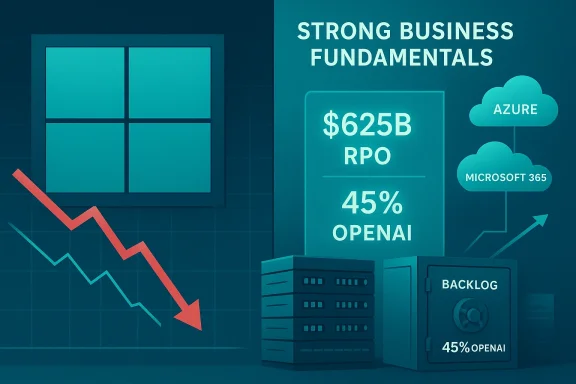
The answer, at least in management’s telling, is that the revenue pipeline is already there. Microsoft’s commercial remaining performance obligation, or RPO, jumped to $625 billion and the company said roughly 45% of that balance is tied to OpenAI, while the rest is spread across a broad base of customers, industries, and geographies. In the company’s own words, the significant OpenAI contract represents multi-year demand needs and creates quarterly volatility in bookings and RPO growth rates going forward. (microsoft.com)
That combination — heavy investment, powerful backlog, and near-term valuation anxiety — is what makes Microsoft one of the most closely watched names in the market today. For long-term investors, the key issue is not whether the business is slowing in an absolute sense. It is whether the current selloff is pricing in a cyclical problem when the evidence still points to a structural expansion in Microsoft’s enterprise franchise.
What the market seems to be saying is that it now wants proof, not just promise. Revenue growth of 17% is still exceptional for a company of Microsoft’s size, but when a stock has already been awarded premium multiple status, investors start to scrutinize the conversion of capital into free cash flow, not just the top line. The recent selloff therefore reflects a shift from scarcity premium to return-on-capital premium.
That distinction matters because markets often mistake constrained supply for slowing demand. Microsoft’s case may be exactly the opposite. If the company is supply-constrained, then softer near-term revenue expansion can coexist with a much larger booked pipeline, which is one reason the backlog disclosure has become so central to the debate. (microsoft.com)
That backlog matters because it is a strong signal of revenue visibility. It does not guarantee execution, but it does indicate that customers have already committed significant spend to Microsoft’s cloud stack and commercial software ecosystem. Microsoft also said that roughly 45% of the backlog is linked to OpenAI, meaning the remaining 55% — about $350 billion — comes from a broad base of enterprise demand. (microsoft.com)
The company’s own guidance supports that interpretation. Management said the significant OpenAI contract will create quarterly volatility in bookings and RPO growth rates, which is exactly what you would expect when one very large agreement lands in an already large backlog. That means investors should be careful about reading quarter-to-quarter changes too literally. (microsoft.com)
This is where the bull case gets stronger, not weaker. A business with a $625 billion backlog and strong near-term conversion is not dependent on speculative future sales alone; it is operating with a deep reservoir of committed demand. That does not eliminate risk, but it does make the current selloff look more like a valuation problem than a franchise problem. That is an important distinction.
The market, however, is looking past the growth rate and into the economics. AI infrastructure is expensive, and Microsoft has been clear that it is spending aggressively to expand capacity. Gross margin in Microsoft Cloud fell to 67%, and management linked that decline to AI investment, even while noting ongoing efficiency gains in Azure and Microsoft 365 Commercial.
The company says it is balancing those trade-offs carefully. Management noted that capital expenditures should decrease sequentially in Q3 because of normal buildout timing, but also said the mix of short-lived assets would remain similar as it closes the gap between demand and supply. In other words, Microsoft is not signaling retreat; it is signaling continuing intensity. (microsoft.com)
That makes the current investment cycle strategically rational even if it looks messy in quarterly financials. Microsoft is not just trying to sell GPU time; it is trying to preserve control over the enterprise application layer as AI becomes embedded in everyday workflows. That is a much larger prize. (microsoft.com)
That is a meaningful development because it shifts the AI story from infrastructure economics to software monetization. If Copilot raises average revenue per user, Microsoft can turn AI from a cost center into a recurring pricing lever. Investors often focus on the size of the GPU bill, but the real economic test is whether AI drives enough incremental ARPU and retention to justify that bill. (microsoft.com)
Consumer AI is still strategically relevant, especially as Microsoft pushes Copilot deeper into Windows and subscriptions, but the enterprise use case is where Microsoft’s moat is strongest. Businesses are more willing to pay for productivity gains, governance, and security than individual consumers are for convenience alone. That makes the commercial segment the more important long-term monetization engine. (microsoft.com)
The strategic logic here is elegant: Azure supplies the compute, Microsoft 365 provides the daily interface, and Copilot ties them together. If that flywheel keeps turning, the company can absorb heavy AI investment while still expanding operating income over time. That is exactly why long-term bulls are willing to overlook the current margin compression. (microsoft.com)
Microsoft itself acknowledged the pressure. The company said Microsoft Cloud gross margin declined to 67% due to continued AI infrastructure investment and growing AI product usage. It also stated that operating expenses rose because of R&D investments in compute capacity and AI talent. That tells you the company is consciously choosing growth and platform control over short-term margin maximization.
The company’s own commentary supports that view. Amy Hood said much of the capital being spent today is already contracted for most of its useful life, and that many GPU contracts are sold for the entirety of their useful life. That means Microsoft is not simply speculating on demand; it is funding capacity against contracted revenue. (microsoft.com)
That is why Microsoft’s results are being interpreted through a different lens than they were two years ago. Investors are no longer asking whether Microsoft can grow; they are asking whether it can grow efficiently enough to justify a premium valuation in a capital-intensive AI era. That is a much stricter test.
The company’s backlog growth also suggests that customers continue to choose Microsoft for large, long-duration commitments. That is important because AI markets can look fragmented early on, but they often consolidate around a few platforms once enterprises standardize workloads and governance. Microsoft appears to be positioning itself as one of those standards. (microsoft.com)
Still, Microsoft has something many competitors do not: a ready-made enterprise distribution engine. When a new capability can be sold into an existing customer base of hundreds of millions of seats and enterprise cloud contracts, the go-to-market advantage is enormous. That is why the company can invest heavily without immediately losing strategic ground. (microsoft.com)
In that sense, the current selloff may be less about Microsoft losing momentum and more about the market finally pricing the cost of maintaining dominance. Leadership is expensive. The question is whether Microsoft’s scale and installed base make that expense manageable enough to preserve superior long-term returns. (microsoft.com)
At the same time, Microsoft’s executives were careful to frame the issue as manageable. Amy Hood emphasized that the remaining 55% of the backlog is broadly diversified and that the non-OpenAI portion still grew 28%. That is not the language of a company hiding weakness; it is the language of a company trying to prevent the market from over-interpreting one very large contract. (microsoft.com)
But the OpenAI relationship is also a strategic asset. It gives Microsoft a front-row seat to frontier model demand, a major infrastructure customer, and a credibility halo in enterprise AI discussions. The risk is real, but so is the optionality. This is a classic high-upside, high-complexity partnership. (microsoft.com)
That is why the OpenAI exposure should be seen as a risk factor, not a thesis killer. Microsoft’s challenge is not to eliminate concentration; it is to keep the rest of the business compounding fast enough that the company is not judged solely on one relationship. (microsoft.com)
It will also be important to watch how management frames capital intensity going forward. Microsoft has already signaled that the mix of short-lived assets will remain elevated in the near term and that capacity remains constrained, which suggests the company is still in expansion mode. If that expansion begins to show up in stronger operating leverage later in the year, the market may quickly rethink its skepticism. (microsoft.com)
Source: Seeking Alpha Microsoft: Beneath The Selloff (NASDAQ:MSFT)
 Background
Microsoft has spent the last several years transforming itself from a mature software company into a cloud-and-AI infrastructure platform with unusually broad enterprise reach. The core story is no longer just Windows, Office, and server software; it is the combination of Azure, Microsoft 365, Dynamics, GitHub, and a growing family of AI copilots that sit on top of those products. That shift matters because it changes the company’s growth ceiling, its capital intensity, and the way investors should think about recurring revenue.The most recent results underline how much the business has evolved. In fiscal Q2 2026, Microsoft said revenue rose 17%, operating income increased 21%, and Microsoft Cloud revenue reached $51.5 billion, up 26%. Management also said Azure and other cloud services grew 39%, with demand continuing to exceed available supply. Those are not the numbers of a company running out of runway; they are the numbers of a company whose bottleneck is increasingly capacity, not customer interest. (microsoft.com)
At the same time, the market is no longer willing to reward growth at any price. Microsoft has been pouring money into AI infrastructure, and gross margin pressure has become visible. The company said Microsoft Cloud gross margin was 67%, down year over year because of continued AI investment, even as efficiency gains in Azure and Microsoft 365 Commercial helped cushion the decline. Investors are now asking a simple but very important question: how quickly can those investments translate into durable earnings leverage?
The answer, at least in management’s telling, is that the revenue pipeline is already there. Microsoft’s commercial remaining performance obligation, or RPO, jumped to $625 billion and the company said roughly 45% of that balance is tied to OpenAI, while the rest is spread across a broad base of customers, industries, and geographies. In the company’s own words, the significant OpenAI contract represents multi-year demand needs and creates quarterly volatility in bookings and RPO growth rates going forward. (microsoft.com)
That combination — heavy investment, powerful backlog, and near-term valuation anxiety — is what makes Microsoft one of the most closely watched names in the market today. For long-term investors, the key issue is not whether the business is slowing in an absolute sense. It is whether the current selloff is pricing in a cyclical problem when the evidence still points to a structural expansion in Microsoft’s enterprise franchise.
The Selloff: Why the Market Hit MSFT
The latest pullback reflects a classic tension between great results and uncomfortable expectations. Microsoft beat revenue and earnings estimates, yet the stock still fell sharply after the report because investors focused on AI spending, a slight margin compression, and the concentration of a giant backlog in a single partner relationship. That is a fundamentally different kind of market reaction than the one Microsoft enjoyed in earlier phases of the cloud boom.What the market seems to be saying is that it now wants proof, not just promise. Revenue growth of 17% is still exceptional for a company of Microsoft’s size, but when a stock has already been awarded premium multiple status, investors start to scrutinize the conversion of capital into free cash flow, not just the top line. The recent selloff therefore reflects a shift from scarcity premium to return-on-capital premium.
Short-Term vs. Long-Term Read-Through
In the short term, the stock is reacting to two visible pressures: rising capex and the possibility that AI demand is lumpy rather than linear. In the long term, though, the same data can be read as evidence of a platform still early in a monetization cycle. Microsoft’s management explicitly said demand continues to exceed supply across Azure, and that the company is reallocating capacity as it opens new infrastructure. (microsoft.com)That distinction matters because markets often mistake constrained supply for slowing demand. Microsoft’s case may be exactly the opposite. If the company is supply-constrained, then softer near-term revenue expansion can coexist with a much larger booked pipeline, which is one reason the backlog disclosure has become so central to the debate. (microsoft.com)
- The selloff is driven more by expectations reset than a collapse in demand.
- AI capex is compressing margins today.
- Backlog visibility argues that revenue is deferred, not disappearing.
- The key question is whether future returns justify current investment intensity.
Understanding the $625 Billion Backlog
The most important number in Microsoft’s latest report may be the one the market is still arguing about: $625 billion in commercial remaining performance obligation. In plain English, that is contracted future revenue that has not yet been recognized. Microsoft said this balance was up 110% year over year and carries a weighted average duration of about two and a half years.That backlog matters because it is a strong signal of revenue visibility. It does not guarantee execution, but it does indicate that customers have already committed significant spend to Microsoft’s cloud stack and commercial software ecosystem. Microsoft also said that roughly 45% of the backlog is linked to OpenAI, meaning the remaining 55% — about $350 billion — comes from a broad base of enterprise demand. (microsoft.com)
Why RPO Is More Useful Than a Simple Bookings Number
RPO is not the same as bookings, and that difference is crucial. Bookings can spike on the timing of large deals, while RPO captures the contracted revenue that has not yet flowed through the income statement. For a company like Microsoft, which increasingly sells multi-year cloud and AI commitments, RPO is often the better indicator of future revenue gravity. (microsoft.com)The company’s own guidance supports that interpretation. Management said the significant OpenAI contract will create quarterly volatility in bookings and RPO growth rates, which is exactly what you would expect when one very large agreement lands in an already large backlog. That means investors should be careful about reading quarter-to-quarter changes too literally. (microsoft.com)
- RPO shows contracted future revenue, not just completed sales.
- Microsoft’s balance is unusually large even by mega-cap standards.
- The OpenAI component adds both scale and volatility.
- The non-OpenAI portion is still growing at a healthy pace.
The Conversion Question
The relevant issue is how much of that backlog turns into revenue within the next twelve months. Microsoft said it expects to recognize about 40% of total company RPO over the next year in its annual report, while earlier quarters showed a similar near-term conversion profile in the mid-30% to 40% range. That implies a huge base of already contracted revenue should continue feeding the top line even if new bookings normalize.This is where the bull case gets stronger, not weaker. A business with a $625 billion backlog and strong near-term conversion is not dependent on speculative future sales alone; it is operating with a deep reservoir of committed demand. That does not eliminate risk, but it does make the current selloff look more like a valuation problem than a franchise problem. That is an important distinction.
Azure, AI, and the Supply Constraint
Azure remains the clearest proof that Microsoft’s cloud engine is still running hot. Revenue from Azure and other cloud services grew 39% in fiscal Q2 2026, and management said demand continues to exceed available supply. That is an unusually strong combination because it implies that the limiting factor is not market interest, but how quickly Microsoft can bring data center and compute capacity online. (microsoft.com)The market, however, is looking past the growth rate and into the economics. AI infrastructure is expensive, and Microsoft has been clear that it is spending aggressively to expand capacity. Gross margin in Microsoft Cloud fell to 67%, and management linked that decline to AI investment, even while noting ongoing efficiency gains in Azure and Microsoft 365 Commercial.
Capacity Today, Revenue Tomorrow
One way to interpret this is that Microsoft is effectively building the road network before the traffic fully arrives. That can be painful in the short run because it drags on margin and free cash flow, but it is also how durable platform advantages are built in infrastructure businesses. If Microsoft underbuilds now, it risks losing demand to rivals. If it overbuilds too aggressively, it risks capital inefficiency. (microsoft.com)The company says it is balancing those trade-offs carefully. Management noted that capital expenditures should decrease sequentially in Q3 because of normal buildout timing, but also said the mix of short-lived assets would remain similar as it closes the gap between demand and supply. In other words, Microsoft is not signaling retreat; it is signaling continuing intensity. (microsoft.com)
- Azure growth remains exceptional.
- Demand still exceeds supply.
- AI infrastructure is pressuring margins today.
- Capacity buildout is the main strategic bottleneck.
Why Rivals Care
The competitive implications are significant. Amazon Web Services and Google Cloud are still formidable rivals, but Microsoft has an edge that comes from integration: cloud infrastructure, enterprise software, identity, collaboration, and AI assistants all reinforce each other. If Azure becomes the default engine for enterprise AI workloads, Microsoft can defend pricing power across a much wider stack than a pure infrastructure vendor can.That makes the current investment cycle strategically rational even if it looks messy in quarterly financials. Microsoft is not just trying to sell GPU time; it is trying to preserve control over the enterprise application layer as AI becomes embedded in everyday workflows. That is a much larger prize. (microsoft.com)
Copilot and the Productivity Flywheel
Microsoft’s AI strategy is not confined to Azure. The company is increasingly monetizing AI through M365 Copilot, GitHub Copilot, and other embedded experiences inside the productivity stack. In fiscal Q2 2026, Microsoft said M365 commercial cloud revenue grew 17%, ARPU growth was led by E5 and M365 Copilot, and paid M365 commercial seats rose to more than 450 million. (microsoft.com)That is a meaningful development because it shifts the AI story from infrastructure economics to software monetization. If Copilot raises average revenue per user, Microsoft can turn AI from a cost center into a recurring pricing lever. Investors often focus on the size of the GPU bill, but the real economic test is whether AI drives enough incremental ARPU and retention to justify that bill. (microsoft.com)
Consumer vs. Enterprise Dynamics
Enterprise is where the clearest monetization is happening. Microsoft emphasized commercial adoption, E5 upgrades, and Copilot contribution in the latest quarter. Consumer subscriptions are growing too, but the enterprise model has the stronger combination of pricing power, seat scale, and workflow lock-in. (microsoft.com)Consumer AI is still strategically relevant, especially as Microsoft pushes Copilot deeper into Windows and subscriptions, but the enterprise use case is where Microsoft’s moat is strongest. Businesses are more willing to pay for productivity gains, governance, and security than individual consumers are for convenience alone. That makes the commercial segment the more important long-term monetization engine. (microsoft.com)
- M365 Copilot is a pricing and retention lever.
- Enterprise adoption matters more than consumer enthusiasm.
- Seat expansion gives Microsoft a huge install base to monetize.
- AI is becoming embedded in workflows, not just sold as a standalone tool.
The Bigger Strategic Payoff
Copilot also strengthens Microsoft’s ecosystem gravity. When AI features are embedded in email, documents, chat, developer tools, and security workflows, switching costs increase. That means Microsoft can defend both its software subscriptions and its cloud relationships more effectively than a vendor with a narrower product line. (microsoft.com)The strategic logic here is elegant: Azure supplies the compute, Microsoft 365 provides the daily interface, and Copilot ties them together. If that flywheel keeps turning, the company can absorb heavy AI investment while still expanding operating income over time. That is exactly why long-term bulls are willing to overlook the current margin compression. (microsoft.com)
Capital Expenditure, Margins, and FCF Pressure
The bear case centers on one thing: Microsoft is spending a lot of money to stay ahead. Reuters reported that the company posted record AI-related capital spending in the quarter, and investors reacted negatively despite the strong earnings beat. The concern is simple: if spending rises faster than monetization, near-term free cash flow can weaken even while the business looks healthy on the surface.Microsoft itself acknowledged the pressure. The company said Microsoft Cloud gross margin declined to 67% due to continued AI infrastructure investment and growing AI product usage. It also stated that operating expenses rose because of R&D investments in compute capacity and AI talent. That tells you the company is consciously choosing growth and platform control over short-term margin maximization.
Why This Is Not Necessarily a Red Flag
There is a difference between inefficient spending and front-loaded investment. Microsoft has a very large contracted revenue base, extraordinary gross profit generation, and a long history of disciplined capital allocation. If the company is using current cash flows to secure a long-lived leadership position in AI infrastructure, the economics may look ugly for a few quarters but attractive over several years.The company’s own commentary supports that view. Amy Hood said much of the capital being spent today is already contracted for most of its useful life, and that many GPU contracts are sold for the entirety of their useful life. That means Microsoft is not simply speculating on demand; it is funding capacity against contracted revenue. (microsoft.com)
- Capex is high, but much of it is tied to contracted demand.
- Margin pressure is visible in Cloud gross margin.
- R&D and AI talent spending remain elevated.
- The question is return timing, not whether spending exists.
What Investors Should Watch
The key financial variable over the next few quarters is not revenue alone, but the spread between revenue growth and capex growth. If revenue keeps compounding while capex normalizes, operating leverage should reassert itself. If capex keeps outrunning monetization, the market may continue to pressure the stock multiple even if the business keeps growing. (microsoft.com)That is why Microsoft’s results are being interpreted through a different lens than they were two years ago. Investors are no longer asking whether Microsoft can grow; they are asking whether it can grow efficiently enough to justify a premium valuation in a capital-intensive AI era. That is a much stricter test.
Competitive Positioning in a Crowded AI Market
Microsoft’s competitive position remains unusually strong because it participates in nearly every important layer of the enterprise AI stack. It has the cloud infrastructure in Azure, the productivity surface in Microsoft 365, the developer relationship through GitHub, and the security and identity footprint that enterprises already trust. That makes Microsoft more than a cloud vendor; it is becoming a control point for enterprise AI adoption.The company’s backlog growth also suggests that customers continue to choose Microsoft for large, long-duration commitments. That is important because AI markets can look fragmented early on, but they often consolidate around a few platforms once enterprises standardize workloads and governance. Microsoft appears to be positioning itself as one of those standards. (microsoft.com)
Enterprise Lock-In vs. Innovation Risk
The flip side is that Microsoft must keep innovating fast enough to justify that lock-in. If Copilot usage does not mature into strong ARPU expansion, or if rivals offer cheaper or better integrated AI services, Microsoft could face pressure on both pricing and perception. The moat is real, but it is not immutable. (microsoft.com)Still, Microsoft has something many competitors do not: a ready-made enterprise distribution engine. When a new capability can be sold into an existing customer base of hundreds of millions of seats and enterprise cloud contracts, the go-to-market advantage is enormous. That is why the company can invest heavily without immediately losing strategic ground. (microsoft.com)
- Azure supplies the compute backbone.
- Microsoft 365 gives Microsoft direct user-level reach.
- GitHub and security expand the platform surface.
- Enterprise trust amplifies adoption and retention.
The Broader Market Implication
Microsoft’s strength also raises the bar for rivals. Amazon Web Services must defend its infrastructure crown while adding more application-layer value. Google must convert technical strength into enterprise trust at scale. Smaller vendors must prove they can survive in a market where Microsoft can bundle products, finance infrastructure, and sell AI through existing customer relationships.In that sense, the current selloff may be less about Microsoft losing momentum and more about the market finally pricing the cost of maintaining dominance. Leadership is expensive. The question is whether Microsoft’s scale and installed base make that expense manageable enough to preserve superior long-term returns. (microsoft.com)
The OpenAI Factor
No discussion of Microsoft today is complete without addressing OpenAI. Microsoft disclosed that roughly 45% of its commercial RPO is tied to OpenAI, and management said this relationship creates expected volatility in bookings and RPO growth rates. That concentration has become the central bear argument because it introduces a single-partner dependency into what is otherwise a broad enterprise portfolio. (microsoft.com)At the same time, Microsoft’s executives were careful to frame the issue as manageable. Amy Hood emphasized that the remaining 55% of the backlog is broadly diversified and that the non-OpenAI portion still grew 28%. That is not the language of a company hiding weakness; it is the language of a company trying to prevent the market from over-interpreting one very large contract. (microsoft.com)
Why the Market Is Nervous
The anxiety is understandable. If one partner accounts for nearly half of a huge backlog, then investor sentiment can swing based on contract timing, capacity allocations, or strategic shifts that sit outside Microsoft’s direct control. Concentration risk is never just about revenue; it is also about negotiating leverage, planning visibility, and capital deployment efficiency. (microsoft.com)But the OpenAI relationship is also a strategic asset. It gives Microsoft a front-row seat to frontier model demand, a major infrastructure customer, and a credibility halo in enterprise AI discussions. The risk is real, but so is the optionality. This is a classic high-upside, high-complexity partnership. (microsoft.com)
- OpenAI adds scale to the backlog.
- It also adds concentration risk.
- The non-OpenAI base is still growing strongly.
- The partnership increases Microsoft’s AI relevance.
The Right Way to Frame It
The most sensible reading is probably somewhere in the middle. OpenAI is large enough to matter materially but not so dominant that Microsoft’s business is reducible to a single customer. The broader commercial franchise is still huge, still expanding, and still diversified across industries and geographies. (microsoft.com)That is why the OpenAI exposure should be seen as a risk factor, not a thesis killer. Microsoft’s challenge is not to eliminate concentration; it is to keep the rest of the business compounding fast enough that the company is not judged solely on one relationship. (microsoft.com)
Strengths and Opportunities
Microsoft still has one of the best combinations of scale, visibility, and strategic optionality in global software. The selloff has made the valuation more attractive than it was before, but the stronger argument is that the business itself continues to compound on multiple fronts. That gives long-term investors several ways to win, even if the next few quarters remain volatile.- Massive revenue visibility from the $625 billion RPO backlog. (microsoft.com)
- Strong Azure demand with growth still far above mega-cap norms. (microsoft.com)
- Enterprise AI monetization through M365 Copilot and related products. (microsoft.com)
- Broad diversification beyond OpenAI across customers, industries, and geographies. (microsoft.com)
- Deep installed base with more than 450 million paid M365 commercial seats. (microsoft.com)
- Potential operating leverage once the current infrastructure cycle matures. (microsoft.com)
- Strategic bundling power across cloud, productivity, security, and developer tools.
Risks and Concerns
The bear case is not imaginary. Microsoft is spending heavily, its cloud margin is under pressure, and a very large chunk of the backlog is tied to one partner. Those are legitimate concerns, especially in a market that has become less forgiving of capital intensity and more focused on near-term cash generation. (microsoft.com)- Margin compression from AI infrastructure spending.
- Capex intensity that could suppress free cash flow in the near term.
- OpenAI concentration representing about 45% of commercial RPO. (microsoft.com)
- Quarterly volatility in bookings and backlog recognition. (microsoft.com)
- Execution risk if supply expansion lags demand or demand softens. (microsoft.com)
- Valuation sensitivity if growth remains strong but multiple expansion stalls.
- Competitive pressure from other hyperscalers and AI platform providers.
Looking Ahead
The next few quarters will likely determine whether this selloff becomes a buying opportunity or the start of a longer de-rating cycle. Investors should watch for whether Microsoft continues to convert backlog into revenue at a healthy pace, whether Azure supply constraints ease, and whether Copilot adoption can translate into measurable ARPU expansion. Those are the metrics that will tell us whether the current spending wave is building a stronger earnings machine or merely stretching the balance between growth and profitability. (microsoft.com)It will also be important to watch how management frames capital intensity going forward. Microsoft has already signaled that the mix of short-lived assets will remain elevated in the near term and that capacity remains constrained, which suggests the company is still in expansion mode. If that expansion begins to show up in stronger operating leverage later in the year, the market may quickly rethink its skepticism. (microsoft.com)
- Azure revenue growth and any signs of supply normalization.
- Microsoft Cloud gross margin trends as AI investment matures.
- Copilot monetization inside Microsoft 365 and developer tools.
- Bookings and RPO mix, especially the non-OpenAI portion.
- Capex trajectory relative to revenue growth and free cash flow.
- Market multiple stability as investors reassess AI return expectations.
Source: Seeking Alpha Microsoft: Beneath The Selloff (NASDAQ:MSFT)
