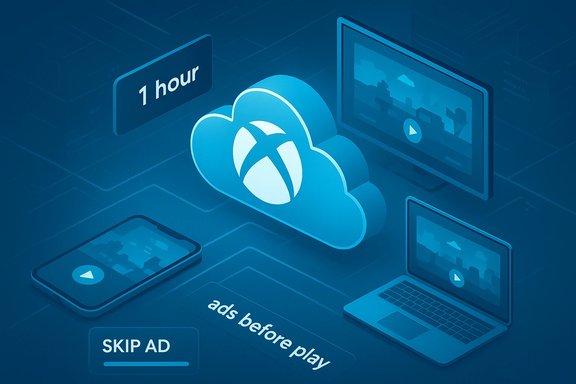
Microsoft’s cloud gaming experiment has entered a new phase: internal tests now include a free, ad‑supported way to play streamed Xbox titles without a Game Pass subscription — a move that could reshape access, economics, and competition in cloud gaming this year. Early indicators suggest sessions will be time‑limited, ad‑triggered, and rolled out as a distinct program separate from existing Game Pass tiers; details remain in flux as Microsoft tests the model with employees and prepares broader trials.
Xbox Cloud Gaming began life as Project xCloud and evolved into the streaming backbone for Xbox Game Pass, allowing console‑class titles to run remotely on Azure infrastructure and stream to phones, PCs, consoles, TVs, and browsers. The service has matured technically — improving resolution, bitrate, and latency — while becoming a strategic doorway into Microsoft’s content and subscription ecosystem. Recent updates added boosted streams for topexpanded cloud availability to more regions and devices.
Cloud gaming’s rise has not been linear. Hardware price inflation, supply issues for consoles, and a growth in free‑to‑play, cross‑platform experiences have all shifted how companies think about audience acquisition. Microsoft’s response has been multi‑pronged: broaden Game Pass, push cloud availability, and now, according to multiple reports, test a free ad‑supported streaming option that lowers the entry barrier while inserting advertising into the session flow.
These are the core, load‑bearing claims confirmed independently by multiple news organizations and Microsoft’s own public acknowledgements that testing is underway. That makes them credible operational attributes of the test program — but not final product guarantees.
What to watch next:
That said, the execution risks are real. Poor ad quality, confusing tiering, publisher resistance, or privacy missteps could blunt the program’s effectiveness or even damage Xbox’s brand in key markets. Whether the ad‑supported tier becomes a growth engine or a marginal experiment will depend on the fine details Microsoft chooses at public launch: ad frequency and relevance, session policies, library breadth, and how clearly it communicates the product to customers and partners.
The current reporting offers a consistent picture across multiple reputable outlets and internal sightings, but key details remain provisional until Microsoft announces public tests or formal availability. Readers should treat reported session lengths, ad lengths, and caps as test configurations, and expect Microsoft to tune them based on real‑world feedback and capacity planning.
Microsoft is testing a delicate trade: make cloud gaming more accessible through ads while preserving the premium value of paid subscriptions. If it executes well, this could be a major distribution lever for Xbox — especially in price‑sensitive regions. If it fails to respect user experience or publisher economics, it may become an awkward stopgap that delivers neither scale nor meaningful conversions. Either way, the next public beta and Microsoft’s official communications will be decisive — and will determine whether ad‑supported Xbox Cloud Gaming is an innovation that extends Xbox’s reach or a tactical experiment that never leaves the test harness.
Source: Windows Central EXCLUSIVE: Xbox Cloud Gaming is getting ad-supported access VERY soon
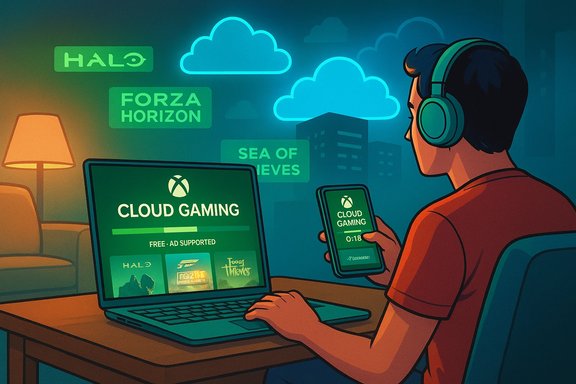 Background
Xbox Cloud Gaming began life as Project xCloud and evolved into the streaming backbone for Xbox Game Pass, allowing console‑class titles to run remotely on Azure infrastructure and stream to phones, PCs, consoles, TVs, and browsers. The service has matured technically — improving resolution, bitrate, and latency — while becoming a strategic doorway into Microsoft’s content and subscription ecosystem. Recent updates added boosted streams for topexpanded cloud availability to more regions and devices.Cloud gaming’s rise has not been linear. Hardware price inflation, supply issues for consoles, and a growth in free‑to‑play, cross‑platform experiences have all shifted how companies think about audience acquisition. Microsoft’s response has been multi‑pronged: broaden Game Pass, push cloud availability, and now, according to multiple reports, test a free ad‑supported streaming option that lowers the entry barrier while inserting advertising into the session flow.
What Microsoft is testing — the facts we can verify
Multiple independent outlets reporting on internal tests describe the same core mechanics: a free, advertising‑supported route into cloud streaming that is not the same as Game Pass. Reported attributes under test include:- Short pre‑roll ad breaks (roughly two minutes before a session begins).
- Session limits currently set at about one hour per session, with an apparent monthly cap (reported tests used five hours per month). These limits are described as provisional and subject to change during testing.
- A library composed primarily of games the user already owns, Free Play Days selections, and legacy/retro catalog titles rather than the full Game Pass catalog.
- Availability across web, PC, consoles, handhelds and smart TVs inpublic beta testing likely to follow recent internal trials.
These are the core, load‑bearing claims confirmed independently by multiple news organizations and Microsoft’s own public acknowledgements that testing is underway. That makes them credible operational attributes of the test program — but not final product guarantees.
Why Microsoft would do this: cloud economics, reach, and strategic leverage
The logic behind a free, ad‑supported Xbox Cloud Gaming tier is straightforward once you connect three business realities: Azure’s economics, market reach, and Game Pass monetization.- Azure utilization matters. Cloud infrastructure is expensive to build and maintain; idle compute is wasted budget and poor capital allocation. Autoscaling and other mechanisms reduce waste, but consumer workloads like game streaming have predictable peaks and troughs. Turning low‑utilization streaming nodes into monetizable capacity via ad‑supported consumption can raise overall utilization and implicitly amortize data center costs more efficiently. Microsoft’s own Azure autoscale guidance and the broader industry trend for pooling or repurposing idle compute show that non‑peak capacity can — and increasingly does — get rerouted to other workloads.
- Reach and customer acquisition. Price sensitivity in many global markets — especially where console hardware is expensive relative to incomes — means a free entry point can create a wider funnel of potential customers. Once players experience cloud streaming, Microsoft has multiple levers to monetize them later: Game Pass subscriptions, in‑game purchases, OneDrive and other services, or ad inventory itself. Reports emphasize Microsoft’s interest in expanding cloud gaming in price‑sensitive regions (India, parts of Africa and Asia), where a free ad‑based option could be particularly effective.
- Competitive positioning. Offering a free tier with ads helps Microsoft compete with other cloud gaming and streaming ecosystems while addressing public backlash over Game Pass price increases. It creates a “try before you buy” path without turning the entire Game Pass catalog into a free product. Industry coverage frames the ad‑supported plan as a strategic hedge: grow reach while preserving paid tiers for the full, premium experience.
How the feature would work for players — practical mechanics and implications
The test parameters reported so far imply an experience aimed at casual discovery, not full replacement of paid Game Pass functionality. Key consumer‑facing mechanics include:- Pre‑session ad breaks: testers saw about two minutes of video advertising before play begins. That is the primary tradeoff for free access in the tested builds.
- Session length limits: one‑hour sessions in current tests, forcing players to stop and potentially re‑queue after a session ends. This reduces per‑user consumption and preserves capacity for paying customers.
- Monthly cap: testing has suggested a monthly aggregate cap (five hours has been reported); this frames the ad‑supported tier as suitable for sampling and casual play rather than heavy usage.
- Library scope: emphasis on owned titles, retro games, and Free Play Days. Day‑one AAA access and the full Game Pass catalog remain premium features.
- Access surfaces: Microsoft intends the feature to be ubiquitous — browsers, Xbox consoles, Windows PCs, select smart TVs and handhelds — though exact device parity at public release will be confirmed later via beta announcements.
Benefits for consumers and Microsoft
- For consumers:
- Lower barrier to entry: free streaming removes the upfront cost of console or Game Pass subscription for those who want casual or occasional access.
- Discovery and trial: players can sample cloud gaming and titles they own on devices that previously couldn’t run them.
- Device flexibility: broad device support lets players pick up sessions on phones, PCs, or TVs with no installs.
- For Microsoft:
- Higher Azure utilization and potential ad revenue to offset cloud costs.
- Broadened funnel into Game Pass and Microsoft’s ecosystem.
- Market expansion in geographies where hardware affordability limits growth.
Risks, downsides, and open questions
- User experience friction. Two‑minute pre‑rolls and session cutoffs risk creating an intrusive, segmented experience. If ads are frequent, poorly targeted, or badly placed, they may sour first impressions and reduce conversion to paid tiers rather than encourage it. Early reports of ad impressions appearing even for paying users underline the potential for accidental exposure that could harm brand perception.
- Complexity and messaging. Xbox’s subscription landscape is already criticized for complexity. Adding an ad‑supported free tier with differing libraries, time limits, and device restrictions increases confusion among consumers and partners. Clear communication will be crucial to avoid user frustration and subscription churn.
- Monetization vs. retention tradeoff. Heavy reliance on ads to monetize casual players could reduce incentives to upgrade to paid tiers. Microsoft must calibrate ad frequency, content, and session caps so that the free tier acts as a funnel rather than a substitute.
- Publisher and rights issues. Streaming publisher‑licensed content in a free tier requires negotiated rights. Not all game publishers will agree to free streaming with ads, nor will they accept the same revenue splits. The initial focus on owned titles and certain curated libraries is a pragmatic workaround but cannot be assumed to scale indefinitely without commercial deals.
- Privacy and ad targeting. Integrating advertising raises privacy questions: what targeting signals will Microsoft use, how will player data be processed, and what opt‑out or choice controls exist? Regulators in multiple markets are scrutinizing ad tech; Microsoft will face compliance complexity if ad delivery uses behavioral targeting. This is a material reputational risk if not handled transparently.
- Infrastructure and quality parity. Free tiers must still meet basic quality thresholds. If the ad‑supported streams suffer from lower bitrates, higher latency, or frequent interruptions, that will undermine the perception of cloud gaming overall and limit long‑term conversion. Premium tiers must remain clearly differentiated.
Technical and operational context: cloud compute, capacity, and AI
The business logic for a free ad‑supported tier is intimately tied to cloud operations. Datacenter capacity is rarely perfectly utilized; autoscaling and dynamic provisioning help, but workloads that have predictable downtimes leave spare capacity. Industry solutions and startups are increasingly focused on pooling idle GPU and CPU capacity to serve AI workloads or fill compute gaps. Microsoft — which runs both Azure and Xbox Cloud Gaming — naturally views this as an opportunity to improve utilization and amortize capital spend.- Microsoft’s guidance on Azure autoscale emphasizes the importance of aligning capacity to demand and reducing idle resources, directly linking to why operators seek to monetize spare capacity rather than let it idle.
- The broader market shows multiple approaches to monetize idle compute (from startups offering GPU pooling to cloud providers introducing spot or shared models), indicating a general industry trend that supports Microsoft’s strategic thinking. Those moves aren’t direct confirmation that Azure will repurpose gaming nodes for AI inference, but they do show feasible pathways for improving utilization and economics. This is an informed inference supported by industry trends and Microsoft’s cloud strategy, not an explicit Microsoft statement about repurposing gaming servers for AI.
Timeline, rollout expectations, and what to watch
Reports indicate internal testing with Microsoft employees has already taken place and that broader public testing could follow through Xbox’s Insider programs. Several outlets anticipate public beta and staged rollouts in the months after internal verification, and some coverage has suggested a wider rollout could occur “this year.” Specific timing and geographic sequencing remain unannounced.What to watch next:
- Official Microsoft announcements and Xbox Wire posts confirming test parameters and timelines.
- Xbox Insider releases or public beta enrollments that let users test the ad‑supported flow.
- Publisher reactions and licensing disclosures — whether major third‑party publishers sign on for free streaming or require separate deals.
- Regulatory or privacy disclosures about ad targeting and data handling for the ad‑supported tier.
Practical advice for Windows and Xbox users
- If you rely on uninterrupted, long sessions or day‑one access to new releases, the ad‑supported tier is unlikely to replace a paid Game Pass plan. Treat it as a discovery and sampling tool.
- If you’re price‑sensitive or live in a market where consoles are expensive, the free tier may be theoud streaming without hardware investment.
- Track Xbox Insider notes and official Xbox communications for opt‑in opportunities to test the service — that’s where Microsoft often surfaces early builds.
- Monitor privacy settings and ad preferences if you try the free tier; understand what data (if any) Microsoft uses for ad delivery and whether you can control personalization.
Final assessment — strategic upside with a narrow sweet spot
Microsoft’s ad‑supported Xbox Cloud Gaming experiment is a pragmatic, technically plausible maneuver that aligns with broader cloud economics and market realities. It offers significant upside: wider reach, a new monetization channel, and better utilization of expensive infrastructure. Early test parameters — short pre‑rolls, session caps, and a curated library — strongly suggest the feature is intended for discovery and casual access, not as a substitute for paid Game Pass tiers.That said, the execution risks are real. Poor ad quality, confusing tiering, publisher resistance, or privacy missteps could blunt the program’s effectiveness or even damage Xbox’s brand in key markets. Whether the ad‑supported tier becomes a growth engine or a marginal experiment will depend on the fine details Microsoft chooses at public launch: ad frequency and relevance, session policies, library breadth, and how clearly it communicates the product to customers and partners.
The current reporting offers a consistent picture across multiple reputable outlets and internal sightings, but key details remain provisional until Microsoft announces public tests or formal availability. Readers should treat reported session lengths, ad lengths, and caps as test configurations, and expect Microsoft to tune them based on real‑world feedback and capacity planning.
Microsoft is testing a delicate trade: make cloud gaming more accessible through ads while preserving the premium value of paid subscriptions. If it executes well, this could be a major distribution lever for Xbox — especially in price‑sensitive regions. If it fails to respect user experience or publisher economics, it may become an awkward stopgap that delivers neither scale nor meaningful conversions. Either way, the next public beta and Microsoft’s official communications will be decisive — and will determine whether ad‑supported Xbox Cloud Gaming is an innovation that extends Xbox’s reach or a tactical experiment that never leaves the test harness.
Source: Windows Central EXCLUSIVE: Xbox Cloud Gaming is getting ad-supported access VERY soon