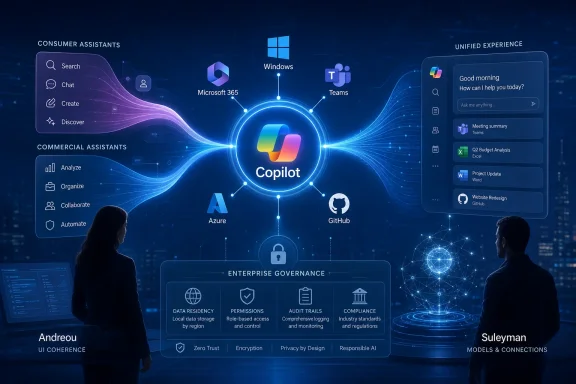
Microsoft’s latest Copilot shake-up puts Jacob Andreou, a 33-year-old former Snap executive, in charge of unifying Microsoft’s consumer and commercial AI experiences in 2026, as the company tries to turn Copilot into a single “Super App” for chat, work, coding, and agents. That is a remarkable bet for a company whose greatest AI asset is not consumer cool but enterprise distribution. The move says Microsoft knows Copilot’s current sprawl is not sustainable. It also says Redmond is willing to risk cultural friction if that is what it takes to make Copilot feel less like a licensing bundle and more like a product people actually choose.
Microsoft usually wins by platform gravity. It puts a capability into Windows, Office, Azure, Teams, Edge, GitHub, or Dynamics, then lets procurement, defaults, developer ecosystems, and compliance comfort do the rest. That model has made the company one of the few organizations on Earth that can turn a feature into an enterprise standard before consumers have decided whether they like it.
Andreou’s appointment cuts across that instinct. A former Snap executive and Greylock partner, he represents a different school of product thinking: fast iteration, consumer engagement, growth loops, visual polish, and a bias toward shipping before the committee has sanded every edge flat. Microsoft has hired outsiders before, but giving a relative newcomer control over Copilot experience across consumer and commercial products is not a normal corporate rotation.
The reason is obvious enough. Copilot may be everywhere, but ubiquity is not the same as affection. Microsoft has spent the last few years inserting Copilot buttons into its estate, from Windows and Edge to Microsoft 365 and developer tools. Yet the company still faces a basic product problem: users can see Copilot, but too often they do not know which Copilot they are using, what it can access, what it costs, or why one version behaves differently from another.
That is not merely a branding annoyance. In AI, confusion is adoption debt. If users do not understand where the assistant lives, what data it sees, and what actions it can safely take, they will treat it as a novelty or a risk rather than a working layer.
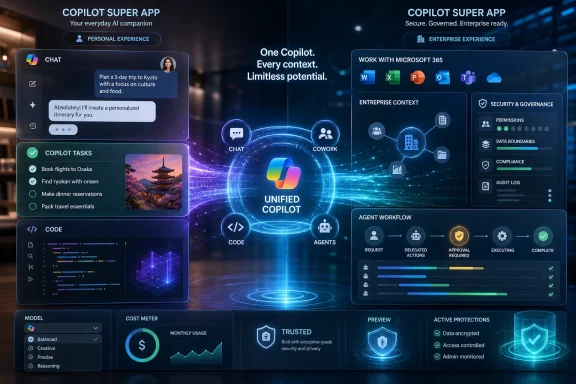
The ambition, as Microsoft has been signaling, is to bring chat, coworking agents, and coding into one Copilot environment. Nadella’s Build message was blunt: Chat, Cowork, and Code are supposed to come together in Copilot this summer. That is the right strategic sentence, but the execution burden is enormous.
The hard part is that Microsoft does not have one Copilot. It has consumer Copilot, Microsoft 365 Copilot, GitHub Copilot, Copilot Studio, Security Copilot, Sales Copilot, service-oriented agents, Windows integrations, Teams surfaces, and a thicket of branded assistants across product groups. Some are licensed per user. Some are metered. Some use Microsoft Graph. Some live closer to the open web. Some can act on enterprise data. Some are basically chat boxes with better distribution.
That sprawl is the residue of Microsoft’s success. Every product team had a reason to move fast, claim the Copilot name, and attach AI to its own roadmap. The result is a brand that is simultaneously powerful and diluted. A Super App is Microsoft’s attempt to make Copilot feel like a coherent destination rather than a family name shared by distant cousins.
That is tolerable for admins. It is fatal for daily habit formation.
Consumer AI products have trained users to expect immediacy. ChatGPT, Claude, Gemini, and Perplexity are imperfect, but they are legible: open the app, type the thing, get the response, refine the task. Microsoft’s advantage is that Copilot can sit inside the actual work graph — documents, mail, meetings, calendars, chats, repositories, business data — but that advantage only matters if the front door is simple enough for normal humans to use.
The tension is that enterprise AI cannot behave like a consumer toy. A workplace assistant must respect permissions, retention policies, audit trails, data residency, security boundaries, and contractual commitments. It must know when to ask for approval, when to draft instead of send, when to cite internal files, and when to stop because the user lacks authority.
So Microsoft is trying to do two contradictory things at once. It wants Copilot to feel like a consumer app and behave like enterprise infrastructure. Andreou’s job is not to make Copilot playful; it is to make the enterprise stack feel usable without making it reckless.
But the Snap playbook cannot simply be pasted onto Redmond. Snapchat could optimize for consumer behavior, attention, and communication loops in a comparatively bounded product. Microsoft must optimize for regulated industries, global tenants, government customers, legacy workflows, and users who may resent every AI prompt they did not ask for.
That difference matters because speed has a cost. Fortune’s profile of Andreou described a harder-charging cadence, including reports of long days as Microsoft tries to keep pace with younger AI companies. That may sound like startup realism to some and cultural regression to others. Microsoft veterans remember the old Windows crunch culture, but modern Microsoft has spent years presenting itself as a more measured, mature, cloud-era company.
The danger is not merely employee morale. Burnout produces bad products, and rushed AI products produce unusually visible failures. A broken toolbar is annoying; an agent that misreads an email thread, books the wrong meeting, sends the wrong summary, or burns through metered compute is a governance incident.
Cowork, in Microsoft 365 Copilot, pushes a similar idea into the enterprise. It is designed for delegated work: planning, reasoning across files and tools, producing drafts, coordinating workflows, and operating inside the Microsoft 365 context. It also brings the enterprise complications that consumer Copilot does not have to carry with the same weight: tenant controls, model subprocessors, billing, plugins, admin oversight, and security review.
The resemblance is obvious. The architectures and data assumptions are not. Consumer Copilot and Microsoft 365 Copilot share a brand but not a simple common substrate. Microsoft cannot just staple Tasks and Cowork together without deciding how identity, memory, work data, personal data, approvals, and auditability should flow across contexts.
That is the deeper meaning of Andreou’s charter. A unified Copilot experience is not a prettier navigation bar. It is a decision about whether Microsoft can build one interaction model for personal and professional AI without creating privacy confusion or governance headaches.
Cowork’s model story captures the moment. Microsoft has expanded beyond a single-model posture, bringing Anthropic models into Microsoft 365 Copilot scenarios and previewing access to OpenAI and Microsoft-developed options. It has also talked up lower-cost, efficient models for customers who are running into the economic limits of agentic AI.
That is not just technical diversification. It is a pricing strategy. Agentic systems can be expensive because they do not merely answer once; they plan, retrieve, reason, call tools, revise, and sometimes run multiple model passes. The more useful they become, the more compute they consume. “Token-maxxed” is an ugly phrase, but it describes a real enterprise problem.
Model choice therefore becomes a control surface. Admins will want to decide when to use the premium reasoning model, when to use a cheaper task-specific model, and when to block an agent entirely. Users may want the best answer; finance teams will want predictable bills. Microsoft’s challenge is to make that trade-off comprehensible instead of dumping another selector into an already crowded interface.
If a user spends evenings with ChatGPT or Claude and workdays with Copilot, the comparison is unavoidable. The assistant that feels faster, clearer, and more capable at home shapes expectations at the office. If Microsoft 365 Copilot feels more constrained, more confusing, or less reliable, users will route around it when policy permits — and sometimes when policy does not.
That is the shadow IT risk in the AI era. Employees do not need to install a rogue SaaS platform to leak value or data; they can paste a problem into a consumer model and get a better-feeling workflow. Microsoft’s enterprise pitch depends on convincing organizations that Copilot is not only safer but good enough that users will not constantly defect.
This is why consumer product taste matters to Microsoft 365. The enterprise buyer may sign the contract, but the daily user decides whether the assistant becomes a habit. A Copilot that satisfies procurement but loses the user is a very expensive sidebar.
That history matters because Microsoft sometimes mistakes distribution for desire. A product that is indispensable at work can feel irrelevant at home. A product that has administrative legitimacy can still lack cultural legitimacy. Users do not adopt a personal app because their employer standardized on its cousin.
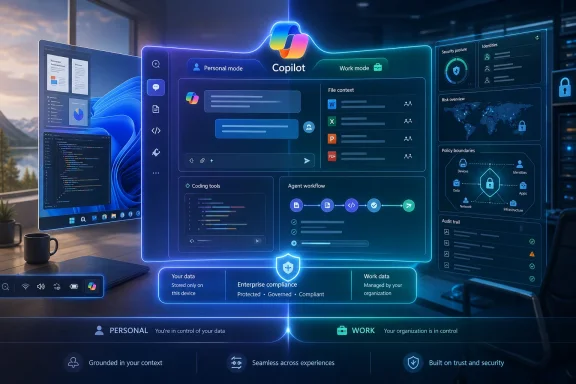
Copilot faces a more complicated version of the same problem. The company wants one Copilot to span personal and professional life, but people often want those worlds separated. They may want their work assistant to know every meeting, file, and deadline. They may not want their personal assistant to feel like it came from the same compliance department.
The winning design will need boundaries that are visible and trustworthy. Microsoft has to make clear when Copilot is acting as a personal assistant, when it is acting inside a tenant, when enterprise data is in scope, and when an action crosses from suggestion to execution. Without that clarity, unification could feel less like convenience and more like surveillance with a friendly icon.
That could be useful. A genuinely capable Copilot on Windows could summarize local and cloud documents, coordinate settings, troubleshoot device problems, automate repetitive tasks, help developers move between code and documentation, and act as a bridge between Microsoft 365, GitHub, Edge, and the desktop. For power users, the dream is not another chatbot; it is a scriptable, permission-aware assistant that understands the machine and the work.
But Windows also magnifies every Microsoft misstep. Users are sensitive to unwanted prompts, cloudy defaults, advertising-like surfaces, and features that appear before they are trustworthy. The more Copilot becomes a front door, the more Microsoft must resist the urge to make it a billboard.
Admins will have their own concerns. If Copilot becomes the place where chat, code, agents, and coworking converge, group policy, Intune controls, audit logs, data loss prevention, model selection, and billing boundaries become everyday management issues. The Super App may be sold as simplification for users, but for IT departments it could initially look like another control plane to learn.
Everyone sees the same destination. The assistant becomes the place where work starts, not a feature inside the place where work used to happen. The prize is not merely answering questions; it is owning the user’s intent before that intent becomes a document, ticket, meeting, pull request, spreadsheet, or purchase.
Microsoft’s advantage is that it already owns many of those endpoints. Its disadvantage is that each endpoint has its own organization, business model, interface, and politics. The risk is product entropy: every team adds an agent, every agent gets a name, every name gets a license, and the user is left staring at a family tree instead of a tool.
Andreou’s mandate is therefore political as much as technical. To make one Copilot, someone has to say no to overlapping surfaces, redundant naming, and product-group exceptionalism. That is hard inside Microsoft, where internal platforms become empires and successful products defend their roadmaps.
That means Copilot should know when a request is a chat, when it is a document task, when it needs a coding environment, when it requires enterprise data, when it should become a recurring workflow, and when it needs explicit approval. The user should not have to understand Microsoft’s org chart to get the right capability.
It also means Microsoft must solve the trust interface. Agents need visible plans, action previews, permission checks, progress views, cost signals, and post-action logs. “AI that works for you” sounds great until it works in a way you cannot inspect.
If the Super App becomes merely a container, rivals will keep the product high ground. If it becomes a genuine orchestration layer, Microsoft could turn Copilot from a brand sprayed across products into the connective tissue of modern Windows and Microsoft 365 work.
A few things now matter more than the slogan:
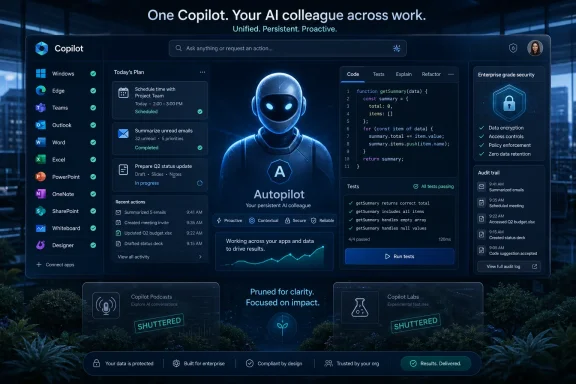
The reported plan goes beyond putting more Copilot surfaces under one roof. Microsoft is said to be preparing to cut underperforming features, including Copilot Podcasts and Copilot Labs, while consolidating around a single app that includes coding capabilities and a paid Autopilot-style agent. That would make the “Super App” effort less of a branding exercise and more of a pruning operation aimed at removing distractions that have not translated into daily use.
The new report also adds adoption pressure to the story. It says paid Copilot users rose from 15 million in January to 20 million in April, still well behind paid ChatGPT users, and representing only a small share of Microsoft 365’s reported 450 million-seat base. For Windows users and Microsoft 365 admins, the practical implication is that Microsoft may become more aggressive about simplifying Copilot’s front door while trimming experiments that do not prove clear value.
For IT departments, the Autopilot angle is the part to watch. If persistent agents become part of the unified Copilot app, tenant controls, spending limits, access policies, auditability, and usage-based billing will become even more central to deployment planning.

The key new point is that Microsoft’s Copilot thinking may have gone beyond a unified app shell. Aion was reportedly described in the leaked material as a web-based agent OS with Copilot built into the core of the shell, rather than bolted on as a sidebar or app. It apparently emphasized web versions of Microsoft 365 apps, Windows 365-style cloud PC access for heavier workloads, and an interface where Copilot could launch and manage tasks in adjacent windows.
For Windows users, the practical implication is that Microsoft has at least explored a much more radical version of Copilot integration: not just Copilot inside Windows, but a Copilot-first environment where local Win32 compatibility becomes secondary or optional. The report also says a version could run as a layer on top of Windows 11, which would make the concept less of a ChromeOS-style replacement and more of an AI shell experiment.
Microsoft reportedly declined to comment, and it remains unclear whether Aion was ever intended to ship. Still, the leak reinforces the broader direction of the current Copilot reset: Microsoft is testing how far it can move Copilot from “assistant inside products” toward “front door for computing.”
The report also says Microsoft plans to connect GitHub Copilot, Copilot chat, Copilot Cowork, and the new AutoPilot agent layer through a shared identity graph, reducing separate sign-ins across GitHub and Microsoft 365. That makes the merger more than a UI consolidation: it suggests Microsoft is trying to unify identity, agent access, and workflow routing across its AI products.
For IT admins, the practical concern is sharper than previously reported. A single Copilot app spanning personal Microsoft accounts and corporate Microsoft 365 data may require updated Conditional Access, DLP, and governance policies to prevent enterprise content from leaking into personal sessions. Tech Times says Microsoft has indicated controls will be available, but detailed tenant configuration guidance has not yet been published.
The report also adds usage-pressure context, citing enterprise surveys that only 20% to 30% of paid Copilot users use it weekly. If accurate, that helps explain why Microsoft is cutting low-engagement features and pushing AutoPilot agents: the company is trying to turn Copilot from an installed product into a recurring habit before the August consolidation lands.

The new detail is scale: the report says Copilot had more than 100 million monthly active users in early 2026. That helps explain why Microsoft is pruning low-usage experiments such as Copilot Podcasts and Copilot Labs while trying to turn Copilot into a more coherent daily destination.
The report also says the reshuffle gives Mustafa Suleyman more room to focus on longer-range AI model and superintelligence work, while Jacob Andreou’s Copilot organization concentrates on product unification. For admins and Windows users, the practical takeaway is unchanged but sharper: Microsoft is trying to collapse Copilot’s sprawl into one front door before fragmentation becomes a permanent adoption drag.
 Microsoft Hires Against Its Own Muscle Memory
Microsoft usually wins by platform gravity. It puts a capability into Windows, Office, Azure, Teams, Edge, GitHub, or Dynamics, then lets procurement, defaults, developer ecosystems, and compliance comfort do the rest. That model has made the company one of the few organizations on Earth that can turn a feature into an enterprise standard before consumers have decided whether they like it.Andreou’s appointment cuts across that instinct. A former Snap executive and Greylock partner, he represents a different school of product thinking: fast iteration, consumer engagement, growth loops, visual polish, and a bias toward shipping before the committee has sanded every edge flat. Microsoft has hired outsiders before, but giving a relative newcomer control over Copilot experience across consumer and commercial products is not a normal corporate rotation.
The reason is obvious enough. Copilot may be everywhere, but ubiquity is not the same as affection. Microsoft has spent the last few years inserting Copilot buttons into its estate, from Windows and Edge to Microsoft 365 and developer tools. Yet the company still faces a basic product problem: users can see Copilot, but too often they do not know which Copilot they are using, what it can access, what it costs, or why one version behaves differently from another.
That is not merely a branding annoyance. In AI, confusion is adoption debt. If users do not understand where the assistant lives, what data it sees, and what actions it can safely take, they will treat it as a novelty or a risk rather than a working layer.
The Super App Is Really a Cleanup Operation
The phrase “Super App” invites skepticism because it carries the scent of slideware. In consumer tech, it usually means a single destination where messaging, payments, commerce, search, services, and mini-apps converge. In Microsoft’s case, the phrase is less about copying WeChat than about solving Copilot’s fragmentation problem before rivals do it first.The ambition, as Microsoft has been signaling, is to bring chat, coworking agents, and coding into one Copilot environment. Nadella’s Build message was blunt: Chat, Cowork, and Code are supposed to come together in Copilot this summer. That is the right strategic sentence, but the execution burden is enormous.
The hard part is that Microsoft does not have one Copilot. It has consumer Copilot, Microsoft 365 Copilot, GitHub Copilot, Copilot Studio, Security Copilot, Sales Copilot, service-oriented agents, Windows integrations, Teams surfaces, and a thicket of branded assistants across product groups. Some are licensed per user. Some are metered. Some use Microsoft Graph. Some live closer to the open web. Some can act on enterprise data. Some are basically chat boxes with better distribution.
That sprawl is the residue of Microsoft’s success. Every product team had a reason to move fast, claim the Copilot name, and attach AI to its own roadmap. The result is a brand that is simultaneously powerful and diluted. A Super App is Microsoft’s attempt to make Copilot feel like a coherent destination rather than a family name shared by distant cousins.
Consumer Taste Meets Enterprise Plumbing
Andreou’s consumer background matters because Copilot’s biggest weakness is not that Microsoft lacks enterprise plumbing. It is that the experience can feel bureaucratic. Users are asked to navigate licensing, tenant settings, model availability, data boundaries, plugin permissions, and product-specific entry points before they ever get to the supposed magic.That is tolerable for admins. It is fatal for daily habit formation.
Consumer AI products have trained users to expect immediacy. ChatGPT, Claude, Gemini, and Perplexity are imperfect, but they are legible: open the app, type the thing, get the response, refine the task. Microsoft’s advantage is that Copilot can sit inside the actual work graph — documents, mail, meetings, calendars, chats, repositories, business data — but that advantage only matters if the front door is simple enough for normal humans to use.
The tension is that enterprise AI cannot behave like a consumer toy. A workplace assistant must respect permissions, retention policies, audit trails, data residency, security boundaries, and contractual commitments. It must know when to ask for approval, when to draft instead of send, when to cite internal files, and when to stop because the user lacks authority.
So Microsoft is trying to do two contradictory things at once. It wants Copilot to feel like a consumer app and behave like enterprise infrastructure. Andreou’s job is not to make Copilot playful; it is to make the enterprise stack feel usable without making it reckless.
The Snap Playbook Has a Microsoft-Sized Problem
The reported arrival of Peter Sellis, another former Snap executive who also worked at Discord, reinforces the signal. Microsoft is not just hiring an AI infrastructure operator; it is importing people who understand engagement, design, and product rhythm. That is a notable choice for a company whose AI story has often been led by platform partnerships, Azure economics, and Microsoft 365 attach rates.But the Snap playbook cannot simply be pasted onto Redmond. Snapchat could optimize for consumer behavior, attention, and communication loops in a comparatively bounded product. Microsoft must optimize for regulated industries, global tenants, government customers, legacy workflows, and users who may resent every AI prompt they did not ask for.
That difference matters because speed has a cost. Fortune’s profile of Andreou described a harder-charging cadence, including reports of long days as Microsoft tries to keep pace with younger AI companies. That may sound like startup realism to some and cultural regression to others. Microsoft veterans remember the old Windows crunch culture, but modern Microsoft has spent years presenting itself as a more measured, mature, cloud-era company.
The danger is not merely employee morale. Burnout produces bad products, and rushed AI products produce unusually visible failures. A broken toolbar is annoying; an agent that misreads an email thread, books the wrong meeting, sends the wrong summary, or burns through metered compute is a governance incident.
Tasks and Cowork Show the Split Microsoft Must Heal
The most interesting evidence of Microsoft’s direction is not the Super App slogan but the parallel evolution of Copilot Tasks and Copilot Cowork. Tasks, in consumer Copilot, is Microsoft’s attempt to move beyond answering questions into handling actionable items. It can manage recurring jobs, generate documents, and run with user review, pause, and cancellation controls.Cowork, in Microsoft 365 Copilot, pushes a similar idea into the enterprise. It is designed for delegated work: planning, reasoning across files and tools, producing drafts, coordinating workflows, and operating inside the Microsoft 365 context. It also brings the enterprise complications that consumer Copilot does not have to carry with the same weight: tenant controls, model subprocessors, billing, plugins, admin oversight, and security review.
The resemblance is obvious. The architectures and data assumptions are not. Consumer Copilot and Microsoft 365 Copilot share a brand but not a simple common substrate. Microsoft cannot just staple Tasks and Cowork together without deciding how identity, memory, work data, personal data, approvals, and auditability should flow across contexts.
That is the deeper meaning of Andreou’s charter. A unified Copilot experience is not a prettier navigation bar. It is a decision about whether Microsoft can build one interaction model for personal and professional AI without creating privacy confusion or governance headaches.
Model Choice Is Becoming a Product Feature, Not a Backend Detail
Microsoft’s Copilot strategy also reflects a broader shift away from treating the model as invisible infrastructure. The company’s early AI momentum depended heavily on OpenAI. That partnership remains central, but Microsoft is now openly emphasizing model choice, Anthropic integration, and home-grown models tuned for cost and enterprise tasks.Cowork’s model story captures the moment. Microsoft has expanded beyond a single-model posture, bringing Anthropic models into Microsoft 365 Copilot scenarios and previewing access to OpenAI and Microsoft-developed options. It has also talked up lower-cost, efficient models for customers who are running into the economic limits of agentic AI.
That is not just technical diversification. It is a pricing strategy. Agentic systems can be expensive because they do not merely answer once; they plan, retrieve, reason, call tools, revise, and sometimes run multiple model passes. The more useful they become, the more compute they consume. “Token-maxxed” is an ugly phrase, but it describes a real enterprise problem.
Model choice therefore becomes a control surface. Admins will want to decide when to use the premium reasoning model, when to use a cheaper task-specific model, and when to block an agent entirely. Users may want the best answer; finance teams will want predictable bills. Microsoft’s challenge is to make that trade-off comprehensible instead of dumping another selector into an already crowded interface.
Microsoft’s Consumer Weakness Is Now an Enterprise Risk
It is tempting to frame Andreou as a consumer hire trying to fix consumer Copilot. That is too narrow. Microsoft’s consumer weakness now threatens its enterprise AI ambitions because the best AI assistants train behavior across contexts.If a user spends evenings with ChatGPT or Claude and workdays with Copilot, the comparison is unavoidable. The assistant that feels faster, clearer, and more capable at home shapes expectations at the office. If Microsoft 365 Copilot feels more constrained, more confusing, or less reliable, users will route around it when policy permits — and sometimes when policy does not.
That is the shadow IT risk in the AI era. Employees do not need to install a rogue SaaS platform to leak value or data; they can paste a problem into a consumer model and get a better-feeling workflow. Microsoft’s enterprise pitch depends on convincing organizations that Copilot is not only safer but good enough that users will not constantly defect.
This is why consumer product taste matters to Microsoft 365. The enterprise buyer may sign the contract, but the daily user decides whether the assistant becomes a habit. A Copilot that satisfies procurement but loses the user is a very expensive sidebar.
Teams Is the Warning Label on the Box
Microsoft has tried consumer-enterprise unification before, and the results should keep the Copilot team humble. Teams is a dominant workplace collaboration product, but its consumer version never became a serious rival to WhatsApp, iMessage, Discord, Messenger, or Slack-like community spaces. The brand could travel; the behavior did not.That history matters because Microsoft sometimes mistakes distribution for desire. A product that is indispensable at work can feel irrelevant at home. A product that has administrative legitimacy can still lack cultural legitimacy. Users do not adopt a personal app because their employer standardized on its cousin.
Copilot faces a more complicated version of the same problem. The company wants one Copilot to span personal and professional life, but people often want those worlds separated. They may want their work assistant to know every meeting, file, and deadline. They may not want their personal assistant to feel like it came from the same compliance department.
The winning design will need boundaries that are visible and trustworthy. Microsoft has to make clear when Copilot is acting as a personal assistant, when it is acting inside a tenant, when enterprise data is in scope, and when an action crosses from suggestion to execution. Without that clarity, unification could feel less like convenience and more like surveillance with a friendly icon.
Windows Users Will Feel the Consequences First
For WindowsForum readers, the Copilot Super App story is not abstract corporate theater. Windows is where Microsoft’s AI ambitions become unavoidable for many users. The company has already made Copilot a visible part of the Windows experience, and the logic of a unified app points toward deeper OS-level presence over time.That could be useful. A genuinely capable Copilot on Windows could summarize local and cloud documents, coordinate settings, troubleshoot device problems, automate repetitive tasks, help developers move between code and documentation, and act as a bridge between Microsoft 365, GitHub, Edge, and the desktop. For power users, the dream is not another chatbot; it is a scriptable, permission-aware assistant that understands the machine and the work.
But Windows also magnifies every Microsoft misstep. Users are sensitive to unwanted prompts, cloudy defaults, advertising-like surfaces, and features that appear before they are trustworthy. The more Copilot becomes a front door, the more Microsoft must resist the urge to make it a billboard.
Admins will have their own concerns. If Copilot becomes the place where chat, code, agents, and coworking converge, group policy, Intune controls, audit logs, data loss prevention, model selection, and billing boundaries become everyday management issues. The Super App may be sold as simplification for users, but for IT departments it could initially look like another control plane to learn.
The Real Race Is Against Product Entropy
Microsoft is not alone in chasing the AI command center. OpenAI is turning ChatGPT into a broader work environment, with coding, memory, file handling, connectors, and assistant-like behavior converging. Anthropic is moving Claude beyond chat into coding, artifacts, workflow execution, and enterprise collaboration. Google is threading Gemini through Workspace, Android, Chrome, and Cloud.Everyone sees the same destination. The assistant becomes the place where work starts, not a feature inside the place where work used to happen. The prize is not merely answering questions; it is owning the user’s intent before that intent becomes a document, ticket, meeting, pull request, spreadsheet, or purchase.
Microsoft’s advantage is that it already owns many of those endpoints. Its disadvantage is that each endpoint has its own organization, business model, interface, and politics. The risk is product entropy: every team adds an agent, every agent gets a name, every name gets a license, and the user is left staring at a family tree instead of a tool.
Andreou’s mandate is therefore political as much as technical. To make one Copilot, someone has to say no to overlapping surfaces, redundant naming, and product-group exceptionalism. That is hard inside Microsoft, where internal platforms become empires and successful products defend their roadmaps.
The Summer Test Is Whether Copilot Becomes a Place
The coming months will show whether Microsoft’s Super App language corresponds to an actual shift in product experience. A meaningful version would not simply place Chat, Cowork, and Code tabs in one shell. It would create a shared interaction model where users can begin with intent and let Copilot route the job to the right tool, model, agent, or workspace.That means Copilot should know when a request is a chat, when it is a document task, when it needs a coding environment, when it requires enterprise data, when it should become a recurring workflow, and when it needs explicit approval. The user should not have to understand Microsoft’s org chart to get the right capability.
It also means Microsoft must solve the trust interface. Agents need visible plans, action previews, permission checks, progress views, cost signals, and post-action logs. “AI that works for you” sounds great until it works in a way you cannot inspect.
If the Super App becomes merely a container, rivals will keep the product high ground. If it becomes a genuine orchestration layer, Microsoft could turn Copilot from a brand sprayed across products into the connective tissue of modern Windows and Microsoft 365 work.
Redmond’s AI Bet Now Has a Human Interface
The concrete story here is not that Microsoft hired a young outsider. It is that Microsoft appears to have concluded its AI problem is no longer primarily access to frontier models. The company has models, partners, infrastructure, enterprise data, developers, distribution, and money. What it lacks is a Copilot experience clear enough to make all of that feel inevitable.A few things now matter more than the slogan:
- Microsoft has put Jacob Andreou in charge of the Copilot experience across consumer and commercial products, signaling that design, growth, and product coherence are now board-level AI concerns.
- The planned Copilot Super App is best understood as an attempt to unify chat, delegated work, coding, and agents before Copilot fragmentation becomes irreversible.
- Consumer Copilot Tasks and Microsoft 365 Copilot Cowork point toward the same future, but their different data, identity, billing, and governance assumptions make unification difficult.
- Model choice is becoming part of the user and admin experience because agentic AI can create unpredictable cost and performance trade-offs.
- Windows and Microsoft 365 admins should watch for new management burdens around permissions, auditability, usage-based billing, model controls, and agent actions.
- Microsoft’s biggest risk is that Copilot becomes omnipresent without becoming loved, leaving users to prefer rival assistants even inside Microsoft-heavy environments.
Update: Microsoft’s Copilot reset reportedly targets August app merger and feature cuts (July 4, 2026)
WinBuzzer reports that Microsoft’s Copilot overhaul is now being framed internally as a sharper product reset, with Jacob Andreou reportedly telling staff that Copilot must “earn the right to exist” with users. The most concrete new detail is timing: the planned merger of personal and workplace Copilot experiences is reportedly slated for August.The reported plan goes beyond putting more Copilot surfaces under one roof. Microsoft is said to be preparing to cut underperforming features, including Copilot Podcasts and Copilot Labs, while consolidating around a single app that includes coding capabilities and a paid Autopilot-style agent. That would make the “Super App” effort less of a branding exercise and more of a pruning operation aimed at removing distractions that have not translated into daily use.
The new report also adds adoption pressure to the story. It says paid Copilot users rose from 15 million in January to 20 million in April, still well behind paid ChatGPT users, and representing only a small share of Microsoft 365’s reported 450 million-seat base. For Windows users and Microsoft 365 admins, the practical implication is that Microsoft may become more aggressive about simplifying Copilot’s front door while trimming experiments that do not prove clear value.
For IT departments, the Autopilot angle is the part to watch. If persistent agents become part of the unified Copilot app, tenant controls, spending limits, access policies, auditability, and usage-based billing will become even more central to deployment planning.
Microsoft Plans Copilot App Overhaul to Prove Its Value
Microsoft is reportedly working on a unified Copilot app that could merge consumer and enterprise apps, cut underused features, and make the AI assistant prove practical value to users.
winbuzzer.com
Update: Leaked Aion project points to deeper Copilot OS ambitions (July 4, 2026)
Club386, citing Windows Central’s report on a leaked Microsoft presentation, says Microsoft previously experimented with a dedicated Copilot-centered operating system called Aion. The project was reportedly a 2024 prototype built around Microsoft Edge, web apps, agentic AI, and a lightweight Windows codebase referred to as Win3.The key new point is that Microsoft’s Copilot thinking may have gone beyond a unified app shell. Aion was reportedly described in the leaked material as a web-based agent OS with Copilot built into the core of the shell, rather than bolted on as a sidebar or app. It apparently emphasized web versions of Microsoft 365 apps, Windows 365-style cloud PC access for heavier workloads, and an interface where Copilot could launch and manage tasks in adjacent windows.
For Windows users, the practical implication is that Microsoft has at least explored a much more radical version of Copilot integration: not just Copilot inside Windows, but a Copilot-first environment where local Win32 compatibility becomes secondary or optional. The report also says a version could run as a layer on top of Windows 11, which would make the concept less of a ChromeOS-style replacement and more of an AI shell experiment.
Microsoft reportedly declined to comment, and it remains unclear whether Aion was ever intended to ship. Still, the leak reinforces the broader direction of the current Copilot reset: Microsoft is testing how far it can move Copilot from “assistant inside products” toward “front door for computing.”
Update: “Copilot Fusion” details point to single codebase and new admin risks (July 4, 2026)
Tech Times adds new implementation detail to the August Copilot merger, reporting that the internal engineering effort is codenamed “Copilot Fusion” and is aimed at creating a single codebase for personal and enterprise Copilot. The app would reportedly adapt based on the signed-in account, with users able to switch between personal and work contexts inside the same window.The report also says Microsoft plans to connect GitHub Copilot, Copilot chat, Copilot Cowork, and the new AutoPilot agent layer through a shared identity graph, reducing separate sign-ins across GitHub and Microsoft 365. That makes the merger more than a UI consolidation: it suggests Microsoft is trying to unify identity, agent access, and workflow routing across its AI products.
For IT admins, the practical concern is sharper than previously reported. A single Copilot app spanning personal Microsoft accounts and corporate Microsoft 365 data may require updated Conditional Access, DLP, and governance policies to prevent enterprise content from leaking into personal sessions. Tech Times says Microsoft has indicated controls will be available, but detailed tenant configuration guidance has not yet been published.
The report also adds usage-pressure context, citing enterprise surveys that only 20% to 30% of paid Copilot users use it weekly. If accurate, that helps explain why Microsoft is cutting low-engagement features and pushing AutoPilot agents: the company is trying to turn Copilot from an installed product into a recurring habit before the August consolidation lands.
Microsoft Copilot Merges Into One App in August as Feature Cuts Reveal a Paid-Adoption Crisis
Microsoft Copilot super app merges consumer and enterprise tools into one unified app targeting August 2026, as a blunt internal memo cuts Copilot Podcasts and Labs, adds a paid AutoPilot agent tier,
www.techtimes.com
Update: New report cites July 2 memo and 100 million Copilot monthly users (July 5, 2026)
Crypto Briefing adds that the August Copilot consolidation is tied to an internal Microsoft memo dated July 2, 2026, framing the move as a direct push to stop maintaining separate consumer and enterprise chatbot experiences. The report says the unified app is intended to cover chat, workplace collaboration, coding assistance, and agentic workflows in one product.The new detail is scale: the report says Copilot had more than 100 million monthly active users in early 2026. That helps explain why Microsoft is pruning low-usage experiments such as Copilot Podcasts and Copilot Labs while trying to turn Copilot into a more coherent daily destination.
The report also says the reshuffle gives Mustafa Suleyman more room to focus on longer-range AI model and superintelligence work, while Jacob Andreou’s Copilot organization concentrates on product unification. For admins and Windows users, the practical takeaway is unchanged but sharper: Microsoft is trying to collapse Copilot’s sprawl into one front door before fragmentation becomes a permanent adoption drag.
References
- Primary source: GeekWire
Published: Mon, 29 Jun 2026 17:44:28 GMT
Mary Jo Foley: What's a consumer-focused outsider doing at the helm of Microsoft's AI push? – GeekWire
Jacob Andreou, a former Snap and Greylock executive, is leading Microsoft's effort to turn Copilot into a 'Super App' that bridges consumer and enterprise AI. But Microsoft hasn't had much luck with that kind of unification before.www.geekwire.com - Official source: blogs.microsoft.com
Announcing Copilot leadership update - The Official Microsoft Blog
Satya Nadella, Chairman and CEO, and Mustafa Suleyman, Executive Vice President and CEO of Microsoft AI, shared the below communications with Microsoft employees this morning. SATYA NADELLA MESSAGE I want to share two org changes we’re making to our Copilot org and superintelligence effort. It’s...blogs.microsoft.com - Related coverage: fortune.com
Exclusive: Microsoft is building a super app that combines coding, chat, and other Copilot AI tools | Fortune
The project is being spearheaded by new Copilot chief Jacob Andreou, as Microsoft seeks to streamline its lineup of AI tools amid competition from Google, OpenAI, and Anthropic.fortune.com
- Related coverage: letsdatascience.com
Microsoft teases Copilot Super App but no demo | Let's Data Science
Microsoft executives referenced a long-rumored Copilot Super App during the Microsoft Build 2026 keynote on June 2, but the company did not show a live demo on stage, per GeekWire. CEO Satya Nadella told the audience, "Come summer, we will be bringing coding to all knowledge work within one... letsdatascience.com
- Related coverage: mlq.ai
Microsoft Restructures Copilot Teams Under New Leader Jacob Andreou | MLQ News
Microsoft announced a major reorganization of its Copilot AI division, merging consumer and commercial product teams under Jacob Andreou, newly promoted to EVP…mlq.ai - Related coverage: bloomberg.com
- Related coverage: windowscentral.com
Microsoft Copilot Changes: Moving Away From OpenAI? | Windows Central
Ex-SnapChat exec takes over Copilot AI experiences as Microsoft AI CEO doubles down on in-house modelswww.windowscentral.com - Related coverage: epcgroup.net
Copilot Is No Longer Just Chat: Build 2026 Shows the...
Agent Mode is now the Microsoft 365 Copilot default. Cowork ships, Scout is live in Frontier, and the Copilot Super App is "coming this summer." EPC Group.www.epcgroup.net - Related coverage: windowsforum.com
Microsoft Build 2026 Copilot Super App Tease: Why the No Demo Matters | Windows Forum
Microsoft used its Build 2026 keynote in San Francisco on June 2 to tease a Copilot “Super App” arriving this summer, but it did not publicly demo the...windowsforum.com - Official source: directionsonmicrosoft.com
Microsoft’s Copilot Cowork Gets Model Choice Plus Usage-Based Billing - Directions on Microsoft
Microsoft’s Copilot 365’s Cowork feature, which is generally available worldwide as of June 16, will offer customers a choice of models and won’t be solely Anthropic-based as it is currently. Microsoft also is adding usage-based...www.directionsonmicrosoft.com - Related coverage: techradar.com
Microsoft is mixing up its Copilot AI leadership, so Suleyman can 'build enterprise tuned lineages' | TechRadar
Microsoft brings consumer and enterprise Copilot into closer alignmentwww.techradar.com - Related coverage: tomsguide.com
Biggest Microsoft Build 2026 announcements — agentic AI, RTX Spark Dev Box, GitHub Copilot app, new MAI models, and more | Tom's Guide
All the big news from Microsoft's AI-focused eventwww.tomsguide.com - Related coverage: nextepinvestimentos.com.br
Microsoft Offers Its First Ever Buyouts to Shape Workforce Around AI Push - WSJ
PDF documentnextepinvestimentos.com.br
- Official source: microsoft.com
Copilot Tasks: From Answers to Actions | Microsoft Copilot Blog
Conversational chatbots were the first chapter of AI. Today is the beginning of the second. We are excited to introduce Copilot Tasks — AI that doesn’t just talk to you, but works for you. This is a...www.microsoft.com - Official source: support.microsoft.com
- Related coverage: computerworld.com
Microsoft launches Copilot Cowork with usage-based pricing – Computerworld
Copilot Cowork customers can choose from Anthropic and OpenAI models to run the AI agent, while Microsoft reportedly plans to offer an open source model from DeepSeek to lower costs. www.computerworld.com
- Official source: news.microsoft.com
Copilot Cowork ist jetzt allgemein verfügbar - Source EMEA
 news.microsoft.com
- Related coverage: rcpmag.com
Microsoft Announces General Availability of Copilot Cowork Following Successful Preview -- Redmond Channel Partner
Microsoft has officially launched Copilot Cowork for organizations worldwide.rcpmag.com - Official source: learn.microsoft.com
New and planned features for Microsoft Copilot Studio, 2026 release wave 1 | Microsoft Learn
Summary of planned features for Microsoft Copilot Studio.learn.microsoft.com - Official source: techcommunity.microsoft.com
- Related coverage: aguidetocloud.com
What's New in Microsoft 365 Copilot: June 2026
June 2026 brought Build: Microsoft Scout, Copilot Cowork GA, Claude in Copilot Chat, Federated Connectors GA and Word edits by default — in plain English.www.aguidetocloud.com - Related coverage: axios.com
Microsoft explores DeepSeek for Copilot Cowork
Microsoft will also shift to usage-based pricing for the enterprise agent.www.axios.com
- Related coverage: techxplore.com
- Related coverage: arturmarkus.com
Microsoft 365 Copilot Rolls Out 27 New Features in January 2026, Adds GPT-5.2 Model Selector with 3 Reasoning Modes
PDF documentwww.arturmarkus.com
Last edited: