

Microsoft is reportedly building a unified Copilot “super app” for a late-summer 2026 launch, an effort led by Copilot chief Jacob Andreou to combine Microsoft’s scattered AI assistants for chat, coding, workplace automation, and agentic workflows into one central experience. The move is less a shiny new product than an admission that Microsoft’s AI strategy has become too fragmented for the people it is supposed to help. If Google’s Gemini surge has exposed anything, it is that distribution alone does not win the AI race. The product has to feel like a place users choose to return to, not another panel bolted onto software they already tolerate.
Microsoft has spent the past three years putting Copilot everywhere: Windows, Edge, Bing, Office, Teams, GitHub, security tools, developer tooling, and enterprise admin surfaces. That blanket deployment once looked like the company’s unbeatable advantage. No rival had comparable access to workers, developers, and PC users at the exact point where AI could be useful.
But ubiquity has a way of turning into clutter. A user who meets Copilot in Word, then another Copilot in Teams, then another in Windows, then GitHub Copilot in the IDE, quickly learns that the name does not guarantee a consistent product. The brand promises a universal assistant; the experience often feels like a set of cousins who share a surname but not a memory.
That is why the reported “Delivering one Copilot” effort matters. Microsoft is not merely trying to make a bigger app. It is trying to reverse the impression that Copilot is a marketing layer stretched across unrelated products rather than a coherent AI system.
The super app idea also reveals the tension at the heart of Microsoft’s AI bet. The company wants AI to be embedded into every workflow, but users often want one reliable place to ask, retrieve, automate, and continue work. Microsoft’s challenge is to make Copilot feel ambient without making it feel scattered.
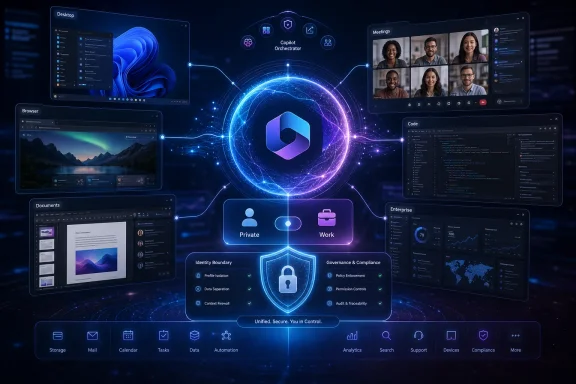
The crucial detail is the planned switching function between private and work profiles. That sounds small, but it is central to the product problem. Microsoft’s users do not live in cleanly separated worlds. They draft personal notes on work laptops, review code in corporate tenants, search email across accounts, and use the same browser profile for tasks that IT departments would prefer to imagine never touch.
A unified Copilot can only work if it respects those boundaries without making the user manage them every five minutes. Microsoft’s identity stack is powerful, but power is not the same thing as elegance. If the app becomes a new maze of tenant restrictions, permissions prompts, and “your admin has disabled this feature” dead ends, the super app will merely centralize the frustration.
There is also a reason Microsoft is reportedly keeping the individual services available. Enterprise buyers do not like being forced into sudden workflow consolidation, and developers are especially quick to rebel when a tool they use daily is folded into a broader corporate productivity vision. GitHub Copilot succeeded because it met programmers inside their editor. If Microsoft turns that into a tab in a general-purpose assistant, it risks confusing integration with dilution.
But Google has changed the narrative. Gemini’s reported user growth, combined with Google’s ability to place AI inside Search, Android, Workspace, Chrome, and developer tools, has made the old “Google missed AI” story look increasingly stale. The company that once seemed embarrassed by ChatGPT’s arrival now looks like it may have the more natural consumer funnel.
That matters because AI adoption is partly a habit race. Users need to learn where they go when they want help, and then they need to trust that location enough to build muscle memory around it. Google has an obvious advantage there: search is already the default act of digital uncertainty.
Microsoft’s default act is work. That is valuable, but it is narrower and more politically complicated. Asking Gemini a question from a phone or search box feels casual; asking Copilot to summarize a corporate meeting, inspect company data, or draft a client response is wrapped in compliance, accuracy, and career risk. The bar is higher because the consequences are higher.
Reports that only a small share of the vast Microsoft 365 base is paying for premium Copilot functionality are not fatal, but they are revealing. Microsoft can point to growth rates, paid seats, and major enterprise pilots. Customers can point to the same recurring concern: the product is expensive, uneven, and hard to justify at scale unless it reliably saves time across many roles.
That is why a unified app may be more than cosmetic. If Microsoft can make Copilot feel like a persistent work companion rather than a collection of feature buttons, the value proposition becomes easier to understand. Instead of selling “AI in Word,” “AI in Teams,” “AI in Outlook,” and “AI for coding,” Microsoft can sell a single assistant that follows the user across tasks.
But this also raises the stakes. A fragmented Copilot can always blame the host app, the tenant, or the scenario. A unified Copilot becomes the thing itself. If it fails, there is nowhere else for the brand to hide.
That advantage is now under pressure. Anthropic’s Claude Code, Cursor, OpenAI’s coding tools, and other agentic development environments are competing not just on autocomplete but on workflow ownership. The new battleground is not “who suggests the next line?” It is “who can understand the repo, make changes, run tests, explain tradeoffs, and behave like a junior teammate who does not sleep?”
Microsoft should be dangerous in that market. It owns GitHub, has Visual Studio Code gravity, has Azure, and has decades of developer platform experience. But developers are unusually sensitive to bloat, lock-in, latency, and corporate bundling. They will use Microsoft tools when those tools are best-in-class; they will mock them mercilessly when they feel like product-management glue.
A super app that includes GitHub Copilot therefore has to be careful. The coding assistant can benefit from a broader memory and agent system, especially if it can connect code changes to tickets, docs, meetings, and deployment environments. But if the integration mostly serves Microsoft’s desire to cross-promote Copilot subscriptions, developers will notice immediately.
Yet centralization concentrates risk. A single AI front door into chat, email, files, code, meetings, and automation is a security and compliance object of enormous importance. It must respect identity boundaries, data-loss prevention rules, retention policies, sensitivity labels, admin controls, and regional requirements. It also has to explain what it did, why it did it, and what data it touched.
That is the quiet enterprise test for Microsoft. CIOs are not merely asking whether Copilot can draft a better email. They are asking whether it can be governed like a serious system. If the super app becomes a high-privilege agentic layer over Microsoft 365 and GitHub, it cannot behave like a consumer chatbot with a corporate badge.
The word agentic is doing a lot of work across the industry right now. In its most useful form, it means software that can plan and act across steps rather than merely answer. In its most dangerous form, it means a probabilistic system with too much access and not enough accountability. Microsoft’s enterprise credibility depends on making the first version real while preventing the second from becoming a headline.
Jacob Andreou’s role is notable because he comes from a consumer growth background. That is not the typical profile for taming Microsoft enterprise complexity. It suggests Microsoft understands that Copilot’s problem is not only model quality or licensing architecture; it is product habit, onboarding, interface rhythm, and emotional clarity.
Mustafa Suleyman’s parallel focus on Microsoft’s own AI models tells the other half of the story. Microsoft’s OpenAI partnership gave it a spectacular early lead, but it also left the company exposed to a strange dependency. When the most visible AI brand in the world is your partner rather than your product, your own assistant can start to feel like a wrapper around somebody else’s magic.
Building more in-house model capacity does not mean Microsoft is walking away from OpenAI. It means Microsoft wants leverage, differentiation, and control. A super app without distinctive intelligence is just a shell. A model strategy without a beloved product is just infrastructure. Microsoft needs both halves to meet in the same place.
Part of the problem is trust. Windows users have endured enough Start menu experiments, Edge nudges, account prompts, cloud backup pitches, and default-app theatrics to approach any new Microsoft “experience” with suspicion. When Copilot appears in Windows, many users do not ask what it can do. They ask how deeply it has been inserted and how easily it can be removed.
That is why the report that users could still access individual services separately matters. The best version of a Copilot super app is an invitation, not a trap. It should win users by being faster, clearer, and more capable than the scattered alternatives, not by becoming another unavoidable icon on the taskbar.
Microsoft has a narrow path here. If Copilot becomes a true command layer for Windows — one that can help configure settings, troubleshoot problems, explain system behavior, and automate dull tasks safely — it could finally deliver on decades of assistant fantasies that Cortana never fulfilled. If it becomes a promotional surface for Microsoft 365 upsells, users will treat it as another thing to disable.
Microsoft’s super app is its answer to that convergence. The company appears to be betting that the winning AI interface will not be a thin feature inside every app but a central command surface that can reach into many apps. That is a meaningful shift for a company whose empire was built on individual applications: Word, Excel, Outlook, PowerPoint, Teams, Visual Studio, Windows.
The difficulty is that Microsoft cannot abandon the app-centric world. Office documents still matter. Teams meetings still matter. Outlook still matters. GitHub issues still matter. The super app has to become the connective tissue without making the organs feel secondary.
That is harder than it sounds. AI assistants are most useful when they have context, but context lives in messy systems. It lives in permissions, file formats, old SharePoint sites, meeting transcripts, code branches, calendar invites, CRM records, and half-remembered chat threads. A super app that cannot reach that context is underpowered. A super app that reaches too freely is dangerous.
Microsoft does not have that luxury. Its customers expect AI to work inside existing systems, obey existing policies, and justify existing budgets. The same enterprise footprint that gives Microsoft enormous distribution also slows down its ability to make Copilot feel simple.
This is why the “super app” label may be misleading. In consumer tech, a super app suggests a dominant portal that absorbs many functions. In Microsoft’s world, the better analogy is an orchestration layer. The app is less important than whether Copilot can carry identity, memory, permissions, and task state across the Microsoft graph of work.
If Microsoft succeeds, the result will not feel like installing another app. It will feel like the company finally made good on the promise implied by the Copilot name. If it fails, “one Copilot” will join the pile of Microsoft branding exercises that tried to simplify confusion by renaming it.
That combination often produces the least satisfying version of a product: a broad launch that demonstrates ambition but hides the most useful capabilities behind previews, licensing gates, region limits, and admin dependencies. Microsoft has done this before. The company is very good at announcing platforms before customers can fully experience them.
The reported decision not to showcase the super app itself at Build suggests Microsoft may know the product is not ready for prime time. That restraint would be wise. Developers and IT pros have become increasingly allergic to AI roadmaps that promise a future assistant while delivering a chat box with branding.
The better move would be to ship a narrower but excellent first version. Give users a reliable account switcher. Make memory and context understandable. Make GitHub Copilot integration additive rather than invasive. Give admins clear controls. Make the app fast. In AI, perceived intelligence collapses quickly when the interface is slow, confused, or unsure what account it is using.
Google’s advantage is that it can catch users at the moment of search and discovery. OpenAI’s advantage is that ChatGPT has become the generic mental model for “ask the AI.” Anthropic’s advantage is trust among users who value careful reasoning and coding competence. Microsoft’s advantage is that work already happens in its software.
The super app is Microsoft’s attempt to turn that workplace advantage into a daily destination. The company does not need every user to love Copilot as a consumer chatbot. It needs enough workers, developers, and admins to decide that Copilot is the fastest way to move from intent to completed task inside Microsoft’s ecosystem.
That is a different race from the one Microsoft seemed to be running in 2023. Back then, the goal was to prove that AI could be injected into everything. In 2026, the goal is to prove that all those injections add up to a product people understand.
A unified app gives Microsoft a chance to reset that mental map. One Copilot could mean one place where the user’s AI work starts, with the underlying capabilities changing based on account, license, device, and context. That is a comprehensible promise.
But the reset will only work if Microsoft is disciplined. The company must resist the urge to make the app a showroom for every AI initiative in Redmond. A product that tries to surface coding, documents, meetings, agents, search, settings, business data, and consumer chat all at once could become the very chaos it was designed to end.
The best Copilot super app would have strong opinions. It would know when to be a chat interface, when to become an agent, when to hand off to Word or VS Code, when to show its sources, when to ask permission, and when to admit it cannot do the job. That kind of restraint is harder than adding another tab.
 Microsoft’s AI Problem Is No Longer Access, It Is Coherence
Microsoft has spent the past three years putting Copilot everywhere: Windows, Edge, Bing, Office, Teams, GitHub, security tools, developer tooling, and enterprise admin surfaces. That blanket deployment once looked like the company’s unbeatable advantage. No rival had comparable access to workers, developers, and PC users at the exact point where AI could be useful.But ubiquity has a way of turning into clutter. A user who meets Copilot in Word, then another Copilot in Teams, then another in Windows, then GitHub Copilot in the IDE, quickly learns that the name does not guarantee a consistent product. The brand promises a universal assistant; the experience often feels like a set of cousins who share a surname but not a memory.
That is why the reported “Delivering one Copilot” effort matters. Microsoft is not merely trying to make a bigger app. It is trying to reverse the impression that Copilot is a marketing layer stretched across unrelated products rather than a coherent AI system.
The super app idea also reveals the tension at the heart of Microsoft’s AI bet. The company wants AI to be embedded into every workflow, but users often want one reliable place to ask, retrieve, automate, and continue work. Microsoft’s challenge is to make Copilot feel ambient without making it feel scattered.
The Super App Is a Product Fix for a Strategy That Got Ahead of Itself
The reported plan would bring together consumer Copilot chat, GitHub Copilot, Microsoft 365 Copilot, Copilot Cowork, and an agentic workflow layer internally referred to as Autopilot. The pitch is obvious: one interface, one identity system, one place to move between personal and business contexts. For Microsoft customers who have watched Copilot sprout across the product line like mushrooms after rain, that could be a relief.The crucial detail is the planned switching function between private and work profiles. That sounds small, but it is central to the product problem. Microsoft’s users do not live in cleanly separated worlds. They draft personal notes on work laptops, review code in corporate tenants, search email across accounts, and use the same browser profile for tasks that IT departments would prefer to imagine never touch.
A unified Copilot can only work if it respects those boundaries without making the user manage them every five minutes. Microsoft’s identity stack is powerful, but power is not the same thing as elegance. If the app becomes a new maze of tenant restrictions, permissions prompts, and “your admin has disabled this feature” dead ends, the super app will merely centralize the frustration.
There is also a reason Microsoft is reportedly keeping the individual services available. Enterprise buyers do not like being forced into sudden workflow consolidation, and developers are especially quick to rebel when a tool they use daily is folded into a broader corporate productivity vision. GitHub Copilot succeeded because it met programmers inside their editor. If Microsoft turns that into a tab in a general-purpose assistant, it risks confusing integration with dilution.
Google’s Comeback Changed the Psychological Race
The question is not whether Microsoft is “losing” AI in a simple scoreboard sense. Microsoft still has cloud scale, Office distribution, Windows reach, GitHub, enterprise relationships, and a deep partnership with OpenAI. Those are not consolation prizes. They are structural advantages most AI startups would sacrifice a board seat to obtain.But Google has changed the narrative. Gemini’s reported user growth, combined with Google’s ability to place AI inside Search, Android, Workspace, Chrome, and developer tools, has made the old “Google missed AI” story look increasingly stale. The company that once seemed embarrassed by ChatGPT’s arrival now looks like it may have the more natural consumer funnel.
That matters because AI adoption is partly a habit race. Users need to learn where they go when they want help, and then they need to trust that location enough to build muscle memory around it. Google has an obvious advantage there: search is already the default act of digital uncertainty.
Microsoft’s default act is work. That is valuable, but it is narrower and more politically complicated. Asking Gemini a question from a phone or search box feels casual; asking Copilot to summarize a corporate meeting, inspect company data, or draft a client response is wrapped in compliance, accuracy, and career risk. The bar is higher because the consequences are higher.
Copilot’s Adoption Numbers Tell a More Awkward Story Than Microsoft’s Demos
Microsoft’s public AI demos have often been impressive in the way keynote demos are designed to be impressive. A Copilot that reads your inbox, understands your calendar, retrieves the right document, drafts the right response, and creates the right deck looks like the future of office work. The problem is that real office work is messier, more political, and more permission-bound than a demo environment.Reports that only a small share of the vast Microsoft 365 base is paying for premium Copilot functionality are not fatal, but they are revealing. Microsoft can point to growth rates, paid seats, and major enterprise pilots. Customers can point to the same recurring concern: the product is expensive, uneven, and hard to justify at scale unless it reliably saves time across many roles.
That is why a unified app may be more than cosmetic. If Microsoft can make Copilot feel like a persistent work companion rather than a collection of feature buttons, the value proposition becomes easier to understand. Instead of selling “AI in Word,” “AI in Teams,” “AI in Outlook,” and “AI for coding,” Microsoft can sell a single assistant that follows the user across tasks.
But this also raises the stakes. A fragmented Copilot can always blame the host app, the tenant, or the scenario. A unified Copilot becomes the thing itself. If it fails, there is nowhere else for the brand to hide.
Developers Are the First Audience Microsoft Cannot Afford to Annoy
GitHub Copilot remains one of Microsoft’s strongest AI success stories because it solved a specific problem before the rest of the Copilot family had fully defined itself. It helped developers write and complete code inside tools they already used. It did not require them to think of themselves as participating in a grand enterprise transformation.That advantage is now under pressure. Anthropic’s Claude Code, Cursor, OpenAI’s coding tools, and other agentic development environments are competing not just on autocomplete but on workflow ownership. The new battleground is not “who suggests the next line?” It is “who can understand the repo, make changes, run tests, explain tradeoffs, and behave like a junior teammate who does not sleep?”
Microsoft should be dangerous in that market. It owns GitHub, has Visual Studio Code gravity, has Azure, and has decades of developer platform experience. But developers are unusually sensitive to bloat, lock-in, latency, and corporate bundling. They will use Microsoft tools when those tools are best-in-class; they will mock them mercilessly when they feel like product-management glue.
A super app that includes GitHub Copilot therefore has to be careful. The coding assistant can benefit from a broader memory and agent system, especially if it can connect code changes to tickets, docs, meetings, and deployment environments. But if the integration mostly serves Microsoft’s desire to cross-promote Copilot subscriptions, developers will notice immediately.
The Enterprise Wants One Door, But Not One Black Box
For IT administrators, the super app is both appealing and alarming. One Copilot could simplify training, licensing, policy, auditing, and support. It could reduce the confusion of multiple AI entry points and make governance less dependent on chasing every new sidebar and plugin across the Microsoft estate.Yet centralization concentrates risk. A single AI front door into chat, email, files, code, meetings, and automation is a security and compliance object of enormous importance. It must respect identity boundaries, data-loss prevention rules, retention policies, sensitivity labels, admin controls, and regional requirements. It also has to explain what it did, why it did it, and what data it touched.
That is the quiet enterprise test for Microsoft. CIOs are not merely asking whether Copilot can draft a better email. They are asking whether it can be governed like a serious system. If the super app becomes a high-privilege agentic layer over Microsoft 365 and GitHub, it cannot behave like a consumer chatbot with a corporate badge.
The word agentic is doing a lot of work across the industry right now. In its most useful form, it means software that can plan and act across steps rather than merely answer. In its most dangerous form, it means a probabilistic system with too much access and not enough accountability. Microsoft’s enterprise credibility depends on making the first version real while preventing the second from becoming a headline.
Nadella’s Reorg Was the Tell
Satya Nadella’s recent AI leadership reshuffle now looks less like ordinary executive housekeeping and more like a recognition that Microsoft’s AI structure had begun to mirror its product sprawl. Splitting consumer and commercial AI may have made sense when the company was racing to ship. It makes less sense when the market starts rewarding continuity, memory, and unified experiences.Jacob Andreou’s role is notable because he comes from a consumer growth background. That is not the typical profile for taming Microsoft enterprise complexity. It suggests Microsoft understands that Copilot’s problem is not only model quality or licensing architecture; it is product habit, onboarding, interface rhythm, and emotional clarity.
Mustafa Suleyman’s parallel focus on Microsoft’s own AI models tells the other half of the story. Microsoft’s OpenAI partnership gave it a spectacular early lead, but it also left the company exposed to a strange dependency. When the most visible AI brand in the world is your partner rather than your product, your own assistant can start to feel like a wrapper around somebody else’s magic.
Building more in-house model capacity does not mean Microsoft is walking away from OpenAI. It means Microsoft wants leverage, differentiation, and control. A super app without distinctive intelligence is just a shell. A model strategy without a beloved product is just infrastructure. Microsoft needs both halves to meet in the same place.
Windows Is Still the Wild Card Microsoft Keeps Mishandling
For Windows users, the Copilot super app could either be the most useful AI improvement Microsoft has made or another chapter in the operating system’s long history of unwanted “help.” Windows remains the most obvious distribution point for Copilot, but it is also the place where Microsoft’s AI push has generated some of its loudest skepticism.Part of the problem is trust. Windows users have endured enough Start menu experiments, Edge nudges, account prompts, cloud backup pitches, and default-app theatrics to approach any new Microsoft “experience” with suspicion. When Copilot appears in Windows, many users do not ask what it can do. They ask how deeply it has been inserted and how easily it can be removed.
That is why the report that users could still access individual services separately matters. The best version of a Copilot super app is an invitation, not a trap. It should win users by being faster, clearer, and more capable than the scattered alternatives, not by becoming another unavoidable icon on the taskbar.
Microsoft has a narrow path here. If Copilot becomes a true command layer for Windows — one that can help configure settings, troubleshoot problems, explain system behavior, and automate dull tasks safely — it could finally deliver on decades of assistant fantasies that Cortana never fulfilled. If it becomes a promotional surface for Microsoft 365 upsells, users will treat it as another thing to disable.
The Super App Is a Bet Against AI Fragmentation
The broader industry is converging on the same problem from different directions. OpenAI wants ChatGPT to become a workspace. Google wants Gemini to become the AI layer across search, Android, Workspace, and the web. Anthropic wants Claude to be a trusted reasoning and coding companion. Browser makers, IDE vendors, productivity startups, and cloud platforms all want to own the place where users ask software to do work.Microsoft’s super app is its answer to that convergence. The company appears to be betting that the winning AI interface will not be a thin feature inside every app but a central command surface that can reach into many apps. That is a meaningful shift for a company whose empire was built on individual applications: Word, Excel, Outlook, PowerPoint, Teams, Visual Studio, Windows.
The difficulty is that Microsoft cannot abandon the app-centric world. Office documents still matter. Teams meetings still matter. Outlook still matters. GitHub issues still matter. The super app has to become the connective tissue without making the organs feel secondary.
That is harder than it sounds. AI assistants are most useful when they have context, but context lives in messy systems. It lives in permissions, file formats, old SharePoint sites, meeting transcripts, code branches, calendar invites, CRM records, and half-remembered chat threads. A super app that cannot reach that context is underpowered. A super app that reaches too freely is dangerous.
Microsoft’s Advantage Is Also Its Burden
Google can introduce Gemini to many users through consumer surfaces where experimentation is relatively cheap. OpenAI can iterate ChatGPT as a destination product with a clear identity. Anthropic can cultivate trust among developers and knowledge workers without having to integrate with every legacy enterprise workflow on Earth.Microsoft does not have that luxury. Its customers expect AI to work inside existing systems, obey existing policies, and justify existing budgets. The same enterprise footprint that gives Microsoft enormous distribution also slows down its ability to make Copilot feel simple.
This is why the “super app” label may be misleading. In consumer tech, a super app suggests a dominant portal that absorbs many functions. In Microsoft’s world, the better analogy is an orchestration layer. The app is less important than whether Copilot can carry identity, memory, permissions, and task state across the Microsoft graph of work.
If Microsoft succeeds, the result will not feel like installing another app. It will feel like the company finally made good on the promise implied by the Copilot name. If it fails, “one Copilot” will join the pile of Microsoft branding exercises that tried to simplify confusion by renaming it.
The Summer Deadline Gives Microsoft Little Room for Theater
A late-summer 2026 target is aggressive given the number of constituencies involved. Consumer users want simplicity. Developers want precision and speed. Enterprise customers want governance. Microsoft’s own product groups want their workflows represented. Security teams want boundaries. Marketing wants a clean story.That combination often produces the least satisfying version of a product: a broad launch that demonstrates ambition but hides the most useful capabilities behind previews, licensing gates, region limits, and admin dependencies. Microsoft has done this before. The company is very good at announcing platforms before customers can fully experience them.
The reported decision not to showcase the super app itself at Build suggests Microsoft may know the product is not ready for prime time. That restraint would be wise. Developers and IT pros have become increasingly allergic to AI roadmaps that promise a future assistant while delivering a chat box with branding.
The better move would be to ship a narrower but excellent first version. Give users a reliable account switcher. Make memory and context understandable. Make GitHub Copilot integration additive rather than invasive. Give admins clear controls. Make the app fast. In AI, perceived intelligence collapses quickly when the interface is slow, confused, or unsure what account it is using.
The Race Is Not for the Best Model, But the Default Workflow
The public AI race is often described as a contest of models: GPT versus Gemini versus Claude versus whatever comes next. That framing is useful for benchmarks and investor decks, but it misses what most users actually experience. Users do not live in benchmarks. They live in workflows.Google’s advantage is that it can catch users at the moment of search and discovery. OpenAI’s advantage is that ChatGPT has become the generic mental model for “ask the AI.” Anthropic’s advantage is trust among users who value careful reasoning and coding competence. Microsoft’s advantage is that work already happens in its software.
The super app is Microsoft’s attempt to turn that workplace advantage into a daily destination. The company does not need every user to love Copilot as a consumer chatbot. It needs enough workers, developers, and admins to decide that Copilot is the fastest way to move from intent to completed task inside Microsoft’s ecosystem.
That is a different race from the one Microsoft seemed to be running in 2023. Back then, the goal was to prove that AI could be injected into everything. In 2026, the goal is to prove that all those injections add up to a product people understand.
The Copilot Brand Gets One More Chance to Mean Something
The danger of naming everything Copilot is that the name eventually stops conveying information. For some users, Copilot means the thing in Windows. For others, it means the paid Microsoft 365 assistant. For developers, it means GitHub’s coding helper. For security teams, it means another specialized product. For many ordinary users, it means a button they clicked once and forgot.A unified app gives Microsoft a chance to reset that mental map. One Copilot could mean one place where the user’s AI work starts, with the underlying capabilities changing based on account, license, device, and context. That is a comprehensible promise.
But the reset will only work if Microsoft is disciplined. The company must resist the urge to make the app a showroom for every AI initiative in Redmond. A product that tries to surface coding, documents, meetings, agents, search, settings, business data, and consumer chat all at once could become the very chaos it was designed to end.
The best Copilot super app would have strong opinions. It would know when to be a chat interface, when to become an agent, when to hand off to Word or VS Code, when to show its sources, when to ask permission, and when to admit it cannot do the job. That kind of restraint is harder than adding another tab.
The Real Test of “One Copilot” Will Arrive After the Keynote Glow Fades
The reported super app gives Microsoft a plausible answer to the criticism that Copilot is everywhere and nowhere at once. But the useful test will not be whether the app exists by September. It will be whether users can tell, within a week, that it reduces friction rather than reorganizing it.- Microsoft is reportedly aiming to unify its major Copilot experiences under a single app rather than forcing users to jump between separate AI tools.
- The project appears designed to fix a real adoption problem: Copilot has broad distribution, but its identity and workflows remain fragmented.
- Google’s Gemini momentum has increased pressure on Microsoft by showing that AI assistants can become habitual consumer destinations, not just enterprise add-ons.
- GitHub Copilot gives Microsoft credibility with developers, but folding coding workflows into a broader super app must be handled carefully.
- Enterprise success will depend less on flashy agent demos than on governance, identity boundaries, auditability, and predictable controls.
- Windows users will judge the new Copilot by whether it behaves like a useful command layer or another Microsoft service pushed too aggressively into the operating system.
References
- Primary source: Research Snipers
Published: 2026-06-04T10:12:09.688872
Microsoft is reportedly working on a new AI super app – Research Snipers
Is Microsoft losing out to Google in the race for the best artificial intelligence? The...researchsnipers.com - Related coverage: fortune.com
Exclusive: Microsoft is building a super app that combines coding, chat, and other Copilot AI tools | Fortune
The project is being spearheaded by new Copilot chief Jacob Andreou, as Microsoft seeks to streamline its lineup of AI tools amid competition from Google, OpenAI, and Anthropic.fortune.com
- Related coverage: aiweekly.co
- Related coverage: fortuneita.com
Microsoft rilancia sull’AI agentica con la super app Copilot - Fortune Italia
Microsoft punta sugli agenti AI con nuove infrastrutture, modelli proprietari e una piattaforma che integra automazione e produttività.www.fortuneita.com - Related coverage: techradar.com
Microsoft spent billions on Copilot, but only 3.3% of users are actually paying for the AI tools | TechRadar
Microsoft spent $37.5 billion on AI tools, with limited returns so farwww.techradar.com - Related coverage: letsdatascience.com
Microsoft Builds Copilot Super App Combining Tools | Let's Data Science
Fortune reports Microsoft is developing a single **Copilot** "super app" that would combine **GitHub Copilot**, Copilot chat, **Copilot Cowork**, and a new agentic workflow capability internally named **Autopilot**. Fortune says the project is being spearheaded by Jacob Andreou... letsdatascience.com

- Related coverage: windowscentral.com
Only 3.3% of Microsoft 365 users pay for Copilot | Windows Central
A new report suggests that only a fraction of the Microsoft 365 and Office 365 users who interact with Copilot Chat actually pay for it.www.windowscentral.com - Related coverage: drwindows.de
Bericht: Microsoft plant einheitliche Super-App für die Copilot-Familie - Dr. Windows
Glaubt man einem aktuellen Bericht der Kollegen bei Thurrott unter Berufung auf Fortune, hat auch Microsoft die Arbeit an einer einheitlichen Super-App für seine KI-Angebote aufgenommen. Das vermutete Projekt entsteht unter der Aufsicht von Copilot-Chef Jacob Andreou und soll den...www.drwindows.de
- Related coverage: windowsforum.com
Microsoft Copilot Super App: One AI Workspace to End Fragmentation | Windows Forum
Microsoft is reportedly building a unified “super app” for Copilot that would combine coding assistance, workplace chat, collaborative agents, and internal...windowsforum.com - Related coverage: it-boltwise.de
Microsoft bündelt Copilots ab Sommer 2026 in einer Super-App und baut eigene Modelle
Microsoft bündelt GitHub Copilot, Copilot Chat und weitere KI-Funktionen in einer Super-App ab Sommer 2026 und baut eigene Modelle, um Abhängigkeiten zu senken. Dazu kommen Windows-Agent-Runtimes und ein Agent-Store.www.it-boltwise.de
