

Microsoft’s position in the software industry remains unusually strong, but the right way to read its valuation is not as a simple “cheap versus expensive” story. The company sits at the intersection of enterprise software, cloud infrastructure, and AI-enabled productivity, which makes its financial profile look very different from most traditional software peers. Compared with the peer set in the supplied article, Microsoft appears to combine slower-looking valuation multiples with faster, larger-scale cash generation and a more conservative balance sheet than many rivals.
What matters most is that Microsoft is not competing in only one software category. It is competing across productivity suites, cloud platforms, security, collaboration, and developer tools, while also shaping the broader economics of enterprise AI adoption. That breadth helps explain why Microsoft can look undervalued on some metrics in a peer table while still trading at a premium to older software names in the market.
Microsoft’s business model has evolved far beyond Windows and Office, even though those franchises still matter enormously. The company now derives strength from a three-part structure: Productivity and Business Processes, Intelligent Cloud, and More Personal Computing. That mix gives Microsoft exposure to both mature recurring revenue streams and newer growth engines such as Azure and AI-driven productivity workloads. Official Microsoft reporting for fiscal 2025 showed annual revenue of $281.7 billion, up 15% year over year, with Azure and other cloud services surpassing $75 billion and growing 34%.
The significance of that mix is that Microsoft can defend its valuation even when one segment slows. Productivity software remains deeply embedded in enterprise operations, while cloud services continue to expand through AI demand and infrastructure buildout. That helps the company avoid the kind of single-product concentration risk that often hits software companies trading at high multiples. It also means Microsoft’s capital intensity is rising, even as its overall margin profile stays strong.
The peer list in the supplied article is broad, stretching from enterprise infrastructure vendors like Oracle and ServiceNow to cybersecurity firms such as Palo Alto Networks, Fortinet, Check Point, and Qualys, plus workflow, data, and niche software names. That matters because software “industry” comparison tables can be misleading when they mix cloud platforms, security vendors, collaboration software, and legacy enterprise applications in one valuation basket. Not all software businesses scale the same way, and not all deserve similar multiples. Microsoft’s economic scale, durability, and operating leverage make it a different animal from most of the table.
Historically, Microsoft has also been one of the cleanest examples of how software can transition from license-driven economics to recurring subscription and cloud economics. Office became Microsoft 365, Windows became a platform tied to ecosystem value, and Azure became the company’s second major pillar. That transition is why investors now focus on cash flow, cloud attach rates, and AI monetization rather than only on personal-computing licenses. The article’s core conclusion—that Microsoft looks favorable on valuation, profitability, and balance-sheet strength—fits the broad arc of that evolution, even if some of the peer table’s arithmetic is imperfect.
From a valuation lens, the most important thing is the relationship between multiple and quality. Microsoft’s earnings are diversified, its recurring revenue base is huge, and its brand power reduces customer acquisition costs across multiple business lines. Those traits often justify higher multiples than mature software peers, but lower multiples than the market may assign to companies with faster headline growth and less capital intensity. That creates a middle ground where Microsoft can appear fairly priced or even slightly discounted depending on the cycle.
A useful interpretation is this: Microsoft is often priced as a quality compounder, not as a moonshot. Investors generally accept a premium because the company consistently converts revenue into profit and cash. What they may not grant is an infinite premium, especially when capital spending rises to support AI infrastructure.
The most important analytical point is that software margins are not all the same. Cloud infrastructure lowers certain gross margins compared with pure SaaS, yet Microsoft offsets that by selling at enormous volume and bundling services across existing customer relationships. The result is a company that can absorb AI-related capex more comfortably than smaller rivals. In other words, Microsoft can afford to invest aggressively without looking financially strained.
There is a second layer here: Microsoft’s profitability is becoming more important as the AI arms race intensifies. Companies like Oracle and ServiceNow are also posting strong growth, but Microsoft’s ability to produce massive cash flow gives it more flexibility in pricing, partnership strategy, and infrastructure buildout. The company can choose to win share first and monetize later, which is a luxury many rivals do not have.
The article’s cited revenue growth of 16.72% compared with the peer average of 16.38% is directionally consistent with Microsoft being a large but still growing software leader. The exact peer average in the original table should be handled carefully, but the message is intact: Microsoft is growing at a healthy pace while sustaining scale. In the software sector, that combination is more valuable than simple percentage growth alone.
AI intensifies that advantage because enterprises want models, inference, data pipelines, and collaboration tools to work together. Microsoft’s positioning with Copilot-like experiences, productivity integration, and cloud infrastructure creates a tighter stack than many rivals can offer. That integration is a real strategic moat, even if some of the monetization is still emerging.
This matters because software companies are increasingly becoming infrastructure investors. The AI era requires data centers, power, networking, and GPUs, all of which raise capital intensity. A company with a healthier balance sheet can fund that investment internally or at lower financial stress. Microsoft’s leverage profile therefore supports long-cycle execution rather than short-term engineering.
There is also a sector-specific twist. Many software peers have relatively low debt by industrial standards, but they do not all have the same earnings durability. Microsoft can tolerate more borrowing than it currently uses, but it does not need to. That distinction becomes important when market conditions tighten or when management wants to preserve flexibility for strategic deals.
Oracle, for example, has been leaning hard into cloud infrastructure and AI workloads, and market commentary increasingly frames it as a beneficiary of massive data-center demand. ServiceNow is using AI to reinforce its enterprise workflow platform, with reported subscription growth above 20% in recent periods. Microsoft competes with both, but on a much broader battlefield. It can be the cloud provider, the workflow surface, the productivity layer, and the identity backbone all at once.
Against Oracle, Microsoft looks less dependent on a single cloud thesis and more embedded in enterprise software spending. Against ServiceNow, it looks broader and more capitalized. Against security vendors, it looks like a platform owner that can bundle security into its core stack. That makes Microsoft harder to displace, even if it sometimes looks less exciting in a headline growth race.
Enterprise buyers care about standardization, security, integration, and vendor reliability. Microsoft scores well on all four. Its broad suite allows IT departments to reduce fragmentation, and that creates a self-reinforcing ecosystem effect. The consumer side adds brand visibility and cross-sell opportunities, but it is the enterprise side that underpins Microsoft’s valuation durability.
This is where Microsoft differs from many software competitors in the table. A niche vendor might show higher growth in a given quarter, but Microsoft’s installed base creates a much deeper moat. That moat also helps explain why the market often treats Microsoft as a lower-risk software benchmark even when valuation looks rich in absolute terms.
That said, the article’s central claim remains valid: Microsoft looks like one of the more financially durable names in the sector. Its valuation is not unreasonable given the quality of earnings, the breadth of the platform, and the consistency of its growth. In a world where software investors increasingly reward durability and AI exposure, Microsoft is often closer to the center of the acceptable range than the edge of it.
Microsoft’s strength, then, is not that it “wins” every ratio. It is that it wins the most important ones simultaneously: scale, growth, profitability, and balance-sheet discipline. That makes it harder for competitors to outrun on any single metric. Quality at scale is often the most valuable category in software.
The broader software industry is also entering a more selective period. Investors are becoming more disciplined about which growth stories deserve premium multiples, and Microsoft will continue to be judged against both the promise of AI and the reality of capital spending. That is not a bad position to be in, but it is a demanding one.
Source: Sahm Comparing Microsoft With Industry Competitors In Software Industry
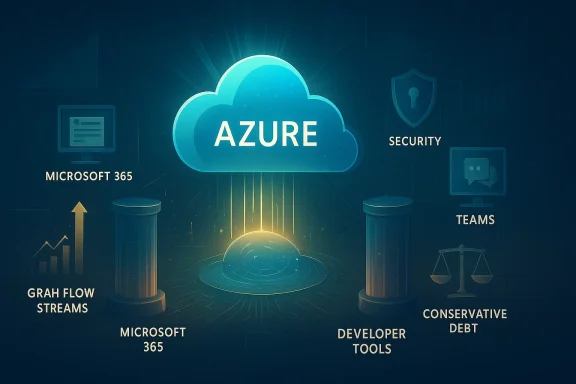
What matters most is that Microsoft is not competing in only one software category. It is competing across productivity suites, cloud platforms, security, collaboration, and developer tools, while also shaping the broader economics of enterprise AI adoption. That breadth helps explain why Microsoft can look undervalued on some metrics in a peer table while still trading at a premium to older software names in the market.
 Background
Microsoft’s business model has evolved far beyond Windows and Office, even though those franchises still matter enormously. The company now derives strength from a three-part structure: Productivity and Business Processes, Intelligent Cloud, and More Personal Computing. That mix gives Microsoft exposure to both mature recurring revenue streams and newer growth engines such as Azure and AI-driven productivity workloads. Official Microsoft reporting for fiscal 2025 showed annual revenue of $281.7 billion, up 15% year over year, with Azure and other cloud services surpassing $75 billion and growing 34%.The significance of that mix is that Microsoft can defend its valuation even when one segment slows. Productivity software remains deeply embedded in enterprise operations, while cloud services continue to expand through AI demand and infrastructure buildout. That helps the company avoid the kind of single-product concentration risk that often hits software companies trading at high multiples. It also means Microsoft’s capital intensity is rising, even as its overall margin profile stays strong.
The peer list in the supplied article is broad, stretching from enterprise infrastructure vendors like Oracle and ServiceNow to cybersecurity firms such as Palo Alto Networks, Fortinet, Check Point, and Qualys, plus workflow, data, and niche software names. That matters because software “industry” comparison tables can be misleading when they mix cloud platforms, security vendors, collaboration software, and legacy enterprise applications in one valuation basket. Not all software businesses scale the same way, and not all deserve similar multiples. Microsoft’s economic scale, durability, and operating leverage make it a different animal from most of the table.
Historically, Microsoft has also been one of the cleanest examples of how software can transition from license-driven economics to recurring subscription and cloud economics. Office became Microsoft 365, Windows became a platform tied to ecosystem value, and Azure became the company’s second major pillar. That transition is why investors now focus on cash flow, cloud attach rates, and AI monetization rather than only on personal-computing licenses. The article’s core conclusion—that Microsoft looks favorable on valuation, profitability, and balance-sheet strength—fits the broad arc of that evolution, even if some of the peer table’s arithmetic is imperfect.
Why this comparison matters now
Software investors in 2026 are weighing three competing narratives at once: AI expansion, cloud saturation fears, and valuation discipline. Microsoft sits in the center of all three. The company benefits from AI demand, but it also bears the cost of data center expansion and the pressure to keep monetizing those investments efficiently. That makes relative valuation analysis useful, but only if the scale differences between firms are respected.- Microsoft is a platform company, not a point solution vendor.
- Its cloud base is large enough to drive companywide growth.
- Its legacy products still generate durable cash flow.
- Its AI investments are now a strategic necessity, not optional spending.
- Its valuation must be interpreted against both growth and balance-sheet resilience.
Valuation: Why Microsoft Still Screens Well
The supplied article argues that Microsoft’s P/E of 26.3, P/B of 7.98, and P/S of 10.27 are all below the stated industry averages in that table. Even if the exact peer-average math in the article should be treated cautiously, the larger point is directionally reasonable: Microsoft is not trading like a speculative high-growth software name, yet it still offers stronger scale and profitability than many peers. In market terms, that combination often earns a premium, but not an excessive one.From a valuation lens, the most important thing is the relationship between multiple and quality. Microsoft’s earnings are diversified, its recurring revenue base is huge, and its brand power reduces customer acquisition costs across multiple business lines. Those traits often justify higher multiples than mature software peers, but lower multiples than the market may assign to companies with faster headline growth and less capital intensity. That creates a middle ground where Microsoft can appear fairly priced or even slightly discounted depending on the cycle.
Multiple comparison and what it implies
The peer group in the article contains companies with very different operating models. Oracle trades on the hopes of accelerating cloud infrastructure growth, ServiceNow on workflow expansion and AI-assisted enterprise transformation, and cybersecurity vendors on defensive demand. Microsoft’s multiple therefore reflects a conglomerate-like software franchise rather than a narrow thematic bet. That breadth usually lowers valuation volatility and reduces the chance of an extreme rerating.A useful interpretation is this: Microsoft is often priced as a quality compounder, not as a moonshot. Investors generally accept a premium because the company consistently converts revenue into profit and cash. What they may not grant is an infinite premium, especially when capital spending rises to support AI infrastructure.
- P/E suggests Microsoft is not cheaply valued in absolute terms, but it is attractive relative to its quality.
- P/B is less meaningful for software than for asset-heavy industries, yet it still reflects disciplined capital use.
- P/S becomes important when software firms are investing heavily and earnings fluctuate.
- The article’s valuation case is strongest when seen as relative attractiveness, not deep value.
Profitability and Operating Efficiency
Microsoft’s profitability is the strongest part of the comparison. The article notes EBITDA of $58.18 billion and gross profit of $55.3 billion, both far above the peer averages listed there. Those figures are not just impressive in isolation; they show the company’s ability to scale a software platform across enterprise licenses, cloud, and consumer ecosystems without sacrificing operating leverage. That is the defining advantage of large-scale software incumbency.The most important analytical point is that software margins are not all the same. Cloud infrastructure lowers certain gross margins compared with pure SaaS, yet Microsoft offsets that by selling at enormous volume and bundling services across existing customer relationships. The result is a company that can absorb AI-related capex more comfortably than smaller rivals. In other words, Microsoft can afford to invest aggressively without looking financially strained.
Gross profit versus growth spending
Gross profit matters because it shows how much economic fuel is available before operating expenses. Microsoft’s size lets it sustain heavy R&D, sales, and capital expenditures while still producing elite profitability. That is a major differentiator from firms whose growth is strong but whose operating structure remains less mature. It also helps explain why analysts keep treating Microsoft as a “core holding” rather than a tactical trade.There is a second layer here: Microsoft’s profitability is becoming more important as the AI arms race intensifies. Companies like Oracle and ServiceNow are also posting strong growth, but Microsoft’s ability to produce massive cash flow gives it more flexibility in pricing, partnership strategy, and infrastructure buildout. The company can choose to win share first and monetize later, which is a luxury many rivals do not have.
- Gross profit provides the raw material for future innovation.
- EBITDA scale supports both reinvestment and shareholder returns.
- Software margins remain a strategic moat when growth is durable.
- Large incumbents can survive temporary margin compression better than smaller rivals.
- Microsoft’s profitability is part of its competitive defense.
Growth Engines: Azure, Productivity, and AI
Microsoft’s growth story is not centered on one product line. The company’s cloud business, especially Azure, remains the clearest long-term engine, while Microsoft 365 and LinkedIn keep the productivity and business processes segment expanding. Fiscal 2025 results showed cloud demand continuing to accelerate, with Azure and other cloud services up 34% for the year. That is especially notable because it comes from an already very large base.The article’s cited revenue growth of 16.72% compared with the peer average of 16.38% is directionally consistent with Microsoft being a large but still growing software leader. The exact peer average in the original table should be handled carefully, but the message is intact: Microsoft is growing at a healthy pace while sustaining scale. In the software sector, that combination is more valuable than simple percentage growth alone.
Azure and the cloud platform effect
Azure is not just a product; it is a distribution layer for the whole Microsoft ecosystem. Customers who adopt Azure often buy adjacent services, including security, identity, developer tools, and data platforms. That bundling effect makes Azure strategically more important than a standalone infrastructure service. It also strengthens Microsoft’s ability to defend enterprise accounts against Oracle, AWS, and Google Cloud.AI intensifies that advantage because enterprises want models, inference, data pipelines, and collaboration tools to work together. Microsoft’s positioning with Copilot-like experiences, productivity integration, and cloud infrastructure creates a tighter stack than many rivals can offer. That integration is a real strategic moat, even if some of the monetization is still emerging.
- Azure expands Microsoft’s enterprise footprint.
- AI increases demand for cloud compute and platform services.
- Productivity tools create high switching costs.
- LinkedIn and Dynamics broaden the monetization surface.
- The company benefits from both new workloads and installed-base expansion.
Balance Sheet Strength and Debt Discipline
The article gives Microsoft a debt-to-equity ratio of 0.15, which it interprets as stronger financial positioning than peers. That conclusion is broadly consistent with Microsoft’s reputation for conservative leverage. For a company of this size, low leverage is not just a risk metric; it is a strategic asset. It gives management optionality in acquisitions, buybacks, infrastructure spending, and AI investments.This matters because software companies are increasingly becoming infrastructure investors. The AI era requires data centers, power, networking, and GPUs, all of which raise capital intensity. A company with a healthier balance sheet can fund that investment internally or at lower financial stress. Microsoft’s leverage profile therefore supports long-cycle execution rather than short-term engineering.
Why debt-to-equity is only part of the story
Debt-to-equity is useful, but it is not the entire picture. Microsoft also generates enough operating cash flow to fund growth, buybacks, and dividends, which means its reported leverage understates its practical financial strength. In a capital-intensive phase, cash generation matters as much as balance-sheet ratios. That’s why Microsoft’s low debt profile should be viewed as a buffer, not merely a statistic.There is also a sector-specific twist. Many software peers have relatively low debt by industrial standards, but they do not all have the same earnings durability. Microsoft can tolerate more borrowing than it currently uses, but it does not need to. That distinction becomes important when market conditions tighten or when management wants to preserve flexibility for strategic deals.
- Low leverage supports strategic optionality.
- Cash flow can outperform accounting ratios in importance.
- Microsoft can invest without overextending financially.
- Conservative financing lowers downside risk in downturns.
- Balance-sheet strength improves resilience during AI capex cycles.
Relative Position Versus Oracle and ServiceNow
If Microsoft has one major challenge in the software peer set, it is that some competitors are now posting very visible AI-fueled acceleration. Oracle’s cloud infrastructure story has reawakened investor enthusiasm, and ServiceNow continues to post strong subscription growth and enterprise workflow momentum. Those companies are often priced around future potential, while Microsoft is priced around scale plus execution. That difference makes direct comparisons tricky but still informative.Oracle, for example, has been leaning hard into cloud infrastructure and AI workloads, and market commentary increasingly frames it as a beneficiary of massive data-center demand. ServiceNow is using AI to reinforce its enterprise workflow platform, with reported subscription growth above 20% in recent periods. Microsoft competes with both, but on a much broader battlefield. It can be the cloud provider, the workflow surface, the productivity layer, and the identity backbone all at once.
The competitive framing
That breadth is an advantage, but it can also dull the market’s excitement. Investors often pay higher multiples for a more focused growth narrative than for a diversified giant. Microsoft’s challenge is that it must keep proving that its scale does not cap its growth. The 2025 fiscal-year numbers helped on that front, especially with Azure and the broader cloud business continuing to expand strongly.Against Oracle, Microsoft looks less dependent on a single cloud thesis and more embedded in enterprise software spending. Against ServiceNow, it looks broader and more capitalized. Against security vendors, it looks like a platform owner that can bundle security into its core stack. That makes Microsoft harder to displace, even if it sometimes looks less exciting in a headline growth race.
- Oracle is a focused cloud infrastructure challenger.
- ServiceNow is a high-multiple workflow and AI play.
- Microsoft is the multi-layer platform in the middle.
- Breadth reduces risk but can reduce narrative premium.
- Scale can be a moat and a valuation constraint at the same time.
Consumer, Enterprise, and Platform Dynamics
Microsoft’s consumer business still matters, but the enterprise side is where the strategic action lives. Windows, Xbox, Surface, and Bing all contribute to the company’s reach, yet the most durable economics come from business productivity and cloud subscriptions. That distinction is important because enterprise software tends to be stickier, more recurring, and less vulnerable to consumer taste shifts. The company’s segment mix therefore improves stability relative to more consumer-sensitive software names.Enterprise buyers care about standardization, security, integration, and vendor reliability. Microsoft scores well on all four. Its broad suite allows IT departments to reduce fragmentation, and that creates a self-reinforcing ecosystem effect. The consumer side adds brand visibility and cross-sell opportunities, but it is the enterprise side that underpins Microsoft’s valuation durability.
Ecosystem lock-in and switching costs
Microsoft’s greatest hidden asset may be workflow inertia. Companies that run Office 365, Teams, Azure, Entra, Dynamics, and related services are not casually replacing that stack. The friction is not just technical; it is organizational, legal, and financial. Switching costs can be more powerful than headline growth rates because they preserve revenue quality over time.This is where Microsoft differs from many software competitors in the table. A niche vendor might show higher growth in a given quarter, but Microsoft’s installed base creates a much deeper moat. That moat also helps explain why the market often treats Microsoft as a lower-risk software benchmark even when valuation looks rich in absolute terms.
- Enterprise adoption deepens Microsoft’s moat.
- Consumer products support brand and reach.
- Integrated tooling lowers switching probability.
- Workflow lock-in improves revenue visibility.
- Platform breadth reduces concentration risk.
The Meaning of the Industry Averages
The article’s peer averages are useful as a directional guide, but they should not be treated as perfectly normalized comparisons. Mixing cybersecurity, workflow software, cloud infrastructure, data platforms, and consumer-adjacent software in one average can distort interpretation. A company with a very high P/S ratio and a company with a low P/S ratio may not be comparable if their margins, growth stages, and capital structures differ significantly.That said, the article’s central claim remains valid: Microsoft looks like one of the more financially durable names in the sector. Its valuation is not unreasonable given the quality of earnings, the breadth of the platform, and the consistency of its growth. In a world where software investors increasingly reward durability and AI exposure, Microsoft is often closer to the center of the acceptable range than the edge of it.
Why sector averages can mislead
The biggest problem with simple averages is that they obscure business-model differences. A cybersecurity vendor facing rapid product cycles may deserve a higher sales multiple than a mature platform company with slower but steadier growth. Conversely, a giant software platform with exceptional cash conversion may deserve a premium even if its growth rate is lower. The comparison only works when investors recognize those distinctions.Microsoft’s strength, then, is not that it “wins” every ratio. It is that it wins the most important ones simultaneously: scale, growth, profitability, and balance-sheet discipline. That makes it harder for competitors to outrun on any single metric. Quality at scale is often the most valuable category in software.
- Averages blur business-model differences.
- High-growth and high-quality are not the same thing.
- Microsoft’s scale changes how its multiples should be read.
- Peer-set construction can influence valuation conclusions.
- Investors should compare operating economics, not just ratios.
Strengths and Opportunities
Microsoft’s strongest advantage is the combination of platform breadth and financial power. The company can push AI, cloud, productivity, and security simultaneously, and that lets it create value across multiple software spending categories at once. It is rare to find a business of this size that still has clear top-line growth, elite cash generation, and room to invest aggressively.- Azure remains a major growth engine.
- Microsoft 365 and related productivity tools provide recurring revenue.
- Low leverage supports flexibility.
- Massive EBITDA gives the company reinvestment capacity.
- Enterprise lock-in strengthens retention.
- AI integration adds new monetization surfaces.
- Global distribution makes scaling efficient.
Risks and Concerns
Microsoft’s biggest risks are not the usual software risks; they are the risks that come with being enormous and strategically central. Heavy AI infrastructure spending can pressure margins, while competition from Oracle, AWS, Google Cloud, ServiceNow, and specialist software vendors can limit pricing power in some categories. The company also faces regulatory scrutiny because of its size and influence across enterprise software markets.- Capex intensity may compress near-term margins.
- AI monetization may lag infrastructure spending.
- Regulatory pressure could rise as the company expands.
- Cloud competition remains intense.
- Platform breadth can make execution more complex.
- Security and uptime failures would be especially costly.
- Currency and macro cycles can still affect enterprise demand.
Looking Ahead
The next phase of Microsoft’s software story will likely be defined by how well it converts AI demand into durable customer value. If the company can keep Azure growing while layering AI features into productivity and enterprise workflows, its competitive position should remain strong. If not, the market may begin to question whether the scale advantage is translating into enough incremental earnings power.The broader software industry is also entering a more selective period. Investors are becoming more disciplined about which growth stories deserve premium multiples, and Microsoft will continue to be judged against both the promise of AI and the reality of capital spending. That is not a bad position to be in, but it is a demanding one.
Key things to watch
- Azure growth relative to other cloud platforms.
- AI monetization across Microsoft 365 and enterprise products.
- Margin effects from data center and infrastructure spending.
- Capital return pace through dividends and buybacks.
- Competitive response from Oracle, ServiceNow, and cloud rivals.
Source: Sahm Comparing Microsoft With Industry Competitors In Software Industry
