

Microsoft has built and begun externalizing an AI-powered Visual Studio Code extension called Python Dependency Remediation to help its developers, and eventually the wider Python community, identify vulnerable Python packages, upgrade dependency chains, and repair breaking code changes inside the editor. The important part is not that Microsoft found another place to put AI. It is that the company is aiming AI at one of software engineering’s least glamorous but most consequential chores: keeping old code safe without turning maintenance into a full-time job. For Windows developers, enterprise admins, and security teams, this is the kind of tool that could matter precisely because it attacks a problem everyone has learned to resent.
The phrase “AI-powered dependency remediation” sounds like something that could have been assembled from three conference banners and a product manager’s whiteboard. But the underlying problem is painfully real. Python is easy to adopt, easy to spread, and easy to embed into every corner of an organization until nobody can quite say how much of the business depends on which package versions.
Microsoft says at least 67,000 employees use Python every day. That makes Python less a language choice than an internal platform, stitched into production services, automation scripts, analytics pipelines, internal tools, and developer experiments that may or may not have grown into something permanent. At that scale, dependency management stops being a housekeeping task and becomes a security exposure.
The company’s own framing is blunt: Python dependencies are now its third-largest vulnerability surface. That is a revealing admission because it shifts the conversation away from the usual headline risks — zero-days, phishing, identity compromise — and toward the mundane software supply chain below the application layer. A vulnerable package pinned in a forgotten requirements file may not look dramatic, but multiplied across thousands of repositories, it becomes an enterprise problem.
The twist is that Microsoft claims visibility was not the weak link. The company already had tools that could detect and surface vulnerable dependencies. The bottleneck was the long, brittle, human process required to do something useful with that information.
Anyone who has maintained a real Python project knows the rhythm. A scanner flags a vulnerable package. The developer bumps the version. Another library objects. A transitive dependency shifts. Tests fail in a place that appears unrelated. A framework has deprecated an API. The fix becomes a small migration, then a larger migration, then a decision to defer until the next sprint.
This is where the security dashboard and the developer’s day diverge. Security teams tend to see a queue of known vulnerabilities. Developers see risk, uncertainty, regression testing, broken builds, and a calendar already full of feature work. Both views are correct, which is why the stalemate is so durable.
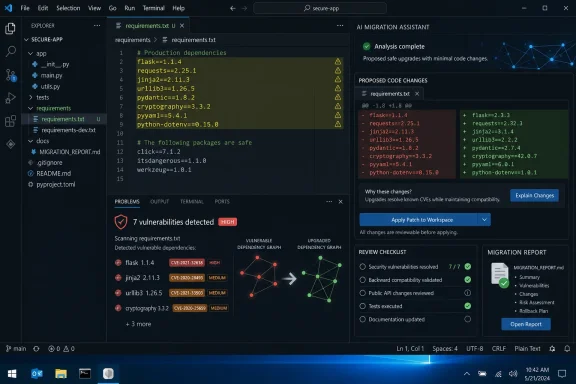
Microsoft’s Python Dependency Remediation tool is interesting because it attempts to compress that gap. The extension does not merely point at the vulnerable package; according to Microsoft and its Marketplace listing, it scans dependency files, identifies known CVE exposure, upgrades packages to safer versions, runs tests in isolated environments, and uses AI to detect and fix breaking API changes. That last clause is the strategic bet.
Package updates are not just version-number changes. They are code changes waiting to happen. The value of an AI agent here is not that it can read a vulnerability feed faster than a script, but that it can inspect the resulting code failure, infer the new API shape, and propose or apply the migration work that used to land on an engineer’s desk.
The Microsoft account captures this neatly: upgrade one library and 17 other things may need to move with it. That is not an exotic failure case; it is Tuesday. The modern Python ecosystem is rich precisely because so much functionality lives in third-party packages, but every imported convenience comes with maintenance obligations.
Dependency trees also hide accountability. A developer may know they installed a top-level library, but the vulnerable component may sit three layers below it. Updating the direct dependency may pull in other changes. Pinning everything may stabilize the build while freezing in the vulnerability. Loosening constraints may fix the CVE but destabilize runtime behavior.
This is why “just update your dependencies” has always been better advice than execution plan. It is morally correct and technically incomplete. In an enterprise estate, the difference matters.
Microsoft’s internal scale makes the problem legible. If a single repository takes a few hours to remediate, that sounds manageable. If thousands of projects each require manual triage, compatibility testing, code changes, and review, the math becomes impossible. Security debt accumulates not because developers are careless, but because remediation has historically been more expensive than detection.
But in this case, the origin is less important than what happened next. A prototype that identifies an internal pain point is not unusual. A prototype that moves into the normal developer workflow, integrates with VS Code, and begins a path toward external release is more significant.
The choice of Visual Studio Code is practical and political. Practical, because VS Code is where a large number of Python developers already live. Political, because Microsoft has spent years making VS Code the center of gravity for its developer tooling strategy. Putting remediation into the editor lets Microsoft say it is shifting security left, but the more important move is that it is shifting remediation into context.
Developers dislike tools that require a workflow detour. If a vulnerability alert sends them to a portal, a wiki page, a spreadsheet, a dependency graph, and finally back to the code, the process is already losing. The editor is where the developer can see the package file, the code using the package, the tests, and the proposed diff. That makes it the logical place for an AI system to act — and the logical place for a human to review.
This is also why the “one click” language should be read carefully. One-click remediation is compelling marketing, but in real software estates, the review step remains essential. The more accurate claim is that Microsoft is trying to turn a scattered research-and-repair task into a guided editor operation.
A conventional tool can identify that a package version is vulnerable. It can suggest a safe version. It can update a requirements file. It can run tests. But when the tests fail because an upgraded library changed a method signature, renamed a function, reorganized imports, or altered expected behavior, the work becomes semantic. The developer must understand what the code intended, what the new API expects, and how to bridge the two.
That is exactly the kind of tedious, local reasoning where AI coding tools can be useful — not as autonomous architects, but as migration assistants. The tool can look at the old call pattern, the upgraded library, the error output, and the surrounding code, then propose a patch. In good cases, it saves time. In bad cases, it still narrows the investigation.
The Microsoft implementation is also notable because it can use any AI model the user has access to through Visual Studio Code’s APIs, according to the company’s description. If no AI model is available, the extension can still perform package updates but will not carry out code remediation fixes. That distinction is important because it separates the mechanical upgrade from the AI-assisted repair.
For enterprise IT, this design has consequences. Organizations with strict data controls will want to know which model is being used, where prompts and code snippets go, what telemetry is collected, and whether private source code leaves approved boundaries. The security tool cannot become a new supply-chain risk.
Automated remediation lives or dies by auditability. A developer needs to know which dependencies changed, why they changed, which vulnerabilities were addressed, what tests were run, and which code edits were made as a consequence. A security team needs evidence that remediation happened. A reviewer needs to understand whether the patch is a safe migration or an AI hallucination with a green checkmark.
This is where AI coding tools often collide with enterprise reality. The faster a tool makes changes, the more important it becomes to explain those changes. A diff alone may not be enough if the dependency graph is large and the vulnerability justification is buried in a scanner result elsewhere.
The report also helps with the inevitable cases where the tool fails. Dependency remediation will not always be clean. Tests may be incomplete. A package may require a larger application refactor. An upgrade may introduce behavior changes that no static or unit test catches. In those moments, a clear report gives the developer a trail instead of a mystery.
Microsoft’s framing suggests a practical compromise: let automation do the repetitive work, but keep the human in the loop for review and escalation. That is less flashy than autonomous patching, but much more plausible in production environments.
That alone would make it another useful extension in a crowded marketplace. The bigger distribution lever is Pylance. Microsoft’s Pylance extension is the default language support experience for Python in Visual Studio Code, built on Pyright and used alongside the official Python extension. Microsoft says the Python and Tools for AI team is working to provide a path from Pylance installation to the remediation extension, effectively turning a widely installed developer tool into an awareness channel for dependency hygiene.
This is classic Microsoft platform strategy. The company does not need every developer to search for a remediation tool. It can surface the tool at the moment a Python developer is already setting up their editor. That kind of placement can change adoption patterns more than a blog post or a security memo ever will.
It also raises a fair question about ecosystem boundaries. VS Code is hugely popular, but Python is not a Microsoft-owned platform. Dependency remediation should not become something that only feels first-class inside Microsoft’s editor. The broader Python community includes PyCharm users, Neovim users, terminal-first developers, CI-driven teams, and organizations with their own internal platforms.
If Microsoft wants this to become more than a VS Code convenience, the underlying remediation logic will need to meet developers where they work. The editor extension is a strong start; the long-term opportunity is an approach that can plug into pull requests, CI pipelines, local development, and enterprise policy systems.
But automation does not eliminate prioritization. Not every vulnerability has the same exploitability, exposure, or business impact. Not every dependency sits in a reachable code path. Not every upgrade is worth the same regression risk. A remediation assistant can make fixes cheaper, but it should not turn vulnerability management into blind patch churn.
This matters because one of the easiest ways to misuse tools like this is to optimize for the dashboard. If the goal becomes reducing the count of flagged CVEs without understanding runtime context, organizations may still waste effort or introduce instability. The better goal is to make the right fixes easier and faster, especially when a vulnerable dependency is actually exposed.
There is also the matter of test quality. Microsoft’s extension can run tests in isolated environments, but tests are only as good as the project provides. A small internal script may have no meaningful tests. A mature service may have extensive unit coverage but weak integration coverage. An AI-assisted migration that passes a shallow test suite can still be wrong.
That is not an argument against the tool. It is an argument against magical thinking. AI remediation is a force multiplier for existing engineering discipline, not a substitute for it.
Python Dependency Remediation tries to improve that bargain. If an engineer can remediate a dependency vulnerability in minutes rather than hours, the security ask becomes less adversarial. If the tool keeps the work inside VS Code, produces a readable report, and generates a reviewable diff, it begins to feel like developer assistance rather than compliance theater.
There is a morale dimension here that enterprises should not underestimate. Developers often avoid upgrades not because they do not care about security, but because they have been burned by dependency cascades. The memory of a routine package bump turning into a half-day debugging session is enough to make anyone postpone maintenance.
AI can help most when it reduces that uncertainty. It can make the first attempt cheaper. It can surface likely breaking changes sooner. It can propose the boring migration edits nobody wants to write by hand. Even when it does not fully solve the problem, it can make starting less painful.
That is how security practices become habitual. Not by telling developers to care more, but by making the secure path less miserable than the insecure one.
JavaScript has its own dependency sprawl and version churn. .NET shops face framework migrations, package updates, and transitive dependencies through NuGet. Front-end frameworks regularly deprecate APIs and reshape build tooling. Enterprise software estates are now layered atop enormous collections of third-party components, many of which move faster than the applications that depend on them.
The generalizable idea is not “use AI to update packages.” It is “connect vulnerability intelligence, dependency solving, test execution, code migration, and human review into one workflow.” That is a much more ambitious and useful proposition.
If Microsoft can make that pattern credible, it could become part of the next generation of secure development tooling. Today’s scanners tell teams what is wrong. Tomorrow’s tools will be judged by how safely they help teams fix it.
The competitive landscape will not stand still. GitHub Dependabot, Snyk, Renovate, GitLab, JetBrains, and cloud security vendors all have pieces of this puzzle. Microsoft’s advantage is the combination of GitHub, VS Code, enterprise security credibility, and its ability to dogfood the tooling inside one of the world’s largest software organizations. The risk is that integration becomes lock-in rather than ecosystem uplift.
That means policy knobs. Administrators will want to decide which models are allowed, which repositories can use the tool, whether code can leave the tenant, which dependency sources are trusted, how reports are stored, and whether remediation can be applied automatically or only proposed. Developers will want easy rollback and clear diffs. Security teams will want evidence.
The tool also needs to avoid flattening all upgrades into the same action. A patch-level security update is different from a major-version migration. A library used in a test helper is different from one exposed in an internet-facing service. A package with a known exploited vulnerability is different from one with a theoretical issue in unreachable functionality. The remediation workflow should carry that nuance forward rather than hide it behind a green button.
There is also the question of AI correctness. An AI system may produce a syntactically valid migration that subtly changes behavior. It may choose a workaround that satisfies a test but weakens validation. It may misread an API change. These are familiar risks in AI coding, but dependency remediation makes them more acute because the context is security.
The answer is not to ban the tool from serious work. The answer is to make the automation observable, constrained, and reviewable. In enterprise software, trust is not a mood; it is a system property.
It applies AI to a well-defined, high-friction workflow. It has measurable outcomes: vulnerabilities found, packages upgraded, tests run, code changes generated, developer time saved. It sits inside an existing tool instead of asking users to invent a new habit. It leaves room for human review. In other words, it looks less like science fiction and more like enterprise software.
That is why this effort deserves attention from WindowsForum’s audience. Many Windows-heavy shops are also Python shops, whether officially or by accumulation. PowerShell may be the administrative lingua franca of Windows environments, but Python is everywhere in automation, data work, DevOps scripts, internal services, and cross-platform tooling. The dependency problem is therefore not somebody else’s open-source hygiene issue; it is part of the Windows enterprise estate.
Microsoft’s internal use also gives the tool a credibility boost. “Customer Zero” programs are not automatically proof of quality, but they do expose tooling to messy reality. A dependency remediation system that can survive Microsoft’s internal sprawl is at least being tested against the kind of scale and heterogeneity that enterprise customers recognize.
The Microsoft tool is one possible answer, especially for teams already invested in VS Code and Python. But the larger operating model matters more than the extension itself. Dependency remediation should be treated as a workflow that spans discovery, prioritization, patch generation, testing, review, and evidence.
There is also a cultural point here. If developers experience dependency updates mainly as surprise labor from security, they will delay them. If updates become smaller, more frequent, and better tooled, they are more likely to become routine. AI can help, but only if it is deployed as assistance rather than enforcement.
This is where Windows and Microsoft-oriented enterprises should pay attention. The company is not just adding a Python extension; it is demonstrating how AI can be embedded into developer infrastructure to attack accumulated maintenance debt. That pattern will almost certainly reappear across Microsoft’s tooling stack.
The best version of this tool will not be the one that dazzles developers with AI theatrics. It will be the one that quietly turns a neglected vulnerability into a reviewed patch before the issue becomes an incident. That is a more modest ambition than replacing programmers, but a much more useful one.
Near-term expectations should be grounded:
 Microsoft Is Turning Dependency Cleanup Into an Editor Workflow
The phrase “AI-powered dependency remediation” sounds like something that could have been assembled from three conference banners and a product manager’s whiteboard. But the underlying problem is painfully real. Python is easy to adopt, easy to spread, and easy to embed into every corner of an organization until nobody can quite say how much of the business depends on which package versions.Microsoft says at least 67,000 employees use Python every day. That makes Python less a language choice than an internal platform, stitched into production services, automation scripts, analytics pipelines, internal tools, and developer experiments that may or may not have grown into something permanent. At that scale, dependency management stops being a housekeeping task and becomes a security exposure.
The company’s own framing is blunt: Python dependencies are now its third-largest vulnerability surface. That is a revealing admission because it shifts the conversation away from the usual headline risks — zero-days, phishing, identity compromise — and toward the mundane software supply chain below the application layer. A vulnerable package pinned in a forgotten requirements file may not look dramatic, but multiplied across thousands of repositories, it becomes an enterprise problem.
The twist is that Microsoft claims visibility was not the weak link. The company already had tools that could detect and surface vulnerable dependencies. The bottleneck was the long, brittle, human process required to do something useful with that information.
The Scanner Was Never the Hard Part
Modern security programs are extremely good at producing alerts. Dependency scanners, software composition analysis tools, GitHub advisories, CI checks, package registries, and vulnerability dashboards can all tell developers that something in the stack needs attention. The failure mode is not ignorance; it is operational drag.Anyone who has maintained a real Python project knows the rhythm. A scanner flags a vulnerable package. The developer bumps the version. Another library objects. A transitive dependency shifts. Tests fail in a place that appears unrelated. A framework has deprecated an API. The fix becomes a small migration, then a larger migration, then a decision to defer until the next sprint.
This is where the security dashboard and the developer’s day diverge. Security teams tend to see a queue of known vulnerabilities. Developers see risk, uncertainty, regression testing, broken builds, and a calendar already full of feature work. Both views are correct, which is why the stalemate is so durable.
Microsoft’s Python Dependency Remediation tool is interesting because it attempts to compress that gap. The extension does not merely point at the vulnerable package; according to Microsoft and its Marketplace listing, it scans dependency files, identifies known CVE exposure, upgrades packages to safer versions, runs tests in isolated environments, and uses AI to detect and fix breaking API changes. That last clause is the strategic bet.
Package updates are not just version-number changes. They are code changes waiting to happen. The value of an AI agent here is not that it can read a vulnerability feed faster than a script, but that it can inspect the resulting code failure, infer the new API shape, and propose or apply the migration work that used to land on an engineer’s desk.
Python’s Flexibility Has a Security Bill
Python became dominant in part because it is a language that rarely says no. It works for machine learning notebooks, infrastructure scripts, web services, data pipelines, test harnesses, glue code, and “temporary” internal utilities that live for a decade. That breadth is a strength, but it also means Python environments tend to accrete dependencies from every era of a project’s life.The Microsoft account captures this neatly: upgrade one library and 17 other things may need to move with it. That is not an exotic failure case; it is Tuesday. The modern Python ecosystem is rich precisely because so much functionality lives in third-party packages, but every imported convenience comes with maintenance obligations.
Dependency trees also hide accountability. A developer may know they installed a top-level library, but the vulnerable component may sit three layers below it. Updating the direct dependency may pull in other changes. Pinning everything may stabilize the build while freezing in the vulnerability. Loosening constraints may fix the CVE but destabilize runtime behavior.
This is why “just update your dependencies” has always been better advice than execution plan. It is morally correct and technically incomplete. In an enterprise estate, the difference matters.
Microsoft’s internal scale makes the problem legible. If a single repository takes a few hours to remediate, that sounds manageable. If thousands of projects each require manual triage, compatibility testing, code changes, and review, the math becomes impossible. Security debt accumulates not because developers are careless, but because remediation has historically been more expensive than detection.
The Hackathon Origin Matters Less Than the Product Path
Microsoft says Python Dependency Remediation began as a hackathon project inside Microsoft Digital, the company’s IT organization. That origin story is familiar enough to invite skepticism. Large companies love a hackathon tale because it gives bureaucracy a garage-band soundtrack.But in this case, the origin is less important than what happened next. A prototype that identifies an internal pain point is not unusual. A prototype that moves into the normal developer workflow, integrates with VS Code, and begins a path toward external release is more significant.
The choice of Visual Studio Code is practical and political. Practical, because VS Code is where a large number of Python developers already live. Political, because Microsoft has spent years making VS Code the center of gravity for its developer tooling strategy. Putting remediation into the editor lets Microsoft say it is shifting security left, but the more important move is that it is shifting remediation into context.
Developers dislike tools that require a workflow detour. If a vulnerability alert sends them to a portal, a wiki page, a spreadsheet, a dependency graph, and finally back to the code, the process is already losing. The editor is where the developer can see the package file, the code using the package, the tests, and the proposed diff. That makes it the logical place for an AI system to act — and the logical place for a human to review.
This is also why the “one click” language should be read carefully. One-click remediation is compelling marketing, but in real software estates, the review step remains essential. The more accurate claim is that Microsoft is trying to turn a scattered research-and-repair task into a guided editor operation.
AI Is Useful Here Because the Problem Is Messy
There are plenty of places where AI is being applied because a vendor needs an AI story. Dependency remediation is different. It is a domain where deterministic tools can get frustratingly close and still fail at the human-costly part.A conventional tool can identify that a package version is vulnerable. It can suggest a safe version. It can update a requirements file. It can run tests. But when the tests fail because an upgraded library changed a method signature, renamed a function, reorganized imports, or altered expected behavior, the work becomes semantic. The developer must understand what the code intended, what the new API expects, and how to bridge the two.
That is exactly the kind of tedious, local reasoning where AI coding tools can be useful — not as autonomous architects, but as migration assistants. The tool can look at the old call pattern, the upgraded library, the error output, and the surrounding code, then propose a patch. In good cases, it saves time. In bad cases, it still narrows the investigation.
The Microsoft implementation is also notable because it can use any AI model the user has access to through Visual Studio Code’s APIs, according to the company’s description. If no AI model is available, the extension can still perform package updates but will not carry out code remediation fixes. That distinction is important because it separates the mechanical upgrade from the AI-assisted repair.
For enterprise IT, this design has consequences. Organizations with strict data controls will want to know which model is being used, where prompts and code snippets go, what telemetry is collected, and whether private source code leaves approved boundaries. The security tool cannot become a new supply-chain risk.
The Report Is as Important as the Patch
One of the quieter but more important details in Microsoft’s description is that the extension produces a report of the changes for developer review. That may sound like administrative garnish, but it is central to whether the tool can be trusted.Automated remediation lives or dies by auditability. A developer needs to know which dependencies changed, why they changed, which vulnerabilities were addressed, what tests were run, and which code edits were made as a consequence. A security team needs evidence that remediation happened. A reviewer needs to understand whether the patch is a safe migration or an AI hallucination with a green checkmark.
This is where AI coding tools often collide with enterprise reality. The faster a tool makes changes, the more important it becomes to explain those changes. A diff alone may not be enough if the dependency graph is large and the vulnerability justification is buried in a scanner result elsewhere.
The report also helps with the inevitable cases where the tool fails. Dependency remediation will not always be clean. Tests may be incomplete. A package may require a larger application refactor. An upgrade may introduce behavior changes that no static or unit test catches. In those moments, a clear report gives the developer a trail instead of a mystery.
Microsoft’s framing suggests a practical compromise: let automation do the repetitive work, but keep the human in the loop for review and escalation. That is less flashy than autonomous patching, but much more plausible in production environments.
Pylance Gives the Tool a Distribution Strategy
The external release path may be the most consequential part of the story. Microsoft says the tool has shown enough promise internally that it has begun releasing it externally. The Visual Studio Marketplace listing presents Python Dependency Remediation as a VS Code extension for scanning Python dependency files, highlighting vulnerable packages, upgrading them, running tests, and using AI for breaking-change repairs.That alone would make it another useful extension in a crowded marketplace. The bigger distribution lever is Pylance. Microsoft’s Pylance extension is the default language support experience for Python in Visual Studio Code, built on Pyright and used alongside the official Python extension. Microsoft says the Python and Tools for AI team is working to provide a path from Pylance installation to the remediation extension, effectively turning a widely installed developer tool into an awareness channel for dependency hygiene.
This is classic Microsoft platform strategy. The company does not need every developer to search for a remediation tool. It can surface the tool at the moment a Python developer is already setting up their editor. That kind of placement can change adoption patterns more than a blog post or a security memo ever will.
It also raises a fair question about ecosystem boundaries. VS Code is hugely popular, but Python is not a Microsoft-owned platform. Dependency remediation should not become something that only feels first-class inside Microsoft’s editor. The broader Python community includes PyCharm users, Neovim users, terminal-first developers, CI-driven teams, and organizations with their own internal platforms.
If Microsoft wants this to become more than a VS Code convenience, the underlying remediation logic will need to meet developers where they work. The editor extension is a strong start; the long-term opportunity is an approach that can plug into pull requests, CI pipelines, local development, and enterprise policy systems.
Security Teams Get Leverage, But Not a Free Pass
For security organizations, the appeal is obvious. Vulnerability management programs often stall at the handoff to engineering. A tool that turns a scanner finding into a proposed patch can reduce mean time to remediation, improve compliance rates, and lower the emotional temperature between security and development teams.But automation does not eliminate prioritization. Not every vulnerability has the same exploitability, exposure, or business impact. Not every dependency sits in a reachable code path. Not every upgrade is worth the same regression risk. A remediation assistant can make fixes cheaper, but it should not turn vulnerability management into blind patch churn.
This matters because one of the easiest ways to misuse tools like this is to optimize for the dashboard. If the goal becomes reducing the count of flagged CVEs without understanding runtime context, organizations may still waste effort or introduce instability. The better goal is to make the right fixes easier and faster, especially when a vulnerable dependency is actually exposed.
There is also the matter of test quality. Microsoft’s extension can run tests in isolated environments, but tests are only as good as the project provides. A small internal script may have no meaningful tests. A mature service may have extensive unit coverage but weak integration coverage. An AI-assisted migration that passes a shallow test suite can still be wrong.
That is not an argument against the tool. It is an argument against magical thinking. AI remediation is a force multiplier for existing engineering discipline, not a substitute for it.
Developers May Finally Get a Better Bargain
The developer bargain around security has often been poor. Engineers are told they own the risk, but they are handed tools that mostly generate work. They are measured on feature delivery, reliability, and incident response, then asked to spend hours resolving dependency issues that may not map cleanly to their product roadmap.Python Dependency Remediation tries to improve that bargain. If an engineer can remediate a dependency vulnerability in minutes rather than hours, the security ask becomes less adversarial. If the tool keeps the work inside VS Code, produces a readable report, and generates a reviewable diff, it begins to feel like developer assistance rather than compliance theater.
There is a morale dimension here that enterprises should not underestimate. Developers often avoid upgrades not because they do not care about security, but because they have been burned by dependency cascades. The memory of a routine package bump turning into a half-day debugging session is enough to make anyone postpone maintenance.
AI can help most when it reduces that uncertainty. It can make the first attempt cheaper. It can surface likely breaking changes sooner. It can propose the boring migration edits nobody wants to write by hand. Even when it does not fully solve the problem, it can make starting less painful.
That is how security practices become habitual. Not by telling developers to care more, but by making the secure path less miserable than the insecure one.
The Supply Chain Lesson Goes Beyond Python
Microsoft’s own engineers are already pointing beyond Python. The same remediation pattern could apply to C#, Angular, React, and other ecosystems where dependency upgrades can break application code. The details vary, but the shape of the problem is familiar across modern software.JavaScript has its own dependency sprawl and version churn. .NET shops face framework migrations, package updates, and transitive dependencies through NuGet. Front-end frameworks regularly deprecate APIs and reshape build tooling. Enterprise software estates are now layered atop enormous collections of third-party components, many of which move faster than the applications that depend on them.
The generalizable idea is not “use AI to update packages.” It is “connect vulnerability intelligence, dependency solving, test execution, code migration, and human review into one workflow.” That is a much more ambitious and useful proposition.
If Microsoft can make that pattern credible, it could become part of the next generation of secure development tooling. Today’s scanners tell teams what is wrong. Tomorrow’s tools will be judged by how safely they help teams fix it.
The competitive landscape will not stand still. GitHub Dependabot, Snyk, Renovate, GitLab, JetBrains, and cloud security vendors all have pieces of this puzzle. Microsoft’s advantage is the combination of GitHub, VS Code, enterprise security credibility, and its ability to dogfood the tooling inside one of the world’s largest software organizations. The risk is that integration becomes lock-in rather than ecosystem uplift.
The Catch Is Trust, Not Intelligence
The hardest problem for AI remediation is not generating code. It is earning permission to change code that matters. Enterprises will not adopt these tools at scale because a demo looks impressive; they will adopt them when the failure modes are understood and controllable.That means policy knobs. Administrators will want to decide which models are allowed, which repositories can use the tool, whether code can leave the tenant, which dependency sources are trusted, how reports are stored, and whether remediation can be applied automatically or only proposed. Developers will want easy rollback and clear diffs. Security teams will want evidence.
The tool also needs to avoid flattening all upgrades into the same action. A patch-level security update is different from a major-version migration. A library used in a test helper is different from one exposed in an internet-facing service. A package with a known exploited vulnerability is different from one with a theoretical issue in unreachable functionality. The remediation workflow should carry that nuance forward rather than hide it behind a green button.
There is also the question of AI correctness. An AI system may produce a syntactically valid migration that subtly changes behavior. It may choose a workaround that satisfies a test but weakens validation. It may misread an API change. These are familiar risks in AI coding, but dependency remediation makes them more acute because the context is security.
The answer is not to ban the tool from serious work. The answer is to make the automation observable, constrained, and reviewable. In enterprise software, trust is not a mood; it is a system property.
Microsoft’s Python Cleanup Points to a Different AI Story
The AI industry has spent much of the past few years selling grand narratives: copilots for everything, agents that replace workflows, chatbots that sit between users and software. Python Dependency Remediation is a smaller story, but it may be the more durable one.It applies AI to a well-defined, high-friction workflow. It has measurable outcomes: vulnerabilities found, packages upgraded, tests run, code changes generated, developer time saved. It sits inside an existing tool instead of asking users to invent a new habit. It leaves room for human review. In other words, it looks less like science fiction and more like enterprise software.
That is why this effort deserves attention from WindowsForum’s audience. Many Windows-heavy shops are also Python shops, whether officially or by accumulation. PowerShell may be the administrative lingua franca of Windows environments, but Python is everywhere in automation, data work, DevOps scripts, internal services, and cross-platform tooling. The dependency problem is therefore not somebody else’s open-source hygiene issue; it is part of the Windows enterprise estate.
Microsoft’s internal use also gives the tool a credibility boost. “Customer Zero” programs are not automatically proof of quality, but they do expose tooling to messy reality. A dependency remediation system that can survive Microsoft’s internal sprawl is at least being tested against the kind of scale and heterogeneity that enterprise customers recognize.
The Practical Reading for Windows Shops
For IT leaders and development managers, the immediate lesson is not to wait for AI to fix the entire software supply chain. It is to look at the remediation gap in your own environment. If your scanners produce more findings than your teams can safely close, your bottleneck is no longer visibility.The Microsoft tool is one possible answer, especially for teams already invested in VS Code and Python. But the larger operating model matters more than the extension itself. Dependency remediation should be treated as a workflow that spans discovery, prioritization, patch generation, testing, review, and evidence.
There is also a cultural point here. If developers experience dependency updates mainly as surprise labor from security, they will delay them. If updates become smaller, more frequent, and better tooled, they are more likely to become routine. AI can help, but only if it is deployed as assistance rather than enforcement.
This is where Windows and Microsoft-oriented enterprises should pay attention. The company is not just adding a Python extension; it is demonstrating how AI can be embedded into developer infrastructure to attack accumulated maintenance debt. That pattern will almost certainly reappear across Microsoft’s tooling stack.
The Real Win Is Making the Boring Work Happen
The most concrete value in Microsoft’s approach is that it does not pretend dependency remediation is glamorous. It treats the work as necessary, repetitive, risky, and overdue — exactly the sort of work software organizations struggle to prioritize until something breaks.The best version of this tool will not be the one that dazzles developers with AI theatrics. It will be the one that quietly turns a neglected vulnerability into a reviewed patch before the issue becomes an incident. That is a more modest ambition than replacing programmers, but a much more useful one.
Near-term expectations should be grounded:
- Microsoft’s tool is aimed at Python dependency files and known CVE exposure, not at every possible supply-chain risk in a project.
- The extension’s AI-assisted value depends on access to an approved AI model and on the quality of the surrounding code, tests, and review process.
- The VS Code and Pylance connection gives Microsoft a powerful distribution path, especially among developers already using Microsoft’s Python tooling.
- Security teams should treat automated remediation reports as evidence to review, not as a replacement for risk-based prioritization.
- The broader idea is likely to spread beyond Python because dependency-driven breakage is a shared problem across modern software ecosystems.
References
- Primary source: Microsoft
Published: 2026-06-25T16:12:11.208118
Taming our Python dependencies at Microsoft with AI - Inside Track Blog
Learn how the AI-powered Python Dependency Remediation extension helps us fix Python vulnerabilities by automating updates within developer workflows.www.microsoft.com - Official source: learn.microsoft.com
Pylance: our new and improved Python experience in VS Code | Microsoft Learn
Get a glimpse of the most performant and user-friendly editing experience for Python in VS Code ever. The newest version of the extension dramatically improves language support via our new language server, Pylance. With Pylance's rich type information in symbol tooltips, auto-completions...learn.microsoft.com - Official source: devblogs.microsoft.com
Announcing Pylance: Fast, feature-rich language support for Python in Visual Studio Code - Microsoft for Python Developers Blog
We are excited to announce Pylance, our fast and feature-rich language support for Python in Visual Studio Code! Pylance is available today in the Visual Studio Code marketplace. Pylance depends on our core Python extension and builds upon that experience, for those of you who have already...devblogs.microsoft.com - Related coverage: marketplace.visualstudio.com
Python Dependency Remediation - Visual Studio Marketplace
Extension for Visual Studio Code - Scan Python dependencies for security vulnerabilities with AI-powered breaking change analysismarketplace.visualstudio.com - Related coverage: techcentral.ie
Pylance: Python extension for Visual Studio Code - TechCentral.ie
Microsoft has pulled back the covers on Pylance, a Visual Studio Code extension for faster and more complete Python language support in that popular code editor. Pylance does not replace the existing Microsoft-authored Python extension for Visual Studio Code, which has some 21 million...www.techcentral.ie - Official source: github.com
GitHub - microsoft/vscode-python: Python extension for Visual Studio Code · GitHub
Python extension for Visual Studio Code. Contribute to microsoft/vscode-python development by creating an account on GitHub. github.com
- Related coverage: code.visualstudio.com
Python in Visual Studio Code
Learn about Visual Studio Code as a Python IDE (code completion, debugging, linting).code.visualstudio.com - Related coverage: pearl.shanghaitech.edu.cn
