

Microsoft used its June 4, 2026 Official Microsoft Blog to argue that AI-enabled biotechnology now requires stronger nucleic acid synthesis screening, customer verification, and government-backed biosecurity rules because modern AI tools can help redesign biological sequences in ways older safeguards may miss. The company’s message is not that biology research should be slowed, but that the physical bottlenecks in the research pipeline need to be hardened before software-driven discovery outruns them. That is a subtle but important shift in the AI safety debate: away from abstract fears about chatbots and toward the mundane infrastructure that turns a digital design into something real.
The core claim is simple enough for WindowsForum readers who have lived through decades of cybersecurity cycles: once a general-purpose technology becomes cheap, programmable, and widely distributed, voluntary best practices stop being enough. Microsoft is treating synthetic biology less like a distant laboratory concern and more like a platform-security problem. The company’s proposed answer is familiar, too: red teaming, disclosure, shared standards, and enforceable controls at the point where risky intent meets real-world execution.
Most public arguments about AI risk still revolve around models: what they can say, what they can generate, whether they can be jailbroken, and how much access users should have to frontier systems. Microsoft’s blog takes a different route. It says the more consequential risk may emerge when general-purpose models, specialist biological software, automated labs, and agentic programming tools are wired together into a working pipeline.
That framing matters because it avoids the lazy binary of “open science versus safety.” The company is not arguing that language models alone can hand a novice a catastrophe. It is arguing that capability compounds when models make expert tools easier to operate, when those tools generate useful biological designs, and when commercial services can translate those designs into physical material.
For IT professionals, the analogy is not hard to see. A vulnerability is rarely catastrophic because of one bug in isolation; it becomes dangerous when chained with privilege escalation, weak identity controls, automation, and exposed infrastructure. Microsoft is describing the biological equivalent of a kill chain, with nucleic acid synthesis providers serving as one of the last practical gates before a design exits the realm of computation.
The company’s vocabulary is deliberately borrowed from security engineering. The Paraphrase Project, Microsoft’s stress test of existing biosecurity screening systems, is presented as a kind of red-team exercise. The lesson is not that screening is pointless because it can be bypassed; the lesson is that screening has to be updated the way intrusion detection, malware signatures, and cloud identity policies have to be updated.
That is the most persuasive part of Microsoft’s argument. It accepts that defensive systems will fail when attackers adapt, but it does not treat failure as an excuse for nihilism. It treats failure as telemetry.
The term paraphrase is doing a lot of work here. In natural language, a paraphrase preserves meaning while changing wording. In this biological context, the fear is that a redesigned sequence might preserve a harmful function while changing enough of its molecular “wording” to dodge a detection system that relies too heavily on similarity to known threats.
That makes the problem more like malware polymorphism than traditional biosafety screening. If a detection regime assumes that future risks will closely resemble known risks, then AI-generated variation becomes a problem. The defender is not merely asking whether a submitted sequence matches a prohibited item; the defender is asking whether it performs a prohibited role despite looking sufficiently different.
Microsoft’s blog stops short of panic, and that restraint is important. Engineering biology remains hard. Wet-lab work is not the same as copying code, and many digital designs fail when confronted with biological reality. But the direction of travel is difficult to dismiss: as design tools improve, the distance between a computational idea and a plausible experimental request narrows.
This is where Microsoft’s software-security worldview becomes useful. The company knows what happens when a technology ecosystem is built first and governed later. The internet’s history is full of protocols, defaults, and trust assumptions that made sense in small communities and became liabilities at global scale. Microsoft is warning that synthetic biology may be reaching a similar transition point.
Microsoft’s argument is that this checkpoint is unusually attractive because it does not require regulating every idea, every paper, every model, or every lab notebook. Instead, it focuses on the moment when someone asks a provider to manufacture a sequence. That is where customer verification and order screening can do real work without freezing legitimate research upstream.
The appeal is obvious. In cybersecurity terms, this is not a ban on writing code; it is an attempt to secure package registries, cloud accounts, signing keys, and deployment pipelines. The goal is to stop dangerous execution paths without making research itself illegal.
The weakness is equally obvious. Screening is only as good as the rules, databases, identity checks, and provider coverage behind it. If the system is voluntary, uneven, and internationally fragmented, then weak links become shopping opportunities. A determined actor may try to split orders, use less rigorous providers, route through intermediaries, or exploit jurisdictions with looser expectations.
That is why Microsoft emphasizes both technical modernization and policy durability. Better algorithms matter, but so does whether providers are required to use them. Customer verification matters, but so does whether evasion carries consequences. A framework that depends entirely on good corporate citizenship is unlikely to survive contact with a global market.
AI complicates both assumptions. Specialist tools can help redesign biological components. Generalist models can explain workflows, translate jargon, assist with code, and lower the intimidation barrier around unfamiliar tools. Agentic systems can connect steps that previously required more manual expertise. Laboratory automation can further compress the gap between design and experiment.
None of this means that AI has made bioweapons easy. It means the old comfort that biology is too hard for non-experts is becoming less reliable as a policy foundation. Competence is still a barrier, but software has a long history of lowering competence barriers one abstraction layer at a time.
That is why Microsoft’s “capability stack” language is useful. The risk does not come from a chatbot sitting alone in a browser tab. It comes from the stack: model, code, biological design tool, database, synthesis provider, lab workflow, and iteration loop. Each layer may be defensible in isolation; together they create a more capable system.
For Windows admins, the lesson should feel familiar. Nobody secures an enterprise by saying that one tool is not dangerous by itself. PowerShell, RDP, macros, OAuth tokens, and cloud storage are all legitimate. The risk emerges when legitimate components are chained in ways defenders did not anticipate.
The proposed legislation would move the system toward mandatory screening requirements, conformity assessments, enforcement mechanisms, technical assistance, and a governance sandbox. In plain English, that means the government would not merely encourage providers to screen; it would start defining what adequate screening looks like and how compliance is measured.
The bipartisan angle is notable because AI policy often collapses into familiar partisan fights over regulation, industrial policy, censorship, national security, or corporate power. Biosecurity cuts differently. Few elected officials want to be on record opposing stronger safeguards against engineered pathogens or toxins, especially when the proposed intervention is aimed at a commercial manufacturing chokepoint rather than at academic speech.
But bipartisan agreement can also hide unresolved details. Who defines the sequences of concern? How are false positives handled? What happens to small synthesis providers that lack large compliance teams? How does the United States prevent risky demand from moving offshore? How much information sharing is necessary to detect order splitting, and how much creates privacy or intellectual-property concerns?
These are not objections to the project. They are the places where policy either becomes operational or becomes theater. A screening mandate that looks clean in a press release can become brittle if the technical standards lag, if providers cannot implement them consistently, or if researchers experience it as arbitrary friction.
That does not make the argument wrong. It does mean readers should separate Microsoft’s public-interest claim from its platform interest. A world that regulates only frontier models is potentially more restrictive for AI vendors. A world that also regulates downstream control points lets vendors say: do not ban the tools; secure the dangerous workflows.
This is the same pattern the tech industry has used in cybersecurity for years. Cloud providers argue that customers can build powerful systems safely if identity, monitoring, logging, policy, and incident response are mature. The answer is rarely to ban computation. The answer is to instrument and govern the pathways where computation becomes operational power.
The difference is that biology has a thinner margin for error. A botched software deployment can be rolled back. A leaked credential can be rotated. Biological misuse, depending on the case, can have consequences that do not fit neatly into an incident-response dashboard. That is why the analogy to cybersecurity is helpful but incomplete.
Still, Microsoft’s position reflects a realistic understanding of where AI governance may be headed. The most durable rules may not be rules about model weights or prompt phrasing. They may be rules about interfaces: who can access which capabilities, under what identity, with what logging, and with what checks before real-world execution.
Enterprise IT will end up in the middle of this whether it wants to or not. Universities, biotech startups, pharmaceutical companies, hospitals, and research institutes all run on ordinary identity providers, endpoints, collaboration suites, storage platforms, and developer environments. If AI-assisted biological design becomes more common, the governance layer will not live only inside the lab. It will live in tenant policies, access controls, procurement systems, data-loss prevention rules, and vendor-risk reviews.
That is the quiet operational implication of Microsoft’s blog. Biosecurity will not be handled solely by biosafety officers in white coats. It will involve the same people who manage conditional access, endpoint detection, privileged accounts, software supply chains, and cloud audit logs.
The risk is not that every sysadmin needs to become a molecular biologist. The risk is that organizations will treat AI-biology workflows as exotic research exceptions rather than as high-risk digital workflows. Once a lab pipeline depends on GitHub repositories, cloud notebooks, LLM assistants, file shares, API keys, and synthesis-provider portals, it belongs partly to IT.
That may be uncomfortable, but it is also an opportunity. The security profession already has patterns for least privilege, separation of duties, approval workflows, anomaly detection, and vendor assurance. Those patterns will not solve biosecurity, but they can make the surrounding digital environment less permissive.
That is a defensible compromise. Screening DNA orders is narrower than restricting access to general AI models or banning publication of broad categories of research. It preserves much of the open scientific process while acknowledging that some requests deserve scrutiny before physical material is produced.
But targeted friction still has costs. False positives can delay research. Vague rules can chill work on vaccines, therapeutics, and countermeasures. Compliance burdens can favor large incumbents over smaller providers. International mismatch can punish companies that follow the rules while leaving less responsible competitors untouched.
The answer is not to pretend those tradeoffs do not exist. The answer is to design the system with transparency, appeal mechanisms, technical assistance, and measurable performance. If a screening regime cannot explain why it stopped an order, cannot update quickly, or cannot distinguish routine work from genuine concern, it will lose legitimacy.
Microsoft’s cybersecurity analogy again cuts both ways. Security controls that are too noisy get bypassed. Controls that block business without context get disabled. Controls that are accurate, auditable, and integrated into normal workflows become part of the operating environment.
That is the right instinct. Static lists and one-off standards cannot keep up with generative design. If models can produce novel variants, screening tools need to reason beyond close sequence matching. If customers can distribute orders, providers need privacy-preserving ways to detect suspicious patterns. If new tools change what non-experts can do, risk assessments need to change with them.
This is where government can help but cannot substitute for technical competence. A law can require screening, but it cannot by itself make screening smart. An agency can define requirements, but it still needs input from researchers, providers, security experts, and companies with enough operational scale to see abuse patterns.
The danger is that policymakers will freeze today’s best guess into tomorrow’s compliance checklist. That would recreate the problem Microsoft is warning about: defenses built for an earlier technological era. The better model is closer to security baselines that evolve, with conformance testing, shared indicators, and periodic reassessment.
For a company like Microsoft, this is familiar terrain. The firm’s own history runs from the insecure-by-default internet era through Trustworthy Computing, monthly patching, cloud telemetry, secure development lifecycles, and now AI red teaming. It is not hard to see why Microsoft views biology’s control points through that lens.
For researchers, the message is that the freedom to innovate may increasingly depend on proving that the surrounding workflow is trustworthy. For synthesis providers, voluntary screening is unlikely to remain a sufficient long-term posture. For enterprise IT, AI risk assessments will need to include not only what a model can output, but what connected systems can do with that output.
There are several practical conclusions to draw now:
Microsoft’s biosecurity argument is therefore bigger than biology. It is a preview of the next phase of AI governance, in which society stops pretending that capability can be managed solely at the chat window and starts securing the pipelines where software touches the physical world. If that shift happens early enough, AI may accelerate the life sciences without repeating the oldest mistake in computing: connecting everything first and asking how to secure it later.
The core claim is simple enough for WindowsForum readers who have lived through decades of cybersecurity cycles: once a general-purpose technology becomes cheap, programmable, and widely distributed, voluntary best practices stop being enough. Microsoft is treating synthetic biology less like a distant laboratory concern and more like a platform-security problem. The company’s proposed answer is familiar, too: red teaming, disclosure, shared standards, and enforceable controls at the point where risky intent meets real-world execution.
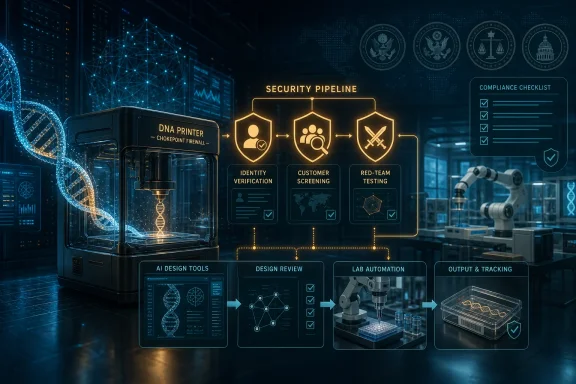 Microsoft Moves the AI Safety Debate From Prompts to Pipelines
Most public arguments about AI risk still revolve around models: what they can say, what they can generate, whether they can be jailbroken, and how much access users should have to frontier systems. Microsoft’s blog takes a different route. It says the more consequential risk may emerge when general-purpose models, specialist biological software, automated labs, and agentic programming tools are wired together into a working pipeline.That framing matters because it avoids the lazy binary of “open science versus safety.” The company is not arguing that language models alone can hand a novice a catastrophe. It is arguing that capability compounds when models make expert tools easier to operate, when those tools generate useful biological designs, and when commercial services can translate those designs into physical material.
For IT professionals, the analogy is not hard to see. A vulnerability is rarely catastrophic because of one bug in isolation; it becomes dangerous when chained with privilege escalation, weak identity controls, automation, and exposed infrastructure. Microsoft is describing the biological equivalent of a kill chain, with nucleic acid synthesis providers serving as one of the last practical gates before a design exits the realm of computation.
The company’s vocabulary is deliberately borrowed from security engineering. The Paraphrase Project, Microsoft’s stress test of existing biosecurity screening systems, is presented as a kind of red-team exercise. The lesson is not that screening is pointless because it can be bypassed; the lesson is that screening has to be updated the way intrusion detection, malware signatures, and cloud identity policies have to be updated.
That is the most persuasive part of Microsoft’s argument. It accepts that defensive systems will fail when attackers adapt, but it does not treat failure as an excuse for nihilism. It treats failure as telemetry.
The Paraphrase Project Turns Biology Into a Zero-Day Story
The Paraphrase Project is the hinge of Microsoft’s case. In the company’s telling, researchers tested whether AI-assisted protein design tools could create variants of dangerous proteins that might preserve harmful function while looking different enough to evade some existing screening systems. The uncomfortable answer was yes: safeguards designed around older assumptions could be fooled by redesigned sequences.The term paraphrase is doing a lot of work here. In natural language, a paraphrase preserves meaning while changing wording. In this biological context, the fear is that a redesigned sequence might preserve a harmful function while changing enough of its molecular “wording” to dodge a detection system that relies too heavily on similarity to known threats.
That makes the problem more like malware polymorphism than traditional biosafety screening. If a detection regime assumes that future risks will closely resemble known risks, then AI-generated variation becomes a problem. The defender is not merely asking whether a submitted sequence matches a prohibited item; the defender is asking whether it performs a prohibited role despite looking sufficiently different.
Microsoft’s blog stops short of panic, and that restraint is important. Engineering biology remains hard. Wet-lab work is not the same as copying code, and many digital designs fail when confronted with biological reality. But the direction of travel is difficult to dismiss: as design tools improve, the distance between a computational idea and a plausible experimental request narrows.
This is where Microsoft’s software-security worldview becomes useful. The company knows what happens when a technology ecosystem is built first and governed later. The internet’s history is full of protocols, defaults, and trust assumptions that made sense in small communities and became liabilities at global scale. Microsoft is warning that synthetic biology may be reaching a similar transition point.
The DNA Printer Becomes the Firewall
Nucleic acid synthesis screening sounds obscure, but it is the practical center of the debate. Synthetic DNA providers make custom genetic material for researchers, companies, and institutions. That makes them a checkpoint between digital biological design and physical biological capability.Microsoft’s argument is that this checkpoint is unusually attractive because it does not require regulating every idea, every paper, every model, or every lab notebook. Instead, it focuses on the moment when someone asks a provider to manufacture a sequence. That is where customer verification and order screening can do real work without freezing legitimate research upstream.
The appeal is obvious. In cybersecurity terms, this is not a ban on writing code; it is an attempt to secure package registries, cloud accounts, signing keys, and deployment pipelines. The goal is to stop dangerous execution paths without making research itself illegal.
The weakness is equally obvious. Screening is only as good as the rules, databases, identity checks, and provider coverage behind it. If the system is voluntary, uneven, and internationally fragmented, then weak links become shopping opportunities. A determined actor may try to split orders, use less rigorous providers, route through intermediaries, or exploit jurisdictions with looser expectations.
That is why Microsoft emphasizes both technical modernization and policy durability. Better algorithms matter, but so does whether providers are required to use them. Customer verification matters, but so does whether evasion carries consequences. A framework that depends entirely on good corporate citizenship is unlikely to survive contact with a global market.
Voluntary Screening Was Built for a Slower Threat Model
The uncomfortable subtext of Microsoft’s post is that today’s screening regime was designed for a world in which dangerous requests were easier to recognize. If a sequence closely resembled a known pathogen or toxin, a provider could flag it. If a customer looked suspicious, the order could be escalated. That model assumes relatively stable signatures and relatively scarce expertise.AI complicates both assumptions. Specialist tools can help redesign biological components. Generalist models can explain workflows, translate jargon, assist with code, and lower the intimidation barrier around unfamiliar tools. Agentic systems can connect steps that previously required more manual expertise. Laboratory automation can further compress the gap between design and experiment.
None of this means that AI has made bioweapons easy. It means the old comfort that biology is too hard for non-experts is becoming less reliable as a policy foundation. Competence is still a barrier, but software has a long history of lowering competence barriers one abstraction layer at a time.
That is why Microsoft’s “capability stack” language is useful. The risk does not come from a chatbot sitting alone in a browser tab. It comes from the stack: model, code, biological design tool, database, synthesis provider, lab workflow, and iteration loop. Each layer may be defensible in isolation; together they create a more capable system.
For Windows admins, the lesson should feel familiar. Nobody secures an enterprise by saying that one tool is not dangerous by itself. PowerShell, RDP, macros, OAuth tokens, and cloud storage are all legitimate. The risk emerges when legitimate components are chained in ways defenders did not anticipate.
The Politics Are Moving Faster Than the Standards
Microsoft’s blog deliberately places its argument inside a bipartisan policy arc. It points to the 2024 federal framework for nucleic acid synthesis screening, the May 5, 2025 executive order on biological research safety, and the Biosecurity Modernization and Innovation Act introduced by Senators Tom Cotton and Amy Klobuchar. That is not just scene-setting; it is Microsoft telling policymakers that the window for voluntary coordination is closing.The proposed legislation would move the system toward mandatory screening requirements, conformity assessments, enforcement mechanisms, technical assistance, and a governance sandbox. In plain English, that means the government would not merely encourage providers to screen; it would start defining what adequate screening looks like and how compliance is measured.
The bipartisan angle is notable because AI policy often collapses into familiar partisan fights over regulation, industrial policy, censorship, national security, or corporate power. Biosecurity cuts differently. Few elected officials want to be on record opposing stronger safeguards against engineered pathogens or toxins, especially when the proposed intervention is aimed at a commercial manufacturing chokepoint rather than at academic speech.
But bipartisan agreement can also hide unresolved details. Who defines the sequences of concern? How are false positives handled? What happens to small synthesis providers that lack large compliance teams? How does the United States prevent risky demand from moving offshore? How much information sharing is necessary to detect order splitting, and how much creates privacy or intellectual-property concerns?
These are not objections to the project. They are the places where policy either becomes operational or becomes theater. A screening mandate that looks clean in a press release can become brittle if the technical standards lag, if providers cannot implement them consistently, or if researchers experience it as arbitrary friction.
Microsoft Is Also Protecting the Legitimacy of Open AI
Microsoft has an obvious institutional interest in this debate. The company sells cloud infrastructure, AI platforms, developer tools, and increasingly agentic systems that can make complex workflows easier to build. When it argues for downstream controls in biotechnology, it is also defending a model in which broad AI capability remains available while specific high-risk conversions are governed.That does not make the argument wrong. It does mean readers should separate Microsoft’s public-interest claim from its platform interest. A world that regulates only frontier models is potentially more restrictive for AI vendors. A world that also regulates downstream control points lets vendors say: do not ban the tools; secure the dangerous workflows.
This is the same pattern the tech industry has used in cybersecurity for years. Cloud providers argue that customers can build powerful systems safely if identity, monitoring, logging, policy, and incident response are mature. The answer is rarely to ban computation. The answer is to instrument and govern the pathways where computation becomes operational power.
The difference is that biology has a thinner margin for error. A botched software deployment can be rolled back. A leaked credential can be rotated. Biological misuse, depending on the case, can have consequences that do not fit neatly into an incident-response dashboard. That is why the analogy to cybersecurity is helpful but incomplete.
Still, Microsoft’s position reflects a realistic understanding of where AI governance may be headed. The most durable rules may not be rules about model weights or prompt phrasing. They may be rules about interfaces: who can access which capabilities, under what identity, with what logging, and with what checks before real-world execution.
The Windows World Should Care Because This Is the Next Security Perimeter
At first glance, a Microsoft blog on biosecurity may look distant from the concerns of Windows enthusiasts and enterprise administrators. It is not. The same architectural shift reshaping software security is now reaching scientific infrastructure: AI agents operating across tools, identity systems controlling access to sensitive workflows, cloud platforms hosting models and data, and audit trails becoming the difference between responsible use and plausible deniability.Enterprise IT will end up in the middle of this whether it wants to or not. Universities, biotech startups, pharmaceutical companies, hospitals, and research institutes all run on ordinary identity providers, endpoints, collaboration suites, storage platforms, and developer environments. If AI-assisted biological design becomes more common, the governance layer will not live only inside the lab. It will live in tenant policies, access controls, procurement systems, data-loss prevention rules, and vendor-risk reviews.
That is the quiet operational implication of Microsoft’s blog. Biosecurity will not be handled solely by biosafety officers in white coats. It will involve the same people who manage conditional access, endpoint detection, privileged accounts, software supply chains, and cloud audit logs.
The risk is not that every sysadmin needs to become a molecular biologist. The risk is that organizations will treat AI-biology workflows as exotic research exceptions rather than as high-risk digital workflows. Once a lab pipeline depends on GitHub repositories, cloud notebooks, LLM assistants, file shares, API keys, and synthesis-provider portals, it belongs partly to IT.
That may be uncomfortable, but it is also an opportunity. The security profession already has patterns for least privilege, separation of duties, approval workflows, anomaly detection, and vendor assurance. Those patterns will not solve biosecurity, but they can make the surrounding digital environment less permissive.
The Real Fight Is Over Friction
Every governance debate eventually becomes a debate about friction. Too little friction, and dangerous actors exploit easy pathways. Too much friction, and legitimate researchers route around the system, lose time, or move work into less visible channels. Microsoft’s blog is an argument for targeted friction at the point of synthesis.That is a defensible compromise. Screening DNA orders is narrower than restricting access to general AI models or banning publication of broad categories of research. It preserves much of the open scientific process while acknowledging that some requests deserve scrutiny before physical material is produced.
But targeted friction still has costs. False positives can delay research. Vague rules can chill work on vaccines, therapeutics, and countermeasures. Compliance burdens can favor large incumbents over smaller providers. International mismatch can punish companies that follow the rules while leaving less responsible competitors untouched.
The answer is not to pretend those tradeoffs do not exist. The answer is to design the system with transparency, appeal mechanisms, technical assistance, and measurable performance. If a screening regime cannot explain why it stopped an order, cannot update quickly, or cannot distinguish routine work from genuine concern, it will lose legitimacy.
Microsoft’s cybersecurity analogy again cuts both ways. Security controls that are too noisy get bypassed. Controls that block business without context get disabled. Controls that are accurate, auditable, and integrated into normal workflows become part of the operating environment.
The AI-Biology Stack Needs Its Own Patch Tuesday
The most Windows-like idea in Microsoft’s post is not the mention of AI or the policy endorsement. It is the assumption that biosecurity controls must be continuously maintained. The Paraphrase Project is presented less as a one-time revelation than as evidence that screening systems need a recurring update cycle.That is the right instinct. Static lists and one-off standards cannot keep up with generative design. If models can produce novel variants, screening tools need to reason beyond close sequence matching. If customers can distribute orders, providers need privacy-preserving ways to detect suspicious patterns. If new tools change what non-experts can do, risk assessments need to change with them.
This is where government can help but cannot substitute for technical competence. A law can require screening, but it cannot by itself make screening smart. An agency can define requirements, but it still needs input from researchers, providers, security experts, and companies with enough operational scale to see abuse patterns.
The danger is that policymakers will freeze today’s best guess into tomorrow’s compliance checklist. That would recreate the problem Microsoft is warning about: defenses built for an earlier technological era. The better model is closer to security baselines that evolve, with conformance testing, shared indicators, and periodic reassessment.
For a company like Microsoft, this is familiar terrain. The firm’s own history runs from the insecure-by-default internet era through Trustworthy Computing, monthly patching, cloud telemetry, secure development lifecycles, and now AI red teaming. It is not hard to see why Microsoft views biology’s control points through that lens.
The Practical Lesson Hidden Inside Microsoft’s Biosecurity Push
The most concrete reading of Microsoft’s blog is that AI governance is becoming less about dramatic bans and more about boring infrastructure. That is usually where serious security lives. The hard work is identity, logging, provider obligations, standard interfaces, escalation paths, and tested response procedures.For researchers, the message is that the freedom to innovate may increasingly depend on proving that the surrounding workflow is trustworthy. For synthesis providers, voluntary screening is unlikely to remain a sufficient long-term posture. For enterprise IT, AI risk assessments will need to include not only what a model can output, but what connected systems can do with that output.
There are several practical conclusions to draw now:
- AI-biology risk is not confined to frontier chatbots; it emerges when general models, specialist tools, automation, and synthesis services operate as a connected workflow.
- Nucleic acid synthesis screening is becoming a favored policy control because it targets the transition from digital design to physical material.
- Microsoft’s Paraphrase Project suggests that older screening systems can be stressed by AI-redesigned biological sequences and need continuous updating.
- Bipartisan U.S. policy momentum is moving toward mandatory screening, customer verification, conformity assessment, and enforcement rather than purely voluntary norms.
- Enterprise security teams in research-heavy organizations should treat AI-enabled lab workflows as governed digital systems, not as isolated scientific side projects.
Microsoft’s biosecurity argument is therefore bigger than biology. It is a preview of the next phase of AI governance, in which society stops pretending that capability can be managed solely at the chat window and starts securing the pipelines where software touches the physical world. If that shift happens early enough, AI may accelerate the life sciences without repeating the oldest mistake in computing: connecting everything first and asking how to secure it later.
References
- Primary source: The Official Microsoft Blog
Published: Thu, 04 Jun 2026 09:03:35 GMT
Strengthening biosecurity in the era of AI - Microsoft On the Issues
AI is reshaping biology, unlocking breakthroughs while raising new risks. Learn how smarter safeguards can strengthen biosecurity without slowing innovation.blogs.microsoft.com - Official source: microsoft.com
Strengthening nucleic acid biosecurity screening against generative protein design tools - Microsoft Research
Advances in artificial intelligence (AI)–assisted protein engineering are enabling breakthroughs in the life sciences but also introduce new biosecurity challenges. Synthesis of nucleic acids is a choke point in AI-assisted protein engineering pipelines. Thus, an important focus for efforts to...www.microsoft.com - Related coverage: fas.org
Biosecurity Modernization and Innovation Act of 2026 is a Major Step
By preparing credible, bipartisan options now, before the bill becomes law, we can give the Administration a plan that is ready to implement rather than another study that gathers dust.fas.org
