

On May 15, 2015, Microsoft clarified that PCs running non-genuine Windows would not receive the standard free Windows 10 upgrade, but said it and OEM partners planned “very attractive” offers to help those users move to legitimate Windows 10 installations. That was not amnesty, and it was not quite generosity. It was Microsoft admitting, in public, that Windows licensing enforcement had become less important than getting the world onto a safer, more current, more serviceable version of Windows. Eleven years later, with Windows 10 itself now past mainstream support, the decision looks less like a licensing footnote and more like the opening move in the modern Windows era.
The old Microsoft instinct would have been simple: pirates get the stick, customers get the carrot, and the distinction must be made loudly enough that nobody mistakes one group for the other. The Windows Genuine Advantage years had trained users to expect black desktops, nagging notifications, and a moralizing tone around software authenticity. Windows was a product you bought, activated, and defended against counterfeiters.
But Windows 10 arrived in a different Microsoft. Satya Nadella had been CEO for just over a year. Windows 8 had bruised the company’s credibility with desktop users. Mobile had slipped away. The PC market was no longer the unquestioned center of consumer computing, and Microsoft needed Windows to become less of a box-sale event and more of a living platform.
That is why Terry Myerson’s May 2015 clarification mattered. Microsoft was not saying non-genuine systems were suddenly genuine. It was saying that the company’s long-term interest lay in giving even those users a path back into the fold. The distinction was lawyerly, but the strategy was plain: a fragmented Windows population was now more dangerous to Microsoft than a too-soft posture toward unlicensed installs.
There was still a watermark. There was still language about malware, fraud, privacy exposure, poor performance, and lack of support. Microsoft did not abandon the idea that counterfeit Windows was risky and illegitimate. What changed was the emphasis: enforcement was no longer the whole story.
That “free” offer was not charity. It was customer acquisition, fleet consolidation, developer reassurance, and security hygiene bundled into one marketing campaign. Microsoft needed Windows 10 to become the default target for app makers, hardware vendors, IT departments, and consumers tired of Windows 8’s split personality.
The non-genuine Windows question exposed the tension inside that strategy. If Microsoft really wanted a single modern platform, it could not ignore the large number of machines running questionable copies of Windows, especially in markets where piracy had long been common or where buyers had unknowingly purchased counterfeit systems. Yet if Microsoft simply converted every pirated copy into a licensed Windows 10 installation, it risked angering paying customers and undermining the license model that still funded the Windows business.
So Microsoft tried to split the difference. Genuine Windows users received the clean free upgrade path. Non-genuine users were told they could move to Windows 10, but not as magically legitimized customers. OEMs would help with discounted or attractive offers, while Microsoft preserved the principle that activation still mattered.
It was a compromise, but a revealing one. The value of Windows was starting to move away from the initial license and toward the ongoing relationship.
That mattered because Microsoft’s rhetoric around non-genuine Windows was never only about piracy. It was also about supply-chain trust. A user who intentionally downloaded a cracked ISO and a user who bought a cheap PC from a dubious retailer might both end up in the same activation state, but they were not the same customer. Microsoft wanted room to condemn piracy while acknowledging that some customers were victims of it.
This was the practical genius of the 2015 posture. It allowed Microsoft to say: we will not reward counterfeit software, but we will not abandon the people trapped on it either. The company could keep the watermark as a visible sign of illegitimacy while still nudging those machines toward a supported, patched, modern OS.
For IT pros, that distinction was familiar. Licensing compliance is not the same problem as endpoint security, and treating it as such can produce bad outcomes. A non-compliant machine may be a legal problem, but an unpatched machine is a network problem. Windows 10 forced Microsoft to admit that the network problem was bigger.
Windows 7 remained beloved. Windows 8 and 8.1 remained divisive. Enterprise customers were cautious. Consumers were inconsistent about updates. Developers were being courted by iOS, Android, and the web. Microsoft’s answer was to make Windows 10 the place where the ecosystem could regroup.
That made every holdout a problem. A Windows 7 diehard was a compatibility drag. A Windows 8.1 user was a reminder of a failed design bet. A non-genuine Windows user was outside the licensing perimeter but still inside the broader Windows reality: using Windows apps, connecting to Windows networks, and shaping perceptions of the platform.
Microsoft’s “olive branch” was therefore less sentimental than it sounded. The company needed a migration wave large enough to turn Windows 10 into a fact of life. Leaving millions of non-genuine installations marooned on old builds would have protected licensing purity while weakening the ecosystem Microsoft was trying to build.
This was the same logic that made Windows 10 feel, at times, unusually aggressive. Upgrade prompts became unavoidable for many users. Compatibility telemetry became central to rollout management. Windows Update became less optional. Microsoft was not merely offering an upgrade; it was trying to move the center of gravity.
That trust problem became more serious as Windows moved into the service era. An operating system that depends on regular cumulative updates, cloud-assisted protections, driver servicing, app store integration, and account-linked features cannot work well when its activation state, update chain, or system files are suspect. The more Windows became a service, the less tolerance Microsoft had for murky installs.
This is why the non-genuine upgrade issue was never only a consumer licensing story. It was part of Microsoft’s broader attempt to make Windows more governable. A governable Windows estate can be patched, measured, upgraded, and secured. An ungovernable one becomes a liability for users, administrators, developers, and Microsoft’s own reputation.
The company’s language about malware and exposure of personal information may have sounded like fear-based marketing. But behind it was a sober truth: counterfeit software often leaves users with the worst possible combination of risk and false confidence. They think they have Windows; what they may actually have is an unknown build with unknown modifications and no trusted support path.
That bargain produced real gains. Windows 10 normalized cumulative updates, accelerated security fixes, and reduced some of the old service-pack-era fragmentation. It gave Microsoft a platform for Defender improvements, virtualization-based security, Windows Hello, Edge, WSL, and a more modern app and driver model. It also made Windows feel less like a product users owned outright and more like a system Microsoft continuously adjusted beneath them.
The non-genuine upgrade posture sits squarely inside that trade. Microsoft was willing to soften the licensing edge because the future value of Windows depended on participation. But participation came with conditions: activation, telemetry, updates, support lifecycles, and eventually Microsoft account nudges and cloud tie-ins.
That is why the olive branch should not be romanticized. It was user-friendly compared with the old enforcement model, but it was also self-interested platform management. Microsoft wanted everyone aboard because the train was leaving the station.
That reversal is instructive. In 2015, Microsoft’s problem was how to move people off Windows 7 and Windows 8.1. In 2026, the company’s problem is how to move people off Windows 10, especially when Windows 11’s hardware requirements exclude some otherwise functional PCs and when many users still regard Windows 10 as stable, familiar, and sufficient.
The comparison is uncomfortable for Microsoft. Windows 10’s upgrade campaign was expansive; Windows 11’s migration path is more selective. Windows 10 offered a bridge even to users in messy licensing situations; Windows 11 often begins with a hardware gate. Windows 10 framed modernization as inclusion; Windows 11 can feel, to some users, like a procurement decision.
That does not make the Windows 11 requirements wrong. TPM support, newer CPUs, virtualization-based protections, and stronger baseline security are not imaginary benefits. But it does mean Microsoft’s 2015 strategy is harder to repeat. The company cannot easily promise “everyone forward together” when the current forward path leaves many PCs behind.
That is especially true in mixed environments where consumer-grade PCs, small-business machines, inherited hardware, and contractor systems intersect with corporate networks. Non-genuine Windows may sound like a home-user problem, but the conditions that produce it — informal procurement, gray-market devices, image sprawl, and neglected asset management — are common in the real world.
Microsoft’s 2015 stance gave administrators a useful framing. The goal was not to excuse bad licensing. The goal was to create a remediation path. Identify the state, warn the user, preserve the compliance boundary, and make it practical to become legitimate.
That same framing remains relevant now that Windows 10 is out of support. Organizations do not solve end-of-life risk by shaming users for having older PCs. They solve it by inventorying devices, mapping compatibility, budgeting replacements, using extended security options where necessary, and building a credible migration schedule. Enforcement without a path forward breeds shadow IT.
Windows 10 weakened that model. The license still mattered, but the ongoing installed base mattered more. Microsoft needed users on a current branch, using current services, running current security components, and participating in the same developer target. The economic value shifted toward search, store activity, subscriptions, cloud identity, enterprise management, security services, and the broader Microsoft ecosystem.
That shift explains why Microsoft could afford to be pragmatic with non-genuine users. A user stuck forever on a pirated copy of Windows 7 generated little value and plenty of ecosystem drag. A user converted into a legitimate Windows 10 participant, even through a discounted OEM path, became part of the addressable future.
This is the same logic visible across modern software. Vendors would rather have users inside a managed, updateable, monetizable ecosystem than outside it with a technically “pure” enforcement victory. The trick is maintaining enough fairness that paying customers do not feel like fools.
Microsoft mostly managed that balance in 2015 by refusing to declare pirated Windows genuine. That sentence did a lot of work. It reassured license-paying customers while still leaving the door open for remediation.
When a company has to design a path for non-genuine users into a new operating system, it is acknowledging that the real world did not conform to the licensing diagram. Some users pirated intentionally. Some bought cheap machines and got burned. Some inherited devices. Some lived in markets where legitimate Windows pricing was out of reach or where counterfeit supply chains were normalized.
The olive branch did not absolve any of that, but it recognized it. And that recognition was important because platform companies often prefer pretending that edge cases are marginal. Microsoft, in 2015, understood that the edge cases were large enough to affect the success of Windows 10.
That is the part worth remembering now. Platform strategy is not made in the clean room. It is made in the installed base, with all its old drivers, strange partitions, expired licenses, forgotten passwords, counterfeit stickers, regional pricing problems, and users who just want the machine to work.
That meant messaging, compatibility work, telemetry, OEM coordination, upgrade tooling, and licensing exceptions all became part of the Windows 10 story. The non-genuine upgrade offer was one small but symbolically loaded piece of that machinery. It showed that Microsoft was willing to make the path forward wider than the strictest interpretation of licensing policy would allow.
Modern Microsoft sometimes remembers this lesson and sometimes forgets it. Windows 11’s rollout has been cleaner in some technical respects, but harder in emotional ones. Users understand why security baselines matter; they are less forgiving when functional hardware is nudged toward retirement. Administrators understand lifecycle deadlines; they are less pleased when consumer messaging, account requirements, and hardware policy complicate their migration plans.
A successful migration campaign must persuade users that the future is not merely mandatory but worth joining. Windows 10 did that more effectively than most Microsoft releases. The non-genuine olive branch helped because it made the campaign feel bigger than a normal upgrade cycle.
Source: Windows Central ON THIS DAY: Microsoft offers an olive branch for users of 'Non-Genuine' Windows PCs to get a Windows 10 upgrade
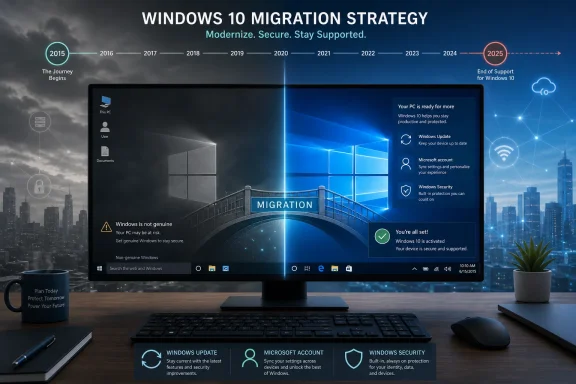 Microsoft Chose the Installed Base Over the Rulebook
The old Microsoft instinct would have been simple: pirates get the stick, customers get the carrot, and the distinction must be made loudly enough that nobody mistakes one group for the other. The Windows Genuine Advantage years had trained users to expect black desktops, nagging notifications, and a moralizing tone around software authenticity. Windows was a product you bought, activated, and defended against counterfeiters.But Windows 10 arrived in a different Microsoft. Satya Nadella had been CEO for just over a year. Windows 8 had bruised the company’s credibility with desktop users. Mobile had slipped away. The PC market was no longer the unquestioned center of consumer computing, and Microsoft needed Windows to become less of a box-sale event and more of a living platform.
That is why Terry Myerson’s May 2015 clarification mattered. Microsoft was not saying non-genuine systems were suddenly genuine. It was saying that the company’s long-term interest lay in giving even those users a path back into the fold. The distinction was lawyerly, but the strategy was plain: a fragmented Windows population was now more dangerous to Microsoft than a too-soft posture toward unlicensed installs.
There was still a watermark. There was still language about malware, fraud, privacy exposure, poor performance, and lack of support. Microsoft did not abandon the idea that counterfeit Windows was risky and illegitimate. What changed was the emphasis: enforcement was no longer the whole story.
The Free Upgrade Was a Platform Strategy Disguised as a Giveaway
The headline Windows 10 offer was already radical by Microsoft’s historical standards. Users running licensed Windows 7 and Windows 8.1 could upgrade for free during the first year after launch, a decision that would have sounded bizarre in the age of boxed Windows releases and paid upgrade SKUs. Windows 10 launched publicly on July 29, 2015, in 190 countries, with Microsoft pitching it not merely as another operating system but as the foundation for a continuously updated Windows.That “free” offer was not charity. It was customer acquisition, fleet consolidation, developer reassurance, and security hygiene bundled into one marketing campaign. Microsoft needed Windows 10 to become the default target for app makers, hardware vendors, IT departments, and consumers tired of Windows 8’s split personality.
The non-genuine Windows question exposed the tension inside that strategy. If Microsoft really wanted a single modern platform, it could not ignore the large number of machines running questionable copies of Windows, especially in markets where piracy had long been common or where buyers had unknowingly purchased counterfeit systems. Yet if Microsoft simply converted every pirated copy into a licensed Windows 10 installation, it risked angering paying customers and undermining the license model that still funded the Windows business.
So Microsoft tried to split the difference. Genuine Windows users received the clean free upgrade path. Non-genuine users were told they could move to Windows 10, but not as magically legitimized customers. OEMs would help with discounted or attractive offers, while Microsoft preserved the principle that activation still mattered.
It was a compromise, but a revealing one. The value of Windows was starting to move away from the initial license and toward the ongoing relationship.
The Watermark Became the Boundary Between Punishment and Participation
The desktop watermark was Microsoft’s symbolic line in the sand. It told the user that Windows could not verify the installation as properly licensed, installed, and untampered with. It also served as a warning to anyone who bought a supposedly new PC and discovered that the machine had arrived with a counterfeit copy of Windows.That mattered because Microsoft’s rhetoric around non-genuine Windows was never only about piracy. It was also about supply-chain trust. A user who intentionally downloaded a cracked ISO and a user who bought a cheap PC from a dubious retailer might both end up in the same activation state, but they were not the same customer. Microsoft wanted room to condemn piracy while acknowledging that some customers were victims of it.
This was the practical genius of the 2015 posture. It allowed Microsoft to say: we will not reward counterfeit software, but we will not abandon the people trapped on it either. The company could keep the watermark as a visible sign of illegitimacy while still nudging those machines toward a supported, patched, modern OS.
For IT pros, that distinction was familiar. Licensing compliance is not the same problem as endpoint security, and treating it as such can produce bad outcomes. A non-compliant machine may be a legal problem, but an unpatched machine is a network problem. Windows 10 forced Microsoft to admit that the network problem was bigger.
Windows 10 Needed Everyone, Including the Awkward Customers
The industry often remembers Windows 10 as Microsoft’s apology for Windows 8. That is true, but incomplete. Windows 10 was also Microsoft’s attempt to restore the PC as a coherent software target after years of version fragmentation, UI confusion, and inconsistent update behavior.Windows 7 remained beloved. Windows 8 and 8.1 remained divisive. Enterprise customers were cautious. Consumers were inconsistent about updates. Developers were being courted by iOS, Android, and the web. Microsoft’s answer was to make Windows 10 the place where the ecosystem could regroup.
That made every holdout a problem. A Windows 7 diehard was a compatibility drag. A Windows 8.1 user was a reminder of a failed design bet. A non-genuine Windows user was outside the licensing perimeter but still inside the broader Windows reality: using Windows apps, connecting to Windows networks, and shaping perceptions of the platform.
Microsoft’s “olive branch” was therefore less sentimental than it sounded. The company needed a migration wave large enough to turn Windows 10 into a fact of life. Leaving millions of non-genuine installations marooned on old builds would have protected licensing purity while weakening the ecosystem Microsoft was trying to build.
This was the same logic that made Windows 10 feel, at times, unusually aggressive. Upgrade prompts became unavoidable for many users. Compatibility telemetry became central to rollout management. Windows Update became less optional. Microsoft was not merely offering an upgrade; it was trying to move the center of gravity.
The Security Argument Was Real, Even When the Marketing Was Convenient
Microsoft’s warning about non-genuine Windows carrying higher risk was not just corporate scolding. Pirated operating system images have long been attractive vehicles for malware, unwanted modifications, disabled update mechanisms, and tampered activation components. A counterfeit Windows install is not automatically infected, but it begins life with a trust problem.That trust problem became more serious as Windows moved into the service era. An operating system that depends on regular cumulative updates, cloud-assisted protections, driver servicing, app store integration, and account-linked features cannot work well when its activation state, update chain, or system files are suspect. The more Windows became a service, the less tolerance Microsoft had for murky installs.
This is why the non-genuine upgrade issue was never only a consumer licensing story. It was part of Microsoft’s broader attempt to make Windows more governable. A governable Windows estate can be patched, measured, upgraded, and secured. An ungovernable one becomes a liability for users, administrators, developers, and Microsoft’s own reputation.
The company’s language about malware and exposure of personal information may have sounded like fear-based marketing. But behind it was a sober truth: counterfeit software often leaves users with the worst possible combination of risk and false confidence. They think they have Windows; what they may actually have is an unknown build with unknown modifications and no trusted support path.
The Move Foreshadowed the Messy Bargain of Windows-as-a-Service
In retrospect, the 2015 non-genuine Windows decision feels like an early draft of the bargain Microsoft would keep offering users for the next decade. Windows would become cheaper up front, more frequently updated, more integrated with cloud services, and less tolerant of unmanaged drift. Users would get a more secure and current platform, but they would also give Microsoft a larger role in the lifecycle of their PCs.That bargain produced real gains. Windows 10 normalized cumulative updates, accelerated security fixes, and reduced some of the old service-pack-era fragmentation. It gave Microsoft a platform for Defender improvements, virtualization-based security, Windows Hello, Edge, WSL, and a more modern app and driver model. It also made Windows feel less like a product users owned outright and more like a system Microsoft continuously adjusted beneath them.
The non-genuine upgrade posture sits squarely inside that trade. Microsoft was willing to soften the licensing edge because the future value of Windows depended on participation. But participation came with conditions: activation, telemetry, updates, support lifecycles, and eventually Microsoft account nudges and cloud tie-ins.
That is why the olive branch should not be romanticized. It was user-friendly compared with the old enforcement model, but it was also self-interested platform management. Microsoft wanted everyone aboard because the train was leaving the station.
The Windows 10 Anniversary Looks Different After Its End of Support
The timing of this anniversary gives the story a sharper edge. Windows 10 reached end of support on October 14, 2025, after a decade in which it became one of Microsoft’s most important and durable operating systems. What began as the great consolidation project is now itself the legacy platform Microsoft wants users to leave behind.That reversal is instructive. In 2015, Microsoft’s problem was how to move people off Windows 7 and Windows 8.1. In 2026, the company’s problem is how to move people off Windows 10, especially when Windows 11’s hardware requirements exclude some otherwise functional PCs and when many users still regard Windows 10 as stable, familiar, and sufficient.
The comparison is uncomfortable for Microsoft. Windows 10’s upgrade campaign was expansive; Windows 11’s migration path is more selective. Windows 10 offered a bridge even to users in messy licensing situations; Windows 11 often begins with a hardware gate. Windows 10 framed modernization as inclusion; Windows 11 can feel, to some users, like a procurement decision.
That does not make the Windows 11 requirements wrong. TPM support, newer CPUs, virtualization-based protections, and stronger baseline security are not imaginary benefits. But it does mean Microsoft’s 2015 strategy is harder to repeat. The company cannot easily promise “everyone forward together” when the current forward path leaves many PCs behind.
Enterprise IT Learned the Right Lesson for the Wrong Reason
For sysadmins, the lesson of the 2015 episode was not that licensing stopped mattering. It was that licensing policy must serve operational reality, not the other way around. A machine stuck on an unsupported or compromised OS can cost more than a discounted license ever would.That is especially true in mixed environments where consumer-grade PCs, small-business machines, inherited hardware, and contractor systems intersect with corporate networks. Non-genuine Windows may sound like a home-user problem, but the conditions that produce it — informal procurement, gray-market devices, image sprawl, and neglected asset management — are common in the real world.
Microsoft’s 2015 stance gave administrators a useful framing. The goal was not to excuse bad licensing. The goal was to create a remediation path. Identify the state, warn the user, preserve the compliance boundary, and make it practical to become legitimate.
That same framing remains relevant now that Windows 10 is out of support. Organizations do not solve end-of-life risk by shaming users for having older PCs. They solve it by inventorying devices, mapping compatibility, budgeting replacements, using extended security options where necessary, and building a credible migration schedule. Enforcement without a path forward breeds shadow IT.
The Myth of the One-Time Windows Purchase Finally Broke
The non-genuine Windows olive branch also exposed a deeper change in how Microsoft thought about the economics of Windows. The old model treated the operating system license as the central transaction. Once the user paid, activated, and installed, the relationship became relatively quiet until the next paid upgrade or new PC purchase.Windows 10 weakened that model. The license still mattered, but the ongoing installed base mattered more. Microsoft needed users on a current branch, using current services, running current security components, and participating in the same developer target. The economic value shifted toward search, store activity, subscriptions, cloud identity, enterprise management, security services, and the broader Microsoft ecosystem.
That shift explains why Microsoft could afford to be pragmatic with non-genuine users. A user stuck forever on a pirated copy of Windows 7 generated little value and plenty of ecosystem drag. A user converted into a legitimate Windows 10 participant, even through a discounted OEM path, became part of the addressable future.
This is the same logic visible across modern software. Vendors would rather have users inside a managed, updateable, monetizable ecosystem than outside it with a technically “pure” enforcement victory. The trick is maintaining enough fairness that paying customers do not feel like fools.
Microsoft mostly managed that balance in 2015 by refusing to declare pirated Windows genuine. That sentence did a lot of work. It reassured license-paying customers while still leaving the door open for remediation.
The Olive Branch Was Also an Admission of Failure
There is another way to read the 2015 moment: Microsoft was cleaning up a mess partly of its own making. Windows licensing had become confusing, regional pricing had often been poorly matched to local markets, counterfeit PCs had circulated widely, and Microsoft’s own product strategy had left users split across versions they either loved too much or disliked too strongly.When a company has to design a path for non-genuine users into a new operating system, it is acknowledging that the real world did not conform to the licensing diagram. Some users pirated intentionally. Some bought cheap machines and got burned. Some inherited devices. Some lived in markets where legitimate Windows pricing was out of reach or where counterfeit supply chains were normalized.
The olive branch did not absolve any of that, but it recognized it. And that recognition was important because platform companies often prefer pretending that edge cases are marginal. Microsoft, in 2015, understood that the edge cases were large enough to affect the success of Windows 10.
That is the part worth remembering now. Platform strategy is not made in the clean room. It is made in the installed base, with all its old drivers, strange partitions, expired licenses, forgotten passwords, counterfeit stickers, regional pricing problems, and users who just want the machine to work.
The Real Legacy Is Not Forgiveness, but Migration Design
The most durable lesson from May 2015 is that migration design matters as much as product design. Windows 10 did not succeed simply because it had a Start menu, Edge, Cortana, DirectX improvements, or a free upgrade banner. It succeeded because Microsoft treated adoption as the central product problem.That meant messaging, compatibility work, telemetry, OEM coordination, upgrade tooling, and licensing exceptions all became part of the Windows 10 story. The non-genuine upgrade offer was one small but symbolically loaded piece of that machinery. It showed that Microsoft was willing to make the path forward wider than the strictest interpretation of licensing policy would allow.
Modern Microsoft sometimes remembers this lesson and sometimes forgets it. Windows 11’s rollout has been cleaner in some technical respects, but harder in emotional ones. Users understand why security baselines matter; they are less forgiving when functional hardware is nudged toward retirement. Administrators understand lifecycle deadlines; they are less pleased when consumer messaging, account requirements, and hardware policy complicate their migration plans.
A successful migration campaign must persuade users that the future is not merely mandatory but worth joining. Windows 10 did that more effectively than most Microsoft releases. The non-genuine olive branch helped because it made the campaign feel bigger than a normal upgrade cycle.
The 2015 Compromise Still Explains Microsoft’s 2026 Windows Problem
The anniversary is not just nostalgia for a clever licensing maneuver. It is a reminder that Windows succeeds when Microsoft aligns security, licensing, hardware, and user trust into a migration path people can actually follow. The concrete lessons are still visible:- Microsoft did not make non-genuine Windows legitimate for free, but it did create a route for affected users to move toward legitimate Windows 10 installations.
- The free Windows 10 upgrade for licensed Windows 7 and Windows 8.1 users was a platform consolidation strategy, not merely a consumer promotion.
- The watermark preserved the licensing boundary while allowing Microsoft to focus on the larger problem of unsafe and unsupported Windows installations.
- Windows 10’s rise showed that Microsoft could be pragmatic when ecosystem health mattered more than short-term upgrade revenue.
- Windows 10’s end of support in October 2025 has made the old lesson newly relevant, because migration is again Microsoft’s hardest Windows problem.
- Windows 11’s stricter hardware baseline makes the 2015 “everyone forward” message harder to repeat, even when the security rationale is stronger.
Source: Windows Central ON THIS DAY: Microsoft offers an olive branch for users of 'Non-Genuine' Windows PCs to get a Windows 10 upgrade
