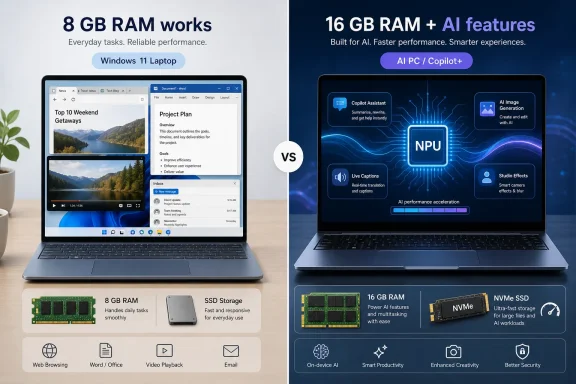
Microsoft has begun selling and describing 8GB Surface configurations as suitable for everyday Windows 11 use in June 2026, even though its Copilot+ PC push made 16GB RAM the practical floor for the AI-branded Windows machines it spent two years promoting. That reversal is not just a spec-sheet oddity. It is a confession that the AI PC upgrade cycle collided with component pricing, consumer budgets, and Microsoft’s own inconsistent story about what a modern Windows laptop should be. The awkward part is that Microsoft helped create the pressure that now makes 8GB look both necessary and inadequate.
For years, the clean advice around Windows laptops was simple: 8GB was the minimum you could tolerate, 16GB was the amount you should buy, and anything less belonged in bargain bins, kiosks, or machines destined for one browser tab and regret. Microsoft did not invent that wisdom, but it amplified it when Copilot+ PCs arrived with a hardware definition that made 16GB RAM part of the new premium Windows baseline.
That is why the latest Surface messaging lands so strangely. Microsoft’s own buying guidance now says 8GB is “great” for everyday work such as browsing, streaming, schoolwork, and productivity apps. In isolation, that is not an outrageous statement. Plenty of people still use 8GB machines every day, and for restrained workloads they can be perfectly serviceable.
But product messaging does not exist in isolation. Microsoft spent the Copilot+ PC era telling buyers, developers, OEMs, and IT departments that the next Windows experience required more local memory, a fast NPU, and a modern platform. Now it is carving out a cheaper Surface tier that does not meet the AI PC requirement the company itself spent so much energy legitimizing.
This is not hypocrisy in the moral sense. It is market correction in the corporate sense. Microsoft is trying to keep Surface prices from drifting into parody while memory prices and AI infrastructure demand squeeze the PC supply chain. The result is a machine that may be rational for Microsoft to sell but deeply awkward for Microsoft to explain.
The 16GB RAM requirement made sense in that framework. Local AI features such as Recall, Click to Do, image generation, language models, and background indexing are not free. They compete with browsers, Teams, Office, antivirus, vendor utilities, and the normal background machinery of Windows. A machine with 8GB RAM can run Windows 11; that is not the same as saying it can run Microsoft’s preferred future for Windows 11.
The problem is that Microsoft blurred those two arguments. It treated 16GB as the responsible spec for the AI era, then allowed that recommendation to harden into a broader consumer assumption that a good Windows 11 laptop should not start below it. Reviewers, retail staff, and buyers followed. In many cases, they were right to do so.
Now Microsoft needs a narrower claim. It wants to say that 8GB is fine for ordinary users while 16GB remains the threshold for Copilot+ experiences. Technically, that distinction is coherent. Politically, it is a mess, because the company spent the last two years trying to convince everyone that ordinary users were about to become AI users.
The new lower-memory Surface configurations tell OEMs that 8GB is back on the menu. They also tell buyers that the Copilot+ badge is optional, even on machines that otherwise resemble the very category Microsoft has been promoting. If a Surface Laptop or Surface Pro can be sold as a good modern Windows device without enough RAM for Copilot+ features, the category starts to look less like the future of Windows and more like a premium upsell.
That distinction matters because PC buyers are not buying requirements documents. They are buying a laptop at a price. If Microsoft sells an 8GB Surface at a premium price and says it is good for everyday productivity, plenty of customers will assume that means it is good enough for the next several years of Windows. Some will later discover that Microsoft’s most advertised AI features require a configuration they did not buy.
There is a defensible version of this strategy. Microsoft could clearly position 8GB Surface models as lightweight, non-AI, lower-cost Windows devices for students and basic productivity. It could make the tradeoff explicit and price them aggressively. Instead, the company appears to be trying to preserve the Surface premium while walking back the memory floor, and that is where the argument strains.
PC makers are now facing an ugly menu. They can raise prices, reduce memory, reduce storage, cut display quality, delay launches, or accept thinner margins. None of those choices are attractive in a market where consumers are already holding onto PCs longer and where the post-pandemic replacement cycle has been uneven.
In that sense, Microsoft’s 8GB Surface move is understandable. A lower entry price matters. If the alternative is a Surface line that starts so high it abandons students, families, and small businesses, a cheaper configuration has a purpose. The trouble is that Microsoft is not merely reacting to the market; it is reacting to a market distorted by the AI investment cycle it helped accelerate.
That does not mean Microsoft single-handedly caused RAM prices to rise. It did not. But the company cannot spend years telling investors that AI infrastructure is the central platform shift of the age, spend heavily to support that shift, define a new AI PC class around higher memory requirements, and then act surprised when consumer PCs get squeezed by the economics of the same transition.
Windows 11 can run on 8GB, and on a carefully configured machine it can feel fine. The operating word is carefully. A clean install, a handful of browser tabs, webmail, Word, streaming, and light schoolwork are one thing. Teams, Edge with dozens of tabs, OneDrive sync, a password manager, vendor control panels, background update agents, and a few Electron apps are another.
Microsoft knows this, which is why its messaging tends to use phrases like “everyday tasks” rather than “great for multitasking” or “ready for the next five years.” The company is drawing a workload boundary that many normal users will cross without realizing it. A student who starts with web research and Word may end up with Zoom, Teams, browser-based learning tools, Spotify, cloud storage, and AI features all competing for the same small pool of memory.
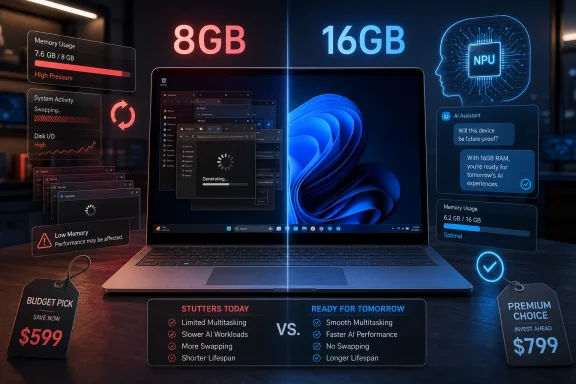
This is where the resentment comes from. Users do not experience RAM as a spec; they experience it as the moment the laptop starts swapping, stuttering, reloading tabs, or aging prematurely. If Microsoft wants 8GB to be acceptable again, it has to make Windows behave like 8GB is a first-class target, not merely a price-point concession.
This is not just a Microsoft problem. Electron and Chromium-based app frameworks are everywhere because they reduce development friction and make web-native teams productive. But on Windows, where Microsoft controls both the platform and many of the first-party apps and shell-adjacent experiences, the company’s choices carry extra weight.
The result is a strange bargain. Windows users get faster-moving interfaces and service-connected features, but they also get a platform where memory efficiency often feels subordinate to developer convenience and cloud integration. On a 16GB or 32GB machine, that tax is annoying. On an 8GB machine, it can define the experience.
That is why Microsoft’s new 8GB language cannot be judged only against the Windows 11 minimum requirement. Minimum requirements are legal and logistical thresholds. The real question is whether Microsoft has disciplined its own software enough to make an 8GB Windows laptop feel dignified in daily use. For many buyers, the answer will depend less on the Snapdragon or Intel chip inside and more on how many Microsoft and third-party processes are quietly running before they open their first document.
That does not mean 8GB MacBooks are magic. They have limits, and Apple has been criticized for selling low-memory configurations at premium prices. But Apple’s advantage is that it can optimize around a small number of chips, machines, and OS assumptions. Microsoft has to support a sprawling ecosystem of hardware vendors, drivers, legacy apps, gaming stacks, enterprise tools, and peripherals.
Windows on Arm was supposed to narrow that gap. Qualcomm’s Snapdragon X chips gave Microsoft its strongest Arm PC foundation yet, and emulation through Prism improved the compatibility story. But “improved” is not the same as invisible. If a user is running translated apps, browser workloads, native Arm apps, and Windows services on an 8GB machine, the memory ceiling arrives quickly.
That is the credibility problem. Microsoft wants to compete with Apple-like thin-and-light efficiency while preserving the breadth of Windows compatibility. That is possible, but it requires relentless optimization and honest positioning. Selling 8GB Windows on Arm devices at prices that invite comparison with better-optimized competitors is a risky way to prove the point.
For gaming, 16GB has become the practical mainstream floor, while 32GB is increasingly sensible for enthusiasts, heavy multitaskers, modded games, content creation, and users who keep launchers, browsers, chat apps, and recording tools open. But there is a difference between recommending 32GB to enthusiasts and making it sound like the responsible Windows 11 gaming choice for everyone.
That episode matters because it shows how Microsoft’s messaging keeps drifting upward until pricing reality snaps it back. For gaming, the company could talk itself into 32GB. For AI PCs, it could define 16GB as the new category floor. For entry Surface models, it now needs 8GB to be fine.
These are not separate stories. They are symptoms of a company trying to serve three incompatible narratives at once: Windows should be affordable, Windows should be premium, and Windows should be the local AI platform. The memory requirements of those narratives do not line up neatly.
Recall became controversial before it became useful. Other AI features have rolled out gradually, regionally, or with caveats. Some experiences are clever but not essential. Others remain more interesting to Microsoft’s strategic narrative than to the average buyer standing in front of a laptop display at retail.
That leaves 16GB in an awkward place. It is required for the full Copilot+ class, but the class itself has not yet become the thing every Windows buyer knows they need. When memory prices rose and device prices followed, OEMs had to ask a brutal question: are customers really paying extra for the badge, or are they buying the cheapest acceptable machine?
Microsoft’s 8GB Surface answer suggests the company knows the answer. Copilot+ may still matter, especially for developers and future Windows AI APIs, but it has not displaced price as the primary force in mainstream PC buying. The AI PC upgrade cycle did not fail completely, but it failed to become strong enough to protect the 16GB floor.
That is exactly what many human reviewers would say. It is also exactly the message Microsoft’s product pages are trying not to foreground too aggressively. The company needs 8GB to sound good enough, because good enough lowers the starting price. But its own buying logic knows that 16GB is the safer recommendation for longevity.
This is not a trivial contradiction. A laptop is not a disposable accessory for most people. Buyers expect three, four, five, or more years of use. Schools, families, and small businesses often stretch devices even longer. A configuration that is acceptable on day one can become a false economy if Windows, browsers, security tools, and user habits grow around it.
“Future proof” is always a dangerous phrase in technology, because no laptop is truly protected from the future. But memory is one of the few specs users usually cannot upgrade in modern thin-and-light machines. If Microsoft sells soldered 8GB laptops in 2026, it is making an irreversible bet on behalf of the buyer.
If Surface can ship with 8GB again, so can midrange Windows laptops from every major vendor. Some will use that flexibility responsibly, pairing 8GB with genuinely low prices and clear positioning. Others will use it to protect margins while keeping price tags high, hoping consumers see a sleek chassis and a familiar brand rather than a constrained memory configuration.
The PC industry has done this before with storage, displays, webcams, and Wi-Fi cards. A spec that should mark an entry-level product quietly appears in machines priced one tier too high. The difference with RAM is that the penalty shows up later, after the return window closes and after Windows Update, browser growth, and real-world multitasking have had time to expose the compromise.
This is why Microsoft’s role matters. Surface sets tone. If Microsoft wants to bring back 8GB without poisoning buyer trust, it should also set guardrails: plain-language storefront warnings, workload examples, clear Copilot+ exclusions, and prices that make the compromise understandable. If it does not, the ecosystem will do what ecosystems do — turn ambiguity into margin.
That means reducing idle memory footprint in ways users can feel. It means limiting preloading on low-memory systems. It means making Teams, Widgets, Edge integrations, Copilot hooks, OneDrive, search indexing, and vendor startup items less aggressive by default. It means giving users and administrators clearer controls over background behavior without requiring registry spelunking or third-party debloat scripts.
Microsoft has already signaled work in this direction, including comments around reducing Windows memory use and making the system more responsive under load. That work should become central to the 8GB Surface pitch. The message should not be “8GB is great because we say so.” It should be “8GB is viable because we changed Windows to respect it.”
The company could also segment Windows experiences more honestly. A low-memory mode should not be a shameful fallback; it should be a supported configuration profile. If a device cannot run Copilot+ features, Windows should say so cleanly, not bury the distinction behind branding fog.
Apple can sell a low-memory machine more confidently because it owns the whole platform story. Google can sell Chromebooks with modest specs because ChromeOS sets narrower expectations. Microsoft’s challenge is harder. Windows is expected to be everything: legacy desktop, gaming platform, enterprise endpoint, developer workstation, tablet OS, AI runtime, and cheap school laptop.
That breadth is Windows’ strength, but it is also why 8GB is dangerous. The buyer of an inexpensive Windows laptop may expect it to behave like any other Windows laptop, just cheaper. Microsoft knows the difference between “runs Windows” and “runs the Windows experiences we are advertising.” The buyer often does not.
So the competitive answer is not merely a cheaper Surface. It is a more trustworthy Surface. If Microsoft wants an 8GB machine to compete with low-cost Apple hardware, it should price it like an entry device, optimize it like a first-class target, and stop implying that the AI era applies equally to machines that do not meet the AI era’s own requirements.
 Microsoft Rediscovers the Entry-Level PC It Helped Make Uncomfortable
For years, the clean advice around Windows laptops was simple: 8GB was the minimum you could tolerate, 16GB was the amount you should buy, and anything less belonged in bargain bins, kiosks, or machines destined for one browser tab and regret. Microsoft did not invent that wisdom, but it amplified it when Copilot+ PCs arrived with a hardware definition that made 16GB RAM part of the new premium Windows baseline.That is why the latest Surface messaging lands so strangely. Microsoft’s own buying guidance now says 8GB is “great” for everyday work such as browsing, streaming, schoolwork, and productivity apps. In isolation, that is not an outrageous statement. Plenty of people still use 8GB machines every day, and for restrained workloads they can be perfectly serviceable.
But product messaging does not exist in isolation. Microsoft spent the Copilot+ PC era telling buyers, developers, OEMs, and IT departments that the next Windows experience required more local memory, a fast NPU, and a modern platform. Now it is carving out a cheaper Surface tier that does not meet the AI PC requirement the company itself spent so much energy legitimizing.
This is not hypocrisy in the moral sense. It is market correction in the corporate sense. Microsoft is trying to keep Surface prices from drifting into parody while memory prices and AI infrastructure demand squeeze the PC supply chain. The result is a machine that may be rational for Microsoft to sell but deeply awkward for Microsoft to explain.
The 16GB Baseline Was a Branding Strategy Before It Was a User Benefit
Copilot+ PCs were never just laptops with NPUs. They were Microsoft’s attempt to impose a new floor under the Windows ecosystem: modern silicon, local AI acceleration, enough memory to keep models and apps alive, and a marketing badge that would persuade consumers that their existing PCs were suddenly old.The 16GB RAM requirement made sense in that framework. Local AI features such as Recall, Click to Do, image generation, language models, and background indexing are not free. They compete with browsers, Teams, Office, antivirus, vendor utilities, and the normal background machinery of Windows. A machine with 8GB RAM can run Windows 11; that is not the same as saying it can run Microsoft’s preferred future for Windows 11.
The problem is that Microsoft blurred those two arguments. It treated 16GB as the responsible spec for the AI era, then allowed that recommendation to harden into a broader consumer assumption that a good Windows 11 laptop should not start below it. Reviewers, retail staff, and buyers followed. In many cases, they were right to do so.
Now Microsoft needs a narrower claim. It wants to say that 8GB is fine for ordinary users while 16GB remains the threshold for Copilot+ experiences. Technically, that distinction is coherent. Politically, it is a mess, because the company spent the last two years trying to convince everyone that ordinary users were about to become AI users.
Surface Becomes the Contradiction in Hardware Form
Surface has always carried more symbolic weight than its market share suggests. It is Microsoft’s reference argument: this is what Windows hardware can look like when Redmond controls the whole stack, or at least more of it than usual. That makes the return of 8GB Surface models more than a pricing tweak.The new lower-memory Surface configurations tell OEMs that 8GB is back on the menu. They also tell buyers that the Copilot+ badge is optional, even on machines that otherwise resemble the very category Microsoft has been promoting. If a Surface Laptop or Surface Pro can be sold as a good modern Windows device without enough RAM for Copilot+ features, the category starts to look less like the future of Windows and more like a premium upsell.
That distinction matters because PC buyers are not buying requirements documents. They are buying a laptop at a price. If Microsoft sells an 8GB Surface at a premium price and says it is good for everyday productivity, plenty of customers will assume that means it is good enough for the next several years of Windows. Some will later discover that Microsoft’s most advertised AI features require a configuration they did not buy.
There is a defensible version of this strategy. Microsoft could clearly position 8GB Surface models as lightweight, non-AI, lower-cost Windows devices for students and basic productivity. It could make the tradeoff explicit and price them aggressively. Instead, the company appears to be trying to preserve the Surface premium while walking back the memory floor, and that is where the argument strains.
The Memory Crisis Gives Microsoft Cover, Not Absolution
The industry context is real. Memory pricing has been under pressure from the same AI boom that Microsoft, OpenAI, Google, Amazon, Meta, Nvidia, and the rest of the hyperscale economy are feeding. High-bandwidth memory for accelerators sits in a different segment from laptop LPDDR, but the wider allocation of fab capacity, packaging, capital spending, and supplier priorities affects the whole chain.PC makers are now facing an ugly menu. They can raise prices, reduce memory, reduce storage, cut display quality, delay launches, or accept thinner margins. None of those choices are attractive in a market where consumers are already holding onto PCs longer and where the post-pandemic replacement cycle has been uneven.
In that sense, Microsoft’s 8GB Surface move is understandable. A lower entry price matters. If the alternative is a Surface line that starts so high it abandons students, families, and small businesses, a cheaper configuration has a purpose. The trouble is that Microsoft is not merely reacting to the market; it is reacting to a market distorted by the AI investment cycle it helped accelerate.
That does not mean Microsoft single-handedly caused RAM prices to rise. It did not. But the company cannot spend years telling investors that AI infrastructure is the central platform shift of the age, spend heavily to support that shift, define a new AI PC class around higher memory requirements, and then act surprised when consumer PCs get squeezed by the economics of the same transition.
Windows 11 Makes 8GB Feel Smaller Than It Used To
The deeper issue is that 8GB in 2026 is not the same user experience as 8GB in 2016. The number is identical, but the software environment around it has changed. Browsers are heavier, web apps are more ambitious, collaboration tools sit resident in memory, security software does more, and Windows itself has accumulated more services, integration points, and web-powered surfaces.Windows 11 can run on 8GB, and on a carefully configured machine it can feel fine. The operating word is carefully. A clean install, a handful of browser tabs, webmail, Word, streaming, and light schoolwork are one thing. Teams, Edge with dozens of tabs, OneDrive sync, a password manager, vendor control panels, background update agents, and a few Electron apps are another.
Microsoft knows this, which is why its messaging tends to use phrases like “everyday tasks” rather than “great for multitasking” or “ready for the next five years.” The company is drawing a workload boundary that many normal users will cross without realizing it. A student who starts with web research and Word may end up with Zoom, Teams, browser-based learning tools, Spotify, cloud storage, and AI features all competing for the same small pool of memory.
This is where the resentment comes from. Users do not experience RAM as a spec; they experience it as the moment the laptop starts swapping, stuttering, reloading tabs, or aging prematurely. If Microsoft wants 8GB to be acceptable again, it has to make Windows behave like 8GB is a first-class target, not merely a price-point concession.
WebView2 Is the Windows Tax Nobody Sees on the Shelf
One reason Windows feels more memory-hungry is Microsoft’s embrace of web technologies inside desktop experiences. WebView2 has practical advantages: it gives developers a consistent embedded browser runtime, lets Microsoft update web-backed components more rapidly, and makes cross-platform service integration easier. It also contributes to the feeling that every modern app is carrying a browser engine in its backpack.This is not just a Microsoft problem. Electron and Chromium-based app frameworks are everywhere because they reduce development friction and make web-native teams productive. But on Windows, where Microsoft controls both the platform and many of the first-party apps and shell-adjacent experiences, the company’s choices carry extra weight.
The result is a strange bargain. Windows users get faster-moving interfaces and service-connected features, but they also get a platform where memory efficiency often feels subordinate to developer convenience and cloud integration. On a 16GB or 32GB machine, that tax is annoying. On an 8GB machine, it can define the experience.
That is why Microsoft’s new 8GB language cannot be judged only against the Windows 11 minimum requirement. Minimum requirements are legal and logistical thresholds. The real question is whether Microsoft has disciplined its own software enough to make an 8GB Windows laptop feel dignified in daily use. For many buyers, the answer will depend less on the Snapdragon or Intel chip inside and more on how many Microsoft and third-party processes are quietly running before they open their first document.
Windows on Arm Still Has to Earn the Apple Comparison
The Apple comparison is unavoidable because Apple has made a business out of selling machines whose specs look modest on paper but perform better than skeptics expect. Unified memory, tight hardware-software integration, efficient silicon, and aggressive control over background behavior give macOS a different relationship with RAM than commodity Windows PCs have traditionally enjoyed.That does not mean 8GB MacBooks are magic. They have limits, and Apple has been criticized for selling low-memory configurations at premium prices. But Apple’s advantage is that it can optimize around a small number of chips, machines, and OS assumptions. Microsoft has to support a sprawling ecosystem of hardware vendors, drivers, legacy apps, gaming stacks, enterprise tools, and peripherals.
Windows on Arm was supposed to narrow that gap. Qualcomm’s Snapdragon X chips gave Microsoft its strongest Arm PC foundation yet, and emulation through Prism improved the compatibility story. But “improved” is not the same as invisible. If a user is running translated apps, browser workloads, native Arm apps, and Windows services on an 8GB machine, the memory ceiling arrives quickly.
That is the credibility problem. Microsoft wants to compete with Apple-like thin-and-light efficiency while preserving the breadth of Windows compatibility. That is possible, but it requires relentless optimization and honest positioning. Selling 8GB Windows on Arm devices at prices that invite comparison with better-optimized competitors is a risky way to prove the point.
The Deleted 32GB Gaming Message Shows the Strategy Overshot
The RAM debate is not limited to thin-and-light laptops. Microsoft’s earlier gaming guidance reportedly pushed 32GB as the ideal amount of memory for serious Windows 11 gaming, and a separate post described 32GB as a “no worries” upgrade before drawing backlash. Even if the advice had a performance rationale for some workloads, it landed badly because it sounded disconnected from what most buyers can afford.For gaming, 16GB has become the practical mainstream floor, while 32GB is increasingly sensible for enthusiasts, heavy multitaskers, modded games, content creation, and users who keep launchers, browsers, chat apps, and recording tools open. But there is a difference between recommending 32GB to enthusiasts and making it sound like the responsible Windows 11 gaming choice for everyone.
That episode matters because it shows how Microsoft’s messaging keeps drifting upward until pricing reality snaps it back. For gaming, the company could talk itself into 32GB. For AI PCs, it could define 16GB as the new category floor. For entry Surface models, it now needs 8GB to be fine.
These are not separate stories. They are symptoms of a company trying to serve three incompatible narratives at once: Windows should be affordable, Windows should be premium, and Windows should be the local AI platform. The memory requirements of those narratives do not line up neatly.
Copilot+ Became a Hardware Standard Before It Became a Must-Have Experience
The most damaging part of the Copilot+ PC push is not that the hardware requirements were unreasonable. The problem is that the hardware standard arrived before the software experience became indispensable. Microsoft gave the industry a badge, a spec, and a launch campaign, but the user-facing reasons to insist on that badge have been uneven.Recall became controversial before it became useful. Other AI features have rolled out gradually, regionally, or with caveats. Some experiences are clever but not essential. Others remain more interesting to Microsoft’s strategic narrative than to the average buyer standing in front of a laptop display at retail.
That leaves 16GB in an awkward place. It is required for the full Copilot+ class, but the class itself has not yet become the thing every Windows buyer knows they need. When memory prices rose and device prices followed, OEMs had to ask a brutal question: are customers really paying extra for the badge, or are they buying the cheapest acceptable machine?
Microsoft’s 8GB Surface answer suggests the company knows the answer. Copilot+ may still matter, especially for developers and future Windows AI APIs, but it has not displaced price as the primary force in mainstream PC buying. The AI PC upgrade cycle did not fail completely, but it failed to become strong enough to protect the 16GB floor.
The Chatbot Saying “Future Proof” Is the Quiet Part Out Loud
The most revealing character in this drama may not be a Surface executive or a Windows product manager, but Microsoft’s own store assistant. According to the report that kicked off this latest round of scrutiny, Microsoft’s AI shopping helper hedges when asked whether 8GB is enough in 2026 and suggests that 16GB is the safer choice for users who want a more future-proof laptop.That is exactly what many human reviewers would say. It is also exactly the message Microsoft’s product pages are trying not to foreground too aggressively. The company needs 8GB to sound good enough, because good enough lowers the starting price. But its own buying logic knows that 16GB is the safer recommendation for longevity.
This is not a trivial contradiction. A laptop is not a disposable accessory for most people. Buyers expect three, four, five, or more years of use. Schools, families, and small businesses often stretch devices even longer. A configuration that is acceptable on day one can become a false economy if Windows, browsers, security tools, and user habits grow around it.
“Future proof” is always a dangerous phrase in technology, because no laptop is truly protected from the future. But memory is one of the few specs users usually cannot upgrade in modern thin-and-light machines. If Microsoft sells soldered 8GB laptops in 2026, it is making an irreversible bet on behalf of the buyer.
OEMs Will Read the Surface Signal Their Own Way
Microsoft may intend 8GB Surface configurations as a narrow response to component costs. OEMs may read them as permission. That is the risk for the wider Windows market.If Surface can ship with 8GB again, so can midrange Windows laptops from every major vendor. Some will use that flexibility responsibly, pairing 8GB with genuinely low prices and clear positioning. Others will use it to protect margins while keeping price tags high, hoping consumers see a sleek chassis and a familiar brand rather than a constrained memory configuration.
The PC industry has done this before with storage, displays, webcams, and Wi-Fi cards. A spec that should mark an entry-level product quietly appears in machines priced one tier too high. The difference with RAM is that the penalty shows up later, after the return window closes and after Windows Update, browser growth, and real-world multitasking have had time to expose the compromise.
This is why Microsoft’s role matters. Surface sets tone. If Microsoft wants to bring back 8GB without poisoning buyer trust, it should also set guardrails: plain-language storefront warnings, workload examples, clear Copilot+ exclusions, and prices that make the compromise understandable. If it does not, the ecosystem will do what ecosystems do — turn ambiguity into margin.
A Better 8GB Strategy Would Start With Windows, Not Store Copy
There is a constructive version of Microsoft’s reversal. It begins with treating 8GB not as a marketing inconvenience but as an engineering target. If Microsoft wants to sell 8GB Windows 11 devices in 2026, it should prove that the OS, first-party apps, and default experiences are tuned for that class of hardware.That means reducing idle memory footprint in ways users can feel. It means limiting preloading on low-memory systems. It means making Teams, Widgets, Edge integrations, Copilot hooks, OneDrive, search indexing, and vendor startup items less aggressive by default. It means giving users and administrators clearer controls over background behavior without requiring registry spelunking or third-party debloat scripts.
Microsoft has already signaled work in this direction, including comments around reducing Windows memory use and making the system more responsive under load. That work should become central to the 8GB Surface pitch. The message should not be “8GB is great because we say so.” It should be “8GB is viable because we changed Windows to respect it.”
The company could also segment Windows experiences more honestly. A low-memory mode should not be a shameful fallback; it should be a supported configuration profile. If a device cannot run Copilot+ features, Windows should say so cleanly, not bury the distinction behind branding fog.
The $599 Problem Is Really a Trust Problem
The reported pressure from Apple’s lower-cost MacBook strategy shows why this matters. Whether the specific comparison is Apple’s newest budget MacBook, a Chromebook Plus machine, or a discounted previous-generation MacBook Air, the same problem remains: Windows OEMs cannot win solely by matching a low entry price if the experience feels compromised.Apple can sell a low-memory machine more confidently because it owns the whole platform story. Google can sell Chromebooks with modest specs because ChromeOS sets narrower expectations. Microsoft’s challenge is harder. Windows is expected to be everything: legacy desktop, gaming platform, enterprise endpoint, developer workstation, tablet OS, AI runtime, and cheap school laptop.
That breadth is Windows’ strength, but it is also why 8GB is dangerous. The buyer of an inexpensive Windows laptop may expect it to behave like any other Windows laptop, just cheaper. Microsoft knows the difference between “runs Windows” and “runs the Windows experiences we are advertising.” The buyer often does not.
So the competitive answer is not merely a cheaper Surface. It is a more trustworthy Surface. If Microsoft wants an 8GB machine to compete with low-cost Apple hardware, it should price it like an entry device, optimize it like a first-class target, and stop implying that the AI era applies equally to machines that do not meet the AI era’s own requirements.
The Numbers Now Say What the Branding Tried to Hide
Microsoft’s latest Surface RAM shuffle leaves buyers with a simpler but less flattering picture than the Copilot+ launch campaign suggested. The memory tiers now map less to innovation than to compromise.- An 8GB Windows 11 laptop can still make sense for tightly bounded everyday use, but it should be priced and marketed as an entry-level machine rather than a future-facing premium PC.
- A 16GB configuration remains the safer baseline for most Windows buyers who multitask, keep laptops for several years, or want access to Copilot+ PC features.
- A 32GB configuration is increasingly reasonable for gaming, development, content creation, virtualization, and heavy browser workloads, but it should not be framed as the default requirement for ordinary users.
- Surface devices carry ecosystem signaling power, so Microsoft’s 8GB return may encourage OEMs to ship more low-memory Windows laptops unless the company communicates the tradeoffs clearly.
- The real test is whether Microsoft can reduce Windows 11’s memory appetite enough that 8GB feels deliberately supported rather than reluctantly tolerated.
References
- Primary source: Windows Latest
Published: 2026-06-25T00:27:11.701854
Microsoft admits 8GB RAM is fine for Windows 11, after years of pushing 16GB as the baseline
Microsoft now tells that 8GB RAM is great for everyday use on Surface devices, after years of insisting 16GB was the minimum for Windows 11. www.windowslatest.com
- Related coverage: windowscentral.com
Microsoft knows its new Surface PCs are too expensive: Combats skyrocketing prices with new 8GB RAM models that start at $849 | Windows Central
Surface Pro 12-inch and Surface Laptop 13-inch have been updated with new 8GB RAM configurations that bring prices back down to earth.www.windowscentral.com - Official source: microsoft.com
A Laptop Buying Guide: Compare Key Specs | Microsoft Surface
Learn how to compare devices and choose the best laptop specs for your needs. Discover how Surface Laptop and Surface Pro deliver power, portability, and AI.www.microsoft.com
- Official source: blogs.windows.com
Introducing all-new Surface Copilot+ PCs: The Surface Pro, 12-inch and Surface Laptop, 13-inch
Copilot+ PCs continue to define the next wave of personal computing — fast, long lasting, secure PCs that are purpose-built to unlock AI experiences that empower us to get more done. Today, Microsoft and Surface expand the Copilot+ PC family with tblogs.windows.com - Official source: support.microsoft.com
Learn more about Copilot+ PCs and Windows 11 PCs from Surface | Microsoft Support
Learn more about Copilot + PCs with powerful neural processing units and AI experiences like Recall and Cocreator, as well as Windows 11 PCs from Surface.support.microsoft.com - Related coverage: tomshardware.com
New Microsoft Surface for Business PCs pair Panther Lake chips with as little as 8GB of RAM — 13-inch Surface Laptop goes light on memory but still starts at $1,299 | Tom's Hardware
The AI gold rush crimps the local AI ambitions of the cheapest business-focused Surfacewww.tomshardware.com
- Official source: learn.microsoft.com
New Surface Pro CoPilot +PC Does it meet the following recommendation? - Microsoft Q&A
My Son is going off to college to study Aerospace Engineering. This is the system they recommend. Would the new Surface Pro CoPilot + PC meet these requirements or do I need a different computer. He really loves his old surface. Operating system …learn.microsoft.com - Official source: news.microsoft.com
- Related coverage: bhphotovideo.com
Microsoft 13" Surface Pro Copilot+ PC EP2-66386 B&H Photo Video
Buy Microsoft 13" Surface Pro Copilot+ PC (12th Edition, Platinum) featuring Snapdragon X2 Plus 10-Core, 16GB LPDDR5x | 256GB SSD, 13" LCD PixelSense Flow Touchscreen, 2880 x 1920 Screen Resolution (267 ppi), Adreno Graphics | Built-In NPU (80 TOPS), Wi-Fi 7 (802.11be) | Bluetooth 5.4...www.bhphotovideo.com - Related coverage: pcgamer.com
Microsoft plans to launch a cheaper 8 GB Surface laptop later this year which won't meet the requirements of a Copilot+ PC | PC Gamer
How far we have fallen.www.pcgamer.com - Related coverage: na.ingrammicro.com