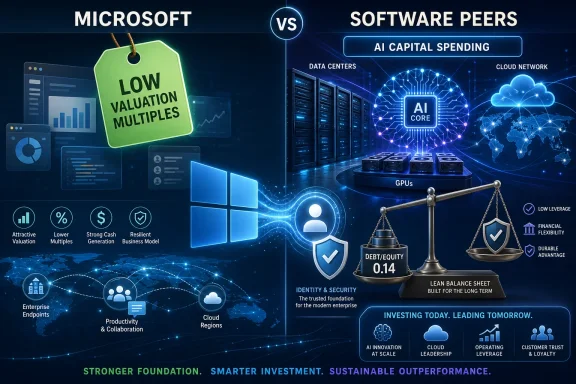
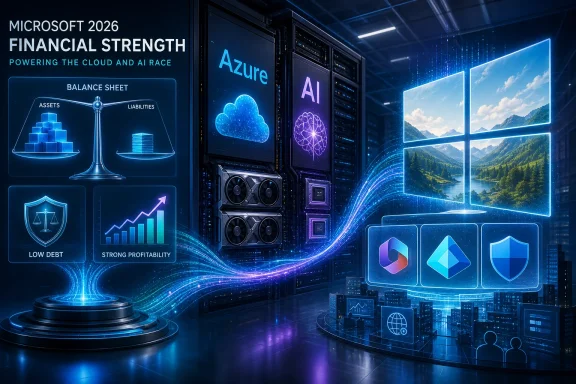
Benzinga’s June 2026 peer comparison says Microsoft ranks more conservatively financed than four software-industry peers, with a debt-to-equity ratio of 0.14, lower valuation multiples than the peer set, strong EBITDA and gross profit, but weaker return on equity and slower revenue growth. That is a clean, marketable snapshot, and it tells part of the truth. The more interesting story is that Microsoft now looks simultaneously safer, more expensive to run, and harder to compare than almost any “software” peer group can comfortably capture. For WindowsForum readers, the question is less whether Microsoft is cheap or expensive than whether its balance sheet can keep absorbing the AI-era infrastructure bill without turning Windows, Azure, and Microsoft 365 into margin-management machines.
A debt-to-equity ratio of 0.14 is the kind of number investors like because it appears to speak in a plain language: Microsoft is not leaning heavily on debt to fund itself. In a sector where many companies use leverage, stock compensation, aggressive growth spending, or acquisition debt to shape their financial profile, Microsoft’s capital structure looks almost boring.
That boredom is useful. It means Microsoft has room to finance large projects, handle shocks, and keep investing through downturns without immediately asking shareholders or bond markets for mercy. For administrators and enterprise customers, that matters because Microsoft is not a discretionary app vendor sitting on the edge of a funding cliff. It is the platform company underneath identity, productivity, cloud infrastructure, endpoint management, developer tooling, security operations, gaming, and, still, the Windows desktop.
But low leverage is not the same thing as low risk. Microsoft’s current risk is not primarily that it has borrowed too much money. It is that the company is committing itself to a capital-intensive AI race whose economics are still being proven at enterprise scale.
That is the part a simple debt-to-equity comparison tends to flatten. Traditional software companies scale beautifully because the next license, tenant, or subscription seat is cheap to deliver. AI infrastructure is different. It drags Microsoft deeper into chips, power, cooling, data center construction, GPU allocation, network design, and depreciation schedules that feel more like heavy industry than the old software gross-margin dream.
The problem is that Microsoft is unusually difficult to classify. It is a software company, yes, but also a cloud infrastructure operator, AI platform distributor, cybersecurity vendor, productivity monopoly, gaming publisher, search advertiser, developer ecosystem owner, and operating-system steward. Put Microsoft next to smaller, faster-growing software names and it may look cheap. Put it next to older infrastructure and enterprise vendors and it may look expensive.
Peer comparisons are not useless, but they are fragile. A price-to-sales ratio can make sense when comparing companies with similar margins, growth rates, and capital requirements. It becomes much less precise when one company sells high-margin subscriptions, another sells security appliances, another sells developer tools, and Microsoft sells the whole stack from Windows endpoints to Azure AI capacity.
That matters because valuation ratios are not verdicts. They are compression algorithms. They squeeze an entire company into a few numbers, and in Microsoft’s case they compress too much.
This is why Microsoft can carry a relatively conservative balance sheet while still spending aggressively. It does not need to fund every strategic move with debt because its existing platforms continue to throw off cash. The company can afford to pursue AI integration across Copilot, Azure, Windows, developer tools, and enterprise security because its core businesses remain deeply embedded in customer workflows.
The Windows angle is especially important. Consumer Windows may no longer define Microsoft’s growth story the way it did two decades ago, but Windows remains a distribution and management surface for the rest of the Microsoft ecosystem. Entra ID, Intune, Defender, Edge, Microsoft 365 Apps, OneDrive, Teams, and Copilot all become more valuable when Windows remains the default enterprise endpoint.
That installed base gives Microsoft pricing power, but it also creates responsibility. When Microsoft changes licensing, pushes cloud integration, alters default experiences, or folds AI into paid plans, customers cannot always respond like normal consumers. They are often operationally committed.
That does not mean AI is a bad business. It may become one of Microsoft’s strongest businesses. Azure is well positioned because enterprises already trust Microsoft with identity, compliance, data governance, and procurement. Copilot has the benefit of sitting inside the tools many workers already use all day.
But AI revenue is not identical to classic SaaS revenue. Running inference at scale costs real money. Training and tuning models cost real money. Building data centers costs real money. Securing AI systems, managing data boundaries, and proving compliance to regulated industries cost real money.
This is where EBITDA and gross profit need careful interpretation. Strong operating metrics show Microsoft is executing well today. They do not automatically settle whether AI services will preserve Microsoft’s historical margin profile after the industry normalizes pricing, customers demand measurable productivity returns, and competitors use open models or cheaper infrastructure to pressure margins.
For a company of Microsoft’s size, slower growth is not surprising. The law of large numbers is real. A smaller software company can grow revenue at 25 percent from a much smaller base and still add less absolute revenue than Microsoft adds at a lower percentage rate. Comparing growth rates without comparing scale can lead to false drama.
Still, growth matters because Microsoft’s valuation depends on the belief that cloud and AI can keep expanding the company’s earnings base. If growth slows while capital intensity rises, the market’s patience could thin. Investors may tolerate massive AI investment when Azure consumption is accelerating and Copilot adoption is visible. They will be less forgiving if AI becomes a costly feature bundle rather than a high-margin expansion engine.
For IT buyers, slower growth can show up in a different way. Vendors under pressure to defend margins often simplify packaging in their own favor, push customers toward premium tiers, retire legacy licensing paths, and make “optional” cloud services feel less optional over time. Microsoft has already spent years nudging customers toward subscriptions and cloud-connected management. AI gives it another reason to keep moving in that direction.
A low ROE relative to peers does not automatically mean Microsoft is underperforming. A company with less leverage may show a different ROE profile than a more debt-heavy competitor. A company making large long-term infrastructure investments may also look less efficient during the build-out phase than a more narrowly focused software vendor.
But the signal is worth respecting. Microsoft is no longer simply harvesting a mature software empire. It is rebuilding parts of that empire around AI infrastructure, model partnerships, security, cloud capacity, and subscription packaging. Those investments may pay off handsomely, but they also make the company more asset-heavy than many investors still imagine when they hear the word software.
The irony is that Microsoft’s financial strength gives it permission to accept lower near-term efficiency. The company can spend into the AI cycle because it has the balance sheet to do so. The risk is that investors mistake that capacity for guaranteed returns.
That misses how Microsoft actually exercises platform power. Windows remains the endpoint layer where enterprise policy, identity, security, application compatibility, browser defaults, update management, and AI experiences collide. Even when revenue growth is elsewhere, Windows helps determine how easily Microsoft can distribute new services.
This is why Windows users and admins should read financial comparisons as product signals. If Microsoft is rewarded for AI monetization, Windows will become more AI-forward. If Microsoft is rewarded for cloud attach rates, Windows management will keep leaning toward cloud policy and subscription services. If Microsoft needs to protect margins, legacy local-first workflows may receive less love than cloud-connected, telemetry-rich, service-backed workflows.
That does not mean Windows is doomed to become a thin client. It means Windows is increasingly valuable to Microsoft as a gateway. The operating system’s strategic role is no longer just to run applications. It is to keep users and organizations inside Microsoft’s identity, security, productivity, and AI orbit.
A strong balance sheet lets Microsoft wait through messy adoption cycles. Copilot can take longer to prove itself. Azure AI capacity can be overbuilt in one period and absorbed later. Gaming acquisitions can be integrated slowly. Security products can mature across multiple release waves. Windows AI features can stumble, retreat, and return.
Many competitors do not have that luxury. Smaller AI vendors may depend on venture funding, hyperscaler credits, or rapid enterprise adoption. SaaS peers with higher multiples may be punished harder if growth decelerates. Infrastructure rivals may have to choose between margin protection and capital spending. Microsoft can often choose both, at least for a while.
That patience is an advantage in enterprise technology, where customers move slowly and winners often look inevitable only after years of procurement cycles. Microsoft does not need every Copilot pitch to land in 2026. It needs enough customers to standardize over time.
But the format encourages a particular kind of analysis: ratio goes up, ratio goes down, relative comparison produces conclusion. Microsoft is too structurally important for that treatment to be sufficient. The company’s financial profile is inseparable from its platform control, enterprise lock-in, regulatory exposure, AI spending, cloud capacity, and security obligations.
A lower price-to-earnings ratio than peers may suggest undervaluation. It may also reflect investor skepticism about growth durability, AI spending, or the limits of further monetization inside already-saturated enterprise accounts. A lower debt-to-equity ratio suggests resilience. It may also signal that Microsoft can take on more obligations if the AI race demands it.
The useful reading is not “Microsoft is cheap.” It is more conditional: Microsoft appears financially stronger than many software peers, but the market is trying to price a company whose future depends on turning massive AI and cloud investments into durable, high-margin services.
Microsoft’s strongest businesses are not abstract financial units. They are contracts, licenses, subscriptions, usage meters, support agreements, security bundles, and management tools that customers pay for every month. If Microsoft needs to fund data centers, AI accelerators, model access, and cloud security, some of that cost will be recovered through packaging and pricing.
This is already the direction of the industry. Software vendors increasingly bundle features into higher tiers, reserve advanced security and compliance capabilities for premium plans, and use AI as a justification for new per-user charges. Microsoft has the advantage of being able to package AI into workflows where users already live: Outlook, Word, Excel, Teams, SharePoint, Windows, GitHub, and Azure.
The danger for customers is not simply higher prices. It is reduced architectural optionality. Once identity, endpoint management, productivity, collaboration, compliance, and AI assistance are all purchased from the same vendor, switching costs become more than a procurement headache. They become an operational redesign.
The problem is that Microsoft rarely needs to win every category on product purity. It needs to be good enough across enough categories that CIOs choose integration over fragmentation. That has been Microsoft’s enterprise superpower for decades, and AI may amplify it.
A standalone AI productivity startup has to prove procurement value, security posture, compliance handling, data integration, identity integration, and user adoption. Microsoft can walk into the same conversation and say the feature is already near the tenant, the identity layer, the document store, and the admin console. That is not always the best technical argument, but it is often the winning enterprise argument.
This is why peer comparisons can mislead when they treat Microsoft as one software name among others. Microsoft is not merely competing inside the software industry. It is defining the default bundle against which many software companies must justify their separate existence.
This matters financially because regulatory friction can slow integration strategies that otherwise look obvious on a spreadsheet. If Microsoft wants to bundle aggressively, regulators may object. If it uses Windows or Microsoft 365 distribution to privilege its own AI services, rivals may complain. If security failures affect governments or critical infrastructure, customers and policymakers may demand changes that are expensive rather than optional.
The balance sheet helps here too. Microsoft can absorb legal costs, compliance investments, and product adjustments better than smaller competitors. But regulation can still reduce strategic freedom, and strategic freedom is part of what investors pay for when they assign Microsoft a premium.
For WindowsForum readers, this is not distant policy theater. Regulatory outcomes can affect default apps, cloud licensing terms, Teams bundling, browser choice, security logging, identity integration, and the way AI features are presented inside Windows and Microsoft 365.
The classic Microsoft was an operating-system and productivity-software company with extraordinary margins and distribution power. The cloud-era Microsoft became a subscription and infrastructure giant, trading some simplicity for greater growth. The AI-era Microsoft is becoming something more complicated: a software company with the capital needs of an infrastructure operator and the social exposure of a platform utility.
That future can still be highly profitable. In fact, Microsoft may be one of the few companies with the distribution, trust, cash flow, and technical stack to make enterprise AI pay at scale. But the company’s risk profile is changing. Low debt does not erase that; it enables it.
The question is whether Microsoft can preserve software-like economics while taking on infrastructure-like obligations. If it can, today’s valuation comparisons may indeed look too conservative. If it cannot, the market may discover that “cheap versus peers” was less a bargain than a warning that the peer set was wrong.
 Microsoft Looks Conservative Until You Remember What It Is Building
A debt-to-equity ratio of 0.14 is the kind of number investors like because it appears to speak in a plain language: Microsoft is not leaning heavily on debt to fund itself. In a sector where many companies use leverage, stock compensation, aggressive growth spending, or acquisition debt to shape their financial profile, Microsoft’s capital structure looks almost boring.That boredom is useful. It means Microsoft has room to finance large projects, handle shocks, and keep investing through downturns without immediately asking shareholders or bond markets for mercy. For administrators and enterprise customers, that matters because Microsoft is not a discretionary app vendor sitting on the edge of a funding cliff. It is the platform company underneath identity, productivity, cloud infrastructure, endpoint management, developer tooling, security operations, gaming, and, still, the Windows desktop.
But low leverage is not the same thing as low risk. Microsoft’s current risk is not primarily that it has borrowed too much money. It is that the company is committing itself to a capital-intensive AI race whose economics are still being proven at enterprise scale.
That is the part a simple debt-to-equity comparison tends to flatten. Traditional software companies scale beautifully because the next license, tenant, or subscription seat is cheap to deliver. AI infrastructure is different. It drags Microsoft deeper into chips, power, cooling, data center construction, GPU allocation, network design, and depreciation schedules that feel more like heavy industry than the old software gross-margin dream.
The Peer Group Makes Microsoft Look Cheap, But the Peer Group Is Doing a Lot of Work
Benzinga’s automated comparison frames Microsoft against top software peers and concludes that its price-to-earnings, price-to-book, and price-to-sales ratios look low relative to the group. That supports the familiar “potential undervaluation” reading: investors may be getting a higher-quality company at a lower multiple than comparable names.The problem is that Microsoft is unusually difficult to classify. It is a software company, yes, but also a cloud infrastructure operator, AI platform distributor, cybersecurity vendor, productivity monopoly, gaming publisher, search advertiser, developer ecosystem owner, and operating-system steward. Put Microsoft next to smaller, faster-growing software names and it may look cheap. Put it next to older infrastructure and enterprise vendors and it may look expensive.
Peer comparisons are not useless, but they are fragile. A price-to-sales ratio can make sense when comparing companies with similar margins, growth rates, and capital requirements. It becomes much less precise when one company sells high-margin subscriptions, another sells security appliances, another sells developer tools, and Microsoft sells the whole stack from Windows endpoints to Azure AI capacity.
That matters because valuation ratios are not verdicts. They are compression algorithms. They squeeze an entire company into a few numbers, and in Microsoft’s case they compress too much.
The Balance Sheet Is Strong Because the Franchise Is Strong
Microsoft’s low leverage does not exist in isolation. It is a consequence of the company’s extraordinary cash-generating machine. Microsoft 365 renewals, Azure consumption, Windows commercial licensing, LinkedIn, Dynamics, GitHub, and security subscriptions create a recurring-revenue base that few competitors can match.This is why Microsoft can carry a relatively conservative balance sheet while still spending aggressively. It does not need to fund every strategic move with debt because its existing platforms continue to throw off cash. The company can afford to pursue AI integration across Copilot, Azure, Windows, developer tools, and enterprise security because its core businesses remain deeply embedded in customer workflows.
The Windows angle is especially important. Consumer Windows may no longer define Microsoft’s growth story the way it did two decades ago, but Windows remains a distribution and management surface for the rest of the Microsoft ecosystem. Entra ID, Intune, Defender, Edge, Microsoft 365 Apps, OneDrive, Teams, and Copilot all become more valuable when Windows remains the default enterprise endpoint.
That installed base gives Microsoft pricing power, but it also creates responsibility. When Microsoft changes licensing, pushes cloud integration, alters default experiences, or folds AI into paid plans, customers cannot always respond like normal consumers. They are often operationally committed.
AI Turns Microsoft’s Old Software Advantage Into a New Infrastructure Obligation
The clearest reason to be cautious about the “Microsoft is undervalued” conclusion is that AI changes the cost profile of software. The old Microsoft sold code that could be replicated cheaply. The new Microsoft increasingly sells intelligence-backed services that require expensive compute every time users ask the system to summarize, search, draft, classify, generate, or reason.That does not mean AI is a bad business. It may become one of Microsoft’s strongest businesses. Azure is well positioned because enterprises already trust Microsoft with identity, compliance, data governance, and procurement. Copilot has the benefit of sitting inside the tools many workers already use all day.
But AI revenue is not identical to classic SaaS revenue. Running inference at scale costs real money. Training and tuning models cost real money. Building data centers costs real money. Securing AI systems, managing data boundaries, and proving compliance to regulated industries cost real money.
This is where EBITDA and gross profit need careful interpretation. Strong operating metrics show Microsoft is executing well today. They do not automatically settle whether AI services will preserve Microsoft’s historical margin profile after the industry normalizes pricing, customers demand measurable productivity returns, and competitors use open models or cheaper infrastructure to pressure margins.
Low Revenue Growth Is Not a Footnote
The Benzinga summary flags low revenue growth as a concern relative to peers. That deserves more weight than an automated takeaway usually gives it.For a company of Microsoft’s size, slower growth is not surprising. The law of large numbers is real. A smaller software company can grow revenue at 25 percent from a much smaller base and still add less absolute revenue than Microsoft adds at a lower percentage rate. Comparing growth rates without comparing scale can lead to false drama.
Still, growth matters because Microsoft’s valuation depends on the belief that cloud and AI can keep expanding the company’s earnings base. If growth slows while capital intensity rises, the market’s patience could thin. Investors may tolerate massive AI investment when Azure consumption is accelerating and Copilot adoption is visible. They will be less forgiving if AI becomes a costly feature bundle rather than a high-margin expansion engine.
For IT buyers, slower growth can show up in a different way. Vendors under pressure to defend margins often simplify packaging in their own favor, push customers toward premium tiers, retire legacy licensing paths, and make “optional” cloud services feel less optional over time. Microsoft has already spent years nudging customers toward subscriptions and cloud-connected management. AI gives it another reason to keep moving in that direction.
ROE Weakness Complicates the “Undervalued” Story
Benzinga’s note that Microsoft’s return on equity appears low versus peers cuts against the easy interpretation of cheapness. ROE can be distorted by capital structure, buybacks, accounting treatment, and the composition of the peer group, but it still asks a useful question: how efficiently is the company turning shareholder equity into profit?A low ROE relative to peers does not automatically mean Microsoft is underperforming. A company with less leverage may show a different ROE profile than a more debt-heavy competitor. A company making large long-term infrastructure investments may also look less efficient during the build-out phase than a more narrowly focused software vendor.
But the signal is worth respecting. Microsoft is no longer simply harvesting a mature software empire. It is rebuilding parts of that empire around AI infrastructure, model partnerships, security, cloud capacity, and subscription packaging. Those investments may pay off handsomely, but they also make the company more asset-heavy than many investors still imagine when they hear the word software.
The irony is that Microsoft’s financial strength gives it permission to accept lower near-term efficiency. The company can spend into the AI cycle because it has the balance sheet to do so. The risk is that investors mistake that capacity for guaranteed returns.
Windows Is No Longer the Growth Engine, but It Is Still the Control Plane
Any comparison of Microsoft with software competitors tends to understate Windows because Windows is no longer the company’s flashiest growth segment. Azure gets the cloud multiple. Copilot gets the AI narrative. Microsoft 365 gets the subscription resilience. Windows is treated as legacy plumbing.That misses how Microsoft actually exercises platform power. Windows remains the endpoint layer where enterprise policy, identity, security, application compatibility, browser defaults, update management, and AI experiences collide. Even when revenue growth is elsewhere, Windows helps determine how easily Microsoft can distribute new services.
This is why Windows users and admins should read financial comparisons as product signals. If Microsoft is rewarded for AI monetization, Windows will become more AI-forward. If Microsoft is rewarded for cloud attach rates, Windows management will keep leaning toward cloud policy and subscription services. If Microsoft needs to protect margins, legacy local-first workflows may receive less love than cloud-connected, telemetry-rich, service-backed workflows.
That does not mean Windows is doomed to become a thin client. It means Windows is increasingly valuable to Microsoft as a gateway. The operating system’s strategic role is no longer just to run applications. It is to keep users and organizations inside Microsoft’s identity, security, productivity, and AI orbit.
The Debt Number Says Microsoft Can Wait Out Competitors
The most bullish reading of the 0.14 debt-to-equity ratio is not that Microsoft has no financial risk. It is that Microsoft has time. In technology markets, time is underrated.A strong balance sheet lets Microsoft wait through messy adoption cycles. Copilot can take longer to prove itself. Azure AI capacity can be overbuilt in one period and absorbed later. Gaming acquisitions can be integrated slowly. Security products can mature across multiple release waves. Windows AI features can stumble, retreat, and return.
Many competitors do not have that luxury. Smaller AI vendors may depend on venture funding, hyperscaler credits, or rapid enterprise adoption. SaaS peers with higher multiples may be punished harder if growth decelerates. Infrastructure rivals may have to choose between margin protection and capital spending. Microsoft can often choose both, at least for a while.
That patience is an advantage in enterprise technology, where customers move slowly and winners often look inevitable only after years of procurement cycles. Microsoft does not need every Copilot pitch to land in 2026. It needs enough customers to standardize over time.
The Automated Article Gets the Ratios Right and the Story Half Right
The Benzinga article is transparent about being generated by an automated content engine and reviewed by an editor. That is not inherently a flaw. Automated financial summaries can be useful when they surface metrics quickly and consistently.But the format encourages a particular kind of analysis: ratio goes up, ratio goes down, relative comparison produces conclusion. Microsoft is too structurally important for that treatment to be sufficient. The company’s financial profile is inseparable from its platform control, enterprise lock-in, regulatory exposure, AI spending, cloud capacity, and security obligations.
A lower price-to-earnings ratio than peers may suggest undervaluation. It may also reflect investor skepticism about growth durability, AI spending, or the limits of further monetization inside already-saturated enterprise accounts. A lower debt-to-equity ratio suggests resilience. It may also signal that Microsoft can take on more obligations if the AI race demands it.
The useful reading is not “Microsoft is cheap.” It is more conditional: Microsoft appears financially stronger than many software peers, but the market is trying to price a company whose future depends on turning massive AI and cloud investments into durable, high-margin services.
Enterprise Customers Will Pay for Microsoft’s Strategy One Way or Another
Investors look at Microsoft’s ratios and ask whether the stock is attractive. IT departments should ask where the money comes from.Microsoft’s strongest businesses are not abstract financial units. They are contracts, licenses, subscriptions, usage meters, support agreements, security bundles, and management tools that customers pay for every month. If Microsoft needs to fund data centers, AI accelerators, model access, and cloud security, some of that cost will be recovered through packaging and pricing.
This is already the direction of the industry. Software vendors increasingly bundle features into higher tiers, reserve advanced security and compliance capabilities for premium plans, and use AI as a justification for new per-user charges. Microsoft has the advantage of being able to package AI into workflows where users already live: Outlook, Word, Excel, Teams, SharePoint, Windows, GitHub, and Azure.
The danger for customers is not simply higher prices. It is reduced architectural optionality. Once identity, endpoint management, productivity, collaboration, compliance, and AI assistance are all purchased from the same vendor, switching costs become more than a procurement headache. They become an operational redesign.
Competitors Can Attack Microsoft Only at the Edges
Microsoft’s broad footprint is both its strength and its vulnerability. Competitors can beat Microsoft in individual categories. They can build better endpoint tools, sharper developer platforms, more elegant collaboration products, cheaper AI services, or more focused security offerings.The problem is that Microsoft rarely needs to win every category on product purity. It needs to be good enough across enough categories that CIOs choose integration over fragmentation. That has been Microsoft’s enterprise superpower for decades, and AI may amplify it.
A standalone AI productivity startup has to prove procurement value, security posture, compliance handling, data integration, identity integration, and user adoption. Microsoft can walk into the same conversation and say the feature is already near the tenant, the identity layer, the document store, and the admin console. That is not always the best technical argument, but it is often the winning enterprise argument.
This is why peer comparisons can mislead when they treat Microsoft as one software name among others. Microsoft is not merely competing inside the software industry. It is defining the default bundle against which many software companies must justify their separate existence.
Regulators Are Now Part of the Financial Model
A company with Microsoft’s platform reach does not get to grow without scrutiny. Antitrust pressure, cloud licensing complaints, app bundling concerns, security accountability, and AI governance rules all shape the company’s future operating environment.This matters financially because regulatory friction can slow integration strategies that otherwise look obvious on a spreadsheet. If Microsoft wants to bundle aggressively, regulators may object. If it uses Windows or Microsoft 365 distribution to privilege its own AI services, rivals may complain. If security failures affect governments or critical infrastructure, customers and policymakers may demand changes that are expensive rather than optional.
The balance sheet helps here too. Microsoft can absorb legal costs, compliance investments, and product adjustments better than smaller competitors. But regulation can still reduce strategic freedom, and strategic freedom is part of what investors pay for when they assign Microsoft a premium.
For WindowsForum readers, this is not distant policy theater. Regulatory outcomes can affect default apps, cloud licensing terms, Teams bundling, browser choice, security logging, identity integration, and the way AI features are presented inside Windows and Microsoft 365.
The Real Comparison Is Between Microsoft’s Past and Its Future
The most revealing comparison is not Microsoft versus four software peers. It is Microsoft versus the version of Microsoft investors think they own.The classic Microsoft was an operating-system and productivity-software company with extraordinary margins and distribution power. The cloud-era Microsoft became a subscription and infrastructure giant, trading some simplicity for greater growth. The AI-era Microsoft is becoming something more complicated: a software company with the capital needs of an infrastructure operator and the social exposure of a platform utility.
That future can still be highly profitable. In fact, Microsoft may be one of the few companies with the distribution, trust, cash flow, and technical stack to make enterprise AI pay at scale. But the company’s risk profile is changing. Low debt does not erase that; it enables it.
The question is whether Microsoft can preserve software-like economics while taking on infrastructure-like obligations. If it can, today’s valuation comparisons may indeed look too conservative. If it cannot, the market may discover that “cheap versus peers” was less a bargain than a warning that the peer set was wrong.
The Numbers Point to a Stronger Microsoft, Not a Simpler One
Benzinga’s snapshot gives investors a useful starting point, but the practical interpretation is more nuanced than the automated summary suggests.- Microsoft’s 0.14 debt-to-equity ratio signals balance-sheet strength and gives the company room to keep funding cloud and AI investment.
- Low valuation multiples versus selected software peers may indicate undervaluation, but the conclusion depends heavily on which companies are included in the peer group.
- Strong EBITDA and gross profit show that Microsoft’s core engine remains powerful even as the company spends heavily on AI infrastructure.
- Lower ROE and slower revenue growth deserve attention because they hint at the cost of scaling a mature platform company into the AI era.
- Windows remains strategically important because it gives Microsoft a distribution surface for identity, security, management, productivity, and AI services.
- Enterprise customers should expect Microsoft’s financial strategy to show up in licensing, bundling, cloud attach, and premium AI packaging.
References
- Primary source: Benzinga
Published: 2026-06-24T09:59:08.090224
Comparing Microsoft With Industry Competitors In Software Industry - Microsoft (NASDAQ:MSFT) - Benzinga
In the fast-paced and highly competitive business world of today, conducting thorough company analysis is essential for investors and industry observers. In this article, we will conduct an extensive industrywww.benzinga.com - Related coverage: cdn6.benzinga.com
Comparative Study: Microsoft And Industry Competitors In Software Industry
In the ever-changing and fiercely competitive business landscape, conducting thorough company analysis is crucial for investors and industry experts. In ...cdn6.benzinga.com
- Related coverage: cdn4.benzinga.com
Evaluating Microsoft Against Peers In Software Industry
In the ever-changing and fiercely competitive business landscape, conducting thorough company analysis is crucial for investors and industry experts. In ... - Related coverage: sahmcapital.com
Comparing Microsoft With Industry Competitors In Software Industry
In today's fast-paced and highly competitive business world, it is crucial for investors and industry followers to conduct comprehensive company evaluations. In this article, we will delve into an extensive industry comparison, evaluating Microsof...www.sahmcapital.com - Related coverage: nasdaq.com
Industry Comparison: Evaluating Microsoft Against Competitors In Software Industry | Nasdaq
In today's rapidly changing and highly competitive business world, it is vital for investors and industry enthusiasts to carefully assess companies. In this article, we will perform a comprehensive industry comparison, evaluating Microsoft (NASDAQ:MSFT) against its key competitors in the...www.nasdaq.com - Related coverage: windowsforum.com
Microsoft Looks Cheap: Debt-Low Metrics vs AI/Cloud Infrastructure Stakes (2026) | Windows Forum
Microsoft’s latest peer-comparison snapshot, published June 2026 by Benzinga, argues that the company carries less balance-sheet risk than major software...windowsforum.com