

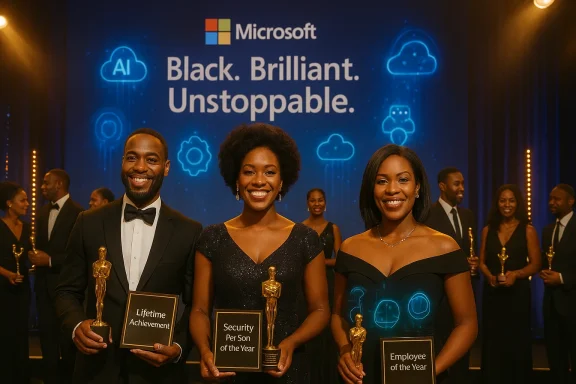
Microsoft’s showing at the Black Tech Achievement Awards 2026 was bigger than a good night at an industry gala. The company left London with three awards, several nominations, and a particularly visible place inside an event designed to celebrate Black excellence in technology as something foundational rather than symbolic. The message from the room was clear: representation is not a side conversation in tech anymore; it is part of how leadership, innovation, and influence are measured. Microsoft’s own UK Stories account frames the event around the idea that Black talent in tech is “Black. Brilliant. Unstoppable,” a phrase that captures both the mood of the evening and the ambition behind the awards themselves. ack Tech Achievement Awards have become one of the UK tech calendar’s most visible celebrations of Black talent, and 2026 marked the event’s sixth year. Held at the JW Marriott Grosvenor House hotel in London’s Mayfair, the ceremony brought together leaders, innovators, advocates, and allies from across the ecosystem to recognise people shaping the future of technology. According to Microsoft’s coverage, the Awards now span 18 categories, and this year also introduced the inaugural BTA Top 50, a list meant to highlight the most influential Black voices in UK tech today.
That matters becausst about trophies. They define what an industry chooses to celebrate, what it considers worthy of visibility, and where it wants younger talent to imagine a future. In a sector still wrestling with underrepresentation, especially for Black professionals and Black women, public recognition becomes a practical tool of culture-building, not just a ceremonial flourish. Microsoft’s reporting from last year’s ceremony noted that Black professionals remain significantly underrepresented in UK tech, which makes every visible success story carry extra weight.
Microsoft’s presence at the event was especially notable because the company was not simply sponsoring the room from the sidelines. Its employees were among the winners, nominees, and recognised voices, and the coverage places those accomplishments alongside wider themes of mentorship, inclusion, and community leadership. The result is a picture of an organisation using awards not only to celebrate outcomes, but also to validate the role of employee resource communities, sponsorship, and cross-industry visibility.
The awards also arrived during a period when Microsoft is aggressively positioning itself around AI, cloud transformation, and responsible technology adoption. That context gives the honours more strategic significance. They are not merely a cultural snapshot; they are also a signal about who inside the company is helping shape those changes and how Microsoft wants to present that internal leadership to the outside world. In other words, the ceremony was about identity, but it was also about influence.
The Black Tech Achievement Awards were founded on a simple but powerful premise: Black excellence in technology should be seen, celebrated, and championed. Dr Raphael Sofoluke, Founder and CEO of the Awards, described that mission in explicitly affirmative terms, stressing that the future of technology is “Black,” “brilliant,” and “unstoppable.” That language is more than event branding. It reflects a deliberate effort to counter a tech culture that often treats diversity as an add-on instead of an engine of progress.
The event’s growth into a sixth-year landmark says something important about demand. When an awards programme moves from niche recoixture, it usually means the community it serves has built its own institutional gravity. In practice, that means the ceremony is no longer simply rewarding success after the fact; it is helping shape what success looks like, who gets to model it, and which stories the sector circulates most widely. That is a substantial cultural role.
Microsoft’s involvement in that ecosystem is also part of a broader pattern. The company has spent the past several years widening its footprint across nclusion, and community-led talent building in the UK. In Microsoft UK Stories coverage from 2025, the company described how its employees and communities used the awards as a platform to elevate Black talent across the industry, not just within Microsoft itself. That continuity matters because it suggests the 2026 wins were not an isolated success, but part of a deeper relationship between the company and Black tech leadership in the UK.
There is also a clear strategic dimension to this year’s awards. The tech industry is in the middle of a broader AI transition, and leadership in that era depends on more than narrow technical skill. It also depends on trust, customer influence, security thinking, design judgment, and the ability to bring others along. The Microsoft people recognised at BTA 2026 represent that broader definition of technical impact, which is why the awards feel especially relevant to where tech is heading next.
The awards also help address a persistent challenge in tech: talent visibility does not automatically follow talent quality. Many employees contribute in ways that are consequential but not always publicly legible. Recognition events like BTA give those contributions a stage, which can matter for career development, recruitment, retention, and the wider perception of what leadership looks like in a modern technology company.
Maynard’s win also matters because it comes at a time when AI transformation is forcing companies to rethink the shape of leadership itself. Titles alone do not tell the full story anymore. Influence now spans strategy, people development, customer outcomes, and the ability to guide organisations throughg sight of the human side of the transition. A Lifetime Achievement Award in that context is as much about future relevance as past accomplishment.
The emotional resonance of her comments should not be underestimated either. Awards events can become performative unless they connect to lived experience. By speaking about inspiration and encouragement, Maynard grounded the honour in something more practical: the power of seeing yourself reflected in the room. That is a recurring theme in Microsoft’s owninclusion and Black talent.
Microsoft also secured the Security Person of the Year award through Vanessa Anderson, Director, Chief Architect Cloud & AI. The category recognises people protecting organisations and individuals from cyber threats through innovative security solutions or sector-leading programmes. Anderson’s comments tied cybersecurity to community impact, framing the work as a way to help others change their lives. That is a useful reminder that security is never only technical; it is also social infrastructure.
The third Microsoft win was Employee of the Year, awarded to Dedun Oyenuga, a UX Consultant. That honour celebrates people who go beyond their job description, drive exceptional results, and become indispensable to their teams. Oyenuga’s remarks about the importance of spaces that bring Black talent together at scale highlight the emotional and professional value of recognition. His win also underlinesed in mainstream coverage of tech awards: user experience and design can be just as transformative as code.
That matters tolar because the company’s product strategy increasingly depends on bringing those disciplines together. AI systems need security, design, governance, and customer trust if they are going to work at scale. Awards that recognise the people behind those layers are effectively rewarding the connective tissue of modern technology delivery.
Among the nominees was Ore Akin-Odidi, a Cloud Solutions Architect, who was recognised for turning complex challenges into innovative solutions. Another nominee, RoseMary Buahin, Northern Europe Xbox Marketing Lead, was cited for her culturally relevant campaigns and advocacy for inclusion. Both nominations are important because they show Microsoft’s influence reaching beyond classic enterprise roles into marketing, gaming, and customer-facing innovation.
RoseMary Buahin’s nomination is equally revealing, but for aming remains one of the most culturally influential parts of Microsoft’s portfolio, and her recognition shows that inclusion work is not confined to the corporate or infrastructure side of the business. It reaches consumer storytelling too, where representation can influence how communities see themselves in the products they use and love.
The article also highlights Kwadwo Benko, Lizette Stephens, and Michaela McCollin as part of the Top 50 Most Inlack Tech** list. Benko was recognised for responsible, large-scale AI adoption in the UK public sector, Stephens for the intersection of cloud, AI, and equity, and McCollin for people-centred leadership in complex customer environments. Collectively, they show that Microsoft’s influence in Black tech extends into policy, public sector transformation, and enterprise customer success.
McCollin’s recognition is a good example of why this matters. Restoring trust in a complex enterprise account and turning that into a three-year renewal is not flashy work, but it is st It demonstrates that operational discipline, transparency, and collaboration can be just as valuable as big product announcements.
This is where awards can become more than publicity. They create shared language around aspiration, making it easier for current employees and future candidates to see a path f where talent competition is intense, that matters as much as any recruitment campaign. The symbolism is obvious, but the operational value is real too.
This matters especially in tech, where advancement is often framed as an individual merit story. The reality is messier. People rise faster when they have sponsors, communities, and environments that make their success legible. Awards help make that visible, and visibility can be catalytic.
The Black Tech Achievement Awards also create a bridge between recognition and accountability. Celebrating progress is meaningful, but the event’s stated aims include encouraging organisations to invest in inclusion, equity, and opportunity. That means the ceremony is not meant to be an endpoint. It is supposed to push the sector toward action.
This is partthe AI era, where new tools can amplify inequality if only a narrow group gets access to the skills and decision-making power required to shape them. Microsoft’s awards presence hints at a counter-strategy: diversify the people who influence AI adoption, customer transformation, and secue start. That is both ethically sound and commercially sensible.
For consumers and the broader public, the significance is subtler but still important. Gaming, productivity, and cloud products all depend on cultural relevance, and culturally relevant products are usually better at meeting the needs of diverse audiences. RoseMary Buahin’s recognition is a good reminder that representation can shape the tone, reach, and credibility of a brand far beyond one internal team.
The 2026 ceremony also sits in tension with the common tech habit of reducing success to metrics alone. Awards nights are emotional, but they also reveal what companies choose to measure. By highlighting mentorship, advocacy, and community leadership alongside technical work, BTA pushes the industry toward a wider definition of value. That is a useful corrective in an era when everything can be reduced to dashboards.
Microsoft’s inclusion of multiple colleagues on the list tells a story of distributed influence. Rather than presenting one few supporting players, the company can point to talent across security, cloud, customer success, gaming, and public sector AI. That breadth is valuable because it suggests the company’s culture is not dependent on a single exceptional figure.
For the wider industry, the list may also help shift networking patterns. People often connect around title, sector, or geography, but recognitions like this can create a moreho matters and why. That can lead to better collaboration and a more visible pipeline of future speakers, mentors, and board-level voices.
A list is only as meaningful as the influence it creates afterward, of course. But if the BTA Top 50 becomes a recurring fixture, it could shape the public narrative around Black tech leadership in the UK in a way that endures well beyond one awards a real achievement.
The company also benefits because these recognitions bridge internal culture and external perception. Customers often want reassurance that the firms they buy from have a deep bench of talent, strong leadership, and credible values. Awards like BTA offer a public-facing shortha## The talent narrative matters
Microsoft competes against companies that are equally eager to tell a story about innovation. What distinguishes Microsoft here is the way it connects innovation to inclusion rather than treating them as competing priorities. That is not just a moral posture; iy. Companies that can recruit and retain broad talent pools are better positioned to solve complex problems across security, AI, and customer transformation.
This matters even more as the company pushes deeper into AI adoption. AI products are only as credible as the institutions that support them, and those institutions need diverse perspectives to avoid blind spots. The award winners and nominees showcased at BTA 2026 embody that broader approach to building trust.
One of the most interesting subtexts of the night is that these honours span both visible and less visible forms of influence. Security architecture, UX consulting, customer success, and public sector AI are all different lanes, but the awards suggest they are equally important to Microsoft’s future. That is a subtle but powerful message to the market.
--- portunities
Microsoft’s BTA 2026 performance offers a useful blueprint for how large technology companies can align internal culture with external credibility. It also shows that inclusion can be measured through more than policy statements; it can be demonstrated through who gets nominated, who wins, and whose influence is made visible. The most important opportunity now is to turn one successful awards night into a durable model for leadership development and talent visibility.
The wider industry should also pay attention. As AI, security, and customer transformation become more tightly intertwined, companies will increasingly need leaders who can bridge technology and community impact. The people Microsoft celebrated at BTA les of that hybrid leadership model, which is likely to become even more important in the years ahead.
Source: ukstories.microsoft.com Black Tech Achievement Awards 2026: 'Black. Brilliant. Unstoppable'
That matters becausst about trophies. They define what an industry chooses to celebrate, what it considers worthy of visibility, and where it wants younger talent to imagine a future. In a sector still wrestling with underrepresentation, especially for Black professionals and Black women, public recognition becomes a practical tool of culture-building, not just a ceremonial flourish. Microsoft’s reporting from last year’s ceremony noted that Black professionals remain significantly underrepresented in UK tech, which makes every visible success story carry extra weight.
Microsoft’s presence at the event was especially notable because the company was not simply sponsoring the room from the sidelines. Its employees were among the winners, nominees, and recognised voices, and the coverage places those accomplishments alongside wider themes of mentorship, inclusion, and community leadership. The result is a picture of an organisation using awards not only to celebrate outcomes, but also to validate the role of employee resource communities, sponsorship, and cross-industry visibility.
The awards also arrived during a period when Microsoft is aggressively positioning itself around AI, cloud transformation, and responsible technology adoption. That context gives the honours more strategic significance. They are not merely a cultural snapshot; they are also a signal about who inside the company is helping shape those changes and how Microsoft wants to present that internal leadership to the outside world. In other words, the ceremony was about identity, but it was also about influence.
 Background
The Black Tech Achievement Awards were founded on a simple but powerful premise: Black excellence in technology should be seen, celebrated, and championed. Dr Raphael Sofoluke, Founder and CEO of the Awards, described that mission in explicitly affirmative terms, stressing that the future of technology is “Black,” “brilliant,” and “unstoppable.” That language is more than event branding. It reflects a deliberate effort to counter a tech culture that often treats diversity as an add-on instead of an engine of progress.The event’s growth into a sixth-year landmark says something important about demand. When an awards programme moves from niche recoixture, it usually means the community it serves has built its own institutional gravity. In practice, that means the ceremony is no longer simply rewarding success after the fact; it is helping shape what success looks like, who gets to model it, and which stories the sector circulates most widely. That is a substantial cultural role.
Microsoft’s involvement in that ecosystem is also part of a broader pattern. The company has spent the past several years widening its footprint across nclusion, and community-led talent building in the UK. In Microsoft UK Stories coverage from 2025, the company described how its employees and communities used the awards as a platform to elevate Black talent across the industry, not just within Microsoft itself. That continuity matters because it suggests the 2026 wins were not an isolated success, but part of a deeper relationship between the company and Black tech leadership in the UK.
There is also a clear strategic dimension to this year’s awards. The tech industry is in the middle of a broader AI transition, and leadership in that era depends on more than narrow technical skill. It also depends on trust, customer influence, security thinking, design judgment, and the ability to bring others along. The Microsoft people recognised at BTA 2026 represent that broader definition of technical impact, which is why the awards feel especially relevant to where tech is heading next.
Why this event matters now
The timing of the ceremony matters because the industry is increasingly asking hard questions about who benefits from transformation. As Microsoft expands AI adoption across enterprise, public sector, and consumer products, it also faces scrutiny over how those systems are governed and who is empowered to lead them. Celebrating Black leaders in that environment is not just a matter of optics. It is a statement that the company sees inclusion and innovation as mutually reinforcing.The awards also help address a persistent challenge in tech: talent visibility does not automatically follow talent quality. Many employees contribute in ways that are consequential but not always publicly legible. Recognition events like BTA give those contributions a stage, which can matter for career development, recruitment, retention, and the wider perception of what leadership looks like in a modern technology company.
Microsoft’s Award Winners
Microsoft’s strongest showing came through Pamela Maynard OBE, who won the Lifetime Achievement Award. The honour recognises sustained contribution, mentorship, and leadership over a long period, and it places her in the category of leaders whose impact extends beyond a single role or product cycle. Her reaction was telling: being in a room “surrounded by so much Black talent in tech” gave her inspiration, encouragement, and confidence to keep going. That is exactly the kind of sentiment this event is designed to amplify.Maynard’s win also matters because it comes at a time when AI transformation is forcing companies to rethink the shape of leadership itself. Titles alone do not tell the full story anymore. Influence now spans strategy, people development, customer outcomes, and the ability to guide organisations throughg sight of the human side of the transition. A Lifetime Achievement Award in that context is as much about future relevance as past accomplishment.
Pamela Maynard and the long view
Maynard’s role as Chief AI Transformation Officer for Microsoft Customer & Partner Solutions places her right at the fault line between enterprise demand and Microsoft’s AI ambitions. That makes her award especially interesting, because it reflects not only tenure but also continued relevance in one of the company’s most strategically important moments. In a market obsessed with the next big thing, the award acknowledges the value of leaders who can provide continuity while helping organisations move forward.The emotional resonance of her comments should not be underestimated either. Awards events can become performative unless they connect to lived experience. By speaking about inspiration and encouragement, Maynard grounded the honour in something more practical: the power of seeing yourself reflected in the room. That is a recurring theme in Microsoft’s owninclusion and Black talent.
Microsoft also secured the Security Person of the Year award through Vanessa Anderson, Director, Chief Architect Cloud & AI. The category recognises people protecting organisations and individuals from cyber threats through innovative security solutions or sector-leading programmes. Anderson’s comments tied cybersecurity to community impact, framing the work as a way to help others change their lives. That is a useful reminder that security is never only technical; it is also social infrastructure.
The third Microsoft win was Employee of the Year, awarded to Dedun Oyenuga, a UX Consultant. That honour celebrates people who go beyond their job description, drive exceptional results, and become indispensable to their teams. Oyenuga’s remarks about the importance of spaces that bring Black talent together at scale highlight the emotional and professional value of recognition. His win also underlinesed in mainstream coverage of tech awards: user experience and design can be just as transformative as code.
Security, UX, and the full-stack idea of contribution
These wins are notable because they span very different kinds of value creation. Security leadership, UX work, and executive transformation operate on different timescales and require different skill sets. Yet the awards grouped them under one umbrella, which suggests the industry is slowly acknowledging that tech impact is broader than engineering alone.That matters tolar because the company’s product strategy increasingly depends on bringing those disciplines together. AI systems need security, design, governance, and customer trust if they are going to work at scale. Awards that recognise the people behind those layers are effectively rewarding the connective tissue of modern technology delivery.
The Nominees That Broaden the Story
Microsoft’s night was not defined ral colleagues were also recognised as nominees and Top 50 honourees, which widened the story from individual achievement to organisational depth. That distinction matters because a strong awards night is rarely about a single standout person; it is often about whether a company can show sustained excellence across multiple functions and levels.Among the nominees was Ore Akin-Odidi, a Cloud Solutions Architect, who was recognised for turning complex challenges into innovative solutions. Another nominee, RoseMary Buahin, Northern Europe Xbox Marketing Lead, was cited for her culturally relevant campaigns and advocacy for inclusion. Both nominations are important because they show Microsoft’s influence reaching beyond classic enterprise roles into marketing, gaming, and customer-facing innovation.
Developer and gaming visibility
T Year nomination for Ore Akin-Odidi reinforces a simple point: technical architecture still matters, even as AI gets more attention. Behind every polished product experience lies a body of work that has to be resilient, scalable, and understandable. Recognising an architect in this way suggests that Microsoft’s internal culture still values the deep technical craft that makes later innovation possible.RoseMary Buahin’s nomination is equally revealing, but for aming remains one of the most culturally influential parts of Microsoft’s portfolio, and her recognition shows that inclusion work is not confined to the corporate or infrastructure side of the business. It reaches consumer storytelling too, where representation can influence how communities see themselves in the products they use and love.
The article also highlights Kwadwo Benko, Lizette Stephens, and Michaela McCollin as part of the Top 50 Most Inlack Tech** list. Benko was recognised for responsible, large-scale AI adoption in the UK public sector, Stephens for the intersection of cloud, AI, and equity, and McCollin for people-centred leadership in complex customer environments. Collectively, they show that Microsoft’s influence in Black tech extends into policy, public sector transformation, and enterprise customer success.
A broader leadership map
The Toly important because it moves beyond category-based awards and into ecosystem influence. That shift suggests the Awards are interested not only in who performs well within a role, but in who changes the conditions around the role. That is a more sophisticated way to measure leadership, and it fits the way modern tech careers increasingly unfold.McCollin’s recognition is a good example of why this matters. Restoring trust in a complex enterprise account and turning that into a three-year renewal is not flashy work, but it is st It demonstrates that operational discipline, transparency, and collaboration can be just as valuable as big product announcements.
Representation, Belonging, and Industry Influence
The awards night worked because it was not only about achievements; it was also about belonging. The quotes from Microsoft honourees repeatedly circle back to the power of being in a room with peers who share simi. That feeling is hard to quantify, but it is central to retention and progression in any industry where underrepresentation can make advancement feel isolating.This is where awards can become more than publicity. They create shared language around aspiration, making it easier for current employees and future candidates to see a path f where talent competition is intense, that matters as much as any recruitment campaign. The symbolism is obvious, but the operational value is real too.
Community as infrastructure
Microsoft’s coverage of Black Tech Achievement Awards 2025 said the stories of its nominees showcased the strength of diversity and the value of bringing different perspectives to the table. That logic clearly carries into 2026. When companies amplify these stories, they are effectively investing in social infrastructure: the networks, role models, and peer support systems that help talent persist and progress.This matters especially in tech, where advancement is often framed as an individual merit story. The reality is messier. People rise faster when they have sponsors, communities, and environments that make their success legible. Awards help make that visible, and visibility can be catalytic.
The Black Tech Achievement Awards also create a bridge between recognition and accountability. Celebrating progress is meaningful, but the event’s stated aims include encouraging organisations to invest in inclusion, equity, and opportunity. That means the ceremony is not meant to be an endpoint. It is supposed to push the sector toward action.
Why visibility changes careers
For emerging professionals, especially those from underrepresented communities, seeing someone like them honoured in a public setting can reframe what is possible. It can also change how managers think about sponsorship and succession planning. If an organisation wants future leaders, it needs to make leadership visible in all its forms, not only the most traditional onson the Top 50 list feels so important. It broadens the definition of influence and makes room for people whose impact might otherwise be tucked away behind titles or project teams. In doing so, it gives the awards a longer shelf life than a single night of celebration.Microsoft’s Inclusion Strategy in a Wider Tech Context
Microsoft’sld also be read alongside its broader approach to skills, AI, and access. The company has been expanding training, developer enablement, and ecosystem-building efforts across markets, including UK-focused programmes that connect learning with opportunity. That kind of strategy suggests inclusion is not being treated as a separate track from innovation, but as one of the ways innovation is scaled.This is partthe AI era, where new tools can amplify inequality if only a narrow group gets access to the skills and decision-making power required to shape them. Microsoft’s awards presence hints at a counter-strategy: diversify the people who influence AI adoption, customer transformation, and secue start. That is both ethically sound and commercially sensible.
Enterprise and consumer implications
For enterprise customers, the message is that Microsoft wants inclusive leadership embedded in the teams that shape cloud, security, and AI deployments. That can improve customer confidence because clients increasingly care about governance, accountability, and the quality of the teams behind critical systems. A more diverse leadership bench is not a guarantee of better outcomes, but it can improve the odds of more balanced decision-making.For consumers and the broader public, the significance is subtler but still important. Gaming, productivity, and cloud products all depend on cultural relevance, and culturally relevant products are usually better at meeting the needs of diverse audiences. RoseMary Buahin’s recognition is a good reminder that representation can shape the tone, reach, and credibility of a brand far beyond one internal team.
The 2026 ceremony also sits in tension with the common tech habit of reducing success to metrics alone. Awards nights are emotional, but they also reveal what companies choose to measure. By highlighting mentorship, advocacy, and community leadership alongside technical work, BTA pushes the industry toward a wider definition of value. That is a useful corrective in an era when everything can be reduced to dashboards.
Why the Top 50 List Matters
The inaugural BTA Top 50 may turn out to be the most strategically interesting part of the night. Lists like this often outlive ceremony buzz because they create a reference point for future hiring, speaking invitations, and industry collaboration. In a market where visibility drives opportunity, a credible Top 50 can function almost like a leadership index.Microsoft’s inclusion of multiple colleagues on the list tells a story of distributed influence. Rather than presenting one few supporting players, the company can point to talent across security, cloud, customer success, gaming, and public sector AI. That breadth is valuable because it suggests the company’s culture is not dependent on a single exceptional figure.
What the list signals to the market
The list also sends a message to competitors. If Microsoft can consistently surface influential Black leaders in different parts of the business, it strengthens its employer brand in a market where elite talent has options. This is particularly important in AI, where companies are competing not just for customers but for the people capable of responsibly building and deploying the technology.For the wider industry, the list may also help shift networking patterns. People often connect around title, sector, or geography, but recognitions like this can create a moreho matters and why. That can lead to better collaboration and a more visible pipeline of future speakers, mentors, and board-level voices.
A list is only as meaningful as the influence it creates afterward, of course. But if the BTA Top 50 becomes a recurring fixture, it could shape the public narrative around Black tech leadership in the UK in a way that endures well beyond one awards a real achievement.
Competitive Implications for Microsoft
Microsoft’s success at the awards is strategically useful because it reinforces the company’s identity at a moment when its products are increasingly tied to questions of trust, safety, and responsible deployment. The people being celebrated are not decorative figures; they are part of the machinery that helps Microsoft prove it can build at scale without losing sight of the humans using its systems. That is a competitive advantage in enterprise tech.The company also benefits because these recognitions bridge internal culture and external perception. Customers often want reassurance that the firms they buy from have a deep bench of talent, strong leadership, and credible values. Awards like BTA offer a public-facing shortha## The talent narrative matters
Microsoft competes against companies that are equally eager to tell a story about innovation. What distinguishes Microsoft here is the way it connects innovation to inclusion rather than treating them as competing priorities. That is not just a moral posture; iy. Companies that can recruit and retain broad talent pools are better positioned to solve complex problems across security, AI, and customer transformation.
This matters even more as the company pushes deeper into AI adoption. AI products are only as credible as the institutions that support them, and those institutions need diverse perspectives to avoid blind spots. The award winners and nominees showcased at BTA 2026 embody that broader approach to building trust.
One of the most interesting subtexts of the night is that these honours span both visible and less visible forms of influence. Security architecture, UX consulting, customer success, and public sector AI are all different lanes, but the awards suggest they are equally important to Microsoft’s future. That is a subtle but powerful message to the market.
--- portunities
Microsoft’s BTA 2026 performance offers a useful blueprint for how large technology companies can align internal culture with external credibility. It also shows that inclusion can be measured through more than policy statements; it can be demonstrated through who gets nominated, who wins, and whose influence is made visible. The most important opportunity now is to turn one successful awards night into a durable model for leadership development and talent visibility.
- Pamela Maynard’s Lifetime Achievement Award gives Microsoft a senior leader whose influence spans transformation, mentorship, and strategic continuity.
- Vanessa Anderson’s security win reinforces Microsoft’s credibility in one of the most business-critical areas of modern tech.
- Dedun Oyenuga’s Employee of the Year award highlights the value of UX and cross-functional excellence, not just engineering.
- Multiple Top 50 recognitions show depth across cloud, AI, customer success, gaming, and public sector work.
- The event creates role models for future generations, which can improve hiring and retention.
- Microsoft can use the night to strengthen its story around **responsible AI and inc
- The recognition across different functions suggests a broad leadership pipeline, not a single-department success.
Risks and Concerns
The biggest risk is that awards can become symbolic if they are not followed by measurable change. Celebration is valuable, but if it is not tied to promotion pathways, sponsorship, and systemic opportunity, then the impact can fade quickly. The challenge for Microsoft is to ensure that visibility translates into sustained advancement and not just one night of applbe read as performative if they are not backed by long-term investment in inclusion.- Public recognition does not automatically fix underrepresentation es.
- There is always a danger of over-indexing on hero narratives instead of building systems that help many people succeed. mes too static, it could risk feeling like a closed club rather than an open pathway.
- The company must avoid separating **incom the realities of product, security, and AI governance.
- Recognition across many categories can lose force if tnot keep amplifying new voices and emerging talent.
- The broader industry may still remain scepconcrete retention and promotion outcomes.
Looking Ahead
The next test for Microsoft is whether the energy from BTA 2026 becomes part of the company’s everyday operating culture. That means more than posting about the event after the fact. It mng structures, sponsorship opportunities, and visibility pathways that make the award winners’ stories repeatable across teams and geographies.The wider industry should also pay attention. As AI, security, and customer transformation become more tightly intertwined, companies will increasingly need leaders who can bridge technology and community impact. The people Microsoft celebrated at BTA les of that hybrid leadership model, which is likely to become even more important in the years ahead.
- Whether Microsoft expands the Top 50 into a recurring platform with year-round visibility.
- Whether the company pairs awards recognition with promotion and retention data that shows deeper structural change.
- Whether more Microsoft leaders use ect AI transformation with inclusive leadership.
- Whether the next round of winners includes even more crsuch as design, security, public sector, and customer success.
- Whether rival firms respond with more visible, credible programmes of their own, making inclusion a competitive benchmark rather than a branding exercise.
Source: ukstories.microsoft.com Black Tech Achievement Awards 2026: 'Black. Brilliant. Unstoppable'
