

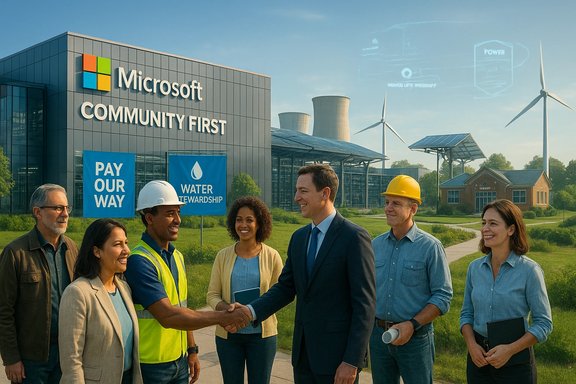
Microsoft’s new “Community‑First” pledge for AI datacenters landed with the kind of theatrical polish Microsoft excels at, but the reaction from the ground — from grassroots activists to snarky social feeds and skeptical local officials — made one thing clear: promises alone will not persuade communities that have seen resource strains, tax gamesmanship, and unkept sustainability claims before.
The past three years have turned hyperscale datacenters into the physical infrastructure of an AI economy. Running modern generative AI at scale requires far more GPUs, power and cooling than traditional cloud workloads, which drives an unprecedented demand for electrified, water‑cooled facilities. Microsoft itself told investors and the public that it planned an enormous buildout to meet that demand — a fiscal‑year commitment widely reported as roughly $80 billion in AI data‑center spending. That spending and the localized impacts it produces — higher grid load, new transmission lines, industrial cooling water needs, construction booms, and rapid land‑use change — have triggered a cascade of community pushback, permitting delays, and political scrutiny in multiple U.S. states. Independent industry channel checks also reported that Microsoft paused or canceled some leases and conversions for new capacity midstream, a signal investors and analysts flagged as evidence of reassessment amid oversupply concerns and shifting partner relationships. Against this backdrop Microsoft President and Vice Chair Brad Smith published a detailed plan called “Community‑First AI Infrastructure” on January 13, 2026, positioning the company’s next phase of datacenter expansion as an effort to be a better neighbor. The plan is explicit: five commitments that include paying so datacenters don’t raise household electricity prices, minimizing and replenishing water use, creating local jobs, contributing to local tax bases, and investing in AI training and nonprofits.
Key community grievances rest on three cores of experience:
Source: Windows Central Microsoft's "Community-First" AI data centers claims mocked
 Background: why datacenters wound up at the center of a political and social storm
The past three years have turned hyperscale datacenters into the physical infrastructure of an AI economy. Running modern generative AI at scale requires far more GPUs, power and cooling than traditional cloud workloads, which drives an unprecedented demand for electrified, water‑cooled facilities. Microsoft itself told investors and the public that it planned an enormous buildout to meet that demand — a fiscal‑year commitment widely reported as roughly $80 billion in AI data‑center spending. That spending and the localized impacts it produces — higher grid load, new transmission lines, industrial cooling water needs, construction booms, and rapid land‑use change — have triggered a cascade of community pushback, permitting delays, and political scrutiny in multiple U.S. states. Independent industry channel checks also reported that Microsoft paused or canceled some leases and conversions for new capacity midstream, a signal investors and analysts flagged as evidence of reassessment amid oversupply concerns and shifting partner relationships. Against this backdrop Microsoft President and Vice Chair Brad Smith published a detailed plan called “Community‑First AI Infrastructure” on January 13, 2026, positioning the company’s next phase of datacenter expansion as an effort to be a better neighbor. The plan is explicit: five commitments that include paying so datacenters don’t raise household electricity prices, minimizing and replenishing water use, creating local jobs, contributing to local tax bases, and investing in AI training and nonprofits. What Microsoft formally promised — the facts, verified
Microsoft’s post lays out a structured set of commitments and operational targets for its U.S. datacenters. These aren’t marketing blurbs; they include specific operational pledges and metrics the company says it will pursue:- No pass‑through on household electricity rates: Microsoft says it will “pay our way” so its datacenters don’t increase local residential prices, working with utilities on rate design and infrastructure expansion rather than seeking subsidized residential rates.
- Water‑use reduction and replenishment: The company commits to a 40% improvement in datacenter water‑use intensity by 2030, will deploy closed‑loop cooling designs and alternatives that reduce potable water use, and intends to replenish more water than specific facilities withdraw.
- Local economic benefits: Microsoft promises to create construction and operational jobs, expand its Datacenter Academy-style partnerships for local workforce training, and invest in libraries, community colleges and nonprofit programs near its sites.
- Tax and fiscal commitments: The company says it will contribute to local tax bases, avoid seeking tax deals that shift costs onto other taxpayers, and be transparent about property and other payments.
- Community investments in AI literacy: Microsoft pledges to fund AI training centers, local nonprofits and K‑12/college AI literacy programs so host communities can tangibly benefit from proximity to AI infrastructure.
What critics and communities say — grievances, mockery and a history of skepticism
Public response ranged from guarded optimism among some mayors to outright ridicule in parts of the tech press and on social media. A recent feature in Windows Central captured the tone from many grassroots and skeptical corners: the plan was labeled corporate PR dressed up as remediation for harms residents already anticipate — higher utility bills, water stress, gentrification, and jobs lost to automation — and the coverage warned that Microsoft’s track record on sustainability and community promises leaves room for doubt.Key community grievances rest on three cores of experience:
- Energy and rates: Local utilities historically reallocate cost across rate classes when a new “very large” customer lands. Communities that once accepted modest datacenter projects now worry those deals hide cross‑subsidies, back‑door rate shifts, and new transmission costs that ultimately affect residential bills.
- Water and environment: AI datacenters’ cooling needs — especially in hotter months — can put pressure on local water supplies. Communities in drought‑prone regions view even “closed‑loop” cooling claims with suspicion until they see audited usage reports.
- Economics and inequality: The construction phase brings cash and jobs, but permanent operations usually employ far fewer people. Locals worry about transient benefits that leave long‑term social costs — rising rents, pressure on services, and the risk of becoming a company‑town without robust protections. Critics also tie Microsoft’s AI push into broader debates on labor displacement, automation, and corporate concentration.
Verifying the numbers and claims — cross‑checking the big assertions
Several of the most consequential claims are verifiable against independent reporting and company disclosures:- $80 billion spending plan — Microsoft’s expectation of roughly $80 billion in AI‑grade datacenter spending in FY2025 has been reported broadly and independently by major business outlets. CNBC and Bloomberg documented Microsoft’s fiscal commitment in early 2025, confirming the public, company‑level statement about large capital expenditures for AI infrastructure.
- Lease cancellations and capacity reassessment — Channel checks reported in investor notes (TD Cowen) and picked up by Bloomberg and other financial outlets indicate Microsoft canceled or allowed to lapse multiple leases totaling hundreds of megawatts — evidence that the company has adjusted its footprint plans amid shifting demand and partner dynamics. Those reports corroborate each other but are based on third‑party channel checks rather than explicit Microsoft disclosure. Treat them as informed but not definitive until Microsoft confirms.
- Water‑use targets and closed‑loop cooling — Microsoft’s own blog commits to a 40% improvement in datacenter water‑use intensity by 2030 and describes closed‑loop, non‑potable cooling designs already deployed in some sites. Those technical claims come from Microsoft’s sustainability and engineering teams; they are specific targets and documented in the company’s post. Independent verification — for example via utility or municipal water‑use audits — would be required to confirm real‑world performance at each site.
- Emissions and sustainability track record — Microsoft’s sustainability reports confirm ambitious targets (carbon‑negative by 2030, removal of historical emissions by 2050) and also acknowledge that Scope‑3 emissions rose materially as the company expanded datacenters and hardware procurement. Independent trackers and analysts have noted that Microsoft’s absolute emissions increased amid growth, even as operational (Scope 1/2) improvements and renewable contracts progressed. That history is why many watchdogs argue Microsoft must back community pledges with audited, independent metrics.
Strengths of the Community‑First plan — what’s real and potentially valuable
Microsoft’s proposal is not purely performative. Several elements are technically and politically meaningful:- Explicit rate and tax commitments narrow a key negotiation vector: by publicly committing to “pay our way” and avoid seeking subsidies that shift costs to residents, Microsoft raises the bar for what developers should accept in good governance. That matters for municipalities negotiating host‑community agreements.
- Concrete water targets and engineering fixes — the 40% water intensity improvement target and adoption of closed‑loop cooling are tangible engineering commitments that can be measured, audited and improved. If implemented and independently verified, they could materially reduce stress on local freshwater systems.
- Local workforce and training investments: Datacenter Academies and partnerships with community colleges have proven to deliver local certified technicians in some regions; replicating and scaling those programs — with binding local hiring targets — could be a net positive for communities.
- Public positioning and regulatory engagement: By anchoring the initiative in formal public commitments and policy advocacy, Microsoft creates an auditable trail and a political narrative that makes it harder to quietly extract subsidies or dodge local concerns.
The unresolved risks and where corporate promises often fail
Promises can be powerful — but they are not substitutes for enforceable conditions. The plan leaves several open risks:- Rate redesign complexity: Utilities and regulatory commissions set rates; corporate commitments to “pay more” are meaningful only when formalized in tariffs, interconnection agreements, or community benefit agreements. Without binding regulatory filings, pledges can be renegotiated or undermined by future rate cases.
- Accounting and measurement gaps: Water‑use intensity and “replenishment” can be defined in many ways. Closed‑loop systems reduce potable water needs but still require makeup water and energy for pumps. Companies sometimes offset local withdrawals by remote replenishment projects, which may not materially relieve local watershed stress. Independent, place‑based monitoring is essential.
- Tax deals and local bargaining power: Microsoft’s public refusal to accept tax reductions in principle helps, but the reality of corporate tax negotiations is complicated; municipalities often compete fiercely for investment. The best protection for communities is to insist on visible, written, and enforceable benefit packages that are not easily revoked.
- Operational permanence vs transient benefits: Construction booms deliver a flood of temporary jobs and local demand, but operational employment for datacenters is modest. Communities can be left with infrastructure costs long after construction ends unless long‑term planning and revenue streams (e.g., property taxes, community reinvestment) are secured.
- Trust deficit and credibility risk: Microsoft’s sustainability disclosures themselves show absolute emissions can rise amid growth even while intensity metrics improve; this history gives critics ammunition to call new promises “greenwashing” unless independent audits and transparent reporting accompany them.
Practical guardrails: what communities, regulators and journalists should insist on
If communities want to turn promises into durable protections, the negotiating checklist should include binding, measurable, and enforceable items:- Place‑based, legally binding Community Benefit Agreements (CBAs) that include:
- Direct local hiring targets and apprenticeship quotas tied to construction and operations.
- Enforceable property‑tax commitments and a schedule for payments.
- A transparent escrow or penalty mechanism if commitments aren’t met.
- Independent environmental monitoring with:
- Real‑time public dashboards for electricity consumption, power factor, and water withdrawals measured at the facility level.
- Third‑party audits of water reclamation/replenishment claims and published annual reports.
- Utility tariff transparency and regulatory filings:
- Require the company and utilities to file interconnection and rate proposals publicly, with impact studies showing distribution and residential bill effects.
- Condition any municipal approvals on regulatory engagement that prevents hidden cross‑subsidization.
- Sunset clauses and contingency planning:
- If a site is idled or operations decline, require remediation funds and obligations for site reuse and community transition support.
- Data‑use and AI governance commitments for local communities:
- If training or AI services are co‑located, require clarity on data flows, privacy protections, and non‑monetary community access to AI tools for local benefit.
What Microsoft owes the public — beyond glossy pledges
For the Community‑First plan to move from rhetoric to credibility, Microsoft should do three things at minimum:- Publish a publicly auditable timeline with granular metrics (monthly water use per site, power draw, workforce hiring by ZIP code) and commit to third‑party verification.
- File and defend concrete regulatory tariff proposals that demonstrate the company is not shifting grid upgrade costs onto residential ratepayers.
- Offer legally enforceable CBAs, not only in markets where it seeks political goodwill but in every jurisdiction where it builds.
Conclusion: a narrow path from skepticism to credible community partnership
Microsoft’s Community‑First AI Infrastructure is an acknowledgement of the tradeoffs of modern AI — and a signal that hyperscalers now see community acceptance as a non‑negotiable part of infrastructure strategy. The plan contains meaningful, measurable commitments — water intensity targets, closed‑loop cooling, local training and stated tax behavior — and those are worth pursuing and testing. Yet the credibility gap is large. The company’s historical trajectory on absolute emissions, the messy reality of municipal bargaining, and third‑party reports about lease cancellations and recalibrated expansion all mean local leaders should treat pledges as the start of a negotiation, not the end. Independent audits, binding legal agreements, and visible utilities and water monitoring are the practical instruments that will determine whether communities actually benefit — or merely inherit new burdens with a better corporate press release. This is a test of governance as much as engineering. The AI era will be defined not only by who builds the biggest models, but by who builds the most resilient social contracts around the infrastructure those models require. Microsoft’s new plan could be a template for that work — or another lesson in why communities and watchdogs must insist on measurements, enforceability, and independent oversight before believing the next big promise.Source: Windows Central Microsoft's "Community-First" AI data centers claims mocked
