

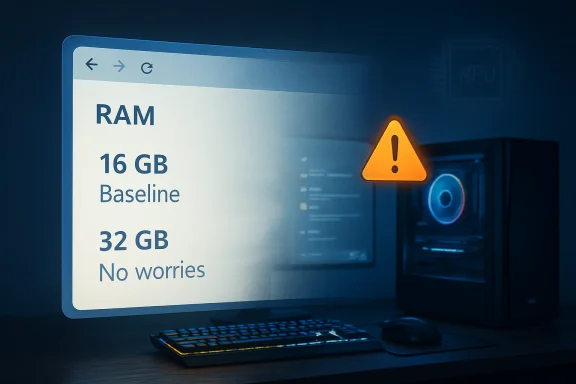
Microsoft briefly published Windows 11 gaming guidance in early May 2026 describing 16GB of RAM as the practical baseline and 32GB as the “no worries” upgrade, then removed the page after PC hardware sites and users noticed the recommendation. That sequence matters more than the number itself. The 32GB line was not an official new Windows 11 minimum, but it landed because it sounded like Microsoft had accidentally said the quiet part out loud. Windows 11 is still sold as broadly accessible software; Microsoft’s own messaging increasingly describes it like a platform that expects users to buy their way out of its weight.
The obvious defense of Microsoft is also the weakest one: 32GB is not an outrageous amount of RAM for a serious gaming PC in 2026. Anyone who plays modern open-world games, keeps Discord open, records clips, streams, runs a browser, and leaves half a launcher ecosystem idling in the background knows that 16GB is no longer the luxurious target it once was. The industry has moved, game assets have ballooned, and multitasking has become the default state of the PC.
But that is not why the post detonated. It detonated because Microsoft is not a neutral PC-building YouTuber offering shopping advice. Microsoft is the steward of the operating system sitting underneath the game, the launchers, the overlays, the browser, the capture tools, the driver stack, and now the AI assistantry it keeps trying to normalize. When Microsoft says 32GB is the “no worries” tier, users hear more than a memory buying guide. They hear the vendor responsible for the platform telling them that the platform’s appetite is now their problem.
That is the uncomfortable subtext PC Perspective seized on in its ICYMI item. Microsoft did not change the Windows 11 minimum requirement from 4GB. It did not formally tell every gamer that 32GB is mandatory. But it briefly published language that made the gap between minimum support and comfortable real-world use impossible to ignore.
The company can delete the page, but it cannot delete the mood around it. Windows enthusiasts have spent years watching Microsoft add services, ads, prompts, cloud hooks, AI features, account requirements, background experiences, and telemetry infrastructure while insisting that each individual addition is small, optional, helpful, or misunderstood. The complaint is cumulative: users are not reacting only to one deleted RAM recommendation. They are reacting to the long-running sense that Windows 11 is becoming heavier while Microsoft describes that heaviness as progress.
The distinction matters. Windows 11’s published minimum remains 4GB of RAM, with Microsoft’s support material still presenting that as the floor for installation. Copilot+ PCs, meanwhile, require substantially more: 16GB of RAM, 256GB of storage, and a neural processing unit capable of Microsoft’s AI feature set. Those two worlds now coexist uneasily in Microsoft’s messaging. One says Windows 11 can run on modest hardware; the other says the experience Microsoft most wants to sell begins at a much higher tier.
The gaming page collapsed those worlds into a single uncomfortable sentence. If 16GB is the baseline for gaming and 32GB is the stress-free level, the official 4GB minimum becomes less a meaningful promise than a legal threshold. It says the OS can install, not that the machine will feel good, age well, or avoid swapping itself into molasses under ordinary modern use.
That is not unique to Windows. Minimum specs have always been aspirationally low across the software industry. The difference is that Windows is infrastructure, not just an app. When a game publisher says 16GB recommended, the user can decide whether that one title is worth it. When Microsoft’s ecosystem nudges the entire PC baseline upward, the user sees the bill arrive from every direction at once.
Deleting the page therefore made the story worse, not better. If the language was wrong, Microsoft could have corrected it. If it was right but poorly phrased, Microsoft could have explained the distinction between Windows requirements and gaming recommendations. Instead, the disappearance gave the internet exactly what it loves: the scent of a corporate retreat.
Had the company left the page up, the story might have remained a short-lived hardware debate: is 32GB now sensible for gaming, or is 16GB still enough? That argument is already familiar, and in many cases boring. Different games behave differently, integrated graphics can borrow memory, browsers are gluttonous, launchers multiply like weeds, and a clean Windows install is not the same thing as a vendor-loaded laptop image. There is no single RAM answer that applies to every gamer.
But the takedown shifted the conversation from hardware sizing to corporate credibility. Users asked why the page vanished. Was Microsoft embarrassed by the recommendation? Was the article generated or assisted by AI and published with too little review? Did the company realize that recommending Copilot+ PCs for gaming sounded absurd to people who know the difference between an NPU and a discrete GPU? Was the company trying to scrub an inconvenient admission during a period of painful memory prices?
Some of those theories are stronger than others. The point is that Microsoft invited them by leaving the story under-explained. A company of Microsoft’s scale cannot behave like a small blog quietly editing a sloppy post. Its documentation, learning center material, and product guidance are treated as signals. When those signals disappear, the disappearance becomes the signal.
This is the modern Microsoft communications trap. The company wants to speak in friendly, SEO-shaped consumer language, but its words are parsed by sysadmins, OEMs, procurement teams, gamers, journalists, and power users who have learned to distrust softness. A phrase like “no worries” reads less like helpful advice and more like marketing copy trying to smuggle in a new normal.
That does not make the minimum dishonest by itself. Operating system vendors define minimums for installation, servicing, and basic function. They do not define the point at which a browser with ten tabs, Teams, OneDrive sync, a game launcher, a security suite, and a Windows Update cycle all coexist gracefully. The minimum is the door handle, not the room.
The problem is that Microsoft benefits from the optimistic reading of that minimum while increasingly designing for the premium reading of the platform. Windows 11 is officially lightweight enough to install on 4GB. Microsoft’s most advertised future-facing experiences, especially around local AI, assume hardware far beyond that. Gaming guidance that points users toward 32GB merely exposes the split.
That split affects perception. When users complain that Windows feels bloated, Microsoft can answer with benchmarks, memory compression details, idle process explanations, and claims about modern resource management. Some of that technical defense is valid. Windows is doing more than it used to do, and many background tasks are there for security, sync, compatibility, device management, and recoverability.
But the lived experience is not a white paper. If a user opens Task Manager on a new laptop and sees a dense thicket of processes before launching anything meaningful, they do not feel reassured by the explanation that memory is there to be used. They feel that the operating system arrived with roommates.
Yet the symbolism is brutal. Users who already think Windows is carrying too much baggage see AI arriving not as a productivity breakthrough, but as another layer of services they did not ask for. Microsoft sees a platform transition. Skeptics see more background hooks, more cloud prompts, more upsell surfaces, and more justification for premium hardware.
That is why the Copilot+ angle is so volatile. Copilot+ PCs are primarily about NPUs and on-device AI workloads, not about traditional gaming performance. A good gaming PC is still defined first by GPU performance, CPU capability, thermals, display quality, driver support, and memory configuration. An NPU may be useful for certain AI tasks, but it does not make a thin-and-light notebook a gaming rig.
So when Microsoft-adjacent consumer guidance appears to recommend Copilot+ machines as attractive gaming choices, the audience hears category confusion. It sounds like the company is trying to make every road lead back to its AI hardware narrative, even when the use case belongs to an older and better-understood performance hierarchy. Gamers know what a GPU is. They also know when a marketing department is trying to make a new badge do too much work.
This is the cost of making AI the default seasoning for every Windows conversation. Even sensible advice starts to look suspect. A 32GB gaming recommendation might have been read as ordinary enthusiast guidance five years ago. In 2026, it is read through the lens of Copilot, Recall controversies, cloud account pressure, and Microsoft’s desire to turn the PC into an AI endpoint.
Microsoft’s increasing insistence on internet connectivity and Microsoft account sign-in during consumer Windows 11 setup has been framed as security, recovery, sync, and user convenience. Those are not imaginary benefits. Account-backed device recovery, BitLocker key escrow, app sync, parental controls, and identity-based services can help many users, especially non-technical ones.
But power users and IT pros notice the direction of travel. Local setup has become harder to find, harder to explain, and more dependent on workarounds. A clean install now often feels less like claiming ownership of a machine and more like negotiating with a cloud service before the desktop is even available.
That matters because Windows historically won the PC partly by being permissive. You could build a box from parts, install the OS, avoid the vendor account ecosystem, and make the machine yours. Microsoft still supports enormous flexibility compared with locked-down mobile platforms, but the consumer setup experience increasingly gestures toward a different model: identity first, services first, desktop second.
Memory pressure fits into that same resentment because users see both as forms of creep. The account requirement consumes autonomy. The background services consume resources. The AI features consume attention. The hardware recommendations consume budget. Each can be justified in isolation; together they create a sense that Windows is drifting away from the user who wants a fast, local, quiet operating system.
But the timing is poisonous. Memory pricing has been under pressure from AI infrastructure demand, supply constraints, and the industry’s shift toward higher-value components. For consumers, that means the upgrade path is no longer a casual $40 decision. For laptop buyers, it is worse: soldered memory turns the choice into a point-of-purchase tax, often attached to higher storage tiers or premium configurations.
That is where “no worries” becomes a loaded phrase. A desktop owner with open DIMM slots can treat 32GB as a reasonable medium-term upgrade. A student buying a laptop, a parent configuring a family machine, or a small business replacing a fleet sees something different. They see Microsoft normalizing a tier that OEMs may use to push more expensive models.
The pain is especially sharp in gaming laptops. Many machines still ship with 16GB, sometimes upgradeable, sometimes not. Models with 32GB often sit higher in the stack, paired with better GPUs, larger SSDs, or premium panels that push the total price far beyond the cost of the RAM itself. The user is not merely buying memory; they are buying into a pricing ladder.
Microsoft did not create the RAM market. It did not force OEMs to solder memory. It did not make Unreal Engine assets bigger, browser tabs heavier, or Discord an Electron-shaped space heater. But when the platform owner blesses 32GB as the anxiety-free tier, it gives the whole market permission to treat 16GB as yesterday’s compromise.
That does not mean Windows is about to lose the gaming desktop. Anti-cheat compatibility remains uneven. Some multiplayer titles are still effectively Windows-only. Vendor utilities, RGB control panels, capture workflows, VR support, mod tools, and niche peripherals can be easier or only practical on Windows. The inertia is massive, and DirectX remains a gravitational force.
But alternatives do not need to conquer the market to discipline Microsoft’s behavior. They only need to become plausible enough that enthusiasts can credibly say, “I have somewhere else to go.” SteamOS on handhelds already changed expectations around what a console-like PC gaming experience can feel like. Bazzite and similar distributions build on that by offering a more desktop-oriented path for users who want the gaming stack without the Windows baggage.
The irony is that Microsoft helped create the opening. The more Windows feels like a service platform optimized around Microsoft accounts, AI surfaces, and monetizable engagement, the more attractive a narrower gaming-focused OS becomes. Users who once tolerated Windows because it was the path of least resistance are now at least curious about whether the path has moved.
Linux still asks users to accept tradeoffs. Windows increasingly asks users to accept Microsoft’s priorities. The difference is that one set of tradeoffs is chosen by the enthusiast, while the other is imposed by the incumbent.
Users remember. They remember forced account flows, Start menu experiments, default app friction, ads in system surfaces, Copilot placement, Recall’s first impression, and the slow expansion of cloud-tethered assumptions. Even when Microsoft adjusts course, the memory that it tried becomes part of the next reaction.
The deleted 32GB guidance slots into that archive. If Microsoft says the page was an error, users will ask why error-prone content reached a public Microsoft domain. If Microsoft says the advice was broadly accurate, users will ask why the company removed it. If Microsoft says nothing, users will fill the silence with the least charitable interpretation available.
This is the penalty for accumulated skepticism. Microsoft cannot rely on users to assume good faith when so many recent Windows debates have involved the company testing boundaries first and explaining later. The burden shifts. Instead of users needing to prove Microsoft meant something bad, Microsoft has to prove that it understands why the reaction happened.
That is hard for a company whose Windows strategy is pulled between incompatible audiences. Consumers want simplicity. Enthusiasts want control. OEMs want sellable feature tiers. Enterprises want manageability and predictability. Microsoft wants AI adoption, cloud attachment, security hardening, and recurring services revenue. Windows is the place where all those incentives collide.
Enterprise fleets are not built around “no worries” gaming configurations, but they are affected by the same memory inflation. Teams, Edge, Office, endpoint protection, device management agents, VPN clients, collaboration tools, browser-based line-of-business apps, and security telemetry can make 8GB feel tight and 16GB feel merely adequate. Add developer tooling, virtual machines, data analysis, or creative workloads, and the old client hardware assumptions collapse quickly.
The lesson for IT is not that every employee needs 32GB. It is that Windows endpoint planning can no longer treat RAM as a static line item. The lifecycle of a business laptop often stretches three to five years. A machine bought with “enough” memory in 2026 must survive the software expectations of 2029 or 2030, and soldered memory makes that bet irreversible.
Microsoft’s messaging complicates procurement because it creates two baselines: the official support baseline and the experience baseline. IT departments already know the difference, but vendor language influences budget conversations. A CFO may see that Windows 11 runs on 4GB. A help desk sees the ticket queue from 8GB machines running modern collaboration stacks. A security team sees the need for agents that consume more resources, not fewer.
The practical result is that 16GB is becoming the sane enterprise floor for knowledge workers, while 32GB is increasingly defensible for developers, analysts, engineers, power users, and anyone expected to keep a modern collaboration environment open all day. That was true before Microsoft’s deleted page. The controversy simply gave IT pros another awkward example to bring into budget meetings.
The better critique is narrower and more damning. Microsoft is presiding over a Windows era in which the comfortable hardware floor keeps rising while the company spends its political capital on features many users experience as clutter. That does not mean every new feature is useless. It means Microsoft has failed to persuade a large and technically literate part of its audience that the tradeoff is worth it.
Performance is not only about benchmarks. It is about confidence. Users want to believe that the operating system vendor is fighting on their behalf: trimming waste, reducing background noise, protecting local choice, and making old hardware last where possible. When Microsoft instead appears to say “buy more RAM,” it confirms the fear that optimization has been replaced by hardware escalation.
This is why the PC Perspective framing resonates even if its tone is openly exasperated. The anger is not the pure technical claim that Windows 11 alone needs 32GB. It is the suspicion that Microsoft would rather normalize higher requirements than make the OS feel leaner, quieter, and more respectful.
The company’s defenders can point out, correctly, that games and apps are major memory consumers. They can point out that unused RAM is wasted RAM, that caching improves responsiveness, that 32GB desktops are common among enthusiasts, and that no serious gaming build in 2026 should be planned around 4GB or 8GB. All true. None of it answers the trust problem.
Source: PC Perspective ICYMI - Microsoft Definitely Never Said You Want 32GB Of RAM To Run Win11 - PC Perspective
 Microsoft’s Memory Problem Is Really a Trust Problem
The obvious defense of Microsoft is also the weakest one: 32GB is not an outrageous amount of RAM for a serious gaming PC in 2026. Anyone who plays modern open-world games, keeps Discord open, records clips, streams, runs a browser, and leaves half a launcher ecosystem idling in the background knows that 16GB is no longer the luxurious target it once was. The industry has moved, game assets have ballooned, and multitasking has become the default state of the PC.But that is not why the post detonated. It detonated because Microsoft is not a neutral PC-building YouTuber offering shopping advice. Microsoft is the steward of the operating system sitting underneath the game, the launchers, the overlays, the browser, the capture tools, the driver stack, and now the AI assistantry it keeps trying to normalize. When Microsoft says 32GB is the “no worries” tier, users hear more than a memory buying guide. They hear the vendor responsible for the platform telling them that the platform’s appetite is now their problem.
That is the uncomfortable subtext PC Perspective seized on in its ICYMI item. Microsoft did not change the Windows 11 minimum requirement from 4GB. It did not formally tell every gamer that 32GB is mandatory. But it briefly published language that made the gap between minimum support and comfortable real-world use impossible to ignore.
The company can delete the page, but it cannot delete the mood around it. Windows enthusiasts have spent years watching Microsoft add services, ads, prompts, cloud hooks, AI features, account requirements, background experiences, and telemetry infrastructure while insisting that each individual addition is small, optional, helpful, or misunderstood. The complaint is cumulative: users are not reacting only to one deleted RAM recommendation. They are reacting to the long-running sense that Windows 11 is becoming heavier while Microsoft describes that heaviness as progress.
The Deleted Page Said Less Than the Reaction Revealed
The now-removed guidance appears to have framed 16GB as the baseline for PC gaming and 32GB as the safer, more future-proof amount for users who want headroom. That is plausible advice if the speaker is a system integrator. It is combustible advice if the speaker is Microsoft.The distinction matters. Windows 11’s published minimum remains 4GB of RAM, with Microsoft’s support material still presenting that as the floor for installation. Copilot+ PCs, meanwhile, require substantially more: 16GB of RAM, 256GB of storage, and a neural processing unit capable of Microsoft’s AI feature set. Those two worlds now coexist uneasily in Microsoft’s messaging. One says Windows 11 can run on modest hardware; the other says the experience Microsoft most wants to sell begins at a much higher tier.
The gaming page collapsed those worlds into a single uncomfortable sentence. If 16GB is the baseline for gaming and 32GB is the stress-free level, the official 4GB minimum becomes less a meaningful promise than a legal threshold. It says the OS can install, not that the machine will feel good, age well, or avoid swapping itself into molasses under ordinary modern use.
That is not unique to Windows. Minimum specs have always been aspirationally low across the software industry. The difference is that Windows is infrastructure, not just an app. When a game publisher says 16GB recommended, the user can decide whether that one title is worth it. When Microsoft’s ecosystem nudges the entire PC baseline upward, the user sees the bill arrive from every direction at once.
Deleting the page therefore made the story worse, not better. If the language was wrong, Microsoft could have corrected it. If it was right but poorly phrased, Microsoft could have explained the distinction between Windows requirements and gaming recommendations. Instead, the disappearance gave the internet exactly what it loves: the scent of a corporate retreat.
The Streisand Effect Runs on Corporate Ambiguity
The Streisand Effect does not require a conspiracy. It requires a gap between what an institution does and what its audience thinks that action means. Microsoft’s removal of the RAM guidance created precisely that gap.Had the company left the page up, the story might have remained a short-lived hardware debate: is 32GB now sensible for gaming, or is 16GB still enough? That argument is already familiar, and in many cases boring. Different games behave differently, integrated graphics can borrow memory, browsers are gluttonous, launchers multiply like weeds, and a clean Windows install is not the same thing as a vendor-loaded laptop image. There is no single RAM answer that applies to every gamer.
But the takedown shifted the conversation from hardware sizing to corporate credibility. Users asked why the page vanished. Was Microsoft embarrassed by the recommendation? Was the article generated or assisted by AI and published with too little review? Did the company realize that recommending Copilot+ PCs for gaming sounded absurd to people who know the difference between an NPU and a discrete GPU? Was the company trying to scrub an inconvenient admission during a period of painful memory prices?
Some of those theories are stronger than others. The point is that Microsoft invited them by leaving the story under-explained. A company of Microsoft’s scale cannot behave like a small blog quietly editing a sloppy post. Its documentation, learning center material, and product guidance are treated as signals. When those signals disappear, the disappearance becomes the signal.
This is the modern Microsoft communications trap. The company wants to speak in friendly, SEO-shaped consumer language, but its words are parsed by sysadmins, OEMs, procurement teams, gamers, journalists, and power users who have learned to distrust softness. A phrase like “no worries” reads less like helpful advice and more like marketing copy trying to smuggle in a new normal.
Windows 11’s Minimum Spec Was Never the Experience Spec
Windows 11’s 4GB minimum RAM requirement has always occupied a strange place in the product’s story. It is high enough to exclude some ancient hardware from the conversation, but low enough to imply that Windows 11 remains accessible to ordinary PCs. In practice, nobody who cares about responsiveness should be buying or deploying a 4GB Windows 11 machine in 2026 unless the workload is extremely constrained.That does not make the minimum dishonest by itself. Operating system vendors define minimums for installation, servicing, and basic function. They do not define the point at which a browser with ten tabs, Teams, OneDrive sync, a game launcher, a security suite, and a Windows Update cycle all coexist gracefully. The minimum is the door handle, not the room.
The problem is that Microsoft benefits from the optimistic reading of that minimum while increasingly designing for the premium reading of the platform. Windows 11 is officially lightweight enough to install on 4GB. Microsoft’s most advertised future-facing experiences, especially around local AI, assume hardware far beyond that. Gaming guidance that points users toward 32GB merely exposes the split.
That split affects perception. When users complain that Windows feels bloated, Microsoft can answer with benchmarks, memory compression details, idle process explanations, and claims about modern resource management. Some of that technical defense is valid. Windows is doing more than it used to do, and many background tasks are there for security, sync, compatibility, device management, and recoverability.
But the lived experience is not a white paper. If a user opens Task Manager on a new laptop and sees a dense thicket of processes before launching anything meaningful, they do not feel reassured by the explanation that memory is there to be used. They feel that the operating system arrived with roommates.
AI Makes the Bloat Argument Harder to Dismiss
Microsoft’s AI push has made every resource conversation more politically charged. Notepad with AI features is not a catastrophic memory event. Paint with generative tools is not the reason a game stutters. Copilot integration is not, by itself, the full explanation for why a budget laptop feels cramped.Yet the symbolism is brutal. Users who already think Windows is carrying too much baggage see AI arriving not as a productivity breakthrough, but as another layer of services they did not ask for. Microsoft sees a platform transition. Skeptics see more background hooks, more cloud prompts, more upsell surfaces, and more justification for premium hardware.
That is why the Copilot+ angle is so volatile. Copilot+ PCs are primarily about NPUs and on-device AI workloads, not about traditional gaming performance. A good gaming PC is still defined first by GPU performance, CPU capability, thermals, display quality, driver support, and memory configuration. An NPU may be useful for certain AI tasks, but it does not make a thin-and-light notebook a gaming rig.
So when Microsoft-adjacent consumer guidance appears to recommend Copilot+ machines as attractive gaming choices, the audience hears category confusion. It sounds like the company is trying to make every road lead back to its AI hardware narrative, even when the use case belongs to an older and better-understood performance hierarchy. Gamers know what a GPU is. They also know when a marketing department is trying to make a new badge do too much work.
This is the cost of making AI the default seasoning for every Windows conversation. Even sensible advice starts to look suspect. A 32GB gaming recommendation might have been read as ordinary enthusiast guidance five years ago. In 2026, it is read through the lens of Copilot, Recall controversies, cloud account pressure, and Microsoft’s desire to turn the PC into an AI endpoint.
The Local Account Fight Is Part of the Same Story
The anger around Windows 11 setup is not separate from the RAM controversy. It is part of the same broader argument over who controls the PC.Microsoft’s increasing insistence on internet connectivity and Microsoft account sign-in during consumer Windows 11 setup has been framed as security, recovery, sync, and user convenience. Those are not imaginary benefits. Account-backed device recovery, BitLocker key escrow, app sync, parental controls, and identity-based services can help many users, especially non-technical ones.
But power users and IT pros notice the direction of travel. Local setup has become harder to find, harder to explain, and more dependent on workarounds. A clean install now often feels less like claiming ownership of a machine and more like negotiating with a cloud service before the desktop is even available.
That matters because Windows historically won the PC partly by being permissive. You could build a box from parts, install the OS, avoid the vendor account ecosystem, and make the machine yours. Microsoft still supports enormous flexibility compared with locked-down mobile platforms, but the consumer setup experience increasingly gestures toward a different model: identity first, services first, desktop second.
Memory pressure fits into that same resentment because users see both as forms of creep. The account requirement consumes autonomy. The background services consume resources. The AI features consume attention. The hardware recommendations consume budget. Each can be justified in isolation; together they create a sense that Windows is drifting away from the user who wants a fast, local, quiet operating system.
The Price of RAM Turns Guidance Into a Class Marker
If RAM were cheap, this story would have less oxygen. The move from 16GB to 32GB would feel like another routine step in the long history of PC baseline inflation. We have been here before with 512MB, 2GB, 4GB, 8GB, and 16GB. The PC always grows into its hardware.But the timing is poisonous. Memory pricing has been under pressure from AI infrastructure demand, supply constraints, and the industry’s shift toward higher-value components. For consumers, that means the upgrade path is no longer a casual $40 decision. For laptop buyers, it is worse: soldered memory turns the choice into a point-of-purchase tax, often attached to higher storage tiers or premium configurations.
That is where “no worries” becomes a loaded phrase. A desktop owner with open DIMM slots can treat 32GB as a reasonable medium-term upgrade. A student buying a laptop, a parent configuring a family machine, or a small business replacing a fleet sees something different. They see Microsoft normalizing a tier that OEMs may use to push more expensive models.
The pain is especially sharp in gaming laptops. Many machines still ship with 16GB, sometimes upgradeable, sometimes not. Models with 32GB often sit higher in the stack, paired with better GPUs, larger SSDs, or premium panels that push the total price far beyond the cost of the RAM itself. The user is not merely buying memory; they are buying into a pricing ladder.
Microsoft did not create the RAM market. It did not force OEMs to solder memory. It did not make Unreal Engine assets bigger, browser tabs heavier, or Discord an Electron-shaped space heater. But when the platform owner blesses 32GB as the anxiety-free tier, it gives the whole market permission to treat 16GB as yesterday’s compromise.
Linux Gaming Is No Longer an Empty Threat
PC Perspective’s closing jab about Bazzite and SteamOS lands because Linux gaming is no longer the punchline it once was. Valve’s Proton work, the Steam Deck, modern Mesa drivers, and gaming-focused distributions have made Linux a credible option for a meaningful slice of PC gamers. It is not universal, and it is not frictionless, but it is no longer a weekend science project reserved for people who enjoy editing config files at 2 a.m.That does not mean Windows is about to lose the gaming desktop. Anti-cheat compatibility remains uneven. Some multiplayer titles are still effectively Windows-only. Vendor utilities, RGB control panels, capture workflows, VR support, mod tools, and niche peripherals can be easier or only practical on Windows. The inertia is massive, and DirectX remains a gravitational force.
But alternatives do not need to conquer the market to discipline Microsoft’s behavior. They only need to become plausible enough that enthusiasts can credibly say, “I have somewhere else to go.” SteamOS on handhelds already changed expectations around what a console-like PC gaming experience can feel like. Bazzite and similar distributions build on that by offering a more desktop-oriented path for users who want the gaming stack without the Windows baggage.
The irony is that Microsoft helped create the opening. The more Windows feels like a service platform optimized around Microsoft accounts, AI surfaces, and monetizable engagement, the more attractive a narrower gaming-focused OS becomes. Users who once tolerated Windows because it was the path of least resistance are now at least curious about whether the path has moved.
Linux still asks users to accept tradeoffs. Windows increasingly asks users to accept Microsoft’s priorities. The difference is that one set of tradeoffs is chosen by the enthusiast, while the other is imposed by the incumbent.
Microsoft Keeps Mistaking Reversal for Repair
One of the recurring patterns in Windows 11 has been Microsoft pushing an unpopular change, waiting for backlash, softening or reversing the edge, and then moving on as if the underlying trust damage were resolved. That works for individual controversies. It does not work as a governance model.Users remember. They remember forced account flows, Start menu experiments, default app friction, ads in system surfaces, Copilot placement, Recall’s first impression, and the slow expansion of cloud-tethered assumptions. Even when Microsoft adjusts course, the memory that it tried becomes part of the next reaction.
The deleted 32GB guidance slots into that archive. If Microsoft says the page was an error, users will ask why error-prone content reached a public Microsoft domain. If Microsoft says the advice was broadly accurate, users will ask why the company removed it. If Microsoft says nothing, users will fill the silence with the least charitable interpretation available.
This is the penalty for accumulated skepticism. Microsoft cannot rely on users to assume good faith when so many recent Windows debates have involved the company testing boundaries first and explaining later. The burden shifts. Instead of users needing to prove Microsoft meant something bad, Microsoft has to prove that it understands why the reaction happened.
That is hard for a company whose Windows strategy is pulled between incompatible audiences. Consumers want simplicity. Enthusiasts want control. OEMs want sellable feature tiers. Enterprises want manageability and predictability. Microsoft wants AI adoption, cloud attachment, security hardening, and recurring services revenue. Windows is the place where all those incentives collide.
Enterprise IT Reads the Same Page Differently
For sysadmins, the 32GB kerfuffle is not primarily about gaming. It is about baseline drift.Enterprise fleets are not built around “no worries” gaming configurations, but they are affected by the same memory inflation. Teams, Edge, Office, endpoint protection, device management agents, VPN clients, collaboration tools, browser-based line-of-business apps, and security telemetry can make 8GB feel tight and 16GB feel merely adequate. Add developer tooling, virtual machines, data analysis, or creative workloads, and the old client hardware assumptions collapse quickly.
The lesson for IT is not that every employee needs 32GB. It is that Windows endpoint planning can no longer treat RAM as a static line item. The lifecycle of a business laptop often stretches three to five years. A machine bought with “enough” memory in 2026 must survive the software expectations of 2029 or 2030, and soldered memory makes that bet irreversible.
Microsoft’s messaging complicates procurement because it creates two baselines: the official support baseline and the experience baseline. IT departments already know the difference, but vendor language influences budget conversations. A CFO may see that Windows 11 runs on 4GB. A help desk sees the ticket queue from 8GB machines running modern collaboration stacks. A security team sees the need for agents that consume more resources, not fewer.
The practical result is that 16GB is becoming the sane enterprise floor for knowledge workers, while 32GB is increasingly defensible for developers, analysts, engineers, power users, and anyone expected to keep a modern collaboration environment open all day. That was true before Microsoft’s deleted page. The controversy simply gave IT pros another awkward example to bring into budget meetings.
The Real Scandal Is Not 32GB
There is a version of this debate that lets Microsoft off too easily and a version that attacks the wrong target. The too-easy defense says 32GB is normal now, so users should stop complaining. The wrong-target attack says Microsoft literally changed Windows 11 to require 32GB, which it did not.The better critique is narrower and more damning. Microsoft is presiding over a Windows era in which the comfortable hardware floor keeps rising while the company spends its political capital on features many users experience as clutter. That does not mean every new feature is useless. It means Microsoft has failed to persuade a large and technically literate part of its audience that the tradeoff is worth it.
Performance is not only about benchmarks. It is about confidence. Users want to believe that the operating system vendor is fighting on their behalf: trimming waste, reducing background noise, protecting local choice, and making old hardware last where possible. When Microsoft instead appears to say “buy more RAM,” it confirms the fear that optimization has been replaced by hardware escalation.
This is why the PC Perspective framing resonates even if its tone is openly exasperated. The anger is not the pure technical claim that Windows 11 alone needs 32GB. It is the suspicion that Microsoft would rather normalize higher requirements than make the OS feel leaner, quieter, and more respectful.
The company’s defenders can point out, correctly, that games and apps are major memory consumers. They can point out that unused RAM is wasted RAM, that caching improves responsiveness, that 32GB desktops are common among enthusiasts, and that no serious gaming build in 2026 should be planned around 4GB or 8GB. All true. None of it answers the trust problem.
The Vanishing “No Worries” Page Left Microsoft With More Worries
The concrete lessons from this episode are not complicated, which is why Microsoft’s handling of it feels so avoidable. The company does not need to pretend 16GB is luxurious forever. It needs to stop communicating like users will not notice the difference between minimum viability and a comfortable modern PC.- Microsoft’s official Windows 11 minimum RAM requirement remains far below what most gamers and power users should consider acceptable in 2026.
- The removed guidance appears to have described 16GB as the gaming baseline and 32GB as the safer tier for multitasking and future headroom.
- The backlash was amplified because Microsoft is already under scrutiny for AI features, account pressure, and background services in Windows 11.
- Copilot+ branding does not automatically map to gaming performance, and Microsoft risks confusing users when AI hardware messaging bleeds into gaming advice.
- Rising RAM prices and soldered laptop memory make “just buy 32GB” feel less like advice and more like a new affordability barrier.
- Linux gaming alternatives such as SteamOS-style environments and Bazzite are becoming credible enough to make enthusiast dissatisfaction matter.
Source: PC Perspective ICYMI - Microsoft Definitely Never Said You Want 32GB Of RAM To Run Win11 - PC Perspective
