

Microsoft’s next full‑size Xbox is shaping up to be less of a traditional, purpose‑built console and more of a TV‑focused Windows 11 PC under a console shell — a radical architectural pivot that promises flexibility and scale, but also brings material engineering, pricing, and policy risks that could redefine what a “console” is in 2027 and beyond. erview
Microsoft’s public moves over the last 18 months have left a clear breadcrumb trail: a multi‑year silicon partnership with AMD, the release of Xbox‑branded Windows handhelds built with ASUS (the ROG Xbox Ally family), and the formal rollout of a Windows 11 controller‑first Full Screen Experience (FSE) that can boot directly into an Xbox‑style front end. Taken together, those building blocks make the idea of a living‑room device that runs Windows 11 with a controller‑first Xbox shell not only plausible, but likely.
Two recent, independent signals cryd technical partnership at the center of this shift. First, AMD CEO Lisa Su told investors that AMD’s semi‑custom SoC work with Microsoft is progressing “to support a launch in 2027,” language that industry outlets have widely reported and parsed as a firm hint toward a 2027 earliest‑case window. Second, Microsoft’s Xbox and Windows teams have been shipping and expanding the Xbox Full Screen Experience on retail hardware (the ASUS ROG Xbox Ally/Ally X) and via Insider channels, building a practical testbed for a TV‑first, controller‑first experience layered on Windows 11.
That combination — AMD co‑engineered silicon and a Windows session posture that can hide desktop clutter and allocate more resources to games — is the foundation of what industryosoft’s Gen‑10 or “next‑gen” Xbox: a premium, Windows‑rooted platform that behaves like a console by default but can be used as a full Windows PC when desired.
ASUS’s official press materials for the ROG Xbox Ally family show Microsoft and OEM partners prototyping high‑end handhelds with integrated NPUs and generous LPDDR5X memory configurations. Those devices are the real, public testbeds for Xbox’s Windows‑first experiments. The Ally X, for example, ships with an integrated NPU in its Ryzen AI Z2 Extreme APU and advertises features like Auto Super Resolution (Auto SR) and NPU‑assisted highlights.
Lessons so far are mixed. Shipping handhelds has exposed Windows-specific stabilitsues that would be far more visible on a living‑room device with millions of users. Microsoft is iterating on the Ally firmware and FSE features rapidly, but those iterations underscore the complexity of compressing the full Windows stack into a console‑grade experience. The Ally program is valuable — but it also proves this is a hard engineeringroduct‑ization exercise.
Two critical market pressures to note:
The evidence we have — Microsoft’s FSE rollout, the ROG Xbox Ally partnership, the evolving Xbox PC app, and AMD’s comment about a 2027‑targeted SoC timeline — point to a deliberate experiment that could become the new baseline for Xbox hardware. But many of the load‑bearing technical and commercial claims remain unverified or contingent: precise SoC specs, price points, and how seamlessly will function by default are still unknown. Those are the questions that will determine whether Gen‑10 becomes an industry‑reshaping triumph or a technically impressive but commercially constrained niche.
For now, the safest interpretation is this: Microsoft is betting on Windows as a unifying substrate for gaming devices, and it’s prepared to lean on partners to make that vision tangible. The company is experimenting publicly, learning from Brass tacks hardware like the ROG Xbox Ally, and iterating the Full Screen Experience. If Microsoft can deliver a console‑grade living‑room device that feels like a console while is an open PC under the hood, the next Xbox won’t merely be a new console — it will be the start of a new hardware ecosystem. If it fails to land that UX polish, the project risks being a cautionary tale in blending two historically different product philosophies.
We’ll be watching each software beta, AMD release note, and Microsoft developer briefing closely; the next decisive signals will likely come from hardware announcements and developer‑facing events in the months and quarters ahead.
Source: Windows Central https://www.windowscentral.com/gami...-next-gen-xbox-2027-locked-in-most-ambitious/
Microsoft’s public moves over the last 18 months have left a clear breadcrumb trail: a multi‑year silicon partnership with AMD, the release of Xbox‑branded Windows handhelds built with ASUS (the ROG Xbox Ally family), and the formal rollout of a Windows 11 controller‑first Full Screen Experience (FSE) that can boot directly into an Xbox‑style front end. Taken together, those building blocks make the idea of a living‑room device that runs Windows 11 with a controller‑first Xbox shell not only plausible, but likely.
Two recent, independent signals cryd technical partnership at the center of this shift. First, AMD CEO Lisa Su told investors that AMD’s semi‑custom SoC work with Microsoft is progressing “to support a launch in 2027,” language that industry outlets have widely reported and parsed as a firm hint toward a 2027 earliest‑case window. Second, Microsoft’s Xbox and Windows teams have been shipping and expanding the Xbox Full Screen Experience on retail hardware (the ASUS ROG Xbox Ally/Ally X) and via Insider channels, building a practical testbed for a TV‑first, controller‑first experience layered on Windows 11.
That combination — AMD co‑engineered silicon and a Windows session posture that can hide desktop clutter and allocate more resources to games — is the foundation of what industryosoft’s Gen‑10 or “next‑gen” Xbox: a premium, Windows‑rooted platform that behaves like a console by default but can be used as a full Windows PC when desired.
 What Microsoft (and its partners) have actually confirmed
- Microsoft and AMD have a multi‑year collaboration to co‑engineer silicon across consoles, handhelds, and cloud hardware; that program is public and ongoing.
- ASUS shipped the ROG Xbox Ally and the more powerful ROG Xbox Ally X, devices explicitly built in partnership with Xbox and running Windows 11 with the Xbox full‑screen interface. ASUS’s press materials and Xbox Wire posts document the hardware and the Handheld Compatibility Program.
- Microsoft has made the Windows 11 Full Screen Experience broadly available to Windows handhelds and preview channels, with the Xbox PC app evolving to surface an aggregated gaming library (Game Pass, Microsoft Store, and discovered installs from other PC storefronts).
Hardware: “Magnus,” NPUs, and a PC‑class platform (what’s real — and what’s rumor)
What’s on the record
AMD has confirmed semi‑custom SoC work with Microsoft; Lisa Su’s earnings‑call remark that development is progressing to “support a launch in 2027” is a major new timing data point. Multiple outlets independently reported and analyzed Su’s comment. That makes 2027 the most cited earliest‑case launch window in contemporary coverage — but it’s explicitly conditional on software readiness, supply chain dynamics, and Microsoft’s internal decisions.ASUS’s official press materials for the ROG Xbox Ally family show Microsoft and OEM partners prototyping high‑end handhelds with integrated NPUs and generous LPDDR5X memory configurations. Those devices are the real, public testbeds for Xbox’s Windows‑first experiments. The Ally X, for example, ships with an integrated NPU in its Ryzen AI Z2 Extreme APU and advertises features like Auto Super Resolution (Auto SR) and NPU‑assisted highlights.
What’s still leaks and conjecture
A large tranche of reporting and online leaks centers on an AMD internal codename — “Magnus” — for a next‑generation semi‑custom APU that could be targeted at consoles. Leaks describe a multi‑chiplet 3nm design, RDNA 5 GPU cores, Zen 6 CPU elements, large GDDR7 pools, and an integrated Neural Processing Unit. Those leak reports circulate widely across hardware outlets and enthusiast channels, but they remain unverified by Microsoft or AMD and should be treated with caution. Independent coverage corroborates the existence of high‑end silicon work but does not (yet) confirm retail specs such as memory bus widths, exact CU counres for potential NPUs.Practical implications of a PC‑class SoC
If Microsoft’s retail hardware is genuinely built on PC‑class SoCs with large unified memory budgets and on‑device NPUs, expect:- higher baseline performance for native Windows titles and PC ports, especially in variable‑resolution or AI‑assisted upscaling scenarios;
- greater flexibility to run non‑Xbox storefronts natively (subject to third‑party DRM/anti‑cheat constraints);
- increased BOM pressure and a higher retail starting price than prior generations — likely driving the “premium” label Microsoft has publicly signaled.
Software: Full Screen Experience, the Xbox PC app, and storefront aggregation
The Full Screen Experience (FSE)
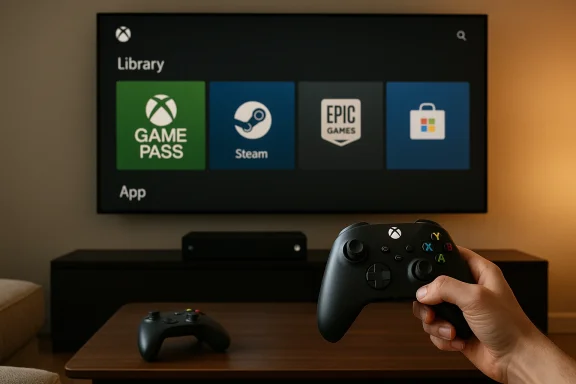
FSE is the software posture Microsoft has been shipping to demonstrate a controller‑first session on top of Windows 11. In practice, FSE launches a “home app” (by default the Xbox PC app) in full screen, reduces desktop subsystems and background services, and surfaces a console‑style UI designed for controller navigation. Microsoft shipped FSE as the default on the ASUS ROG Xbox Ally units and has been expanding it via Xbox/Windows Insider releases. This is the most visible evidence that Microsoft is attempting to present a console‑grade front door while keeping Windows as the runtime underneath.Aggregated libraries and third‑party storefronts
Microsoft is actively evolving the Xbox PC app into an aggregated launcher that can discover and surface installed games from Steam, Epic, GOG, Battle.net and other PC storefronts — a crucial piece of the “one place for all my games” vision for a Windows‑based Xbox endpoint. Xbox Wire announced an Aggregated Gaming Library preview, and Microsoft’s official messaging emphasizes surfacing installed games in a single, controller‑friendly library. That doesn’t mean every game will run identically; titles with certain kernel anti‑cheat or DRM models may require different launch flows, or publisher consent, to run smoothly on a console‑skinned Windows device.What this means for the living‑room UX
A successful FSE implementation would let mainstream players “turn on and play” with a familiar Xbox shell, while advanced users could exit to full Windows to run productivity apps, tools, or alternative storefronts. The UX challenge is enormous: Microsoft must ensure FSE is fast, reliable, secure, and that Windows updates don’t break the console‑grade front door.OUS ROG Xbox Ally lessons
The ROG Xbox Ally family is Microsoft’s public field trial. ASUS’s hardware and Xbox’s software team co‑developed the devices to test the FSE model and handheld compatibility program. Ally units ship with high memory budgets and NPUs to experiment with system‑level AI features like Auto SR and automated highlight reels. Those shipping products give Microsoft both telemetry and PR proof‑points for a Windows‑underneath retail device.Lessons so far are mixed. Shipping handhelds has exposed Windows-specific stabilitsues that would be far more visible on a living‑room device with millions of users. Microsoft is iterating on the Ally firmware and FSE features rapidly, but those iterations underscore the complexity of compressing the full Windows stack into a console‑grade experience. The Ally program is valuable — but it also proves this is a hard engineeringroduct‑ization exercise.
Pricing and market positioning: premium product, broad ecosystem
Multiple reporters and insiders expect Microsoft’s first full‑fledged Windows‑based Xbox console to be positioned as a premium, high‑end device. Microsoft’s language about a “very premium, very high‑end, curated experience” and the likely higher memory and silicon budgets support the same time, Microsoft is leaning on OEM partners to deliver a range of devices across price points — from boutique first‑party consoles to more affordable OEM variants and handhelds — creating a broadened hardware endpoint ecosystem rather than a single SKU to rule them all.Two critical market pressures to note:
- Component markets are volatile. DRAM and high‑bandwidth memory pricing has seen upward pressure due to AI and HPC demand; that directly affects BOM and retail price. Analysts and OEMs have warned that consumer device pricing may increase industry‑wide. Expect Microsoft to factor that into SKU planning.
- Microsoft’s device strategy needn’t aim for the same unit volumes as prior Xbox launches. The company can treat first‑party hardware as a curated, premium “Surface‑style” device while building a larger Xbox ecosystem through OEM partners and cloud/PC channels. That reduces the absolute unit‑sales pressure, but increases reliance on software, services, and Game Pass economics.
Developer, DRM, and anti‑cheat complexity: the elephant in the living room
One of the largest practical constraints on tdows does” promise is kernel‑level anti‑cheat and DRM models. Many PC games today rely on kernel drivers for anti‑cheat, or vendor‑specific DRM flows that are not trivially portable across platforms. A Windows‑based Xbox that can run arbitrary PC storefronts will need to:- coordinate with anti‑cheat vendors to certify their drivers on the console SKU(s);
- provide clear, secure certification and update paths so a console‑like UX is not interrupted by uncontrolled updates or incompatible driver changes;
- document and enforce a developer certification model that balances publisher protection and user freedom.
Consumer risks and userBringing Windows to the living room creates several non‑trivial risks for consumers if Microsoft does not execute carefully:
- Update behavior: Windows updates are more frequent and broader than console firmware up not staged for the console experience, users may see interruptions, regressions, or forced reboots that undermine the “plug‑and‑play” expectation.
- Privacy and telemetry: A Windows runtime brings an OS with a large telemetry footprint and many background services. Microsoft will need to ensure the default FSE posture respects living‑room privacy expectations or face backlash.
- Reliability/complexity: Even ion of background services, Windows under the hood is larger and more complex than a bespoke console OS. Stability and driver maturity must equal or exceed the perceived reliability of prior consoles to keep mainstream players happy.
Strategic upside: why Microsoft is pursuing this
There are several strong strategic rationales behind the Windows‑first Xbox pivot:- Platform ubiquity: A Windows‑rooted Xbox would create one unified gaming platform across console, PC, handheld, and cloud. That consolidation reduces duplication of engine and driver work and makes Microsoft’s ecosystem more attractive to developers who want a single target.
- Store and service flexibility: Aggregated libraries and cross‑store discoverability unlock incremental sales and make Game Pass a gateway rather than a gate. Allowing Epic, Steam, and others to coexist on the same hardware can make Xbox hardware more enticing to PCom])
- Hardware leverage: Co‑engineering silicon with AMD gives Microsofly optimize performance and AI features (Auto SR, highlights, etc.) across device classes, from handhelds to living‑room boxes. That can accelerate innovation in areas like on‑device upscaling and performance‑efficient rendering.
The downside and existential risks
- Diluted console identity: If the device feels too PC‑like (complex updates, flaky drivers, or frequent configuration issues), Microsoft risks alienating mainstream console buyers who expect “turn on and play.”
- Higher entry price: A premium BOM increases the risk of slow adoption and a prolonged lifecycle for Xbox Series X|S and PS5 units, fragmenting install base economics for developers and publishers.
- Policy and regulatory exposure: Opening consoles to third‑party stores and alternative payment flows intersects with competition and platform policy debates. Microsoft must thread a regulatory needle while preserving commercial relationships with platform partners and publishers.
- Technical debt: Building a polished console‑grade FSE on top of a constantly evolving Windows codebase will require long‑term engineering commitment and may force Microsoft to carve out special support and testing flows for console SKUs to preserve stability.
How Microsoft should mitigate the risks (practical recommendations)
- Ship a curated default experience that locks down non‑essential Windows endpoints by default, while offering a clearly labeled “Power User Mode” for those who want a full Windows desktop.
- Implemenhannels* for console SKUs so driver and OS updates are staged and validated before broad rollout, preserving the reliability users expect from consoles.
- Build anti‑cheat and DRM certification toolkits and fast‑track middleware vendor cooperation to minimize friction for PC titles on console‑skinned Windows devices.
- Offer transparent pricing tiers across OEMs: a flagship Microsoft SKU for a boutique audience, and partner SKUs at varied price/performance points to preserve accessibility.
- Make telemetry and privacy defaults clear and minimal in FSE to keep living‑room norms intact.
What to watch next
- Microsoft’s public remarks and official demos at developer events (notably GDC and subsequent Xbox developer showcases) will reveal how deeply third‑party storefronts and anti‑cheat ecosystems integrate into the retail experience.
- AMD’s next earnings calls and official technical documentation will clarify what was meant by a 2027 target and whether the “Magnus” name appears in any validated engineering materials. For now, “Magnus” remains a credible leak codename but not an official product name.
- Pricing signals from Microsoft and major OEM partners will determine whether the first‑party device is a mainstream successor or a boutique, premium entry point analogous to Surface hardware.
Conclusion
The shift Microsoft is attempting — a living‑room Xbox that is a Windows 11 PC beneath a console‑first shell — is both the boldest and riskiest play the company has made in hardware since the Xbox’s creation. The potential upside is compelling: unmatched platform flexibility, native access to PC storefronts, and the ability to ship differentiated devices across price points and form factors. The hazards are equally stark: higher BOMs, Windows‑specific reliability and privacy concerns, DRM/anti‑cheat complexity, and the need to sustain a console‑grade UX in an environment designed for open PCs.The evidence we have — Microsoft’s FSE rollout, the ROG Xbox Ally partnership, the evolving Xbox PC app, and AMD’s comment about a 2027‑targeted SoC timeline — point to a deliberate experiment that could become the new baseline for Xbox hardware. But many of the load‑bearing technical and commercial claims remain unverified or contingent: precise SoC specs, price points, and how seamlessly will function by default are still unknown. Those are the questions that will determine whether Gen‑10 becomes an industry‑reshaping triumph or a technically impressive but commercially constrained niche.
For now, the safest interpretation is this: Microsoft is betting on Windows as a unifying substrate for gaming devices, and it’s prepared to lean on partners to make that vision tangible. The company is experimenting publicly, learning from Brass tacks hardware like the ROG Xbox Ally, and iterating the Full Screen Experience. If Microsoft can deliver a console‑grade living‑room device that feels like a console while is an open PC under the hood, the next Xbox won’t merely be a new console — it will be the start of a new hardware ecosystem. If it fails to land that UX polish, the project risks being a cautionary tale in blending two historically different product philosophies.
We’ll be watching each software beta, AMD release note, and Microsoft developer briefing closely; the next decisive signals will likely come from hardware announcements and developer‑facing events in the months and quarters ahead.
Source: Windows Central https://www.windowscentral.com/gami...-next-gen-xbox-2027-locked-in-most-ambitious/
