

Microsoft’s move is simple in language but seismic in ambition: build a new AI research group that aims to produce powerful, domain‑focused systems that are explicitly designed to remain under human control and to solve real‑world problems. The MAI Superintelligence Team, announced by Microsoft AI CEO Mustafa Suleyman on November 6, 2025, represents a strategic pivot away from a public race for unfettered artificial general intelligence (AGI) and toward what Suleyman calls “humanist superintelligence”—highly capable, domain‑specific AI that is constrained, explainable, and aligned with human interests.
Microsoft’s new team is not an ad hoc PR stunt. The announcement arrives weeks after a significant reworking of Microsoft’s relationship with OpenAI that clarifies IP rights, independent AGI verification, and Microsoft’s freedom to pursue its own model development. That commercial and contractual context matters: Microsoft now has broader latitude to develop in‑house models and invests heavily in Azure and GPU capacity—factors that materially change the company’s incentives and capabilities as an AI platform provider. Mustafa Suleyman—co‑founder of DeepMind and later Inflection, who joined Microsoft to lead its AI efforts—will head the MAI Superintelligence Team. Microsoft names Karén Simonyan as Chief Scientist for MAI, and the group will be staffed by a mix of existing Microsoft AI talent and new recruits. The company says the team will focus first on critical, high‑impact domains such as medical diagnosis, renewable energy and battery research, and educational companions.
Conclusion: Microsoft's public pledge to pursue humanist superintelligence reframes the company’s AI ambitions in a way designed to reassure regulators, customers, and the public while preserving the ability to push technical boundaries. The depth of its resources and the credibility of its leadership give the initiative a real chance of producing valuable, deployable systems. Yet the announcement also raises clear expectations—scientific evidence, independent audits, regulatory compliance, and an ongoing commitment to transparency. If Microsoft can demonstrate concrete, reproducible benefits under strict safety regimes, the MAI Superintelligence Team could set a new pattern for how the industry builds powerful AI that stays on humanity’s side.
Source: dailyresearchnews.com Microsoft Assembles Humanist Superintelligence Team to Reinvent AI
 Background
Microsoft’s new team is not an ad hoc PR stunt. The announcement arrives weeks after a significant reworking of Microsoft’s relationship with OpenAI that clarifies IP rights, independent AGI verification, and Microsoft’s freedom to pursue its own model development. That commercial and contractual context matters: Microsoft now has broader latitude to develop in‑house models and invests heavily in Azure and GPU capacity—factors that materially change the company’s incentives and capabilities as an AI platform provider. Mustafa Suleyman—co‑founder of DeepMind and later Inflection, who joined Microsoft to lead its AI efforts—will head the MAI Superintelligence Team. Microsoft names Karén Simonyan as Chief Scientist for MAI, and the group will be staffed by a mix of existing Microsoft AI talent and new recruits. The company says the team will focus first on critical, high‑impact domains such as medical diagnosis, renewable energy and battery research, and educational companions. What Microsoft announced and why it matters
- Microsoft formally launched the MAI Superintelligence Team inside Microsoft AI on November 6, 2025, with Mustafa Suleyman in charge and Karén Simonyan as chief scientist. The stated aim: advance humanist superintelligence (HSI)—systems that are powerful but limited in autonomy and scope, designed to amplify human welfare and avoid runaway behaviors.
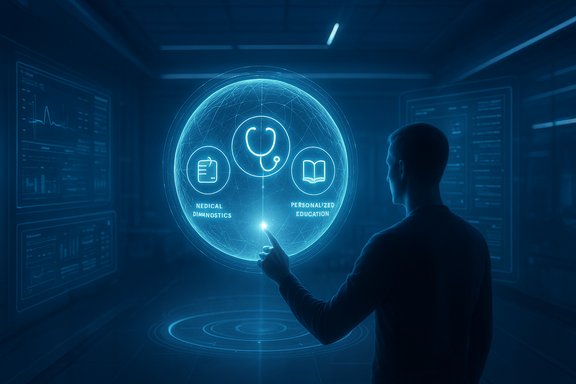
- The team’s early priorities are applied and domain‑specific: medical diagnostics and operational clinical reasoning, accelerated materials and battery research for renewables, and personalized AI companions for education and productivity. Microsoft frames these as opportunities to produce “superhuman” capability in tightly scoped problems rather than general‑purpose, unconstrained agents.
- Suleyman and Microsoft explicitly reject an “AGI arms race” narrative. The language is striking: instead of accelerating “at all costs,” the company says it will emphasize predictability, explainability and human oversight. Suleyman told media outlets that unchecked acceleration would be a “crazy suicide mission,” arguing for a path that balances responsibility with progress.
Overview: What is “Humanist Superintelligence”?
Defining the term
Humanist Superintelligence (HSI), as articulated by Suleyman and Microsoft AI, is a design philosophy rather than a single technical blueprint: build AI systems with advanced reasoning and predictive power, but constrain their autonomy, focus them on clearly defined societal problems, and embed human control mechanisms and transparent behavior by design. The objective is to deliver measurable benefits—improved diagnostics, better battery chemistry, individualized learning—while avoiding the most severe risks associated with unrestricted general intelligence.Key characteristics Microsoft emphasizes
- Domain specificity: HSI targets narrow but deep capabilities (e.g., diagnostic reasoning across clinical cases).
- Calibrated autonomy: systems will operate within limits and remain interpretable.
- Human centricity: humans remain in the loop and the systems are explicitly designed to serve people.
The technical and timeline claims: what Microsoft is promising—and what’s plausible
Microsoft and Suleyman make bold timetable statements. In the blog announcing MAI, Suleyman writes that the team already has a “line of sight to medical superintelligence in the next two to three years,” citing experiments where orchestrated diagnostic systems performed well on difficult clinical case challenges. Reuters and other outlets repeat the same claim, and Microsoft public materials point to early research artifacts to justify optimism. Cross‑checking those claims against independent benchmarks and expert commentary yields a more cautious conclusion:- There are credible, concrete examples where AI has produced domain‑changing results—most famously AlphaFold’s success in protein folding—but mapping those breakthroughs to operational medical superintelligence is nontrivial. Clinical diagnostic deployment requires rigorous prospective validation, regulatory approval, robust performance across diverse populations, and integration with clinical workflows. Microsoft’s internal test scores are promising, but independent, peer‑reviewed replication and real‑world trials remain necessary before claiming medical superintelligence is imminent.
- Many AI safety and research leaders forecast a broad range of timelines for AGI or “superintelligence”—from a few years to many decades. Some leaders suggest a high‑risk near‑term possibility; others urge prudence in predictions. The diversity of expert opinion makes hard timelines controversial. Microsoft’s two‑to‑three‑year window for medical‑domain superintelligence is ambitious and plausible in narrow, well‑defined tasks, but it should be treated as a company projection rather than a settled scientific fact.
Applications Microsoft highlights
Microsoft frames HSI around three anchor use cases that also map to clear public needs and enterprise markets:- Medical superintelligence
- Ambition: expert‑level diagnostic reasoning, earlier disease detection, operational planning in clinical settings. Microsoft claims orchestrated diagnostic models are showing strong early results on hard clinical case challenges.
- Clean energy and materials science
- Ambition: accelerate discovery of new materials, improve battery chemistry and storage, and optimize grid operations to make renewable energy cheaper and more plentiful. Microsoft positions AI as a scientific accelerator akin to AlphaFold’s impact on biology.
- AI companions for education and productivity
- Ambition: personalized tutors and assistants that adapt to a learner’s strengths and weaknesses and augment human productivity without replacing social interactions or professional judgment.
Organizational and strategic implications for Microsoft and the industry
Microsoft’s strategic pivot and OpenAI ties
Microsoft’s newly articulated HSI program sits alongside a freshly restructured partnership with OpenAI that gives Microsoft expanded IP rights and the ability to pursue its own AGI or superintelligence research while preserving commercial ties. The corporate arrangement explicitly permits Microsoft to develop independent models and products even as OpenAI remains a strategic partner—an arrangement that materially changes Microsoft’s posture from mere cloud provider and distribution partner to an independent competitor in frontier model development.Hiring, compute and competition
Suleyman told reporters Microsoft will invest substantially in the superintelligence effort and recruit top talent. The market for elite AI researchers is already aggressively competitive: other companies are offering sizable incentives to poach talent. Microsoft’s scale (Azure, enterprise reach, and chip deals) gives it a structural advantage, but the talent and capital arms race will intensify.Product roadmap and enterprise customers
Enterprises want trusted, explainable systems—not speculative AGI. Microsoft is marketing HSI as directly relevant to enterprises that must reason about regulation, accountability and integration into workflows. That practical positioning makes MAI attractive to enterprise buyers but also raises the bar for Microsoft to demonstrate real‑world safety and compliance.Strengths of Microsoft’s approach
- Clear, pragmatic framing. By emphasizing domain specificity and human control, Microsoft avoids the spectacle of an open AGI arms race while committing to high‑value research targets that can deliver measurable societal benefits. That framing is likely to resonate with regulators, enterprise customers, and risk‑averse governments.
- Organizational muscle and cloud scale. Microsoft can assemble large teams, vast Azure compute, and cross‑product distribution channels (Windows, Office, Azure, Teams, Copilot). That infrastructure reduces friction between research breakthroughs and scaled deployment.
- Experienced leadership. Mustafa Suleyman brings credibility from DeepMind and Inflection, and Microsoft’s choice of a respected research chief signals seriousness. Leadership that talks openly about ethics and restraint helps shape public credibility and employee recruiting.
- Regulatory and corporate alignment. Framing the work as human‑centric and controlled creates a position that can plausibly align with emerging regulation (e.g., transparency, risk assessment), giving Microsoft a potential first‑mover advantage in compliance‑sensitive sectors like healthcare.
Risks, tensions and unanswered questions
No major initiative is risk‑free. Key concerns:- Timeline optimism vs. scientific reality. Company forecasts (e.g., two to three years to medical superintelligence) are unavoidably optimistic. Independent validation, clinical trials, and regulatory approval typically take longer in healthcare—so expectations must be tempered. Microsoft’s internal benchmarks are valuable signals, but until independent, peer‑reviewed results and prospective trials are published, ambitious timelines remain speculative.
- Talent and competitive escalation. Other players (Meta, Google/DeepMind, Anthropic, OpenAI and well‑funded startups) are pursuing near‑frontier work. Aggressive recruiting and compensation could further heat competition and create incentives for rushed releases or secrecy—contradicting the HSI pledge to be open and cautious.
- Governance and verification. Statements like “line of sight to medical superintelligence” invite demands for external verification. Who will audit and certify HSI systems? Microsoft’s internal controls will be scrutinized by regulators, clinicians, and civil society. The recent restructured OpenAI deal, which created external verification for AGI claims, underscores how vital independent review has become.
- Operational safety and integration. Domain‑specific superintelligence in medicine or energy implies high‑stakes integration: a diagnostic model’s errors could cause patient harm, and a materials model could steer expensive R&D down dead ends. Robust human‑in‑the‑loop designs, simulation testing, and fail‑safe mechanisms must be deeply engineered.
- Public trust and “seemingly conscious” systems. Suleyman has flagged the social risk that AI may become seemingly conscious and produce emotional dependency, “AI psychosis” or misplaced trust. Building powerful, companion‑like systems raises real social and ethical tradeoffs that go beyond traditional engineering.
What’s not fully verified (and why it matters)
Certain claims circulating in secondary reporting—such as assertions that Microsoft is actively “experimenting” with Google’s Gemini or Anthropic’s Claude models in a developer sense—are not well documented in primary public statements. Some outlets report Microsoft is broadening experiments with multiple model sources, and Microsoft does host other vendors’ models on Azure in specific commercial contexts, but explicit programs or technical integrations require clearer evidence before they can be treated as established fact. This is an example where third‑party reporting and corporate statements diverge; readers should treat such claims as provisional until Microsoft provides concrete details.Practical implications for enterprises and Windows users
- Enterprise IT and cloud leaders will face new choices about procurement, compliance, and migration. Microsoft’s promise of domain‑specific HSI could become a compelling proposition for regulated industries seeking capable AI with guardrails.
- CIOs and compliance teams must demand evidence—validation studies, audit trails, and continuous monitoring—before deploying any clinical HSI tools in production. Integration will require pilot programs, insurance models, and regulatory sign‑offs.
- For Windows and Office ecosystems, tighter Microsoft control of vertical HSI means more potential enterprise features embedded into Copilot and productivity stacks—but also raises concerns about vendor lock‑in and dependency on Microsoft’s cloud and model IP. Businesses should weigh the benefits of deep integration against the risks of concentration.
- Security and data governance become central. HSI systems trained on sensitive data (medical records, energy grids) require stringent privacy, provenance and consent frameworks. Enterprises should prepare data pipelines and governance processes now.
A pragmatic checklist: what Microsoft must deliver to make HSI credible
- Publish peer‑reviewed, reproducible results for the diagnostic and scientific claims that underlie the “medical superintelligence” thesis.
- Run and report prospective clinical trials and real‑world deployments with transparent safety metrics.
- Open auditing mechanisms and independent red teams to stress‑test governance and failure modes.
- Invest in explainability and human‑in‑the‑loop interfaces that make decision‑making interpretable to clinicians and regulators.
- Establish clear contractual and ethical guardrails for partner integrations, data sharing and IP usage—especially given the new OpenAI arrangement.
Broader industry and policy implications
Microsoft’s announcement is both a competitive maneuver and a public signal. By reframing superintelligence as humanist and domain‑bounded, Microsoft seeks to own the narrative of responsible progress while preserving a seat at the innovation table. This reframing will likely influence regulators, partners, and rivals.- Regulators will watch closely. Microsoft’s emphasis on restraint and control may make it easier to collaborate with governments, but it will also invite scrutiny into whether rhetoric matches practice. Regulatory bodies will demand audits, transparency and evidence before allowing high‑stakes deployments.
- Competitors may respond by sharpening their own safety narratives or by doubling down on raw capability. The result is an industry bifurcation between “responsibility‑first” narratives and capability‑first races—both attracting capital and talent.
- Public discourse will shift from abstract AGI timelines to tangible domain‑level questions: how will AI affect access to healthcare, energy costs, and education outcomes? Concrete deployments will accelerate social debates about fairness, liability, and accountability.
Final analysis: realistic optimism, guarded skepticism
Microsoft’s MAI Superintelligence Team is a consequential move. It marries Microsoft’s cloud scale and enterprise relationships with a leadership voice that foregrounds safety and human oversight. That combination is powerful. If Microsoft follows through—publishing reproducible results, conducting independent validations, and building robust human‑centered controls—HSI could deliver meaningful breakthroughs in medicine, energy and education while setting a new standard for responsible AI deployment. But the initiative also faces real headwinds: the near‑term timeline claims are optimistic; independent verification is essential; talent and compute arms races could reintroduce the very dynamics Microsoft says it wants to avoid; and social risks from convincing, companion‑like AI will require non‑technical guardrails and public policy engagement. The gap between rhetoric and reproducible impact will determine whether HSI is a transformative model for responsible AI or another high‑profile corporate pivot. Microsoft has framed the debate cleverly: it asks, “What kind of AI does the world really want?” The MAI Superintelligence Team is Microsoft’s answer—an ambitious, human‑centered program aimed at measurable benefits. Turning that answer into durable, safe systems will require scientific rigor, independent verification, deliberate governance, and genuine engagement with clinicians, educators, regulators and the public. The next 12–36 months will show whether Microsoft can convert the promise of HSI into demonstrable, trustworthy impact—or whether the industry’s old incentives will steer the race back toward raw capability and secrecy.Conclusion: Microsoft's public pledge to pursue humanist superintelligence reframes the company’s AI ambitions in a way designed to reassure regulators, customers, and the public while preserving the ability to push technical boundaries. The depth of its resources and the credibility of its leadership give the initiative a real chance of producing valuable, deployable systems. Yet the announcement also raises clear expectations—scientific evidence, independent audits, regulatory compliance, and an ongoing commitment to transparency. If Microsoft can demonstrate concrete, reproducible benefits under strict safety regimes, the MAI Superintelligence Team could set a new pattern for how the industry builds powerful AI that stays on humanity’s side.
Source: dailyresearchnews.com Microsoft Assembles Humanist Superintelligence Team to Reinvent AI
