

Microsoft filed a proposed Ratepayer Protection Tariff with Nevada utility regulators in May 2026, asking the Public Utilities Commission of Nevada to create a framework that makes large AI data center customers pay for grid infrastructure built primarily to serve them. The filing is not just another utility docket; it is Microsoft trying to turn a political promise into a regulated cost-allocation machine. If Nevada accepts the idea, the tariff could become a template for how states handle the next wave of AI-driven electricity demand. If it fails, the industry’s “we’ll pay our way” pledge may look more like public relations than public policy.
For the past two years, the AI infrastructure debate has been trapped between two blunt claims. Tech companies say they need enormous new power supplies to keep the United States competitive in artificial intelligence. Ratepayer advocates, consumer groups, and state regulators worry that ordinary households will quietly subsidize the substations, transmission lines, and generation plants needed to feed those GPU farms.
Microsoft’s Nevada filing is important because it moves the argument out of press releases and into the machinery of utility regulation. A tariff is not a slogan. It is a binding set of rules that determines who pays, when they pay, how costs are tracked, and what happens if the customer walks away before the utility has recovered its investment.
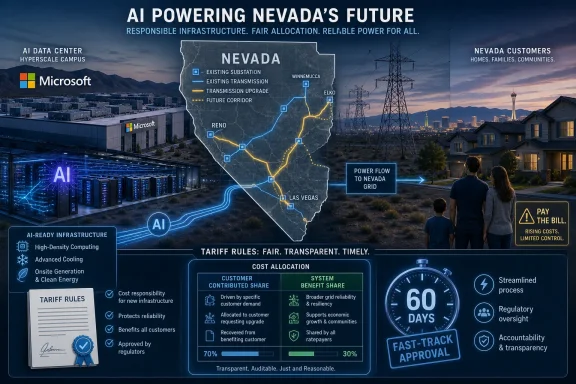
The company’s proposal, as described in the filing and reported by Utility Dive, would split data center-related infrastructure into two broad buckets. The Customer Contributed Share would be paid by the large-load customer whose project triggered the investment. The System Benefit Share could be reviewed for inclusion in the utility rate base if regulators decide the asset also benefits the wider grid.
That distinction is the whole ballgame. AI data centers do not merely consume electricity; they can reshape regional planning assumptions. A single hyperscale campus can look, from the grid’s perspective, like adding a small city almost overnight. The Nevada proposal tries to answer the obvious political question: if Microsoft creates that need, why should a Las Vegas apartment dweller or Reno small business owner pay for it?
That is why the Nevada filing matters beyond Nevada. Public utility commissions are built to decide prudently incurred costs, approve rates, and balance reliability with affordability. They are not naturally designed to absorb a technology platform shift that compresses years of demand growth into the interconnection queue of a few corporate customers.
Microsoft appears to understand that the politics of AI infrastructure are changing. Its Community-First AI Infrastructure initiative, announced earlier this year, promised that its data centers would not push local electricity bills onto communities. The company also joined other major AI and cloud firms in a federal ratepayer protection pledge in March, committing to cover the energy and infrastructure costs associated with new data center operations.
Those promises sound tidy until they meet utility accounting. Electricity grids are shared systems. A new transmission line may be built because a data center needs it, but once built it may improve reliability, unlock renewable generation, or serve future customers. Conversely, a project described as broadly useful may be timed, sized, or routed mainly for one hyperscaler’s load ramp.
The proposed tariff is Microsoft’s attempt to create a formal sorting mechanism. It acknowledges that some infrastructure is plainly customer-specific, while some may have legitimate system value. More importantly, it tries to make that distinction visible before the costs disappear into a general rate case.
The proceeding sits inside PUCN Docket No. 20-08014, a long-running Nevada resource adequacy and planning docket opened after capacity constraints during a major heat wave in 2020. That origin story matters. This is not a clean-room debate about futuristic AI clusters. It is taking place in a state where summer reliability, peak demand, and infrastructure timing are not abstractions.
Microsoft has reportedly acquired property for a new data center in NV Energy territory. That gives the filing a practical edge. The company is not asking regulators to bless a theoretical framework for some distant industry trend; it is proposing a mechanism that could govern real load, real substations, real transmission, and real customer bills.
The mention of Nevada’s Greenlink transmission project is especially revealing. Greenlink is a major grid expansion intended to improve statewide transmission capacity and access to generation resources. Microsoft’s argument, in effect, is that large-load customers can help fund early or incremental costs where their projects drive or benefit from the buildout. That could make the tariff attractive to regulators who want infrastructure built quickly but do not want residential customers stuck with speculative costs.
Utility fights often become murky because costs are socialized through planning categories. A substation expansion, a transmission upgrade, or a generation procurement can be described as part of general system growth even when one large customer is the practical reason it is needed now. By forcing project-specific assets onto a public accounting track, the tariff would make cost causation harder to blur.
That transparency is valuable for more than consumer protection. It also gives utilities a clearer planning signal. If a hyperscaler signs an electric service agreement with a defined contract demand and load ramp, the utility can model the project as a known obligation rather than a speculative request. Regulators can then ask whether the infrastructure matches the customer’s schedule, whether the allocation is fair, and whether the rest of the system benefits enough to justify rate-base treatment.
The risk is that the asset schedule becomes a battleground of classification. Every dollar assigned to the Customer Contributed Share is a dollar Microsoft or another large-load customer must carry. Every dollar moved to the System Benefit Share becomes a candidate for broader recovery. The tariff’s success would depend less on its conceptual elegance than on the commission’s willingness to police those boundaries.
That fits the political mood. The federal ratepayer protection pledge emphasized that AI companies should fund the power and infrastructure their facilities require. For policymakers worried about rising bills, Bring Your Own Power sounds like the cleanest solution: if you want a giant AI campus, bring the megawatts with you.
But power is not quite so portable. Generation has location, capacity value, deliverability constraints, fuel risk, and operating characteristics. A solar contract does not solve a summer evening peak unless storage, transmission, and reliability accreditation line up. A gas plant may provide firm capacity but raise emissions and fuel-price questions. A third-party project may be useful on paper but not available when the grid actually needs it.
That is why the phrase “accredited capacity” matters. Regulators and utilities will need to decide how much reliability value to assign to customer-procured generation. If they over-credit it, the system risks underbuilding. If they under-credit it, data center customers may argue that they are being forced to pay twice: once for their own power and again for utility resources built as if that power did not exist.
That phrase has become the data center industry’s quiet obsession. AI infrastructure is a race against competitors, model timelines, chip supply, and customer demand. A delayed interconnection can mean stranded servers, missed product windows, and billions in underused capital. From Microsoft’s perspective, paying upfront may be worthwhile if it shortens the regulatory path.
From a regulator’s perspective, expedited review is both tempting and dangerous. If a developer is truly paying the full project-specific cost, the case for a faster process is strong. The utility gets infrastructure, the customer gets service, and the general ratepayer is theoretically protected.
But speed can also narrow scrutiny. A 60-day pathway must not become a side door through which large customers define “project-specific” too narrowly, understate downstream impacts, or lock in assumptions that later migrate into the general rate base. The tariff’s promise depends on a simple bargain: faster treatment for genuinely self-funded infrastructure, not faster socialization under a new name.
That mismatch creates a moral hazard. A utility may build for a customer that later delays, downsizes, or exits. If the asset is placed in rate base, ordinary customers can end up paying for infrastructure that was justified by a private project. If the utility refuses to build until every risk is eliminated, states may lose investment and reliability planning may become reactive.
Microsoft’s exit-charge concept is designed to address that problem. The proposal would require large-load customers to pay the full cost of infrastructure built for them, including a final charge if they leave before payments are complete. That is essential. Without exit protection, ratepayer protection is only as durable as a hyperscaler’s site strategy.
Still, exit charges are not magic. They require enforceable contracts, creditworthy counterparties, and regulatory discipline. They must also survive the messy realities of corporate restructuring, project phasing, and changes in technology. The AI industry is flush today, but utility assets can last decades. The tariff has to work after the current boom’s easy money has thinned.
A formal tariff gives Microsoft a rebuttal. When opponents argue that AI campuses will raise household power bills, the company can point to commission-approved cost tracking, customer contributions, exit charges, and third-party generation. It turns a soft promise into a procedural defense.
That defense matters because AI infrastructure is becoming inseparable from Microsoft’s product strategy. Copilot, Azure AI, model hosting, enterprise inference, and the company’s partnership ecosystem all require physical capacity. The cloud is not an abstraction; it is land, water, transformers, switchyards, fiber, and energy contracts.
The Nevada proposal is therefore a permitting strategy as much as a rate design. If Microsoft can convince regulators and communities that its data centers will pay their way, it reduces one of the largest sources of delay. In the AI race, regulatory trust becomes infrastructure.
The hard cases are the mixed-use assets. A transmission upgrade may serve Microsoft today and thousands of future customers tomorrow. A generation resource may be needed because of data center load but improve reserve margins for everyone. A grid project may be oversized intentionally because doing it once is cheaper than rebuilding it later.
That is where the System Benefit Share comes in. The tariff would allow portions of an asset to be reviewed for inclusion in rate base if they provide broader system benefits. This is reasonable in theory and contentious in practice.
Consumer advocates will worry that “system benefit” becomes the loophole that swallows the rule. Utilities may have incentives to classify more assets as broadly beneficial because rate-base treatment can support earnings. Large-load customers will want credit for anything that looks generally useful. Regulators will be left to decide whether the public is getting a real benefit or merely inheriting part of a private customer’s bill.
If ratepayers do not fund the infrastructure, Microsoft and its cloud peers will. If Microsoft funds it, those costs become part of the economics of AI services. They may surface in cloud pricing, enterprise subscriptions, Copilot licensing, reserved capacity contracts, or the pace at which AI features are bundled into existing products.
That does not mean every Windows user should expect a line item called “Nevada substation recovery” on a Microsoft bill. It means the economics of AI are leaving the realm of software margins and entering the world of regulated infrastructure. The old cloud story was about scale driving marginal costs down. The AI cloud story is more complicated: scale now requires massive upfront commitments to energy and grid capacity.
For sysadmins and IT buyers, this should sharpen the way AI roadmaps are evaluated. Features that look frictionless in a demo are backed by infrastructure with very real constraints. Reliability, regional availability, data residency, carbon commitments, and price stability are all downstream of the same physical bottleneck.
A tariff creates a common vocabulary. It tells large-load customers what they must commit to, tells utilities how to track assets, and tells the public where costs are supposed to land. It can also reduce litigation by making expectations clear before construction begins.
But Nevada should not treat Microsoft’s draft as self-validating. The commission needs independent scenario modeling, public comment, and a skeptical review of classification rules. The tariff should require detailed disclosures about load ramps, asset schedules, accredited capacity, exit obligations, and any later reclassification of customer-funded assets.
The reclassification issue deserves particular attention. If a customer-funded asset can later be moved into rate base, the commission must ensure that ratepayers are not buying the same infrastructure twice. Any transfer should come with transparent valuation, depreciation treatment, and proof of system value.
A few points should guide how readers understand the proceeding:
 Microsoft Turns a Data Center Talking Point Into a Utility Tariff
For the past two years, the AI infrastructure debate has been trapped between two blunt claims. Tech companies say they need enormous new power supplies to keep the United States competitive in artificial intelligence. Ratepayer advocates, consumer groups, and state regulators worry that ordinary households will quietly subsidize the substations, transmission lines, and generation plants needed to feed those GPU farms.Microsoft’s Nevada filing is important because it moves the argument out of press releases and into the machinery of utility regulation. A tariff is not a slogan. It is a binding set of rules that determines who pays, when they pay, how costs are tracked, and what happens if the customer walks away before the utility has recovered its investment.
The company’s proposal, as described in the filing and reported by Utility Dive, would split data center-related infrastructure into two broad buckets. The Customer Contributed Share would be paid by the large-load customer whose project triggered the investment. The System Benefit Share could be reviewed for inclusion in the utility rate base if regulators decide the asset also benefits the wider grid.
That distinction is the whole ballgame. AI data centers do not merely consume electricity; they can reshape regional planning assumptions. A single hyperscale campus can look, from the grid’s perspective, like adding a small city almost overnight. The Nevada proposal tries to answer the obvious political question: if Microsoft creates that need, why should a Las Vegas apartment dweller or Reno small business owner pay for it?
The AI Buildout Has Reached the Rate Case
Data centers used to be treated as large but manageable commercial loads. The AI boom has changed the scale. Training and inference facilities are increasingly measured not in megawatts as an operational footnote, but as the central design constraint for new generation, transmission, and distribution planning.That is why the Nevada filing matters beyond Nevada. Public utility commissions are built to decide prudently incurred costs, approve rates, and balance reliability with affordability. They are not naturally designed to absorb a technology platform shift that compresses years of demand growth into the interconnection queue of a few corporate customers.
Microsoft appears to understand that the politics of AI infrastructure are changing. Its Community-First AI Infrastructure initiative, announced earlier this year, promised that its data centers would not push local electricity bills onto communities. The company also joined other major AI and cloud firms in a federal ratepayer protection pledge in March, committing to cover the energy and infrastructure costs associated with new data center operations.
Those promises sound tidy until they meet utility accounting. Electricity grids are shared systems. A new transmission line may be built because a data center needs it, but once built it may improve reliability, unlock renewable generation, or serve future customers. Conversely, a project described as broadly useful may be timed, sized, or routed mainly for one hyperscaler’s load ramp.
The proposed tariff is Microsoft’s attempt to create a formal sorting mechanism. It acknowledges that some infrastructure is plainly customer-specific, while some may have legitimate system value. More importantly, it tries to make that distinction visible before the costs disappear into a general rate case.
Nevada Is a Test Bed Because the Stress Is Already Visible
Nevada is not an arbitrary venue. The state has become increasingly attractive to data center developers because of land availability, tax policy, renewable energy potential, and proximity to Western digital infrastructure corridors. At the same time, the grid is already under pressure from population growth, electrification, extreme heat, and major transmission planning.The proceeding sits inside PUCN Docket No. 20-08014, a long-running Nevada resource adequacy and planning docket opened after capacity constraints during a major heat wave in 2020. That origin story matters. This is not a clean-room debate about futuristic AI clusters. It is taking place in a state where summer reliability, peak demand, and infrastructure timing are not abstractions.
Microsoft has reportedly acquired property for a new data center in NV Energy territory. That gives the filing a practical edge. The company is not asking regulators to bless a theoretical framework for some distant industry trend; it is proposing a mechanism that could govern real load, real substations, real transmission, and real customer bills.
The mention of Nevada’s Greenlink transmission project is especially revealing. Greenlink is a major grid expansion intended to improve statewide transmission capacity and access to generation resources. Microsoft’s argument, in effect, is that large-load customers can help fund early or incremental costs where their projects drive or benefit from the buildout. That could make the tariff attractive to regulators who want infrastructure built quickly but do not want residential customers stuck with speculative costs.
The Most Important Word Is “Schedule”
Under the proposal, NV Energy would identify and track facilities needed to serve a large-load customer on a customer-specific asset schedule. That sounds bureaucratic, because it is. But the schedule may be the most important part of the entire framework.Utility fights often become murky because costs are socialized through planning categories. A substation expansion, a transmission upgrade, or a generation procurement can be described as part of general system growth even when one large customer is the practical reason it is needed now. By forcing project-specific assets onto a public accounting track, the tariff would make cost causation harder to blur.
That transparency is valuable for more than consumer protection. It also gives utilities a clearer planning signal. If a hyperscaler signs an electric service agreement with a defined contract demand and load ramp, the utility can model the project as a known obligation rather than a speculative request. Regulators can then ask whether the infrastructure matches the customer’s schedule, whether the allocation is fair, and whether the rest of the system benefits enough to justify rate-base treatment.
The risk is that the asset schedule becomes a battleground of classification. Every dollar assigned to the Customer Contributed Share is a dollar Microsoft or another large-load customer must carry. Every dollar moved to the System Benefit Share becomes a candidate for broader recovery. The tariff’s success would depend less on its conceptual elegance than on the commission’s willingness to police those boundaries.
“Bring Your Own Power” Is the Escape Hatch and the Complication
The proposal’s Bring Your Own Power provision is where the tariff reaches beyond wires and into the generation debate. Under that approach, a large-load customer could procure generation from third-party providers, with accredited capacity incorporated into utility planning assumptions. In plain English, Microsoft could help bring power to the table rather than merely asking NV Energy to find it.That fits the political mood. The federal ratepayer protection pledge emphasized that AI companies should fund the power and infrastructure their facilities require. For policymakers worried about rising bills, Bring Your Own Power sounds like the cleanest solution: if you want a giant AI campus, bring the megawatts with you.
But power is not quite so portable. Generation has location, capacity value, deliverability constraints, fuel risk, and operating characteristics. A solar contract does not solve a summer evening peak unless storage, transmission, and reliability accreditation line up. A gas plant may provide firm capacity but raise emissions and fuel-price questions. A third-party project may be useful on paper but not available when the grid actually needs it.
That is why the phrase “accredited capacity” matters. Regulators and utilities will need to decide how much reliability value to assign to customer-procured generation. If they over-credit it, the system risks underbuilding. If they under-credit it, data center customers may argue that they are being forced to pay twice: once for their own power and again for utility resources built as if that power did not exist.
Speed to Power Meets the Public Interest
Microsoft’s proposal includes an expedited review pathway for projects fully funded upfront by developers, with approval potentially available within 60 days where no system-benefit cost recovery is involved. This is the most candid part of the filing. Hyperscalers do not merely want lower cost uncertainty; they want speed to power.That phrase has become the data center industry’s quiet obsession. AI infrastructure is a race against competitors, model timelines, chip supply, and customer demand. A delayed interconnection can mean stranded servers, missed product windows, and billions in underused capital. From Microsoft’s perspective, paying upfront may be worthwhile if it shortens the regulatory path.
From a regulator’s perspective, expedited review is both tempting and dangerous. If a developer is truly paying the full project-specific cost, the case for a faster process is strong. The utility gets infrastructure, the customer gets service, and the general ratepayer is theoretically protected.
But speed can also narrow scrutiny. A 60-day pathway must not become a side door through which large customers define “project-specific” too narrowly, understate downstream impacts, or lock in assumptions that later migrate into the general rate base. The tariff’s promise depends on a simple bargain: faster treatment for genuinely self-funded infrastructure, not faster socialization under a new name.
The Old Utility Model Was Not Built for AI’s Load Shape
Traditional utility planning assumes growth, but it often assumes growth that is geographically distributed, economically explainable, and somewhat predictable. AI data centers break that comfort zone. They are large, concentrated, and tied to corporate deployment strategies that can change faster than a utility’s integrated resource plan.That mismatch creates a moral hazard. A utility may build for a customer that later delays, downsizes, or exits. If the asset is placed in rate base, ordinary customers can end up paying for infrastructure that was justified by a private project. If the utility refuses to build until every risk is eliminated, states may lose investment and reliability planning may become reactive.
Microsoft’s exit-charge concept is designed to address that problem. The proposal would require large-load customers to pay the full cost of infrastructure built for them, including a final charge if they leave before payments are complete. That is essential. Without exit protection, ratepayer protection is only as durable as a hyperscaler’s site strategy.
Still, exit charges are not magic. They require enforceable contracts, creditworthy counterparties, and regulatory discipline. They must also survive the messy realities of corporate restructuring, project phasing, and changes in technology. The AI industry is flush today, but utility assets can last decades. The tariff has to work after the current boom’s easy money has thinned.
Microsoft Is Also Protecting Microsoft
It would be naive to read the filing as pure civic virtue. Microsoft has a clear business reason to support a tariff that separates its costs from general rates. Public backlash is becoming a material risk to data center development, and electricity bills are the easiest way for that backlash to become politically explosive.A formal tariff gives Microsoft a rebuttal. When opponents argue that AI campuses will raise household power bills, the company can point to commission-approved cost tracking, customer contributions, exit charges, and third-party generation. It turns a soft promise into a procedural defense.
That defense matters because AI infrastructure is becoming inseparable from Microsoft’s product strategy. Copilot, Azure AI, model hosting, enterprise inference, and the company’s partnership ecosystem all require physical capacity. The cloud is not an abstraction; it is land, water, transformers, switchyards, fiber, and energy contracts.
The Nevada proposal is therefore a permitting strategy as much as a rate design. If Microsoft can convince regulators and communities that its data centers will pay their way, it reduces one of the largest sources of delay. In the AI race, regulatory trust becomes infrastructure.
The System Benefit Share Is Where the Fight Will Go
The cleanest version of the tariff is easy to support. A data center requires a substation, so the data center pays for the substation. A data center requires a dedicated line, so the data center pays for the line. A data center exits early, so it pays the remaining balance.The hard cases are the mixed-use assets. A transmission upgrade may serve Microsoft today and thousands of future customers tomorrow. A generation resource may be needed because of data center load but improve reserve margins for everyone. A grid project may be oversized intentionally because doing it once is cheaper than rebuilding it later.
That is where the System Benefit Share comes in. The tariff would allow portions of an asset to be reviewed for inclusion in rate base if they provide broader system benefits. This is reasonable in theory and contentious in practice.
Consumer advocates will worry that “system benefit” becomes the loophole that swallows the rule. Utilities may have incentives to classify more assets as broadly beneficial because rate-base treatment can support earnings. Large-load customers will want credit for anything that looks generally useful. Regulators will be left to decide whether the public is getting a real benefit or merely inheriting part of a private customer’s bill.
Windows Users Are Closer to This Than They Think
At first glance, a Nevada utility tariff might seem distant from the daily concerns of WindowsForum readers. It is not. Microsoft’s AI strategy is now woven through Windows, Microsoft 365, Azure, developer tools, security products, and enterprise management workflows. The cost of powering that strategy will show up somewhere.If ratepayers do not fund the infrastructure, Microsoft and its cloud peers will. If Microsoft funds it, those costs become part of the economics of AI services. They may surface in cloud pricing, enterprise subscriptions, Copilot licensing, reserved capacity contracts, or the pace at which AI features are bundled into existing products.
That does not mean every Windows user should expect a line item called “Nevada substation recovery” on a Microsoft bill. It means the economics of AI are leaving the realm of software margins and entering the world of regulated infrastructure. The old cloud story was about scale driving marginal costs down. The AI cloud story is more complicated: scale now requires massive upfront commitments to energy and grid capacity.
For sysadmins and IT buyers, this should sharpen the way AI roadmaps are evaluated. Features that look frictionless in a demo are backed by infrastructure with very real constraints. Reliability, regional availability, data residency, carbon commitments, and price stability are all downstream of the same physical bottleneck.
Regulators Should Welcome the Framework Without Surrendering to It
The best argument for Nevada adopting some version of Microsoft’s proposal is that the alternative is worse. Without a tailored tariff, regulators may be forced to handle AI loads through conventional line-extension policies, ad hoc special contracts, or after-the-fact rate cases. That approach invites opacity.A tariff creates a common vocabulary. It tells large-load customers what they must commit to, tells utilities how to track assets, and tells the public where costs are supposed to land. It can also reduce litigation by making expectations clear before construction begins.
But Nevada should not treat Microsoft’s draft as self-validating. The commission needs independent scenario modeling, public comment, and a skeptical review of classification rules. The tariff should require detailed disclosures about load ramps, asset schedules, accredited capacity, exit obligations, and any later reclassification of customer-funded assets.
The reclassification issue deserves particular attention. If a customer-funded asset can later be moved into rate base, the commission must ensure that ratepayers are not buying the same infrastructure twice. Any transfer should come with transparent valuation, depreciation treatment, and proof of system value.
The Nevada Filing Gives the AI Boom a Price Tag
The practical lesson from Microsoft’s filing is that AI infrastructure is no longer hiding behind the word “cloud.” The boom has a footprint, and that footprint has a bill. The Nevada proposal is one of the first serious attempts to decide who gets the invoice before the concrete is poured.A few points should guide how readers understand the proceeding:
- Microsoft is asking Nevada regulators to formalize a tariff that would make large-load customers pay for infrastructure built specifically to serve their data centers.
- The proposal’s central distinction is between customer-specific costs and broader system-benefit costs that may be eligible for rate-base treatment.
- The Bring Your Own Power provision could help reduce overbuilding risk, but only if regulators apply strict reliability and deliverability standards.
- The expedited 60-day review path is defensible for fully customer-funded projects, but it must not become a shortcut around scrutiny of wider grid impacts.
- The tariff’s credibility will depend on transparent asset schedules, enforceable exit charges, and careful review of any later attempt to shift customer-funded assets into general rates.
- For Microsoft customers, the filing is another reminder that AI features in Windows, Azure, and Microsoft 365 are backed by capital-intensive energy infrastructure, not just clever software.
References
- Primary source: Utility Dive
Published: Mon, 08 Jun 2026 16:27:56 GMT
Microsoft seeks Nevada tariff to shield ratepayers from data center costs | Utility Dive
The proposal would require large-load customers to pay for infrastructure built specifically to serve their projects while preserving standard utility charges for broader grid services.www.utilitydive.com
- Official source: blogs.microsoft.com
Building Community-First AI Infrastructure - Microsoft On the Issues
Microsoft is launching a new initiative to build what we call Community-First AI Infrastructure—a commitment to do this work differently than some others and to do it responsibly. This commits us to the concrete steps needed to be a good neighbor in the communities where we build, own, and...blogs.microsoft.com - Related coverage: latimes.com
Top tech companies sign Trump's pledge to provide their own power for AI data centers
The pledge signed by Amazon, Google, Meta, Microsoft, xAI, Oracle and OpenAI does not include requirements for how companies will source the energy.www.latimes.com - Related coverage: tomshardware.com
Trump orders Big Tech to generate its own power for AI data centers — reveals new 'ratepayer protection pledge' to curb rising electricity prices in the US | Tom's Hardware
Corporations will be told to build their own power plants.www.tomshardware.com - Related coverage: techradar.com
"We will set a high bar" - Microsoft reveals multiple new data centers, and promises your energy bills won't go up to pay for them | TechRadar
Microsoft says its next data centers won't pass on costs to regular folkwww.techradar.com - Official source: local.microsoft.com
</rdf:Alt> </dc:title> <dc:creator> <rdf:Seq> <rdf:li>Claudia Richey
PDF documentlocal.microsoft.com
- Related coverage: semafor.com
Big Tech pledges to cover AI data center power costs | Semafor
Executives from Amazon, Google, Meta, Microsoft, xAI, Oracle, and OpenAI signed a “ratepayer protection pledge.”www.semafor.com - Related coverage: windowsforum.com
Microsoft Pledges Community First AI Infrastructure to Protect Local Bills | Windows Forum
Microsoft’s newest public commitment — a pledge to ensure its AI datacenters do not drive up local electricity bills — marks a turning point in how...windowsforum.com - Related coverage: rdworldonline.com
White House wins pledge from tech firms including Amazon, Google, Meta and Microsoft to fund power for AI data centers
On Wednesday, the White House applied that same logic at a vastly different scale, announcing that seven of the world's largest tech companies have pledged to build, bring or buy their own power plants and grid infrastructure for AI data centers, commitments that could run into the tens of billion www.rdworldonline.com
- Related coverage: news.constructconnect.com
White House, Tech Giants Sign Pledge to Shield Ratepayers from AI Data Center Power Costs
Ratepayer Protection Pledge makes data center owners, not households, pay for new power and grid upgrades amid $25.2B surge in projects.news.constructconnect.com - Related coverage: datacenters.economictimes.indiatimes.com
Microsoft unveils community first ai data center plan for us projects, ETDatacenters
Read microsoft unveils community first ai data center plan for us projects on datacenters. datacenters.economictimes.indiatimes.com
- Related coverage: energy.gov
NV Energy Nevada Dynamic Pricing Trial Interim Report – Volume 1
Nevada Dynamic Pricing Trial marketed as the NV Energize Choose When You Use Programwww.energy.gov
- Related coverage: quinnemanuel.com
Microsoft Word - Client Alert - AI Data Center Financing and Litigation Risks_Formatted_Final.docx
PDF documentwww.quinnemanuel.com
