

Microsoft’s new retail blueprint lands at a moment of acute opportunity and risk: the company has published a detailed playbook that pairs a broad market forecast for “agentic commerce” with out-of-the-box agent templates for product discovery, catalog enrichment, and store operations — and it frames the coming wave of autonomous assistants as one that must be human‑led to deliver durable value. The announcement lays out a clear thesis: agents will accelerate routine decisioning and scale personalization, but the competitive advantage will sit with retailers who embed these agents into human workflows, retain brand authenticity, and govern the systems that act on their behalf.
Microsoft’s retail brief situates three linked trends as the business case for its agent playbook: rapid consumer acceptance of AI-driven shopping behaviors, analyst forecasts that agentic commerce could capture a material share of ecommerce dollars by 2030, and the accelerating availability of platform primitives that let retailers assemble, govern, and operate agents at scale. The company explicitly ties product capabilities — Microsoft Foundry, Copilot Studio and managed agent templates — to a broader organizational thesis it calls the Frontier Firm: firms that treat AI as an operating layer across functions and measure a larger return on intelligence. Two market datapoints Microsoft cites anchor the urgency. Morgan Stanley models that agentic shoppers could represent roughly 10–20% of U.S. ecommerce by 2030 — a potential USD 190–385 billion market — and Adobe Analytics reported an enormous year‑over‑year increase in AI‑driven traffic during the 2025 holiday season (Adobe’s reporting is summarized widely in the press as a 670% jump in AI-sourced sessions on Cyber Monday). Both numbers are being used by vendors and retailers alike to justify urgent investment in agentic experiences. I verified the Morgan Stanley forecast and Adobe’s Cyber Monday metrics in recent industry reporting. Taken together, these signals explain why Microsoft is shipping retail-specific agent templates now: there’s perceived demand, a credible revenue runway, and a platform play to supply the orchestration, grounding, and governance that enterprises require.
The most durable insight is organizational: agents are amplifiers, not replacements. Retailers that institutionalize human-plus-agent teams, measure outcomes rigorously, and bake governance into their agent lifecycle will capture the real “return on intelligence.” Microsoft’s new retail templates make that path easier — but they are only one set of tools in a larger organizational transformation that requires investment in people, data, and controls to deliver the promised value at scale.
Retailers prepared to act will find practical, sanctioned routes to experiment and scale; those that rush without the right data, governance and human oversight risk eroding brand trust and incurring operational surprises. The coming era is agentic — but the advantage will belong to the firms that treat agents as disciplined collaborators in service of human expertise and customer trust.
Source: Microsoft Return on intelligence: The human edge in an agentic era - Microsoft Industry Blogs
 Background / Overview
Microsoft’s retail brief situates three linked trends as the business case for its agent playbook: rapid consumer acceptance of AI-driven shopping behaviors, analyst forecasts that agentic commerce could capture a material share of ecommerce dollars by 2030, and the accelerating availability of platform primitives that let retailers assemble, govern, and operate agents at scale. The company explicitly ties product capabilities — Microsoft Foundry, Copilot Studio and managed agent templates — to a broader organizational thesis it calls the Frontier Firm: firms that treat AI as an operating layer across functions and measure a larger return on intelligence. Two market datapoints Microsoft cites anchor the urgency. Morgan Stanley models that agentic shoppers could represent roughly 10–20% of U.S. ecommerce by 2030 — a potential USD 190–385 billion market — and Adobe Analytics reported an enormous year‑over‑year increase in AI‑driven traffic during the 2025 holiday season (Adobe’s reporting is summarized widely in the press as a 670% jump in AI-sourced sessions on Cyber Monday). Both numbers are being used by vendors and retailers alike to justify urgent investment in agentic experiences. I verified the Morgan Stanley forecast and Adobe’s Cyber Monday metrics in recent industry reporting. Taken together, these signals explain why Microsoft is shipping retail-specific agent templates now: there’s perceived demand, a credible revenue runway, and a platform play to supply the orchestration, grounding, and governance that enterprises require.What Microsoft announced (the product view)
Enterprise primitives: Foundry, Copilot Studio, and managed templates
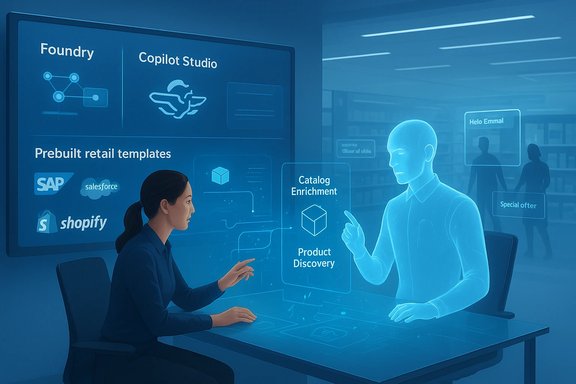
Microsoft’s message differentiates between two developer audiences and three delivery patterns:- Pro‑code, customizable: Microsoft Foundry (aka Azure AI Foundry) offers an enterprise-grade stack where developers can choose from multiple foundation models (including Azure OpenAI and third‑party models), ground agents on enterprise data, and integrate at scale across retail systems.
- Low‑code/no‑code: Copilot Studio provides a simplified, configurable experience for business or developer teams to prototype and deploy agents quickly.
- Managed templates: Microsoft ships preconfigured agent templates in Copilot Studio and the Microsoft Marketplace — tuned workflows that reduce time-to-value for common retail problems. All three retail templates (personalized shopping, catalog enrichment, store operations) are available today.
The three retail agent templates (what they do)
- Personalized shopping agent — a “digital expert associate” running conversational product discovery across channels, asking clarifying questions, and recommending items tuned to brand voice and business rules. Microsoft highlights Ralph Lauren’s “Ask Ralph” as an early example that maps directly to this template.
- Catalog enrichment agent — automates cleaning, completing, and standardizing product metadata by ingesting images, PDFs, vendor feeds, and unstructured content, then transforming inputs into brand-aligned catalog entries. The agent flags low‑confidence outputs for human review and learns from merchandiser corrections. Microsoft positions this as a pragmatic alternative to expensive replatforming.
- Store operations agent — monitors external signals (weather, local events, seasonality) and orchestrates task assignments through Microsoft Teams Planner and connected operational systems. It’s a low‑code toolkit for turning signal-to-action pipelines into auditable, trackable processes at the store level. Microsoft cites Strandbags, Murdoch’s Ranch & Home Supply, and PacSun as early adopters.
Why this matters: market context and verification
Microsoft’s narrative rests on three interlocking claims: (1) consumers will adopt agentic shopping, (2) agentic commerce is a large, addressable market, and (3) the technical stack exists to build reliable, governed agents.- On adoption and market size: Morgan Stanley’s research explicitly models a scenario where agentic commerce captures 10–20% of U.S. ecommerce spending by 2030, translating to a USD 190–385 billion annual market in that upper bound. That calculation assumes rapid consumer acceptance and platform adoption — credible, but not guaranteed.
- On near-term behavior shifts: Adobe Analytics’ reporting of a roughly 670% year‑over‑year increase in AI‑driven traffic during Cyber Monday 2025 (and similarly large holiday-season spikes) demonstrates that consumers are already experimenting with AI-assisted discovery and comparison tools at scale. Press coverage from multiple outlets corroborates Adobe’s summary metrics. These figures are directional proof that AI is influencing purchase journeys today.
- On technical readiness: Microsoft’s Foundry and Copilot Studio aim to answer common enterprise barriers — grounding, observability, connectors, and lifecycle governance — but product capability does not automatically equate to safe, effective deployments. The underlying engineering, data quality, and governance work required remain substantial. Independent analysis in industry forums cautions readers to treat vendor‑sponsored ROI claims with scrutiny and to require reproducible benchmarks before committing capital.
Critical analysis — strengths Microsoft’s plan gets right
1) Practicality: templates meet where retailers live
The decision to ship templates is sensible. Retail teams are not looking for another SDK; they need end-to-end, easily configurable automation that integrates with ERP, PIM, and POS systems. By providing headless, tailless templates and a breadth of connectors, Microsoft lowers engineering friction and shortens the path from pilot to production — a practical multiplier for time‑pressed merchandizing and operations teams.2) Human‑centered framing
Microsoft consistently emphasizes human-in-the-loop patterns: merchandisers review catalog changes, store managers approve operational recommendations, and brand voice is tunable in discovery agents. This approach addresses the two biggest adoption levers in retail — trust and brand authenticity — where human judgment remains essential.3) Platform-level governance primitives
Foundry’s promise of model selection, grounding, prompt flow orchestration, and lifecycle observability is an important counterweight to the risks of unchecked agent sprawl. If implemented well, these primitives reduce the chance that an agent will inadvertently expose sensitive data or execute an unauthorized action across systems. The emphasis on observability and agent registries reflects lessons enterprises learned the hard way during earlier automation waves.Critical analysis — risks, limitations, and open questions
1) Vendor‑sponsored studies and headline multipliers
Microsoft’s Frontier Firm case relies on an IDC InfoBrief that reports striking multipliers (Frontier firms realizing three times the returns of slow adopters). That IDC brief is explicitly sponsored by Microsoft; while IDC is reputable, sponsored InfoBriefs are designed for vendor audiences and their framing can amplify vendor-preferred narratives. Treat those multipliers as directional and require reproducible pilots and independent validation before embedding them in financial forecasts.2) Data quality is the Achilles’ heel of conversational discovery
Conversational search amplifies metadata gaps. Agents that drive discovery require rich, trustworthy product data: fit dimensions, materials, SKU hierarchies, localization, and up-to-date inventory. Microsoft’s catalog enrichment agent reduces the pain, but the underlying challenge remains: how much manual curation, audit, and governance is required before agents produce acceptable outputs? Retailers with complex assortments or regulatory labeling requirements (e.g., cosmetics, food ingredients) will face more work.3) Hallucinations, drift, and approval workflows
Generative outputs can hallucinate or overconfidently assert details. When agents write product claims (dimensions, performance, certifications), those outputs need robust approval workflows and traceable provenance. Microsoft’s templates include review gates, but the operational burden of surfacing and resolving false positives at scale remains material. Expect initial deployments to require conservative approval modes rather than automatic publishing.4) Integration surface area — security and privacy risk
Agents connecting across hundreds of systems create new attack surfaces and a nontrivial risk of data leakage when connectors are misconfigured. Least privilege, identity binding (Azure AD/Entra), and strict audit logging are not optional; they must be mandatory rollout checkpoints. Enterprises should demand model provenance, data retention policies, and contractual protections for tenant data flowing through third‑party models.5) Workforce and organizational change
Agentic systems change job scope: merchandisers become reviewers, store associates become executional leaders, and new roles (agent ops, model stewards, prompt engineers) appear. Without proactive reskilling and role redefinition, agents risk hollowing out essential domain expertise or creating brittle dependence on automation. The human-centered rhetoric is necessary but requires operational investments in training, change management, and measurement.6) Portability and lock‑in
Deeply coupling catalog logic, memory, and brand voice to a proprietary agent runtime and dataset creates migration risk. Retailers should design for portability: exportable datasets, model‑agnostic prompts, and a clear migration path for connectors and playbooks to mitigate supplier lock‑in. Microsoft’s multi‑model support softens this concern, but contractual and architectural work is necessary.Practical checklist for retail leaders — an operational playbook
- Define success metrics first
- Baseline: measure current conversion, search-to‑cart rates, time-to‑publish for product updates, and store task completion rates.
- Targets: specify measurable KPIs (e.g., reduce time-to-publish by X%, increase conversational conversion rate by Y points).
- Start with two bounded pilots (3–6 months)
- Pilot A: catalog enrichment for a high-velocity category (e.g., accessories or seasonal apparel) with human review turned on.
- Pilot B: personalized shopping agent for a single channel (mobile app) and a curated product set.
- Prepare canonical data
- Create a minimum viable PIM layer: canonical attributes, attribute provenance, and quality checks.
- Label sensitive attributes and enforce retention/residency policies.
- Implement governance and observability
- Agent registry (versioned definitions, data scopes).
- Logging: prompts, model outputs, confidence scores, and action audits.
- SLOs/SLA for agent availability and error rates.
- Human‑in‑the‑loop escalation design
- Approval gates for new product copy and any product claims.
- Exception queues for low-confidence items and automated triage for high‑priority fixes.
- Security hardening
- Enforce least privilege, conditional access, and tenant-scoped connectors.
- Integrate agent telemetry into SIEM/AIOps stacks.
- Cost and environmental accounting
- Track inference spend per agent, and model routing to balance latency and price.
- Include compute and energy as part of TCO modeling for large catalog operations.
- Iterate with measurement and independent validation
- A/B test agent-driven experiences against a control group.
- Request reproducible benchmarking from vendors and require transparency on model training data and provenance when procurement decisions hinge on vendor claims.
Governance and ethical guardrails — minimum standards
- Model provenance and catalog traceability: every generated product trait or marketing claim must be traceable to a data source or human approval event.
- Drift monitoring: set automated checks to detect semantic drift in catalog enrichment outputs and periodic audits for discriminatory or incorrect content.
- Human accountability: assign clear owners for agent outputs and create escalation paths for customer disputes or compliance incidents.
- Privacy by design: agents must default to not exfiltrate PII or sensitive vendor terms without explicit consent and must support tenant-side grounding options for sensitive data.
Verdict: when to adopt, when to wait
Adopt when:- You have a data foundation (or a clear plan to build one) and a focused business case (measured conversions, time savings, or compliance efficiency).
- You can staff a small cross‑functional team: merchandiser, data steward, security engineer, and a product owner to run the pilot.
- You require brand-sensitive, controlled automation and are prepared to keep conservative human approvals in early phases.
- Your product data is fractured across many legacy systems with no canonical PIM.
- You lack governance controls for connector access, identity binding, or auditability.
- Your use case would publish agent‑generated product claims without a human‑review workflow.
Final assessment and cautions
Microsoft’s retail agent templates are a pragmatic and useful set of building blocks for an inevitable trend: shoppers increasingly expect conversational, fast, and personalized experiences. The combination of Foundry’s grounding tools, Copilot Studio’s low‑code workflows, and curated managed templates offers a realistic path to move from pilot to scale. Real examples — Ralph Lauren’s “Ask Ralph” and other early adopters — show this is not hypothetical; brands are actively experimenting with and producing customer-facing agent experiences today. At the same time, several cautionary points must shape any strategy: headline ROI multipliers (for example those in IDC‑sponsored briefs) should be tested with internal pilots and independent validation before they inform board-level forecasts; catalog quality, governance, and human‑in‑the‑loop design remain the primary determiners of success; and operational complexity, security posture, and vendor portability should factor into procurement and architecture decisions. Industry analysis from practitioner communities reinforces these cautions and offers a practical roadmap to avoid the pitfalls of “pilot purgatory.”The most durable insight is organizational: agents are amplifiers, not replacements. Retailers that institutionalize human-plus-agent teams, measure outcomes rigorously, and bake governance into their agent lifecycle will capture the real “return on intelligence.” Microsoft’s new retail templates make that path easier — but they are only one set of tools in a larger organizational transformation that requires investment in people, data, and controls to deliver the promised value at scale.
Retailers prepared to act will find practical, sanctioned routes to experiment and scale; those that rush without the right data, governance and human oversight risk eroding brand trust and incurring operational surprises. The coming era is agentic — but the advantage will belong to the firms that treat agents as disciplined collaborators in service of human expertise and customer trust.
Source: Microsoft Return on intelligence: The human edge in an agentic era - Microsoft Industry Blogs
