

Microsoft’s software stack is on the move: in December 2025 a senior Microsoft engineer publicly framed an audacious plan to remove every line of C and C++ from Microsoft by 2030, using a hybrid of algorithmic program analysis, large‑scale AI agents, and hands‑on engineering to translate legacy systems into Rust.
Microsoft has been experimenting with Rust and memory‑safe languages for several years, and the company has publicly acknowledged Rust as a strategic tool for reducing memory‑safety vulnerabilities in system code. In 2023 Microsoft security leadership described Rust as a practical alternative to C and C++ for performance‑sensitive code where managed languages do not fit, and the company has already placed Rust into critical components across Azure and Windows on a trial basis.
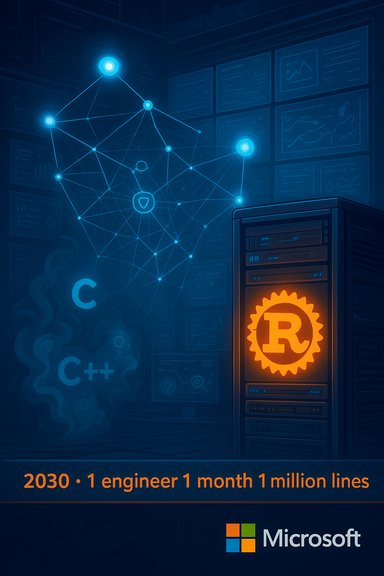
What changed in December 2025 was the explicit, public declaration by a senior Microsoft engineer of a timeline and scale: a corporate objective to replace C/C++ code across Microsoft's codebases by 2030, driven by a purpose‑built code‑processing infrastructure that fuses algorithmic analysis with AI agents. The announcement also included a striking productivity target — “1 engineer, 1 month, 1 million lines of code” — that codifies the level of automation Microsoft aims to reach.
This article lays out what that ambition actually means, why Microsoft is pursuing it, what technical and organizational hurdles lie ahead, and how realistic the timetable is. The intent is to provide Windows‑focused readers and developers with a clear, practical, and critical account of Microsoft’s proposed large‑scale Rust migration and the role of AI in making it possible.
At the same time, the operational and technical complexity of rewriting an entire company’s worth of systems‑level code cannot be understated. Automatic translation at scale will require breakthroughs in whole‑program analysis, rigorous verification, and sophisticated human‑in‑the‑loop workflows. The “1 engineer, 1 month, 1 million lines” productivity metric sets the right north‑star for automation, but the path to that productivity will be iterative, selective, and careful.
For Windows users and developers the transition promises long‑term gains in reliability and safety, but the migration will be evolutionary rather than overnight. The coming years will be an important laboratory for AI‑assisted engineering: a place where ambitious automation meets the unforgiving realities of systems programming. What matters most is not an absolute deadline but the rigor with which the migration is executed — preserving compatibility, proving correctness, and preventing new classes of failure even as old ones are retired.
Source: Windows Central https://www.windowscentral.com/micr...soft-bets-on-ai-to-finally-modernize-windows/
 Background
Microsoft has been experimenting with Rust and memory‑safe languages for several years, and the company has publicly acknowledged Rust as a strategic tool for reducing memory‑safety vulnerabilities in system code. In 2023 Microsoft security leadership described Rust as a practical alternative to C and C++ for performance‑sensitive code where managed languages do not fit, and the company has already placed Rust into critical components across Azure and Windows on a trial basis.What changed in December 2025 was the explicit, public declaration by a senior Microsoft engineer of a timeline and scale: a corporate objective to replace C/C++ code across Microsoft's codebases by 2030, driven by a purpose‑built code‑processing infrastructure that fuses algorithmic analysis with AI agents. The announcement also included a striking productivity target — “1 engineer, 1 month, 1 million lines of code” — that codifies the level of automation Microsoft aims to reach.
This article lays out what that ambition actually means, why Microsoft is pursuing it, what technical and organizational hurdles lie ahead, and how realistic the timetable is. The intent is to provide Windows‑focused readers and developers with a clear, practical, and critical account of Microsoft’s proposed large‑scale Rust migration and the role of AI in making it possible.
Why Microsoft wants Rust: the security and engineering case
Memory safety as a business imperative
- Legacy C/C++ codebases have been the dominant source of certain high‑impact security vulnerabilities for decades. Buffer overruns, use‑after‑free and other memory‑corruption bugs are classically associated with C and C++ and have been central to a large share of historical CVEs affecting OS and cloud infrastructure.
- Rust’s language design enforces memory and thread safety at compile time. By embedding ownership and borrowing rules directly in the type system, Rust reduces whole classes of memory corruption errors without imposing a garbage collector or the runtime costs of managed languages.
- Microsoft has already piloted Rust in critical infrastructure. Over the past several years Microsoft has introduced Rust components into Azure infrastructure and into Windows internals as part of a staged adoption strategy focused on safety‑sensitive subsystems.
Performance, ecosystems, and language tradeoffs
Rust is designed to be competitive with C/C++ for performance and systems programming. It supports zero‑cost abstractions and predictable runtime behavior while adding safety features. However, Rust’s ecosystem is younger and smaller than C++’s; many APIs, libraries, and toolchains in the Windows ecosystem are C/C++ centric. Migration therefore implies not just translation of code, but also ecosystem adaptation: bindings, build systems, debugging workflows, and retraining.What Microsoft has announced (and what it did not)
The public commitment and the tools
Microsoft is assembling a team to scale code translation with three main pillars:- Algorithmic program analysis that constructs large, queryable graphs of code — call graphs, control/data flow graphs, and other semantic representations — enabling deterministic, compiler‑grade reasoning about program structure at scale.
- AI agents (LLMs and other models) that perform translation, refactoring, and specification inference tasks under algorithmic supervision.
- Human engineering and verification to validate and harden AI outputs, integrate translated code into product builds, and resolve corner cases that require domain knowledge.
Bold targets that are necessarily aspirational
Two elements of the statement merit special scrutiny:- The 2030 deadline to eliminate C and C++ across Microsoft is a company‑level aspiration, not an operational plan with publicly disclosed milestones. It signals priority but does not, by itself, guarantee that all lines of C/C++ will be rewritten by that date.
- The “1 engineer, 1 month, 1 million lines of code” productivity target is a shorthand for high automation. It defines the throughput Microsoft expects from its infrastructure once mature. Historically, fully automatic translation of complex systems is rare; this target should be treated as a long‑term goal rather than an immediate engineering reality.
How AI + algorithms could actually work in large‑scale code translation
The algorithmic layer: program graphs and deterministic checks
At scale you cannot treat source code as text. A robust pipeline begins with static analysis that produces structured representations:- ASTs and typed IRs (intermediate representations) for each translation unit.
- Call and dependency graphs to map module interactions and ABI boundaries.
- Data‑flow and taint analysis to find aliasing, ownership, and lifetime semantics.
- Behavioral fingerprints derived from tests, telemetry, and historical bug data.
The AI layer: agents that perform synthesis, suggestion, and repair
Large models can assist in several roles:- Translation: converting idiomatic C/C++ constructs into idiomatic Rust patterns, including ownership modeling and safe replacements for raw pointer usage.
- Spec inference: suggesting likely invariants or contracts where unit tests or formal specs are missing.
- Refactoring helpers: extracting safe abstractions, rewriting legacy macros and idioms, and mediating API shape changes.
- Test generation: producing candidate unit and fuzz tests that can exercise translated code paths.
The human verification loop
Even sophisticated pipelines require humans in the loop for:- Reviewing translated code for correctness and performance.
- Designing and running integration tests and fuzzing campaigns.
- Writing or adjusting shims and FFI layers to guarantee ABI stability.
- Intervening for hardware‑specific or platform‑intrinsic code — e.g., assembly, SIMD intrinsics, or bootstrap code.
Technical hurdles that make this a hard engineering problem
Undefined behavior and semantic mismatches
C and C++ have a large body of code that depends, implicitly or explicitly, on undefined behavior or platform‑specific semantics. Rust’s safety model forbids many such patterns, so automated translation must either:- Prove that the original UB‑prone patterns are benign in practice (rare), or
- Insert explicit runtime checks and fallbacks, or
- Redesign the code to eliminate UB while preserving semantics.
Performance‑critical hotspots
High‑performance kernels, drivers, and cryptographic code often use nuanced low‑level optimizations. Translating these segments safely and without regressions requires deep knowledge of processor microarchitecture, compiler codegen, and the original intention of the code — not something a black‑box model can reliably infer.Inline assembly, platform intrinsics, and third‑party dependencies
Legacy code contains inline assembly, compiler intrinsics, and platform‑specific APIs that cannot be mechanically rewritten without careful substitution. For third‑party libraries and drivers where source is unavailable or licensed differently, Microsoft will need to either keep C/C++ wrappers or replace entire components.Build systems and deployment pipelines
MSBuild, Visual Studio toolchains, and the Windows driver stack are historically tuned for C/C++. Replacing languages at scale means reworking build artifacts, continuous‑integration rules, distribution, and symbol/debugging metadata across the company’s CI/CD fabric.The “last 1%” of correctness
At scale, many automated translations will work for 99% of cases; the remaining 1% will be the most subtle, security‑critical, and user‑visible. Those cases will require the most human effort and careful verification, which will slow overall throughput.Security: gains, limits, and real‑world evidence
Real improvements, but not a silver bullet
- Rust reduces memory‑safety bugs — the type system and ownership model eliminate many common exploit vectors that derive from buffer overflows and dangling pointers.
- Attack surface shifts — while memory‑safety issues decline, logic bugs, cryptographic misuse, and insecure configurations remain attack vectors that Rust does not automatically fix.
Practical lessons from Rust in the kernel
Early experience shows both promise and reality checks. Microsoft and independent researchers have found issues even in Rust components, underscoring the fact that Rust reduces a class of bugs but does not guarantee zero vulnerabilities. Fuzzing and standard security testing remain essential.Supply‑chain and binary compatibility
The migration alters the dependency graph and the supply chain: compiled Rust artifacts, new compiler versions, and a changed ecosystem increase the complexity of security‑scanning, SBOM generation, and incident response. Microsoft will need to integrate Rust toolchain assurance into its existing security compliance frameworks.Organizational implications: skills, hiring, and culture
Hiring and retraining
Rust systems experience is currently rarer than C/C++ experience for large‑scale OS and database engineering. Microsoft’s requirement for experienced Rust systems programmers signals both immediate hiring needs and a multi‑year retraining program.Developer productivity and code ownership
- Productivity gains may appear after teams become fluent in Rust and in the new tooling chain.
- Initially, the cost of training, tooling, and code review may slow development velocity on some teams.
- Over time, lower incident rates and reduced security patches might yield net savings.
Legal and compatibility considerations
Some components are tied to third‑party licensing and vendor contracts that assume C/C++ runtime and ABI. Migration will require careful legal and compatibility audits.What this means for Windows users, ISVs, and the broader ecosystem
For end users
Most users will see no immediate difference in feature parity or UI. The benefits are indirect — fewer security patches, fewer high‑severity vulnerabilities, and potentially more robust performance and reliability over the long term.For ISVs and third‑party drivers
The driver model and ABI compatibility are critical. Microsoft will need to maintain stable interfaces or furnish migration pathways for ISVs that supply drivers and native extensions. Backward compatibility is nonnegotiable for Windows, so a phased, compatibility‑first approach is expected.For open source and the Rust community
A major push by Microsoft will accelerate Rust ecosystem growth, producing more libraries, patterns, and tooling for systems programming. This benefits the Rust community but also places responsibility on Microsoft to upstream improvements and to participate in security and governance processes for widely used crates.Realistic timeline and likely scenarios
Microsoft’s ambition to remove C/C++ across the company by 2030 is a signal of priority and will accelerate investment. But realistic outcomes will likely follow one of two broad paths:- Pragmatic hybrid migration (most likely):
- Core, safety‑sensitive subsystems are rewritten or replaced in Rust.
- Legacy C/C++ remains where ABI, performance, or vendor constraints require it, with wrapper layers and isolation mitigations.
- The codebase at large gradually moves toward Rust for new development, while C/C++ remains for special cases beyond 2030.
- Aggressive full migration (optimistic):
- The AI + algorithms platform matures to replace large swaths of C/C++ with human review, hitting the 2030 target broadly.
- This outcome depends on significant breakthroughs in whole‑program verification, automatic handling of UB, and toolchain maturity.
Practical risks and mitigations to watch
- Regression risk during translation: Robust integration tests, staged rollouts, and canary deployments are mandatory to catch performance and correctness regressions.
- Overreliance on automation: AI must be tied to deterministic checks and human review. The algorithmic layer must enforce invariants and block transformations that cannot be proven safe.
- Toolchain correctness and compiler bugs: Switching language ecosystems increases exposure to new compiler bugs and toolchain regressions; comprehensive testing and cross‑compiler validation are necessary.
- Operational costs and developer experience: The cost of retraining and tooling must be accounted for; Microsoft can ease this by investing in migration utilities, debuggers, and cross‑language diagnostics.
- Security complacency: Rust reduces some classes of bugs but should not be treated as an all‑purpose cure. Existing security practices — fuzzing, code audits, threat modeling — must be maintained and expanded.
Why this is a big moment for systems software engineering
Microsoft’s public commitment puts a major industrial actor behind a Rust‑forward, AI‑assisted modernization strategy. If even a portion of this migration succeeds at scale, it will:- Provide a model for other large software organizations contemplating language modernization.
- Accelerate the maturity of translation tooling and large‑scale program analysis.
- Drive ecosystem investment in cross‑language toolchains, cargo/Visual Studio integration, and security tooling.
Conclusion: ambitious, sensible, and fraught with tough engineering choices
Microsoft’s stated goal to eliminate C and C++ internally by 2030 is both a bold engineering vision and a clear market signal. The technical rationales are sound — memory safety and reduced vulnerability surface — and Microsoft’s incremental Rust work over the past few years provides concrete precedent for larger adoption.At the same time, the operational and technical complexity of rewriting an entire company’s worth of systems‑level code cannot be understated. Automatic translation at scale will require breakthroughs in whole‑program analysis, rigorous verification, and sophisticated human‑in‑the‑loop workflows. The “1 engineer, 1 month, 1 million lines” productivity metric sets the right north‑star for automation, but the path to that productivity will be iterative, selective, and careful.
For Windows users and developers the transition promises long‑term gains in reliability and safety, but the migration will be evolutionary rather than overnight. The coming years will be an important laboratory for AI‑assisted engineering: a place where ambitious automation meets the unforgiving realities of systems programming. What matters most is not an absolute deadline but the rigor with which the migration is executed — preserving compatibility, proving correctness, and preventing new classes of failure even as old ones are retired.
Source: Windows Central https://www.windowscentral.com/micr...soft-bets-on-ai-to-finally-modernize-windows/
