

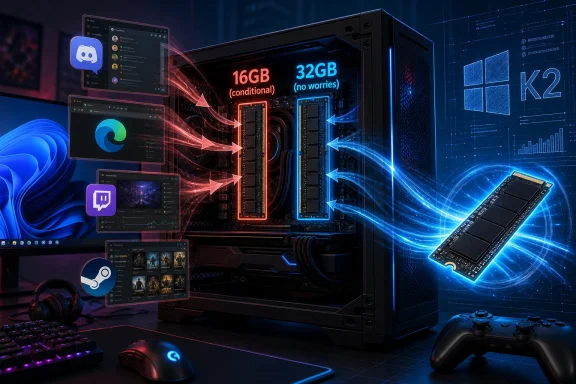
Microsoft’s Windows gaming guidance, updated on April 9, 2026, now describes 16GB of RAM as a practical starting point and 32GB as the “no worries” upgrade for Windows 11 players who keep Discord, browsers, streaming tools, and modern games running together. That is not a scandal because 32GB has quietly become the sane enthusiast build target. It is a scandal because Microsoft is saying it at the precise moment Windows users have the least patience for being told to buy their way out of software sprawl. The company is technically right, politically clumsy, and strategically exposed.
For years, the folk wisdom of PC gaming was simple: 8GB was survival, 16GB was comfort, and 32GB was what you bought if you streamed, modded, rendered video, or wanted to stop thinking about memory for the life of the machine. Microsoft’s new framing does not blow up that hierarchy so much as formalize what many builders already knew. The “recommended” gaming PC is no longer just a box that can launch the game; it is a box that can launch the game while the rest of a modern Windows life keeps breathing in the background.
That distinction matters. A Windows 11 gaming session in 2026 is rarely just a game executable. It is a launcher, an overlay, a chat client, a browser with walkthroughs or streams open, RGB utilities, capture software, anti-cheat services, controller middleware, cloud sync, telemetry, and sometimes a second monitor full of tabs. The memory pressure is not one villain but an ecosystem of small claims on the same finite pool.
Microsoft’s language is careful. It has not said 16GB is dead, nor has it declared that every gamer must immediately upgrade. It says 16GB is a baseline and 32GB gives breathing room. That is a reasonable sentence if it appears in a PC buyer’s guide; it becomes more combustible when spoken by the company whose operating system, bundled apps, UI stack, widgets, browser hooks, cloud prompts, and AI ambitions all compete for that same breathing room.
This is where the story stops being about RAM sticks and starts being about trust. Microsoft is not merely a neutral observer describing the state of PC gaming. It is one of the largest forces shaping that state.
The real-world PC is messy. A user may start with a clean boot and a single game, then slowly accrete Discord, Steam, Xbox, Epic, Battle.net, a Chromium browser, a hardware control suite, a headset app, GeForce Experience or Radeon Software, OneDrive, Teams, a password manager, and Windows’ own increasingly service-shaped shell. None of these pieces alone makes 16GB untenable. Together they turn 16GB from “comfortable” into “conditional.”
That conditional nature is what Microsoft is trying to express. If a PC has 32GB, the operating system has more room to cache files, background apps are less likely to be squeezed, and the game has a better chance of avoiding sudden stalls when assets load or another process wakes up. The benefit is not always a higher benchmark number. Often it is the absence of weirdness.
But consumers do not buy absence. They buy a kit of memory, or a more expensive laptop configuration, or a prebuilt tier that quietly jumps in price. When a company says “no worries,” it is also telling users that the cheaper configuration comes with worries attached. In a vacuum, that is normal buying advice. In the Windows ecosystem, it sounds like a bill for bloat.
Yet Microsoft does not get to stand outside that trend. Windows 11 itself has steadily absorbed web-driven surfaces, account prompts, widgets, cloud integration, Teams-era communication hooks, Edge dependencies, Copilot-era affordances, and UI layers that often feel less native than the Windows users grew up with. The modern Windows desktop is less a clean stage for applications than a stack of Microsoft services with a desktop metaphor painted over the top.
That may be overstated in any single technical comparison. A stripped-down test machine can make Windows 11 look perfectly reasonable. But the frustration is experiential: users feel that more of the system is animated by things they did not ask for, cannot fully remove, or must manage through settings pages that change names every release. Memory is only one proxy for that larger resentment.
This is why the phrase “no worries” lands badly. Users know what worrying about Windows feels like. They worry about updates arriving at the wrong time, settings being reset, ads appearing in system surfaces, OneDrive becoming the default answer to local storage, AI features showing up before core annoyances are fixed, and background processes multiplying faster than the visible value they provide. A RAM recommendation becomes a referendum.
The difference between HDD and SSD is not subtle in daily use. Boot time, patching, level loading, shader preparation, asset streaming, and system responsiveness all benefit from solid-state storage. Unlike the RAM debate, where “enough” depends heavily on workload, the SSD question is close to settled for gaming PCs. If the OS and active library still live on spinning rust, that machine is not merely budget-conscious; it is compromised.
The console market made this unavoidable. Once the PlayStation 5 and Xbox Series generation standardized SSD assumptions, game design could lean harder into fast storage. PC gamers can often brute-force around console constraints with better GPUs and CPUs, but storage is different. An HDD can turn a high-end rig into a stuttery mess when a game expects fast asset access.
This is where Microsoft’s advice feels most useful. It gives non-technical buyers permission to prioritize the right part. A 1TB NVMe SSD may not sound as exciting as a bigger GPU model number, but for the feel of a Windows gaming PC, it is foundational.
The market in 2026 is not that forgiving. Memory pricing has been distorted by demand across servers, AI infrastructure, mobile devices, and high-bandwidth memory supply chains. Even when ordinary desktop DIMMs are not the direct beneficiary of AI spending, the same manufacturers, wafers, capacity planning, and profit incentives shape what reaches consumers. The old assumption that RAM upgrades are the cheap part of a build has weakened.
That changes how Microsoft’s guidance is heard. For desktop builders, 32GB may still be manageable if the motherboard has open slots and the platform uses standard DIMMs. For laptop buyers, the recommendation is more punishing. Soldered memory turns a purchasing guideline into a permanent class distinction: buy enough at checkout or live with the consequences.
This is especially awkward for Windows laptops sold as gaming-capable but configured with 16GB of non-upgradable RAM. The marketing says modern, AI-ready, creator-friendly, gamer-friendly, multitasking machine. The memory configuration says “choose your background apps carefully.” Microsoft’s own ecosystem has encouraged thin, sealed, premium devices while Windows itself has grown more service-heavy. Those two trends collide exactly at the RAM line.
The result is not simply higher cost. It is shorter useful life. A 16GB desktop can often be rescued later. A 16GB laptop with soldered memory becomes a device whose limitations are baked into the chassis, long after the CPU and GPU might otherwise remain adequate.
That is the shadow over every Windows hardware recommendation right now. Users are not evaluating it as a single sentence on a learning-center page. They are hearing it after years of Windows 11 complaints: the taskbar regressions, the Start menu compromises, the account pressure, the ad-like surfaces, the Copilot saturation, the inconsistent settings experience, and the sense that Microsoft’s priorities were increasingly upstream from the customer.
The rumored and reported “Windows K2” effort matters because it suggests Microsoft understands the problem is not just vibes. The project has been described as a broad internal push to improve Windows 11 fundamentals, including responsiveness, consistency, resource usage, and UI quality. Whether K2 becomes a real turning point or merely another codename in the long history of Windows course corrections depends on execution, not branding.
The RAM guidance therefore lands in a delicate place. Microsoft is telling users to provision more memory for a better Windows gaming experience while, at the same time, acknowledging through its broader messaging that Windows must get leaner and better. Those two positions can coexist, but they create an obvious question: if Windows needs foundational repairs, how much of the 32GB recommendation is future-proofing for games, and how much is headroom for Microsoft’s own unfinished work?
This is not only Microsoft’s sin. Discord, Slack, Spotify, WhatsApp, Teams, launchers, store clients, and countless utilities have helped normalize the idea that a simple interface can require an absurd amount of resident memory. The industry has converted cheap RAM into a subsidy for developer convenience. Now that RAM is less cheap, the subsidy is visible.
Gamers feel it first because games are among the few consumer applications that can still use all the hardware you give them. A chat client that idles like a small operating system is annoying on a work laptop. It is actively parasitic on a gaming rig trying to maintain frame-time consistency. Background waste is no longer background when it causes a hitch during a match.
Microsoft has influence here. It owns Windows, Edge WebView2, the Microsoft Store story, the developer guidance, the performance tooling, and a large suite of first-party apps that set norms. If it wants to tell Discord and browser-tab users to buy 32GB, it should also be telling developers that lazy memory consumption is no longer acceptable desktop behavior.
What has changed is the confidence attached to it. A few years ago, 16GB could be recommended with a shrug: good enough, move on, spend the money on the GPU. Now it requires caveats. Is the memory soldered? Is it dual-channel? Is the integrated GPU sharing system memory? Does the user keep Chrome open? Does the game have a heavy modding scene? Does the machine run capture software? Does the buyer expect to keep it for five years?
Those caveats are the death of a mainstream recommendation. Once the advice needs that many conditions, it is no longer the comfortable default; it is the budget compromise. That does not make 32GB extravagant. It makes it the new peace-of-mind tier.
Still, there is an important class dimension here. Enthusiast desktops normalize upgrades because enthusiasts can open the case. Mainstream buyers buy sealed machines, often from OEMs whose upsell pricing for memory is far above component cost. When Microsoft shifts the language of comfort from 16GB to 32GB, it strengthens the hand of every vendor that wants to turn RAM into a margin lever.
That is why average FPS is a poor way to settle the RAM argument. A benchmark run on a clean system can show little difference between 16GB and 32GB, leading to the familiar claim that extra memory is wasted. But the user experience is shaped by lows, stalls, swapping, alt-tab behavior, launch times, and what happens after three hours of accumulated background activity.
The shift to 32GB is therefore less about peak performance than resilience. More RAM makes the system less brittle. It gives Windows room to cache, the browser room to misbehave, the game room to grow, and the user room to forget what is open. That is not glamorous, but it is exactly what “no worries” means in practice.
The danger is that this resilience can become an excuse for inefficiency. If every sloppy app assumes users have 32GB, the headroom disappears. The history of computing is full of expanded resources being consumed by expanded expectations. Today’s comfort tier becomes tomorrow’s baseline, and the software industry congratulates itself for progress while users wonder why the machine feels no faster.
On a handheld, every watt, gigabyte, background service, and UI delay is harder to ignore. There is less screen space for desktop metaphors, less thermal headroom for waste, and often shared memory pressure between CPU and GPU. A bloated background stack does not feel abstract when it competes directly with battery life and smooth play.
This is why Microsoft’s gaming ambitions cannot be separated from Windows fundamentals. Xbox on PC, Game Pass, handheld gaming, cross-device play, and Copilot-era experiences all depend on Windows feeling like a platform that respects the hardware. If Windows feels like a tax on the machine before the game even starts, rivals do not need to be perfect. They only need to feel lighter.
The 32GB guidance may be sensible for a desktop buyer, but it is a poor philosophy for the next wave of gaming devices. The future of PC gaming is not only giant towers with oversized coolers. It is handhelds, compact living-room boxes, laptops, streaming hybrids, and devices where efficiency is a feature customers can feel.
That does not mean Microsoft should pretend modern workloads have not grown. Games are larger, assets are richer, browsers are heavier, and players multitask more aggressively than they did a decade ago. A serious gaming recommendation in 2026 should probably say 32GB. The problem is not the number. The problem is whether Microsoft treats the number as an endpoint or a permission slip.
A leaner Windows would not make 32GB unnecessary. It would make 32GB feel like luxury again instead of self-defense. It would let 16GB systems age more gracefully, reduce friction on laptops, improve handheld viability, and give Microsoft a stronger answer to users who suspect every new feature arrives with a hidden resource bill.
The company also needs to stop pretending that consumer goodwill can be rebuilt with feature volume. Windows users have not been asking for more surfaces. They have been asking for more control, less noise, and better craft. If K2 focuses on those basics, the RAM controversy will look like a symptom of a company finally diagnosing the disease. If it does not, 32GB will become just another toll booth on the road to a heavier Windows.
Microsoft is right that 32GB is the safer Windows 11 gaming recommendation in 2026, and it is right that SSDs should carry the operating system and modern games. But the company should be careful about confusing accurate advice with absolution. If Windows is going to win back enthusiasts, it cannot simply ask them to bring more RAM to the table; it has to prove that the next gigabyte goes to the game, the user, and the experience—not to another layer of avoidable operating-system appetite.
Source: OC3D Microsoft recommends 32GB or RAM for "no worries" PC gaming - OC3D
 Microsoft Just Moved the Goalposts Without Saying the Old Field Was Broken
For years, the folk wisdom of PC gaming was simple: 8GB was survival, 16GB was comfort, and 32GB was what you bought if you streamed, modded, rendered video, or wanted to stop thinking about memory for the life of the machine. Microsoft’s new framing does not blow up that hierarchy so much as formalize what many builders already knew. The “recommended” gaming PC is no longer just a box that can launch the game; it is a box that can launch the game while the rest of a modern Windows life keeps breathing in the background.That distinction matters. A Windows 11 gaming session in 2026 is rarely just a game executable. It is a launcher, an overlay, a chat client, a browser with walkthroughs or streams open, RGB utilities, capture software, anti-cheat services, controller middleware, cloud sync, telemetry, and sometimes a second monitor full of tabs. The memory pressure is not one villain but an ecosystem of small claims on the same finite pool.
Microsoft’s language is careful. It has not said 16GB is dead, nor has it declared that every gamer must immediately upgrade. It says 16GB is a baseline and 32GB gives breathing room. That is a reasonable sentence if it appears in a PC buyer’s guide; it becomes more combustible when spoken by the company whose operating system, bundled apps, UI stack, widgets, browser hooks, cloud prompts, and AI ambitions all compete for that same breathing room.
This is where the story stops being about RAM sticks and starts being about trust. Microsoft is not merely a neutral observer describing the state of PC gaming. It is one of the largest forces shaping that state.
The 32GB Recommendation Is Sensible, Which Is Why It Irritates People
The easiest version of the backlash is also the weakest: pretending 16GB remains universally luxurious. It does not. Plenty of games still run happily on 16GB, and many competitive titles barely stress it, but the experience around the game has changed. Smoothness now depends as much on avoiding paging, tab reloads, hitching, and background contention as it does on average frame rate.The real-world PC is messy. A user may start with a clean boot and a single game, then slowly accrete Discord, Steam, Xbox, Epic, Battle.net, a Chromium browser, a hardware control suite, a headset app, GeForce Experience or Radeon Software, OneDrive, Teams, a password manager, and Windows’ own increasingly service-shaped shell. None of these pieces alone makes 16GB untenable. Together they turn 16GB from “comfortable” into “conditional.”
That conditional nature is what Microsoft is trying to express. If a PC has 32GB, the operating system has more room to cache files, background apps are less likely to be squeezed, and the game has a better chance of avoiding sudden stalls when assets load or another process wakes up. The benefit is not always a higher benchmark number. Often it is the absence of weirdness.
But consumers do not buy absence. They buy a kit of memory, or a more expensive laptop configuration, or a prebuilt tier that quietly jumps in price. When a company says “no worries,” it is also telling users that the cheaper configuration comes with worries attached. In a vacuum, that is normal buying advice. In the Windows ecosystem, it sounds like a bill for bloat.
Windows Has Become the Background App It Warns You About
Microsoft’s examples are revealing. It points to Discord, browsers, and streaming tools as the multitasking scenarios that make 32GB more attractive. Fair enough. Discord is no longer a tiny voice app, browsers have become operating systems inside the operating system, and streaming tools can chew through CPU, GPU, and memory all at once.Yet Microsoft does not get to stand outside that trend. Windows 11 itself has steadily absorbed web-driven surfaces, account prompts, widgets, cloud integration, Teams-era communication hooks, Edge dependencies, Copilot-era affordances, and UI layers that often feel less native than the Windows users grew up with. The modern Windows desktop is less a clean stage for applications than a stack of Microsoft services with a desktop metaphor painted over the top.
That may be overstated in any single technical comparison. A stripped-down test machine can make Windows 11 look perfectly reasonable. But the frustration is experiential: users feel that more of the system is animated by things they did not ask for, cannot fully remove, or must manage through settings pages that change names every release. Memory is only one proxy for that larger resentment.
This is why the phrase “no worries” lands badly. Users know what worrying about Windows feels like. They worry about updates arriving at the wrong time, settings being reset, ads appearing in system surfaces, OneDrive becoming the default answer to local storage, AI features showing up before core annoyances are fixed, and background processes multiplying faster than the visible value they provide. A RAM recommendation becomes a referendum.
The SSD Advice Is the Easy Part Because the Industry Already Settled It
Microsoft’s parallel advice that Windows and active games should live on an SSD is much less controversial. On this point, the company is simply stating what the hardware market, console generation, and game developers have already decided. HDDs remain useful for bulk storage, backups, archives, media libraries, and cheap capacity, but they are no longer a dignified home for the operating system or modern game installs.The difference between HDD and SSD is not subtle in daily use. Boot time, patching, level loading, shader preparation, asset streaming, and system responsiveness all benefit from solid-state storage. Unlike the RAM debate, where “enough” depends heavily on workload, the SSD question is close to settled for gaming PCs. If the OS and active library still live on spinning rust, that machine is not merely budget-conscious; it is compromised.
The console market made this unavoidable. Once the PlayStation 5 and Xbox Series generation standardized SSD assumptions, game design could lean harder into fast storage. PC gamers can often brute-force around console constraints with better GPUs and CPUs, but storage is different. An HDD can turn a high-end rig into a stuttery mess when a game expects fast asset access.
This is where Microsoft’s advice feels most useful. It gives non-technical buyers permission to prioritize the right part. A 1TB NVMe SSD may not sound as exciting as a bigger GPU model number, but for the feel of a Windows gaming PC, it is foundational.
The Timing Is Brutal Because Memory Is No Longer Cheap Background Noise
A few years ago, telling gamers to buy 32GB was almost casual. DDR4 prices had fallen, 2x16GB kits were broadly accessible, and even DDR5 was moving from early-adopter pain toward normalcy. In that climate, “just get 32GB” was often good advice.The market in 2026 is not that forgiving. Memory pricing has been distorted by demand across servers, AI infrastructure, mobile devices, and high-bandwidth memory supply chains. Even when ordinary desktop DIMMs are not the direct beneficiary of AI spending, the same manufacturers, wafers, capacity planning, and profit incentives shape what reaches consumers. The old assumption that RAM upgrades are the cheap part of a build has weakened.
That changes how Microsoft’s guidance is heard. For desktop builders, 32GB may still be manageable if the motherboard has open slots and the platform uses standard DIMMs. For laptop buyers, the recommendation is more punishing. Soldered memory turns a purchasing guideline into a permanent class distinction: buy enough at checkout or live with the consequences.
This is especially awkward for Windows laptops sold as gaming-capable but configured with 16GB of non-upgradable RAM. The marketing says modern, AI-ready, creator-friendly, gamer-friendly, multitasking machine. The memory configuration says “choose your background apps carefully.” Microsoft’s own ecosystem has encouraged thin, sealed, premium devices while Windows itself has grown more service-heavy. Those two trends collide exactly at the RAM line.
The result is not simply higher cost. It is shorter useful life. A 16GB desktop can often be rescued later. A 16GB laptop with soldered memory becomes a device whose limitations are baked into the chassis, long after the CPU and GPU might otherwise remain adequate.
Microsoft’s “Win Back Fans” Moment Makes the RAM Message Riskier
The larger context is that Microsoft has recently been unusually candid about needing to repair sentiment around Windows and Xbox. Satya Nadella’s remark about doing the foundational work required to win back fans across Windows, Xbox, Bing, and Edge is not standard corporate fluff in the way it might first appear. Companies do not usually say they need to win back fans unless they know some have left emotionally, even if they remain statistically trapped.That is the shadow over every Windows hardware recommendation right now. Users are not evaluating it as a single sentence on a learning-center page. They are hearing it after years of Windows 11 complaints: the taskbar regressions, the Start menu compromises, the account pressure, the ad-like surfaces, the Copilot saturation, the inconsistent settings experience, and the sense that Microsoft’s priorities were increasingly upstream from the customer.
The rumored and reported “Windows K2” effort matters because it suggests Microsoft understands the problem is not just vibes. The project has been described as a broad internal push to improve Windows 11 fundamentals, including responsiveness, consistency, resource usage, and UI quality. Whether K2 becomes a real turning point or merely another codename in the long history of Windows course corrections depends on execution, not branding.
The RAM guidance therefore lands in a delicate place. Microsoft is telling users to provision more memory for a better Windows gaming experience while, at the same time, acknowledging through its broader messaging that Windows must get leaner and better. Those two positions can coexist, but they create an obvious question: if Windows needs foundational repairs, how much of the 32GB recommendation is future-proofing for games, and how much is headroom for Microsoft’s own unfinished work?
The Browser-App Economy Has Made Native Efficiency Feel Like a Luxury
One reason the 16GB line has moved is that desktop software culture has changed. Many everyday apps are now web applications wrapped in desktop clothing. The convenience is obvious for developers: shared code, faster updates, consistent cross-platform behavior, easier deployment, and fewer native UI headaches. The cost is paid by users in memory, latency, battery life, and a general feeling that every app brought its own browser to the party.This is not only Microsoft’s sin. Discord, Slack, Spotify, WhatsApp, Teams, launchers, store clients, and countless utilities have helped normalize the idea that a simple interface can require an absurd amount of resident memory. The industry has converted cheap RAM into a subsidy for developer convenience. Now that RAM is less cheap, the subsidy is visible.
Gamers feel it first because games are among the few consumer applications that can still use all the hardware you give them. A chat client that idles like a small operating system is annoying on a work laptop. It is actively parasitic on a gaming rig trying to maintain frame-time consistency. Background waste is no longer background when it causes a hitch during a match.
Microsoft has influence here. It owns Windows, Edge WebView2, the Microsoft Store story, the developer guidance, the performance tooling, and a large suite of first-party apps that set norms. If it wants to tell Discord and browser-tab users to buy 32GB, it should also be telling developers that lazy memory consumption is no longer acceptable desktop behavior.
16GB Is Not Dead, but It Has Lost Its Moral Authority
The most useful way to think about 16GB in 2026 is not “bad” but “managed.” A 16GB Windows 11 gaming PC can still be perfectly competent if the user plays esports titles, keeps background apps lean, avoids heavy mod packs, and does not expect to stream, browse, chat, capture, and alt-tab through a dozen tools at once. For budget machines, handheld-style PCs, and entry-level laptops, 16GB remains a defensible floor.What has changed is the confidence attached to it. A few years ago, 16GB could be recommended with a shrug: good enough, move on, spend the money on the GPU. Now it requires caveats. Is the memory soldered? Is it dual-channel? Is the integrated GPU sharing system memory? Does the user keep Chrome open? Does the game have a heavy modding scene? Does the machine run capture software? Does the buyer expect to keep it for five years?
Those caveats are the death of a mainstream recommendation. Once the advice needs that many conditions, it is no longer the comfortable default; it is the budget compromise. That does not make 32GB extravagant. It makes it the new peace-of-mind tier.
Still, there is an important class dimension here. Enthusiast desktops normalize upgrades because enthusiasts can open the case. Mainstream buyers buy sealed machines, often from OEMs whose upsell pricing for memory is far above component cost. When Microsoft shifts the language of comfort from 16GB to 32GB, it strengthens the hand of every vendor that wants to turn RAM into a margin lever.
The Gaming PC Is Becoming a Multitasking Appliance
The phrase “gaming PC” increasingly undersells what the machine is asked to do. It is a social terminal, media station, streaming booth, browser workstation, modding platform, update manager, store hub, and sometimes a part-time creator rig. The actual game may be the most demanding foreground task, but it is not the whole workload.That is why average FPS is a poor way to settle the RAM argument. A benchmark run on a clean system can show little difference between 16GB and 32GB, leading to the familiar claim that extra memory is wasted. But the user experience is shaped by lows, stalls, swapping, alt-tab behavior, launch times, and what happens after three hours of accumulated background activity.
The shift to 32GB is therefore less about peak performance than resilience. More RAM makes the system less brittle. It gives Windows room to cache, the browser room to misbehave, the game room to grow, and the user room to forget what is open. That is not glamorous, but it is exactly what “no worries” means in practice.
The danger is that this resilience can become an excuse for inefficiency. If every sloppy app assumes users have 32GB, the headroom disappears. The history of computing is full of expanded resources being consumed by expanded expectations. Today’s comfort tier becomes tomorrow’s baseline, and the software industry congratulates itself for progress while users wonder why the machine feels no faster.
Windows on Handhelds Exposes the Problem in Miniature
The RAM debate looks different on desktop towers than it does on handheld gaming PCs and compact devices. Windows has made progress in the handheld space, but it still carries the assumptions of a general-purpose desktop OS. Valve’s SteamOS and Linux-based handheld environments have benefited from appearing more focused, even when compatibility and anti-cheat realities complicate the picture.On a handheld, every watt, gigabyte, background service, and UI delay is harder to ignore. There is less screen space for desktop metaphors, less thermal headroom for waste, and often shared memory pressure between CPU and GPU. A bloated background stack does not feel abstract when it competes directly with battery life and smooth play.
This is why Microsoft’s gaming ambitions cannot be separated from Windows fundamentals. Xbox on PC, Game Pass, handheld gaming, cross-device play, and Copilot-era experiences all depend on Windows feeling like a platform that respects the hardware. If Windows feels like a tax on the machine before the game even starts, rivals do not need to be perfect. They only need to feel lighter.
The 32GB guidance may be sensible for a desktop buyer, but it is a poor philosophy for the next wave of gaming devices. The future of PC gaming is not only giant towers with oversized coolers. It is handhelds, compact living-room boxes, laptops, streaming hybrids, and devices where efficiency is a feature customers can feel.
The K2 Promise Has to Be Measured in Megabytes and Milliseconds
If Windows K2 is to mean anything to ordinary users, it cannot merely be a prettier internal process or a new collection of roadmap slides. It has to show up as lower memory overhead, faster shell response, fewer forced surfaces, less duplication, cleaner settings, more predictable updates, and a system that feels calm under load. The metric is not whether Microsoft can produce a keynote phrase; it is whether a 16GB machine feels less harassed.That does not mean Microsoft should pretend modern workloads have not grown. Games are larger, assets are richer, browsers are heavier, and players multitask more aggressively than they did a decade ago. A serious gaming recommendation in 2026 should probably say 32GB. The problem is not the number. The problem is whether Microsoft treats the number as an endpoint or a permission slip.
A leaner Windows would not make 32GB unnecessary. It would make 32GB feel like luxury again instead of self-defense. It would let 16GB systems age more gracefully, reduce friction on laptops, improve handheld viability, and give Microsoft a stronger answer to users who suspect every new feature arrives with a hidden resource bill.
The company also needs to stop pretending that consumer goodwill can be rebuilt with feature volume. Windows users have not been asking for more surfaces. They have been asking for more control, less noise, and better craft. If K2 focuses on those basics, the RAM controversy will look like a symptom of a company finally diagnosing the disease. If it does not, 32GB will become just another toll booth on the road to a heavier Windows.
The New Windows Gaming Checklist Is Really a Trust Test
The practical advice is not hard, but the implications are larger than a spec sheet. Microsoft’s recommendation should be read as both useful buying guidance and an indictment of where the desktop ecosystem has drifted.- A new Windows 11 gaming desktop should be treated as a 32GB target unless the budget is tight and the motherboard leaves a clear upgrade path.
- A 16GB gaming laptop should be bought cautiously if its memory is soldered, because the compromise cannot be fixed later.
- An SSD is no longer optional for Windows and active game installs, while HDDs belong in bulk storage and backup roles.
- Background apps now matter enough that gamers should audit launchers, overlays, chat clients, browser tabs, and capture tools as part of performance tuning.
- Microsoft’s Windows K2 work should be judged by responsiveness and resource reduction, not by how many new features or AI entry points ship alongside it.
- Developers of desktop apps need to treat memory efficiency as a user-facing feature again, because the era of cheap, invisible RAM waste is over.
Microsoft is right that 32GB is the safer Windows 11 gaming recommendation in 2026, and it is right that SSDs should carry the operating system and modern games. But the company should be careful about confusing accurate advice with absolution. If Windows is going to win back enthusiasts, it cannot simply ask them to bring more RAM to the table; it has to prove that the next gigabyte goes to the game, the user, and the experience—not to another layer of avoidable operating-system appetite.
Source: OC3D Microsoft recommends 32GB or RAM for "no worries" PC gaming - OC3D
