

Custom e‑commerce stacks promised control and differentiation—but for many brands that promise slowly calcified into a recurring drain on time, talent, and cash. What began as strategic advantage often becomes a maintenance tax: security updates, bespoke integrations, infrastructure overage, and firefighting that pull developers away from revenue-driving work. This article examines the claims behind Shopify’s “move off custom” case, verifies the most important technical and commercial statements against independent and primary evidence, and lays out a practical, realistic view of what migration unlocks—and what it costs—so IT and commerce leaders can decide with eyes open. ://www.shopify.com/in/enterprise/blog/custom-ecommerce-platform-migration)
Custom platforms were once the rational answer for brands with unique business rules, unusual checkout flows, or complex fulfillment networks. Over time, however, bespoke stacks accumulate complexity: ad hoc integrations, custom connectors, unstandardized catalog data, and tightly coupled checkout logic. The result is predictable operational drag.
Forrester’s Wave references also appear in Shopify materials: Shopify cites Forrester recognition across B2B/B2C evaluations in 2024. Third‑party analyst placements are meaningful validation that a platform's capabilities and go‑to‑market are recognized beyond marketing collateral, though each analyst report has its own scope and scoring model; teams should read the underlying reports for the evaluated criteria and comparator set.
A cautionary note: the AI commerce landscape is immature and standards will change fast. Vendor‑provided primitives reduce integration risk today but create dependency on how a platform implements future agent protocols and tokenization schemes. Keep catalog hygiene and an exportable data model if you want portability across emerging discovery channels.
A practical rule of thumb for evaluation:
If your backlog contains critical revenue projects delayed by maintenance, and if you can identify specific features or channels you would build with reclaimed capacity, the migration conversation becomes strategic rather than technical. Use the eight‑step playbook, validate the lift with pilot migrations or partner references, and preserve portability in your architecture. Do that, and the choice moves from “Can we keep this running?” to “What should we build next?”—and that is the operational shift that actually drives growth.
Source: Shopify Beyond Custom: When Innovation No Longer Competes with Maintenance (2026) - Shopify India
 Background: the maintenance tax and why it matters
Custom platforms were once the rational answer for brands with unique business rules, unusual checkout flows, or complex fulfillment networks. Over time, however, bespoke stacks accumulate complexity: ad hoc integrations, custom connectors, unstandardized catalog data, and tightly coupled checkout logic. The result is predictable operational drag.- Direct costs: cloud and CDN bills, specialized SRE headcount, license and monitoring fees, and recurring third‑party maintenance.
- Opportunity costs: A/B tests, personalization, checkout experiments, and new sales channels that stay in backlog while teams triage incidents.
- Strategic risk: inability to reach rapidly evolving discovery surfaces—mobile wallets, marketplaces, and conversational AI—without months of engineering per channel.
Overview: what Shopify claims you get by migrating
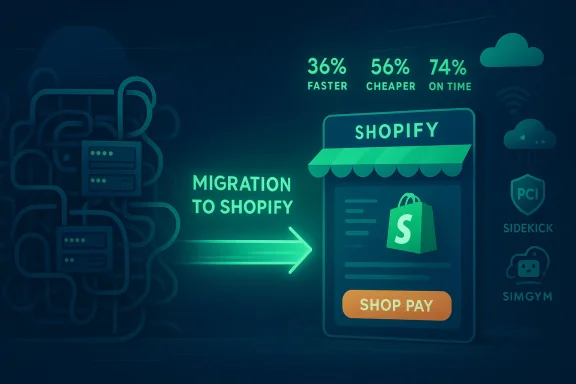
Shopify’s enterprise materials make several concrete claims that anchor their migration thesis:- Migrations to Shopify are materially faster, less expensive, and more predictable than bespoke rewrites—Shopify cites headline figures showing migrations are 36% faster, 56% less expensive, and 74% more likely to finish on time in one analysis. Those figures appear in Shopify’s migration narrative, but materially similar—but not identical—numbers reappear across different Shopify pages, which suggests different datasets or comparator sets were used for different publications. Treat headline percentages as directional and verify with aner for your specific estate.
- Ongoing total cost of ownership (TCO) is meaningfully lower: Shopify cites average platform and operating cost advantages in the low‑to‑mid 30% range versus certain competitors. The scale, multitenant economics, and bundled cos here.
- Conversion and checkout uplift: Shopify reports that Shopify Checkout converts up to 36% better than alternatives and that when customers use Shop Pay, conversion can increase by as much as 50%—claims that are supported in Shopify’s financial and product disclosures and repeated in earnings commentary. These conversion benefits are a major part of the ROI case for migration because higher conversion compounds over time.
- Product velocity and channel readiness: features like Shop Pay, Agentic Storefronts, Sidekick (Shopify’s commerce AI), and simulation/testing tools (SimGym) are framed as capabilities merchants would otherwise need to build and maintain in‑house. Twice‑yearly Editions releases are cited as an engine of continuous improvement that a platform merchant “gets” without lifting the engineering burden.
Verification: what’s provable and where to be cautious
Analyst recognition and platform posture
Shopify points to independent analyst accolades to validate its enterprise credentials. IDC lists Shopify as a Leader in the 2024 IDC MarketScape for Worldwide Enterprise B2C Digital Commerce Applications—an independent, structured vendor assessment focused on enterprise requirements. That recognition supports Shopify’s claim that the platform meets many enterprise needs for integration, security, and scale.Forrester’s Wave references also appear in Shopify materials: Shopify cites Forrester recognition across B2B/B2C evaluations in 2024. Third‑party analyst placements are meaningful validation that a platform's capabilities and go‑to‑market are recognized beyond marketing collateral, though each analyst report has its own scope and scoring model; teams should read the underlying reports for the evaluated criteria and comparator set.
Shop Pay and conversion uplift
Shopify’s conversion claims around Shop Pay and Checkout are corroborated by public earnings commentary and SEC filings: executives have stated that Shop Pay has over 150 million users and that Shop Pay–enabled checkout flows show materially higher conversion metrics. These points are also echoed in public financial disclosures and press comments from Shopify leadership. Use these numbers as strong directional evidence that accelerated checkouts and a network effect exist, but verify conversion impact on a per‑store basis because lift depends on customer mix, product type, and marketing funnel.Migration and TCO claims—vendor‑commissioned research
The specific migration percentages (36% faster, 56% less expensive, 74% more likely to launch on time) appear in Shopify’s commissioned materials and partner research. Independent verification of vendor-commissioned findings raw data and the comparator cohorts, so treat the exact numbers as informative but not determinative. In other words:- Use Shopify’s migration figures as a directional benchmark.
- Require an independent quote or a proof‑of‑concept from migration partners that models your catalog, integrations, and compliance needs before accepting headline percent savings as a guaranteed outcome.
What Shopify manages so your team can build
One of the strongest, verifiable parts of the platform tradeoff is operational centralization. On Shopify, several recurring, time‑consuming responsibilities move to the platform:- Security and compliance: PCI DSS hanrtifacts, vulnerability patching, and DDoS protections are managed centrally—reducing the recurring audit and patch burden on merchant teams. Shopify publishes compliance artifacts and has a centralized compliance program that eases merchant obligations; however, merchants retain responsibility for third‑party app governance and their own data handling policies.
- Platform‑level performance and uptime: Multi‑tenant platforms perform and scale for bursts; Shopify’s enterprise materials reference high uptime SLAs that reduce the need for bespoke SRE teams. Note: SLAs vary by plan and implementation; confirm contractual uptime and incident response expecrise agreement.
- App ecosystem and prebuilt integrations: Shopify’s app ecosystem—tens of thousands of apps—represents an economy of reuse: specialists build, maintain, and evolve functionality that many merchants need. When thousands of merchants invest in similar solutions, the marginal cost of integrating those capabilities falls dramatically for each new merchant. This is a concrete productivity multiplier.
What migration unlocks in practice: patterns from merchant stories
Vendor case studies are anecdotes, but they reveal consistent operational patterns when interpreted cautiously:- Faster feature cycles: Loyalty programs and personalization that used to take months now ship in days or weeks when using app partners and Flow automations.
- Reallocated engineering: Brands report moving engineers from 30–50% maintenance loads to product and experimentation work (reports vary by merchant size and complexity).
- Lower infrastructure overhead: Merchants show reductions in infrastructure bills and SRE headcount following migration.
The new frontier: AI channels and agentic storefronts
A central strategic risk for custom platforms today is time to market for emergent channels—specifically agentic AI assistants and conversational discovery surfaces where purchase intent can originate. Shopify’s Agentic Storefront primitives and catalog normalization aim to make product discovery in AI chats and agents “turn‑on” simple rather than months of engineering work. Shopify also promotes Sidekick—an AI assistant for generating automations, theme edits, and app scaffolds—and SimGym for traffic‑free A/B testing with synthetic shoppers. These features represent platform investments that would be expensive to replicate i])A cautionary note: the AI commerce landscape is immature and standards will change fast. Vendor‑provided primitives reduce integration risk today but create dependency on how a platform implements future agent protocols and tokenization schemes. Keep catalog hygiene and an exportable data model if you want portability across emerging discovery channels.
Trade‑offs and technical risks you must budget for
No migration is zero risk. Here are the practical tradeoffs IT leaders must consider.1) Loss of absolute control
Platforms trade some control for speed. If you have true, sustainable differentiation embedded in checkout, pricing or fulfillment logic that requires sub‑millisecond control or regulatory entitlements, moving to an opinionated checkout or data model may require re‑engineering—or preserving are layer.2) Integration depth and re‑architecture
Enterprises with deep ERP, OMS, CRM, and PIM customization will need careful migration mapping. Prebuilt connectors accelerate common cases (Microsoft Dynamics, SAP, NetSuite, Salesforce), but complex business rules, contract pricing, and multi‑warehouse logic often require bespoke middleware or partner involvement. Expect design and test cycles, and budget for pilot rollouts.3) Vendor dynamics and lock‑in
Platform dependency shifts the risk profile: instead of patch cycles, you now track roadmap alignment and pricing changes. Architect your integrations with portability in mind (API‑based middleware, data exportability, and documented transformational logic) so you can preserve negotiating leverage.4) App selection and third‑party governance
Shopify’s ecosystem reduces build time but increases dependency on third‑party apps. Each app introduces a surface area for performance degradation, data leakage, or upgrade conflict. Maintain a governance process: vet app vendors, require SLAs for critical partners, and periodically review app performance and permissions.A pragmatic migration playbook (8 steps for IT and commerce teams)
- Inventory and classify systems. Catalog every integration (ERP, OMS, PIM, CMS, fulfillment), label criticality and complexity.
- Define non‑negotiables. Decide which checkout flows, legal/regulatory behaviors, or fulfillment guarantees must be preserved exactly.
- Benchmark backlog and opportunity cost. Identify features delayed by maintenance and estimate their revenue impact.
- Select migration partners and pilot. Choose systems integrators or specialist agencies with enterprise migration experience and run a limited pilot (region, brand, or SKU subset).
- Normalize your catalog. Standardize SKUs, variants, tax rules, and inventory signals before import to avoid downstream data cleanup costs.
- Build a staged rollout plan. Start with non‑critical geographies or product lines, validate flows, and cut over incremompliance posture. Map platform compliance artifacts to your audit needs and document any merchant‑retained controls.
- Reallocate resources. Plan how dev teams will be redeployed to innovation work and set KPIs for converted capacity (e.g., tests shipped, channels launched).
Economics: where the math usually lands
The financial argument for migration has three levers:- One‑time migration cost vs. ongoing maintenance burn.
- Ongoing platform fees and app costs vs. in‑house infrastructure and headcount.
- Revenue uplift from better checkout and faster feature delivery.
A practical rule of thumb for evaluation:
- Model 3‑year TCO: include migration fees, partner costs, platform/subscription fees, and app fees.
- Model a conservative conversion uplift (e.g., 5–10% incremental) and scenario test higher outcomes driven by Shop Pay adoption.
- Add the opportunity value of reclaimed developer capacity: estimate what percentage of features you will accelerate and the expected revenue uplift.
Implementation governance: how to preserve optionality
If you decide to migrate, preserve optionality and portability:- Architect a middleware layer for complex business rules so you can decouple core ERP logic from the storefront.
- Maintain an authoritative data model and regular exports of product, customer, and order data.
- Use feature flags and canary releases to validate user flows in production without full cutovers.
- Keep a small internal team focused on platform‑agnostic capabilities (data science, personalization rules that can be reimplemented on any platform).
Final assessment: when migration is the right call—and when it isn’t
Migration to a commerce platform like Shopify is compelling when:- Your engineering team spends a material portion of capacity on maintenance rather than innovation.
- You lack scale in payments and checkout optimization (Shop Pay’s network effects are real and can be measured).
- Your backlog contains high‑value experiments (checkout, loyalty, AI channels) that are repeatedly delayed.
- You want faster access to emerging discovery surfaces without building bespoke connectors for each one.
- Your business differentiation is tightly bound to unique, non‑replicable checkout or fulfillment logic that customers cannot get elsewhere.
- You have a sustained, proven cost advantage with custom infrastructure and the headcount to maintain it efficiently.
- Regulatory or data residency constraints require a highly customized architecture that multitenant SaaS cannot satisfy.
is not “platform vs. custom” for every module of commerce; it’s a strategic, operational choice about where your organization creates value. Move the undifferentiated infrastructure to a platform and redeploy engineering to the customer experiences and channel innovations that build brand value. Keep the unique, hard‑to‑replicate logic where it matters.
Conclusion: stop subsidizing the past; invest in what wins next
The maintenance tax is a real phenomenon and one that shows up repeatedly across merchant interviews and case examples: development capacity eaten by patching, integrations, and uptime rather than product experiments. Shopify’s core promise—faster migrations, lower ongoing TCO, and instant access to conversion primitives and new sales channels—has supporting evidence in analyst recognition, earnings commentary, and merchant stories. But the exact magnitude of savings and uplift is context dependent and should be modeled for your estate, not simply accepted as a headline.If your backlog contains critical revenue projects delayed by maintenance, and if you can identify specific features or channels you would build with reclaimed capacity, the migration conversation becomes strategic rather than technical. Use the eight‑step playbook, validate the lift with pilot migrations or partner references, and preserve portability in your architecture. Do that, and the choice moves from “Can we keep this running?” to “What should we build next?”—and that is the operational shift that actually drives growth.
Source: Shopify Beyond Custom: When Innovation No Longer Competes with Maintenance (2026) - Shopify India
