

Minecraft players across Bedrock and Java Realms were hit by a widespread service outage on June 3, 2026, beginning around midnight Pacific time, with Bedrock authentication failures locking some players out of the game entirely while Realms users on both editions encountered server errors. The immediate problem is access; the larger problem is confidence. For a game sold as both a purchased product and a living platform, repeated authentication failures turn downtime from an inconvenience into a dispute over ownership itself.
The outage, first reported by PCGamesN and echoed by user reports across community channels and outage trackers, arrived just two days after another major Minecraft disruption tied to Microsoft Azure problems. That timing matters. A single bad morning can be dismissed as operational noise; two major failures in three days start to look like a pattern in the plumbing beneath one of Microsoft’s most important games.
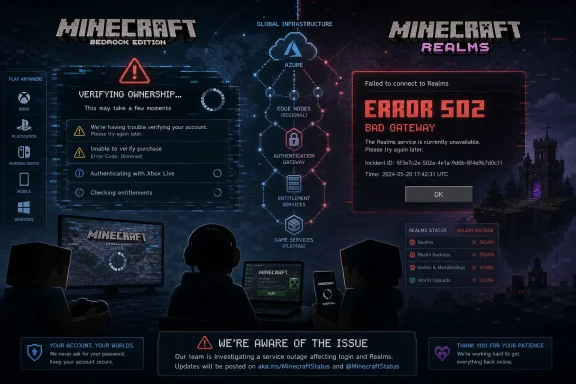
The June 3 failure split Minecraft’s player base in a telling way. Java Edition authentication reportedly remained functional enough for single-player access, while Bedrock players saw errors indicating the game could not connect to Minecraft services or verify ownership. Realms, Microsoft’s paid hosted multiplayer product, failed across both Bedrock and Java with Error 502.
That distinction is more than technical trivia. Java players had a fallback path because the game’s offline and single-player traditions remain partly intact. Bedrock players, especially those using console, mobile, or Microsoft Store versions, were more exposed to the modern account-and-entitlement stack that sits between the player and the software.
The most aggravating Bedrock error message was not simply that servers were unavailable. It was the claim that Minecraft could not verify what products the player owned. In plain English, the system could not confirm that a paying customer was entitled to launch or use the game they had already bought.
That is the point at which an outage stops feeling like downtime and starts feeling like a licensing failure. Players expect online worlds to require online infrastructure. They are far less forgiving when a game they own behaves as though ownership itself is temporarily unavailable.
That makes it a particularly appropriate error for modern Minecraft. The game is no longer just a client connecting to a world. It is a stack of Microsoft accounts, Xbox services, Mojang services, entitlement checks, Realms routing, marketplace systems, and cloud infrastructure. Each layer may be defensible on its own; together, they create a chain in which one weak link can deny access to millions.
This is the bargain Microsoft has implicitly made with players. Centralized identity and cloud-hosted services enable cross-platform play, parental controls, subscriptions, marketplace purchases, and the managed convenience of Realms. But they also mean Minecraft increasingly inherits the fragility of a live-service platform, even when the activity a player wants is as simple as opening a world or joining a small family server.
The uncomfortable truth is that Minecraft’s scale now cuts both ways. Its enormous player base justifies industrial-grade infrastructure. It also means that when authentication or Realms fails, the blast radius is immense.
That strategy has generally worked. Minecraft is playable across an absurdly broad range of hardware, and Microsoft accounts allow friends, purchases, safety settings, and Realms subscriptions to follow users across devices. For parents managing children’s accounts, for schools using controlled environments, and for players who move between Xbox, PC, Switch, and mobile, the benefits are real.
But identity as the front door also means identity as the failure point. When authentication is unavailable, the system cannot gracefully distinguish between a pirate, an expired entitlement, a disconnected client, and a legitimate customer caught behind a broken service. The player sees a message about ownership; the platform sees a failed check.
That is a design choice with consequences. Microsoft may not intend to make ownership feel conditional, but every authentication outage teaches players that their access is mediated by infrastructure they cannot see, control, or bypass.
When Realms works, that promise is powerful. It makes small-group Minecraft simple for families, friend groups, classrooms, and casual players who do not want to become server administrators. When Realms fails, however, Microsoft owns the entire experience. There is no ISP to blame, no modpack maintainer to chase, no community host to reboot.
That makes Error 502 especially corrosive. A Realms subscriber is not just failing to connect to a random server; they are failing to reach the service Microsoft sold as the low-friction alternative to running one themselves. The whole point of Realms is that Microsoft handles the hard parts.
Players can tolerate occasional outages from any online service. What they resent is opacity. If a paid service fails for hours and the official response lags behind community reporting, the downtime begins to feel less like a technical incident and more like neglect.
If Minecraft’s June 3 outage turns out to be unrelated, Microsoft still has a communications problem. Players are seeing repeated failures close together, and absent a clear explanation, they will naturally connect the dots themselves. Silence invites architecture speculation.
If the June 3 outage is related to the same general class of backend or cloud dependency, the problem is more serious. Minecraft would then be demonstrating a recurring inability to shield players from failures in the identity, entitlement, or routing layers that underpin Microsoft’s gaming ecosystem.
Either way, Microsoft cannot treat Minecraft like a niche service. This is one of the most recognizable games in the world, and for many younger players it is their first experience of Microsoft account infrastructure. When Minecraft authentication breaks, it is not just a game outage. It is a consumer-facing demonstration of whether Microsoft’s identity stack feels trustworthy.
That user-led investigation is not inherently bad. Minecraft’s community is technically literate, and many players can read an HTTP error as more than a vague inconvenience. But community diagnosis is a poor substitute for platform accountability, especially when the outage affects paid access and subscriptions.
A basic outage update does not need to reveal sensitive internal architecture. It needs to answer three simple questions: what is affected, whether users need to do anything, and whether engineers are working on it. Even a terse acknowledgement can stop players from wasting hours reinstalling clients, rebooting routers, changing DNS settings, or blaming their own accounts.
This is where Microsoft’s gaming operation still sometimes behaves like a collection of product teams rather than a unified service provider. Xbox, Minecraft, Azure, Microsoft accounts, and Mojang support may all have separate operational realities. To the player, they are one company.
Java Edition, for all its quirks, still carries the cultural memory of PC software. It has launchers, local worlds, modded installs, direct server addresses, and a long history of community-run infrastructure. Bedrock is more streamlined, but that streamlining comes with more gates.
When Bedrock authentication fails, the experience can resemble being locked out of a storefront rather than disconnected from a server. The game’s architecture, marketplace model, and platform integrations make entitlement verification feel central to the launch experience. That may be normal for modern console ecosystems, but Minecraft is not an ordinary console game.
Minecraft’s identity has always rested on persistence. Worlds are supposed to outlast sessions, devices, and trends. When a platform outage makes access feel temporary, it cuts against the emotional contract that made Minecraft durable in the first place.
Minecraft has avoided the worst version of that story because it remains broadly available and actively developed. Yet outages like this remind players that even a purchased game can become dependent on remote approval. The line between owning software and holding a revocable access token gets blurrier every year.
Microsoft would argue, fairly, that authentication protects accounts, enables cross-platform purchases, supports child safety, and prevents fraud. Those are legitimate goals. But good intentions do not erase the user experience of being told a service cannot verify ownership during a server failure.
The practical lesson is simple: if a game requires online verification for basic access, the reliability bar becomes much higher. Authentication is not a bonus service. It is part of the product.
Parents and educators experience the same problem without the vocabulary. A child cannot access a world. A classroom activity stalls. A family Realm does not load. The advice to “check your internet connection” becomes actively misleading when the problem is server-side.
That mismatch between error message and root cause is one of the most fixable parts of the incident. Minecraft does not need to expose internal service names. But it should be able to say, clearly, that account verification or Realms access is temporarily unavailable and that reinstalling the game will not help.
Bad error messages externalize support costs onto users. They turn outages into troubleshooting rituals. In a game with Minecraft’s reach, that means millions of people may waste time trying to fix a problem only Microsoft can solve.
Minecraft’s repeated service disruptions challenge that promise at the consumer edge. Even if the underlying causes are mundane, the observed experience is simple: the game could not reliably authenticate players or connect them to paid multiplayer infrastructure. That is the metric users care about.
There may be reasonable technical explanations. Authentication systems are hard. Global entitlement checks are hard. Cross-platform services are hard. Keeping Bedrock, Java, Xbox, mobile, console, and Realms aligned across regions is hard.
But Minecraft is not an experimental startup running on a hobby VPS. It is one of Microsoft’s crown jewels. The scale of the challenge explains why perfection is impossible; it does not excuse weak communication or repeated user-visible failures.
Trust in online services is cumulative. Players do not maintain a spreadsheet of incident causes. They carry an impression of whether a platform is dependable, whether the vendor is honest when things break, and whether paying for the official service buys them stability.
This is especially important for Realms because its competition is not only other games. It is self-hosting, third-party Minecraft hosts, community servers, and simply choosing to play something else. A subscription service must continuously justify the convenience premium.
The danger for Microsoft is not a mass abandonment of Minecraft. The game is too culturally entrenched for that. The danger is a slow shift in perception: Realms as convenient but flaky, Bedrock as polished but fragile, Microsoft authentication as powerful but intrusive.
The company does not need to publish a deeply technical root-cause analysis for every consumer outage, but Minecraft is large enough to merit a higher standard than vague status posts. A credible response would distinguish between Bedrock authentication, Java authentication, Realms routing, Xbox dependencies, and Azure infrastructure. It would also say whether paid Realms customers should expect any service credit or compensation if downtime crossed a meaningful threshold.
More importantly, Microsoft should revisit what happens when entitlement verification is unavailable. If a player has a locally installed copy and recently validated ownership, there may be room for better grace periods, clearer offline modes, or more resilient cached entitlements. Security and anti-fraud concerns are real, but so is the reputational cost of blocking legitimate customers during backend failures.
Minecraft’s architecture has evolved around connected services. The next phase has to evolve around graceful degradation. A platform this large should not have only two modes: fully connected or locked out.
The outage, first reported by PCGamesN and echoed by user reports across community channels and outage trackers, arrived just two days after another major Minecraft disruption tied to Microsoft Azure problems. That timing matters. A single bad morning can be dismissed as operational noise; two major failures in three days start to look like a pattern in the plumbing beneath one of Microsoft’s most important games.
 Minecraft’s Outage Was Not Just a Multiplayer Problem
The June 3 failure split Minecraft’s player base in a telling way. Java Edition authentication reportedly remained functional enough for single-player access, while Bedrock players saw errors indicating the game could not connect to Minecraft services or verify ownership. Realms, Microsoft’s paid hosted multiplayer product, failed across both Bedrock and Java with Error 502.That distinction is more than technical trivia. Java players had a fallback path because the game’s offline and single-player traditions remain partly intact. Bedrock players, especially those using console, mobile, or Microsoft Store versions, were more exposed to the modern account-and-entitlement stack that sits between the player and the software.
The most aggravating Bedrock error message was not simply that servers were unavailable. It was the claim that Minecraft could not verify what products the player owned. In plain English, the system could not confirm that a paying customer was entitled to launch or use the game they had already bought.
That is the point at which an outage stops feeling like downtime and starts feeling like a licensing failure. Players expect online worlds to require online infrastructure. They are far less forgiving when a game they own behaves as though ownership itself is temporarily unavailable.
Error 502 Is the Symptom, Not the Story
Error 502, often described as a bad gateway error, generally means one server received an invalid or unusable response from another server upstream. For users, it looks like a generic failure. For platform operators, it is usually a sign that one piece of a distributed backend cannot get a clean answer from another.That makes it a particularly appropriate error for modern Minecraft. The game is no longer just a client connecting to a world. It is a stack of Microsoft accounts, Xbox services, Mojang services, entitlement checks, Realms routing, marketplace systems, and cloud infrastructure. Each layer may be defensible on its own; together, they create a chain in which one weak link can deny access to millions.
This is the bargain Microsoft has implicitly made with players. Centralized identity and cloud-hosted services enable cross-platform play, parental controls, subscriptions, marketplace purchases, and the managed convenience of Realms. But they also mean Minecraft increasingly inherits the fragility of a live-service platform, even when the activity a player wants is as simple as opening a world or joining a small family server.
The uncomfortable truth is that Minecraft’s scale now cuts both ways. Its enormous player base justifies industrial-grade infrastructure. It also means that when authentication or Realms fails, the blast radius is immense.
Microsoft Bought Minecraft, Then Made Identity the Front Door
Microsoft’s acquisition of Mojang was never only about owning a game. Minecraft became a strategic platform: a children’s social network, an education product, a marketplace, a console service driver, a subscription asset, and a cross-platform proof point for Microsoft’s gaming ambitions. In that world, account identity is not a side feature. It is the front door.That strategy has generally worked. Minecraft is playable across an absurdly broad range of hardware, and Microsoft accounts allow friends, purchases, safety settings, and Realms subscriptions to follow users across devices. For parents managing children’s accounts, for schools using controlled environments, and for players who move between Xbox, PC, Switch, and mobile, the benefits are real.
But identity as the front door also means identity as the failure point. When authentication is unavailable, the system cannot gracefully distinguish between a pirate, an expired entitlement, a disconnected client, and a legitimate customer caught behind a broken service. The player sees a message about ownership; the platform sees a failed check.
That is a design choice with consequences. Microsoft may not intend to make ownership feel conditional, but every authentication outage teaches players that their access is mediated by infrastructure they cannot see, control, or bypass.
Realms Turns Downtime Into a Billing Problem
Realms deserves separate scrutiny because it is not merely part of Minecraft’s free online fabric. It is a paid server rental product. Players subscribe because Microsoft promises convenience: no port forwarding, no third-party hosting, no Linux box under a desk, no Discord scramble to find which friend’s machine is online.When Realms works, that promise is powerful. It makes small-group Minecraft simple for families, friend groups, classrooms, and casual players who do not want to become server administrators. When Realms fails, however, Microsoft owns the entire experience. There is no ISP to blame, no modpack maintainer to chase, no community host to reboot.
That makes Error 502 especially corrosive. A Realms subscriber is not just failing to connect to a random server; they are failing to reach the service Microsoft sold as the low-friction alternative to running one themselves. The whole point of Realms is that Microsoft handles the hard parts.
Players can tolerate occasional outages from any online service. What they resent is opacity. If a paid service fails for hours and the official response lags behind community reporting, the downtime begins to feel less like a technical incident and more like neglect.
The June 1 Azure Link Raises the Stakes
The earlier June 1 outage reportedly traced back to a Microsoft Azure issue that also affected Xbox Live. That matters because Azure is not a small dependency hidden in the corner of the architecture. It is Microsoft’s cloud backbone, the commercial infrastructure Microsoft sells to businesses precisely on the promise of resilience.If Minecraft’s June 3 outage turns out to be unrelated, Microsoft still has a communications problem. Players are seeing repeated failures close together, and absent a clear explanation, they will naturally connect the dots themselves. Silence invites architecture speculation.
If the June 3 outage is related to the same general class of backend or cloud dependency, the problem is more serious. Minecraft would then be demonstrating a recurring inability to shield players from failures in the identity, entitlement, or routing layers that underpin Microsoft’s gaming ecosystem.
Either way, Microsoft cannot treat Minecraft like a niche service. This is one of the most recognizable games in the world, and for many younger players it is their first experience of Microsoft account infrastructure. When Minecraft authentication breaks, it is not just a game outage. It is a consumer-facing demonstration of whether Microsoft’s identity stack feels trustworthy.
Mojang’s Silence Makes the Outage Feel Larger
Technical failures are inevitable. Communication failures are optional. The longer Mojang and Microsoft go without a clear acknowledgement, the more players fill the vacuum with screenshots, Reddit diagnostics, Downdetector spikes, and theories about Azure, Realms backends, and authentication endpoints.That user-led investigation is not inherently bad. Minecraft’s community is technically literate, and many players can read an HTTP error as more than a vague inconvenience. But community diagnosis is a poor substitute for platform accountability, especially when the outage affects paid access and subscriptions.
A basic outage update does not need to reveal sensitive internal architecture. It needs to answer three simple questions: what is affected, whether users need to do anything, and whether engineers are working on it. Even a terse acknowledgement can stop players from wasting hours reinstalling clients, rebooting routers, changing DNS settings, or blaming their own accounts.
This is where Microsoft’s gaming operation still sometimes behaves like a collection of product teams rather than a unified service provider. Xbox, Minecraft, Azure, Microsoft accounts, and Mojang support may all have separate operational realities. To the player, they are one company.
Bedrock Players Are Carrying the Heaviest Burden
The Bedrock Edition is supposed to be the accessible version of Minecraft: console-friendly, mobile-friendly, cross-play-friendly, and deeply integrated with Microsoft’s account ecosystem. That is precisely why outages like this hit Bedrock players harder.Java Edition, for all its quirks, still carries the cultural memory of PC software. It has launchers, local worlds, modded installs, direct server addresses, and a long history of community-run infrastructure. Bedrock is more streamlined, but that streamlining comes with more gates.
When Bedrock authentication fails, the experience can resemble being locked out of a storefront rather than disconnected from a server. The game’s architecture, marketplace model, and platform integrations make entitlement verification feel central to the launch experience. That may be normal for modern console ecosystems, but Minecraft is not an ordinary console game.
Minecraft’s identity has always rested on persistence. Worlds are supposed to outlast sessions, devices, and trends. When a platform outage makes access feel temporary, it cuts against the emotional contract that made Minecraft durable in the first place.
The Ownership Debate Keeps Coming Back
The wording of the Bedrock error message lands badly because the broader software industry has trained users to distrust digital ownership. Games disappear from storefronts. Launchers break. Subscription tiers change. Authentication servers are retired. Features move behind accounts that did not exist when the original purchase was made.Minecraft has avoided the worst version of that story because it remains broadly available and actively developed. Yet outages like this remind players that even a purchased game can become dependent on remote approval. The line between owning software and holding a revocable access token gets blurrier every year.
Microsoft would argue, fairly, that authentication protects accounts, enables cross-platform purchases, supports child safety, and prevents fraud. Those are legitimate goals. But good intentions do not erase the user experience of being told a service cannot verify ownership during a server failure.
The practical lesson is simple: if a game requires online verification for basic access, the reliability bar becomes much higher. Authentication is not a bonus service. It is part of the product.
Admins and Parents See a Different Failure Mode
For IT pros, the Minecraft outage is familiar because it resembles enterprise dependency sprawl. One visible service fails because an upstream identity provider, gateway, entitlement database, or cloud region misbehaves. Users see a simple error. Administrators know the actual failure path may cross five teams and three dashboards.Parents and educators experience the same problem without the vocabulary. A child cannot access a world. A classroom activity stalls. A family Realm does not load. The advice to “check your internet connection” becomes actively misleading when the problem is server-side.
That mismatch between error message and root cause is one of the most fixable parts of the incident. Minecraft does not need to expose internal service names. But it should be able to say, clearly, that account verification or Realms access is temporarily unavailable and that reinstalling the game will not help.
Bad error messages externalize support costs onto users. They turn outages into troubleshooting rituals. In a game with Minecraft’s reach, that means millions of people may waste time trying to fix a problem only Microsoft can solve.
The Cloud Was Supposed to Hide This Complexity
The promise of cloud gaming infrastructure was not that failures would never happen. It was that sophisticated operators could build redundancy, failover, monitoring, and incident response that made failures less visible to users. Microsoft, more than almost any company, has built its public cloud business around that promise.Minecraft’s repeated service disruptions challenge that promise at the consumer edge. Even if the underlying causes are mundane, the observed experience is simple: the game could not reliably authenticate players or connect them to paid multiplayer infrastructure. That is the metric users care about.
There may be reasonable technical explanations. Authentication systems are hard. Global entitlement checks are hard. Cross-platform services are hard. Keeping Bedrock, Java, Xbox, mobile, console, and Realms aligned across regions is hard.
But Minecraft is not an experimental startup running on a hobby VPS. It is one of Microsoft’s crown jewels. The scale of the challenge explains why perfection is impossible; it does not excuse weak communication or repeated user-visible failures.
The Community Will Remember the Pattern, Not the Postmortem
If Mojang eventually explains the June 3 outage, the details will matter to engineers and journalists. Most players, however, will remember the pattern: Minecraft was down, it had been down recently before, and official communication did not keep pace with the disruption. That is how trust erodes.Trust in online services is cumulative. Players do not maintain a spreadsheet of incident causes. They carry an impression of whether a platform is dependable, whether the vendor is honest when things break, and whether paying for the official service buys them stability.
This is especially important for Realms because its competition is not only other games. It is self-hosting, third-party Minecraft hosts, community servers, and simply choosing to play something else. A subscription service must continuously justify the convenience premium.
The danger for Microsoft is not a mass abandonment of Minecraft. The game is too culturally entrenched for that. The danger is a slow shift in perception: Realms as convenient but flaky, Bedrock as polished but fragile, Microsoft authentication as powerful but intrusive.
The Next Fix Has to Be More Than a Reboot
Microsoft and Mojang need to treat this stretch of outages as more than a service restoration exercise. Getting servers back online is the first obligation. Explaining what failed and how similar failures will be reduced is the second.The company does not need to publish a deeply technical root-cause analysis for every consumer outage, but Minecraft is large enough to merit a higher standard than vague status posts. A credible response would distinguish between Bedrock authentication, Java authentication, Realms routing, Xbox dependencies, and Azure infrastructure. It would also say whether paid Realms customers should expect any service credit or compensation if downtime crossed a meaningful threshold.
More importantly, Microsoft should revisit what happens when entitlement verification is unavailable. If a player has a locally installed copy and recently validated ownership, there may be room for better grace periods, clearer offline modes, or more resilient cached entitlements. Security and anti-fraud concerns are real, but so is the reputational cost of blocking legitimate customers during backend failures.
Minecraft’s architecture has evolved around connected services. The next phase has to evolve around graceful degradation. A platform this large should not have only two modes: fully connected or locked out.
The Concrete Lesson From a Very Microsoft Minecraft Outage
The June 3 outage is not just a story about impatient players watching a status page. It is a preview of what happens when a beloved game becomes inseparable from centralized identity, cloud routing, and subscription infrastructure. The more Minecraft becomes a Microsoft platform, the more Microsoft-grade reliability and communication players will expect.- Bedrock players were hit hardest because authentication failures could block access before they ever reached a world.
- Java players had a partial safety valve because single-player access reportedly remained available even while Realms failed.
- Realms errors are more serious than ordinary multiplayer downtime because users pay Microsoft to manage that infrastructure for them.
- The earlier June 1 Azure-linked disruption makes the June 3 outage feel like part of a reliability pattern, even if the exact cause differs.
- Mojang and Microsoft need clearer incident communication because vague ownership and connection errors push users into pointless local troubleshooting.
- The long-term fix is not just restoring service, but making Minecraft degrade more gracefully when authentication or backend systems fail.
References
- Primary source: GameLuster
Published: 2026-06-04T09:30:30.109213
Minecraft Servers Are Down and Players Have Been Locked Out for Hours | GameLuster
Minecraft Servers Are Down and Players Are Locked Outgameluster.com - Related coverage: pcgamesn.com
Minecraft's servers are down, locking players out of the game for hours
Minecraft players are finding themselves locked out of their accounts when they boot up the game, thanks to pesky server issues.www.pcgamesn.com - Related coverage: techyorker.com
Minecraft Realms 502 Bad Gateway Error: 8 Ways to Fix It - TechYorker
A 502 Bad Gateway error in Minecraft Realms means the game client successfully reached a Mojang server, but that server failed to… techyorker.com
- Related coverage: en.androidayuda.com
Error 502 in Minecraft Realms: Causes, Solutions, and a Complete Guide
Learn why error 502 appears in Minecraft Realms and how to fix it step by step to get back into your private server without problems.en.androidayuda.com - Related coverage: dotesports.com
Is Minecraft Realms down? How to check server status
Here's a guide on a how to check Minecraft Realms server status and troubleshoot your connection if there are no outages.dotesports.com - Related coverage: techsanjib.com
Minecraft Realms Down Not Working? Here’s Why and What to Do | 2026 Guide
Is your Minecraft Realm down in 2026? Learn the common causes, how to check server status, fix issues yourself, and get the latest updates. Personal twww.techsanjib.com
- Related coverage: fdaytalk.com
Minecraft Realms Down Today on Bedrock as Mojang Confirms Outage
Minecraft Realms is down today for many Bedrock Edition players, with users reporting that Realms fail to load or show connection errors across multiplewww.fdaytalk.com - Related coverage: windowsreport.com
Minecraft Realms 502 Bad Gateway Error: 8 Ways to Fix It
Fix the 502 error on Minecraft Realms now and get back to creating a new world. This server-related issue is common in the multiplayer mode. windowsreport.com
- Related coverage: game8.co
How to Check Server Status: Are Realms and Servers Down? | Minecraft|Game8
As of May 20th 2022, Java Realms are currently down in Minecraft. Read on to see the status of the Minecraft servers, and when servers go back up whenever they undergo server maintenance!game8.co
