

On May 17, 2026, a researcher using the handles Chaotic Eclipse and Nightmare-Eclipse released MiniPlasma, a public Windows proof-of-concept exploit that reportedly grants SYSTEM privileges on fully patched Windows 11 machines by abusing a Cloud Filter driver flaw Microsoft had associated with CVE-2020-17103 in December 2020. That date matters because this is not merely another zero-day in a crowded Patch Tuesday calendar. MiniPlasma is more damaging to Microsoft’s credibility because it suggests a supposedly closed hole may still be open, or may have been reopened by regression. The technical danger is local privilege escalation; the institutional danger is that Windows users are being asked to trust a patching machine whose memory may be less reliable than its marketing.
The phrase “fully patched Windows 11” is supposed to be a comfort. It is the baseline assumption behind enterprise compliance dashboards, security questionnaires, cyber-insurance attestations, and the monthly ritual of rebooting systems at inconvenient hours. MiniPlasma lands precisely because it attacks that assumption.
According to public reporting and researcher verification, MiniPlasma targets
That distinction is easy to flatten in consumer coverage, where “hackers take over your PC” becomes a universal headline. The more precise point is scarier for administrators: local privilege escalation bugs are the connective tissue of modern attack chains. Phishing, malicious installers, browser escapes, stolen credentials, and abused remote-management tools all become more dangerous when a low-privilege process can climb to the operating system’s most powerful account.
MiniPlasma is not being framed as a remote wormable catastrophe like the Windows vulnerabilities that haunt incident-response slide decks. It is something subtler and, in its own way, more corrosive. It says that an old Windows security promise may not mean what customers thought it meant.
That is why MiniPlasma has drawn more attention than the usual “PoC released on GitHub” churn. Security teams are accustomed to new bugs. They are less comfortable with old bugs returning from the grave with working exploit code and a grudge attached.
There are several possible explanations, and not all of them are equally damning. Microsoft may have fixed one path but not another. A later Windows change may have accidentally reintroduced the vulnerable behavior. The original issue may have been misunderstood, incompletely modeled, or only partially remediated. Or the present exploit may sit in a gray zone that overlaps with the old CVE but deserves its own identifier.
The difference matters to engineers. To customers, the experience is simpler: a vulnerability they believed was handled in 2020 appears to be relevant again in 2026. That is the sort of chronology that turns a security bulletin into an accountability problem.
The researcher has claimed that Microsoft mishandled vulnerability reports, delayed fixes, ignored concerns, and treated them badly. Microsoft, for its part, has publicly emphasized coordinated vulnerability disclosure, the industry norm that gives vendors time to investigate and patch before technical details become public. The gulf between those positions is where this incident becomes more than a bug.
Coordinated disclosure only works when both sides believe the process is legitimate. Vendors need researchers to avoid dropping working exploits into the wild. Researchers need vendors to respond promptly, transparently, and with enough respect that restraint does not feel like unpaid containment work for a trillion-dollar company. When that trust collapses, the public internet becomes the escalation channel.
None of that justifies releasing exploit code that can be folded into malware. It does explain why the industry keeps arriving at the same ugly place. Bug bounty programs and security response centers are not just intake forms and severity calculators; they are political systems for managing technical risk. When participants conclude that the system has no meaningful appeal, they route around it.
Those are different classes of risk. YellowKey is the kind of bug that makes laptop theft, border searches, insider access, and unattended devices more concerning. GreenPlasma is the kind of bug that helps malware finish the job after it has already convinced a user to run something. MiniPlasma then arrived with the additional sting of a supposedly old fix.
The sequence matters because Microsoft’s May 2026 Patch Tuesday was already a large release, with reporting placing the number of addressed vulnerabilities around 138 across the company’s product portfolio. That monthly haul included serious remote-code-execution issues in core Windows and enterprise components. Yet the named exploits at the center of this controversy were not resolved by that cycle.
This is the rhythm administrators hate most. A large patch bundle lands, testing begins, deployment windows are negotiated, and then a separate public exploit narrative blooms immediately afterward. The operational message becomes incoherent: patch urgently, but also understand that patching may not cover the most discussed risks of the week.
That does not mean MiniPlasma magically steals every password on every machine. Attackers still need delivery, execution, and often additional steps depending on the target. But privilege escalation compresses the distance between initial compromise and durable control. It also makes cleanup harder because the attacker is no longer merely a guest in the user’s session.
This is why defenders care so much about local privilege escalation even when remote execution gets the scarier headlines. A phishing payload running as a standard user is constrained. A phishing payload that can become SYSTEM is an incident-response problem. The Windows security model is full of boundaries, and privilege escalation is the art of turning those boundaries into suggestions.
MiniPlasma’s reported reliability on current Windows 11 systems is therefore the key operational concern. A flaky proof of concept may worry researchers. A reliable SYSTEM shell worries everyone.
That makes a flaw in this area symbolically uncomfortable. Microsoft has spent years moving Windows from a local PC operating system toward a cloud-connected endpoint in a broader identity, storage, and management ecosystem. The more Windows depends on these integration layers, the more their kernel-adjacent components become part of the trusted computing base.
Cloud file placeholders are designed to make remote storage feel local. Security flaws in that machinery expose the cost of making invisible complexity feel effortless. The user sees an icon in File Explorer; the kernel sees filters, callbacks, access decisions, and state transitions that must be correct under hostile conditions.
This is one of the recurring tensions in Windows development. Compatibility and feature richness make the platform valuable. They also create a sprawling attack surface where fixes must survive not just the next patch, but years of servicing, refactoring, and feature interaction.
But scale cuts both ways. When Microsoft ships a giant monthly security update, it demonstrates capacity. When a public exploit appears days later for a Windows flaw allegedly tied to a 2020 fix, it demonstrates the limits of capacity. Customers do not merely need many patches; they need confidence that the patches did what they said.
The modern Windows servicing model has also made trust more abstract. Users rarely inspect individual fixes. Administrators rely on KB numbers, CVE metadata, vendor statements, and third-party validation. Security teams measure exposure through asset inventories and patch compliance tools. The whole process depends on the belief that the advisory-to-update pipeline maps cleanly onto real risk.
MiniPlasma complicates that belief. If a bug can be listed as fixed and later work again, compliance becomes less of an endpoint and more of a probability statement. That is not how enterprises prefer to think about risk, but it may be closer to reality.
Regressions happen everywhere. Large codebases evolve, tests miss edge cases, components are rewritten, assumptions drift, and fixes that looked sufficient in one branch fail in another. Windows, with its decades of compatibility and multiple serviced versions, is especially exposed to this class of problem. Nobody should pretend regression is shocking.
But security regressions are uniquely damaging because they undermine patch finality. A security fix is supposed to close an attack path and keep it closed. When that closure is uncertain, every old advisory becomes a dormant question: did the fix persist, and is it still covered by tests that actually exercise the exploit condition?
That is where Microsoft owes the ecosystem more than a generic statement about investigating reports. If MiniPlasma truly overlaps with CVE-2020-17103, customers need to know whether the 2020 fix was incomplete, later reverted, bypassed, or mischaracterized. The answer affects not just this bug but the credibility of old Windows CVEs as closed risk items.
But crypto is only the consumer-facing tip of the problem. The same class of compromise threatens developer signing keys, SSH keys, VPN credentials, browser cookies, enterprise tokens, RDP files, cloud CLI profiles, and local secrets used by build tools. For administrators, the more serious risk may be lateral movement from a compromised workstation into higher-value systems.
Crypto users are mentioned because theft is immediate and irreversible. Enterprises should translate the same technical risk into their own language: credential theft, persistence, defense evasion, token replay, and endpoint trust failure. The machine that signs into Azure, GitHub, Microsoft 365, an EDR console, or a privileged access workstation may be more valuable than a retail wallet.
The practical lesson is not “crypto users panic.” It is “do not treat an endpoint with public local privilege escalation code as a safe place to hold secrets.” That applies whether the secret is a seed phrase, a domain admin token, or a production deployment key.
For BitLocker-related concerns around YellowKey, mitigations such as pre-boot PINs, firmware passwords, Secure Boot hygiene, and physical custody become relevant. For local privilege escalation bugs like GreenPlasma and MiniPlasma, the best defense is reducing the chance that attacker-controlled code runs in the first place. Application control, least privilege, browser isolation, attachment hardening, and software provenance matter more when post-exploitation paths are public.
High-risk users should consider dedicated machines for sensitive work. That does not mean everyone needs to flee Windows. It means the old convenience model — wallets, admin consoles, personal email, pirated utilities, gaming mods, developer tools, and random downloads all on the same endpoint — looks increasingly indefensible.
Enterprises should also revisit detection. A proof-of-concept that spawns a SYSTEM shell is one thing; a criminalized version may be quieter. Monitoring unusual child processes, driver interactions, privilege transitions, tampering with security tools, and suspicious access to credential material is not glamorous, but it is where real defense will live until a patch arrives.
Microsoft has made major investments in vulnerability programs, but its scale also makes it a frequent target of frustration. Researchers complain about slow triage, severity downgrades, insufficient payouts, duplicate rulings, opaque communication, and patches that silently fail to address root causes. Vendors complain, often correctly, that some researchers skip coordination, exaggerate impact, or weaponize publicity.
MiniPlasma sits in the worst possible overlap: a researcher airing grievances through public exploit drops, and a vendor whose prior fix is now under a microscope. Users are not well served by either side’s institutional bruising. They need working patches and accurate risk information, not a feud conducted through GitHub repositories and press statements.
Still, Microsoft has more power here, and therefore more responsibility. A company that sells Windows as the managed endpoint foundation of modern work cannot treat researcher confidence as a public-relations accessory. It is part of the security supply chain.
The May 2026 sequence is a case study in calendar mismatch. Microsoft shipped a large batch of fixes. Then high-profile public exploit code dominated the security conversation. Whether the exploits missed the cutoff, were not reported through standard channels, or were still under investigation, the outcome for customers was the same: the official patch cycle and the public risk cycle diverged.
Microsoft sometimes ships out-of-band updates when the risk justifies it. The open question is whether MiniPlasma will receive that treatment or wait for a regular cycle. Out-of-band patches carry testing and reliability risks, especially for kernel-adjacent changes. Waiting carries exploitation risk and reputational cost.
There is no painless answer. But there is a necessary one: Microsoft should explain what is affected, what is not, whether current supported Windows versions are vulnerable, whether Windows Insider builds contain relevant changes, and what mitigations are credible. Silence creates room for hype, and hype is where defenders waste time.
MiniPlasma does not erase that progress. A fully updated Windows 11 system is still generally better defended than the average unmanaged Windows 7 or early Windows 10 machine. But the incident does show the gap between platform posture and exploit reality. Modern mitigations raise costs; they do not eliminate logic flaws in privileged components.
That distinction matters because Microsoft’s consumer and enterprise messaging sometimes blurs it. “Secure by default” is an aspiration, not a state of nature. A Windows box can have TPM-backed encryption, cloud-delivered antivirus, and current cumulative updates while still being vulnerable to a local privilege escalation flaw that turns a bad click into a full compromise.
For Windows enthusiasts, this is frustrating but not surprising. Windows security has always been a layered bargain: compatibility, manageability, hardware diversity, and user freedom in exchange for a vast attack surface. Microsoft can improve the bargain. It cannot pretend the bargain has disappeared.
 MiniPlasma Turns a Patch Note Into a Trust Problem
The phrase “fully patched Windows 11” is supposed to be a comfort. It is the baseline assumption behind enterprise compliance dashboards, security questionnaires, cyber-insurance attestations, and the monthly ritual of rebooting systems at inconvenient hours. MiniPlasma lands precisely because it attacks that assumption.According to public reporting and researcher verification, MiniPlasma targets
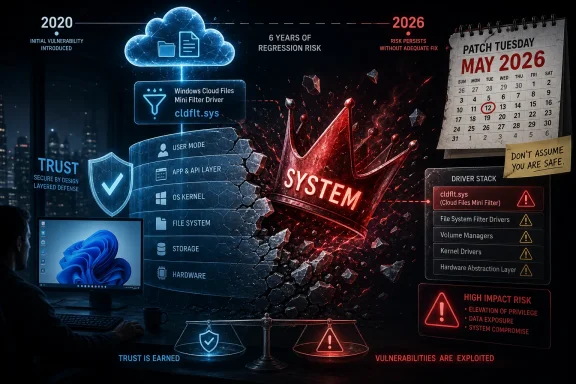
cldflt.sys, the Windows Cloud Files Mini Filter Driver used in the plumbing behind cloud-backed file placeholders. The exploit is being discussed as a local privilege escalation, meaning an attacker generally needs some foothold first. But once that foothold exists, SYSTEM access is the difference between an annoying compromise and ownership of the box.That distinction is easy to flatten in consumer coverage, where “hackers take over your PC” becomes a universal headline. The more precise point is scarier for administrators: local privilege escalation bugs are the connective tissue of modern attack chains. Phishing, malicious installers, browser escapes, stolen credentials, and abused remote-management tools all become more dangerous when a low-privilege process can climb to the operating system’s most powerful account.
MiniPlasma is not being framed as a remote wormable catastrophe like the Windows vulnerabilities that haunt incident-response slide decks. It is something subtler and, in its own way, more corrosive. It says that an old Windows security promise may not mean what customers thought it meant.
The Six-Year Shadow Is the Real Story
CVE-2020-17103 was not born last week. It was described in 2020 as a Windows Cloud Files Mini Filter Driver elevation-of-privilege vulnerability, with Microsoft publishing an advisory during the December 2020 security cycle. The new allegation is that the relevant weakness, or something close enough to be operationally indistinguishable, can still be exploited today.That is why MiniPlasma has drawn more attention than the usual “PoC released on GitHub” churn. Security teams are accustomed to new bugs. They are less comfortable with old bugs returning from the grave with working exploit code and a grudge attached.
There are several possible explanations, and not all of them are equally damning. Microsoft may have fixed one path but not another. A later Windows change may have accidentally reintroduced the vulnerable behavior. The original issue may have been misunderstood, incompletely modeled, or only partially remediated. Or the present exploit may sit in a gray zone that overlaps with the old CVE but deserves its own identifier.
The difference matters to engineers. To customers, the experience is simpler: a vulnerability they believed was handled in 2020 appears to be relevant again in 2026. That is the sort of chronology that turns a security bulletin into an accountability problem.
A Public Researcher Feud Became a Windows Security Event
MiniPlasma is also inseparable from the person releasing it. Chaotic Eclipse, also identified in reports as Nightmare-Eclipse, has spent recent weeks publishing a stream of Windows exploit material with names that sound engineered for virality: BlueHammer, RedSun, UnDefend, YellowKey, GreenPlasma, and now MiniPlasma. The naming is theatrical, but the underlying pattern is not.The researcher has claimed that Microsoft mishandled vulnerability reports, delayed fixes, ignored concerns, and treated them badly. Microsoft, for its part, has publicly emphasized coordinated vulnerability disclosure, the industry norm that gives vendors time to investigate and patch before technical details become public. The gulf between those positions is where this incident becomes more than a bug.
Coordinated disclosure only works when both sides believe the process is legitimate. Vendors need researchers to avoid dropping working exploits into the wild. Researchers need vendors to respond promptly, transparently, and with enough respect that restraint does not feel like unpaid containment work for a trillion-dollar company. When that trust collapses, the public internet becomes the escalation channel.
None of that justifies releasing exploit code that can be folded into malware. It does explain why the industry keeps arriving at the same ugly place. Bug bounty programs and security response centers are not just intake forms and severity calculators; they are political systems for managing technical risk. When participants conclude that the system has no meaningful appeal, they route around it.
YellowKey and GreenPlasma Built the Stage for MiniPlasma
MiniPlasma did not appear in a vacuum. Earlier in May, YellowKey and GreenPlasma had already put Microsoft on the defensive. YellowKey was described as a BitLocker bypass involving physical access and recovery-related components. GreenPlasma was described as a local privilege escalation affecting Windows input or desktop-adjacent components, giving low-privilege code a path upward.Those are different classes of risk. YellowKey is the kind of bug that makes laptop theft, border searches, insider access, and unattended devices more concerning. GreenPlasma is the kind of bug that helps malware finish the job after it has already convinced a user to run something. MiniPlasma then arrived with the additional sting of a supposedly old fix.
The sequence matters because Microsoft’s May 2026 Patch Tuesday was already a large release, with reporting placing the number of addressed vulnerabilities around 138 across the company’s product portfolio. That monthly haul included serious remote-code-execution issues in core Windows and enterprise components. Yet the named exploits at the center of this controversy were not resolved by that cycle.
This is the rhythm administrators hate most. A large patch bundle lands, testing begins, deployment windows are negotiated, and then a separate public exploit narrative blooms immediately afterward. The operational message becomes incoherent: patch urgently, but also understand that patching may not cover the most discussed risks of the week.
SYSTEM Access Is Not a Metaphor
For non-specialists, “SYSTEM privileges” can sound like another severity adjective. On Windows, it is closer to the operating system’s crown. Code running as SYSTEM can interact with protected services, tamper with security tools, access sensitive process memory, and establish persistence in places ordinary users cannot reach.That does not mean MiniPlasma magically steals every password on every machine. Attackers still need delivery, execution, and often additional steps depending on the target. But privilege escalation compresses the distance between initial compromise and durable control. It also makes cleanup harder because the attacker is no longer merely a guest in the user’s session.
This is why defenders care so much about local privilege escalation even when remote execution gets the scarier headlines. A phishing payload running as a standard user is constrained. A phishing payload that can become SYSTEM is an incident-response problem. The Windows security model is full of boundaries, and privilege escalation is the art of turning those boundaries into suggestions.
MiniPlasma’s reported reliability on current Windows 11 systems is therefore the key operational concern. A flaky proof of concept may worry researchers. A reliable SYSTEM shell worries everyone.
The Cloud Files Driver Is an Awkward Place for an Old Bug to Reappear
The alleged target, the Cloud Files Mini Filter Driver, is not an obscure relic bolted onto the side of Windows. It is part of the substrate that helps Windows handle cloud-backed storage experiences, including placeholder files and hydration behavior. In modern Windows, cloud integration is not an optional decorative layer; it is woven into the default experience through OneDrive, Microsoft 365, enterprise sync clients, and storage optimization features.That makes a flaw in this area symbolically uncomfortable. Microsoft has spent years moving Windows from a local PC operating system toward a cloud-connected endpoint in a broader identity, storage, and management ecosystem. The more Windows depends on these integration layers, the more their kernel-adjacent components become part of the trusted computing base.
Cloud file placeholders are designed to make remote storage feel local. Security flaws in that machinery expose the cost of making invisible complexity feel effortless. The user sees an icon in File Explorer; the kernel sees filters, callbacks, access decisions, and state transitions that must be correct under hostile conditions.
This is one of the recurring tensions in Windows development. Compatibility and feature richness make the platform valuable. They also create a sprawling attack surface where fixes must survive not just the next patch, but years of servicing, refactoring, and feature interaction.
Microsoft’s Patch Machine Is Huge, but Huge Is Not the Same as Reassuring
Microsoft’s security operation is among the most mature in the industry. The company processes an enormous volume of vulnerabilities, coordinates across product groups, publishes advisories at global scale, and ships patches to consumer laptops and regulated enterprises alike. It is fashionable to mock Patch Tuesday until one remembers how many moving parts it contains.But scale cuts both ways. When Microsoft ships a giant monthly security update, it demonstrates capacity. When a public exploit appears days later for a Windows flaw allegedly tied to a 2020 fix, it demonstrates the limits of capacity. Customers do not merely need many patches; they need confidence that the patches did what they said.
The modern Windows servicing model has also made trust more abstract. Users rarely inspect individual fixes. Administrators rely on KB numbers, CVE metadata, vendor statements, and third-party validation. Security teams measure exposure through asset inventories and patch compliance tools. The whole process depends on the belief that the advisory-to-update pipeline maps cleanly onto real risk.
MiniPlasma complicates that belief. If a bug can be listed as fixed and later work again, compliance becomes less of an endpoint and more of a probability statement. That is not how enterprises prefer to think about risk, but it may be closer to reality.
Regression Is the Word That Should Keep Redmond Awake
The most important unresolved question is whether MiniPlasma represents a regression. In software, a regression is not merely a bug; it is a failure of institutional memory. It means something once understood, tested, and corrected has become broken again.Regressions happen everywhere. Large codebases evolve, tests miss edge cases, components are rewritten, assumptions drift, and fixes that looked sufficient in one branch fail in another. Windows, with its decades of compatibility and multiple serviced versions, is especially exposed to this class of problem. Nobody should pretend regression is shocking.
But security regressions are uniquely damaging because they undermine patch finality. A security fix is supposed to close an attack path and keep it closed. When that closure is uncertain, every old advisory becomes a dormant question: did the fix persist, and is it still covered by tests that actually exercise the exploit condition?
That is where Microsoft owes the ecosystem more than a generic statement about investigating reports. If MiniPlasma truly overlaps with CVE-2020-17103, customers need to know whether the 2020 fix was incomplete, later reverted, bypassed, or mischaracterized. The answer affects not just this bug but the credibility of old Windows CVEs as closed risk items.
The Crypto Panic Is Understandable but Too Narrow
Memeburn’s framing emphasizes crypto users, and that concern is not misplaced. Software wallets, browser extensions, exchange sessions, seed phrases stored in files, API keys, and password managers all become more exposed on a machine where malware has SYSTEM-level control. If a Windows PC is used as a vault, a local privilege escalation exploit helps turn it into a crime scene.But crypto is only the consumer-facing tip of the problem. The same class of compromise threatens developer signing keys, SSH keys, VPN credentials, browser cookies, enterprise tokens, RDP files, cloud CLI profiles, and local secrets used by build tools. For administrators, the more serious risk may be lateral movement from a compromised workstation into higher-value systems.
Crypto users are mentioned because theft is immediate and irreversible. Enterprises should translate the same technical risk into their own language: credential theft, persistence, defense evasion, token replay, and endpoint trust failure. The machine that signs into Azure, GitHub, Microsoft 365, an EDR console, or a privileged access workstation may be more valuable than a retail wallet.
The practical lesson is not “crypto users panic.” It is “do not treat an endpoint with public local privilege escalation code as a safe place to hold secrets.” That applies whether the secret is a seed phrase, a domain admin token, or a production deployment key.
There Is No Magic Mitigation, Only Layered Friction
In the absence of a Microsoft fix, the honest defensive advice is unsatisfying. Users should avoid running untrusted code, keep systems updated, use standard accounts where possible, maintain endpoint protection, and separate sensitive activity from general browsing and downloads. That is all true. It is also the advice people were supposed to follow before MiniPlasma existed.For BitLocker-related concerns around YellowKey, mitigations such as pre-boot PINs, firmware passwords, Secure Boot hygiene, and physical custody become relevant. For local privilege escalation bugs like GreenPlasma and MiniPlasma, the best defense is reducing the chance that attacker-controlled code runs in the first place. Application control, least privilege, browser isolation, attachment hardening, and software provenance matter more when post-exploitation paths are public.
High-risk users should consider dedicated machines for sensitive work. That does not mean everyone needs to flee Windows. It means the old convenience model — wallets, admin consoles, personal email, pirated utilities, gaming mods, developer tools, and random downloads all on the same endpoint — looks increasingly indefensible.
Enterprises should also revisit detection. A proof-of-concept that spawns a SYSTEM shell is one thing; a criminalized version may be quieter. Monitoring unusual child processes, driver interactions, privilege transitions, tampering with security tools, and suspicious access to credential material is not glamorous, but it is where real defense will live until a patch arrives.
The Disclosure Fight Exposes a Market Failure
The industry likes to describe vulnerability disclosure as a moral framework. In practice, it is also labor economics. Independent researchers find dangerous flaws in products used by billions, then negotiate with vendors whose timelines, bounty decisions, legal posture, and communications can determine whether that work feels respected or exploited.Microsoft has made major investments in vulnerability programs, but its scale also makes it a frequent target of frustration. Researchers complain about slow triage, severity downgrades, insufficient payouts, duplicate rulings, opaque communication, and patches that silently fail to address root causes. Vendors complain, often correctly, that some researchers skip coordination, exaggerate impact, or weaponize publicity.
MiniPlasma sits in the worst possible overlap: a researcher airing grievances through public exploit drops, and a vendor whose prior fix is now under a microscope. Users are not well served by either side’s institutional bruising. They need working patches and accurate risk information, not a feud conducted through GitHub repositories and press statements.
Still, Microsoft has more power here, and therefore more responsibility. A company that sells Windows as the managed endpoint foundation of modern work cannot treat researcher confidence as a public-relations accessory. It is part of the security supply chain.
Patch Tuesday Needs a Feedback Loop, Not Just a Calendar
Patch Tuesday is one of Microsoft’s great standardization achievements. It gives enterprises a predictable cadence, lets vendors plan, and turns chaotic vulnerability flow into a manageable monthly process. The problem is that attackers and aggrieved researchers do not respect the calendar.The May 2026 sequence is a case study in calendar mismatch. Microsoft shipped a large batch of fixes. Then high-profile public exploit code dominated the security conversation. Whether the exploits missed the cutoff, were not reported through standard channels, or were still under investigation, the outcome for customers was the same: the official patch cycle and the public risk cycle diverged.
Microsoft sometimes ships out-of-band updates when the risk justifies it. The open question is whether MiniPlasma will receive that treatment or wait for a regular cycle. Out-of-band patches carry testing and reliability risks, especially for kernel-adjacent changes. Waiting carries exploitation risk and reputational cost.
There is no painless answer. But there is a necessary one: Microsoft should explain what is affected, what is not, whether current supported Windows versions are vulnerable, whether Windows Insider builds contain relevant changes, and what mitigations are credible. Silence creates room for hype, and hype is where defenders waste time.
Windows 11’s Security Pitch Meets Its Messy Reality
Windows 11 has been sold with security as a central premise. TPM 2.0 requirements, Secure Boot expectations, virtualization-based security, memory integrity, Pluton on some hardware, Smart App Control, and increasingly cloud-backed defense all point toward a harder default target. The promise is not invulnerability; it is a better baseline.MiniPlasma does not erase that progress. A fully updated Windows 11 system is still generally better defended than the average unmanaged Windows 7 or early Windows 10 machine. But the incident does show the gap between platform posture and exploit reality. Modern mitigations raise costs; they do not eliminate logic flaws in privileged components.
That distinction matters because Microsoft’s consumer and enterprise messaging sometimes blurs it. “Secure by default” is an aspiration, not a state of nature. A Windows box can have TPM-backed encryption, cloud-delivered antivirus, and current cumulative updates while still being vulnerable to a local privilege escalation flaw that turns a bad click into a full compromise.
For Windows enthusiasts, this is frustrating but not surprising. Windows security has always been a layered bargain: compatibility, manageability, hardware diversity, and user freedom in exchange for a vast attack surface. Microsoft can improve the bargain. It cannot pretend the bargain has disappeared.
The MiniPlasma Lesson Is Written in the Patch History
The practical conclusions are sharper than the drama around the researcher. MiniPlasma matters because it touches a previously addressed CVE, works reportedly on current Windows 11 builds, and arrived amid a cluster of public exploit releases aimed at embarrassing Microsoft. Until Microsoft publishes a definitive technical response, defenders should treat it as a live local privilege escalation risk rather than a theoretical dispute.- MiniPlasma is being reported as a Windows local privilege escalation exploit tied to the Cloud Files Mini Filter Driver and the older CVE-2020-17103 vulnerability history.
- The most important unresolved issue is whether Microsoft’s 2020 fix was incomplete, later regressed, or simply bypassed by a related but distinct flaw.
- YellowKey and GreenPlasma remain part of the same operational story because they show a broader pattern of public Windows exploit releases in May 2026.
- Fully patched systems should still be patched, but patch compliance should not be mistaken for complete immunity while public proof-of-concept code is circulating.
- Users handling wallets, admin credentials, signing keys, or other high-value secrets should isolate that work from everyday browsing, downloads, and experimental software.
- Microsoft’s next response needs to be technical and specific, because generic coordinated-disclosure language will not answer the trust problem MiniPlasma has created.
References
- Primary source: Memeburn
Published: Sun, 24 May 2026 12:40:07 GMT
MiniPlasma Is Turning Into a Nightmare for Microsoft - Memeburn
MiniPlasma is raising new concerns after researchers claimed Microsoft’s 2020 Windows fix may still be vulnerable on Windows 11 systems.memeburn.com - Related coverage: techradar.com
Chaotic Eclipse strikes again with another worrying Windows security flaw
A new Windows 11 bug called MiniPlasma was disclosed on GitHub, together with a PoC.www.techradar.com
- Related coverage: thecybersignal.com
MiniPlasma SYSTEM Exploit Shows Microsoft's 2020 Fix Is Gone
Nightmare-Eclipse dropped MiniPlasma — a SYSTEM-level exploit for cldflt.sys on fully patched Windows 11. The 2020 fix for CVE-2020-17103 is missing. www.thecybersignal.com
- Related coverage: cvedaily.io
Windows Zero-Day: 'YellowKey' & 'GreenPlasma' Exploited
Attackers exploited 'YellowKey' and 'GreenPlasma' Windows zero-day vulnerabilities within 24 hours of their public disclosure. Learn about the impact and the tension between researchers and vendors over patching cycles for these critical Windows zero-day flaws. cvedaily.io
- Related coverage: innovationnetworkdesign.com
CRITICAL: 'MiniPlasma' Windows 0-Day Resurrects 2020… | Innovation ND
A working zero-day exploit dubbed MiniPlasma escalates standard users to SYSTEM on fully patched Windows 11. It abuses cldflt.sys, the same Cloud Filter driver behind CVE-2020-17103 that Microsoft 'fixed' in 2020. PoC is public on GitHub. No patch yet. Assume compromise paths exist on...www.innovationnetworkdesign.com - Related coverage: bleepingcomputer.com
New Windows 'MiniPlasma' zero-day exploit gives SYSTEM access, PoC released
A cybersecurity researcher has released a proof-of-concept exploit for a Windows privilege escalation zero-day dubbedwww.bleepingcomputer.com
- Related coverage: borncity.com
Nightmare Eclipse veröffentlicht MiniPlasma-Schwachstelle CVE-2020-17103Borns IT- und Windows-Blog
So ganz spontan fällt mir „Einer geht noch, einer geht noch rein“ zur neuesten Veröffentlichung von Nightmare Eclipse, aka Chaotic Eclipse, ein.borncity.com - Related coverage: thehackernews.com
MiniPlasma Windows 0-Day Enables SYSTEM Privilege Escalation on Fully Patched Systems
MiniPlasma revives a 2020 Windows cldflt.sys flaw, enabling SYSTEM access on May 2026 patched Windows 11 systems.thehackernews.com
- Related coverage: winbuzzer.com

Old Windows Flaw Returns to Spotlight With MiniPlasma Exploit
MiniPlasma raises fresh doubts about Microsoft's Windows 11 fix for CVE-2020-17103 after a new proof of concept claimed patched systems can reach SYSTEM.
winbuzzer.com
- Related coverage: aha.org
- Related coverage: buildings.honeywell.com
The purpose of this document is to identify the patches that have been delivered by Microsoft® which have been tested against Pro-Watch
PDF documentbuildings.honeywell.com
- Related coverage: securitypointbreak.com
Microsoft’s May Patch Tuesday Rains Down 138 Fixes - Security Point Break
Microsoft’s May 2026 Patch Tuesday delivered 138 fixes, including critical vulnerabilities affecting DNS, Netlogon, TCP/IP and Dynamics 365. Here’s what admins should prioritize.securitypointbreak.com - Related coverage: computerweekly.com
Microsoft releases rare zero-day free Patch Tuesday update | Computer Weekly
Zero zero-day flaws were addressed in May’s Patch Tuesday update but as usual there is much for admins to chew over in the coming days.www.computerweekly.com - Related coverage: 1337skills.com

Microsoft Patch Tuesday May 2026: 138 Vulnerabilities Including Critical DNS and Netlogon RCE | 1337skills
Breakdown of May 2026's massive patch release with CVSS 9.8 Netlogon buffer overflow, DNS Client heap corruption, and 29 critical RCE flaws across the Microsoft ecosystem
1337skills.com
- Related coverage: windowscentral.com
Windows 11’s May update is causing install failures and slow internet — here’s what we know | Windows Central
Some users are hitting install failures and internet slowdowns after the May 2026 Patch Tuesday update.www.windowscentral.com - Related coverage: sra.io
