

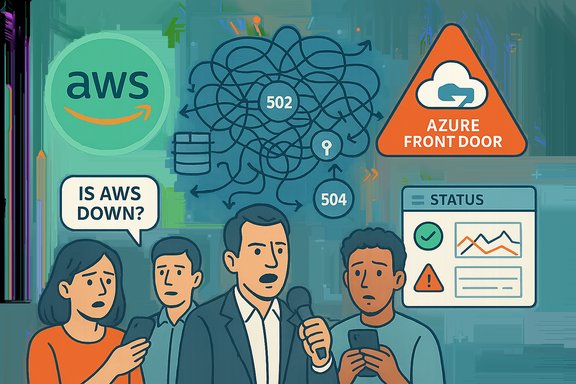
Yesterday’s outage story had a twist: crowd-sourced monitors and social feeds made it look like Amazon Web Services (AWS) was failing again, but the root cause was a separate Microsoft Azure outage — and the misattribution exposed how fragile public outage narratives can become when cloud control planes and DNS fail at scale.
Cloud outages are no longer isolated technical footnotes; they create visible, real‑world disruptions across commerce, entertainment and critical services. Two high‑visibility incidents in late October illustrated this clearly. The first was an AWS disruption centered on the US‑EAST‑1 region that produced DNS and control‑plane failures tied to DynamoDB endpoints. The second, separate event was a Microsoft Azure disruption caused by an inadvertent configuration change in Azure Front Door (AFD), Microsoft’s global edge/routing fabric. Both incidents generated cascading errors that amplified public confusion when monitoring services and user reports spiked.
These two episodes are important to separate in time and cause. The AWS control‑plane/DynamoDB issue was observed earlier in the month and produced widespread symptoms for many services. The Azure Front Door incident came later and directly affected Microsoft 365, Xbox/Minecraft identity flows and thousands of customer sites worldwide. The public’s conflation of these events — amplified by outage trackers — is the core reason reporters briefly but mistakenly suggested AWS was down during Microsoft’s problem.
This is not purely theoretical: large public services and critical infrastructure often run on a small set of hyperscalers. When control‑plane or edge fabrics fail, the aggregate impact can touch airports, banks and healthcare portals — renewing arguments for stronger procurement rules, portability standards and clearer incident disclosure requirements.
The October incidents were a reminder that the internet’s plumbing is both powerful and fragile: convenience and scale come with correlated risks. Misattribution in the heat of a multi‑provider disruption is an understandable human error, but it is also an avoidable one — if we pair better verification, clearer provider communication and more resilient architectures, the next time a control plane stumbles we’ll be better at saying what truly failed, who was affected, and how to reduce the blast radius for everyone.
Source: Tom's Guide https://www.tomsguide.com/computing...m-like-it-was-heres-what-went-down-yesterday/
 Background
Cloud outages are no longer isolated technical footnotes; they create visible, real‑world disruptions across commerce, entertainment and critical services. Two high‑visibility incidents in late October illustrated this clearly. The first was an AWS disruption centered on the US‑EAST‑1 region that produced DNS and control‑plane failures tied to DynamoDB endpoints. The second, separate event was a Microsoft Azure disruption caused by an inadvertent configuration change in Azure Front Door (AFD), Microsoft’s global edge/routing fabric. Both incidents generated cascading errors that amplified public confusion when monitoring services and user reports spiked.These two episodes are important to separate in time and cause. The AWS control‑plane/DynamoDB issue was observed earlier in the month and produced widespread symptoms for many services. The Azure Front Door incident came later and directly affected Microsoft 365, Xbox/Minecraft identity flows and thousands of customer sites worldwide. The public’s conflation of these events — amplified by outage trackers — is the core reason reporters briefly but mistakenly suggested AWS was down during Microsoft’s problem.
What actually happened: a concise timeline
1. AWS: DNS failures in US‑EAST‑1 (late October)
- Monitoring systems and operator telemetry first detected elevated error rates and latencies in the US‑EAST‑1 region. Diagnostics pointed to DNS resolution issues for Amazon DynamoDB API endpoints, which are used heavily as a lightweight control‑plane/store for session tokens, metadata and other small but critical data. Those DNS failures propagated into throttles and impairments in EC2 subsystems, Lambda invocations and load‑balancer health checks, producing a broad outage footprint for some customers. AWS applied mitigations, disabled the offending automation, and worked through backlogs.
2. Microsoft: Azure Front Door misconfiguration (October 29, 2025)
- On October 29, Microsoft acknowledged a global service degradation tied to Azure Front Door. The company traced the problem to an inadvertent configuration change that affected routing and DNS behavior across AFD Points of Presence (PoPs). Microsoft froze AFD configuration changes, rolled back to a “last known good configuration,” and began node recovery and traffic rebalancing to restore availability. The outage produced DNS/TLS anomalies and authentication failures for Microsoft 365, the Azure Portal, Xbox Live/Minecraft and many third‑party sites that rely on AFD.
3. The overlap and public confusion
- During Microsoft’s AFD disruption, outage aggregators — which rely on user reports and heuristics — recorded simultaneous spikes not only for Microsoft services but for other cloud providers as well. Many users emailed reporters and posted complaints naming AWS when they saw service errors in apps that use multiple cloud providers. AWS repeatedly stated its services were operating normally and pointed customers to the AWS Health Dashboard as the authoritative source of provider telemetry. AWS also acknowledged that an “operational issue at another infrastructure provider may have impacted some customers’ applications and networks,” implicitly referring to inter‑provider knock‑on effects.
Why the misattribution happened — technical anatomy
Several technical realities explain why a Microsoft Front Door misconfiguration made it look like AWS (and even Google Cloud) were failing.DNS and control planes are shared primitives
- DNS is not just name lookup. In hyperscale cloud platforms, DNS entries for managed APIs are deeply embedded in service discovery, control‑plane orchestration, auth flows and health checks. When DNS for a widely used endpoint returns empty or incorrect answers, SDKs, load balancers and internal controllers act as if the service is unreachable. That behavior cascades into retry storms, throttling and queue backlogs. AWS’s prior DynamoDB DNS problems are a textbook example of how a single DNS problem can amplify into broad platform disruption.
Edge fabrics like Azure Front Door sit at the first hop
- Azure Front Door is a global Layer‑7 ingress fabric. AFD performs TLS termination, global HTTP(S) routing, Web Application Firewall (WAF) enforcement and routing decisions in front of identity issuance (Microsoft Entra ID) and many Microsoft SaaS control planes. A misapplied configuration can therefore break TLS handshakes, misroute traffic, or prevent token issuance — creating authentication failures that look identical to service outages from the user perspective. When tokens can’t be issued or routes fail, clients see timeouts and blank admin blades even though origin services may be healthy.
Multi‑cloud deployments complicate attribution
- Many large applications use a poly‑cloud strategy: different components or services live across AWS, Azure and Google Cloud. When a high‑impact provider experiences a control‑plane or edge failure, it can disrupt multi‑cloud applications that rely on the affected provider for specific functions (authentication, CDN, identity, or database). A user-facing app that uses AWS for compute but Azure for identity might fail during an Azure AFD event; observers in outage trackers typically report the app’s visible name, not the underlying provider component that failed. This leads to rapid misattribution.
The role of outage trackers and social signals
Public outage aggregators (DownDetector-style services), social platforms and reader emails are invaluable for rapid situational awareness, but they have limitations:- They rely on human reports and automated heuristics, not provider telemetry.
- They often capture the visible surface name of a service (e.g., an app name) rather than the internal dependency that failed.
- Simultaneous, high‑visibility outages prime observers to see patterns where none exist — a flywheel effect that amplifies apparent cross‑provider problems.
What reporters and editors got wrong — and how to do better
The brief headline that “AWS was down” was a misstep rooted in normal newsroom pressures: speed, high reader concern after a prior AWS outage, and a flood of user reports. That said, accountability matters — and there are practical, implementable improvements for live reporting on cloud outages.Key errors that led to the incorrect headline
- Relying on outage‑tracker spikes and reader emails before confirming provider status via official channels.
- Underestimating the likelihood of cross‑provider knock‑on effects and control‑plane dependencies.
- Treating user‑reported product names as definitive evidence of a provider outage.
A better live‑reporting checklist (recommended)
- Check the provider’s official status page (authoritative provider telemetry).
- Seek a company comment (press channels or verified Twitter/X accounts).
- Verify with at least one independent observability source (BGP/HTTP latencies, CDN traces).
- Corroborate with direct user evidence that includes logs, error messages, or timestamps that map to provider events.
- Use cautious language in headlines until steps 1–4 are satisfied.
Real‑world impact: who felt it
The disruptions were far from academic. Tangible impacts included:- Microsoft 365 web apps (Outlook on the web, Teams) experiencing sign‑in failures and blank admin panes.
- Gaming ecosystems (Xbox/Minecraft) suffering authentication and matchmaking errors when Entra ID flows traversing AFD failed.
- Consumer services and ecommerce portals showing 502/504 errors when AFD routes misbehaved.
- Earlier AWS DNS problems affected social apps, fintech, and IoT devices — leading to login blocks, payment errors and stalled streams in various cases.
Technical takeaways for architects and operations teams
The incidents expose repeated architectural weaknesses that engineering teams should treat as actionable red flags.Harden DNS and control‑plane dependencies
- Treat DNS for critical managed APIs as a high‑risk dependency.
- Replicate critical metadata and state stores (session tokens, feature flags) across independent primitives where possible.
- Reduce single points of control by avoiding global state dependencies that cannot failover cleanly.
Design for graceful degradation
- Ensure that authentication flows can fall back to an alternate identity provider or cached tokens for short windows.
- Make non‑blocking the reads or writes for non‑critical metadata — avoid making user-facing flows gate on a single small write.
- Implement circuit breakers and exponential backoff to prevent retry storms from amplifying faults.
Edge and gateway safety nets
- For edge configuration rollouts (AFD, CDNs), use canaryed, region‑aware deployments and automated rollback safeguards with short TTLs for config changes.
- Lock down change windows and require multi‑actor approvals for global ingress fabric changes.
Monitoring and incident response
- Correlate internal telemetry (DNS resolution metrics, control‑plane latencies) with external observability (BGP, public HTTP probes).
- Maintain an “incident triage list” that maps common public errors (e.g., TLS handshakes failing) to possible root causes (edge misconfig vs origin failure), so operators and customer success teams can respond with accurate guidance.
Public policy and market implications
The October sequence of incidents has reignited debate about concentration risk in cloud computing. Governments and industry bodies are taking notice: for example, the UK Department for Science, Innovation & Technology (DSIT) has been assessing the impact of hyperscaler failures and exploring mechanisms to improve cloud diversity and visibility. Calls for greater interoperability, competitive remedies, and mandatory resilience reporting are gaining traction as the economic and societal cost of those outages becomes clearer.This is not purely theoretical: large public services and critical infrastructure often run on a small set of hyperscalers. When control‑plane or edge fabrics fail, the aggregate impact can touch airports, banks and healthcare portals — renewing arguments for stronger procurement rules, portability standards and clearer incident disclosure requirements.
How to interpret user reports and public trackers going forward
For IT teams, incident responders and editors, a pragmatic approach reduces confusion and panic:- Treat outage‑tracker spikes as early warning — not decisive proof — and combine them with provider status and telemetry before attribution.
- Collect structured user evidence (timestamps, traceroutes, resolver output, error payloads) that can be correlated with provider logs.
- Remember that shared primitives (DNS, identity) create shared pain: parallel spikes across providers can be a symptom of a single root cause hitting multiple dependent services.
Where claims remain unverifiable
Several user narratives that circulated during the confusion window are credible but lack independent confirmation in provider status channels:- Specific device errors like “UnfillableCapacity” tied to Fire TV outages were widely reported by users, but there was no immediate corroborating statement from the device manufacturer or the cloud provider’s status pages at the incident time. These should be treated as user‑reported and provisional until corroborated.
- Aggregated dollar‑loss figures quoted in some rapid analyses are model‑based estimates and should be understood as high‑level indicators rather than audited economic impact numbers. Precise economic damage assessments require forensic access to vendor telemetry and business revenue metrics.
Final analysis — strengths, weaknesses and the path forward
These incidents highlight both impressive operational strengths and systemic weaknesses.- What went right: Rapid public acknowledgment by providers, staged rollback tactics (Microsoft’s “last known good” configuration), and the availability of multiple telemetry feeds that helped incident response teams prioritize mitigation. These are signs that the ecosystem takes resilience seriously and has playbooks for containment.
- What went wrong: Control‑plane centralization, brittle dependencies on shared primitives like DNS and global edge fabrics, and the public’s natural tendency to conflate user‑visible product names with underlying provider failures. Those structural issues make recovery slower and public attribution error‑prone.
- Vendors: invest in safer configuration pipelines, better observability for external customers, and clearer, faster status updates that map symptoms to impacted subsystems.
- Customers: assume failure by design — implement fallbacks for identity and session stores, and validate multi‑cloud resilience in chaos testing.
- Journalists: confirm provider telemetry before definitive headlines, explicitly state uncertainty when attribution is provisional, and report the difference between user‑facing symptoms and provider‑level incidents.
The October incidents were a reminder that the internet’s plumbing is both powerful and fragile: convenience and scale come with correlated risks. Misattribution in the heat of a multi‑provider disruption is an understandable human error, but it is also an avoidable one — if we pair better verification, clearer provider communication and more resilient architectures, the next time a control plane stumbles we’ll be better at saying what truly failed, who was affected, and how to reduce the blast radius for everyone.
Source: Tom's Guide https://www.tomsguide.com/computing...m-like-it-was-heres-what-went-down-yesterday/
