

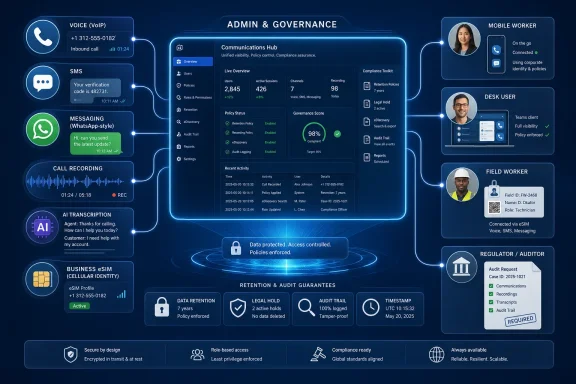
On July 6, 2026, Technology Reseller News published a podcast interview in which Mobex founder and CEO John Dalrymple described a platform for bringing Microsoft Teams, VoIP calling, SMS, WhatsApp, business eSIMs, recording, transcription, and communications governance into one managed enterprise workflow. The pitch is simple, but the timing is not accidental. The workplace has already standardized on collaboration suites; the messy part is that customers, field workers, executives, and regulators still live across phone numbers, text threads, mobile apps, and messaging platforms. Mobex is betting that the next communications consolidation wave will not be about replacing Microsoft Teams, but about making Teams the administrative front door for everything Teams does not natively solve.
For two decades, unified communications vendors sold a fairly linear story: move the PBX to the cloud, replace the desk phone with an app, and collapse voicemail, presence, conferencing, and calling into one service. That story worked because the enemy was obvious. It was the aging phone closet, the contract with the incumbent carrier, and the support ticket that began with, “My extension does not ring.”
The modern problem is more slippery. Voice is only one part of the business conversation, and often not the first part. A customer texts a sales rep, a supplier uses WhatsApp, a patient calls a clinic number, a manager answers from a personal mobile device, and the formal record of what happened is scattered across platforms the IT department may not administer.
That is the gap Dalrymple was pointing at in the Technology Reseller News interview with publisher Doug Green. Mobex’s message is not that Teams, SMS, WhatsApp, VoIP, and mobile calling are novel on their own. It is that organizations are already using all of them, usually in combinations that are convenient for employees and uncomfortable for compliance teams.
Microsoft Teams has become the gravitational center of many workdays, but it was never the whole communications universe. Microsoft’s own Teams Phone positioning gives enterprises several ways to connect Teams to the public phone network, including Calling Plans, Operator Connect, Teams Phone Mobile, and Direct Routing. Those options solve a major chunk of telephony modernization, but they do not automatically tame every customer text, WhatsApp exchange, or mobile-originated business call.
Mobex’s opportunity sits in that seam. It is not trying to persuade a Teams shop to abandon Teams. It is trying to persuade Teams shops that the real fragmentation begins at the edge of the Teams window.
For users, however, the customer relationship often still starts somewhere else. A call comes to a business number. A text lands on a mobile device. A WhatsApp message appears because that is what the customer, region, or industry prefers. The employee does not care whether the resulting workflow is elegant. The employee cares whether the reply gets sent.
That is how shadow communications become normalized. Not because workers are trying to evade governance, but because the approved system often does not match the communication channel the outside world uses. The result is an organization that looks standardized from the CIO dashboard and chaotic from the legal hold.
Dalrymple’s “single pane of glass” framing is familiar industry language, but in this case it lands on a real operational sore spot. The single pane is not valuable because staff enjoy fewer tabs. It is valuable because business identity, routing, recording, transcription, retention, and administration can be applied consistently to conversations that would otherwise leak into personal devices and unmanaged apps.
That is especially relevant for small and midsize businesses that have adopted Teams through Microsoft 365 but do not have the internal telecom staff of a bank or hospital system. They may have already retired the old PBX, but they still face a harder question: who owns the business conversation when it happens over a mobile number that belongs psychologically, if not contractually, to the employee?
Dalrymple told Technology Reseller News that Mobex has expanded into the UK, where WhatsApp plays a larger role in business communications than traditional SMS. That detail should not be treated as a footnote. It is the difference between a feature request and a market requirement.
For multinational firms, channel preference is not merely cultural. It becomes a data governance issue. A customer interaction that is routine in one geography may be unacceptable under another jurisdiction’s retention policy, privacy framework, or industry regulation unless the organization can capture, supervise, and retrieve it.
This is where the consumer success of WhatsApp creates enterprise tension. Its value is precisely that customers already use it, messages are immediate, and the app feels personal. Those are the same characteristics that make compliance officers nervous when business decisions, pricing discussions, financial instructions, or customer commitments migrate there without oversight.
The SEC’s off-channel communications enforcement campaign made this concern concrete for the financial sector. In 2023, the commission said it had brought 30 enforcement actions and ordered more than $1.5 billion in penalties related to recordkeeping failures involving platforms including iMessage, WhatsApp, and Signal. In August 2024, the SEC announced another $390 million in combined penalties against 26 firms for widespread recordkeeping failures tied to unapproved communication methods.
The regulatory story is not that WhatsApp is uniquely suspect. The story is that regulators increasingly care less about the brand of the app and more about whether business communications are preserved, supervised, and producible. That is a much broader problem than finance, even if finance has been the loudest warning siren.
Dalrymple’s argument, as summarized by Technology Reseller News, is that organizations need to route business communications through managed platforms rather than leaving employees to conduct work conversations on personal devices outside company oversight. That is not just a neat IT preference. It is increasingly the difference between having an audit trail and having a policy document nobody can enforce.
Recording and transcription add another layer. In the old PBX era, call recording was typically a contact center feature or a regulated-industry requirement. In the Teams era, the boundary between a contact center conversation, a sales conversation, and a support escalation is blurrier. A customer may move from call to text to meeting to WhatsApp within the same commercial relationship.
AI transcription makes the archive more useful, but also more sensitive. Once conversations are transcribed, they become searchable, reviewable, discoverable, and potentially subject to more internal policies. That raises the value of centralized governance while also raising the stakes for security, retention, and access controls.
This is why the phrase single pane of glass can be both overused and still meaningful. A unified interface alone is cosmetic. A unified policy plane is strategic. The test for Mobex and its peers is not whether users can send a message from Teams; it is whether administrators can prove where the message went, who sent it, how it was retained, and whether it complied with company policy.
Microsoft has already acknowledged the compliance recording ecosystem around Teams by supporting certified third-party compliance recording integrations for calls and meetings. That ecosystem exists because the native collaboration suite is only one part of a regulated communications architecture. Mobex is positioning itself in the adjacent space where telephony, messaging, mobile identity, and partner delivery meet.
A business eSIM changes the framing. Instead of asking an employee to carry a second phone or expose a personal number to customers, the organization can put a business identity on the device while preserving the native mobile experience. Calls and texts can appear on the same handset without pretending that the personal and business personas are the same thing.
That matters because communications policy fails when it asks users to behave in ways that are visibly worse than the workaround. If the approved business channel is clumsy, employees will use the fast channel. If the company-issued mobile app misses calls, users will forward them elsewhere. If customers already know a rep’s personal number, the organization may never fully regain control of the relationship.
A business eSIM does not magically solve every mobile management problem. It still requires careful policy around ownership, consent, retention, emergency calling, regional telecom rules, and employee departure. But it attacks a practical root cause: the fact that the mobile phone is now a primary business endpoint, whether or not the endpoint management spreadsheet says so.
For MSPs, that makes the product easier to explain. The sales pitch is not abstract UC modernization. It is: keep one phone, separate business and personal communications, and bring the business side back under management.
Many MSPs have spent years moving customers into Microsoft 365, securing tenants, configuring Teams, and layering backup, identity, endpoint, and security services around the Microsoft stack. Voice and messaging are natural add-ons, but they are also operationally hazardous if the MSP has to become a traditional carrier overnight.
Mobex’s promise to partners is that they can extend Teams into business calling, texting, WhatsApp, compliance, and recording without turning each deployment into a bespoke telecom engineering project. That phrase “minimal deployment complexity,” from the Technology Reseller News summary, is doing a lot of commercial work. Complexity is where margin goes to die.
The partner economics are obvious. Recurring revenue attaches more easily to communications workflows than to one-time migrations. Compliance and recording features create stickier accounts than basic dial tone. Mobile identity extends the managed surface area beyond the laptop and the Teams desktop client.
But there is also a risk for the channel. Communications is unforgiving. If email is delayed, users complain. If the phone does not ring, the MSP gets blamed. If a regulated message is not captured, the customer may not discover the failure until the worst possible moment.
That means the winners in this category will not be the vendors with the broadest logo slide. They will be the vendors that can make provisioning, number management, compliance capture, support escalation, and user training feel boring. In telecom, boring is an underrated compliment.
At the same time, Microsoft’s own communications roadmap is always a strategic variable. Teams Phone has steadily expanded its role in business telephony, and Microsoft continues to refine PSTN connectivity models through Calling Plans, Operator Connect, Teams Phone Mobile, and Direct Routing. Third-party vendors must therefore live in a careful middle zone: close enough to Teams to feel native, differentiated enough to justify their existence.
That differentiation is most defensible where Microsoft does not want to own every last carrier, compliance, regional messaging, and mobile workflow nuance. The Teams ecosystem is large precisely because Microsoft tends to provide the platform primitives and partner frameworks while specialists fill vertical, geographic, and operational gaps.
Mobex’s focus on SMS, WhatsApp, eSIM-enabled business mobility, and compliance-oriented capture is a bet that these gaps will remain commercially meaningful. That is plausible. The more Teams becomes the default workbench, the more organizations will notice the workflows that still escape it.
The danger is that customers may assume “we use Teams” already means “we have governed communications.” That assumption is wrong. Teams can be the hub, but the hub does not automatically control every spoke. Vendors like Mobex exist because the enterprise communications map is messier than the Microsoft 365 admin center makes it look.
That is why Mobex’s workflow argument matters. Dalrymple told Technology Reseller News that Mobex tries to help clients integrate communication channels into what makes sense for their workflow and work process. That sounds almost modest, but it is a more realistic thesis than the usual vendor dream of forcing users into one perfect interface.
If a salesperson lives in Teams but the customer lives in SMS, the answer is not a lecture about approved tools. If a UK customer expects WhatsApp, banning WhatsApp may simply move the conversation off the books. If a field worker needs native mobile calling, requiring all activity to happen through a desktop-centric workflow will fail.
The better model is to meet the user close to the behavior and move the compliance boundary around the communication. That is what business eSIMs, Teams-side messaging, managed calling, and recording integrations are trying to accomplish. The goal is not to eliminate channel diversity. It is to stop channel diversity from becoming governance chaos.
There is a WindowsForum angle here that is easy to miss. For admins, Teams is often experienced less as an app than as an operating layer for work: identity, presence, meetings, chat, phone, files, policy, and increasingly AI-assisted workflows. Mobex’s pitch extends that operating layer into communications that have historically sat outside the Microsoft-controlled workspace.
A recorded call sitting in cold storage is mainly a liability until someone needs to retrieve it. A transcribed call becomes searchable operational data. It can feed coaching, dispute resolution, compliance review, customer intelligence, and quality assurance. The same is true of message capture across SMS and WhatsApp when it is normalized into a reviewable system.
But AI also magnifies governance concerns. Searchable transcripts can reveal sensitive personal data, trade secrets, employee issues, customer complaints, and legally privileged material. If organizations are going to centralize more communications, they must also think harder about who can search, summarize, export, delete, or train models on that data.
The vendor story will naturally emphasize productivity. That is fair; there is real value in turning messy conversations into structured records. But the security story is equally important. A central archive is easier to govern than scattered personal devices, but it is also a richer target.
For IT leaders, the right question is not whether AI transcription is useful. It is whether the organization’s retention, access control, consent, privacy, and incident response policies are mature enough for the data it creates. Capture without governance is just a better-indexed mess.
A modern communications platform now has to answer several practical questions at once:
 The Real UC Problem Is No Longer Voice
For two decades, unified communications vendors sold a fairly linear story: move the PBX to the cloud, replace the desk phone with an app, and collapse voicemail, presence, conferencing, and calling into one service. That story worked because the enemy was obvious. It was the aging phone closet, the contract with the incumbent carrier, and the support ticket that began with, “My extension does not ring.”The modern problem is more slippery. Voice is only one part of the business conversation, and often not the first part. A customer texts a sales rep, a supplier uses WhatsApp, a patient calls a clinic number, a manager answers from a personal mobile device, and the formal record of what happened is scattered across platforms the IT department may not administer.
That is the gap Dalrymple was pointing at in the Technology Reseller News interview with publisher Doug Green. Mobex’s message is not that Teams, SMS, WhatsApp, VoIP, and mobile calling are novel on their own. It is that organizations are already using all of them, usually in combinations that are convenient for employees and uncomfortable for compliance teams.
Microsoft Teams has become the gravitational center of many workdays, but it was never the whole communications universe. Microsoft’s own Teams Phone positioning gives enterprises several ways to connect Teams to the public phone network, including Calling Plans, Operator Connect, Teams Phone Mobile, and Direct Routing. Those options solve a major chunk of telephony modernization, but they do not automatically tame every customer text, WhatsApp exchange, or mobile-originated business call.
Mobex’s opportunity sits in that seam. It is not trying to persuade a Teams shop to abandon Teams. It is trying to persuade Teams shops that the real fragmentation begins at the edge of the Teams window.
Teams Won the Desktop, But the Customer Kept the Phone Number
The most important thing about Teams is not that it is a chat app, a meeting app, or a phone interface. It is that it is already installed, already authenticated, and already wrapped in the administrative machinery of Microsoft 365. For IT, that makes Teams a natural place to concentrate policy.For users, however, the customer relationship often still starts somewhere else. A call comes to a business number. A text lands on a mobile device. A WhatsApp message appears because that is what the customer, region, or industry prefers. The employee does not care whether the resulting workflow is elegant. The employee cares whether the reply gets sent.
That is how shadow communications become normalized. Not because workers are trying to evade governance, but because the approved system often does not match the communication channel the outside world uses. The result is an organization that looks standardized from the CIO dashboard and chaotic from the legal hold.
Dalrymple’s “single pane of glass” framing is familiar industry language, but in this case it lands on a real operational sore spot. The single pane is not valuable because staff enjoy fewer tabs. It is valuable because business identity, routing, recording, transcription, retention, and administration can be applied consistently to conversations that would otherwise leak into personal devices and unmanaged apps.
That is especially relevant for small and midsize businesses that have adopted Teams through Microsoft 365 but do not have the internal telecom staff of a bank or hospital system. They may have already retired the old PBX, but they still face a harder question: who owns the business conversation when it happens over a mobile number that belongs psychologically, if not contractually, to the employee?
WhatsApp Turns a Regional Preference Into a Governance Problem
The WhatsApp portion of Mobex’s pitch matters because it exposes how American-centric a lot of business communications planning can be. In the United States, SMS remains deeply embedded in business workflows. In the UK and many other markets, WhatsApp is not a side channel; it is part of ordinary commercial life.Dalrymple told Technology Reseller News that Mobex has expanded into the UK, where WhatsApp plays a larger role in business communications than traditional SMS. That detail should not be treated as a footnote. It is the difference between a feature request and a market requirement.
For multinational firms, channel preference is not merely cultural. It becomes a data governance issue. A customer interaction that is routine in one geography may be unacceptable under another jurisdiction’s retention policy, privacy framework, or industry regulation unless the organization can capture, supervise, and retrieve it.
This is where the consumer success of WhatsApp creates enterprise tension. Its value is precisely that customers already use it, messages are immediate, and the app feels personal. Those are the same characteristics that make compliance officers nervous when business decisions, pricing discussions, financial instructions, or customer commitments migrate there without oversight.
The SEC’s off-channel communications enforcement campaign made this concern concrete for the financial sector. In 2023, the commission said it had brought 30 enforcement actions and ordered more than $1.5 billion in penalties related to recordkeeping failures involving platforms including iMessage, WhatsApp, and Signal. In August 2024, the SEC announced another $390 million in combined penalties against 26 firms for widespread recordkeeping failures tied to unapproved communication methods.
The regulatory story is not that WhatsApp is uniquely suspect. The story is that regulators increasingly care less about the brand of the app and more about whether business communications are preserved, supervised, and producible. That is a much broader problem than finance, even if finance has been the loudest warning siren.
Compliance Is the Feature That Explains the Bundle
At first glance, Mobex’s bundle can sound like a grab bag: Teams integration, VoIP, SMS, WhatsApp, call recording, AI transcription, centralized management, and business eSIM capability. The common thread is not the channel. The common thread is control.Dalrymple’s argument, as summarized by Technology Reseller News, is that organizations need to route business communications through managed platforms rather than leaving employees to conduct work conversations on personal devices outside company oversight. That is not just a neat IT preference. It is increasingly the difference between having an audit trail and having a policy document nobody can enforce.
Recording and transcription add another layer. In the old PBX era, call recording was typically a contact center feature or a regulated-industry requirement. In the Teams era, the boundary between a contact center conversation, a sales conversation, and a support escalation is blurrier. A customer may move from call to text to meeting to WhatsApp within the same commercial relationship.
AI transcription makes the archive more useful, but also more sensitive. Once conversations are transcribed, they become searchable, reviewable, discoverable, and potentially subject to more internal policies. That raises the value of centralized governance while also raising the stakes for security, retention, and access controls.
This is why the phrase single pane of glass can be both overused and still meaningful. A unified interface alone is cosmetic. A unified policy plane is strategic. The test for Mobex and its peers is not whether users can send a message from Teams; it is whether administrators can prove where the message went, who sent it, how it was retained, and whether it complied with company policy.
Microsoft has already acknowledged the compliance recording ecosystem around Teams by supporting certified third-party compliance recording integrations for calls and meetings. That ecosystem exists because the native collaboration suite is only one part of a regulated communications architecture. Mobex is positioning itself in the adjacent space where telephony, messaging, mobile identity, and partner delivery meet.
The Business eSIM Is a Quiet Attack on BYOD Ambiguity
The business eSIM element may be the most underappreciated part of the Mobex story. BYOD has always been a compromise sold as flexibility. Employees like carrying one device, finance likes avoiding another hardware purchase, and IT inherits the blurry line between personal life and company records.A business eSIM changes the framing. Instead of asking an employee to carry a second phone or expose a personal number to customers, the organization can put a business identity on the device while preserving the native mobile experience. Calls and texts can appear on the same handset without pretending that the personal and business personas are the same thing.
That matters because communications policy fails when it asks users to behave in ways that are visibly worse than the workaround. If the approved business channel is clumsy, employees will use the fast channel. If the company-issued mobile app misses calls, users will forward them elsewhere. If customers already know a rep’s personal number, the organization may never fully regain control of the relationship.
A business eSIM does not magically solve every mobile management problem. It still requires careful policy around ownership, consent, retention, emergency calling, regional telecom rules, and employee departure. But it attacks a practical root cause: the fact that the mobile phone is now a primary business endpoint, whether or not the endpoint management spreadsheet says so.
For MSPs, that makes the product easier to explain. The sales pitch is not abstract UC modernization. It is: keep one phone, separate business and personal communications, and bring the business side back under management.
The Channel Opportunity Is Real Because Teams Created a Default Doorway
Dalrymple’s comments about MSPs and channel partners are not incidental. Mobex is a member of the Cloud Communications Alliance, and its go-to-market logic depends on providers that already sell, deploy, or manage Microsoft Teams environments. That is the right hunting ground.Many MSPs have spent years moving customers into Microsoft 365, securing tenants, configuring Teams, and layering backup, identity, endpoint, and security services around the Microsoft stack. Voice and messaging are natural add-ons, but they are also operationally hazardous if the MSP has to become a traditional carrier overnight.
Mobex’s promise to partners is that they can extend Teams into business calling, texting, WhatsApp, compliance, and recording without turning each deployment into a bespoke telecom engineering project. That phrase “minimal deployment complexity,” from the Technology Reseller News summary, is doing a lot of commercial work. Complexity is where margin goes to die.
The partner economics are obvious. Recurring revenue attaches more easily to communications workflows than to one-time migrations. Compliance and recording features create stickier accounts than basic dial tone. Mobile identity extends the managed surface area beyond the laptop and the Teams desktop client.
But there is also a risk for the channel. Communications is unforgiving. If email is delayed, users complain. If the phone does not ring, the MSP gets blamed. If a regulated message is not captured, the customer may not discover the failure until the worst possible moment.
That means the winners in this category will not be the vendors with the broadest logo slide. They will be the vendors that can make provisioning, number management, compliance capture, support escalation, and user training feel boring. In telecom, boring is an underrated compliment.
Microsoft’s Platform Gravity Cuts Both Ways
Any vendor building around Teams benefits from Microsoft’s reach and suffers from Microsoft’s shadow. Teams gives Mobex a distribution context: millions of users already live in the client, and many companies would rather extend an existing collaboration hub than introduce another standalone app.At the same time, Microsoft’s own communications roadmap is always a strategic variable. Teams Phone has steadily expanded its role in business telephony, and Microsoft continues to refine PSTN connectivity models through Calling Plans, Operator Connect, Teams Phone Mobile, and Direct Routing. Third-party vendors must therefore live in a careful middle zone: close enough to Teams to feel native, differentiated enough to justify their existence.
That differentiation is most defensible where Microsoft does not want to own every last carrier, compliance, regional messaging, and mobile workflow nuance. The Teams ecosystem is large precisely because Microsoft tends to provide the platform primitives and partner frameworks while specialists fill vertical, geographic, and operational gaps.
Mobex’s focus on SMS, WhatsApp, eSIM-enabled business mobility, and compliance-oriented capture is a bet that these gaps will remain commercially meaningful. That is plausible. The more Teams becomes the default workbench, the more organizations will notice the workflows that still escape it.
The danger is that customers may assume “we use Teams” already means “we have governed communications.” That assumption is wrong. Teams can be the hub, but the hub does not automatically control every spoke. Vendors like Mobex exist because the enterprise communications map is messier than the Microsoft 365 admin center makes it look.
The Hard Part Is Not Integration, It Is Behavior
Every communications consolidation project eventually runs into human behavior. Employees do not wake up excited to comply with retention policy. They use the channel that gets a response.That is why Mobex’s workflow argument matters. Dalrymple told Technology Reseller News that Mobex tries to help clients integrate communication channels into what makes sense for their workflow and work process. That sounds almost modest, but it is a more realistic thesis than the usual vendor dream of forcing users into one perfect interface.
If a salesperson lives in Teams but the customer lives in SMS, the answer is not a lecture about approved tools. If a UK customer expects WhatsApp, banning WhatsApp may simply move the conversation off the books. If a field worker needs native mobile calling, requiring all activity to happen through a desktop-centric workflow will fail.
The better model is to meet the user close to the behavior and move the compliance boundary around the communication. That is what business eSIMs, Teams-side messaging, managed calling, and recording integrations are trying to accomplish. The goal is not to eliminate channel diversity. It is to stop channel diversity from becoming governance chaos.
There is a WindowsForum angle here that is easy to miss. For admins, Teams is often experienced less as an app than as an operating layer for work: identity, presence, meetings, chat, phone, files, policy, and increasingly AI-assisted workflows. Mobex’s pitch extends that operating layer into communications that have historically sat outside the Microsoft-controlled workspace.
The AI Layer Makes Capture More Valuable and More Dangerous
The Technology Reseller News piece notes that Mobex supports AI transcription as part of the managed communications platform. That feature belongs in the center of the story, not the margin. Transcription changes the economics of archived communication.A recorded call sitting in cold storage is mainly a liability until someone needs to retrieve it. A transcribed call becomes searchable operational data. It can feed coaching, dispute resolution, compliance review, customer intelligence, and quality assurance. The same is true of message capture across SMS and WhatsApp when it is normalized into a reviewable system.
But AI also magnifies governance concerns. Searchable transcripts can reveal sensitive personal data, trade secrets, employee issues, customer complaints, and legally privileged material. If organizations are going to centralize more communications, they must also think harder about who can search, summarize, export, delete, or train models on that data.
The vendor story will naturally emphasize productivity. That is fair; there is real value in turning messy conversations into structured records. But the security story is equally important. A central archive is easier to govern than scattered personal devices, but it is also a richer target.
For IT leaders, the right question is not whether AI transcription is useful. It is whether the organization’s retention, access control, consent, privacy, and incident response policies are mature enough for the data it creates. Capture without governance is just a better-indexed mess.
The Mobex Pitch Reveals Where Unified Communications Is Heading
The concrete takeaway from the Mobex podcast is not that every business should immediately bolt WhatsApp and SMS into Teams. It is that the definition of business communications has outrun the old UC checklist.A modern communications platform now has to answer several practical questions at once:
- Business communications increasingly span Teams, voice, SMS, WhatsApp, and native mobile calling, so governance has to follow the conversation rather than the application.
- Microsoft Teams is a powerful administrative hub, but it does not by itself eliminate off-channel communications risk.
- Business eSIMs are becoming a serious tool for separating personal and work identities without forcing employees to carry two phones.
- MSPs can turn Teams-adjacent communications services into recurring revenue, but only if deployment, support, and compliance capture are operationally reliable.
- AI transcription raises the value of recorded communications while increasing the need for disciplined access control, retention rules, and privacy oversight.
- Regional behavior matters, because a channel that feels optional in one market may be the default customer channel in another.
References
- Primary source: Telecom Reseller / Technology Reseller News
Published: 2026-07-06T16:42:08.520657
- Official source: microsoft.com
Your request has been blocked. This could be due to several reasons.
www.microsoft.com
- Official source: support.microsoft.com
Join a Teams meeting by phone | Microsoft Support
Join a Teams meeting by phonesupport.microsoft.com - Related coverage: techtarget.com
Compare Microsoft Teams Operator Connect vs. Direct Routing | TechTarget
Learn the differences between Operator Connect vs. Direct Routing when evaluating third-party PSTN connectivity with the Microsoft Teams phone system.www.techtarget.com - Related coverage: globenewswire.com
17a-4 Announces New DataParser Capabilities for Microsoft
With the addition of call recordings, meeting transcripts and SMS collection, DataParser helps firms preserve a broader record of business communications....www.globenewswire.com - Official source: learn.microsoft.com
Microsoft Teams compliance recording (third-party) - Microsoft Teams | Microsoft Learn
Learn about Teams third-party compliance recording for calling, meetings, town halls, webinars, and live events.learn.microsoft.com
- Related coverage: legalclarity.org
Are Teams Calls Recorded? Consent and Privacy Rules - LegalClarity
Teams calls can be recorded by employers, AI bots, or compliance tools — and what consent laws apply depends on your state and industry.legalclarity.org - Official source: info.microsoft.com
Connectivity Options for Microsoft Teams Phone
Connectivity Options for Microsoft Teams Phoneinfo.microsoft.com - Related coverage: techradar.com
Microsoft Teams Phone System review | TechRadar
Microsoft Teams Phone System offers an easy to set up, integrated VoIP for business, but it does have some configuration limitations.www.techradar.com - Related coverage: elpais.com
- Official source: download.microsoft.com
- Related coverage: bridgeall.com
- Related coverage: mayerbrown.com
WhatsApp All Over Again: The SEC Brings More Recordkeeping Charges Against Broker-Dealers and Investment Advisers for Off-Channel Communications | Insights | Mayer Brown
On February 9, 2024, the Securities and Exchange Commission (SEC) announced charges against five broker-dealers, seven dually registered brokerwww.mayerbrown.com
- Related coverage: kirkland.com
Off-Channel Communications | Publications | Kirkland & Ellis LLP
 www.kirkland.com
- Related coverage: bclplaw.com
SEC off-channel communications enforcement sweep continues — settlements by 12 firms and assessments of over $63 million in penalties | BCLP - Bryan Cave Leighton Paisner
On January 13, 2025, the U.S. Securities and Exchange Commission (the “SEC”) announced settled charges against twelve firms for recordkeeping failures related to off-channel communications – i.e.,…www.bclplaw.com - Related coverage: hklaw.com
A Long Winter's Nap? SEC Off-Channel Communications Enforcement May Draw to a Close | Insights | Holland & Knight
The SEC's wave of enforcement actions concerning "off-channel" communications did not abate in 2024.www.hklaw.com - Related coverage: lowenstein.com
- Related coverage: gtlaw.com
SEC Collects $390 Million in Latest Crackdown on ‘Off-Channel’ Communications in the Financial Industry | Insights | Greenberg Traurig LLP
In the latest installment of its ongoing “off-channel” communications sweep, on Aug. 14, 2024, the Securities and Exchange Commission announced settlements totaling $393 million with 26 investment advisers and brokers-dealers for widespread use of texting, messaging applications, and other...www.gtlaw.com
- Related coverage: richmaylaw.com
- Related coverage: lw.com
Key Takeaways From SEC’s First “Off-Channel Communications†Settlement With Stand-Alone Registered Investment Adviser
The SEC’s enforcement action sends a clear message that the Commission intends to enforce “off-channel communication†violations against private fund advisers that are not affiliated with a broker-dealer.www.lw.com
