

Russian engineers have adapted the ubiquitous Molniya family of FPV loitering munitions into a reconnaissance-capable platform by integrating satellite communications, stabilized zoom optics, and general-purpose computing — a combination that extends range and resilience while introducing new operational and legal questions for defenders and technologists alike.
The Molniya series began as inexpensive, short-range FPV (first-person-view) kamikaze drones used to deliver small warheads with manual operator guidance. Over time the design evolved into the Molniya-2 variants with twin motors, enlarged airframe, and greater endurance for longer autonomous sorties. Recent battlefield imagery and intelligence reporting indicate yet another iteration: a reconnaissance-configured Molniya variant (reported as “Molniya‑2R”) equipped not only with optical payloads but with satellite-linked communications to maintain connectivity beyond line-of-sight. This modification marks a notable shift from purely short‑range strike drones to multi-role, ISR-enabled loitering munitions. These changes are not a single technological leap but rather a pragmatic recombination of widely available components: small single-board computers, low-cost x86/ARM mini‑PCs, commercial camera gimbals, and consumer satellite user terminals. That mix makes the upgrade path inexpensive and scalable — exactly the conditions that encourage rapid field modification and widespread adoption.
It is important to flag the parts of that claim that are currently not independently corroborated in open sources: the specific model name of the mini‑PC (F8), the commercial brand “Raskat” on the device, and the assertion that Windows 11 is a licensed installation on that unit — those details appear in the GUR‑derived reporting but lack independent photographic or supply‑chain confirmation at the time of writing. Those claims should therefore be treated as reported intelligence rather than verified fact. Caution is warranted. (User-provided reporting surfaced this narrative; open-source coverage confirms the Starlink and camera elements but does not yet independently prove the Windows license claim.
Practical next steps: continue rapid forensic analysis of recovered systems, expand sensor fusion investments for early detection, and coordinate internationally to mitigate illicit SATCOM flows while pursuing transparency where possible about hardware provenance. Public reporting confirms the core phenomenon — satellite‑connected Molniya variants are appearing in the theatre — but several of the more sensational technical specifics still require corroboration. Treat confirmed imagery of Starlink‑equipped Molniya drones as operationally significant; treat claims about specific mini‑PC models and licensed Windows installations as provisional until independently proven.
The battlefield is being re-shaped not by one exotic new technology but by the clever recombination of readily available hardware and services: satellite internet, compact gimbaled optics, and commodity compute. That makes the problem both harder to stop and easier to understand — defenders can prepare because the building blocks are familiar, but they must do so quickly because the pace of adaptation is rapid and inexpensive.
Source: dev.ua Russian engineers equipped the Molniya FPV drone with Starlink satellite communication and licensed Windows 11
 Background / Overview
The Molniya series began as inexpensive, short-range FPV (first-person-view) kamikaze drones used to deliver small warheads with manual operator guidance. Over time the design evolved into the Molniya-2 variants with twin motors, enlarged airframe, and greater endurance for longer autonomous sorties. Recent battlefield imagery and intelligence reporting indicate yet another iteration: a reconnaissance-configured Molniya variant (reported as “Molniya‑2R”) equipped not only with optical payloads but with satellite-linked communications to maintain connectivity beyond line-of-sight. This modification marks a notable shift from purely short‑range strike drones to multi-role, ISR-enabled loitering munitions. These changes are not a single technological leap but rather a pragmatic recombination of widely available components: small single-board computers, low-cost x86/ARM mini‑PCs, commercial camera gimbals, and consumer satellite user terminals. That mix makes the upgrade path inexpensive and scalable — exactly the conditions that encourage rapid field modification and widespread adoption.What the Ukrainian intelligence report claims
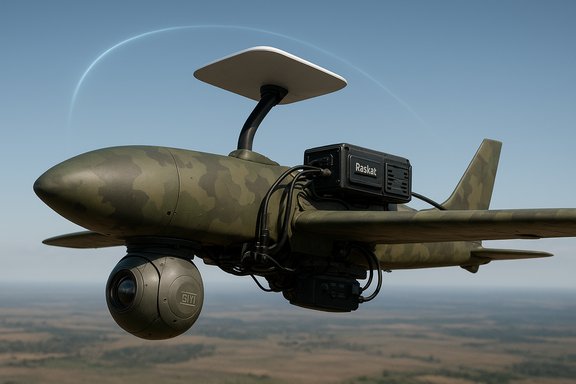
According to reporting that summarised a Main Intelligence Directorate (GUR) assessment, the new Molniya-2R reconnaissance variant includes:- A Raspberry Pi 5 microcomputer as one on-board controller.
- A Chinese mini‑PC (reported as Mini PC F8) labelled with a Russian brand “Raskat” and running a licensed installation of Windows 11.
- A Chinese SIYI ZR10 electro‑optical camera with 10× optical zoom and a three‑axis stabilized gimbal.
- A Starlink satellite user terminal to relay video, telemetry and control commands beyond line‑of‑sight.
It is important to flag the parts of that claim that are currently not independently corroborated in open sources: the specific model name of the mini‑PC (F8), the commercial brand “Raskat” on the device, and the assertion that Windows 11 is a licensed installation on that unit — those details appear in the GUR‑derived reporting but lack independent photographic or supply‑chain confirmation at the time of writing. Those claims should therefore be treated as reported intelligence rather than verified fact. Caution is warranted. (User-provided reporting surfaced this narrative; open-source coverage confirms the Starlink and camera elements but does not yet independently prove the Windows license claim.
Why Starlink matters for small drones
Satcom integration on small UAVs changes the operational calculus in three concrete ways:- Range and persistence: a satellite link removes the need for line‑of‑sight radio, letting operators maintain command and video beyond horizon and over contested terrain.
- Jamming resilience: satellite links bypass many local jamming efforts that target VHF/UHF/LOS datalinks, making control harder to sever with conventional EW.
- Data richness: broadband satellite relays support higher‑bandwidth sensor payloads — live HD video, multiple camera streams, and telemetry — improving situational awareness and remote targeting.
The optics: SIYI ZR10 and what it brings
Open product documentation and vendor payload pages for third‑party imaging packages show that the SIYI ZR10 family offers mid‑weight electro‑optical pods with:- 10× optical zoom and additional digital zoom options.
- A 3‑axis stabilized gimbal for smooth imagery during forward flight.
- Lightweight construction suitable for medium‑size UAVs.
The computing question: Raspberry Pi 5 and "mini PC F8" with Windows 11
Two different computing approaches appear in the reporting: (1) a low-power SBC such as the Raspberry Pi 5, and (2) a small, x86-style mini‑PC (reported locally as Mini PC F8, branded “Raskat”) running Windows 11.- Raspberry Pi family boards are frequently used for on‑platform data collection, sensor fusion, and light automation. The Raspberry Pi 5, released into the hobbyist and industrial market, provides more compute and media capability than prior models and is a logical choice when low SWaP (size, weight, and power) and cost are priorities. Community documentation and hands‑on coverage confirm that Raspberry Pi 5 platforms are being used as compact controllers and even as hosts for experimental Windows Arm images or for interfacing imaging payloads.
- Running Windows 11 on constrained hardware is technically possible: Microsoft documents Windows 11 licensing, hardware compatibility and deployment models for enterprise and OEM channels, and Windows 11/Pro installations are common on x86 mini‑PCs sold through legitimate channels. That said, Windows 11 has minimum hardware and platform expectations (UEFI, TPM 2.0 for many OEM scenarios, and adequate RAM and storage), and it is unusual for this OS to be deployed on disposable loitering munitions unless a full x86 mini‑PC is present and properly ruggedised. Microsoft’s licensing and activation systems are also enterprise‑oriented and create signals that can be tracked when devices phone home for updates or activation.
Why the use of Windows 11 (if true) is noteworthy — and risky for the operator
If a genuine, properly licensed Windows 11 instance is being used aboard a fielded UAV, the implications are layered:- Operational footprint: Windows is a large, general-purpose OS. It brings richer driver support and a broad ecosystem of off‑the‑shelf imaging and compression software — but it also consumes more storage, CPU headroom and memory than an RTOS or embedded Linux stack. For a constrained UAV, that increases thermal and power needs, making the hardware heavier and more complex.
- Telemetry and traceability: Standard Windows installations often include update, telemetry, and activation behaviors that contact Microsoft and other cloud services. Those network patterns can leave forensic trails and introduce operational security risks, especially if the operator has not intentionally hardened or air‑gapped the device.
- Licensing and supply chains: A licensed Windows installation implies a purchase or volume agreement path; that raises questions about how such licenses are being procured, and whether third‑party vendors or intermediaries are being used. It also creates potential leverage points for tracking and legal interdiction if vendors or registries are subpoenaed or otherwise compelled to share activation records.
- Vulnerability surface: A full Windows stack increases the attack surface compared with a minimal embedded controller. Regular Windows vulnerabilities, misconfiguration or incorrect patching can expose the device to remote compromise or malfunction.
Tactical and strategic consequences
- Increased reach and accuracy: Satellite links plus stabilized zoom optics let operators detect, identify, and strike targets at farther ranges with greater confidence. That mechanically increases the lethality per sortie and raises the operational cost for defenders.
- EW and C‑UAS implications: Standard short‑range RF jammers are less effective against satellite relay links. Defenders must therefore augment jamming strategies with directed-energy, physical interception, and improved kinetic C‑UAS capabilities — or attempt to neutralize the UAV earlier in its flight envelope. Some EW tactics can still impede local control (e.g., GPS spoofing, jam LOS channels for backup links), but the satellite link turns the problem into a multi-domain challenge.
- Detection and attribution: The presence of a consumer-grade satellite terminal may offer a signal for detection — unique RF signatures, bootstrap communication patterns, or simply the physical profile of a terminal visible on imagery. Conversely, the commercial nature of the components complicates supply‑side interdiction: these parts are widely available on the global market, easing procurement for non-state and state actors alike.
- Legal and policy angle: SpaceX/Starlink and Western governments have stated policies and taken measures to restrict the misuse of consumer satellite services in active combat. Enforcement is difficult: black‑market and grey‑market procurement channels persist, and once a hardware terminal is in theatre it can be moved or modified to evade simple geofencing controls. Past official statements expressed progress in limiting unauthorized use, but open reporting indicates that unauthorized satellite use continues to be observed.
Supply chain and procurement realities
The modular upgrades reported on the Molniya — SBCs, mini‑PCs, off‑the‑shelf EO pods, and consumer satellite terminals — are products that circulate in global electronics markets. That makes the adaptations cheap and replicable. Open-source reporting of recovered components shows a pattern: operators mix hobbyist and commercial parts with simple mounting hardware to create pragmatic, purpose‑built systems rather than fully integrated bespoke products. This minimises R&D time and uses known commodity logistics to replenish losses. That fact alone accelerates the speed at which tactics evolve in a contested environment.Defensive recommendations and mitigation priorities
For defenders and system architects the priority set should be:- Improve early detection: invest in multi‑sensor C2 that fuses radar, acoustic, optical and RF domains to spot small drones at range and track them through handover.
- Hard‑kill and non‑kinetic layering: add directed‑energy, interceptor drones, and rapid response ground systems to mitigate assets that satellite links make harder to jam.
- Forensic capture and analysis: recover downed systems for component and firmware analysis; extract IMEI/serials and any OS telemetry to trace supply chains and activation records.
- Policy & international pressure: strengthen export controls and target intermediaries in the black market; coordinate across allied jurisdictions to limit the distribution of sensitive SATCOM hardware when used for military purposes.
- Signal intelligence: monitor satellite uplinks for unusual correlations that could indicate operational usage patterns; that requires legal and technical frameworks to avoid crossing privacy and sovereignty lines.
Strengths and limitations of the new Molniya-2R concept
Strengths- Extended control range and real-time ISR through satellite relay.
- Higher quality targeting via stabilized zoom optics.
- Rapid field upgrades using commodity SBCs, mini‑PCs and commercial sensors.
- Power and weight penalties: Starlink terminals and x86 mini‑PCs add mass and increase energy demand.
- Detectability and forensic residue: consumer OSes and activated licences can leave trails.
- Reliability under contest: satellite terminal orientation, initialisation delays, and weather may still cause outages.
- Policy and supply-chain fragility: acquisition of terminals exposes procurement chains to interdiction and sanctions pressure.
What remains unverified — and why that matters
Several precise claims in the circulated summaries require independent corroboration before they should be treated as proven operational facts:- The presence of a specific mini‑PC model (referred to as “Mini PC F8”) branded “Raskat” on Molniya‑2R bodies.
- The assertion that a licensed copy of Windows 11 is installed on that mini‑PC (rather than an unlicensed, cracked, or offline image).
- Detailed supply‑chain provenance showing where the Starlink terminal and Windows license originated.
Final assessment — what this means for Windows users, defenders and technologists
The trend of integrating commercial satellite comms and higher‑quality sensors into low-cost aerial platforms is a clear and present development. For defenders, it raises the bar for ISR and counter‑UAV systems and requires a recalibration of EW and interdiction tactics. For security engineers and policy makers, the reported use of mainstream desktop OSes like Windows 11 — if verified — will raise new questions about licensing, telemetry and attribution. For technologists and hobbyists, the same availability and modularity that enables creative non‑military projects also lowers the barrier for militarised adaptations; that dual‑use reality complicates arms control and export control regimes.Practical next steps: continue rapid forensic analysis of recovered systems, expand sensor fusion investments for early detection, and coordinate internationally to mitigate illicit SATCOM flows while pursuing transparency where possible about hardware provenance. Public reporting confirms the core phenomenon — satellite‑connected Molniya variants are appearing in the theatre — but several of the more sensational technical specifics still require corroboration. Treat confirmed imagery of Starlink‑equipped Molniya drones as operationally significant; treat claims about specific mini‑PC models and licensed Windows installations as provisional until independently proven.
Quick technical checklist for analysts recovering a Molniya-type UAV
- Photograph the entire airframe in high resolution, focusing on payload mounts, connectors, and any serial/label markings.
- Preserve any storage media (SD cards, NVMe modules) and image them under chain-of-custody protocols.
- Extract firmware and binaries from SBCs and mini‑PCs; document OS builds, installed software and network configuration.
- Capture and analyze RF emissions and antenna construction for satellite terminal identification.
- Document battery chemistry and connector types to aid in supplier tracing.
The battlefield is being re-shaped not by one exotic new technology but by the clever recombination of readily available hardware and services: satellite internet, compact gimbaled optics, and commodity compute. That makes the problem both harder to stop and easier to understand — defenders can prepare because the building blocks are familiar, but they must do so quickly because the pace of adaptation is rapid and inexpensive.
Source: dev.ua Russian engineers equipped the Molniya FPV drone with Starlink satellite communication and licensed Windows 11
