

A subtle lapse in compiler bookkeeping has left mruby — the lightweight, embeddable Ruby implementation used widely in embedded systems and constrained environments — exposed to a heap-based buffer overflow in its code generator: CVE-2025-7207 affects the nregs handler in mrbgems/mruby-compiler/core/codegen.c (function scope_new), and a small, targeted patch landed in the upstream tree to initialize the register count correctly. (github.com)
mruby is designed to be small, fast, and embeddable: a minimal Ruby runtime and bytecode compiler that vendors and device makers can compile into appliances, firmware, and applications where resource footprint matters. Because mruby is often embedded, even seemingly low‑risk bugs in the compiler or VM can have outsized operational impact for vendors that bundle it into firmware and closed binaries.
On July 9, 2025 the vulnerability designated CVE‑2025‑7207 was published: a heap‑based buffer overflow in the scope_new routine of the mruby compiler’s nregs handler. Public vulnerability trackers and several security vendors have catalogued the issue, rated it at medium under CVSS v4.0 in some assessments, and flagged the fix by commit 1fdd96104180cc0fb5d3cb086b05ab6458911bb9 in the mruby Git repository. The issue affects mruby releases up to 3.4.0‑rc2.
Why that matters: in a compiler or bytecode generator, nlocals tracks how many local variables are declared in the scope while nregs describes how many register slots are reserved for expression evaluation and temporary storage. Many codegen paths index into the register array using values derived from nregs; if that counter is incorrect the program may write beyond the allocated area, corrupt heap metadata, and cause crashes or worse. This class of bug is routine in compilers, but it’s also a common source of critical memory corruptions because compiler internals manipulate offsets and indices intensively.
Practical outcomes to prepare for:
Multiple vulnerability trackers and vendors mirrored the fix and published entries identifying the same commit hash as the remediation. Distributions and packaging ecosystems subsequently flagged the CVE and included the patch in their advisories where applicable. Operators should treat the upstream commit as authoritative and prefer vendor-supplied packages or rebuilds performed with the patched sources.
Practical guidance on PoCs:
Two practical lessons here:
The incident also reinforces recurring lessons for language runtime maintainers and deployers: initialize state explicitly; integrate fuzzing and sanitizer-based tests into CI; treat build artifacts and vendorized binaries the same as runtime packages (they must be rebuilt to carry fixes); and treat local‑only vulnerabilities seriously when the runtime is embeddable or commonly used in supply‑chain contexts. Operators who follow those practices will both close this hole and reduce their exposure to the next subtle, low‑level memory bug. (github.com)
In short: the fix is available and straightforward; the hard work for many teams will be in inventory and rebuilding embargoed or embedded artifacts. Prioritize patching where mruby is reachable from untrusted inputs or runs with elevated privileges, and add compiler invariants to your test suite so a one‑line oversight does not repeat itself. (github.com)
Source: MSRC Security Update Guide - Microsoft Security Response Center
 Background
mruby is designed to be small, fast, and embeddable: a minimal Ruby runtime and bytecode compiler that vendors and device makers can compile into appliances, firmware, and applications where resource footprint matters. Because mruby is often embedded, even seemingly low‑risk bugs in the compiler or VM can have outsized operational impact for vendors that bundle it into firmware and closed binaries.On July 9, 2025 the vulnerability designated CVE‑2025‑7207 was published: a heap‑based buffer overflow in the scope_new routine of the mruby compiler’s nregs handler. Public vulnerability trackers and several security vendors have catalogued the issue, rated it at medium under CVSS v4.0 in some assessments, and flagged the fix by commit 1fdd96104180cc0fb5d3cb086b05ab6458911bb9 in the mruby Git repository. The issue affects mruby releases up to 3.4.0‑rc2.
What exactly is broken? Technical summary
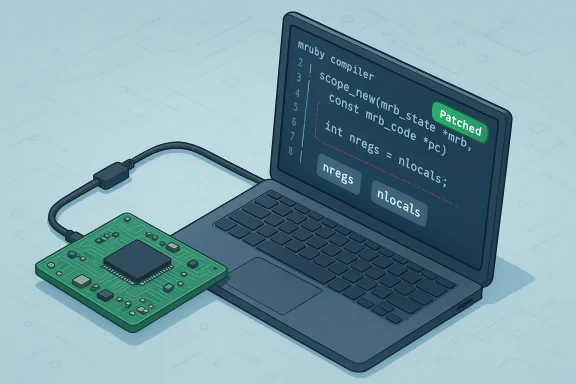
At a high level the problem is a missing initialization: the code that creates a new compiler scope (used to track local variables, registers, and related state while compiling a function or block) failed to initialize the nregs field to the same value as nlocals. The result is that the compiler may assume there are more register slots available than were actually set up, leading to a heap write past the allocated buffer when the code generator subsequently emits instructions that assign to those registers. The upstream change sets both fields together:- Before: s->nlocals = s->sp;
- After: s->nlocals = s->nregs = s->sp;
Why that matters: in a compiler or bytecode generator, nlocals tracks how many local variables are declared in the scope while nregs describes how many register slots are reserved for expression evaluation and temporary storage. Many codegen paths index into the register array using values derived from nregs; if that counter is incorrect the program may write beyond the allocated area, corrupt heap metadata, and cause crashes or worse. This class of bug is routine in compilers, but it’s also a common source of critical memory corruptions because compiler internals manipulate offsets and indices intensively.
Affected versions, scope and exploitation model
- Affected releases: mruby up to and including 3.4.0‑rc2, per public trackers.
- Fixed by: commit 1fdd96104180cc0fb5d3cb086b05ab6458911bb9 committed to the mruby upstream tree. (github.com)
- Attack vector: local — exploitation requires local access to the target runtime or build environment that runs the vulnerable mruby compiler/VM. Public databases list the attack vector as AV:L and the attack complexity as Low in several published assessments.
Impact — what can happen in practice
The immediate, high‑confidence outcome is denial of service: heap corruption commonly leads to crashes when malloc/realloc/free or heap metadata is damaged. Vendors and trackers emphasize process crashes and availability effects as the most probable result. Several trackers also caution that heap corruption can be a stepping stone to arbitrary code execution (RCE) in favorable circumstances — but that path is highly dependent on allocator behavior, platform, compiler flags, and surrounding code. Public scoring and EPSS values for this CVE reflect the local attack vector and relatively constrained impact: CVSS v3.1 assessments cluster in the low to medium range, and EPSS projections are low (indicating limited probability of widespread exploitation).Practical outcomes to prepare for:
- Immediate crash of the process that hosts mruby (availability impact).
- Local privilege escalation when the vulnerable process runs with elevated privileges — for example, if mruby runs inside a privileged daemon that accepts script input. This scenario is context dependent but worth treating seriously.
- Supply‑chain risk if vendors embed the vulnerable version into firmware or statically link mruby into appliances; patching the host OS will not fix embedded binaries — the artifact must be rebuilt with the patched mruby.
Patch, vendor response and timeline
The upstream project accepted a minimal, targeted fix: initialize nregs to the same value as nlocals in scope_new. The commit message is explicit about the rationale: “nregs should not be smaller than nlocals.” That single fix closed the condition that allowed writing past the allocated register area. (github.com)Multiple vulnerability trackers and vendors mirrored the fix and published entries identifying the same commit hash as the remediation. Distributions and packaging ecosystems subsequently flagged the CVE and included the patch in their advisories where applicable. Operators should treat the upstream commit as authoritative and prefer vendor-supplied packages or rebuilds performed with the patched sources.
Detection, hunting and verification
Because exploitation requires local access, detection focuses on these areas:- Inventory: find every place you compile or embed mruby. Search for mruby in SBOMs, package manifests, build artifacts, firmware images, and vendor‑provided packages. If you vendorize or statically link mruby into a product, inspect the exact commit hash used during the build. Public trackers list affected ranges (up to 3.4.0‑rc2) but binary artifacts must be verified individually.
- Crash signatures: after a successful exploit or crash, typical signs include segmentation faults, aborts, or AddressSanitizer messages referencing codegen.c:scope_new or writes beyond register arrays. If you run sanitizers in CI or during fuzzing, they will likely show heap‑buffer‑overflow traces similar to those reported in upstream issue threads. (github.com)
- Fuzzing traces: OSS‑Fuzz and other continuous fuzzing harnesses have been productive against mruby in the past. If you maintain a fuzz target for embedded scripting languages, add a focused harness that exercises the compiler code paths which build scopes and allocate registers. This will detect similar initialization and indexing bugs proactively. (github.com)
- Confirm installed/package version and whether it corresponds to a commit that predates 1fdd961.
- If you rely on distribution packages, consult your distro's security advisory or package metadata to confirm the patch has been applied.
- If you vendorize mruby in a product, rebuild the product against a patched mruby and re-release.
- Run regression and fuzz tests that exercise compilation of complex scopes and lots of local variables; validate that no OOB writes occur.
Exploit maturity and PoC status — what the public record shows
Several vulnerability trackers indicate a proof‑of‑concept (PoC) or exploit code has been made public. Security vendors document PoC availability and list the CVE as disclosed; however, public exploit telemetry for widespread in‑the‑wild exploitation is low — consistent with the fact the attack requires local access and some specific runtime contexts to escalate beyond DoS. Treat claims of RCE with caution unless a reliable, platform‑specific exploit is demonstrated.Practical guidance on PoCs:
- PoC code is useful for defenders to validate whether a given build is vulnerable in a controlled lab. Reproduce PoCs only in isolated, instrumented environments.
- Do not run unreviewed PoC code on production systems. Use containerized testbeds and sanitizers (ASAN/UBSAN) to observe memory corruptions safely.
- If a public PoC exists for your platform, assume motivated adversaries could adapt it for local exploitation; respond by applying the upstream patch or rebuilding affected artifacts.
Why compiler/VM bugs remain a special class of risk
Compiler internals and bytecode generators are densely stateful: they maintain arrays, stacks, symbol tables, and temporary registers while mapping high-level constructs down to bytecode. Small invariants — such as the guarantee that nregs >= nlocals — are often implicitly relied upon across multiple code paths. When those invariants are violated the consequences cascade quickly.Two practical lessons here:
- Initialization matters. Uninitialized or incorrectly initialized counters commonly trigger heap/stack corruption in low-level runtime code. The fix in this case is trivial, which is why careful reviews and simple unit tests around invariants can prevent whole classes of bugs. (github.com)
- Fuzzing is effective. The mruby project has worked with fuzzing harnesses and OSS‑Fuzz in the past; the broader community’s experience shows that fuzzers catch many of these memory‑safety defects early. Continuous fuzzing and CI integration reduce the window between introduction and detection. (github.com)
Short-term mitigations and compensations for operators
If applying the upstream patch or rebuilding binaries is not immediately feasible, consider the following mitigations:- Restrict local access. Limit who can run or supply code to the mruby interpreter/compiler. On systems where mruby is accessible via local sockets, restrict permissions and use OS-level access controls to minimize exposure.
- Run mruby in a sandboxed helper process. Execute untrusted compile/interpret tasks in a short‑lived, isolated process with strict resource limits (memory and CPU) and process restart supervision.
- Use containerization and memory limits (cgroups, ulimit) for processes that embed mruby, so a crash cannot cascade to host‑wide failures.
- Instrument and monitor for crashes and repeated failures related to mruby; set alerts for repeated OOMs or segfaults referencing mruby binaries.
Recommendations for maintainers and packagers
- Upstream fix adoption: package maintainers should apply the upstream commit or upgrade to a release that includes the fix. Prefer vendor‑backported packages when available and documented.
- Rebuild static binaries: for any product that statically links mruby or vendorizes the source into appliances, a rebuild with the patched source is required — OS-level package updates alone are not sufficient.
- Add unit tests asserting invariants: maintainers should add compiler-level tests that ensure nregs >= nlocals after scope initialization and test compile paths that create deep scopes and many locals.
- Integrate sanitizer-based testing in CI: address classes of memory bugs using ASAN/UBSAN in CI for debug builds, and use fuzzing to continuously probe the compiler front end and codegen. (github.com)
Critical analysis — strengths, weaknesses and residual risks
Strengths of the response and fix:- The upstream patch is small, localized, and easy to verify; the commit message and diff are explicit about the problem and the remedy. That makes auditing and backporting straightforward for distribution maintainers. (github.com)
- Multiple independent trackers (NVD, Ubuntu, Snyk, OpenCVE) have aligned on the affected file and function and reference the same upstream commit, lending confidence to the public record and remediation guidance.
- The local attack vector lowers remote exploitability, but the vulnerability remains relevant in the widely real scenario where mruby is embedded into appliances, developer tools, or build systems that accept untrusted inputs. Vendors that package mruby into firmware images must rebuild and reissue images — otherwise the flaw persists despite host OS patches.
- Public PoCs reportedly exist; while they are useful for defenders, they also lower the barrier for attackers with local access. Exercise caution when running PoCs and prioritize patching in environments where local access is possible.
- Heap corruptions are notoriously context-dependent. While this defect is fixable and clearly understood, the potential for complex exploitation (beyond DoS) depends on allocator internals and binary layout — conditions that vary across platforms. Defenders should avoid assuming “low severity” equates to “no risk” — context matters.
Actionable checklist (operator-ready)
- Inventory:
- Locate every use of mruby in your environment (packages, vendorized source, firmware images).
- Check whether the version used is <= 3.4.0‑rc2 or otherwise compiled from a pre‑patch tree.
- Patch and rebuild:
- Apply the upstream change (commit 1fdd961) or upgrade to a release that contains it. (github.com)
- Rebuild any static binaries or firmware that include mruby; redeploy updated artifacts.
- Contain:
- Restrict local script submission and limit who can execute mruby‑based compiles.
- Run suspicious or untrusted inputs in isolated helper processes with strict resource caps.
- Test:
- Run regression tests and fuzzing targets that exercise the compiler’s scope and register allocation paths.
- Use sanitizers (ASAN/UBSAN) on debug builds to spot residual memory-safety problems.
- Monitor:
- Alert on mruby-related process crashes, OOMs, or repeat failures.
- Scan images and SBOMs (software bills of materials) for vulnerable mruby commits or versions.
Final assessment and conclusion
CVE‑2025‑7207 is a textbook example of how a small compiler invariant — in this case failing to initialize the nregs counter — can produce a heap‑based overflow with real operational consequences. The vulnerability is local in nature, the upstream fix is concise and correct, and major trackers have corroborated the affected file, function, and patch commit. That combination makes this a manageable risk provided vendors and operators take standard remediation steps: apply the patch, rebuild embedded artifacts, and adopt containment and testing practices where immediate fixes are impractical. (github.com)The incident also reinforces recurring lessons for language runtime maintainers and deployers: initialize state explicitly; integrate fuzzing and sanitizer-based tests into CI; treat build artifacts and vendorized binaries the same as runtime packages (they must be rebuilt to carry fixes); and treat local‑only vulnerabilities seriously when the runtime is embeddable or commonly used in supply‑chain contexts. Operators who follow those practices will both close this hole and reduce their exposure to the next subtle, low‑level memory bug. (github.com)
In short: the fix is available and straightforward; the hard work for many teams will be in inventory and rebuilding embargoed or embedded artifacts. Prioritize patching where mruby is reachable from untrusted inputs or runs with elevated privileges, and add compiler invariants to your test suite so a one‑line oversight does not repeat itself. (github.com)
Source: MSRC Security Update Guide - Microsoft Security Response Center
