

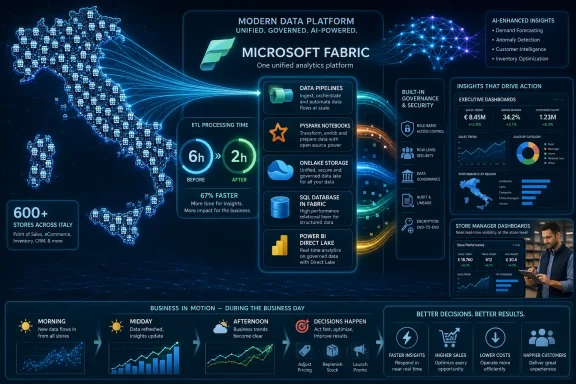
On May 15, 2026, Microsoft published a customer story saying Italian retail operator Multicedi modernized its data platform with Microsoft Fabric, Power BI, SQL Database in Fabric, OneLake, Spark, and AI-assisted analytics to accelerate decisions across more than 600 stores. The headline number is simple: a reported reduction in ETL processing from about six hours to about two. The more interesting story is not the stopwatch, but the architectural wager behind it. Multicedi is becoming a useful case study in how Microsoft wants large retailers to stop treating analytics as a nightly accounting exercise and start treating it as part of the operating rhythm of the business.
For years, the standard business intelligence promise was that companies could make prettier, faster, more centralized reports. That mattered, but it often left the underlying machinery untouched: data still moved through brittle pipelines, teams still argued about whose spreadsheet was authoritative, and store-level decisions still arrived after the business day had already moved on.
Multicedi’s modernization lands squarely in Microsoft’s newer argument for Fabric: the idea that analytics, operational data, machine learning, and business reporting should live closer together. In Microsoft’s telling, the company had a fragmented data landscape, with information flowing from stores, distribution centers, purchasing processes, transfers, administrative systems, and finance. That is a familiar state for any retailer that has grown through years of systems accumulation rather than one clean platform design.
The company’s problem was not merely that data existed in too many places. It was that the latency and inconsistency of that data constrained decisions around promotions, product mix, inventory, and store performance. In food and beverage retail, where margins are narrow and demand patterns can change quickly, that delay is not an abstract IT inefficiency. It becomes an operational tax.
Microsoft’s case study says Multicedi, working with partner Advisio, built a unified data platform using Microsoft Fabric to centralize and govern its data estate. Data pipelines ingest point-of-sale and operational data, Fabric Notebooks written in PySpark transform it, OneLake provides the unified storage layer, SQL Database in Fabric stores transactional data, and Power BI delivers interactive reporting through Direct Lake mode and shared semantic models. In product-marketing language, that is a tidy stack. In practical terms, it is a bid to collapse several older layers of retail analytics into one Microsoft-controlled fabric.
A six-hour analytics cycle has consequences. It means promotional effectiveness may be visible only after the promotion has already underperformed. It means store anomalies may be discovered after managers have moved on to the next day’s problems. It means central teams can spend more time waiting for data to settle than interpreting what it says.
Cutting the processing window to two hours changes the cadence. It does not magically create a fully real-time business, and Microsoft’s own phrasing is careful: near real-time analytics, not instantaneous operational control. Still, for many retail decisions, “during the business day” is the real threshold. A report that arrives at 2 p.m. can change staffing, merchandising, replenishment, or promotional action. A report that arrives tomorrow mostly changes the postmortem.
The architecture also suggests why Microsoft is emphasizing Fabric Spark and PySpark notebooks. Retail transaction data is not just large; it is repetitive, seasonal, messy, and highly dimensional. Parallel processing matters because the work is not a single elegant query. It is the grind of normalizing transactions, joining operational context, preparing curated datasets, and keeping the output consistent enough that business users can trust it.
That matters because enterprise BI has always involved a trade-off. Import mode can be fast, but it introduces refresh windows and duplicated data. DirectQuery can be fresher, but performance depends heavily on the source system and query patterns. Direct Lake is designed to sit between those poles: high-performance interactive analysis without the same level of data-copying overhead.
For Multicedi, Microsoft says Direct Lake improved report performance while simplifying the analytics architecture, even with very large datasets. That is exactly the kind of claim Microsoft needs Fabric to prove in the field. The platform is not just trying to be a lakehouse, a warehouse, a data integration suite, a BI system, and an AI workbench. It is trying to make those boundaries less visible to the people building and consuming analytics.
The shared semantic model layer is just as important. In a retailer, “sales,” “promotion,” “basket,” “margin,” and “store performance” are not self-defining terms. If each department builds its own interpretation, the company gets speed at the cost of trust. Shared semantic models are Microsoft’s way of saying the business can have self-service analytics without returning to spreadsheet anarchy.
That is why the move from delayed reporting to proactive monitoring is the core business change. A central team that can see daily sales performance more quickly can verify whether promotions are actually working across locations. It can spot unexpected shifts in sales patterns. It can adjust promotional actions before a campaign’s value leaks away. It can make more informed calls about inventory planning and product mix.
The difference between retrospective analysis and operational monitoring is subtle but decisive. Retrospective analysis asks what happened. Monitoring asks whether something is happening now that deserves intervention. Most retailers have long wanted the second capability, but legacy data estates often forced them back into the first.
This is where Microsoft’s AI positioning enters the picture, though it should be read with the usual caution. The case study says machine learning models built with Fabric Notebooks support analysis of sales behavior, including demand forecasting and basket analysis. It also says Copilot integration allows users to explore data using natural language. Those are plausible and useful scenarios, but the business value depends heavily on data quality, model governance, and whether frontline or central teams actually trust the outputs.
Multicedi’s story follows that pattern. The most consequential elements are not the flashiest. Fabric Data Pipelines, PySpark transformations, OneLake centralization, SQL Database in Fabric, Direct Lake models, role-based security, and consistent definitions are the foundation. Copilot and machine learning sit on top of that foundation.
That ordering matters for IT pros. Natural-language analytics can be impressive in a demo, but if two departments define revenue differently, Copilot merely accelerates confusion. Demand forecasting can sound strategic, but if store-level data arrives late or inconsistently, the model inherits the mess. Basket analysis can help with merchandising, but only if product, promotion, and transaction data are reliable enough to support the inference.
The strongest reading of Microsoft’s case study is that Multicedi did not modernize because it wanted AI in the abstract. It modernized because the business needed faster and more reliable visibility into the mechanics of retail operations. AI becomes more credible only after that plumbing is in place.
The same consolidation also raises the classic enterprise-platform question: how much of the data estate should sit inside one vendor’s operating model? For many Microsoft shops, the answer may be “quite a lot,” because the savings in integration time, skills alignment, security administration, and reporting consistency can outweigh concerns about portability. But that is not a purely technical decision.
Fabric’s promise is strongest when the customer wants a Microsoft-native path from raw data to executive dashboard to AI-assisted exploration. Multicedi appears to fit that pattern. Its story is not about assembling a best-of-breed analytics stack across multiple vendors. It is about simplifying a fragmented environment into a governed, scalable platform that business teams can use more directly.
That simplification has operational value, especially for mid-sized and large organizations that cannot afford endless data-platform sprawl. Yet IT leaders should still ask hard questions about capacity planning, cost predictability, data egress, disaster recovery, security boundaries, and the skills required to operate Fabric well. A unified platform reduces certain complexities by absorbing them; it does not abolish complexity altogether.
For many enterprises, SQL remains the language of trust. Data engineers may work in Spark, analysts may live in Power BI, and data scientists may prefer notebooks, but SQL is still the common grammar of business data. Placing SQL Database inside the Fabric story helps Microsoft appeal to teams that want modern analytics without abandoning familiar database concepts.
The combination is also politically useful inside organizations. A data modernization project can stall if it appears to belong only to data scientists or only to BI developers. SQL Database, Power BI, notebooks, pipelines, and semantic models give different teams a recognizable entry point. That can make adoption easier, even if the underlying platform is a significant shift.
For Multicedi, the practical effect is that transactional data can support faster monitoring during the business day. That does not mean every operational system has been replaced by Fabric, nor does it imply that Fabric is acting as the point-of-sale system of record. The better interpretation is that Fabric is becoming the governed analytical control plane through which operational signals become business decisions.
Microsoft says Multicedi’s teams can now adjust promotional actions, monitor store performance, and react more quickly to unexpected sales trends during the business day. That is the promise every retailer wants from analytics modernization. A promotion that underperforms in one region can be investigated sooner. A product category that suddenly accelerates can influence replenishment planning. A store with anomalous results can be checked before the anomaly becomes a weekly variance report.
The challenge is that data speed can expose organizational slowness. If the reporting cycle drops from six hours to two, but approval chains still take two days, the business has not fully changed. If store managers distrust central analytics, faster dashboards become faster arguments. If teams lack clear playbooks for promotional intervention, real-time insight becomes real-time anxiety.
This is why the Multicedi project should be read as both a technical modernization and an operating model test. Microsoft can provide the platform. Advisio can help design the architecture. But Multicedi’s business value will depend on how deeply the company embeds those insights into decisions about assortment, promotions, inventory, and performance management.
Multicedi’s story shows that pattern. The visible business experience is Power BI: interactive reports, shared semantic models, role-based access, and self-service exploration. But behind that user interface is a larger Fabric architecture that reaches into ingestion, transformation, storage, governance, and AI. The dashboard is the front door; the data estate is the prize.
For WindowsForum’s audience of sysadmins and IT pros, this is worth watching because it changes where analytics projects live. A Power BI rollout used to be something an analytics team could treat as mostly separate from infrastructure strategy. Fabric makes that separation harder. Capacity, identity, governance, data protection, workspace design, tenant settings, and cost controls become part of the same conversation as report performance.
That is not necessarily bad. In fact, it may be overdue. BI systems that become mission-critical without enterprise-grade governance tend to create hidden risk. But it means Fabric adoption should not be treated as a departmental reporting upgrade. It is closer to a platform decision.
Near real-time systems still have latency. They still depend on ingestion frequency, transformation design, capacity, source-system behavior, semantic model updates, and report design. Direct Lake reduces certain bottlenecks, but it does not repeal the laws of distributed systems. Large datasets still require careful modeling, partitioning strategies, security design, and performance monitoring.
There is also a cultural risk. Once business users get faster data, expectations rise quickly. Yesterday’s breakthrough becomes tomorrow’s baseline. A team that celebrates two-hour processing today may soon ask why it is not twenty minutes. A dashboard that feels fast during rollout may feel slow once everyone builds their daily workflow around it.
Microsoft would likely welcome that pressure, because it pulls customers deeper into Fabric optimization, capacity scaling, and AI-assisted analytics. Customers should welcome it only if they have a clear view of cost and operational ownership. Speed is a feature, but in enterprise analytics, sustained speed is an operating expense.
Fabric may unify tools, but it does not automatically design a data architecture. Someone still has to decide how data is ingested, how transformations are structured, how semantic models are governed, how roles are assigned, how refresh or reframing behavior is managed, and how business users will consume the output. Those decisions require domain context as much as platform knowledge.
Retail data is particularly unforgiving. Promotions, loyalty behavior, returns, transfers, substitutions, seasonal demand, local assortment differences, and supplier constraints all complicate the clean story told by dashboards. A partner that understands both Fabric and retail operations can reduce the risk of building an elegant platform that answers the wrong questions.
This is also part of Microsoft’s go-to-market strength. Fabric is not merely a product sold by Microsoft; it is an ecosystem opportunity for partners that can translate the platform into industry-specific outcomes. Multicedi’s story functions as a proof point for that ecosystem as much as for the software.
Retail is one of the sectors where data-platform modernization has immediate competitive implications. Pricing, promotions, inventory, replenishment, and customer behavior all change quickly. A retailer that can spot and respond to patterns earlier may not need a revolutionary AI model to gain an edge. It may simply need fewer delays, fewer conflicting metrics, and a better view of what is happening across stores.
That is why Microsoft is emphasizing operational responsiveness as much as technical modernization. The company wants Fabric to be seen not just as a warehouse or lakehouse competitor, but as the analytics substrate for day-to-day business execution. If that framing sticks, Fabric becomes harder for customers to evaluate as a narrow IT purchase. It becomes part of the business operating system.
For competitors, the pressure is obvious. Snowflake, Databricks, Google Cloud, AWS, and other analytics vendors all have credible stories around scale, AI, governance, and open data formats. Microsoft’s advantage is the installed base of Power BI, Office, Teams, Azure, and identity infrastructure. Fabric’s challenge is to turn that advantage into a platform that customers find simpler in practice, not just broader on paper.
That means organizations looking at Fabric should resist the temptation to begin with Copilot demos or executive dashboards. The better starting point is a sober inventory of where data originates, how it is transformed, where definitions diverge, who owns access, and which decisions would actually improve if information arrived sooner. Without that discipline, Fabric can become another platform layered on top of old confusion.
Multicedi’s reported gains came from aligning multiple layers: pipelines, Spark processing, OneLake storage, SQL Database in Fabric, Direct Lake reporting, shared semantic models, role-based security, and AI exploration. Any one of those components can be marketed separately. The value comes from the chain.
That chain also gives IT leaders a more realistic way to measure success. Reduced ETL time is one metric. Report responsiveness is another. But the deeper test is whether business teams can make better decisions during the day, using consistent definitions, without waiting for specialists to assemble the truth after the fact.
Source: Microsoft Multicedi modernizes data platform with Microsoft Fabric for faster decisions | Microsoft Customer Stories
 Microsoft’s Retail Pitch Is No Longer Just “Better Dashboards”
For years, the standard business intelligence promise was that companies could make prettier, faster, more centralized reports. That mattered, but it often left the underlying machinery untouched: data still moved through brittle pipelines, teams still argued about whose spreadsheet was authoritative, and store-level decisions still arrived after the business day had already moved on.Multicedi’s modernization lands squarely in Microsoft’s newer argument for Fabric: the idea that analytics, operational data, machine learning, and business reporting should live closer together. In Microsoft’s telling, the company had a fragmented data landscape, with information flowing from stores, distribution centers, purchasing processes, transfers, administrative systems, and finance. That is a familiar state for any retailer that has grown through years of systems accumulation rather than one clean platform design.
The company’s problem was not merely that data existed in too many places. It was that the latency and inconsistency of that data constrained decisions around promotions, product mix, inventory, and store performance. In food and beverage retail, where margins are narrow and demand patterns can change quickly, that delay is not an abstract IT inefficiency. It becomes an operational tax.
Microsoft’s case study says Multicedi, working with partner Advisio, built a unified data platform using Microsoft Fabric to centralize and govern its data estate. Data pipelines ingest point-of-sale and operational data, Fabric Notebooks written in PySpark transform it, OneLake provides the unified storage layer, SQL Database in Fabric stores transactional data, and Power BI delivers interactive reporting through Direct Lake mode and shared semantic models. In product-marketing language, that is a tidy stack. In practical terms, it is a bid to collapse several older layers of retail analytics into one Microsoft-controlled fabric.
The Six-Hour Pipeline Was the Symptom, Not the Disease
The most quotable metric in the story is the reduction in ETL processing time from roughly six hours to roughly two. That is a meaningful improvement, especially when the workload involves billions of annual point-of-sale transactions from more than 600 stores. But focusing only on that number risks missing why the project matters.A six-hour analytics cycle has consequences. It means promotional effectiveness may be visible only after the promotion has already underperformed. It means store anomalies may be discovered after managers have moved on to the next day’s problems. It means central teams can spend more time waiting for data to settle than interpreting what it says.
Cutting the processing window to two hours changes the cadence. It does not magically create a fully real-time business, and Microsoft’s own phrasing is careful: near real-time analytics, not instantaneous operational control. Still, for many retail decisions, “during the business day” is the real threshold. A report that arrives at 2 p.m. can change staffing, merchandising, replenishment, or promotional action. A report that arrives tomorrow mostly changes the postmortem.
The architecture also suggests why Microsoft is emphasizing Fabric Spark and PySpark notebooks. Retail transaction data is not just large; it is repetitive, seasonal, messy, and highly dimensional. Parallel processing matters because the work is not a single elegant query. It is the grind of normalizing transactions, joining operational context, preparing curated datasets, and keeping the output consistent enough that business users can trust it.
Direct Lake Is the Strategic Center of the Story
Power BI has long been Microsoft’s most visible analytics brand, but Direct Lake is the piece that makes this story more than a Power BI deployment. Direct Lake is Microsoft’s attempt to bridge the gap between the speed of imported models and the freshness of querying data closer to where it lives. Rather than forcing every report into a traditional import cycle or pushing every query through DirectQuery, Direct Lake lets Power BI semantic models work directly with Delta tables in OneLake.That matters because enterprise BI has always involved a trade-off. Import mode can be fast, but it introduces refresh windows and duplicated data. DirectQuery can be fresher, but performance depends heavily on the source system and query patterns. Direct Lake is designed to sit between those poles: high-performance interactive analysis without the same level of data-copying overhead.
For Multicedi, Microsoft says Direct Lake improved report performance while simplifying the analytics architecture, even with very large datasets. That is exactly the kind of claim Microsoft needs Fabric to prove in the field. The platform is not just trying to be a lakehouse, a warehouse, a data integration suite, a BI system, and an AI workbench. It is trying to make those boundaries less visible to the people building and consuming analytics.
The shared semantic model layer is just as important. In a retailer, “sales,” “promotion,” “basket,” “margin,” and “store performance” are not self-defining terms. If each department builds its own interpretation, the company gets speed at the cost of trust. Shared semantic models are Microsoft’s way of saying the business can have self-service analytics without returning to spreadsheet anarchy.
The Store Network Becomes a Sensor Grid
Multicedi’s more than 600 stores are not just outlets; in this architecture, they become a distributed sensor network. Every transaction is a signal about demand, pricing, assortment, promotion execution, and customer behavior. The value of that signal depends on how quickly it can be assembled into a pattern.That is why the move from delayed reporting to proactive monitoring is the core business change. A central team that can see daily sales performance more quickly can verify whether promotions are actually working across locations. It can spot unexpected shifts in sales patterns. It can adjust promotional actions before a campaign’s value leaks away. It can make more informed calls about inventory planning and product mix.
The difference between retrospective analysis and operational monitoring is subtle but decisive. Retrospective analysis asks what happened. Monitoring asks whether something is happening now that deserves intervention. Most retailers have long wanted the second capability, but legacy data estates often forced them back into the first.
This is where Microsoft’s AI positioning enters the picture, though it should be read with the usual caution. The case study says machine learning models built with Fabric Notebooks support analysis of sales behavior, including demand forecasting and basket analysis. It also says Copilot integration allows users to explore data using natural language. Those are plausible and useful scenarios, but the business value depends heavily on data quality, model governance, and whether frontline or central teams actually trust the outputs.
AI Is the Sizzle, Governance Is the Meal
Microsoft’s customer stories increasingly frame AI as the natural endpoint of data modernization. That is not wrong, but it can obscure the harder truth: companies do not get useful AI by adding a chatbot to a swamp. They get useful AI by first doing the unglamorous work of ingestion, normalization, access control, semantic modeling, and governance.Multicedi’s story follows that pattern. The most consequential elements are not the flashiest. Fabric Data Pipelines, PySpark transformations, OneLake centralization, SQL Database in Fabric, Direct Lake models, role-based security, and consistent definitions are the foundation. Copilot and machine learning sit on top of that foundation.
That ordering matters for IT pros. Natural-language analytics can be impressive in a demo, but if two departments define revenue differently, Copilot merely accelerates confusion. Demand forecasting can sound strategic, but if store-level data arrives late or inconsistently, the model inherits the mess. Basket analysis can help with merchandising, but only if product, promotion, and transaction data are reliable enough to support the inference.
The strongest reading of Microsoft’s case study is that Multicedi did not modernize because it wanted AI in the abstract. It modernized because the business needed faster and more reliable visibility into the mechanics of retail operations. AI becomes more credible only after that plumbing is in place.
Fabric’s Big Advantage Is Also Its Lock-In Risk
For Microsoft, Fabric’s appeal is integration. The platform brings together data engineering, data science, real-time analytics, data warehousing, lake storage, Power BI, and governance under one umbrella. For organizations already invested in Microsoft 365, Azure, Entra identity, and Power BI, that consolidation can reduce friction.The same consolidation also raises the classic enterprise-platform question: how much of the data estate should sit inside one vendor’s operating model? For many Microsoft shops, the answer may be “quite a lot,” because the savings in integration time, skills alignment, security administration, and reporting consistency can outweigh concerns about portability. But that is not a purely technical decision.
Fabric’s promise is strongest when the customer wants a Microsoft-native path from raw data to executive dashboard to AI-assisted exploration. Multicedi appears to fit that pattern. Its story is not about assembling a best-of-breed analytics stack across multiple vendors. It is about simplifying a fragmented environment into a governed, scalable platform that business teams can use more directly.
That simplification has operational value, especially for mid-sized and large organizations that cannot afford endless data-platform sprawl. Yet IT leaders should still ask hard questions about capacity planning, cost predictability, data egress, disaster recovery, security boundaries, and the skills required to operate Fabric well. A unified platform reduces certain complexities by absorbing them; it does not abolish complexity altogether.
The SQL Database in Fabric Detail Deserves More Attention
One notable detail in the Multicedi story is the use of SQL Database in Microsoft Fabric for transactional data. That matters because it signals Microsoft’s broader ambition to make Fabric not merely a destination for analytical replicas, but a more complete environment for operationally relevant data and reporting workflows.For many enterprises, SQL remains the language of trust. Data engineers may work in Spark, analysts may live in Power BI, and data scientists may prefer notebooks, but SQL is still the common grammar of business data. Placing SQL Database inside the Fabric story helps Microsoft appeal to teams that want modern analytics without abandoning familiar database concepts.
The combination is also politically useful inside organizations. A data modernization project can stall if it appears to belong only to data scientists or only to BI developers. SQL Database, Power BI, notebooks, pipelines, and semantic models give different teams a recognizable entry point. That can make adoption easier, even if the underlying platform is a significant shift.
For Multicedi, the practical effect is that transactional data can support faster monitoring during the business day. That does not mean every operational system has been replaced by Fabric, nor does it imply that Fabric is acting as the point-of-sale system of record. The better interpretation is that Fabric is becoming the governed analytical control plane through which operational signals become business decisions.
The Real Win Is Shortening the Distance Between Signal and Action
Retail analytics is often discussed as if the hard part is seeing the data. In reality, the hard part is creating an organization that can act on it. Faster reports are useful only if someone has the authority, process, and confidence to respond.Microsoft says Multicedi’s teams can now adjust promotional actions, monitor store performance, and react more quickly to unexpected sales trends during the business day. That is the promise every retailer wants from analytics modernization. A promotion that underperforms in one region can be investigated sooner. A product category that suddenly accelerates can influence replenishment planning. A store with anomalous results can be checked before the anomaly becomes a weekly variance report.
The challenge is that data speed can expose organizational slowness. If the reporting cycle drops from six hours to two, but approval chains still take two days, the business has not fully changed. If store managers distrust central analytics, faster dashboards become faster arguments. If teams lack clear playbooks for promotional intervention, real-time insight becomes real-time anxiety.
This is why the Multicedi project should be read as both a technical modernization and an operating model test. Microsoft can provide the platform. Advisio can help design the architecture. But Multicedi’s business value will depend on how deeply the company embeds those insights into decisions about assortment, promotions, inventory, and performance management.
Power BI Remains Microsoft’s Trojan Horse for the Data Estate
One reason Fabric has a credible path into enterprises is that Power BI is already there. Many companies standardized on Power BI years before they were ready to rethink their data engineering architecture. Microsoft’s strategic move has been to turn that reporting footprint into a broader platform conversation.Multicedi’s story shows that pattern. The visible business experience is Power BI: interactive reports, shared semantic models, role-based access, and self-service exploration. But behind that user interface is a larger Fabric architecture that reaches into ingestion, transformation, storage, governance, and AI. The dashboard is the front door; the data estate is the prize.
For WindowsForum’s audience of sysadmins and IT pros, this is worth watching because it changes where analytics projects live. A Power BI rollout used to be something an analytics team could treat as mostly separate from infrastructure strategy. Fabric makes that separation harder. Capacity, identity, governance, data protection, workspace design, tenant settings, and cost controls become part of the same conversation as report performance.
That is not necessarily bad. In fact, it may be overdue. BI systems that become mission-critical without enterprise-grade governance tend to create hidden risk. But it means Fabric adoption should not be treated as a departmental reporting upgrade. It is closer to a platform decision.
Near Real-Time Does Not Mean No Compromises
The phrase near real-time is doing important work in Microsoft’s story. It promises a major improvement over batch-oriented reporting without making the stronger claim that every event is instantly reflected everywhere. That distinction matters.Near real-time systems still have latency. They still depend on ingestion frequency, transformation design, capacity, source-system behavior, semantic model updates, and report design. Direct Lake reduces certain bottlenecks, but it does not repeal the laws of distributed systems. Large datasets still require careful modeling, partitioning strategies, security design, and performance monitoring.
There is also a cultural risk. Once business users get faster data, expectations rise quickly. Yesterday’s breakthrough becomes tomorrow’s baseline. A team that celebrates two-hour processing today may soon ask why it is not twenty minutes. A dashboard that feels fast during rollout may feel slow once everyone builds their daily workflow around it.
Microsoft would likely welcome that pressure, because it pulls customers deeper into Fabric optimization, capacity scaling, and AI-assisted analytics. Customers should welcome it only if they have a clear view of cost and operational ownership. Speed is a feature, but in enterprise analytics, sustained speed is an operating expense.
The Advisio Role Shows the Partner Model Still Matters
Microsoft’s platform story often sounds self-contained, but the Multicedi case underlines the continuing role of implementation partners. Advisio is credited with supporting the modernization and helping design a scalable platform for billions of retail transactions. That is not a minor footnote.Fabric may unify tools, but it does not automatically design a data architecture. Someone still has to decide how data is ingested, how transformations are structured, how semantic models are governed, how roles are assigned, how refresh or reframing behavior is managed, and how business users will consume the output. Those decisions require domain context as much as platform knowledge.
Retail data is particularly unforgiving. Promotions, loyalty behavior, returns, transfers, substitutions, seasonal demand, local assortment differences, and supplier constraints all complicate the clean story told by dashboards. A partner that understands both Fabric and retail operations can reduce the risk of building an elegant platform that answers the wrong questions.
This is also part of Microsoft’s go-to-market strength. Fabric is not merely a product sold by Microsoft; it is an ecosystem opportunity for partners that can translate the platform into industry-specific outcomes. Multicedi’s story functions as a proof point for that ecosystem as much as for the software.
The Competitive Stakes Go Beyond One Italian Retailer
It would be easy to treat this as a routine customer-win story: an Italian retailer modernized its analytics stack, Microsoft published the case study, and everyone involved got a neat quote. But the broader stakes are larger.Retail is one of the sectors where data-platform modernization has immediate competitive implications. Pricing, promotions, inventory, replenishment, and customer behavior all change quickly. A retailer that can spot and respond to patterns earlier may not need a revolutionary AI model to gain an edge. It may simply need fewer delays, fewer conflicting metrics, and a better view of what is happening across stores.
That is why Microsoft is emphasizing operational responsiveness as much as technical modernization. The company wants Fabric to be seen not just as a warehouse or lakehouse competitor, but as the analytics substrate for day-to-day business execution. If that framing sticks, Fabric becomes harder for customers to evaluate as a narrow IT purchase. It becomes part of the business operating system.
For competitors, the pressure is obvious. Snowflake, Databricks, Google Cloud, AWS, and other analytics vendors all have credible stories around scale, AI, governance, and open data formats. Microsoft’s advantage is the installed base of Power BI, Office, Teams, Azure, and identity infrastructure. Fabric’s challenge is to turn that advantage into a platform that customers find simpler in practice, not just broader on paper.
The Multicedi Lesson Is That Faster BI Starts Before BI
The practical lesson from Multicedi’s modernization is that report performance is the last visible mile of a much longer road. The dashboards matter, but they only become transformative when the upstream architecture is designed for freshness, consistency, and governance.That means organizations looking at Fabric should resist the temptation to begin with Copilot demos or executive dashboards. The better starting point is a sober inventory of where data originates, how it is transformed, where definitions diverge, who owns access, and which decisions would actually improve if information arrived sooner. Without that discipline, Fabric can become another platform layered on top of old confusion.
Multicedi’s reported gains came from aligning multiple layers: pipelines, Spark processing, OneLake storage, SQL Database in Fabric, Direct Lake reporting, shared semantic models, role-based security, and AI exploration. Any one of those components can be marketed separately. The value comes from the chain.
That chain also gives IT leaders a more realistic way to measure success. Reduced ETL time is one metric. Report responsiveness is another. But the deeper test is whether business teams can make better decisions during the day, using consistent definitions, without waiting for specialists to assemble the truth after the fact.
A Two-Hour Data Cycle Changes the Management Conversation
Multicedi’s Fabric deployment is notable because it reframes analytics as an active management system rather than a rearview mirror, and that gives IT teams a concrete way to judge the project beyond vendor language.- Multicedi reportedly reduced ETL processing from about six hours to about two hours, improving data freshness across a large store network.
- The architecture uses Microsoft Fabric components including Data Pipelines, PySpark notebooks, OneLake, SQL Database in Fabric, Power BI, Direct Lake, and shared semantic models.
- The business goal is faster visibility into sales performance, promotions, product mix, inventory planning, and operational trends across more than 600 stores.
- Direct Lake is central because it aims to combine interactive Power BI performance with fresher access to data stored in Fabric.
- The AI story is credible only because the project first addresses data consolidation, governance, semantic consistency, and access control.
- The main operational test will be whether Multicedi can turn faster insight into faster action, not merely faster reporting.
Source: Microsoft Multicedi modernizes data platform with Microsoft Fabric for faster decisions | Microsoft Customer Stories
