

UNC Health Chose the Cloud When the Cloud Stopped Looking Like a Compromise
Healthcare has never been short of data. Hospitals have electronic health records, claims systems, lab systems, imaging platforms, scheduling tools, supply chain applications, staffing systems, research registries, quality reporting pipelines, and a thicket of departmental spreadsheets that somehow still matter. The problem has never been the absence of information; it has been the inability to make that information consistent, governed, and reachable without building a private data engineering empire around every use case.
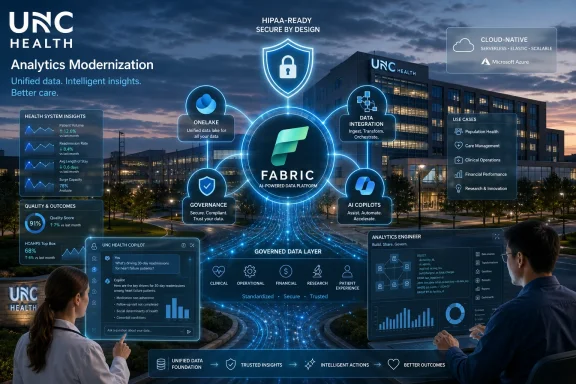
That is the context behind UNC Health’s Fabric decision. The organization did not frame the shift as a panicked escape from aging servers, according to Microsoft’s customer account. Instead, it treated cloud analytics as an architectural pivot made possible by a maturing SaaS platform and made urgent by the arrival of generative AI.
That distinction matters. Many enterprise cloud migrations of the last decade were sold as infrastructure modernization and then discovered, belatedly, that moving complexity from a data center into a hyperscaler did not make it disappear. Virtual machines still needed patching. Identity models still needed hardening. Data platforms still needed tuning, monitoring, and lifecycle discipline. The cloud reduced some constraints while preserving many of the old operational burdens.
UNC Health’s argument for Fabric is that a more integrated SaaS analytics platform changes that balance. Shaun McDonald, manager of the Enterprise Data Warehouse team, put the confidence question bluntly: a SaaS environment where more security and platform capability is built into the system felt different from maintaining infrastructure in the cloud oneself. For a healthcare provider, that is not a minor procurement preference. It is the difference between renting raw ingredients and buying into a managed operating model.
Generative AI Turned Data Gravity Into Boardroom Strategy
The most interesting phrase in UNC Health’s story is not “cloud migration” or even “Microsoft Fabric.” It is “conversational analytics.” That phrase captures the shift now happening across enterprise IT: executives and clinicians are being shown a future in which users ask questions of institutional data in natural language, and suddenly the hidden plumbing of data governance becomes a strategic concern.
Hamid Moosavi, UNC Health’s chief analytics officer, described generative AI as a way to paint a picture. If an organization wants conversational analytics, its data has to live where AI services can use it safely and at scale. That framing turns what was once an internal data warehouse debate into a broader business argument.
The implication is uncomfortable for organizations that spent years treating analytics as a reporting function. You cannot bolt a chatbot onto a fragmented data estate and expect clinical-grade answers. Natural language interfaces only make the underlying data problem more visible. If definitions differ across departments, if lineage is unclear, if access controls are inconsistent, or if the most important data is locked in brittle on-premises pipelines, generative AI does not solve the problem. It accelerates the embarrassment.
That is why UNC Health’s Fabric deployment is best understood as an AI-readiness move, not simply a BI modernization project. Microsoft would naturally prefer every customer story to sound like a validation of its platform strategy, but the larger point is vendor-neutral: generative AI has increased the value of clean, governed, consolidated data. The winners will be the organizations that treat the data layer as infrastructure for future intelligence, not as a back-office reporting warehouse.
Fabric’s Pitch Is Simplicity, but Its Real Product Is Consolidation
Microsoft Fabric is designed to collapse a familiar analytics sprawl into one branded environment: data integration, data engineering, data warehousing, lakehouse storage, real-time analytics, data science, and Power BI-style business intelligence. The gravitational center is OneLake, Microsoft’s attempt to make data storage feel less like a collection of disconnected lakes, warehouses, and departmental repositories.
For Microsoft customers, the pitch is deliberately pragmatic. If an organization already uses Entra identity, Power BI, Microsoft 365, Azure services, and the broader Microsoft security and compliance stack, Fabric promises fewer seams. That is especially attractive in healthcare, where every new platform means another access model to validate, another audit story to maintain, and another set of data movement patterns to explain.
UNC Health’s choice was reinforced by that existing Microsoft footprint. This is not a trivial point. Platform decisions in regulated enterprises are rarely made on feature checklists alone. They are made on the basis of operational trust, existing skills, procurement history, support relationships, and the boring but decisive question of whether administrators can govern the new system without inventing an entirely new control plane.
That is where Fabric’s SaaS posture becomes central. Microsoft is not merely selling compute and storage; it is selling the idea that analytics should feel more like a governed service layer than a hand-assembled cloud estate. For hospitals, that means fewer places where responsibility can become ambiguous. It does not eliminate the customer’s obligations under HIPAA or internal policy, but it can reduce the surface area of bespoke infrastructure decisions that create operational drag.
HIPAA Does Not Bless Architectures; It Tests Them
The temptation in any healthcare cloud story is to treat HIPAA as a checkbox. That is dangerous. HIPAA compliance is not a magic property conferred on a workload because it lands in a certified platform. It is a combination of contractual commitments, administrative controls, technical safeguards, access policies, monitoring, training, incident response, and disciplined data handling.
Microsoft says healthcare data solutions in Fabric support healthcare standards and compliance programs including HIPAA and HITRUST, and Fabric has been covered by Microsoft’s Business Associate Agreement. Those facts matter. They make Fabric a plausible platform for regulated health data in a way that early cloud analytics services often were not. But they do not absolve healthcare organizations from designing their own governance model properly.
That nuance is central to UNC Health’s decision. The organization was not looking for a cloud vendor to make compliance disappear. It wanted a platform where more of the security and governance foundation was built in, so internal teams could spend less energy recreating infrastructure controls and more energy governing data products, access patterns, and analytics outcomes.
This is the mature version of healthcare cloud adoption. The early debate often sounded like a binary argument between on-premises control and cloud risk. The current debate is more sophisticated: which risks are reduced by a managed platform, which risks are newly introduced by cloud concentration, and which responsibilities remain stubbornly local no matter how many compliance badges a vendor can show?
The Old Data Warehouse Is Being Recast as an AI Supply Chain
Enterprise data warehouses once had a relatively clear job: consolidate structured data, feed reports, standardize metrics, and support executive dashboards. That world has not vanished, but it is no longer sufficient. The warehouse is becoming part of an AI supply chain, where data must be prepared not only for analysts but for models, agents, and natural language systems that may sit closer to frontline workflows.
In a hospital system, that distinction is especially important. Analytics can influence bed capacity planning, staffing, readmission analysis, revenue cycle work, population health, research cohort identification, quality measures, and operational throughput. If generative AI enters that environment, it will rely on the same foundation. Weak governance in the data layer becomes weak governance in the AI layer.
UNC Health’s Fabric move points toward a future in which data engineering teams become stewards of institutional reasoning infrastructure. Their pipelines and notebooks are not just technical artifacts. They determine what the organization can know reliably, how quickly it can know it, and who is allowed to act on that knowledge.
That shift may be empowering, but it also raises the bar. Data teams will need stronger practices around lineage, metadata, semantic models, data product ownership, and validation. Conversational analytics sounds friendly. The engineering discipline behind it is not.
Copilot Is Useful, but It Is Not the Architect
UNC Health’s analytics teams are also using Copilot in Microsoft Fabric to assist with pipeline development and notebook workflows. That detail is small, but it is a useful window into how generative AI is actually entering enterprise IT. The first wave is not necessarily autonomous clinical decision-making or fully conversational hospital operations. It is code assistance, workflow acceleration, and lower-friction development inside tools professionals already use.
That is sensible. Pipeline development and notebook work are full of repetitive tasks, boilerplate transformations, syntax lookups, and pattern reuse. A capable assistant can help engineers move faster, particularly when they are working inside a platform that already understands some of the surrounding context. Used well, Copilot can reduce toil and help teams experiment with less friction.
But the word “assist” is doing important work. In healthcare analytics, Copilot-generated code still needs review, testing, validation, and governance. A model can propose a transformation; it cannot own the consequences of a wrong definition, an unintended join, a privacy leak, or a downstream report that quietly changes how a department allocates staff.
That is why the most credible enterprise AI stories are the least magical. Copilot is not replacing the data team. It is becoming another tool in the development environment, useful precisely because humans remain responsible for architecture, policy, and correctness.
Microsoft’s Healthcare Strategy Runs Through the Data Layer
Microsoft has spent years positioning itself as an enterprise healthcare platform company rather than merely a cloud vendor with healthcare customers. Its partnership work with Epic, its Microsoft Cloud for Healthcare portfolio, its compliance messaging, and its investments in Fabric all point in the same direction: Microsoft wants to own the trusted substrate on which healthcare analytics and AI run.
UNC Health’s story fits that strategy neatly. The customer already lives in a Microsoft ecosystem. Fabric becomes the unified analytics layer. Copilot becomes the AI assistant inside the workflow. Power BI remains the familiar front door for many users. The cloud platform supplies identity, security, compliance, and integration scaffolding.
For Microsoft, this is the advantage of being boring in the right places. Healthcare organizations do not typically want novelty in identity management, compliance documentation, or audit trails. They want innovation at the analytics edge and stability underneath. Microsoft’s bet is that it can deliver enough innovation through Fabric and Copilot while reassuring CIOs and compliance officers with the enterprise machinery around them.
The risk is lock-in, though Microsoft would use friendlier language. A unified platform can reduce fragmentation, but it can also concentrate dependency. Once data models, pipelines, governance practices, reports, and AI workflows are built around Fabric, switching costs rise. For some organizations, that is an acceptable trade for operational coherence. For others, it will be a reason to insist on open formats, careful architecture, and exit planning from the beginning.
The Real Competition Is Not Just Snowflake or Databricks
It is easy to frame Fabric as Microsoft’s answer to Snowflake, Databricks, and the broader lakehouse market. That is true at the product level, but the healthcare decision is broader than a vendor bake-off. UNC Health was not simply choosing between query engines. It was choosing an operating model for analytics under regulatory pressure and AI expectation.
That makes the competitive landscape more complicated. Snowflake and Databricks have strong claims in enterprise data platforms, openness, scale, and data science workflows. Cloud-native teams may prefer their flexibility. Organizations with heterogeneous estates may resist a Microsoft-centered analytics stack. Meanwhile, Epic, Oracle Health, specialized healthcare data platforms, and research data environments all have gravitational pull of their own.
Fabric’s advantage is not that it is always the best individual tool in every category. Its advantage is that it bundles the categories into a familiar enterprise environment. For a Microsoft-heavy healthcare organization, the integrated path may beat a theoretically superior collection of specialized tools if it reduces governance friction and speeds adoption.
That is the old Microsoft playbook, updated for AI. The company wins not by making every component irresistible in isolation, but by making the combined platform easier to buy, govern, and explain. In healthcare, “explain” may be the most important verb.
A Governed Lake Is Still a Lake Full of Hard Choices
The phrase “single governed data environment” sounds clean. In practice, it hides a great deal of institutional labor. A hospital system has to decide who owns data definitions, which datasets are authoritative, how research use differs from operational use, how long data is retained, how sensitive fields are masked or restricted, and how access changes when employees move between roles.
Fabric can provide tools for governance, but it cannot settle those political and operational questions. No platform can decide whether finance, clinical operations, or quality leadership gets the final say on a metric that crosses departmental boundaries. No SaaS control plane can automatically resolve the tension between enabling self-service analytics and preventing accidental exposure of protected health information.
That is why modernization projects often succeed or fail outside the architecture diagram. A unified platform can make governance easier to enforce, but only after the organization has done the harder work of defining governance in the first place. Without that, centralization can simply create a larger and more impressive mess.
UNC Health’s move suggests the organization believes Fabric gives it a better foundation for that work. The significance is not that all complexity vanishes. The significance is that the complexity moves up the stack, away from infrastructure maintenance and toward data stewardship, policy, and analytics product design.
Windows Shops Should Recognize the Pattern
For WindowsForum readers, the Fabric story may feel adjacent to traditional Windows administration, but the underlying pattern is familiar. Microsoft has spent decades turning discrete infrastructure responsibilities into managed platform layers. Active Directory centralized identity. Microsoft 365 absorbed Exchange and collaboration infrastructure. Intune and Defender shifted endpoint management and security toward cloud control planes. Fabric is part of the same movement in analytics.
The administrator’s job does not disappear in that transition. It changes shape. Instead of maintaining every server and integration point, IT teams manage identity boundaries, conditional access, tenant configuration, data permissions, compliance posture, lifecycle controls, and user enablement. The command line and the admin console remain, but the center of gravity shifts from hardware ownership to policy architecture.
That shift is not universally welcomed. Some teams value the transparency and control of self-managed systems. Others have been burned by cloud service changes, licensing complexity, regional availability issues, or platform features that lag behind marketing. Microsoft Fabric itself has drawn criticism from practitioners around maturity, DevOps workflows, deployment patterns, and the rough edges that come with a fast-evolving platform.
Those criticisms should not be dismissed as resistance to progress. They are the predictable result of Microsoft trying to turn a sprawling analytics market into an integrated SaaS suite while customers are already using it for serious workloads. The platform may be strategic, but strategy does not exempt it from the grind of enterprise readiness.
The Hospital Analytics Stack Is Becoming a Clinical Risk Surface
The more hospitals depend on analytics, the more analytics becomes part of the care environment. A dashboard that forecasts capacity can affect staffing. A quality metric can affect clinical priorities. A research cohort query can shape which patients are studied and which are invisible. An operational model can influence where resources go.
That does not mean every analytics workload is a medical device or that every report is a clinical intervention. It does mean the boundary between back-office data and frontline care is becoming porous. When analytics becomes faster, more conversational, and more embedded in workflows, mistakes travel faster too.
This is where governance becomes a patient safety issue, not merely an IT compliance issue. Data lineage, access control, semantic consistency, and validation are not bureaucratic niceties. They are safeguards against confident nonsense in environments where confident nonsense can cause harm.
UNC Health’s Fabric deployment should therefore be read as part of a larger healthcare reckoning. The industry wants AI-powered insight, but AI-powered insight depends on data environments that are trustworthy enough to deserve that power. The platform is the beginning of that story, not the end.
The Lesson From Chapel Hill Is Less About Fabric Than About Timing
The timing of UNC Health’s move is instructive. A few years ago, the case for cloud analytics might have leaned heavily on elasticity, infrastructure savings, and modernization. Today, those arguments still exist, but they are overshadowed by AI readiness. Generative AI has given data leaders a more compelling way to explain why fragmented estates are no longer tolerable.
That does not mean every healthcare organization should immediately standardize on Fabric. Some will choose different platforms. Some will move more slowly because their data quality, governance maturity, or contractual constraints are not ready. Some will decide that specific workloads should remain isolated or on premises.
But the strategic direction is increasingly clear. Healthcare data platforms are being judged by whether they can support governed, AI-adjacent analytics at scale. That requires more than storage and dashboards. It requires identity, compliance, lineage, integration, developer tooling, and user-facing analytics to work together without forcing every hospital to become a cloud platform engineering company.
UNC Health’s bet is that Microsoft Fabric can provide that foundation. The broader lesson is that healthcare organizations are no longer asking whether cloud analytics is acceptable. They are asking which cloud analytics model gives them enough governance to move quickly without pretending the risks are gone.
The Fabric Bet at UNC Health Comes Down to Five Practical Tests
The UNC Health story is ultimately a test of whether an integrated analytics platform can reduce infrastructure burden while increasing the organization’s capacity to use data responsibly. The marketing language is about modernization and AI, but the operational stakes are more concrete.
- UNC Health has standardized enterprise analytics workloads on Microsoft Fabric as a single governed environment for care, operations, and research data.
- The organization’s rationale reflects a broader shift from cloud migration as infrastructure replacement to cloud migration as preparation for generative AI and conversational analytics.
- Fabric’s SaaS model appealed because it reduces the need for healthcare IT teams to recreate and maintain every layer of cloud infrastructure themselves.
- HIPAA alignment and Microsoft’s compliance posture make the platform viable for healthcare use, but UNC Health still remains responsible for governance, access control, and safe data practices.
- Copilot in Fabric is being used as an engineering accelerator for pipelines and notebooks, not as a substitute for human review or accountable data architecture.
- The long-term value of the move will depend less on the brand name of the platform than on UNC Health’s ability to turn unified data into trusted, governed, and clinically useful insight.
UNC Health’s Fabric deployment is a useful marker for where enterprise healthcare IT is heading: away from isolated reporting systems and toward governed cloud data foundations built with AI in mind. Microsoft gets a strong customer proof point, but hospitals get the harder assignment. They must prove that the same platform shift that makes analytics faster can also make it safer, clearer, and more accountable. The next phase of healthcare AI will not be won by the organization with the flashiest chatbot; it will be won by the one whose data estate is boringly trustworthy enough for the chatbot to matter.
References
- UNC Health modernizes data analytics for care, operations, and research with Fabric Microsoft · 2026-05-26T17:30:09.868751
- learn.microsoft.com learn.microsoft.com
- powerbi.microsoft.com powerbi.microsoft.com