

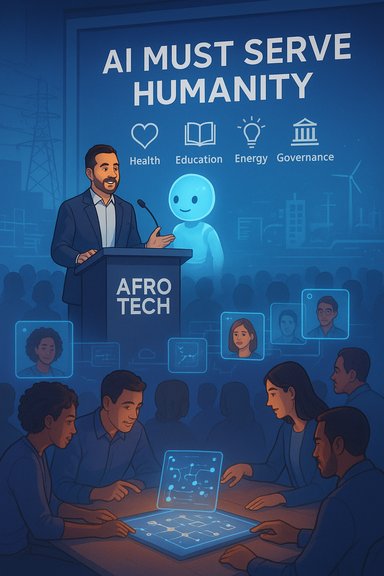
Mustafa Suleyman framed superintelligence not as an inevitability to fear but as a responsibility to shape, telling a packed AFROTECH stage that any future superintelligent system "must always work in service of humanity" and offering a sweeping, optimistic roadmap that ranges from group-friendly Copilot features to the provocative idea that AI could one day cut the cost of energy by two orders of magnitude.
Mustafa Suleyman is the executive at the center of Microsoft’s consumer AI push. The British entrepreneur – co‑founder of DeepMind and later of Inflection.ai – joined Microsoft in 2024 to lead a consolidated consumer AI organization that now houses Copilot, Bing, Edge and other AI‑first consumer services. His appointment and the creation of the Microsoft AI unit signaled a strategic pivot for Microsoft from partner-and-integrator to an aggressive product-focused AI organization with in‑house initiatives and an explicit safety and governance posture.
At AFROTECH™ Conference 2025 Suleyman spoke to an audience of creators, developers and business leaders about what "superintelligence" should mean in practice. His remarks covered three broad themes: (1) capabilities already emerging in the field, (2) product directions for Microsoft Copilot and allied services, and (3) grander, long‑term societal impacts — including a striking prediction that effective use of AI could radically lower the cost of energy and thus transform consumer prices across the board.
The remarks reflect a Microsoft strategy that blends product rollout with safety framing: build powerful agents and reasoning systems while insisting on principled constraints and human-centered objectives. That dual posture is now a central operating premise for many Big Tech AI efforts.
Key product directions include:
Why the optimism has a rational basis
What’s happening in product terms
Principal risks to track
On the other hand, his bolder forecast — that AI could reduce the cost of energy by 100× and unlock an era of abundance — is a hopeful research projection that depends on breakthroughs in materials, manufacturing and infrastructure far beyond any single company’s roadmap. It’s a plausible long‑run scenario if multiple technical revolutions succeed, but it is not a near‑term inevitability.
The real, immediate story is that Microsoft (and other platform players) are deliberately pushing capabilities forward while foregrounding human‑centered safety. That approach will shape how millions of users experience AI in the next several years. The crucial work now is not only inventing more capable agents, but creating robust governance, transparent auditability, and equitable access so that the coming wave of AI benefits society broadly rather than a select few.
Source: afrotech.com Microsoft AI CEO Mustafa Suleyman Says Superintelligence 'Must Always Work In Service Of Humanity' - AfroTech
 Background / Overview
Mustafa Suleyman is the executive at the center of Microsoft’s consumer AI push. The British entrepreneur – co‑founder of DeepMind and later of Inflection.ai – joined Microsoft in 2024 to lead a consolidated consumer AI organization that now houses Copilot, Bing, Edge and other AI‑first consumer services. His appointment and the creation of the Microsoft AI unit signaled a strategic pivot for Microsoft from partner-and-integrator to an aggressive product-focused AI organization with in‑house initiatives and an explicit safety and governance posture.At AFROTECH™ Conference 2025 Suleyman spoke to an audience of creators, developers and business leaders about what "superintelligence" should mean in practice. His remarks covered three broad themes: (1) capabilities already emerging in the field, (2) product directions for Microsoft Copilot and allied services, and (3) grander, long‑term societal impacts — including a striking prediction that effective use of AI could radically lower the cost of energy and thus transform consumer prices across the board.
The remarks reflect a Microsoft strategy that blends product rollout with safety framing: build powerful agents and reasoning systems while insisting on principled constraints and human-centered objectives. That dual posture is now a central operating premise for many Big Tech AI efforts.
What Suleyman Actually Said — and What Is Verifiable
Suleyman’s AFROTECH comments touched on concrete product developments and high‑ambition projections. Paraphrased, his public points were:- Superintelligence must serve humanity. He said that if systems reach far deeper reasoning and autonomy, they should remain aligned to human interests and values.
- AI is already doing world‑class medical diagnostics. He referenced advances that demonstrate AI’s ability to diagnose complex cases at scale.
- AI will master practical autonomy. He predicted agents that can call APIs, send emails, make phone calls and otherwise act on users’ behalf.
- Social intelligence matters. He applauded Copilot features designed for groups and social workflows rather than isolating individuals.
- A bold energy claim. He suggested AI could enable reductions in the cost of energy by two orders of magnitude within a couple of decades — unlocking dramatically cheaper goods and services.
Microsoft’s AI posture today: products, agents and Copilot
Microsoft’s product push: agents, "deep reasoning" and Copilot everywhere
Microsoft’s recent product announcements have emphasized modular agents and task‑specific reasoning models. The company has added built‑in agents to Microsoft 365 Copilot — notably reasoning agents intended to carry out multi‑step research and advanced analytics — and expanded Copilot Studio to let organizations build custom agent flows and orchestration logic.Key product directions include:
- Reasoning agents (Researcher, Analyst): Designed to break down complex queries into stepwise sub‑tasks and return evidence‑backed answers or code.
- Agent orchestration: Systems that combine multiple specialized agents (or model instances) to simulate debate, cross‑check outputs and improve robustness.
- Extensibility/connectors: Copilot can be connected to enterprise systems (CRM, ticketing, file stores) so agents can operate on real business data.
- Copilot Vision and screen‑aware helpers: Features that let Copilot "see" or interpret screen content to provide contextually relevant assistance.
- Autonomous agent capabilities: Previewed and rolling out in controlled fashion, allowing Copilot agents to execute sequences of actions (generate code, run queries, create artifacts) under guardrails.
What this means for users and organizations
For end users and IT, the shift is less about a single new product and more about a new interaction model: Copilot is transitioning from a reactive assistant (answering prompts) into an active collaborator that can orchestrate multiple tools, consult internal data, and produce executable outputs. That increases productivity potential but also raises urgent governance questions for admins and privacy officers — including how to control data access, audit agent decisions, and prevent unintended actions.Medical diagnostics: evidence that AI is already powerful — and the limitations
Suleyman’s statement that AI is “already capable of world‑class medical diagnostics” is anchored in recent, public technical demonstrations and industry reporting.- Research teams and industry groups have built benchmarks showing advanced AI systems can solve highly complex diagnostic puzzles drawn from challenging medical case series. Microsoft’s own diagnostic orchestrator research reported exceptionally high accuracy on a suite of New England Journal of Medicine case problems by coordinating multiple models and running a stepwise decision process.
- The regulatory and commercial landscape confirms rapid progress: hundreds of AI‑enabled medical devices have received regulatory clearances, and hospitals increasingly deploy imaging and workflow tools that embed AI.
- Most high‑profile results come from benchmarks and controlled studies, not from large multicenter clinical trials showing improved real‑world outcomes when AI is integrated into care pathways. In many evaluations the human comparator had constrained information or workflow support, which can bias comparisons.
- Regulation, liability and clinical validation remain bottlenecks. Translation into routine care requires controlled trials, regulatory approvals and clinician adoption — steps that take time and careful oversight.
- Model brittleness, data shift and demographic bias are real risks in clinical settings. An AI that excels in curated tests may fail in underrepresented patient populations or when presented with atypical presentations.
Energy and materials: a realistic route to huge cost declines — or wishful thinking?
Suleyman’s most headline‑grabbing line at AFROTECH was his suggestion that AI could reduce the cost of energy by "100 times" — and that doing so would cascade into drastically cheaper goods and services.Why the optimism has a rational basis
- AI has already accelerated discovery in domains such as protein folding and materials science. The same underlying techniques — foundation models, graph neural networks, closed‑loop experimentation — have been applied to discover novel compounds, catalysts, and crystalline materials that could improve batteries, superconductors and photovoltaic materials.
- AI is being used to optimize complex systems: grid management, predictive maintenance, supply chain logistics and even plasma control in experimental fusion devices. Each of these areas offers potential percentage gains that compound over time.
- Historical precedent: transformative algorithms (e.g., in computational chemistry or genomics) have compressed research timelines dramatically. If a similar leap happens in energy‑critical material discovery or reactor design, the downstream economic impact could be profound.
- Energy costs are a complex function of capital costs, materials, labor, regulatory frameworks and grid infrastructure. Even large R&D gains on materials or control systems typically translate into incremental cost reductions unless paired with radical manufacturing, policy and deployment changes.
- Key "hard" technologies — commercial fusion, room‑temperature superconductors, or radically new energy carriers — remain uncertain. AI can accelerate discovery and design, but turning discoveries into mass manufacturable systems requires engineering, supply chains and capital deployment.
- Timelines and scale matter: halving the cost of a technology over a decade is very different from achieving a 100× reduction. Even aggressive learning curves combined with AI enhancements are unlikely to yield two orders of magnitude improvement across the entire energy stack within 15 years without multiple concurrent breakthroughs.
- Near‑term (5–10 years): AI will deliver material and process improvements, lower R&D costs and improve operational efficiency across the energy sector. Expect notable gains in battery chemistry, grid management and manufacturing process optimization.
- Mid‑term (10–25 years): If AI helps discover a game‑changing material or control method (e.g., enabling practical fusion or cheap, widely deployable superconductors), we could see dramatic cost declines in specific segments. Whether this translates to a uniform 100× reduction in consumer energy costs is speculative and contingent on large systemic changes.
Social intelligence and group interactions: design choices matter
Suleyman emphasized that AI should not isolate humans from one another. He pointed to new Copilot features that enable shared interactions — group chat experiences where multiple people can interact with the same AI instance — and framed social group experiences as a design priority.What’s happening in product terms
- Copilot is being integrated into collaborative platforms (teams, chat, shared workspaces) and Microsoft has introduced agent primitives intended to work in multi‑person workflows.
- Product teams are explicitly thinking about social intelligence — how AI can mediate group coordination, provide a shared memory for teams, and encourage offline collaboration rather than deepening attention fragmentation.
- Shared AI experiences can boost coordination, but they also raise new privacy and moderation challenges: who owns the conversation record, how are permissions managed, and how do shared agents handle sensitive or conflicting requests?
- The user experience choices (transparent chain‑of‑thought, visible citations, human handoff mechanisms) will determine whether group AI fosters trust or creates confusion.
Risks, governance and the need for hard constraints
Suleyman’s human‑centered mantra does not eliminate risk. The move from useful assistant to systems with significant autonomy introduces challenges that require active mitigation.Principal risks to track
- Alignment and value drift: As agents get more autonomous, ensuring they reliably follow intended goals and human values becomes harder. Even well‑trained models can hallucinate, follow shortcuts, or optimize for proxy objectives.
- Concentrated power and centralization: Sophisticated models and the compute stacks to train and run them are expensive. Concentrated capabilities in a few corporations or states raise economic and geopolitical risks.
- Privacy and surveillance: Agents that connect to corporate and personal data sources can become vectors for leaks, misuse or inappropriate profiling unless strong technical and legal safeguards are implemented.
- Safety and robustness in high‑stakes domains: Medicine, energy systems and critical infrastructure require provable guarantees, monitoring and human oversight — a model‑centric deployment without rigorous controls is dangerous.
- Auditable chains of action: Implementing systems that log decisions, provide human‑readable rationales and allow complete human override is essential.
- Regulatory engagement: Coordination with domain regulators (health authorities, energy regulators, data protection agencies) will be necessary for safe deployment.
- Open research and external review: Inviting independent audits, stress tests and red‑team evaluations helps uncover blind spots and build public trust.
What Windows users and creators should know now
- Copilot is becoming core to productivity and Windows experiences. Expect deeper system integrations that let AI act across files, apps and services — from writing emails to summarizing meetings to creating visuals.
- Privacy and admin controls are becoming first‑class features. Enterprises will have new tenant settings to manage agent access, and individual users should review privacy settings for Copilot and Companion features.
- New tools will change workflows, not replace judgment. Agents will automate routine tasks and surface insights, but human oversight remains essential — especially in specialized or high‑risk work.
- Creators and developers have new channels. Microsoft’s Copilot Studio and agent frameworks open routes to build customized assistants and experiences that can be embedded into apps and workflows.
- Update Copilot privacy and access settings in the Microsoft 365 admin center.
- Pilot advanced agent features with a small, well‑instrumented team before broader rollout.
- Require explainability and trace logs for any AI system used in clinical, financial or safety‑critical contexts.
Conclusion
Mustafa Suleyman’s AFROTECH remarks stitch together product realism and aspirational futurism. On one hand, the technical trajectory he described is visible in Microsoft’s recent agent launches, Copilot expansions and high‑profile medical AI experiments. Those developments underpin his assertion that agents will learn to use APIs, take actions and support complex professional tasks.On the other hand, his bolder forecast — that AI could reduce the cost of energy by 100× and unlock an era of abundance — is a hopeful research projection that depends on breakthroughs in materials, manufacturing and infrastructure far beyond any single company’s roadmap. It’s a plausible long‑run scenario if multiple technical revolutions succeed, but it is not a near‑term inevitability.
The real, immediate story is that Microsoft (and other platform players) are deliberately pushing capabilities forward while foregrounding human‑centered safety. That approach will shape how millions of users experience AI in the next several years. The crucial work now is not only inventing more capable agents, but creating robust governance, transparent auditability, and equitable access so that the coming wave of AI benefits society broadly rather than a select few.
Source: afrotech.com Microsoft AI CEO Mustafa Suleyman Says Superintelligence 'Must Always Work In Service Of Humanity' - AfroTech
