Mustafa Suleyman’s offhand description of Elon Musk as a “bulldozer” and his praise for Sam Altman as “courageous” crystallize a moment in the AI industry where personalities, infrastructure, and governance are colliding — and Microsoft’s AI chief is placing himself squarely at the center of that collision.
In a wide-ranging interview with Bloomberg, Suleyman sketched three different leadership archetypes at the top of the AI race — the executional force, the rapid infrastructure builder, and the scientist–polymath — and used blunt language to describe each. Those characterizations are more than color commentary: they signal how Microsoft thinks about competition, partnerships, and the existential policy questions dogging AI right now.
Mustafa Suleyman’s profile matters because he’s not just a senior Microsoft executive; he’s a visible architect of the company’s consumer-AI strategy and a public voice on AI safety and governance. He co-founded DeepMind, led Inflection AI, and now runs the newly organized Microsoft AI group that oversees Copilot and Microsoft’s push toward more independent AI capabilities. His judgments about peers — Elon Musk (xAI/Tesla/SpaceX/Neuralink), Sam Altman (OpenAI), and Demis Hassabis (DeepMind/Google) — reflect both personal history and strategic positioning.
Suleyman’s remarks landed amid a broader industry narrative: the compute and data-center arms race is accelerating; companies are shifting from partnerships to diversified infrastructure strategies; and the political debate over AI regulation is intensifying. Those three trends intersect in his descriptions of Musk, Altman, and Hassabis and offer a window into how Microsoft intends to compete without surrendering the policy high ground.
For Windows users, IT professionals, and enterprise leaders, the takeaway is straightforward: expect accelerating capability, increasing infrastructure complexity, and a governance environment that will progressively define what advanced AI looks like in practice. The next phase of AI will not be decided by a single personality or company, but by how well the ecosystem — engineers, companies, and governments — coordinates scale, safeguards, and shared benefit.
Source: livemint.com Microsoft AI boss Suleyman calls Elon Musk a ‘bulldozer’, labels Sam Altman ‘courageous’ | Mint
In a wide-ranging interview with Bloomberg, Suleyman sketched three different leadership archetypes at the top of the AI race — the executional force, the rapid infrastructure builder, and the scientist–polymath — and used blunt language to describe each. Those characterizations are more than color commentary: they signal how Microsoft thinks about competition, partnerships, and the existential policy questions dogging AI right now.
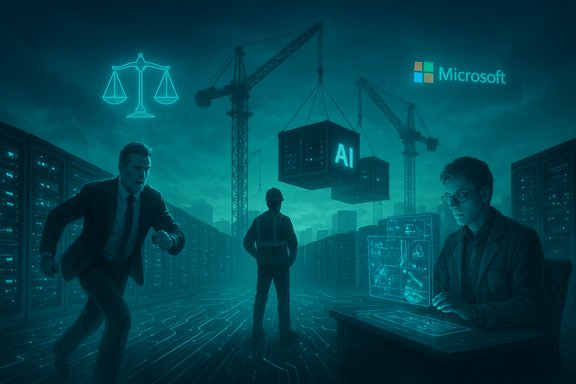 Background: why a CEO’s shorthand matters
Mustafa Suleyman’s profile matters because he’s not just a senior Microsoft executive; he’s a visible architect of the company’s consumer-AI strategy and a public voice on AI safety and governance. He co-founded DeepMind, led Inflection AI, and now runs the newly organized Microsoft AI group that oversees Copilot and Microsoft’s push toward more independent AI capabilities. His judgments about peers — Elon Musk (xAI/Tesla/SpaceX/Neuralink), Sam Altman (OpenAI), and Demis Hassabis (DeepMind/Google) — reflect both personal history and strategic positioning.Suleyman’s remarks landed amid a broader industry narrative: the compute and data-center arms race is accelerating; companies are shifting from partnerships to diversified infrastructure strategies; and the political debate over AI regulation is intensifying. Those three trends intersect in his descriptions of Musk, Altman, and Hassabis and offer a window into how Microsoft intends to compete without surrendering the policy high ground.
Overview: what Suleyman actually said — and what it implies
- When asked to describe Elon Musk in a word, Suleyman chose “bulldozer,” elaborating that Musk has “superhuman capabilities to bend reality to his will” and an “incredible track record” of pulling off the seemingly impossible.
- On Sam Altman, Suleyman was effusive: he called Altman “courageous,” credited him with an unusually aggressive data‑center buildout, and suggested Altman “may well turn out to be one of the great entrepreneurs of our generation.”
- On Demis Hassabis, Suleyman reverted to a familiar, respectful line: “a great scientist,” a polymath who has made “massive contributions” to the field.
Microsoft’s strategic posture: infrastructure, self-sufficiency, and rivalry
The infrastructure imperative
Suleyman’s praise for Altman highlights a plain fact of the current AI era: compute matters. Training and operating frontier models has become a capital‑intensive, logistics-heavy endeavor that requires not just GPUs and chips but power contracts, specialized cooling, networking, and sovereign hosting arrangements.- Major players are moving far beyond ad-hoc cloud usage into long-term infrastructure commitments: multi‑year cloud and chip deals, bespoke data‑center builds, and partnerships with hardware and real‑estate operators.
- This is reshaping competitive advantage: firms that control or secure reliable, low-latency clusters of accelerators will have a throughput and cost profile that gives them leverage in model scale and deployment speed.
Why Suleyman’s comments are strategic signaling
Calling Altman “courageous” for a rapid data‑center buildout is both recognition and a stake in the ground. It acknowledges OpenAI’s infrastructure bet but also telegraphs Microsoft’s tolerance for large-scale capital plays. Microsoft can credibly say it values governance and safety while still preparing to meet competing firms on raw infrastructure capacity.The “bulldozer” — unpacking Suleyman’s description of Elon Musk
Executional audacity vs. governance unpredictability
When Suleyman called Elon Musk a “bulldozer,” he meant two things simultaneously: admiration for Musk’s uncanny ability to execute on transformative engineering projects, and an implied warning about divergent values and unpredictable modes of operation.- Musk’s track record — reusable rockets, mainstream electric vehicles, work on brain‑computer interfaces, and a willingness to pursue moonshot verticals — embodies the executional force Suleyman was describing.
- But the term “bulldozer” also suggests a certain externality: rapid, forceful progress that can reshape industry norms without the same deference to consensus governance or regulatory process that others might follow.
The practical implications for the AI ecosystem
A bulldozer actor can be invaluable in advancing what’s technically possible, but such actors can also complicate efforts to coordinate safety standards, norms, and policy. If multiple organizations pursue different governance trade-offs while racing at full scale, the system-wide risk profile changes.- Rapid, independent progress by actors like xAI may force competitors and regulators to adapt more quickly than planned.
- That dynamic raises coordination costs for governments and for industry groups that prefer incrementalism and verifiable safety benchmarks.
Sam Altman: the fast builder — financing, risk, and upside
Data centers, capital intensity, and the scale gamble
Suleyman’s specific point — that Altman is building data centers “at a faster rate than anyone in the industry” — is a reference to OpenAI’s recent infrastructure pushes and multi‑partner compute deals. The OpenAI strategy has moved from a single‑cloud dependency toward a diversified, large‑scale compute footprint, secured through multi‑year agreements and direct infrastructure projects.- Rapid deck‑out of data‑center capacity reduces latency and gives a competitive edge in training cadence and inference throughput.
- It also raises balance‑sheet and operational risks: long-term commitments to chip supply, power, and real‑estate are expensive and can be mismatched with revenue growth if commercial monetization lags expectations.
Why Microsoft cares — and why Suleyman praises the move
Suleyman’s praise is pragmatic: a more capable OpenAI makes Microsoft’s Copilot and Azure offerings more relevant and drives the market forward. But the praise also recognizes the cost — and the managerial skill — of executing such a broad infrastructure plan.- If OpenAI pulls off the buildout, it will significantly increase the pace of state‑of‑the‑art model development.
- If it stumbles — on supply, regulation, or profitability — the repercussions will ripple through a compute market that is already tight.
Demis Hassabis and the science posture: the enduring value of research
The polymath archetype
Suleyman’s view of Demis Hassabis as a “great scientist” and polymath is an acknowledgment that foundational research and long‑term thinking still matter. DeepMind’s contributions have repeatedly advanced the theoretical underpinnings of modern AI, from reinforcement learning breakthroughs to biological insights.- Deep scientific leadership creates durable competitive advantages that cannot be bought in a single spending cycle.
- Companies that maintain deep research pipelines provide calibration for safety‑oriented, long-horizon thinking that complements the infrastructure‑driven sprint.
What this means for Microsoft and the industry
Microsoft’s posture — a mix of research respect, strategic infrastructure, and consumer product focus — attempts to blend the strengths of all three archetypes Suleyman outlined. That combination is aimed at delivering practical products while maintaining a claim to ethical stewardship.Regulation, governance, and Suleyman’s temperate stance
“Regulation is necessary” — a counter‑point to Silicon Valley reflexes
A notable aspect of the interview was Suleyman’s explicit support for government involvement. He argued that regulation has made many technologies better, and that public policy should play a role in shaping AI’s trajectory.- That stance is significant: prominent industry figures often default to arguing that innovation moves fastest without regulatory friction; Suleyman argues for structured friction.
- For Microsoft, which supplies enterprise customers and public-sector clients, clear rules create more predictable markets and defendable compliance postures.
Policy consequences: what to expect
If large firms follow Suleyman’s lead, we can expect:- A push for baseline safety and transparency standards for foundation models and large-scale deployments.
- Coalitions between governments and hyperscalers to define procurement frameworks and certification regimes for high‑risk AI.
- A political scramble as firms lobby for rules that shape winner-take-most outcomes in compute and model access.
The talent war, pay packages, and cultural differences
Hiring strategy: cohesion vs. bounty hunting
Suleyman also addressed the talent war, signaling Microsoft’s unwillingness to match extravagant pay packages reported at other firms. He emphasized team cohesion and selective hiring — a philosophy with consequences.- Lavish signing bonuses and mega‑packages can accelerate team building quickly but may erode team cohesion and distort incentives.
- Microsoft’s approach favors slower, culture‑aligned recruitment, which may scale sustainably but risks losing top talent in a zero‑sum market.
Cultural fault lines
Suleyman’s language exposes a larger cultural split inside tech today:- The “bulldozer” ethos prizes speed and disruption.
- The “courageous builder” ethos prizes capital intensity and bold infrastructure bets.
- The research ethos prizes depth and gradualism.
Risks and blind spots: what Suleyman’s framing does not solve
Concentration risk and geopolitical exposure
The compute race drives concentration: a few firms and consortiums will own the bulk of high‑end accelerators and capacity. That concentration creates geopolitical and supply‑chain vulnerabilities (chip supply, energy grids, and data‑sovereignty concerns).- Concentrated infrastructure can be weaponized by state actors or become targets for geopolitical pressure.
- It also changes bargaining dynamics for cloud customers and governments.
Coordination failures on safety
If companies interpret “safety” differently — some prioritizing speed, others governance — the potential for coordination failure grows. A single actor pursuing aggressive deployments can raise systemic risks that are not mitigated by unilateral measures.The public’s trust problem
The bluntness of Suleyman’s language — praising audacity while urging regulation — reflects a tension the industry must square away. Governments and the public may see these moves as either necessary modernization or unchecked power grabs. Reputation risk, therefore, is material.What this means for Windows users, enterprises, and developers
Short-term: more capability, more choice
- Expect faster rollout of new Copilot features and Azure-based AI services as Microsoft scales compute and product development.
- Enterprises should prepare for new procurement options (on‑premise + cloud hybrid solutions), accompanied by compliance frameworks and security expectations.
Medium-term: higher costs and new architectures
- Organizations will need to evaluate the cost of shifting workloads onto specialized AI accelerators versus remaining on general-purpose cloud compute.
- Edge and hybrid architectures will become practical for enterprises that cannot tolerate latency or data residency risks.
Long-term: governance shapes product design
- Regulatory frameworks that emerge over the next few years will materially affect product roadmaps, particularly for models deployed in regulated industries like healthcare, finance, and public services.
- Firms that bake compliance and transparency into their models will likely win long-term trust and market share.
Practical takeaways for IT leaders and Windows enthusiasts
- Reassess AI procurement plans. Inventory current dependencies on third‑party APIs and cloud providers; build contingency plans for changes in pricing or capacity.
- Plan for hybrid deployments. Design architectures that can span on‑prem and cloud accelerators to avoid single‑vendor lock-in.
- Prioritize explainability and data governance. As regulation matures, enterprises that can demonstrate auditable pipelines will find smoother approvals and lower compliance costs.
- Invest in energy and cooling readiness. AI compute has material facility-level demands; understanding power and cooling constraints is now part of capacity planning.
- Track policy developments. Sovereign data rules, export controls for chips, and AI certification regimes will move quickly and can reshape supplier choices.
Strengths and weaknesses of Suleyman’s public positioning
Strengths
- Clarity and realism. Suleyman openly recognizes the need for both scale and governance — a balanced position that improves Microsoft’s credibility with enterprise customers and regulators.
- Strategic alignment. His comments align Microsoft’s technical moves (buildout of compute) with its market position as a trusted, regulated cloud provider.
- Narrative control. By publicly acknowledging the merits of peers like Altman and Hassabis, Suleyman positions Microsoft as a pragmatic, collaborative player rather than a reflexive adversary.
Weaknesses and risks
- Potential for mixed signals. Praising speed and scale while calling for regulation can be read as hedging; competitors may use that tension to push the pace and exploit regulatory uncertainty.
- Infrastructure costs and timing. Large compute commitments are capital intensive. If regulation or market demand shifts, sunk costs could become liabilities.
- Reputational exposure. Close, public relationships with leading AI figures expose Microsoft to reputational and legal risks should those firms face controversies.
Unverifiable claims and cautionary notes
Some numbers and long-term financial projections circulating in commentary about data‑center investments and multi‑year deals are estimates or reported by outlets with varying levels of confirmation. Large multi‑billion-dollar figures for cloud and chip contracts have been reported in major media, but readers should treat multi‑year spending estimates and speculative totals as directional rather than precisely settled. When evaluating vendor claims about GPU counts, petaflops, or dollar totals, rely on official filings or company announcements for contractual certainty.Conclusion: a defining moment in the AI era
Mustafa Suleyman’s blunt labels — “bulldozer,” “courageous,” “great scientist” — do more than describe peers; they map the strategic terrain of modern AI. The industry split between executional audacity, capital-intensive buildouts, and deep scientific research is now baked into both product strategy and public policy. Microsoft’s stance, as articulated by Suleyman, is to compete on infrastructure and product while publicly embracing the need for regulatory guardrails.For Windows users, IT professionals, and enterprise leaders, the takeaway is straightforward: expect accelerating capability, increasing infrastructure complexity, and a governance environment that will progressively define what advanced AI looks like in practice. The next phase of AI will not be decided by a single personality or company, but by how well the ecosystem — engineers, companies, and governments — coordinates scale, safeguards, and shared benefit.
Source: livemint.com Microsoft AI boss Suleyman calls Elon Musk a ‘bulldozer’, labels Sam Altman ‘courageous’ | Mint