

GNOME’s Mutter compositor is now experimentally able to survive a Linux GPU reset without destroying the user’s graphical session, thanks to a 2026 Google Summer of Code project by Toluwaleke Ogundipe that was detailed this week on the GNOME blogs and amplified by Phoronix. That sentence sounds narrow, almost surgical, but the stakes are larger than one compositor bug. If this work lands upstream, it will mark a quiet shift in Linux desktop reliability: from treating graphics-driver failure as a session-ending event to treating it as a recoverable fault. For users who have ever watched a Wayland session vanish because the GPU hiccupped, that distinction is the whole ballgame.
The Linux desktop has spent years improving the ordinary experience: fractional scaling, HDR plumbing, explicit sync, variable refresh rates, multi-monitor behavior, hybrid GPU handling, and the long march away from X11 assumptions. But reliability under failure has lagged behind reliability under normal operation. A desktop that works beautifully until the graphics stack trips over itself is still a desktop with a weak recovery story.
That is why Ogundipe’s work matters. As Michael Larabel reported at Phoronix, the usual state of affairs under GNOME has been blunt: if the GPU resets under the session, GNOME cannot meaningfully recover, and the session is effectively wiped out. GPU resets are not supposed to be routine, and on stable hardware they usually are not. But “rare” is not the same as “irrelevant,” especially for gamers, developers, laptop users with hybrid graphics, workstation owners, and anyone running drivers or kernels close to the edge.
Mutter sits at a particularly unforgiving place in the stack. It is not merely another app with a lost OpenGL context. It is the compositor at the heart of GNOME Shell, the process responsible for presenting the desktop, coordinating windows, handling much of the visible session, and keeping input and rendering coherent. When Mutter loses its graphics footing, the user loses the floor.
The project’s thesis is simple enough to say and hard to implement: when the GPU resets, Mutter should notice, wait, rebuild its graphics state, and keep going. That is the kind of behavior users expect from mature platforms, not because they know the mechanics, but because they expect a screen flicker to be survivable. On Linux, that expectation has too often been optimistic.
Ogundipe’s GNOME blog post describes the key mistake in naive recovery logic: detecting a reset and immediately rebuilding the rendering context is not safe. The hardware may still be mid-reset. Try to recreate the context too early and the compositor can simply trip into another failure.
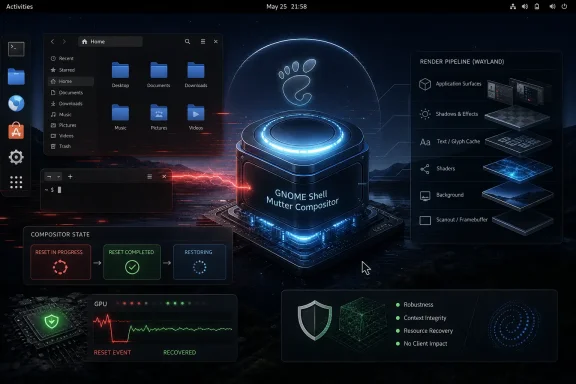
The design now being prototyped in Mutter treats recovery as a state machine. Mutter detects the reset, enters a reset-in-progress state, polls until the hardware appears to have completed the reset, and only then begins restoration. If the reset takes too long, the code eventually proceeds anyway rather than waiting forever. That is not just defensive programming; it is the difference between a compositor that can reason about failure and a compositor that is surprised by it.
The technical hook is OpenGL robustness infrastructure, including the GL_EXT_robustness family of behavior that allows software to detect graphics reset conditions. This is the unglamorous plumbing layer that lets a compositor move from “something exploded” to “the graphics context was lost, and here is the path back.” It gives Mutter a vocabulary for recovery, but not the whole recovery itself.
That distinction is important. Detecting that the floor collapsed does not rebuild the building. Mutter still has to tear down and recreate the right pieces of its graphics pipeline in the right order, without corrupting the rest of the session.
But the deeper story is what has to be rebuilt after the reset. A compositor’s world is full of GPU-backed assumptions: textures, glyph atlases, framebuffers, shader programs, render targets, and per-monitor stage views. Some of those can be recreated naturally as clients redraw their buffers. Others live inside the compositor and must be explicitly invalidated, destroyed, or uploaded again.
Ogundipe’s write-up calls out the glyph cache as one of the trickier pieces. Text rendering in GNOME involves cached Pango layouts and GPU-side glyph atlases. After a reset, those cached relationships may point toward resources that no longer exist. The fix is not simply to create a new renderer; stale layout metadata has to be cleared so text can be rendered cleanly against the new graphics state.
That is the part of compositor work users never see until it fails. A desktop background is “just wallpaper” until its texture survives in CPU-side intent but not GPU-side reality. A window title is “just text” until cached glyph data points into a dead context. Recovery is a tour of all the places where the desktop quietly trusted the GPU to remember things.
This also explains why the project is not done despite the impressive demo-stage progress. The current prototype still has known gaps. Framebuffer recreation is not yet automatic, meaning the display may remain dark until some other action triggers the allocation path. The desktop background can render incorrectly because background textures and related shader state still need a clean reset-aware recovery path. Residual OpenGL errors remain to be investigated.
In other words, Mutter has learned to get back on its feet, but it is still checking whether all its limbs are attached.
That design is cleaner in many ways, and GNOME has benefited from it. But it also means Mutter’s robustness is not merely a GNOME Shell quality-of-life issue. It is central to whether the Wayland session feels resilient under pressure.
This is especially relevant because the Linux graphics stack is being asked to do more than it used to. Modern desktops are juggling mixed refresh rates, VRR, HDR work, fractional scaling, multi-GPU routing, hardware overlays, increasingly complex monitor setups, and vendor-specific driver behavior. Most of the time, that complexity is hidden. When it fails, the compositor is where the bill comes due.
The GSoC work does not claim to solve every graphics hang or every driver bug. It cannot make broken hardware reliable, and it cannot guarantee that an application using the GPU will survive its own context loss. But it can prevent the desktop session from being collateral damage in cases where the hardware and driver recover enough for the compositor to resume.
That is the correct ambition. A resilient desktop is not one where nothing ever fails. It is one where failure is contained.
Linux has similar low-level reset concepts in driver land, but the end-user desktop behavior has not always matched that expectation. If the compositor cannot recover its context and rebuild the resources it owns, the kernel’s ability to reset the GPU does not translate into a saved session. The user experiences a failure at the layer they can see, not at the layer that logged the first error.
That gap is where Mutter’s work becomes strategically important. It is a bridge between driver recovery and desktop recovery. The driver may reset the hardware, Mesa or EGL may expose the lost-context condition, but Mutter must turn that into a restored interactive session.
This is also why the work sounds deceptively incremental. A new Cogl helper here, a reset signal there, a careful unrealize-and-realize sequence for stage actors, a timeout loop that avoids recreating contexts during reset. None of those details will make release-note headlines outside the GNOME world. Together, they are the difference between a recoverable graphical stack and a user staring at a dead session.
Linux desktop maturity increasingly lives in these seams. The big architectural arguments are not over, but the daily experience is now shaped by whether the system handles ugly edge cases gracefully.
During recovery, frame dispatch is aborted. Restoration is handled outside the normal frame loop, using GLib idle and timeout mechanisms rather than trying to rebuild everything during per-monitor rendering. That matters because doing recovery in the wrong part of the pipeline could multiply the problem across displays or recreate context state repeatedly.
This is a classic systems lesson: recovery code must be boring, serialized, and explicit. It cannot be a side effect of the next frame. It cannot assume that the monitor update path is the right place to resurrect the rendering backend. It needs a model of time, state, and failure.
Mutter’s emerging model has five broad states: normal operation, reset in progress, reset completed, restoring, and failed. The last state is just as important as the successful path. If restoration cannot complete, Mutter should fail gracefully with a useful error rather than hang indefinitely or collapse without explanation.
That is a more honest contract with users and administrators. Not every GPU reset can be recovered. But a system that knows when it cannot recover is still more diagnosable than one that disappears.
Ogundipe’s post notes a new Cogl display-destroy helper that allows Mutter to tear down the contents of a CoglDisplay without destroying the object itself. That distinction sounds like internal housekeeping, but it is exactly the kind of change needed when a mature codebase holds references across many subsystems. You cannot casually invalidate an object that half the compositor expects to remain alive. You need to reset its innards while preserving its identity.
This is where desktop engineering differs from demo engineering. A prototype renderer can rebuild everything from scratch. A production compositor must preserve the session, object graph, signal behavior, client relationships, and user-visible state. It has to be both destructive and conservative at the same time.
The same pattern appears in text rendering. The old renderer must still exist long enough for stale layout data to be cleared correctly. Destroy things in the wrong order and recovery creates new corruption. Restore things in the wrong place and the next frame may carry old assumptions into a new context.
This is why the project’s current state should be read as promising but not trivial. The hard part is not proving that a reset can be survived once. The hard part is making survival deterministic across hardware, drivers, monitors, Shell extensions, themes, backgrounds, and whatever else users bring to a modern GNOME session.
Framebuffer recreation is the most immediate user-visible problem. If Mutter has rebuilt stage views but nothing allocates a fresh framebuffer until a window action nudges the path, recovery exists but does not yet feel automatic. The user should not need to maximize a window with a keyboard shortcut to coax the desktop back into view.
The background rendering issue is similarly revealing. Client windows may recover naturally because applications redraw or resend buffers, but the shell’s own visual assets are Mutter’s responsibility. Background images and associated shaders have to be treated as GPU resources that die with the context and need explicit resurrection.
Residual OpenGL errors are the sort of detail that decides whether the work can be trusted. A compositor that appears to recover while quietly accumulating errors may be only one driver variation away from a crash. Upstream Mutter maintainers will rightly want the recovery path to be clean, repeatable, and explainable.
There is also a broader test matrix problem. GPU reset behavior varies across drivers and hardware. AMD, Intel, and NVIDIA paths do not behave identically, and open versus proprietary driver stacks can expose different failure modes. A recovery mechanism merged for Mutter has to be robust in the boring, distro-shipping sense, not merely compelling on a developer’s machine.
That is why the next phase is likely to be less glamorous than the current milestone. It will involve cleanup, review, test cases, edge conditions, and probably uncomfortable discoveries. But the project has crossed the threshold from “wouldn’t it be nice” to “here is the recovery architecture, and here are the remaining broken pieces.”
A GPU reset that destroys a session can mean lost work, interrupted meetings, broken remote access, or a support ticket that reads like folklore. The machine did not necessarily crash. The kernel may still be alive. SSH may still work. But the user’s desktop is gone, which is what matters to the person using it.
For organizations standardizing on GNOME-based distributions, compositor recovery reduces the blast radius of graphics instability. It does not remove the need for stable drivers, conservative kernel choices, or certified hardware. It does give administrators a better failure mode when something goes wrong.
The security-minded angle is also worth noting. Robustness is not only about convenience. Systems that recover cleanly from device faults are generally easier to observe and manage than systems that wedge unpredictably. A graceful compositor exit with a descriptive message is better than a hang; a recovered session is better still.
There is a deployment caveat, of course. This work is not yet an upstreamed, released feature that enterprise distributions can bank on. It is a GSoC project making real progress toward a merge request. The responsible reading is enthusiasm with patience.
That is how platform quality often improves. Not through a single grand feature, but through the removal of catastrophic edges. The suspend bug that no longer eats your session. The monitor hotplug that no longer scrambles your layout. The driver hiccup that no longer forces a reboot. The compositor that no longer treats a recoverable GPU reset as the end of the world.
GNOME has spent the Wayland era absorbing responsibilities that used to be distributed differently. That gives it power and risk. Mutter is the policy engine, compositor, display server, and visible face of the session. Its failure modes are GNOME’s failure modes.
GPU reset recovery is therefore not just a graphics feature. It is a statement about what the GNOME session intends to be: not merely modern when everything works, but resilient when something underneath it misbehaves.
 Mutter Is Learning the Trick Desktop Linux Has Long Needed
The Linux desktop has spent years improving the ordinary experience: fractional scaling, HDR plumbing, explicit sync, variable refresh rates, multi-monitor behavior, hybrid GPU handling, and the long march away from X11 assumptions. But reliability under failure has lagged behind reliability under normal operation. A desktop that works beautifully until the graphics stack trips over itself is still a desktop with a weak recovery story.That is why Ogundipe’s work matters. As Michael Larabel reported at Phoronix, the usual state of affairs under GNOME has been blunt: if the GPU resets under the session, GNOME cannot meaningfully recover, and the session is effectively wiped out. GPU resets are not supposed to be routine, and on stable hardware they usually are not. But “rare” is not the same as “irrelevant,” especially for gamers, developers, laptop users with hybrid graphics, workstation owners, and anyone running drivers or kernels close to the edge.
Mutter sits at a particularly unforgiving place in the stack. It is not merely another app with a lost OpenGL context. It is the compositor at the heart of GNOME Shell, the process responsible for presenting the desktop, coordinating windows, handling much of the visible session, and keeping input and rendering coherent. When Mutter loses its graphics footing, the user loses the floor.
The project’s thesis is simple enough to say and hard to implement: when the GPU resets, Mutter should notice, wait, rebuild its graphics state, and keep going. That is the kind of behavior users expect from mature platforms, not because they know the mechanics, but because they expect a screen flicker to be survivable. On Linux, that expectation has too often been optimistic.
A GPU Reset Is Not a Crash, but It Can Become One
A GPU reset is the system’s attempt to recover from a graphics engine that has stopped responding or entered a bad state. The kernel and driver may be able to reset the hardware, but applications using the GPU still have to deal with the consequences. If the compositor’s GPU context is gone and its textures, framebuffers, shader state, and caches are invalid, pretending nothing happened is not recovery. It is denial with a race condition.Ogundipe’s GNOME blog post describes the key mistake in naive recovery logic: detecting a reset and immediately rebuilding the rendering context is not safe. The hardware may still be mid-reset. Try to recreate the context too early and the compositor can simply trip into another failure.
The design now being prototyped in Mutter treats recovery as a state machine. Mutter detects the reset, enters a reset-in-progress state, polls until the hardware appears to have completed the reset, and only then begins restoration. If the reset takes too long, the code eventually proceeds anyway rather than waiting forever. That is not just defensive programming; it is the difference between a compositor that can reason about failure and a compositor that is surprised by it.
The technical hook is OpenGL robustness infrastructure, including the GL_EXT_robustness family of behavior that allows software to detect graphics reset conditions. This is the unglamorous plumbing layer that lets a compositor move from “something exploded” to “the graphics context was lost, and here is the path back.” It gives Mutter a vocabulary for recovery, but not the whole recovery itself.
That distinction is important. Detecting that the floor collapsed does not rebuild the building. Mutter still has to tear down and recreate the right pieces of its graphics pipeline in the right order, without corrupting the rest of the session.
The Real Work Is Rebuilding the Invisible Desktop
The first visible milestone is encouraging: according to Ogundipe’s progress update, Mutter can now survive a GPU reset with the session remaining stable. Windows update correctly. Input becomes responsive again. The session does not crash or freeze. That is the headline result, and it is a meaningful one.But the deeper story is what has to be rebuilt after the reset. A compositor’s world is full of GPU-backed assumptions: textures, glyph atlases, framebuffers, shader programs, render targets, and per-monitor stage views. Some of those can be recreated naturally as clients redraw their buffers. Others live inside the compositor and must be explicitly invalidated, destroyed, or uploaded again.
Ogundipe’s write-up calls out the glyph cache as one of the trickier pieces. Text rendering in GNOME involves cached Pango layouts and GPU-side glyph atlases. After a reset, those cached relationships may point toward resources that no longer exist. The fix is not simply to create a new renderer; stale layout metadata has to be cleared so text can be rendered cleanly against the new graphics state.
That is the part of compositor work users never see until it fails. A desktop background is “just wallpaper” until its texture survives in CPU-side intent but not GPU-side reality. A window title is “just text” until cached glyph data points into a dead context. Recovery is a tour of all the places where the desktop quietly trusted the GPU to remember things.
This also explains why the project is not done despite the impressive demo-stage progress. The current prototype still has known gaps. Framebuffer recreation is not yet automatic, meaning the display may remain dark until some other action triggers the allocation path. The desktop background can render incorrectly because background textures and related shader state still need a clean reset-aware recovery path. Residual OpenGL errors remain to be investigated.
In other words, Mutter has learned to get back on its feet, but it is still checking whether all its limbs are attached.
Wayland Raises the Stakes Because the Compositor Is the Session
On the old X11 desktop, the failure boundaries were messy but familiar. The X server, the window manager, the compositor, and desktop shell components often had more separable roles depending on the environment. Wayland tightened the architecture. The compositor is not optional decoration; it is the display server.That design is cleaner in many ways, and GNOME has benefited from it. But it also means Mutter’s robustness is not merely a GNOME Shell quality-of-life issue. It is central to whether the Wayland session feels resilient under pressure.
This is especially relevant because the Linux graphics stack is being asked to do more than it used to. Modern desktops are juggling mixed refresh rates, VRR, HDR work, fractional scaling, multi-GPU routing, hardware overlays, increasingly complex monitor setups, and vendor-specific driver behavior. Most of the time, that complexity is hidden. When it fails, the compositor is where the bill comes due.
The GSoC work does not claim to solve every graphics hang or every driver bug. It cannot make broken hardware reliable, and it cannot guarantee that an application using the GPU will survive its own context loss. But it can prevent the desktop session from being collateral damage in cases where the hardware and driver recover enough for the compositor to resume.
That is the correct ambition. A resilient desktop is not one where nothing ever fails. It is one where failure is contained.
This Is Also a Story About Linux Catching Up to User Expectations
Windows users have long known the screen blink that follows a display driver recovery. It is not pleasant, and it does not mean every accelerated application survives. But the operating system’s posture is clear: the desktop should generally come back. The user should not have to reboot just because the graphics driver stumbled.Linux has similar low-level reset concepts in driver land, but the end-user desktop behavior has not always matched that expectation. If the compositor cannot recover its context and rebuild the resources it owns, the kernel’s ability to reset the GPU does not translate into a saved session. The user experiences a failure at the layer they can see, not at the layer that logged the first error.
That gap is where Mutter’s work becomes strategically important. It is a bridge between driver recovery and desktop recovery. The driver may reset the hardware, Mesa or EGL may expose the lost-context condition, but Mutter must turn that into a restored interactive session.
This is also why the work sounds deceptively incremental. A new Cogl helper here, a reset signal there, a careful unrealize-and-realize sequence for stage actors, a timeout loop that avoids recreating contexts during reset. None of those details will make release-note headlines outside the GNOME world. Together, they are the difference between a recoverable graphical stack and a user staring at a dead session.
Linux desktop maturity increasingly lives in these seams. The big architectural arguments are not over, but the daily experience is now shaped by whether the system handles ugly edge cases gracefully.
The Recovery State Machine Is a Bet Against Panic
The most interesting part of Ogundipe’s design is not that Mutter retries. It is that Mutter waits. A GPU reset is not instantaneous, and recovery code that behaves as though it is will fail in ways that look random. The prototype’s state machine acknowledges that the compositor must step out of normal rendering logic and into a different mode entirely.During recovery, frame dispatch is aborted. Restoration is handled outside the normal frame loop, using GLib idle and timeout mechanisms rather than trying to rebuild everything during per-monitor rendering. That matters because doing recovery in the wrong part of the pipeline could multiply the problem across displays or recreate context state repeatedly.
This is a classic systems lesson: recovery code must be boring, serialized, and explicit. It cannot be a side effect of the next frame. It cannot assume that the monitor update path is the right place to resurrect the rendering backend. It needs a model of time, state, and failure.
Mutter’s emerging model has five broad states: normal operation, reset in progress, reset completed, restoring, and failed. The last state is just as important as the successful path. If restoration cannot complete, Mutter should fail gracefully with a useful error rather than hang indefinitely or collapse without explanation.
That is a more honest contract with users and administrators. Not every GPU reset can be recovered. But a system that knows when it cannot recover is still more diagnosable than one that disappears.
GNOME’s Abstraction Layers Are Both the Problem and the Solution
Mutter’s rendering stack sits on layers with long histories: Clutter, Cogl, EGL, OpenGL, Mesa or proprietary driver implementations, and the kernel graphics subsystem beneath them. Those layers can make recovery harder because state is spread across abstractions that were not necessarily designed around losing the GPU underneath a live desktop. They also make recovery possible because the compositor can centralize teardown and reconstruction if the abstractions expose the right hooks.Ogundipe’s post notes a new Cogl display-destroy helper that allows Mutter to tear down the contents of a CoglDisplay without destroying the object itself. That distinction sounds like internal housekeeping, but it is exactly the kind of change needed when a mature codebase holds references across many subsystems. You cannot casually invalidate an object that half the compositor expects to remain alive. You need to reset its innards while preserving its identity.
This is where desktop engineering differs from demo engineering. A prototype renderer can rebuild everything from scratch. A production compositor must preserve the session, object graph, signal behavior, client relationships, and user-visible state. It has to be both destructive and conservative at the same time.
The same pattern appears in text rendering. The old renderer must still exist long enough for stale layout data to be cleared correctly. Destroy things in the wrong order and recovery creates new corruption. Restore things in the wrong place and the next frame may carry old assumptions into a new context.
This is why the project’s current state should be read as promising but not trivial. The hard part is not proving that a reset can be survived once. The hard part is making survival deterministic across hardware, drivers, monitors, Shell extensions, themes, backgrounds, and whatever else users bring to a modern GNOME session.
The Bugs Left Behind Are the Map to Upstream Readiness
The known gaps are not embarrassing; they are useful. Automatic framebuffer recreation, background texture recovery, shader reinitialization, residual GL errors, and deterministic signal ordering are exactly the categories one would expect to surface once the first successful recovery path exists. Before that milestone, everything is just “the session died.” After it, the bugs become specific.Framebuffer recreation is the most immediate user-visible problem. If Mutter has rebuilt stage views but nothing allocates a fresh framebuffer until a window action nudges the path, recovery exists but does not yet feel automatic. The user should not need to maximize a window with a keyboard shortcut to coax the desktop back into view.
The background rendering issue is similarly revealing. Client windows may recover naturally because applications redraw or resend buffers, but the shell’s own visual assets are Mutter’s responsibility. Background images and associated shaders have to be treated as GPU resources that die with the context and need explicit resurrection.
Residual OpenGL errors are the sort of detail that decides whether the work can be trusted. A compositor that appears to recover while quietly accumulating errors may be only one driver variation away from a crash. Upstream Mutter maintainers will rightly want the recovery path to be clean, repeatable, and explainable.
There is also a broader test matrix problem. GPU reset behavior varies across drivers and hardware. AMD, Intel, and NVIDIA paths do not behave identically, and open versus proprietary driver stacks can expose different failure modes. A recovery mechanism merged for Mutter has to be robust in the boring, distro-shipping sense, not merely compelling on a developer’s machine.
That is why the next phase is likely to be less glamorous than the current milestone. It will involve cleanup, review, test cases, edge conditions, and probably uncomfortable discoveries. But the project has crossed the threshold from “wouldn’t it be nice” to “here is the recovery architecture, and here are the remaining broken pieces.”
Enterprise Linux Should Care Even If GPU Resets Are Rare
At first glance, this sounds like a desktop enthusiast story. It has GNOME, Wayland, OpenGL extensions, and compositor internals. But sysadmins should pay attention because graphical session reliability matters wherever Linux desktops are used seriously: developer workstations, design stations, lab systems, kiosks, remote desktops, and specialized enterprise clients.A GPU reset that destroys a session can mean lost work, interrupted meetings, broken remote access, or a support ticket that reads like folklore. The machine did not necessarily crash. The kernel may still be alive. SSH may still work. But the user’s desktop is gone, which is what matters to the person using it.
For organizations standardizing on GNOME-based distributions, compositor recovery reduces the blast radius of graphics instability. It does not remove the need for stable drivers, conservative kernel choices, or certified hardware. It does give administrators a better failure mode when something goes wrong.
The security-minded angle is also worth noting. Robustness is not only about convenience. Systems that recover cleanly from device faults are generally easier to observe and manage than systems that wedge unpredictably. A graceful compositor exit with a descriptive message is better than a hang; a recovered session is better still.
There is a deployment caveat, of course. This work is not yet an upstreamed, released feature that enterprise distributions can bank on. It is a GSoC project making real progress toward a merge request. The responsible reading is enthusiasm with patience.
The Linux Desktop Is Being Civilized One Failure Mode at a Time
There is a temptation in open-source desktop coverage to treat every internal fix as either revolutionary or irrelevant. This one is neither. GPU reset recovery in Mutter is not going to sell Linux to the masses by itself, and most users will never know whether it exists. But the users who need it will know instantly.That is how platform quality often improves. Not through a single grand feature, but through the removal of catastrophic edges. The suspend bug that no longer eats your session. The monitor hotplug that no longer scrambles your layout. The driver hiccup that no longer forces a reboot. The compositor that no longer treats a recoverable GPU reset as the end of the world.
GNOME has spent the Wayland era absorbing responsibilities that used to be distributed differently. That gives it power and risk. Mutter is the policy engine, compositor, display server, and visible face of the session. Its failure modes are GNOME’s failure modes.
GPU reset recovery is therefore not just a graphics feature. It is a statement about what the GNOME session intends to be: not merely modern when everything works, but resilient when something underneath it misbehaves.
The Practical Read on Mutter’s Reset Recovery
The current state of the work is best understood as a credible recovery path rather than a finished user feature. The prototype has reached the point where the session can remain alive and interactive after a reset, but several visible and internal pieces still need to be made automatic and clean before upstream integration is realistic.- Mutter can now experimentally survive a GPU reset without immediately crashing or freezing the GNOME session.
- The recovery design uses OpenGL robustness infrastructure to detect reset conditions and a state machine to avoid rebuilding the graphics context too early.
- Window contents and input responsiveness are already recovering in the prototype, which is the major proof point for the approach.
- Framebuffer recreation, desktop background textures, shader state, and residual OpenGL errors remain unresolved areas before the work is ready for broad users.
- The work matters most because Wayland makes the compositor central to the session, so compositor recovery is desktop recovery.
- Even if GPU resets remain uncommon, turning them from session-ending events into recoverable faults would be a meaningful reliability gain for GNOME users and administrators.
References
- Primary source: Phoronix
Published: 2026-07-04T00:48:11.607366
GNOME Mutter GPU Reset Recovery Becoming A Reality - Phoronix
While typically quite rare encountering a GPU reset under Linux in most conditions, currently if encountering one under GNOME your session gets wiped outwww.phoronix.com
- Related coverage: blogs.gnome.org
GPU Reset Recovery in Mutter: A Progress Update – Toluwaleke's Blog
Five weeks into GSoC 2026, here's where things stand in implementing GPU reset recovery in Mutter. When a reset invalidates the GPU context and memory, Mutter currently has no way to recover: the desktop just freezes or crashes. This post walks through the recovery cycle, restoring the...blogs.gnome.org - Related coverage: gsoc.gnome.org
GNOME + GSoC | 2026 Project Ideas
Project ideas for Google Summer of Code 2026 with GNOMEgsoc.gnome.org - Related coverage: planet.gnome.org
- Related coverage: discourse.gnome.org
GNOME Shell 50.1 crashes in meta_window_x11_update_shape_region() after closing PPSSPP (XWayland / AMD / Fedora 44) - Desktop - GNOME Discourse
GNOME Shell crashes on Fedora 44 during normal desktop use on a Wayland session with XWayland active. The crash happened shortly after closing PPSSPP. Crash Process gnome-shell crashed in meta_window_x11_update_shape_… discourse.gnome.org
- Related coverage: archive.fosdem.org
- Related coverage: lpc.events
- Related coverage: events.gnome.org
