
Satya Nadella used a June 2026 Wall Street Journal interview to warn that artificial intelligence development concentrated inside a handful of dominant model companies risks losing public legitimacy, especially if those firms predict mass white-collar disruption while demanding vast energy, capital, and data-center resources. The Microsoft CEO’s message was aimed at the industry as much as at regulators: AI cannot become another platform economy where everyone else supplies the raw material and a few firms capture the compound returns. It was also a strategic signal from a company trying to turn its own dependence on OpenAI into a broader, more defensible AI platform play. The warning matters because Microsoft is not standing outside the boom; it is one of the companies most responsible for making it unavoidable.
Nadella’s critique lands because it comes from a company that knows exactly what platform power looks like. Microsoft has spent half a century building, defending, and occasionally apologizing for ecosystems that became default infrastructure. When its CEO says society will not tolerate a future in which “a few models” absorb the economic value of entire industries, the line is not academic.
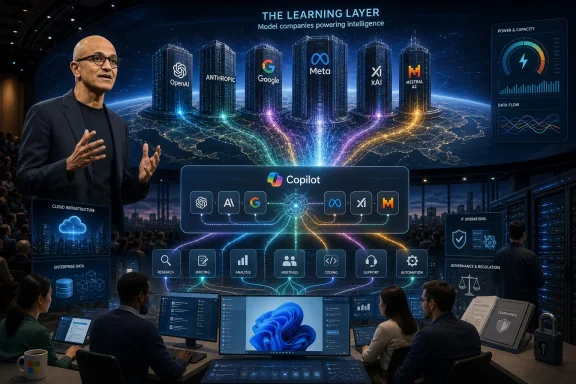
The immediate target is the current frontier-model race. OpenAI, Google, Anthropic, Meta, xAI, and a small cluster of state-backed or heavily capitalized challengers are competing to build models that require extraordinary compute, scarce power, proprietary data pipelines, elite research labor, and privileged distribution. The result is not just a product market. It is a contest over who owns the learning layer of the economy.
That phrase matters. The company that controls the model does not merely sell software. It watches prompts, workflows, failures, corrections, domain patterns, and user habits. Even when enterprise privacy commitments are real, the direction of travel is obvious: the more work that flows through a model, the more the model provider understands how work is done.
Nadella’s objection is that this kind of concentration will not be politically stable. If AI firms present themselves as inevitable replacements for large parts of the workforce, while simultaneously asking for cheap power, favorable regulation, enormous capital expenditure, and permission to ingest the world’s working knowledge, they invite backlash. The more grandiose the claims, the harder it becomes to argue that the industry is merely selling productivity software.
That history does not make Nadella wrong. It does make the argument more interesting. Microsoft appears to have learned that anchoring its AI future too tightly to one model company creates its own strategic ceiling. If OpenAI wins too completely, Microsoft risks becoming the distribution layer for someone else’s intelligence. If OpenAI stumbles, Microsoft inherits platform expectations without full control over the core technology.
The answer, from Redmond’s perspective, is not to abandon OpenAI. It is to make OpenAI one engine among several. That is why the company has been emphasizing small language models, cheaper inference, Azure AI model catalogs, enterprise governance, and Copilot as a configurable platform rather than a single-model wrapper.
This is classic Microsoft. When it cannot own every layer, it tries to own the layer that makes every other layer manageable. Windows did that for PC hardware. Office did it for business documents. Azure does it for cloud workloads. Copilot, in Microsoft’s preferred future, does it for AI models.
In the old enterprise software model, a company bought tools, trained workers, refined processes, and accumulated institutional knowledge internally. Vendors captured license revenue, but the customer retained much of the operational advantage. A law firm, hospital, bank, manufacturer, or government agency might run Microsoft software, but Microsoft did not automatically absorb the professional judgment embedded in every workflow.
Generative AI complicates that boundary. When employees use a model to draft contracts, summarize tickets, generate code, analyze claims, or write policy, the model becomes part of the working process. Even if no customer data is used for training, the provider still shapes the interface through which labor is performed. The model decides what is easy, what is suggested, what is automated, and what becomes invisible.
That is why the concentration question is sharper than ordinary market-share anxiety. A handful of AI vendors could become the default intermediaries for professional cognition. In that world, every company still has employees, documents, and business systems, but the highest-leverage abstraction sits outside the company.
Nadella’s phrase about society not tolerating a few models “eating” everything is blunt because the metaphor fits. The anxiety is not just that AI will take jobs. It is that AI providers will absorb the value created by training, experience, process design, and proprietary know-how across thousands of industries, then sell it back as a subscription.
That matters because the public bargain around computing infrastructure is changing. Cloud data centers were sold as efficiency engines: centralized, optimized, and economically useful. AI data centers are often presented as civilization-scale necessities before the public has seen civilization-scale benefits. The gap between promise and proof is widening.
Nadella’s criticism of companies that warn about mass job loss while demanding enormous power is aimed directly at that legitimacy problem. If the industry says AI may eliminate white-collar work, become a strategic weapon, and require unprecedented energy consumption, it cannot also expect automatic public consent. At some point, governors, grid operators, regulators, and voters will ask what they are getting in return.
Microsoft is vulnerable here too. Azure is a major beneficiary of AI infrastructure demand, and Microsoft’s own data-center expansion has become central to its capital plan. But the company has a better political story if it can argue that AI will be distributed across businesses rather than centralized inside a few model labs. A multi-model enterprise platform sounds less extractive than a frontier model that eats the world.
The second phase is more complicated. Copilot cannot succeed merely by being present. Users compare it against ChatGPT, Gemini, Claude, and specialized tools. Developers compare code quality. Analysts compare reasoning and spreadsheet fluency. Employees compare latency, tone, memory, accuracy, and price, even when they do not know which model is producing the answer.
That creates a platform problem. If Copilot is visibly worse than the best standalone model, users route around it. If it is too expensive, enterprises ration it. If it is too locked to one provider, Microsoft inherits every weakness of that provider’s release cycle.
A multi-engine Copilot is Microsoft’s answer. Instead of betting that one model will win every task, Microsoft can route different jobs to different systems. A cheaper model can summarize routine emails. A stronger model can handle complex reasoning. A domain-tuned model can sit behind a regulated workflow. A local or tenant-controlled model can process sensitive data.
This is not ideological pluralism. It is margin management, customer retention, and platform control dressed as openness. But that does not make it trivial. For enterprise IT, the ability to choose, govern, audit, and swap models may matter more than which company tops a benchmark leaderboard in June 2026.
For Microsoft, a low-cost model provider is useful leverage. It pressures OpenAI and Anthropic on price. It gives Azure customers more options. It supports the argument that Copilot is an orchestration layer, not a captive interface for one model family.
But DeepSeek also carries legal, geopolitical, and trust complications. OpenAI and Anthropic have alleged or raised concerns that DeepSeek may have replicated proprietary techniques or outputs. Those claims are contested, and the boundary between legitimate distillation, competitive learning, benchmark imitation, and intellectual-property abuse remains one of the murkiest areas in AI policy.
There is also the China factor. Enterprise and government customers will not treat a Chinese AI model as a purely technical option, especially in regulated sectors. Even if Microsoft can host, isolate, filter, or govern such a model inside its own infrastructure, procurement teams will ask who built it, what training data shaped it, what risks it introduces, and how quickly it can be removed.
That is why DeepSeek is not just another model in a catalog. It is the stress test for Microsoft’s claim that the platform can be neutral while still being trusted. Neutrality is attractive until the model choice becomes a board-level risk decision.
That arrangement was always unstable. OpenAI wants direct customer relationships, consumer loyalty, developer mindshare, infrastructure independence, and strategic freedom. Microsoft wants enterprise integration, predictable economics, safety controls, and enough model optionality to avoid being trapped by its own partner.
The more valuable AI becomes, the more both sides need the same things. Both want the developer. Both want the enterprise buyer. Both want the default assistant. Both want to define what AI work looks like. The partnership can remain intact and still become more competitive at the edges.
Nadella’s anti-monopoly warning should be read in that context. It is not simply a rebuke of Google or Anthropic. It is also a message to OpenAI that Microsoft will not let its AI future be reduced to one dependency. The company wants OpenAI’s best models, but it also wants the right to compare, substitute, route, and bargain.
That is exactly what large enterprise customers want too. No CIO wants to explain that their AI roadmap depends on a single model vendor’s pricing, outages, governance choices, or product politics. Microsoft is turning its own strategic need into a customer-facing principle.
For Microsoft, Google is dangerous because it can fight on multiple fronts. It can put AI into Workspace, Android, Search, Chrome, Cloud, YouTube, and developer tools. It can subsidize features through advertising economics. It can build custom infrastructure at enormous scale. It can make AI feel ambient to billions of users.
That explains why Copilot cannot simply be “Microsoft’s ChatGPT.” It has to become the AI control plane for organizations that already live in Microsoft 365, Windows, Entra, Defender, Purview, Dynamics, Power Platform, and Azure. Microsoft’s advantage is not that it can always build the best model. It is that it already sits inside the permission structure of enterprise work.
The risk is that users do not care about permission structures when a rival product is visibly better. If employees prefer Gemini, Claude, or ChatGPT for real work, IT departments face the familiar shadow-IT problem in a more dangerous form. Sensitive documents, code, customer data, and internal decisions begin leaking into unsanctioned workflows.
That is where Microsoft’s governance pitch becomes practical. The company can tell customers: give users model choice inside the sanctioned environment, or watch them create model choice outside it. Copilot’s success may depend less on forcing loyalty than on preventing defection.
That contradiction is not unique to Anthropic, but Anthropic embodies it unusually well. A company can sincerely worry about catastrophic or labor-market risks while still racing to deploy more capable systems. It can urge caution while raising billions. It can argue for responsible scaling while selling access to the thing being scaled.
Nadella’s critique cuts through the moral branding. If frontier labs warn that their tools may reshape employment and power, they cannot be surprised when society asks who gave them the mandate. Safety frameworks are not the same as democratic legitimacy. Model cards and policy papers do not answer the economic question of who gets paid when AI automates knowledge work.
Microsoft’s multi-model strategy lets it benefit from Anthropic without fully adopting Anthropic’s worldview. If Claude is the best engine for a task, Microsoft can expose it. If another model is cheaper or better governed for a customer’s needs, Microsoft can route elsewhere. The platform absorbs the safety brand without becoming subordinate to it.
That is a powerful position, if Microsoft can sustain it. It lets the company present itself as the responsible intermediary between enterprises and a volatile model market. But intermediaries are never neutral in practice. The routing decisions, defaults, price bundles, admin controls, and contractual terms become the real policy.
Enterprise work is full of tasks that do not require frontier intelligence. Classifying tickets, summarizing meetings, extracting fields from documents, drafting routine replies, checking policy compliance, generating simple code scaffolds, and searching internal knowledge bases often need reliability, context, and integration more than raw benchmark dominance. Paying premium inference rates for every low-stakes workflow is economically irrational.
This is where Microsoft’s incentives align with customers. The company wants Copilot usage to expand without costs exploding. Customers want AI assistance without turning every employee action into a metered luxury. Smaller models make both goals more plausible.
They also support data control. A smaller model can be fine-tuned, hosted, isolated, or deployed closer to the customer’s environment. It may be easier to audit. It may be good enough for a department-specific workflow. It may reduce the need to send sensitive prompts to a frontier provider.
That does not mean frontier models fade away. The most capable systems will still matter for complex reasoning, agentic workflows, scientific research, advanced coding, and tasks that require broad synthesis. But the enterprise AI market is unlikely to be one model to rule them all. It will look more like a messy routing problem, and Microsoft wants to sell the router.
Consumer users will mostly experience model competition indirectly. They will notice whether Copilot is fast, useful, intrusive, expensive, or easy to disable. They may not know whether a response came from OpenAI, Microsoft’s own model, a smaller task model, or another provider. They will know whether the feature helps or gets in the way.
Administrators will see the harder version of the problem. They will need to decide which AI services are permitted, which data can be used, which logs are retained, which models are approved, which regions apply, and which users receive premium access. The old software-deployment question — “Who gets the app?” — becomes “Which model is allowed to reason over which business process?”
That is a profound change for Windows and Microsoft 365 environments. AI is not just another endpoint feature. It is a new layer of policy, identity, data governance, compliance, and cost control. A multi-model Copilot may reduce vendor lock-in, but it also increases administrative complexity.
Microsoft’s best argument is that this complexity is coming anyway. If organizations do not manage AI through sanctioned platforms, employees will manage it themselves through consumer accounts and browser tabs. The question is not whether model choice exists. It is whether IT can see it.
By arguing for a broader AI ecosystem, Microsoft positions itself against the most obvious monopoly narrative: a single frontier lab or search giant controlling the future of work. But Microsoft itself remains a dominant operating-system, productivity, identity, security, developer, and cloud vendor. If Copilot becomes the enterprise interface through which multiple models reach users, regulators may ask whether Microsoft has merely relocated the bottleneck.
That is the paradox. A neutral aggregator can reduce dependence on any one model provider while increasing dependence on the aggregator. If Microsoft controls the marketplace, admin console, billing relationship, data graph, compliance layer, and user interface, it can claim openness while shaping outcomes.
The company knows this history. Windows was open to hardware partners and software developers, yet still became the center of antitrust scrutiny. Azure is open to workloads, yet cloud concentration remains a policy concern. Copilot may be open to models, yet still become the gatekeeper for AI at work.
Nadella’s argument therefore doubles as a preemptive defense. Microsoft can tell regulators it is enabling competition among models, lowering costs, and giving customers choice. Regulators may respond that choice inside Microsoft’s walls is still Microsoft’s walls.
If AI lets one employee do the work of three, companies may hire fewer people. If AI makes junior work easier to automate, career ladders may weaken. If AI captures routine tasks, human workers may be pushed toward supervision, exception handling, relationship management, and judgment-heavy work. None of that maps neatly onto a headline about jobs disappearing.
For IT departments, the practical consequences are immediate. AI adoption changes access rights, training needs, performance metrics, procurement, security reviews, and incident response. It also changes internal politics. Workers may resist tools they perceive as surveillance or replacement mechanisms, even when management frames them as productivity aids.
Nadella’s insistence on human-AI hybrid systems is therefore more than benevolent rhetoric. It is a deployment strategy. Enterprises are more likely to adopt AI deeply if the tools are presented as augmenting teams, preserving proprietary knowledge, and improving outcomes rather than stripping labor out of the business.
But rhetoric will not be enough. If the economic gains flow mostly to shareholders and vendors while employees experience monitoring, deskilling, and layoffs, the social permission Nadella invokes will erode quickly. The industry cannot talk its way out of the labor question. It has to show its accounting.
That is why the next phase of AI competition will be less visible than the chatbot wars. The public benchmarks will continue, but the decisive battles may happen inside procurement contracts, admin dashboards, service-level agreements, and routing systems. A model that wins the default slot inside a major enterprise platform may matter more than a model that wins a public leaderboard.
Microsoft is well suited to that kind of competition. The company understands enterprise friction. It knows how to turn complexity into subscription tiers. It knows how to make governance a selling point. It knows how to make a feature feel inevitable by placing it inside tools people already use.
The danger for customers is complacency. Multi-model does not automatically mean competitive. A marketplace can become curated dependency. A routing layer can obscure cost and performance trade-offs. A governance console can make some choices easy and others functionally invisible.
That is why IT leaders should treat Microsoft’s AI pivot as an opportunity, not a favor. If Copilot becomes more open, customers should demand portability, auditability, transparent pricing, model-level controls, and meaningful exit options. Choice that cannot be operationalized is marketing.
 Nadella Turns the Monopoly Argument Back on the AI Industry
Nadella’s critique lands because it comes from a company that knows exactly what platform power looks like. Microsoft has spent half a century building, defending, and occasionally apologizing for ecosystems that became default infrastructure. When its CEO says society will not tolerate a future in which “a few models” absorb the economic value of entire industries, the line is not academic.The immediate target is the current frontier-model race. OpenAI, Google, Anthropic, Meta, xAI, and a small cluster of state-backed or heavily capitalized challengers are competing to build models that require extraordinary compute, scarce power, proprietary data pipelines, elite research labor, and privileged distribution. The result is not just a product market. It is a contest over who owns the learning layer of the economy.
That phrase matters. The company that controls the model does not merely sell software. It watches prompts, workflows, failures, corrections, domain patterns, and user habits. Even when enterprise privacy commitments are real, the direction of travel is obvious: the more work that flows through a model, the more the model provider understands how work is done.
Nadella’s objection is that this kind of concentration will not be politically stable. If AI firms present themselves as inevitable replacements for large parts of the workforce, while simultaneously asking for cheap power, favorable regulation, enormous capital expenditure, and permission to ingest the world’s working knowledge, they invite backlash. The more grandiose the claims, the harder it becomes to argue that the industry is merely selling productivity software.
Microsoft Is Preaching Openness After Buying Its Way Into the Frontier
There is an unavoidable irony in Microsoft’s new anti-concentration language. This is the company that invested billions into OpenAI, integrated ChatGPT-style capabilities into Bing, Edge, Windows, GitHub, Office, Teams, Azure, and Copilot, and helped make generative AI a boardroom priority almost overnight. Microsoft did not merely observe the frontier-model race. It helped finance the starting gun.That history does not make Nadella wrong. It does make the argument more interesting. Microsoft appears to have learned that anchoring its AI future too tightly to one model company creates its own strategic ceiling. If OpenAI wins too completely, Microsoft risks becoming the distribution layer for someone else’s intelligence. If OpenAI stumbles, Microsoft inherits platform expectations without full control over the core technology.
The answer, from Redmond’s perspective, is not to abandon OpenAI. It is to make OpenAI one engine among several. That is why the company has been emphasizing small language models, cheaper inference, Azure AI model catalogs, enterprise governance, and Copilot as a configurable platform rather than a single-model wrapper.
This is classic Microsoft. When it cannot own every layer, it tries to own the layer that makes every other layer manageable. Windows did that for PC hardware. Office did it for business documents. Azure does it for cloud workloads. Copilot, in Microsoft’s preferred future, does it for AI models.
The Real Fight Is Over Who Captures the Learning
The most revealing part of Nadella’s argument is not the moral language. It is the economic premise beneath it. AI threatens to change who benefits from organizational learning.In the old enterprise software model, a company bought tools, trained workers, refined processes, and accumulated institutional knowledge internally. Vendors captured license revenue, but the customer retained much of the operational advantage. A law firm, hospital, bank, manufacturer, or government agency might run Microsoft software, but Microsoft did not automatically absorb the professional judgment embedded in every workflow.
Generative AI complicates that boundary. When employees use a model to draft contracts, summarize tickets, generate code, analyze claims, or write policy, the model becomes part of the working process. Even if no customer data is used for training, the provider still shapes the interface through which labor is performed. The model decides what is easy, what is suggested, what is automated, and what becomes invisible.
That is why the concentration question is sharper than ordinary market-share anxiety. A handful of AI vendors could become the default intermediaries for professional cognition. In that world, every company still has employees, documents, and business systems, but the highest-leverage abstraction sits outside the company.
Nadella’s phrase about society not tolerating a few models “eating” everything is blunt because the metaphor fits. The anxiety is not just that AI will take jobs. It is that AI providers will absorb the value created by training, experience, process design, and proprietary know-how across thousands of industries, then sell it back as a subscription.
The Data-Center Bargain Is Becoming Politically Expensive
The industry’s power demands make the argument harder to dodge. AI companies are asking utilities, municipalities, investors, and governments to support an infrastructure buildout measured in gigawatts, not server racks. Data centers are no longer invisible industrial buildings on the edge of town. They are becoming local political actors.That matters because the public bargain around computing infrastructure is changing. Cloud data centers were sold as efficiency engines: centralized, optimized, and economically useful. AI data centers are often presented as civilization-scale necessities before the public has seen civilization-scale benefits. The gap between promise and proof is widening.
Nadella’s criticism of companies that warn about mass job loss while demanding enormous power is aimed directly at that legitimacy problem. If the industry says AI may eliminate white-collar work, become a strategic weapon, and require unprecedented energy consumption, it cannot also expect automatic public consent. At some point, governors, grid operators, regulators, and voters will ask what they are getting in return.
Microsoft is vulnerable here too. Azure is a major beneficiary of AI infrastructure demand, and Microsoft’s own data-center expansion has become central to its capital plan. But the company has a better political story if it can argue that AI will be distributed across businesses rather than centralized inside a few model labs. A multi-model enterprise platform sounds less extractive than a frontier model that eats the world.
Copilot Becomes Microsoft’s Escape Hatch
Copilot began as Microsoft’s attempt to make generative AI feel native to work. It was embedded into the apps people already used: Word, Excel, Outlook, Teams, GitHub, Windows, and the broader Microsoft 365 estate. The early pitch was simple: bring AI to the workflow, not the other way around.The second phase is more complicated. Copilot cannot succeed merely by being present. Users compare it against ChatGPT, Gemini, Claude, and specialized tools. Developers compare code quality. Analysts compare reasoning and spreadsheet fluency. Employees compare latency, tone, memory, accuracy, and price, even when they do not know which model is producing the answer.
That creates a platform problem. If Copilot is visibly worse than the best standalone model, users route around it. If it is too expensive, enterprises ration it. If it is too locked to one provider, Microsoft inherits every weakness of that provider’s release cycle.
A multi-engine Copilot is Microsoft’s answer. Instead of betting that one model will win every task, Microsoft can route different jobs to different systems. A cheaper model can summarize routine emails. A stronger model can handle complex reasoning. A domain-tuned model can sit behind a regulated workflow. A local or tenant-controlled model can process sensitive data.
This is not ideological pluralism. It is margin management, customer retention, and platform control dressed as openness. But that does not make it trivial. For enterprise IT, the ability to choose, govern, audit, and swap models may matter more than which company tops a benchmark leaderboard in June 2026.
DeepSeek Is the Test Case Microsoft Cannot Discuss Casually
The reported possibility of DeepSeek entering the Copilot mix is where Microsoft’s strategy becomes both more compelling and more dangerous. DeepSeek became a symbol of model commoditization because it showed that capable AI systems could be delivered at far lower apparent cost than the leading Western frontier labs had conditioned the market to expect. Whether every cost comparison was apples-to-apples mattered less than the market reaction: suddenly, “bigger and more expensive” was not the only credible AI story.For Microsoft, a low-cost model provider is useful leverage. It pressures OpenAI and Anthropic on price. It gives Azure customers more options. It supports the argument that Copilot is an orchestration layer, not a captive interface for one model family.
But DeepSeek also carries legal, geopolitical, and trust complications. OpenAI and Anthropic have alleged or raised concerns that DeepSeek may have replicated proprietary techniques or outputs. Those claims are contested, and the boundary between legitimate distillation, competitive learning, benchmark imitation, and intellectual-property abuse remains one of the murkiest areas in AI policy.
There is also the China factor. Enterprise and government customers will not treat a Chinese AI model as a purely technical option, especially in regulated sectors. Even if Microsoft can host, isolate, filter, or govern such a model inside its own infrastructure, procurement teams will ask who built it, what training data shaped it, what risks it introduces, and how quickly it can be removed.
That is why DeepSeek is not just another model in a catalog. It is the stress test for Microsoft’s claim that the platform can be neutral while still being trusted. Neutrality is attractive until the model choice becomes a board-level risk decision.
OpenAI Is Still Partner and Problem
Microsoft’s relationship with OpenAI remains one of the most important technology partnerships of the decade. It gave Microsoft a generative AI lead when Google appeared cautious, allowed Azure to become the infrastructure home for a historic workload, and turned Copilot from a branding exercise into a serious product strategy. For a while, the alliance looked like the cleanest answer in enterprise AI: OpenAI builds the intelligence, Microsoft distributes it to the world of work.That arrangement was always unstable. OpenAI wants direct customer relationships, consumer loyalty, developer mindshare, infrastructure independence, and strategic freedom. Microsoft wants enterprise integration, predictable economics, safety controls, and enough model optionality to avoid being trapped by its own partner.
The more valuable AI becomes, the more both sides need the same things. Both want the developer. Both want the enterprise buyer. Both want the default assistant. Both want to define what AI work looks like. The partnership can remain intact and still become more competitive at the edges.
Nadella’s anti-monopoly warning should be read in that context. It is not simply a rebuke of Google or Anthropic. It is also a message to OpenAI that Microsoft will not let its AI future be reduced to one dependency. The company wants OpenAI’s best models, but it also wants the right to compare, substitute, route, and bargain.
That is exactly what large enterprise customers want too. No CIO wants to explain that their AI roadmap depends on a single model vendor’s pricing, outages, governance choices, or product politics. Microsoft is turning its own strategic need into a customer-facing principle.
Google Is the Rival Microsoft Cannot Ignore
Google’s role in this fight is different from OpenAI’s. It has the research history, the chips, the cloud, the consumer distribution, the Android footprint, the productivity suite, and the search economics that AI threatens and reinforces at the same time. Gemini is not just another model family. It is Google’s attempt to rebuild its platform gravity around AI before someone else does.For Microsoft, Google is dangerous because it can fight on multiple fronts. It can put AI into Workspace, Android, Search, Chrome, Cloud, YouTube, and developer tools. It can subsidize features through advertising economics. It can build custom infrastructure at enormous scale. It can make AI feel ambient to billions of users.
That explains why Copilot cannot simply be “Microsoft’s ChatGPT.” It has to become the AI control plane for organizations that already live in Microsoft 365, Windows, Entra, Defender, Purview, Dynamics, Power Platform, and Azure. Microsoft’s advantage is not that it can always build the best model. It is that it already sits inside the permission structure of enterprise work.
The risk is that users do not care about permission structures when a rival product is visibly better. If employees prefer Gemini, Claude, or ChatGPT for real work, IT departments face the familiar shadow-IT problem in a more dangerous form. Sensitive documents, code, customer data, and internal decisions begin leaking into unsanctioned workflows.
That is where Microsoft’s governance pitch becomes practical. The company can tell customers: give users model choice inside the sanctioned environment, or watch them create model choice outside it. Copilot’s success may depend less on forcing loyalty than on preventing defection.
Anthropic Makes the Safety Argument Commercial
Anthropic complicates the monopoly story because it has spent years presenting itself as the safety-conscious alternative to OpenAI. Its Claude models have gained traction with developers, writers, enterprises, and users who value long-context reasoning and a more cautious assistant style. The company’s public warnings about AI risk also make it a natural participant in the contradiction Nadella is criticizing.That contradiction is not unique to Anthropic, but Anthropic embodies it unusually well. A company can sincerely worry about catastrophic or labor-market risks while still racing to deploy more capable systems. It can urge caution while raising billions. It can argue for responsible scaling while selling access to the thing being scaled.
Nadella’s critique cuts through the moral branding. If frontier labs warn that their tools may reshape employment and power, they cannot be surprised when society asks who gave them the mandate. Safety frameworks are not the same as democratic legitimacy. Model cards and policy papers do not answer the economic question of who gets paid when AI automates knowledge work.
Microsoft’s multi-model strategy lets it benefit from Anthropic without fully adopting Anthropic’s worldview. If Claude is the best engine for a task, Microsoft can expose it. If another model is cheaper or better governed for a customer’s needs, Microsoft can route elsewhere. The platform absorbs the safety brand without becoming subordinate to it.
That is a powerful position, if Microsoft can sustain it. It lets the company present itself as the responsible intermediary between enterprises and a volatile model market. But intermediaries are never neutral in practice. The routing decisions, defaults, price bundles, admin controls, and contractual terms become the real policy.
Small Models Are the Rebellion Against Frontier Theater
One of the most important shifts in Microsoft’s AI strategy is the growing emphasis on smaller and cheaper models. That may sound like a technical footnote, but it is central to the anti-monopoly argument. If useful AI requires only the largest models from the richest labs, concentration is inevitable. If many tasks can be handled by smaller, specialized, cheaper, or locally controlled models, the market opens up.Enterprise work is full of tasks that do not require frontier intelligence. Classifying tickets, summarizing meetings, extracting fields from documents, drafting routine replies, checking policy compliance, generating simple code scaffolds, and searching internal knowledge bases often need reliability, context, and integration more than raw benchmark dominance. Paying premium inference rates for every low-stakes workflow is economically irrational.
This is where Microsoft’s incentives align with customers. The company wants Copilot usage to expand without costs exploding. Customers want AI assistance without turning every employee action into a metered luxury. Smaller models make both goals more plausible.
They also support data control. A smaller model can be fine-tuned, hosted, isolated, or deployed closer to the customer’s environment. It may be easier to audit. It may be good enough for a department-specific workflow. It may reduce the need to send sensitive prompts to a frontier provider.
That does not mean frontier models fade away. The most capable systems will still matter for complex reasoning, agentic workflows, scientific research, advanced coding, and tasks that require broad synthesis. But the enterprise AI market is unlikely to be one model to rule them all. It will look more like a messy routing problem, and Microsoft wants to sell the router.
Windows Users Will Feel This as Defaults, Not Speeches
For WindowsForum readers, the monopoly debate may sound abstract until it appears as a toggle, a sidebar, a subscription tier, or a policy setting. Microsoft’s AI strategy reaches users through defaults. Copilot in Windows, Copilot in Edge, Copilot in Microsoft 365, and AI features in system search or productivity apps are where the platform argument becomes lived reality.Consumer users will mostly experience model competition indirectly. They will notice whether Copilot is fast, useful, intrusive, expensive, or easy to disable. They may not know whether a response came from OpenAI, Microsoft’s own model, a smaller task model, or another provider. They will know whether the feature helps or gets in the way.
Administrators will see the harder version of the problem. They will need to decide which AI services are permitted, which data can be used, which logs are retained, which models are approved, which regions apply, and which users receive premium access. The old software-deployment question — “Who gets the app?” — becomes “Which model is allowed to reason over which business process?”
That is a profound change for Windows and Microsoft 365 environments. AI is not just another endpoint feature. It is a new layer of policy, identity, data governance, compliance, and cost control. A multi-model Copilot may reduce vendor lock-in, but it also increases administrative complexity.
Microsoft’s best argument is that this complexity is coming anyway. If organizations do not manage AI through sanctioned platforms, employees will manage it themselves through consumer accounts and browser tabs. The question is not whether model choice exists. It is whether IT can see it.
Regulators Will Hear an Admission, Not Just a Warning
Nadella’s comments will not land only in the tech industry. Regulators are already looking at AI partnerships, cloud concentration, data access, chip supply, and the competitive effects of tying model access to dominant platforms. Microsoft’s warning against AI concentration may be sincere, but it is also politically useful.By arguing for a broader AI ecosystem, Microsoft positions itself against the most obvious monopoly narrative: a single frontier lab or search giant controlling the future of work. But Microsoft itself remains a dominant operating-system, productivity, identity, security, developer, and cloud vendor. If Copilot becomes the enterprise interface through which multiple models reach users, regulators may ask whether Microsoft has merely relocated the bottleneck.
That is the paradox. A neutral aggregator can reduce dependence on any one model provider while increasing dependence on the aggregator. If Microsoft controls the marketplace, admin console, billing relationship, data graph, compliance layer, and user interface, it can claim openness while shaping outcomes.
The company knows this history. Windows was open to hardware partners and software developers, yet still became the center of antitrust scrutiny. Azure is open to workloads, yet cloud concentration remains a policy concern. Copilot may be open to models, yet still become the gatekeeper for AI at work.
Nadella’s argument therefore doubles as a preemptive defense. Microsoft can tell regulators it is enabling competition among models, lowering costs, and giving customers choice. Regulators may respond that choice inside Microsoft’s walls is still Microsoft’s walls.
The Job-Loss Debate Needs Better Accounting
The weakest version of the AI jobs debate asks whether AI will “replace” workers. The better question is who captures the productivity when AI changes the unit economics of work. Nadella is pointing toward that second question, even when he uses the language of social permission.If AI lets one employee do the work of three, companies may hire fewer people. If AI makes junior work easier to automate, career ladders may weaken. If AI captures routine tasks, human workers may be pushed toward supervision, exception handling, relationship management, and judgment-heavy work. None of that maps neatly onto a headline about jobs disappearing.
For IT departments, the practical consequences are immediate. AI adoption changes access rights, training needs, performance metrics, procurement, security reviews, and incident response. It also changes internal politics. Workers may resist tools they perceive as surveillance or replacement mechanisms, even when management frames them as productivity aids.
Nadella’s insistence on human-AI hybrid systems is therefore more than benevolent rhetoric. It is a deployment strategy. Enterprises are more likely to adopt AI deeply if the tools are presented as augmenting teams, preserving proprietary knowledge, and improving outcomes rather than stripping labor out of the business.
But rhetoric will not be enough. If the economic gains flow mostly to shareholders and vendors while employees experience monitoring, deskilling, and layoffs, the social permission Nadella invokes will erode quickly. The industry cannot talk its way out of the labor question. It has to show its accounting.
The Platform That Offers Choice Will Still Pick Winners
Microsoft’s preferred future sounds simple: Copilot becomes a model-agnostic shell where customers choose the right engine for the job. In reality, platforms always make choices. Defaults matter. Bundles matter. Latency matters. Which model is first in a menu matters. Which model is included in a license and which one costs extra matters.That is why the next phase of AI competition will be less visible than the chatbot wars. The public benchmarks will continue, but the decisive battles may happen inside procurement contracts, admin dashboards, service-level agreements, and routing systems. A model that wins the default slot inside a major enterprise platform may matter more than a model that wins a public leaderboard.
Microsoft is well suited to that kind of competition. The company understands enterprise friction. It knows how to turn complexity into subscription tiers. It knows how to make governance a selling point. It knows how to make a feature feel inevitable by placing it inside tools people already use.
The danger for customers is complacency. Multi-model does not automatically mean competitive. A marketplace can become curated dependency. A routing layer can obscure cost and performance trade-offs. A governance console can make some choices easy and others functionally invisible.
That is why IT leaders should treat Microsoft’s AI pivot as an opportunity, not a favor. If Copilot becomes more open, customers should demand portability, auditability, transparent pricing, model-level controls, and meaningful exit options. Choice that cannot be operationalized is marketing.
The Nadella Doctrine Gives IT a Bargaining Position
Nadella’s warning is valuable because it gives customers language for demands they should already be making. If even Microsoft says AI concentration is socially and economically unstable, enterprises do not need to accept single-model dependency as the price of innovation. They can ask harder questions and make vendors compete on more than demos.- Organizations should require clear controls over which AI models can access which classes of data.
- Buyers should compare AI tools on total inference cost, governance, latency, accuracy, and exit flexibility rather than headline model rankings alone.
- Administrators should assume employees will seek outside AI tools unless sanctioned platforms are useful enough to keep them inside policy.
- Microsoft’s multi-model Copilot strategy should be judged by real customer control, not by the number of model logos shown in a product announcement.
- DeepSeek-style low-cost models will keep pricing pressure on frontier labs, but legal, geopolitical, and compliance risks will shape where they can be used.
- The most important AI policy question for enterprises is not whether models are powerful, but who captures the learning produced when employees use them.
References
- Primary source: The Cryptonomist
Published: 2026-06-22T10:50:14.139698
Loading…
en.cryptonomist.ch - Related coverage: techradar.com
'The last thing any of us want': Microsoft CEO Satya Nadella warns AI dominance could 'hollow out entire industries' | TechRadar
Satya Nadella says current AI transition is like early years of globalizationwww.techradar.com - Related coverage: tomshardware.com
Microsoft CEO says AI needs to have a wider impact or else it risks quickly losing ‘social permission’ — also says that the technology should benefit more people to avoid a bubble | Tom's Hardware
Satya Nadella talked about how AI should benefit people and how it can avoid a bubble.www.tomshardware.com - Related coverage: eldiario.es
Loading…
www.eldiario.es - Related coverage: hoodline.com
Loading…
hoodline.com - Related coverage: hindustantimes.com
Loading…
www.hindustantimes.com
