

Microsoft CEO Satya Nadella told employees on The New York Times’ Hard Fork podcast in June 2026 that they should stop reflexively using the most powerful AI systems for routine work and instead let products such as Copilot route tasks to cheaper, appropriate models. His line — “Don’t use frontier models for non-frontier problems” — is not a retreat from AI, but a sign that Microsoft is entering the second phase of the boom. The first phase rewarded usage, spectacle, and benchmark-chasing. The next phase will be judged by whether AI can become cheap, governed, boring, and useful enough to survive enterprise procurement.
There is a temptation to read Nadella’s comment as a bit of executive moderation after years of AI maximalism. That would be too soft. What he is describing is a fundamental change in the economics of workplace AI: the expensive model is no longer automatically the best model, and the impressive answer is no longer automatically the right answer.
That matters because Microsoft has spent the last several years making Copilot the connective tissue across Windows, Microsoft 365, GitHub, Azure, Power Platform, and security tooling. The pitch was simple enough: AI would sit beside the worker, understand the context, and remove friction. The complication is that every “helpful” answer carries an invisible bill in compute, energy, latency, licensing, and operational risk.
Nadella’s “tokenmaxxer” aside is unusually candid because it acknowledges the behavioral trap that many developers, executives, and power users have fallen into. Once a frontier model can write code, summarize meetings, draft strategy, and refactor documents, it becomes addictive to throw everything at it. The novelty makes inefficiency feel like productivity.
But Microsoft does not sell novelty to enterprises for very long. It sells repeatability, compliance, and cost control. Nadella’s comment is a signal that the company wants AI usage to move from experimentation to workload management, where model choice becomes as ordinary as choosing a VM size, a storage tier, or a database SKU.
Most enterprise prompts are not frontier problems. Summarizing a meeting transcript, rewriting a customer email, extracting action items, classifying support tickets, or drafting a first-pass slide outline does not usually require the most advanced reasoning system on the market. It requires a model that is fast, secure, grounded in company data, and good enough to avoid embarrassing mistakes.
That “good enough” phrase will make some AI evangelists wince, but it is the foundation of enterprise computing. Businesses do not run every workload on the most powerful hardware available. They do not store every file on the fastest storage. They do not assign every help desk request to a principal engineer. AI is now being forced into the same discipline.
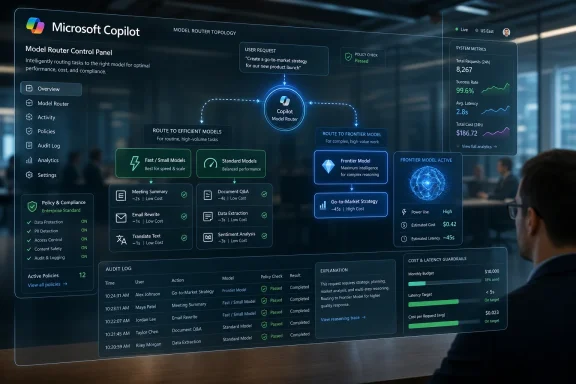
This is where Nadella’s warning becomes more than a podcast quote. If Microsoft can convince customers that Copilot’s Auto mode can select the right model for the job, it can turn a messy AI marketplace into a managed abstraction. The user asks for an outcome; Microsoft decides whether the request needs a heavyweight reasoning model, a smaller tuned model, a code-specialized system, or a cheap summarizer.
That is good product design if it works. It is also a power move. The company that controls the routing layer controls the economics of AI adoption.
That is sensible for normal users, who should not be expected to know whether a task needs GPT-class reasoning, a Claude model, a Microsoft in-house model, or something smaller and cheaper. It is also sensible for IT departments, which generally do not want thousands of employees manually selecting premium inference for routine prompts because the dropdown makes it feel more powerful.
But Auto mode also introduces a trust problem. When a human chooses a model, the tradeoff is visible. When the platform chooses, the platform must prove that it did not silently degrade quality, route sensitive work somewhere inappropriate, or optimize Microsoft’s margins at the customer’s expense.
That is the coming fight over enterprise AI. The question will not be whether Copilot can answer. It will be whether administrators can understand why Copilot answered the way it did, what model family it used, what data it touched, what it cost, and whether the same prompt tomorrow will produce a governed result under the same policy.
For WindowsForum readers, this is familiar territory. We have seen this movie in telemetry, cloud licensing, Windows feature rollouts, Microsoft 365 admin defaults, and security baselines. Abstraction is convenient until it becomes opaque. Then it becomes a governance problem.
That phase had a purpose. It broke the blank-page problem. Developers learned that AI could explain unfamiliar code. Analysts learned that it could restructure documents. Managers learned that it could summarize meetings they probably should have attended. The sheer volume of experimentation exposed where the tools were useful and where they were expensive theater.
But a token leaderboard is a terrible proxy for value. It rewards long prompts, repeated attempts, unnecessary rewrites, and the use of heavyweight models for trivial work. It mistakes consumption for productivity, which is exactly the kind of metric that enterprise software eventually has to abandon.
Nadella’s warning is therefore a correction to the industry’s own incentive structure. Microsoft still wants people using AI, but not in a way that makes every employee a tiny runaway cloud bill. The company wants durable consumption, not reckless consumption. That means fewer tokens wasted on tasks that a smaller model, a deterministic workflow, or an old-fashioned script could handle.
This is not anti-AI. It is what happens when AI leaves the demo stage and meets the finance department.
But infrastructure spending creates pressure. Data centers are not rhetoric. GPUs are not vibes. Power, cooling, networking, memory, and inference capacity have to be paid for, allocated, and justified. If every Copilot interaction leans on the most expensive available model, the margin profile becomes ugly quickly.
That is why the “right model for the right task” is now a strategic priority. Microsoft needs AI to be everywhere, but it cannot afford for every instance of AI to be frontier-grade. The company’s best outcome is a tiered AI stack in which the user experiences a single Copilot brand while the backend quietly arbitrages capability and cost.
This also explains Microsoft’s interest in smaller, task-tuned models. A coding model tuned for GitHub workflows does not need to be a general-purpose oracle. A workplace summarization model does not need to solve graduate-level math. A security triage model does not need to write sonnets. Specialization is how AI becomes economically survivable.
The irony is that the AI industry spent years selling scale as destiny. Now the largest platform companies are rediscovering one of computing’s oldest lessons: specialization beats brute force when the workload is known.
On another level, that is exactly why this category needs governance before it becomes normal. A tool that listens to workplace conversations and modifies code-adjacent projects is not merely a productivity helper. It sits near intellectual property, access control, software supply chains, audit logs, and employee privacy.
The phrase vibe coding began as a playful description of using AI to generate software through intent rather than line-by-line authorship. In enterprise environments, however, vibes are not enough. Code has owners. Repositories have permissions. Pull requests need review. Dependencies need scanning. Requirements need traceability. Security teams need to know whether an AI agent inferred a change from a casual discussion or from an approved ticket.
This is where Microsoft has both an advantage and a burden. Its ecosystem already spans identity, endpoint management, developer tooling, productivity software, and cloud infrastructure. If any company can wrap AI agents in enterprise controls, Microsoft can. But if it gets the defaults wrong, the blast radius is equally large.
For sysadmins, the practical question is not whether AI can update code. It is whether the organization can prove who authorized the change, what context the model used, which model generated it, how it was tested, and how quickly it can be rolled back.
That shift changes what “using Windows” means in managed environments. The operating system is still the endpoint, but the intelligence increasingly lives in cloud services, model routers, tenant data, and policy engines. Windows becomes the surface area through which AI-mediated work happens.
For enthusiasts, this can be frustrating because it makes local control feel less central. The old mental model was that a PC ran software. The new model is that a PC participates in a governed service mesh where identity, data, models, and agents are stitched together through cloud policy. That is powerful when it works and maddening when it does not.
For administrators, the question becomes how much AI behavior can be configured, audited, and constrained. Can organizations block certain model classes? Can they require cheaper models for low-risk work? Can they prevent sensitive prompts from leaving approved boundaries? Can they see cost per department, per workflow, or per agent? If AI is going to be an everyday workplace substrate, these are not advanced features. They are table stakes.
Microsoft’s history suggests the company will eventually expose more knobs, logs, and policy controls. It also suggests those controls may arrive after users have already been pushed into defaults that suit Microsoft’s product strategy.
That dual message matters. Microsoft has been rewarded for convincing Wall Street that it is one of the indispensable companies of the AI era. Azure growth, Copilot monetization, OpenAI access, developer tooling, and enterprise distribution all feed the narrative. But investors are also watching capital expenditure, cloud margins, and the gap between AI hype and paid adoption.
A CEO who says “use fewer expensive tokens” is not puncturing the AI story. He is trying to make it financially credible. The market does not need Microsoft employees to burn inference for sport. It needs Microsoft customers to adopt AI in ways that renew, expand, and justify subscriptions.
This is why frontier restraint can coexist with frontier ambition. Microsoft can still invest in the most advanced models while steering routine work toward cheaper systems. In fact, it has to. The expensive models become the top shelf: available for hard reasoning, complex coding, research, and high-value workflows, but not poured into every glass.
If Microsoft succeeds, Copilot becomes less like a single assistant and more like an AI operating layer with internal cost controls. If it fails, customers will experience either bill shock, inconsistent quality, or the familiar enterprise suspicion that the vendor’s automation is optimizing for the vendor first.
Some tasks should be handled by deterministic automation. Some should be solved with better templates. Some should be eliminated entirely. Some require human judgment because the cost of a plausible wrong answer is higher than the cost of waiting for a person.
This is especially important in regulated industries, legal workflows, finance, healthcare, and security operations. A frontier model may produce a more polished answer, but polish is not provenance. A smaller model may be sufficient for classification. A workflow engine may be safer for approvals. A human may be mandatory for accountability.
The next generation of AI literacy will not be prompt engineering. It will be task triage. Employees will need to understand whether they are asking for drafting, reasoning, retrieval, transformation, classification, or execution. Administrators will need policies that map those categories to approved tools and cost tiers.
That is a less glamorous vision than the all-knowing assistant promised in early AI demos. It is also much closer to how real organizations work.
That stack makes the model itself only one layer in a much larger system. OpenAI, Anthropic, Microsoft’s own MAI models, and smaller specialized systems can all become interchangeable components if Microsoft controls orchestration. This is the cloud platform strategy translated into AI.
It also explains why Nadella’s comment should not be mistaken for humility. “Don’t use frontier models for non-frontier problems” sounds like practical advice, but it nudges customers toward trusting the platform to decide what kind of problem they have. The more that decision is automated, the more valuable the orchestration layer becomes.
For customers, the upside is simplicity. For competitors, the risk is that model choice becomes buried behind Microsoft’s interface. For regulators and enterprise buyers, the concern is lock-in disguised as convenience.
The battle over AI may not be won by the company with the smartest model on a given Tuesday. It may be won by the company that makes model selection disappear.
That means model-routing policies should become as normal as conditional access policies. Cost dashboards should be as ordinary as Azure spending reports. Audit trails for AI-generated work should be as expected as sign-in logs. Data boundary settings should be clear enough that a compliance officer can understand them without reading a research paper.
The Windows and Microsoft 365 communities will also need better language for AI incidents. Was the problem a hallucination, a retrieval failure, a permission leak, a bad plugin action, a model downgrade, a prompt injection, or an agent execution error? These distinctions matter because the fixes are different.
Microsoft’s challenge is to make all of this manageable without turning Copilot into another administrative maze. The company has a habit of solving complexity by adding portals, licenses, SKUs, and overlapping settings. If AI governance follows that pattern, Nadella’s efficiency message may land poorly with the very admins expected to implement it.
The best version of Microsoft’s approach would give organizations clear defaults, transparent routing, explainable cost controls, and strong auditability. The worst version would be a black box that says “Auto” while everyone guesses what happened underneath.
Nadella’s warning is therefore less a scolding than a preview of where enterprise AI is headed. The frontier will still matter, but the money will be made in the routing, governance, and dull operational machinery that decides when the frontier is actually necessary. For Windows users and IT pros, that means the next AI story will not be about a chatbot getting smarter in isolation; it will be about whether Microsoft can make intelligence feel native to work without making cost, control, and accountability disappear behind the word “Auto.”
 Nadella’s Warning Is Really a Cost Model in Disguise
There is a temptation to read Nadella’s comment as a bit of executive moderation after years of AI maximalism. That would be too soft. What he is describing is a fundamental change in the economics of workplace AI: the expensive model is no longer automatically the best model, and the impressive answer is no longer automatically the right answer.That matters because Microsoft has spent the last several years making Copilot the connective tissue across Windows, Microsoft 365, GitHub, Azure, Power Platform, and security tooling. The pitch was simple enough: AI would sit beside the worker, understand the context, and remove friction. The complication is that every “helpful” answer carries an invisible bill in compute, energy, latency, licensing, and operational risk.
Nadella’s “tokenmaxxer” aside is unusually candid because it acknowledges the behavioral trap that many developers, executives, and power users have fallen into. Once a frontier model can write code, summarize meetings, draft strategy, and refactor documents, it becomes addictive to throw everything at it. The novelty makes inefficiency feel like productivity.
But Microsoft does not sell novelty to enterprises for very long. It sells repeatability, compliance, and cost control. Nadella’s comment is a signal that the company wants AI usage to move from experimentation to workload management, where model choice becomes as ordinary as choosing a VM size, a storage tier, or a database SKU.
The Frontier Model Was Always Too Expensive to Be the Default
The phrase frontier model has become a marketing shortcut for the most capable systems available at a given moment: the models with the deepest reasoning, the largest context windows, the strongest coding performance, and the most headline-friendly benchmark scores. They are also the models most likely to be slow, expensive, scarce, and overqualified for everyday office work.Most enterprise prompts are not frontier problems. Summarizing a meeting transcript, rewriting a customer email, extracting action items, classifying support tickets, or drafting a first-pass slide outline does not usually require the most advanced reasoning system on the market. It requires a model that is fast, secure, grounded in company data, and good enough to avoid embarrassing mistakes.
That “good enough” phrase will make some AI evangelists wince, but it is the foundation of enterprise computing. Businesses do not run every workload on the most powerful hardware available. They do not store every file on the fastest storage. They do not assign every help desk request to a principal engineer. AI is now being forced into the same discipline.
This is where Nadella’s warning becomes more than a podcast quote. If Microsoft can convince customers that Copilot’s Auto mode can select the right model for the job, it can turn a messy AI marketplace into a managed abstraction. The user asks for an outcome; Microsoft decides whether the request needs a heavyweight reasoning model, a smaller tuned model, a code-specialized system, or a cheap summarizer.
That is good product design if it works. It is also a power move. The company that controls the routing layer controls the economics of AI adoption.
Copilot’s Auto Mode Is Microsoft’s Attempt to Hide the Meter
The most important word in Nadella’s framing may not be “frontier.” It may be “auto.” Microsoft has been steadily pushing model selection into Copilot experiences, from Microsoft 365 apps to GitHub tooling and Copilot Studio. The user can sometimes pick a model or a thinking mode, but the default direction is clear: let Copilot decide.That is sensible for normal users, who should not be expected to know whether a task needs GPT-class reasoning, a Claude model, a Microsoft in-house model, or something smaller and cheaper. It is also sensible for IT departments, which generally do not want thousands of employees manually selecting premium inference for routine prompts because the dropdown makes it feel more powerful.
But Auto mode also introduces a trust problem. When a human chooses a model, the tradeoff is visible. When the platform chooses, the platform must prove that it did not silently degrade quality, route sensitive work somewhere inappropriate, or optimize Microsoft’s margins at the customer’s expense.
That is the coming fight over enterprise AI. The question will not be whether Copilot can answer. It will be whether administrators can understand why Copilot answered the way it did, what model family it used, what data it touched, what it cost, and whether the same prompt tomorrow will produce a governed result under the same policy.
For WindowsForum readers, this is familiar territory. We have seen this movie in telemetry, cloud licensing, Windows feature rollouts, Microsoft 365 admin defaults, and security baselines. Abstraction is convenient until it becomes opaque. Then it becomes a governance problem.
The Token Leaderboard Era Was Never Going to Last
Reports that Silicon Valley companies encouraged maximum AI usage through internal token leaderboards are believable because they fit the mood of 2024 and 2025. The industry was trying to force habit formation. If employees used AI constantly, vendors could claim adoption, product teams could collect data, and executives could tell investors that the transformation was underway.That phase had a purpose. It broke the blank-page problem. Developers learned that AI could explain unfamiliar code. Analysts learned that it could restructure documents. Managers learned that it could summarize meetings they probably should have attended. The sheer volume of experimentation exposed where the tools were useful and where they were expensive theater.
But a token leaderboard is a terrible proxy for value. It rewards long prompts, repeated attempts, unnecessary rewrites, and the use of heavyweight models for trivial work. It mistakes consumption for productivity, which is exactly the kind of metric that enterprise software eventually has to abandon.
Nadella’s warning is therefore a correction to the industry’s own incentive structure. Microsoft still wants people using AI, but not in a way that makes every employee a tiny runaway cloud bill. The company wants durable consumption, not reckless consumption. That means fewer tokens wasted on tasks that a smaller model, a deterministic workflow, or an old-fashioned script could handle.
This is not anti-AI. It is what happens when AI leaves the demo stage and meets the finance department.
Microsoft’s AI Ambition Now Depends on Boring Operational Discipline
The timing is important. Microsoft is not backing away from AI infrastructure. It continues to invest heavily in Azure capacity, custom models, Copilot integration, agent frameworks, and its relationship with OpenAI, even as it builds more of its own model portfolio. The company’s public posture remains aggressive: AI is becoming the interface layer for work.But infrastructure spending creates pressure. Data centers are not rhetoric. GPUs are not vibes. Power, cooling, networking, memory, and inference capacity have to be paid for, allocated, and justified. If every Copilot interaction leans on the most expensive available model, the margin profile becomes ugly quickly.
That is why the “right model for the right task” is now a strategic priority. Microsoft needs AI to be everywhere, but it cannot afford for every instance of AI to be frontier-grade. The company’s best outcome is a tiered AI stack in which the user experiences a single Copilot brand while the backend quietly arbitrages capability and cost.
This also explains Microsoft’s interest in smaller, task-tuned models. A coding model tuned for GitHub workflows does not need to be a general-purpose oracle. A workplace summarization model does not need to solve graduate-level math. A security triage model does not need to write sonnets. Specialization is how AI becomes economically survivable.
The irony is that the AI industry spent years selling scale as destiny. Now the largest platform companies are rediscovering one of computing’s oldest lessons: specialization beats brute force when the workload is known.
Vibe Coding Moves From Toy to Management Problem
Nadella’s mention of vibe-coding an AI tool that monitors workplace conversations and updates connected code projects is the kind of detail that will thrill some developers and alarm many administrators. On one level, it is a natural extension of the agentic workplace: conversations become requirements, requirements become tasks, and tasks become code changes. The meeting stops being a dead artifact and starts becoming an input stream.On another level, that is exactly why this category needs governance before it becomes normal. A tool that listens to workplace conversations and modifies code-adjacent projects is not merely a productivity helper. It sits near intellectual property, access control, software supply chains, audit logs, and employee privacy.
The phrase vibe coding began as a playful description of using AI to generate software through intent rather than line-by-line authorship. In enterprise environments, however, vibes are not enough. Code has owners. Repositories have permissions. Pull requests need review. Dependencies need scanning. Requirements need traceability. Security teams need to know whether an AI agent inferred a change from a casual discussion or from an approved ticket.
This is where Microsoft has both an advantage and a burden. Its ecosystem already spans identity, endpoint management, developer tooling, productivity software, and cloud infrastructure. If any company can wrap AI agents in enterprise controls, Microsoft can. But if it gets the defaults wrong, the blast radius is equally large.
For sysadmins, the practical question is not whether AI can update code. It is whether the organization can prove who authorized the change, what context the model used, which model generated it, how it was tested, and how quickly it can be rolled back.
Windows Is No Longer the Center, but It Is Still the Surface Area
Nadella’s comments are not specifically about Windows, yet Windows users will feel the consequences. Copilot is no longer just a sidebar or a branded assistant. It is becoming a routing layer that can appear across applications, development environments, administrative consoles, and eventually more OS-level experiences.That shift changes what “using Windows” means in managed environments. The operating system is still the endpoint, but the intelligence increasingly lives in cloud services, model routers, tenant data, and policy engines. Windows becomes the surface area through which AI-mediated work happens.
For enthusiasts, this can be frustrating because it makes local control feel less central. The old mental model was that a PC ran software. The new model is that a PC participates in a governed service mesh where identity, data, models, and agents are stitched together through cloud policy. That is powerful when it works and maddening when it does not.
For administrators, the question becomes how much AI behavior can be configured, audited, and constrained. Can organizations block certain model classes? Can they require cheaper models for low-risk work? Can they prevent sensitive prompts from leaving approved boundaries? Can they see cost per department, per workflow, or per agent? If AI is going to be an everyday workplace substrate, these are not advanced features. They are table stakes.
Microsoft’s history suggests the company will eventually expose more knobs, logs, and policy controls. It also suggests those controls may arrive after users have already been pushed into defaults that suit Microsoft’s product strategy.
The Stock Market Wants AI Growth, Not AI Sobriety
The Benzinga framing around Microsoft’s stock price is a reminder that Nadella is speaking to two audiences at once. Employees and customers hear a message about responsible model selection. Investors hear a message about protecting margins while continuing to scale AI.That dual message matters. Microsoft has been rewarded for convincing Wall Street that it is one of the indispensable companies of the AI era. Azure growth, Copilot monetization, OpenAI access, developer tooling, and enterprise distribution all feed the narrative. But investors are also watching capital expenditure, cloud margins, and the gap between AI hype and paid adoption.
A CEO who says “use fewer expensive tokens” is not puncturing the AI story. He is trying to make it financially credible. The market does not need Microsoft employees to burn inference for sport. It needs Microsoft customers to adopt AI in ways that renew, expand, and justify subscriptions.
This is why frontier restraint can coexist with frontier ambition. Microsoft can still invest in the most advanced models while steering routine work toward cheaper systems. In fact, it has to. The expensive models become the top shelf: available for hard reasoning, complex coding, research, and high-value workflows, but not poured into every glass.
If Microsoft succeeds, Copilot becomes less like a single assistant and more like an AI operating layer with internal cost controls. If it fails, customers will experience either bill shock, inconsistent quality, or the familiar enterprise suspicion that the vendor’s automation is optimizing for the vendor first.
The Real Enterprise Skill Is Knowing When Not to Use AI
Nadella’s warning also exposes a more uncomfortable truth: many organizations still have not developed a mature sense of when AI is the wrong tool. The industry has trained people to ask, “Can AI do this?” The better question is, “Should AI do this, and at what cost?”Some tasks should be handled by deterministic automation. Some should be solved with better templates. Some should be eliminated entirely. Some require human judgment because the cost of a plausible wrong answer is higher than the cost of waiting for a person.
This is especially important in regulated industries, legal workflows, finance, healthcare, and security operations. A frontier model may produce a more polished answer, but polish is not provenance. A smaller model may be sufficient for classification. A workflow engine may be safer for approvals. A human may be mandatory for accountability.
The next generation of AI literacy will not be prompt engineering. It will be task triage. Employees will need to understand whether they are asking for drafting, reasoning, retrieval, transformation, classification, or execution. Administrators will need policies that map those categories to approved tools and cost tiers.
That is a less glamorous vision than the all-knowing assistant promised in early AI demos. It is also much closer to how real organizations work.
Microsoft Wants to Own the Model Router, Not Just the Model
The deeper strategic play is that Microsoft does not need to win every frontier-model benchmark if it owns the place where enterprise prompts are routed. Azure can host models. Copilot can invoke them. Microsoft 365 can ground them in work data. Entra can govern identity. Purview can wrap compliance. GitHub can capture developer workflows. Defender can watch the security edge.That stack makes the model itself only one layer in a much larger system. OpenAI, Anthropic, Microsoft’s own MAI models, and smaller specialized systems can all become interchangeable components if Microsoft controls orchestration. This is the cloud platform strategy translated into AI.
It also explains why Nadella’s comment should not be mistaken for humility. “Don’t use frontier models for non-frontier problems” sounds like practical advice, but it nudges customers toward trusting the platform to decide what kind of problem they have. The more that decision is automated, the more valuable the orchestration layer becomes.
For customers, the upside is simplicity. For competitors, the risk is that model choice becomes buried behind Microsoft’s interface. For regulators and enterprise buyers, the concern is lock-in disguised as convenience.
The battle over AI may not be won by the company with the smartest model on a given Tuesday. It may be won by the company that makes model selection disappear.
The Admin Console Is Where the AI Boom Gets Real
The consumer version of AI can afford ambiguity. A chatbot can be magical one day and flaky the next. Enterprise AI cannot live that way for long. It needs controls that are visible to the people who will be blamed when something breaks.That means model-routing policies should become as normal as conditional access policies. Cost dashboards should be as ordinary as Azure spending reports. Audit trails for AI-generated work should be as expected as sign-in logs. Data boundary settings should be clear enough that a compliance officer can understand them without reading a research paper.
The Windows and Microsoft 365 communities will also need better language for AI incidents. Was the problem a hallucination, a retrieval failure, a permission leak, a bad plugin action, a model downgrade, a prompt injection, or an agent execution error? These distinctions matter because the fixes are different.
Microsoft’s challenge is to make all of this manageable without turning Copilot into another administrative maze. The company has a habit of solving complexity by adding portals, licenses, SKUs, and overlapping settings. If AI governance follows that pattern, Nadella’s efficiency message may land poorly with the very admins expected to implement it.
The best version of Microsoft’s approach would give organizations clear defaults, transparent routing, explainable cost controls, and strong auditability. The worst version would be a black box that says “Auto” while everyone guesses what happened underneath.
The New Rule for Copilot Is Spend the Big Model Only Where It Counts
The practical lesson from Nadella’s warning is not that frontier models are bad. It is that they are scarce instruments, not office supplies. Organizations that treat them as default utilities will pay too much, learn too little, and struggle to separate genuine productivity from expensive convenience.- Organizations should assume that routine summarization, rewriting, extraction, and formatting tasks usually do not need the most capable model available.
- Administrators should press Microsoft and other vendors for visibility into model routing, cost, data access, and audit logs before broad AI deployment.
- Developers should treat AI-generated code changes as supply-chain events that require review, testing, ownership, and rollback plans.
- Business leaders should measure AI success by completed workflows and reduced toil, not by token volume or raw prompt counts.
- Power users should learn to distinguish tasks that need reasoning from tasks that only need transformation, retrieval, or automation.
- Microsoft’s biggest AI advantage may be Copilot’s orchestration layer, not any single model behind it.
Nadella’s warning is therefore less a scolding than a preview of where enterprise AI is headed. The frontier will still matter, but the money will be made in the routing, governance, and dull operational machinery that decides when the frontier is actually necessary. For Windows users and IT pros, that means the next AI story will not be about a chatbot getting smarter in isolation; it will be about whether Microsoft can make intelligence feel native to work without making cost, control, and accountability disappear behind the word “Auto.”
References
- Primary source: Benzinga
Published: 2026-06-11T10:26:07.494625
Microsoft CEO Satya Nadella Warns Against AI Overuse - Microsoft (NASDAQ:MSFT) - Benzinga
Microsoft CEO Satya Nadella urged employees to use AI more efficiently, warning against unnecessary reliance on costly advanced models.www.benzinga.com - Related coverage: windowscentral.com
Satya Nadella denies claims Microsoft wants to “make people addicted" to AI — as the company shifts from Bill Gates’ software vision to an agentic future | Windows Central
Microsoft's pivot from traditional software to agentic AI is off to a rocky start.www.windowscentral.com - Related coverage: techcrunch.com
Satya Nadella says he's ready to 'exploit' the new OpenAI deal | TechCrunch
Microsoft gets to offer OpenAI's tech to its cloud customers and doesn't have to pay for it. "We fully plan to exploit it," Nadella said.techcrunch.com - Related coverage: techspot.com
Satya Nadella warns AI must go mainstream to avoid becoming a bubble | TechSpot
While remaining an enthusiastic proponent of AI, Satya Nadella now warns that the technology could eventually face the consequences of a massively speculative bubble. The Microsoft CEO...www.techspot.com - Related coverage: tomshardware.com
Microsoft CEO says AI needs to have a wider impact or else it risks quickly losing ‘social permission’ — also says that the technology should benefit more people to avoid a bubble | Tom's Hardware
Satya Nadella talked about how AI should benefit people and how it can avoid a bubble.www.tomshardware.com - Related coverage: techradar.com
Microsoft CEO urges AI developers 'to get to a point where we are using this to do something useful,' or 'lose even the social permission...to generate these tokens' | TechRadar
Nadella tells Davos that AI’s legitimacy hinges on making people's lives betterwww.techradar.com
- Related coverage: theinformation.com
Exclusive: Nadella Rebukes Microsoft Executive’s Plan to Make Users “Addicted” to AI Agents — The Information
Microsoft CEO Satya Nadella on Thursday rebuked an internal memo that another company executive had written advocating to “make people addicted” to its new AI agent product called Scout. “This is absolutely a non goal! If anything we are doing the exact opposite. We want to make sure AI...www.theinformation.com - Related coverage: fortune.com
As Microsoft seeks to be AI's center of gravity, CEO Satya Nadella makes the case in San Francisco | Fortune
Microsoft held its annual Build developer conference in SF for the first time in years as the software giant revealed a sweep of product announcements.fortune.com
- Related coverage: computerworld.com
Nadella warns of AI bubble unless more people use the technology – Computerworld
The Microsoft CEO is also certain that AI will transform several industries. www.computerworld.com
- Related coverage: itpro.com
Microsoft CEO Satya Nadella wants an end to the term ‘AI slop’ and says 2026 will be a ‘pivotal year’ for the technology – but enterprises still need to iron out key lingering issues | IT Pro
The Microsoft chief believes “AI slop” arguments need to be put on the back burnerwww.itpro.com - Related coverage: nationthailand.com
Nadella urges shift from ‘AI slop’ to real economic value in 2026
Microsoft CEO Satya Nadella says it is time to stop dismissing AI as “slop” and focus instead on building practical systems that create measurable economic value. www.nationthailand.com
- Related coverage: theregister.com
Microsoft boss says company is working to 'win back fans'
: But why did those fans go away in the first place, Satya?www.theregister.com - Related coverage: crn.com
Microsoft Q2 Earnings: CEO Nadella Defends AI Investments
Microsoft CEO Satya Nadella talks Copilot, Azure, AI, agents, OpenAI and more on the company’s Q2 earnings call.www.crn.com - Related coverage: techxplore.com
- Official source: learn.microsoft.com
Select a primary AI model for your agent - Microsoft Copilot Studio | Microsoft Learn
Choose an AI model for your Microsoft Copilot Studio agent. You can select default models and try out experimental models.learn.microsoft.com - Official source: docs.github.com
About Copilot auto model selection - GitHub Docs
Automatically select the best model for each task. docs.github.com
- Official source: support.microsoft.com
Choose your model in agent mode - Microsoft Support
 support.microsoft.com
- Official source: microsoft.com
What’s New with GPT-5 in Copilot | Microsoft Copilot
GPT-5 is now in Copilot—smarter, safer, and more personal AI with no setup required. Discover what’s new and how it helps you work better.www.microsoft.com - Official source: blogs.microsoft.com
Microsoft Build 2026: Be yourself at work - The Official Microsoft Blog
Platforms shift when developers build. We explore, choose tools, dream, create. This platform shift comes with more information than ever, ready at your fingertips. This shift, it’s about building fast AND THEN: it’s about building, operating, optimizing and observing. Securing your...blogs.microsoft.com - Related coverage: uab.edu
- Related coverage: aguidetocloud.com
Microsoft 365 Copilot January 2026 Recap: 30 Updates
All 30 Microsoft 365 Copilot updates for January 2026 — Writing Coaching in Word, Model Selector, Agent Mode in Excel, video creation upgrades, and more.www.aguidetocloud.com - Official source: developer.microsoft.com
Microsoft Build 2026 recap: vision, launches, and top sessions - Microsoft for Developers
Catch up on Microsoft Build 2026 with the vision lead-off, top developer announcements, and must-watch sessions across the Microsoft developer ecosystem.developer.microsoft.com - Related coverage: datastudios.org
All Copilot models available in 2025: full list for web, app, Microsoft 365, GitHub, Studio, and API integration
Copilot now includes GPT-5 and custom routing across all Microsoft platforms, from Office to developer APIs.As of August 2025, Microsoft’s Copilot ecosystem spans a variety of products powered by orchestrated AI models. From consumer chat experiences in Copilot (web and app) to enterprise... www.datastudios.org
- Official source: techcommunity.microsoft.com
Agent Mode in Excel is now generally available on desktop | Microsoft Community Hub
Agent Mode in Excel, part of Microsoft 365 Copilot, is now generally available on Windows, with Mac rolling out over the coming days — extending access... techcommunity.microsoft.com

